COPPER

A PS Audio Publication

Issue 158 • Free Online Magazine

Issue 158 True-Life Rock Tales

The Ups and Downs of Touring

The Ups and Downs of Touring

As the spring of 1971 turned into summer we continued along with Superstar’s bus and truck tour. (see “Calling the Lubbock Lights” in Issue 156 for the previous installment about the Superstar, The Original Touring Company (OATC) roadshow.) One early afternoon we were checking out of a two-story Holiday Inn. I took one last glance around my room to check to make sure I was not leaving anything behind. My eye caught one of the pillows on the unmade bed. Hmmm, I thought to myself; that would make a fine headrest.

On the bus I settled in and propped my pillow between the bus’s window and my head. A cast member, Christine Raso, asked what was that I was snuggling with. “A pillow,” I said, and everyone turned around and looked at me. Suddenly, Joey Saulter jumped off the bus and ran up the stairs to his now-unoccupied room. Moments later he came out with a pillow.

Art Rushton sprang off the bus and hit the stairs running, then Kenny Lehman, Frank Baier, Bobby Cotter, and Dean Swanson followed, then almost everyone on the bus was running back to their old rooms. Couple of seconds later a flood of hippies came back down the motel’s stairs, each with a pillow in their hands. Oh crap, I thought; this is not going to end well. We were a motley crew on a bus in a small town in the Old West (at least it felt like the Old West to me at the time). This scene of twenty or more pillows leaving the motel looked like a sea of bad judgement. I did not know what was going to happen but whatever it was it did not bode well.

Most of our touring group went on the pillow run, but a few did not. One who stayed on the bus was my girlfriend Susan Morse (who played Mary Magdalene), who had commandeered my pillow, thus making her trip back to our room unnecessary, and reverting me back to a pillow-less traveler.

With everyone back on the bus, I yelled up to Doyle, our bus driver, to get going. We pulled out and headed down the two-lane blacktop road. Phew, we might get away with this. Wrong again: less than a mile down the road a police car with lights flashing passed us and waved the bus over. Uh oh, are we getting arrested?

The police officer got out of his patrol car, motioned to the bus driver to open the door, and boarded the bus. He looked annoyed. He surveyed the scene, looking disgusted by our long-haired crew. “What are you people thinking?” he asked, and with all eyes on him, nobody answered. “Okay everyone off the bus!” he ordered. Holy cow, we are getting arrested, I thought to myself. As we got off the bus his partner opened the trunk of their patrol car and told each departing passenger to put their pillow in the trunk. It was quiet, nobody was talking, and soon we were all standing in a line beside the now-empty bus.

“All right,” the cop said, “back on the bus.” Oh. I think he is going to have the bus transport us to jail. After we were all seated, he reboarded and looked at us in disgust. After a minute of glaring at us he said, “that was some dumb sh*t, don’t do it again!” and turned and got off the bus.

We all breathed a collective sigh of relief as the police car did a U turn and drove back in the direction of the Holiday Inn. The bus driver pulled back onto the road as our now noticeably quiet group looked out the windows. About a half an hour down the road someone broke the silence and conversations started to resume. To my knowledge, nothing was ever said about the incident again, and it goes without saying that we were cured of our pillow lust.

We were doing some gigs in Colorado and had a date in Colorado Springs. Upon arrival, everyone was bone-tired from having done a string of shows in a row. We were sorely needing a break and were fortunate in having the next day off. I was familiar with the Springs, having been stationed at Fort Carson in the winter of ’64 – ’65. I was amazed how much the Springs had grown in the seven years since I had been there. Back in the ’60s I thought of Colorado Springs as a military town with an Army base and the Air Force Academy adding at least 50,000 troops to the local population.

Next morning at breakfast I suggested that it might be a fun experience to rent some motorcycles and drive-up Pikes Peak. I could not do it when I was in the Army because I was stationed there in the winter. I had wanted to, but the winters in Colorado were brutal. But now it was summer. The climate was wonderful; clear, dry, and warm.

I found a motorcycle shop in the Yellow Pages that rented bikes and called them up. The owner was accommodating. His rental stock was six Honda 175cc street motorcycles and one Honda 350cc dirt bike, which was the one I took. The motorcycle shop was just outside of downtown. We filled out the paperwork and the owner gave everyone instructions on how to use the bikes.

The guys (none of the women were interested) took a test drive around the block, and everyone seemed to get the hang of it. We headed out and I took the lead. We went westward for a few miles ’till we got on the road that went up Pikes Peak. There was hardly any traffic but still It was slow going because most of us were new to motorcycle riding.

I slowly developed a big lead, so I pulled over to the side of the road and waited for the rest of them to catch up. Lee Grayson came into view and pulled up beside me. A few others came over and we waited for the rest. Dean Swanson barreled around the corner and took the turn too wide. His motorcycle slid out from under him. Both the bike and him took a slide on the gravelly part of the shoulder and finally came to a stop in a cloud of dust. A moment passed and then Dean jumped up laughing. He had gotten a couple of bloody road rashes and his clothes were ripped, but he was not hurt. Relieved, we all walked over to him, and we lifted the motorcycle, which seemed to be okay.
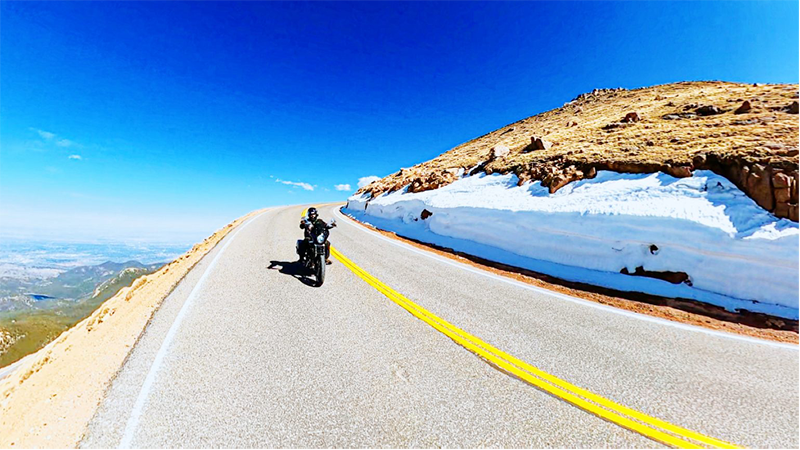
 

The road to Pikes Peak. From Ride to Food.com.

The road to Pikes Peak. From Ride to Food.com.


We were almost a third of the way up and all of them were pooped. They wanted to go back but I was fine and wanted to go all the way up Pikes Peak. I took off alone and I was driving up this dirt road. It was a nice drive with magnificent views, and seemingly pretty safe. Seeing a sign that said that I was two miles from the top, I started to get excited. Suddenly the bike stalled. I checked the gas tank and it was empty. That was surprising – I had assumed I had a full tank. Perhaps the bike did and the drive up the mountain had burned more gas than normal.

Just a few minutes later a police car pulled up. I said to the trooper that I had ran out of gas. He opened his truck and took out an olive drab five-gallon military-type gas can and filled up my tank. I thanked him and he asked for a dollar fifty to replace the gas. He explained, that way he always had gas on hand for those who ran out. It seems that the thin air at high altitude and strain of nonstop uphill driving will burn significantly more gas than normal. Turns out that people running out of gas like this was pretty common.
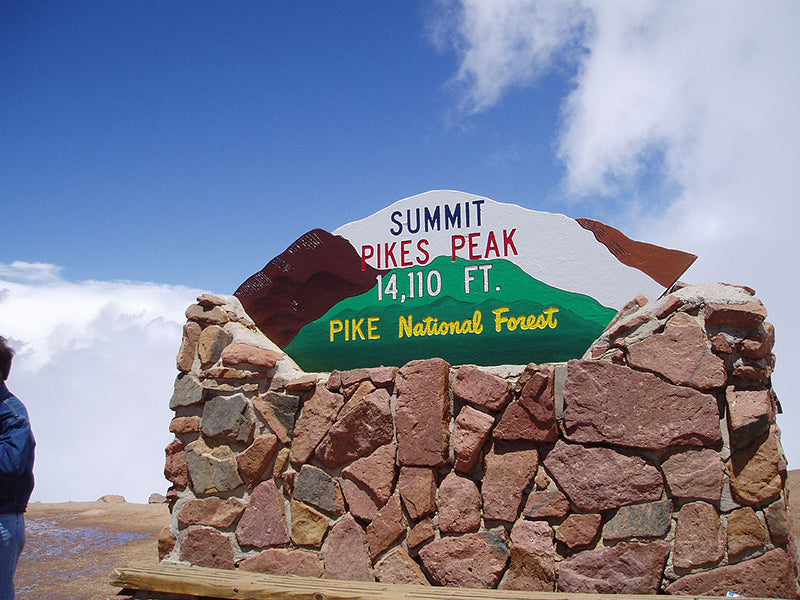
 

At the summit of Pikes Peak. Courtesy of Wikimedia Commons/Charles Williams.

At the summit of Pikes Peak. Courtesy of Wikimedia Commons/Charles Williams.


I made it up to the top and looked, around taking in the view. Then I used the loo and headed back down. That trip down seemed more dangerous, so I kept my speed in check. Back at the motorcycle shop I looked in the mirror and saw that I was covered in dust. All I needed was a cowboy hat to complete the look.
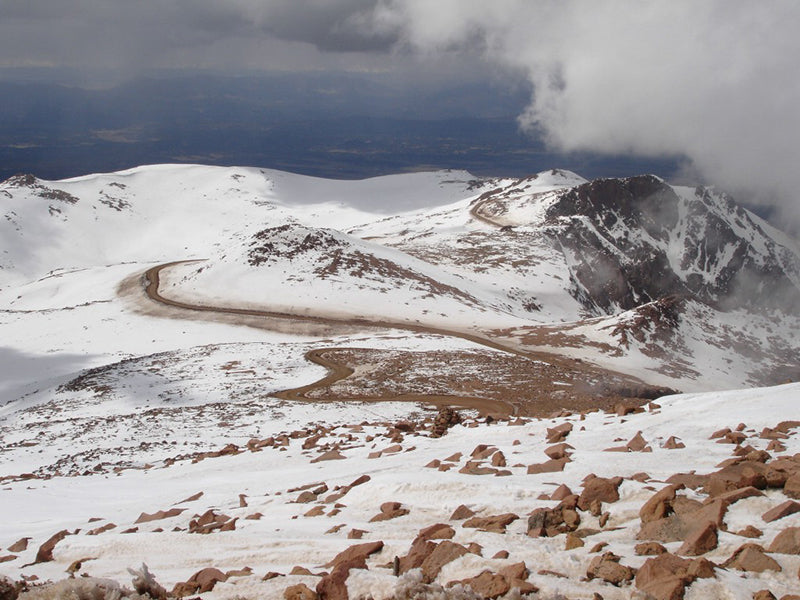
 

Pikes Peak Highway near the summit. Courtesy of Wikimedia Commons/Glenn Harper.

Pikes Peak Highway near the summit. Courtesy of Wikimedia Commons/Glenn Harper.


As summer turned to fall, the news came that the musical Jesus Christ Superstar was in rehearsals and scheduled to open on Broadway in a few months. At first that did not seem to be a problem, but soon enough, it was. Our college bookings started to thin out. Ticket sales started to slump and cash flow was slowing.
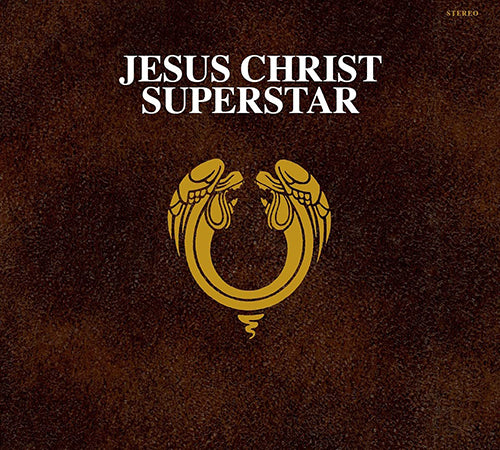
 

Jesus Christ Superstar, album cover.

Jesus Christ Superstar, album cover.


My thinking was that the upcoming Broadway show would create a better option for audiences than our show. One of our selling points was that we were the only show doing this material, (which was based on the soundtrack album that had come out in 1970), or at least, ours was the best show with the most talent. We were innovators, possibly visionaries — at least I liked to think that. As with most Broadway shows, there would also eventually be (other) touring companies and road shows; in the case of Jesus Christ Superstar, they would be produced by RSO Records co-founder Robert Stigwood and The Robert Stigwood Organization, managers of Eric Clapton, the Bee Gees and others.

This helps the producers break in talent, similar to baseball’s Triple-A or minor league teams getting talent ready for the majors. Regional touring companies were opportunities to train and season new talent, or even to break in “name” personalities with something more effective than just rehearsals. An example would be my then-girlfriend Susan Morse. When she was in the musical Hair, she started at the Aquarius Theatre in Los Angeles (technically a road show) and after a month or so they brought (graduated) her to the Broadway show, playing the same part.

These road shows were like branches of the Broadway show, and a surefire way to increase those shows’ profits. Promoters, colleges, and venues would also now have another choice other than booking our OATC touring company. We were now going to be in the shadow of a more serious production, with props, fixtures, and costumes. We would not be up against bus and truck tours, but offshoots of the Great White Way, mighty and in full bloom.

As fall was turning into winter our bookings were becoming scarcer, and we no longer were a guaranteed sell-out. Attendance was falling off.

Betty Sperber, our producer, wanted to cut costs. As part of the belt-tightening, an advance man – me – seemed like a luxury. So, I was off the road. Other cost-cutting measures were initiated. Morale suffered, and the future did not seem as bright. A short time later, before the Broadway opening, Superstar came off the road and that was the end.

Susan joined the cast of Godspell. Joe Morton went on to do television series and movies (The Brother From Another Planet, Terminator 2: Judgment Day, and others} over the next forty years. Kenny Lehman produced Nile Rodgers and Chic’s hit record “Dance, Dance, Dance [Yowsah, Yowsah, Yowsah].” Roy Bittan joined Bruce Springsteen’s E Street Band and I went on the road with Patti LaBelle.
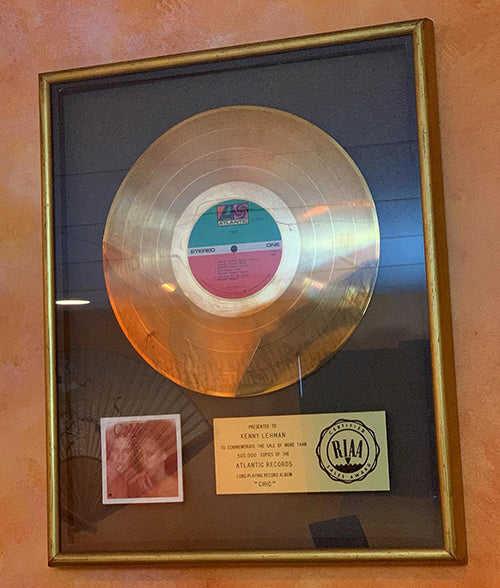
 

Kenny Lehman's Gold Award for Chic's first album.

Kenny Lehman’s Gold Award for Chic’s first album.


That is life on the road. You share with people of similar hearts and minds and then you do it again with a new family.

More from Issue 158

View All Articles in Issue 158

Search Copper Magazine

#232 What came first: Art or Music? A Conversation With Artist Jose Acosta by Joe Caplan Jul 06, 2026 #232 Blow By Blow: The Jeff Beck Story: An Insightful Book About a Guitar Icon by Ray Chelstowski Jul 06, 2026 #232 Creed Over Camaraderie? by B. Jan Montana Jul 06, 2026 #232 Chronicles of a Sound Pilgrim at the 2026 Montreal Audiofest by Hugues Morin Jul 06, 2026 #232 The Vinyl Beat: Summer Grooves by Rudy Radelic Jul 06, 2026 #232 Hibbing Hillbilly Dylan's Acoustic Rock by Wayne Robins Jul 06, 2026 #232 Quad Quads and Plasmatronics Tweeters: An Extraordinary System Comes to Life by Frank Doris Jul 06, 2026 #232 In Praise of Live Music, Once Again by Ted Shafran Jul 06, 2026 #232 Allnic Audio’s L-9000 Preamplifier: Design and Engineering Innovation by Howard Kneller Jul 06, 2026 #232 “Best Of” Lists and Rage Bait: Enough Already by Frank Doris Jul 06, 2026 #232 Quick Takes: Bud Shank, Paulo Almeida, Jakob Dreyer, Tim Eriksen and Peter Irvine by Frank Doris Jul 06, 2026 #232 My Impressions of AXPONA 2026, Part 2 by Frank Doris Jul 06, 2026 #232 How to Play in a Rock Band, 25: Encounters With Famous Musicians, Part Three by Frank Doris Jul 06, 2026 #232 Budgets, and Systems From Small to Outrageous by Paul McGowan Jul 06, 2026 #232 PS Audio in the News by PS Audio Staff Jul 06, 2026 #232 Hand It Over by Frank Doris Jul 06, 2026 #232 Difference of Opinion by Peter Xeni Jul 06, 2026 #232 Wabi-sabi Tree by James Schrimpf Jul 06, 2026 #231 Piano Prodigy Jude Kofie Releases His Debut Album On Octave Records by Frank Doris Jun 01, 2026 #231 Underappreciated Artists, Part Two: City Boy by Rich Isaacs Jun 01, 2026 #231 Music and the Art of Creation: Talking With Saxophonist Rob Scheps by Joe Caplan Jun 01, 2026 #231 How to Play in a Rock Band, 24: Further Adventures at the 2026 Montauk Music Festival by Frank Doris Jun 01, 2026 #231 Courtney Barnett: Creature of Habit by Wayne Robins Jun 01, 2026 #231 Angine de Poitrine: Interstellar Guitar Rock Saviors Headed for Late-Night TV Pop Stardom? by Mark Lepage Jun 01, 2026 #231 My Impressions of AXPONA 2026, Part One by Frank Doris Jun 01, 2026 #231 2026 La Jolla Concours d'Elegance: Another Aesthetic Feast by B. Jan Montana Jun 01, 2026 #231 Country Music Icon Jo Dee Messina’s Bridges: A New Beginning by Ray Chelstowski Jun 01, 2026 #231 The Luxury Dispatch Hosts a Video Podcast With Ken Kessler by Ken Kessler Jun 01, 2026 #231 The Vinyl Beat: Tracking in the Motor City by Rudy Radelic Jun 01, 2026 #231 Lots of Fun With DSP: The Ferrum Audio WANDLA DAC and Its Tube Mode by Frank Doris Jun 01, 2026 #231 From The Audiophile's Guide: Digital Source Components and Streaming Audio by Paul McGowan Jun 01, 2026 #231 Onkyo’s Monster M-510 power amplifier by The Staff at Just Audio Jun 01, 2026 #231 PS Audio in the News by PS Audio Staff Jun 01, 2026 #231 Naming Convention by Peter Xeni Jun 01, 2026 #231 Les Invisibles by Frank Doris Jun 01, 2026 #231 Wildlife Scene by James Schrimpf Jun 01, 2026 #230 Camaraderie by B. Jan Montana May 04, 2026 #230 AXPONA 2026: A Family Gathering by Paul McGowan May 04, 2026 #230 Pianist Ryan Benthall Explores Jazz Realms and Far Beyond With Divine Sky by Frank Doris May 04, 2026 #230 The Vinyl Beat in AXPONA-Land by Rudy Radelic May 04, 2026 #230 Teddy Thompson’s Musical Growth Deepens With Never Be the Same by Ray Chelstowski May 04, 2026 #230 More Fun in the Sun: Florida Audio Expo, Part Two by Frank Doris May 04, 2026 #230 CanJam NYC 2026 Show Report: Heady Sound, Part Two by Frank Doris and Harris Fogel May 04, 2026 #230 Sonic Youth On Murray Street by Wayne Robins May 04, 2026 #230 Graffeo Coffee: A Symphony of Sensory Experience by Joe Caplan May 04, 2026 #230 The Saul Authority: The Story of Hi-Fi Pioneer Saul Marantz by Olivier Meunier-Plante May 04, 2026 #230 How to Play in a Rock Band, 23: Encounters With Famous Musicians, Part Two by Frank Doris May 04, 2026

The Ups and Downs of Touring

The Ups and Downs of Touring

As the spring of 1971 turned into summer we continued along with Superstar’s bus and truck tour. (see “Calling the Lubbock Lights” in Issue 156 for the previous installment about the Superstar, The Original Touring Company (OATC) roadshow.) One early afternoon we were checking out of a two-story Holiday Inn. I took one last glance around my room to check to make sure I was not leaving anything behind. My eye caught one of the pillows on the unmade bed. Hmmm, I thought to myself; that would make a fine headrest.

On the bus I settled in and propped my pillow between the bus’s window and my head. A cast member, Christine Raso, asked what was that I was snuggling with. “A pillow,” I said, and everyone turned around and looked at me. Suddenly, Joey Saulter jumped off the bus and ran up the stairs to his now-unoccupied room. Moments later he came out with a pillow.

Art Rushton sprang off the bus and hit the stairs running, then Kenny Lehman, Frank Baier, Bobby Cotter, and Dean Swanson followed, then almost everyone on the bus was running back to their old rooms. Couple of seconds later a flood of hippies came back down the motel’s stairs, each with a pillow in their hands. Oh crap, I thought; this is not going to end well. We were a motley crew on a bus in a small town in the Old West (at least it felt like the Old West to me at the time). This scene of twenty or more pillows leaving the motel looked like a sea of bad judgement. I did not know what was going to happen but whatever it was it did not bode well.

Most of our touring group went on the pillow run, but a few did not. One who stayed on the bus was my girlfriend Susan Morse (who played Mary Magdalene), who had commandeered my pillow, thus making her trip back to our room unnecessary, and reverting me back to a pillow-less traveler.

With everyone back on the bus, I yelled up to Doyle, our bus driver, to get going. We pulled out and headed down the two-lane blacktop road. Phew, we might get away with this. Wrong again: less than a mile down the road a police car with lights flashing passed us and waved the bus over. Uh oh, are we getting arrested?

The police officer got out of his patrol car, motioned to the bus driver to open the door, and boarded the bus. He looked annoyed. He surveyed the scene, looking disgusted by our long-haired crew. “What are you people thinking?” he asked, and with all eyes on him, nobody answered. “Okay everyone off the bus!” he ordered. Holy cow, we are getting arrested, I thought to myself. As we got off the bus his partner opened the trunk of their patrol car and told each departing passenger to put their pillow in the trunk. It was quiet, nobody was talking, and soon we were all standing in a line beside the now-empty bus.

“All right,” the cop said, “back on the bus.” Oh. I think he is going to have the bus transport us to jail. After we were all seated, he reboarded and looked at us in disgust. After a minute of glaring at us he said, “that was some dumb sh*t, don’t do it again!” and turned and got off the bus.

We all breathed a collective sigh of relief as the police car did a U turn and drove back in the direction of the Holiday Inn. The bus driver pulled back onto the road as our now noticeably quiet group looked out the windows. About a half an hour down the road someone broke the silence and conversations started to resume. To my knowledge, nothing was ever said about the incident again, and it goes without saying that we were cured of our pillow lust.

We were doing some gigs in Colorado and had a date in Colorado Springs. Upon arrival, everyone was bone-tired from having done a string of shows in a row. We were sorely needing a break and were fortunate in having the next day off. I was familiar with the Springs, having been stationed at Fort Carson in the winter of ’64 – ’65. I was amazed how much the Springs had grown in the seven years since I had been there. Back in the ’60s I thought of Colorado Springs as a military town with an Army base and the Air Force Academy adding at least 50,000 troops to the local population.

Next morning at breakfast I suggested that it might be a fun experience to rent some motorcycles and drive-up Pikes Peak. I could not do it when I was in the Army because I was stationed there in the winter. I had wanted to, but the winters in Colorado were brutal. But now it was summer. The climate was wonderful; clear, dry, and warm.

I found a motorcycle shop in the Yellow Pages that rented bikes and called them up. The owner was accommodating. His rental stock was six Honda 175cc street motorcycles and one Honda 350cc dirt bike, which was the one I took. The motorcycle shop was just outside of downtown. We filled out the paperwork and the owner gave everyone instructions on how to use the bikes.

The guys (none of the women were interested) took a test drive around the block, and everyone seemed to get the hang of it. We headed out and I took the lead. We went westward for a few miles ’till we got on the road that went up Pikes Peak. There was hardly any traffic but still It was slow going because most of us were new to motorcycle riding.

I slowly developed a big lead, so I pulled over to the side of the road and waited for the rest of them to catch up. Lee Grayson came into view and pulled up beside me. A few others came over and we waited for the rest. Dean Swanson barreled around the corner and took the turn too wide. His motorcycle slid out from under him. Both the bike and him took a slide on the gravelly part of the shoulder and finally came to a stop in a cloud of dust. A moment passed and then Dean jumped up laughing. He had gotten a couple of bloody road rashes and his clothes were ripped, but he was not hurt. Relieved, we all walked over to him, and we lifted the motorcycle, which seemed to be okay.


The road to Pikes Peak. From Ride to Food.com.

The road to Pikes Peak. From Ride to Food.com.


We were almost a third of the way up and all of them were pooped. They wanted to go back but I was fine and wanted to go all the way up Pikes Peak. I took off alone and I was driving up this dirt road. It was a nice drive with magnificent views, and seemingly pretty safe. Seeing a sign that said that I was two miles from the top, I started to get excited. Suddenly the bike stalled. I checked the gas tank and it was empty. That was surprising – I had assumed I had a full tank. Perhaps the bike did and the drive up the mountain had burned more gas than normal.

Just a few minutes later a police car pulled up. I said to the trooper that I had ran out of gas. He opened his truck and took out an olive drab five-gallon military-type gas can and filled up my tank. I thanked him and he asked for a dollar fifty to replace the gas. He explained, that way he always had gas on hand for those who ran out. It seems that the thin air at high altitude and strain of nonstop uphill driving will burn significantly more gas than normal. Turns out that people running out of gas like this was pretty common.


At the summit of Pikes Peak. Courtesy of Wikimedia Commons/Charles Williams.

At the summit of Pikes Peak. Courtesy of Wikimedia Commons/Charles Williams.


I made it up to the top and looked, around taking in the view. Then I used the loo and headed back down. That trip down seemed more dangerous, so I kept my speed in check. Back at the motorcycle shop I looked in the mirror and saw that I was covered in dust. All I needed was a cowboy hat to complete the look.


Pikes Peak Highway near the summit. Courtesy of Wikimedia Commons/Glenn Harper.

Pikes Peak Highway near the summit. Courtesy of Wikimedia Commons/Glenn Harper.


As summer turned to fall, the news came that the musical Jesus Christ Superstar was in rehearsals and scheduled to open on Broadway in a few months. At first that did not seem to be a problem, but soon enough, it was. Our college bookings started to thin out. Ticket sales started to slump and cash flow was slowing.


Jesus Christ Superstar, album cover.

Jesus Christ Superstar, album cover.


My thinking was that the upcoming Broadway show would create a better option for audiences than our show. One of our selling points was that we were the only show doing this material, (which was based on the soundtrack album that had come out in 1970), or at least, ours was the best show with the most talent. We were innovators, possibly visionaries — at least I liked to think that. As with most Broadway shows, there would also eventually be (other) touring companies and road shows; in the case of Jesus Christ Superstar, they would be produced by RSO Records co-founder Robert Stigwood and The Robert Stigwood Organization, managers of Eric Clapton, the Bee Gees and others.

This helps the producers break in talent, similar to baseball’s Triple-A or minor league teams getting talent ready for the majors. Regional touring companies were opportunities to train and season new talent, or even to break in “name” personalities with something more effective than just rehearsals. An example would be my then-girlfriend Susan Morse. When she was in the musical Hair, she started at the Aquarius Theatre in Los Angeles (technically a road show) and after a month or so they brought (graduated) her to the Broadway show, playing the same part.

These road shows were like branches of the Broadway show, and a surefire way to increase those shows’ profits. Promoters, colleges, and venues would also now have another choice other than booking our OATC touring company. We were now going to be in the shadow of a more serious production, with props, fixtures, and costumes. We would not be up against bus and truck tours, but offshoots of the Great White Way, mighty and in full bloom.

As fall was turning into winter our bookings were becoming scarcer, and we no longer were a guaranteed sell-out. Attendance was falling off.

Betty Sperber, our producer, wanted to cut costs. As part of the belt-tightening, an advance man – me – seemed like a luxury. So, I was off the road. Other cost-cutting measures were initiated. Morale suffered, and the future did not seem as bright. A short time later, before the Broadway opening, Superstar came off the road and that was the end.

Susan joined the cast of Godspell. Joe Morton went on to do television series and movies (The Brother From Another Planet, Terminator 2: Judgment Day, and others} over the next forty years. Kenny Lehman produced Nile Rodgers and Chic’s hit record “Dance, Dance, Dance [Yowsah, Yowsah, Yowsah].” Roy Bittan joined Bruce Springsteen’s E Street Band and I went on the road with Patti LaBelle.


Kenny Lehman's Gold Award for Chic's first album.

Kenny Lehman’s Gold Award for Chic’s first album.


That is life on the road. You share with people of similar hearts and minds and then you do it again with a new family.

0 comments

Leave a comment

0 Comments

Your avatar

Loading comments...

🗑️ Delete Comment

Enter moderator password to delete this comment:

✏️ Edit Comment

Enter your email to verify ownership: