COPPER

A PS Audio Publication

Issue 231 • Free Online Magazine

Issue 231 From The Listening Chair

Onkyo’s Monster M-510 power amplifier

Onkyo’s Monster M-510 power amplifier

This column is written by the staff of Just Audio, a Maryland-based brick-and-mortar and online retailer of new and vintage audio equipment and repair services. It is reprinted here by permission of The Listening Chair.


“What would an ocean be without a monster lurking in the dark?” Werner Herzog 

When a vintage audio component arrives at Just Audio, it usually has a story to tell. Sometimes the component is in mint condition, having been loved and well-cared for by a longtime customer. Sometimes it’s an unusual item that creates a buzz among the staff. (See our recent article in this column on the B.I.C. Beam Box). However, every once in a while, it's something that stops us dead in our tracks.

The Onkyo M-510 Grand Integra amplifier is one of those jaw-dropping components that has come through our doors. In fact, when we first realized what we were looking at, we were in disbelief. The M-510, a prime example of a vintage Japanese “monster” component, is so legendary that it is often spoken about in the same breath as classic amps from high-end brands like Krell, Mark Levinson, and Accuphase.  

When we got the M-510 in the shop, we auditioned it, refreshed ourselves as to its technical specs, and bench tested it. But before we did any of that, we couldn’t help but notice its striking appearance and sheer physical presence. The M-510 doesn’t just sit quietly on the shelf. It doesn't try to be subtle or blend in. Rather, weighing in at over 140 pounds and standing over ten inches tall, it dominates the room.

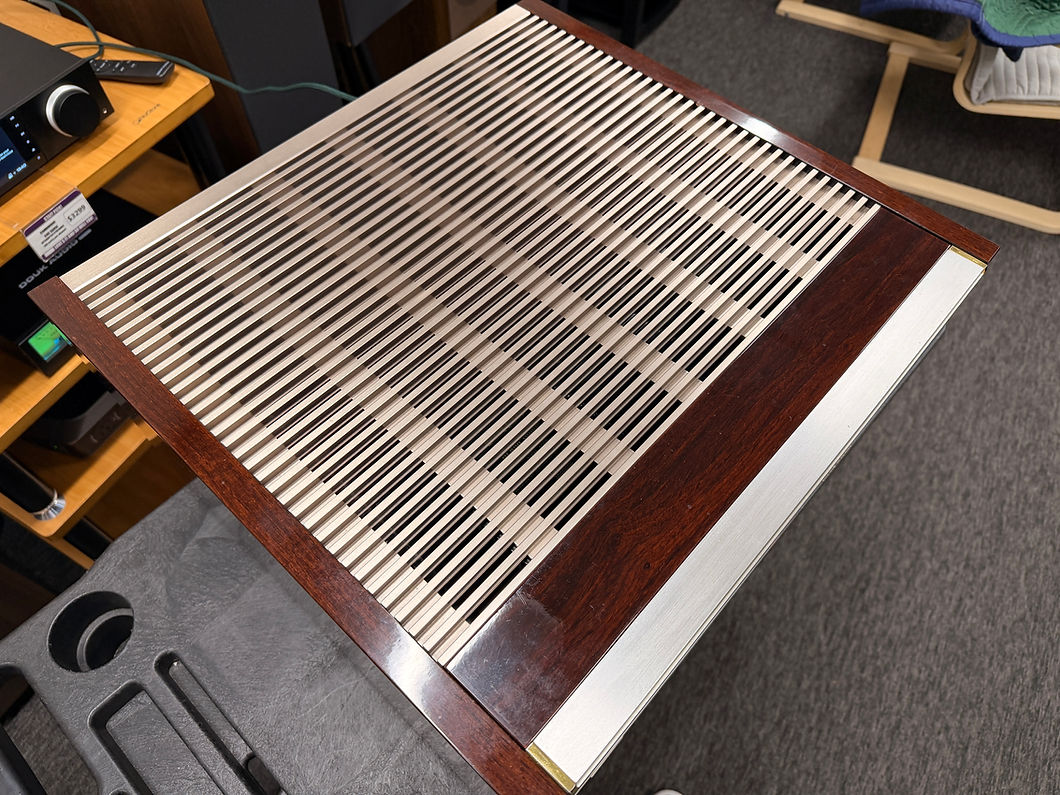
Beyond its size and heft, the M-510 is one good-looking amp. Real rosewood is used for both of the side panels of its chassis and for a handsome strip that is located on the front part of its top panel. Save for the rosewood strip, the top chassis panel consists almost exclusively of a huge heatsink. 
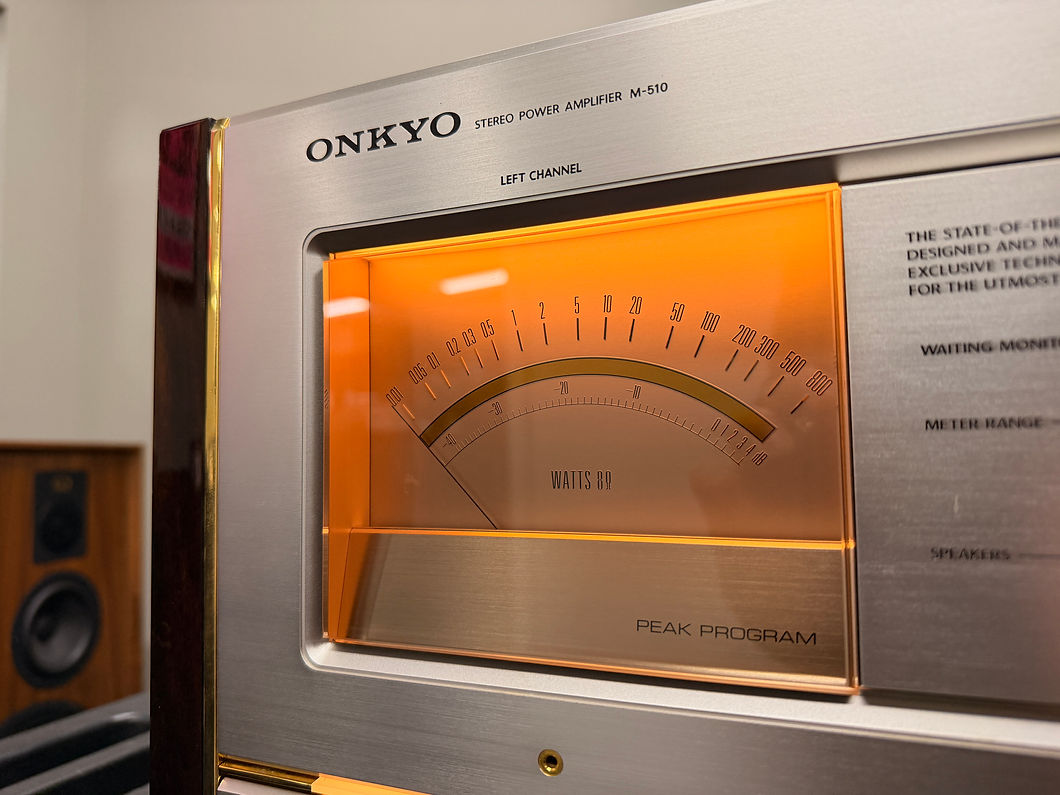
On the front chassis panel, metal surfaces are generously appointed in brushed silver and champagne gold accents. Also on the M-510's front panel are two absolutely massive analog VU meters that illuminate in amber/gold. 

Built Like a Battleship 

The M-510 was part of Onkyo’s Grand Integra series components. As such, it was built not for the average listener but rather was a flagship product that sought to prove to all that Onkyo could stand shoulder-to-shoulder with audio’s most elite names. It was sold from approximately 1984 to 1992 for $3,800 USD at launch, which is approximately $10,000 today.

The Grand Integra components were designed to push technical boundaries. And push them, the M-510 did. To start, it is rated to deliver a staggering 300 watts per channel into 8 ohms, often exceeding 500 watts into lower impedances. It can drive virtually any speaker with authority. Its damping factor of 300 suggests an iron tight control over speaker cone movement and the absence of ringing high frequencies and boomy bass notes.

In addition, the M-510 features a true dual-mono design, meaning that each channel has its own dedicated architecture, including power supply. This reduces crosstalk and other types of electrical interference. It also ensures that each channel performs at its best even under demanding conditions. Looking at the M-510's power supplies, its toroidal transformers are enormous, and they are supported by massive capacitors that store and deliver energy. Each channel’s power board holds seven pairs of transistors. It’s the kind of overbuilt construction that you don’t even see in most modern components.

The M-510's rear panel also reveals that it is designed for serious audiophiles only. Rather than contain a virtual kitchen’s sink of connectors, that panel has only binding posts for two sets of speakers (these posts accommodate thick, low-gauge speaker wire), variable and direct input connectors, a signal ground connector, and a heavy-duty, captive power cord. Large rubber bumpers on the panel assure that the M-510 will not be placed too close to a wall, thus protecting the protruding connectors and allowing for proper heat dissipation.

And then there are the M-510 VU meters. They are more than just visual centerpieces; rather, they are a window into the type of power and dynamics that this machine can deliver. Watching the meters light up and dance as music plays is nothing short of mesmerizing. 
But aesthetics, circuitry design, and technical specifications don’t tell the M-510's full story. What makes this amp so remarkable is how it delivers that power: effortlessly, cleanly, and with a level of control that is still impressive many decades later. As we spent time with this monster, our initial shock turned into admiration. It’s one thing to see a piece like this. But it’s another thing to experience it. Just using its silky smooth and precise controls, for example, reflects the uncompromising level of care that was used in its design and manufacture.

Finally, what sets the Onkyo M-510 apart today is its rarity. Expensive and aimed at a small niche audience of serious audiophiles only about 200 examples were reportedly sold in the United States. Few of those have survived in good condition. If you want to own one, be prepared to pay between $7,500 to $10,000. 

A Connection to Audiophile Days of Past 

 Of course, owning a component like the Onkyo M-510 isn’t just about looks or performance. It’s about owning a piece of audio history, a product from an era when engineers were first given the freedom to dream big and build even bigger. It’s about the craftsmanship, the attention to detail, and the uncompromising approach that went into its design.

In many ways, the M-510 is a reminder of why we do what we do at Just Audio. It’s about more than buying and selling equipment—it’s about preserving and celebrating the history of home audio. It’s about recognizing the significance of pieces like this and sharing our excitement about it with others. 

Is the Onkyo M-510 one of the rarest amplifiers that we’ve ever seen? Without a doubt. But more than that, it’s one of the most memorable. It’s the kind of component that leaves a lasting impression as its designers reached for the stars and, in many ways, succeeded.


All images courtesy of The Listening Chair, a reviewing and news organization for all things audiophile.

Check out the latest from TLC on the web (www.thelisteningchair.net) and its YouTube channel (https://www.youtube.com/@thelisteningchair_).

Also note TLC’s growing social media ecosystem, including its Facebook group (https://www.facebook.com/groups/217745678009888), where members from around the world show off their gear; and LinkedIn group (https://www.linkedin.com/in/howard-kneller/), Instagram (www.instagram.com/howardkneller/), Threads (www.threads.net/@howardkneller) and X (www.x.com/HowardKneller) pages.

More from Issue 231

PS Audio in the News
PS Audio Staff
Naming Convention
Naming Convention
Peter Xeni
Les Invisibles
Les Invisibles
Frank Doris
Wildlife Scene
Wildlife Scene
James Schrimpf
View All Articles in Issue 231

Search Copper Magazine

#231 Onkyo’s Monster M-510 power amplifier by The Staff at Just Audio Jun 01, 2026 #231 PS Audio in the News by PS Audio Staff Jun 01, 2026 #231 Naming Convention by Peter Xeni Jun 01, 2026 #231 Les Invisibles by Frank Doris Jun 01, 2026 #231 Wildlife Scene by James Schrimpf Jun 01, 2026 #230 Camaraderie by B. Jan Montana May 04, 2026 #230 AXPONA 2026: A Family Gathering by Paul McGowan May 04, 2026 #230 Pianist Ryan Benthall Explores Jazz Realms and Far Beyond With Divine Sky by Frank Doris May 04, 2026 #230 The Vinyl Beat in AXPONA-Land by Rudy Radelic May 04, 2026 #230 Teddy Thompson’s Musical Growth Deepens With Never Be the Same by Ray Chelstowski May 04, 2026 #230 More Fun in the Sun: Florida Audio Expo, Part Two by Frank Doris May 04, 2026 #230 CanJam NYC 2026 Show Report: Heady Sound, Part Two by Frank Doris and Harris Fogel May 04, 2026 #230 Sonic Youth On Murray Street by Wayne Robins May 04, 2026 #230 Graffeo Coffee: A Symphony of Sensory Experience by Joe Caplan May 04, 2026 #230 The Saul Authority: The Story of Hi-Fi Pioneer Saul Marantz by Olivier Meunier-Plante May 04, 2026 #230 How to Play in a Rock Band, 23: Encounters With Famous Musicians, Part Two by Frank Doris May 04, 2026 #230 An Outlier in the Rack: A Vintage BIC Beam Box by The Staff at Just Audio May 04, 2026 #230 PS Audio in the News by PS Audio Staff May 04, 2026 #230 A Cautionary Tale by Rich Isaacs May 04, 2026 #230 Reel-to-Reel Roots, Part 33 (Revised): Ken Kessler Reports On the 2026 (British) AudioJumble by Ken Kessler May 04, 2026 #230 Text Messaging by Frank Doris May 04, 2026 #230 The Audiophile Rat Race by Peter Xeni May 04, 2026 #230 On the Rocks by Rich Isaacs May 04, 2026 #229 The Earliest Stars of Country Music, Part Three by Jeff Weiner Apr 06, 2026 #229 The Healing Power of Music and Sound at the Omega Institute by Joe Caplan Apr 06, 2026 #229 CanJam NYC 2026 Show Report: Heady Sound, Part One by Frank Doris Apr 06, 2026 #229 Florida Audio Expo 2026: Warming Up to High-End Audio, Part One by Frank Doris Apr 06, 2026 #229 Quick Takes: Anne Bisson, Sam Morrison, The Velvet Underground, and the Stooges by Frank Doris Apr 06, 2026 #229 The Vinyl Beat: New Arrivals, and Old Audio Show Demo Scores to Settle by Rudy Radelic Apr 06, 2026 #229 Harvard Gets a High-End Audio Education by Frank Doris Apr 06, 2026 #229 No Country for Old Knees by B. Jan Montana Apr 06, 2026 #229 How To Play in A Rock Band, 22: Encounters With Famous Musicians, Part 1 by Frank Doris Apr 06, 2026 #229 The Soulful Grooves of Guinea-Bissau by Steve Kindig Apr 06, 2026 #229 Four-Hand Piano Performance at Its Finest by Stephan Haberthür Apr 06, 2026 #229 The People Who Make Audio Happen: Supreme Acoustics Systems’ Las Vegas Grand Opening by Harris Fogel Apr 06, 2026 #229 Blue Öyster Cult: Tyranny and Expectations by Wayne Robins Apr 06, 2026 #229 Guitarist Rick Vito’s Cinematic New Album, Slidemaster by Ray Chelstowski Apr 06, 2026 #229 Measurements and Observational Listening by Paul McGowan Apr 06, 2026 #229 PS Audio in the News by PS Audio Staff Apr 06, 2026 #229 Back to My Reel-to-Reel Roots, Part 28: The Cassette Strikes Back by Ken Kessler Apr 06, 2026 #229 Are You Receiving Me? by Frank Doris Apr 06, 2026 #229 Hospitality by Peter Xeni Apr 06, 2026 #229 Cantina Gateway by James Schrimpf Apr 06, 2026 #228 Serita’s Black Rose Duo Shakes Your Soul With a Blend of Funk, Rock, Blues and a Whole Lot More by Frank Doris Mar 02, 2026 #228 Vinyl, A Love Story by Wayne Robins Mar 02, 2026 #228 Thrill Seeker by B. Jan Montana Mar 02, 2026 #228 The Vinyl Beat: Donald Byrd, Bill Evans, Wes Montgomery, Eddie Palmieri and Frank Sinatra by Rudy Radelic Mar 02, 2026

Onkyo’s Monster M-510 power amplifier

Onkyo’s Monster M-510 power amplifier

This column is written by the staff of Just Audio, a Maryland-based brick-and-mortar and online retailer of new and vintage audio equipment and repair services. It is reprinted here by permission of The Listening Chair.


“What would an ocean be without a monster lurking in the dark?” Werner Herzog 

When a vintage audio component arrives at Just Audio, it usually has a story to tell. Sometimes the component is in mint condition, having been loved and well-cared for by a longtime customer. Sometimes it’s an unusual item that creates a buzz among the staff. (See our recent article in this column on the B.I.C. Beam Box). However, every once in a while, it's something that stops us dead in our tracks.

The Onkyo M-510 Grand Integra amplifier is one of those jaw-dropping components that has come through our doors. In fact, when we first realized what we were looking at, we were in disbelief. The M-510, a prime example of a vintage Japanese “monster” component, is so legendary that it is often spoken about in the same breath as classic amps from high-end brands like Krell, Mark Levinson, and Accuphase.  

When we got the M-510 in the shop, we auditioned it, refreshed ourselves as to its technical specs, and bench tested it. But before we did any of that, we couldn’t help but notice its striking appearance and sheer physical presence. The M-510 doesn’t just sit quietly on the shelf. It doesn't try to be subtle or blend in. Rather, weighing in at over 140 pounds and standing over ten inches tall, it dominates the room.

Beyond its size and heft, the M-510 is one good-looking amp. Real rosewood is used for both of the side panels of its chassis and for a handsome strip that is located on the front part of its top panel. Save for the rosewood strip, the top chassis panel consists almost exclusively of a huge heatsink. 

On the front chassis panel, metal surfaces are generously appointed in brushed silver and champagne gold accents. Also on the M-510's front panel are two absolutely massive analog VU meters that illuminate in amber/gold. 

Built Like a Battleship 

The M-510 was part of Onkyo’s Grand Integra series components. As such, it was built not for the average listener but rather was a flagship product that sought to prove to all that Onkyo could stand shoulder-to-shoulder with audio’s most elite names. It was sold from approximately 1984 to 1992 for $3,800 USD at launch, which is approximately $10,000 today.

The Grand Integra components were designed to push technical boundaries. And push them, the M-510 did. To start, it is rated to deliver a staggering 300 watts per channel into 8 ohms, often exceeding 500 watts into lower impedances. It can drive virtually any speaker with authority. Its damping factor of 300 suggests an iron tight control over speaker cone movement and the absence of ringing high frequencies and boomy bass notes.

In addition, the M-510 features a true dual-mono design, meaning that each channel has its own dedicated architecture, including power supply. This reduces crosstalk and other types of electrical interference. It also ensures that each channel performs at its best even under demanding conditions. Looking at the M-510's power supplies, its toroidal transformers are enormous, and they are supported by massive capacitors that store and deliver energy. Each channel’s power board holds seven pairs of transistors. It’s the kind of overbuilt construction that you don’t even see in most modern components.

The M-510's rear panel also reveals that it is designed for serious audiophiles only. Rather than contain a virtual kitchen’s sink of connectors, that panel has only binding posts for two sets of speakers (these posts accommodate thick, low-gauge speaker wire), variable and direct input connectors, a signal ground connector, and a heavy-duty, captive power cord. Large rubber bumpers on the panel assure that the M-510 will not be placed too close to a wall, thus protecting the protruding connectors and allowing for proper heat dissipation.

And then there are the M-510 VU meters. They are more than just visual centerpieces; rather, they are a window into the type of power and dynamics that this machine can deliver. Watching the meters light up and dance as music plays is nothing short of mesmerizing. 

But aesthetics, circuitry design, and technical specifications don’t tell the M-510's full story. What makes this amp so remarkable is how it delivers that power: effortlessly, cleanly, and with a level of control that is still impressive many decades later. As we spent time with this monster, our initial shock turned into admiration. It’s one thing to see a piece like this. But it’s another thing to experience it. Just using its silky smooth and precise controls, for example, reflects the uncompromising level of care that was used in its design and manufacture.

Finally, what sets the Onkyo M-510 apart today is its rarity. Expensive and aimed at a small niche audience of serious audiophiles only about 200 examples were reportedly sold in the United States. Few of those have survived in good condition. If you want to own one, be prepared to pay between $7,500 to $10,000. 

A Connection to Audiophile Days of Past 

 Of course, owning a component like the Onkyo M-510 isn’t just about looks or performance. It’s about owning a piece of audio history, a product from an era when engineers were first given the freedom to dream big and build even bigger. It’s about the craftsmanship, the attention to detail, and the uncompromising approach that went into its design.

In many ways, the M-510 is a reminder of why we do what we do at Just Audio. It’s about more than buying and selling equipment—it’s about preserving and celebrating the history of home audio. It’s about recognizing the significance of pieces like this and sharing our excitement about it with others. 

Is the Onkyo M-510 one of the rarest amplifiers that we’ve ever seen? Without a doubt. But more than that, it’s one of the most memorable. It’s the kind of component that leaves a lasting impression as its designers reached for the stars and, in many ways, succeeded.


All images courtesy of The Listening Chair, a reviewing and news organization for all things audiophile.

Check out the latest from TLC on the web (www.thelisteningchair.net) and its YouTube channel (https://www.youtube.com/@thelisteningchair_).

Also note TLC’s growing social media ecosystem, including its Facebook group (https://www.facebook.com/groups/217745678009888), where members from around the world show off their gear; and LinkedIn group (https://www.linkedin.com/in/howard-kneller/), Instagram (www.instagram.com/howardkneller/), Threads (www.threads.net/@howardkneller) and X (www.x.com/HowardKneller) pages.

0 comments

Leave a comment

0 Comments

Your avatar

Loading comments...

🗑️ Delete Comment

Enter moderator password to delete this comment:

✏️ Edit Comment

Enter your email to verify ownership: