COPPER

A PS Audio Publication

Issue 156 • Free Online Magazine

Issue 156 True-Life Rock Tales

Calling the Lubbock Lights

Calling the Lubbock Lights

We flew into Texas knowing we were in for a tough time of it. We were looking at a no-frills bus and truck tour. It was going to be hectic, and we would travel over five thousand miles. We had thirty gigs in 35 days. There were some overnight bus rides. The routing was terrible. They had us zigzagging across the state of Texas and when we flew home all of us were exhausted. Let me back up here. It was in the early 1970s. Bruce Sachs and I got involved when Mike Martineau (the booking agent for the Peace Parade musical) called Bruce with the idea of doing a show based on the successful album Jesus Christ Superstar. We were in a unique position to implement this opportunity and were still buoyed by our recent success with Peace Parade (see my article in Issues 117 and 118). We decided to take a closer look at it. Firstly, we had cost considerations, which were paramount. We needed to have the ability to do a show every night, with the only restriction being travel issues. Keeping things simple – we knew how to do that. Salaries, while being pretty good for everyone, wouldn’t be much of a drain till we were on the road, but by then we would have cash flow. One of the things that helped us create Superstar as a road show on the cheap was that we decided to do the show as an oratorio, rather than as a full-blown production with elaborate scenery and costumes. We also had a world-class cast, with many of our performers being Broadway veterans. Most of them had served long stints in the Broadway cast of Hair. We called the show Superstar, The Original Touring Company (OATC). After a brief and successful start, some developments and realities made us have to temporarily pull the show off the road. This brought into our circle Bruce’s employer, Betty Sperber. A grizzled older gal with questionable ethics, a true music biz character. On the plus side, she had more experience than both of us combined.


Cast of Superstar, the Original Touring Company. Cast of Superstar, the Original Touring Company.
The pieces were in place, but we needed something more to make the show resonate. We had to clean up the show by eliminating some music, adding some original songs and making it more dramatic, while retaining the production’s ability to be nimble. Betty was friendly with Bill Aucoin (KISS’s manager) and he knew this guy Kenny Anderson, who had been a Broadway lighting director and designer. Kenny was not working, and we were told he had some issues, but we thought, let’s see, and he was brought in. The last few rehearsals were held at a theater where we could run through the set and mark the spots on the stage for the performers’ placements, so that Kenny could implement his lighting design. He had developed and created lighting cues that were truly amazing, using only hanging fixed lights. Kenny was able to create scenes, and moods. He could make a bare stage look like a specific environment. At that time he used two different kinds of fixed lights, Leko and Fresnel. These were universal lights that were used on Broadway and in theaters everywhere. Low-tech by today’s standards but incredibly effective. The Leko and Fresnel lights had what were called barn doors, essentially flaps. They shaped the light into tight beams as opposed to just flooding the stage. The lights hit the spots for the performers on stage, with no spillover. You could certainly create drama with just a few lights on an otherwise dark stage. When a performer had a solo and there was movement, Kenny incorporated follow spots. These Incandescent arc lights required professional local operators. For fixed lighting, envision two long bars over the stage. One would be in the front and the other in the back of the usable stage. In setup, the stagehands had to hang and then aim the lights using barn doors. Each of these hanging lights worked in groups of two to six lights per group. The crew also attached specific gels to the lights to create various colors. On the lighting control board, there were about 12 to 18 moveable levers, to brighten or dim these separate groups of fixed hanging lights.
Fresnel fixed hanging light with barn doors. Fresnel fixed hanging light with barn doors.

The lights had to be arranged in very exact placements, which increased the drama of the performance. With the combination of 65 to 90 hanging lights and three high-intensity carbon arc follow spotlights, Kenny developed an intricate lighting script that had over 167 cues over the course of the show. It was amazing, and added such depth and expression that it propelled the show to another level. This was it, the missing element.


An incandescent followspot. Courtesy of Wikimedia Commons/KeepOnTruckin,. An incandescent followspot. Courtesy of Wikimedia Commons/KeepOnTruckin.


The beauty of all this was that it cost us nothing. We could put all of it in our contract rider that required the promoters to provide this equipment. It was considered normal and appropriate for a promoter to provide sound and lights, and we asked for nothing special. The equipment requested on the rider was readily available in most theaters, and if not, could easily be rented locally. The lights were not particularly exotic in themselves. The lighting requirements for Superstar were solidified – and it was just one more reason why the show needed an advance man. I was the obvious choice for the job. I had to make sure that the rider requirements were provided for. There were also other necessities that could be problematic if they were not in place for the show. To name a few, a Hammond B3 organ with two Leslie speakers. An upright piano, freshly tuned on the day of the show. Making sure the specifications for the sound system and the size of the stage were correct. Previously, before I did the advance work, the local promoters were frequently haphazard in fulfilling the rider. When we would pull up on the day of the show, it was too late to make substitutions, and afforded almost no time to make any corrections. It was a source of frustration for all involved when our requirements were not met, a real bummer that hurt morale. The addition of Kenny’s lights made the job of advance man an absolute necessity, where previously it was only an aspiration. I would call and book an appointment with the promoter to meet at the venue a day or two before the show, and review every item of the contract rider. That forced them to make any necessary corrections, which they did. The word got out and the promoters took our requirements much more seriously. In the rare case that there was an issue, I was able to relay that information back to Bruce, and he could advise our people of any needed substitutions or workarounds. It really worked well, and I was able to smooth out the rough spots. That made life on the road easier for everyone and our touring life was much improved. When we finally resumed touring after our hiatus, the lighting gave us the added dimension the performance needed. Our production of Superstar received rave reviews.
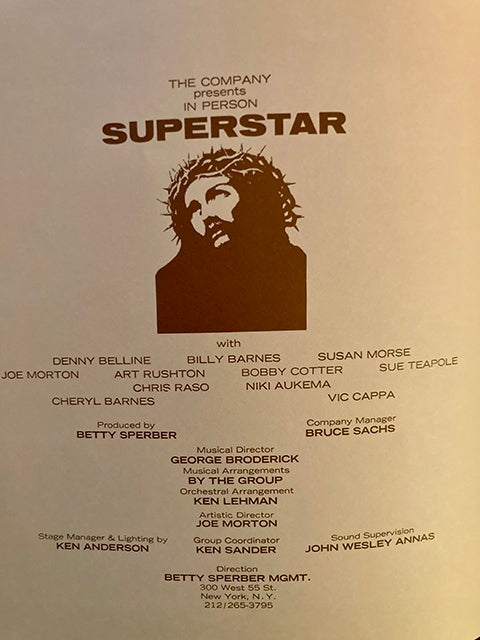
 

Page from the original program for Superstar.

After a few months, the Texas block of dates came up. While we were touring in Texas, Kenny had a family emergency and would have to go home for five days. Somebody had to take over the lights. By default, that was me. I usually was a day ahead of the show and busy doing the advance work, but I was also the obvious choice for the job. My initial reaction was reluctance, because I knew nothing about lighting. The task seemed insurmountable. However, Bruce insisted that I do it. Finally, we agreed that there was no guarantee of success. I would do as best as I could, and we would hope for the best. With that understanding in place I felt less pressured. Before Kenny left, I joined him on stage for the pre-show setup and watched him direct the lighting crew, observing where the fixed lights were hung and grouped. Then the stage crew adjusted the barn doors, to be pointed at specific spots on the stage. Kenny drew up a diagram of how each light was pointed and grouped, and which colored gels would be used. During shows, Kenny and the lighting crew communicated with each other via headsets. The night before the show I would be in charge of, I listened in on a headset to Kenny and the three follow-spot operators, along with the operator of the lighting mixing board. Following along with the notes on the script, I saw and heard how he called the show, and that gave me a good idea of how it was done.


Mid-1960s lighting console. From a Solitrol Lighting Systems brochure.

Next morning Kenny flew home, and we were off to Lubbock for two nights in a dirt-floored arena. It was big and smelled rodeo-ish. I felt that I could do it, well, at least sort of, and I was up for it. My first afternoon as lighting director, the local stage crew lowered the trusses for the lighting rigs, and the fixed lights were hung as Kenny’s notes described.. Going over the diagram with the lighting crew, they set up the banks of lights and aimed them. In a couple of hours all the fixed lighting was hung, gelled and pointed, with their barn doors adjusted. Then the trussed were raised back to the correct height, and only slight adjustments had to be made. Here and there, crew members climbed ladders, made the final adjustments, and locked everything down. That evening about a half hour before the show, I took my place in the balcony next to one of the follow-spot operators, and we put on our headsets. Me, the three follow-spot operators, and the lighting board tech were all situated on the main floor, with the lighting board placed next to the sound booth. While getting familiar with the operators, I asked them how often the lighting elements had to be replaced. The high-intensity carbon had to be replaced every 30 to 45 minutes of use, and took about one minute or so to replace. They would notify me in advance so that I could find a break in the script and give them time to do the replacement. We prepared for the show to start. And away we went. I started calling the lights. This was turning out to be fun, and my operators were very professional. I gave alerts, and made the cues and lighting calls. It was going better than I had expected. The show ended and I thanked my guys. They told me it was fun, and enjoyed working with me. They were unaware that this was my first time. By my account I made just a couple of mistakes, but they were brief and quickly corrected.


Advertisements for Superstar. Advertisements for Superstar.

I went backstage to the dressing room with a big sh*t-eating grin on my face. I was very pleased with myself. I saw Bruce, Susan (Morse, my girlfriend, who played Mary Magdalene), and everyone else in the dressing room just going about their business. I must admit I was surprised. It was inexplicable that no one paid any attention to me. No acknowledgement. nothing, nada. Well, what was I expecting, applause? Yeah, something like that, but seemingly they were not particularly interested. At that moment, I was speechless, and it began to dawn on me that nobody cared. Unless you make some horrid mistake, it seems like nobody notices. Apparently the only one who thought this lack of acknowledgement was a big deal was me. I quickly wiped the smile off my face and tried to appear nonchalant. Thinking about it later in bed that night, I realized that this is probably how a sound mixer feels. No one says anything to them except: “It was too loud!” “I couldn’t hear the monitors!” Or, some other kind of complaint. Silence is good news, because you are not going to get a compliment for a job well done; well, rarely maybe if ever. Kenny came back a day early and he also hardly said boo to me. No big deal. My lighting career was complete, finito, over. A brief but a hell of a good experience. Kenny Anderson later worked for Aucoin Management and became KISS’s production manager from 1976 – 1982.

Header image courtesy of Pixabay.com/KlausHausmann.

More from Issue 156

View All Articles in Issue 156

Search Copper Magazine

#232 What came first: Art or Music? A Conversation With Artist Jose Acosta by Joe Caplan Jul 06, 2026 #232 Blow By Blow: The Jeff Beck Story: An Insightful Book About a Guitar Icon by Ray Chelstowski Jul 06, 2026 #232 Creed Over Camaraderie? by B. Jan Montana Jul 06, 2026 #232 Chronicles of a Sound Pilgrim at the 2026 Montreal Audiofest by Hugues Morin Jul 06, 2026 #232 The Vinyl Beat: Summer Grooves by Rudy Radelic Jul 06, 2026 #232 Hibbing Hillbilly Dylan's Acoustic Rock by Wayne Robins Jul 06, 2026 #232 Quad Quads and Plasmatronics Tweeters: An Extraordinary System Comes to Life by Frank Doris Jul 06, 2026 #232 In Praise of Live Music, Once Again by Ted Shafran Jul 06, 2026 #232 Allnic Audio’s L-9000 Preamplifier: Design and Engineering Innovation by Howard Kneller Jul 06, 2026 #232 “Best Of” Lists and Rage Bait: Enough Already by Frank Doris Jul 06, 2026 #232 Quick Takes: Bud Shank, Paulo Almeida, Jakob Dreyer, Tim Eriksen and Peter Irvine by Frank Doris Jul 06, 2026 #232 My Impressions of AXPONA 2026, Part 2 by Frank Doris Jul 06, 2026 #232 How to Play in a Rock Band, 25: Encounters With Famous Musicians, Part Three by Frank Doris Jul 06, 2026 #232 Budgets, and Systems From Small to Outrageous by Paul McGowan Jul 06, 2026 #232 PS Audio in the News by PS Audio Staff Jul 06, 2026 #232 Hand It Over by Frank Doris Jul 06, 2026 #232 Difference of Opinion by Peter Xeni Jul 06, 2026 #232 Wabi-sabi Tree by James Schrimpf Jul 06, 2026 #231 Piano Prodigy Jude Kofie Releases His Debut Album On Octave Records by Frank Doris Jun 01, 2026 #231 Underappreciated Artists, Part Two: City Boy by Rich Isaacs Jun 01, 2026 #231 Music and the Art of Creation: Talking With Saxophonist Rob Scheps by Joe Caplan Jun 01, 2026 #231 How to Play in a Rock Band, 24: Further Adventures at the 2026 Montauk Music Festival by Frank Doris Jun 01, 2026 #231 Courtney Barnett: Creature of Habit by Wayne Robins Jun 01, 2026 #231 Angine de Poitrine: Interstellar Guitar Rock Saviors Headed for Late-Night TV Pop Stardom? by Mark Lepage Jun 01, 2026 #231 My Impressions of AXPONA 2026, Part One by Frank Doris Jun 01, 2026 #231 2026 La Jolla Concours d'Elegance: Another Aesthetic Feast by B. Jan Montana Jun 01, 2026 #231 Country Music Icon Jo Dee Messina’s Bridges: A New Beginning by Ray Chelstowski Jun 01, 2026 #231 The Luxury Dispatch Hosts a Video Podcast With Ken Kessler by Ken Kessler Jun 01, 2026 #231 The Vinyl Beat: Tracking in the Motor City by Rudy Radelic Jun 01, 2026 #231 Lots of Fun With DSP: The Ferrum Audio WANDLA DAC and Its Tube Mode by Frank Doris Jun 01, 2026 #231 From The Audiophile's Guide: Digital Source Components and Streaming Audio by Paul McGowan Jun 01, 2026 #231 Onkyo’s Monster M-510 power amplifier by The Staff at Just Audio Jun 01, 2026 #231 PS Audio in the News by PS Audio Staff Jun 01, 2026 #231 Naming Convention by Peter Xeni Jun 01, 2026 #231 Les Invisibles by Frank Doris Jun 01, 2026 #231 Wildlife Scene by James Schrimpf Jun 01, 2026 #230 Camaraderie by B. Jan Montana May 04, 2026 #230 AXPONA 2026: A Family Gathering by Paul McGowan May 04, 2026 #230 Pianist Ryan Benthall Explores Jazz Realms and Far Beyond With Divine Sky by Frank Doris May 04, 2026 #230 The Vinyl Beat in AXPONA-Land by Rudy Radelic May 04, 2026 #230 Teddy Thompson’s Musical Growth Deepens With Never Be the Same by Ray Chelstowski May 04, 2026 #230 More Fun in the Sun: Florida Audio Expo, Part Two by Frank Doris May 04, 2026 #230 CanJam NYC 2026 Show Report: Heady Sound, Part Two by Frank Doris and Harris Fogel May 04, 2026 #230 Sonic Youth On Murray Street by Wayne Robins May 04, 2026 #230 Graffeo Coffee: A Symphony of Sensory Experience by Joe Caplan May 04, 2026 #230 The Saul Authority: The Story of Hi-Fi Pioneer Saul Marantz by Olivier Meunier-Plante May 04, 2026 #230 How to Play in a Rock Band, 23: Encounters With Famous Musicians, Part Two by Frank Doris May 04, 2026

Calling the Lubbock Lights

Calling the Lubbock Lights

We flew into Texas knowing we were in for a tough time of it. We were looking at a no-frills bus and truck tour. It was going to be hectic, and we would travel over five thousand miles. We had thirty gigs in 35 days. There were some overnight bus rides. The routing was terrible. They had us zigzagging across the state of Texas and when we flew home all of us were exhausted. Let me back up here. It was in the early 1970s. Bruce Sachs and I got involved when Mike Martineau (the booking agent for the Peace Parade musical) called Bruce with the idea of doing a show based on the successful album Jesus Christ Superstar. We were in a unique position to implement this opportunity and were still buoyed by our recent success with Peace Parade (see my article in Issues 117 and 118). We decided to take a closer look at it. Firstly, we had cost considerations, which were paramount. We needed to have the ability to do a show every night, with the only restriction being travel issues. Keeping things simple – we knew how to do that. Salaries, while being pretty good for everyone, wouldn’t be much of a drain till we were on the road, but by then we would have cash flow. One of the things that helped us create Superstar as a road show on the cheap was that we decided to do the show as an oratorio, rather than as a full-blown production with elaborate scenery and costumes. We also had a world-class cast, with many of our performers being Broadway veterans. Most of them had served long stints in the Broadway cast of Hair. We called the show Superstar, The Original Touring Company (OATC). After a brief and successful start, some developments and realities made us have to temporarily pull the show off the road. This brought into our circle Bruce’s employer, Betty Sperber. A grizzled older gal with questionable ethics, a true music biz character. On the plus side, she had more experience than both of us combined.


Cast of Superstar, the Original Touring Company. Cast of Superstar, the Original Touring Company.
The pieces were in place, but we needed something more to make the show resonate. We had to clean up the show by eliminating some music, adding some original songs and making it more dramatic, while retaining the production’s ability to be nimble. Betty was friendly with Bill Aucoin (KISS’s manager) and he knew this guy Kenny Anderson, who had been a Broadway lighting director and designer. Kenny was not working, and we were told he had some issues, but we thought, let’s see, and he was brought in. The last few rehearsals were held at a theater where we could run through the set and mark the spots on the stage for the performers’ placements, so that Kenny could implement his lighting design. He had developed and created lighting cues that were truly amazing, using only hanging fixed lights. Kenny was able to create scenes, and moods. He could make a bare stage look like a specific environment. At that time he used two different kinds of fixed lights, Leko and Fresnel. These were universal lights that were used on Broadway and in theaters everywhere. Low-tech by today’s standards but incredibly effective. The Leko and Fresnel lights had what were called barn doors, essentially flaps. They shaped the light into tight beams as opposed to just flooding the stage. The lights hit the spots for the performers on stage, with no spillover. You could certainly create drama with just a few lights on an otherwise dark stage. When a performer had a solo and there was movement, Kenny incorporated follow spots. These Incandescent arc lights required professional local operators. For fixed lighting, envision two long bars over the stage. One would be in the front and the other in the back of the usable stage. In setup, the stagehands had to hang and then aim the lights using barn doors. Each of these hanging lights worked in groups of two to six lights per group. The crew also attached specific gels to the lights to create various colors. On the lighting control board, there were about 12 to 18 moveable levers, to brighten or dim these separate groups of fixed hanging lights.
Fresnel fixed hanging light with barn doors. Fresnel fixed hanging light with barn doors.

The lights had to be arranged in very exact placements, which increased the drama of the performance. With the combination of 65 to 90 hanging lights and three high-intensity carbon arc follow spotlights, Kenny developed an intricate lighting script that had over 167 cues over the course of the show. It was amazing, and added such depth and expression that it propelled the show to another level. This was it, the missing element.


An incandescent followspot. Courtesy of Wikimedia Commons/KeepOnTruckin,. An incandescent followspot. Courtesy of Wikimedia Commons/KeepOnTruckin.


The beauty of all this was that it cost us nothing. We could put all of it in our contract rider that required the promoters to provide this equipment. It was considered normal and appropriate for a promoter to provide sound and lights, and we asked for nothing special. The equipment requested on the rider was readily available in most theaters, and if not, could easily be rented locally. The lights were not particularly exotic in themselves. The lighting requirements for Superstar were solidified – and it was just one more reason why the show needed an advance man. I was the obvious choice for the job. I had to make sure that the rider requirements were provided for. There were also other necessities that could be problematic if they were not in place for the show. To name a few, a Hammond B3 organ with two Leslie speakers. An upright piano, freshly tuned on the day of the show. Making sure the specifications for the sound system and the size of the stage were correct. Previously, before I did the advance work, the local promoters were frequently haphazard in fulfilling the rider. When we would pull up on the day of the show, it was too late to make substitutions, and afforded almost no time to make any corrections. It was a source of frustration for all involved when our requirements were not met, a real bummer that hurt morale. The addition of Kenny’s lights made the job of advance man an absolute necessity, where previously it was only an aspiration. I would call and book an appointment with the promoter to meet at the venue a day or two before the show, and review every item of the contract rider. That forced them to make any necessary corrections, which they did. The word got out and the promoters took our requirements much more seriously. In the rare case that there was an issue, I was able to relay that information back to Bruce, and he could advise our people of any needed substitutions or workarounds. It really worked well, and I was able to smooth out the rough spots. That made life on the road easier for everyone and our touring life was much improved. When we finally resumed touring after our hiatus, the lighting gave us the added dimension the performance needed. Our production of Superstar received rave reviews.


Page from the original program for Superstar.

After a few months, the Texas block of dates came up. While we were touring in Texas, Kenny had a family emergency and would have to go home for five days. Somebody had to take over the lights. By default, that was me. I usually was a day ahead of the show and busy doing the advance work, but I was also the obvious choice for the job. My initial reaction was reluctance, because I knew nothing about lighting. The task seemed insurmountable. However, Bruce insisted that I do it. Finally, we agreed that there was no guarantee of success. I would do as best as I could, and we would hope for the best. With that understanding in place I felt less pressured. Before Kenny left, I joined him on stage for the pre-show setup and watched him direct the lighting crew, observing where the fixed lights were hung and grouped. Then the stage crew adjusted the barn doors, to be pointed at specific spots on the stage. Kenny drew up a diagram of how each light was pointed and grouped, and which colored gels would be used. During shows, Kenny and the lighting crew communicated with each other via headsets. The night before the show I would be in charge of, I listened in on a headset to Kenny and the three follow-spot operators, along with the operator of the lighting mixing board. Following along with the notes on the script, I saw and heard how he called the show, and that gave me a good idea of how it was done.


Mid-1960s lighting console. From a Solitrol Lighting Systems brochure.

Next morning Kenny flew home, and we were off to Lubbock for two nights in a dirt-floored arena. It was big and smelled rodeo-ish. I felt that I could do it, well, at least sort of, and I was up for it. My first afternoon as lighting director, the local stage crew lowered the trusses for the lighting rigs, and the fixed lights were hung as Kenny’s notes described.. Going over the diagram with the lighting crew, they set up the banks of lights and aimed them. In a couple of hours all the fixed lighting was hung, gelled and pointed, with their barn doors adjusted. Then the trussed were raised back to the correct height, and only slight adjustments had to be made. Here and there, crew members climbed ladders, made the final adjustments, and locked everything down. That evening about a half hour before the show, I took my place in the balcony next to one of the follow-spot operators, and we put on our headsets. Me, the three follow-spot operators, and the lighting board tech were all situated on the main floor, with the lighting board placed next to the sound booth. While getting familiar with the operators, I asked them how often the lighting elements had to be replaced. The high-intensity carbon had to be replaced every 30 to 45 minutes of use, and took about one minute or so to replace. They would notify me in advance so that I could find a break in the script and give them time to do the replacement. We prepared for the show to start. And away we went. I started calling the lights. This was turning out to be fun, and my operators were very professional. I gave alerts, and made the cues and lighting calls. It was going better than I had expected. The show ended and I thanked my guys. They told me it was fun, and enjoyed working with me. They were unaware that this was my first time. By my account I made just a couple of mistakes, but they were brief and quickly corrected.


Advertisements for Superstar. Advertisements for Superstar.

I went backstage to the dressing room with a big sh*t-eating grin on my face. I was very pleased with myself. I saw Bruce, Susan (Morse, my girlfriend, who played Mary Magdalene), and everyone else in the dressing room just going about their business. I must admit I was surprised. It was inexplicable that no one paid any attention to me. No acknowledgement. nothing, nada. Well, what was I expecting, applause? Yeah, something like that, but seemingly they were not particularly interested. At that moment, I was speechless, and it began to dawn on me that nobody cared. Unless you make some horrid mistake, it seems like nobody notices. Apparently the only one who thought this lack of acknowledgement was a big deal was me. I quickly wiped the smile off my face and tried to appear nonchalant. Thinking about it later in bed that night, I realized that this is probably how a sound mixer feels. No one says anything to them except: “It was too loud!” “I couldn’t hear the monitors!” Or, some other kind of complaint. Silence is good news, because you are not going to get a compliment for a job well done; well, rarely maybe if ever. Kenny came back a day early and he also hardly said boo to me. No big deal. My lighting career was complete, finito, over. A brief but a hell of a good experience. Kenny Anderson later worked for Aucoin Management and became KISS’s production manager from 1976 – 1982.

Header image courtesy of Pixabay.com/KlausHausmann.

0 comments

Leave a comment

0 Comments

Your avatar

Loading comments...

🗑️ Delete Comment

Enter moderator password to delete this comment:

✏️ Edit Comment

Enter your email to verify ownership: