COPPER

A PS Audio Publication

Issue 166 • Free Online Magazine

Issue 166 FROM THE SWEET SPOT

Summer Concerts: Who to See and Where?

Summer Concerts: Who to See and Where?

After an almost two-year continuous drought, it’s quite invigorating to see live music back with a vengeance. Certainly, live streaming was helpful in filling the void, but there’s a different kind of engagement and visceral experience that comes with in-person music that can’t be captured via streaming, especially when the venue has great sound.

I was stoked to see the online music publication Pitchfork’s list of “The 80 Most Anticipated Tours of Summer 2022,” with an eye towards taking in a few. Admittedly, there are several artists on the Pitchfork list that I’m not even remotely familiar with, which likely wouldn’t be the case if I were still in my 20s.

I was especially amused by the names several artists have chosen for their 2022 tours. Many tour names are linked to whatever new or most recent LP they are plugging, but far from all.

Paul McCartney was out early behind his “Got Back North American Tour,“ grammar my high school English teacher would have vigorously circled in red, but forgivable wordplay for any McCartney or Beatles fan. As you probably heard, Sir Paul turned 80 while on tour. Is 80 the new 70? The only other vocation where folks are gainfully employed eight decades in are in Congress, and those peeps are doing a lot more shufflin’ than rockin’.

Whether intentional or not, several artists are making political statements with their title choices. The Weather Station is touring in support of their album Ignorance. However, when the album name is strung together as “Ignorance World Tour,” it reads as if the band is casting aspersions on the state of our planet. Jack White certainly isn’t pulling any punches with his current events titled “The Supply Chain Issues Tour.” Lorde is supporting her latest LP release, Solar Power, with a tour of the same name. Just a hunch, neither Shell nor Mobil are sponsors.


Tears for Fears stole a page from Malcolm Gladwell with “The Tipping Point World Tour 2022.” In his best-selling book The Tipping Point: How Little Things Can Make a Big Difference, Gladwell suggests that “ideas, products, messages and behaviors at a certain point spread like viruses in achieving critical mass.” TFF’s Roland Orzabal and Curt Smith are hoping for similar karma, but first they might need to comp Gladwell with lots of tickets to stave off impending litigation.

Spoon’s “Lucifer on the Sofa Tour” is in support of the band’s critically acclaimed 10th studio album of the same name. The title is a bit dark and satanic for my taste. Maybe post-tour they’ll trade-in the sofa for a couch and a therapist.

The indie UK band Dry Cleaning boringly titled its tour “North American Tour 2022.” I would have gone with the “No Starch Tour” or “Pressed, Not Wrinkled Tour,” both a bit more playful and on-brand.

The Weeknd’s tour is called “After Hours Til Dawn,” an apt title if he was playing the Fillmore East in 1970, where artists actually could play unabated til dawn. My, how we miss you, Bill Graham!

Bad Bunny’s tour is simply titled the “World’s Hottest Tour.” Mr. Bunny probably doesn’t mean “hottest” in a climatic sense, though many of his tour dates are scheduled for the dead of summer.  Rather, it’s a touch of self-aggrandizement with a superlative setting a bar of high expectation. (Overconfidence isn’t a bad thing, is it?)


A big part of the decision-making process for me is not only whom to see, but where they are playing. Let’s face it, not all venues are created equally, particularly from an acoustic standpoint. A bad sounding venue for me is a no-no.

For many years while residing in New York City I wouldn’t attend a concert at Madison Square Garden (MSG) because the acoustics were so bloody awful. Of course, seat location and a venue’s sound system are critical elements, but many large arenas have painfully bad sound with lots of echo and reflections. Since MSG’s billion-dollar renovation was completed in 2013, I can honestly say the venue’s acoustics are dramatically improved.

In NYC I never gave too much thought if the day’s biggest-grossing artists planned to play the market. Most generally do. However, in a smaller city like Seattle, my new hometown, that historically hasn’t been the case. For top-of-the-chart artists, Seattle has traditionally competed for bookings with arenas in Tacoma, Portland and Vancouver, each in relative close proximity. Bookings for smaller-grossing artists and indie bands were less problematic, as several smaller, top-notch venues have consistently contributed to Seattle’s well-deserved reputation as a top music city.

The biggest impediment for booking big name artists in Seattle was KeyArena, the city’s largest venue that for years many referred to as an echo chamber. The original structure was built for the 1962 World’s Fair and was heralded for its architectural design and unique pyramid roof. However, like many large arenas constructed in the 1960s, sound quality was not a strong consideration, nor was the era’s technology particularly advanced. A three-year privately-financed $1.15 billion renovation transformed the venue into a multi-use state-of-the art-facility that re-opened in 2021 as Climate Pledge Arena (CPA).
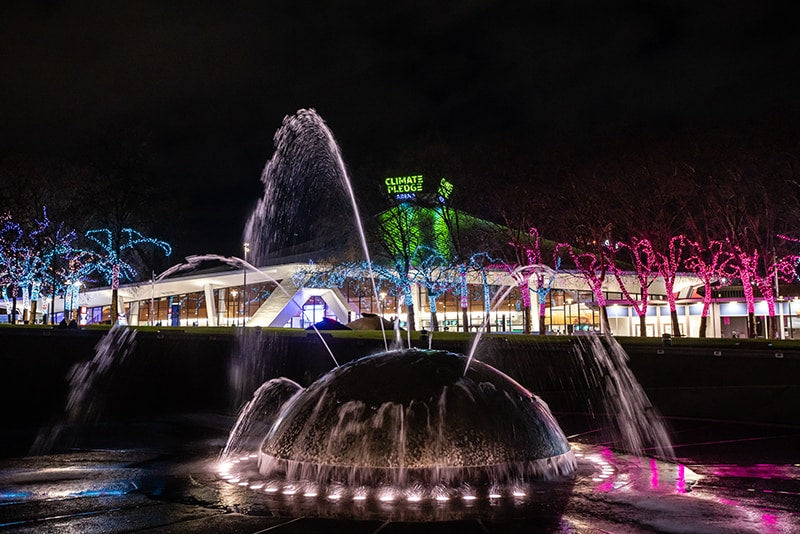
 

Holiday lights outside Climate Pledge Arena, December 2021. Courtesy of David Conger/Climate Pledge Arena.

Holiday lights outside Climate Pledge Arena, December 2021. Courtesy of David Conger/Climate Pledge Arena.


Randy Foster, Director, Production at CPA, was kind enough to give me a behind-the-scenes tour of the new venue. I was curious to understand the thought process that went into the venue’s acoustic design, and in mitigating the unwanted reverberation and echoes that can plague large arenas.

The lead architectural firm on the renovation, Populous, had to overcome many design and structural impediments. The venue’s exterior and pyramid roof are designated landmarks that could not be altered. As a first step, the project’s structural engineers and general contractor Mortenson decided to lift and suspend the 44-million-pound roof above the site so that 660,000 cubic yards of soil could be excavated from the base of the former KeyArena. A truly marvelous engineering feat!

Venue operator, Oak View Group, also brought in high-end audio and video technology consultants Idibri and Diversified Systems for video projection and sound enrichment. An important add-on was the building of an intricate steel grid and rigging system at the top of the arena’s interior. This newly-designed system enables both lighting and audio to be rigged from the very front to the very back of the arena, enhancing sound even in hard-to-reach upper-seating areas, where venue acoustics often are at their worst.

The rigging system gives front-of-house (FOH) sound engineers far more flexibility with speaker placement and sound control. “It’s one of the few arenas with a rigging system that runs the entire span of the venue,” added CPA’s Foster. “Old-school venues were built and engineered with their rigging steel almost exclusively at stage end.”

In smaller venues and clubs, artists frequently tap into the house PA system. At the arena level, however, artists bring their own sound. Speaker system setups generally operate on a “line array” principle, which essentially means that by changing the shape of the line array, engineers can control the sound at various points in a venue. In theory, with a strong line array, either by physical placement or by using digital signal processing, an engineer can deliver quality sound to the back of the venue without the front sounding excessively loud.

Software is used to help determine where best to hang speakers from the steel rigging, based on a venue’s physical dimensions and other considerations. The ultimate goal is to create an acoustically-sound environment that provides a relatively flat frequency response with little room for coloration (e.g., distortion, reflection). “A FOH engineer needs to trust the building, and (in a figurative sense) the building needs to trust the engineer,” added CPA’s Foster. “It’s a give and take process with the ultimate goal of achieving an acoustical balance throughout the venue.”

There are many different types of acoustic treatments and sound mitigation solutions available to venue designers and sound engineers today. The folks at CPA went all in with Lapendary Panels, manufactured by MBI Products Company. They didn’t install just a few hundred panels; instead, they used a mind-boggling 5,155 of them. The large acoustical banners are suspended vertically from the venue’s ceiling, and are specifically designed to reduce reverb, reflection and sound intensity.


Lapindary Panels installed in the roof of Climate Pledge Arena.


Lapindary Panels installed in the roof of Climate Pledge Arena. Courtesy of David Conger/Climate Pledge Arena.


Another acoustic consideration was capping the number of visible corporate suites in the bowl area to 40 (vs. 150-plus in Los Angeles’ Crypto.com arena, for example), minimizing sound reflection from the glass windows that front each suite. There are an additional 19 tunnel suites that are smartly designed with seating in the bowl area, and the entertaining space recessed behind the suite’s seating.

For sporting events, venue loudness is always a welcome, critical element contributing to a team’s “home court advantage.” Conversely, with concert events, venue loudness is problematic. To address the two divergent needs, CPA is also equipped with retractable 40-foot acoustic curtains, that can be drawn open to enhance bowl loudness during sporting events or closed to mute reflection during concerts.

Significant design improvements in the venue were also made at the “back of the house.” The arena now has an “artists’ compound” consisting of four large state-of-the art dressing rooms, while eight new loading docks (vs. two previously) make the load-in and load-out of concert gear far more efficient. Added CPA’s Foster, “in the past 15 to 20 years, tour production has grown considerably and become far more elaborate. What was an eight-truck show is now a 25-truck show.”

The first “unofficial” concert at the venue was Seattle’s very own Foo Fighters and Death Cab For Cutie. Front man and Foo Fighters founder Dave Grohl, who has played the venue numerous times in its earlier incarnation as KeyArena, had this to say: “It’s the best the venue has ever sounded.” A nice endorsement, even if Dave is a bit of a homer!

In sum, CPA is an exquisitely beautiful venue that maintains a level of intimacy rarely seen in a modern-day venue of its size. A lot of time, thought and expense went into the venue’s acoustic design.

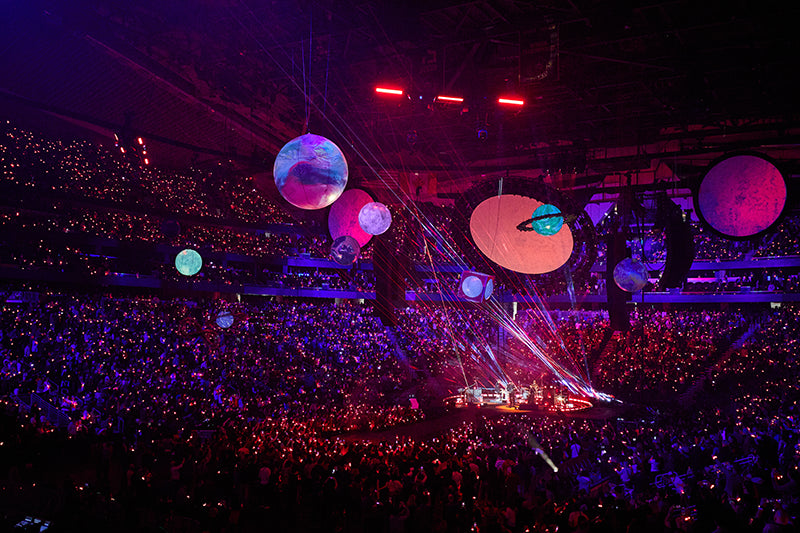
Above: Coldplay performing at the official grand opening of Climate Pledge Arena, October 22, 2021. Courtesy of Climate Pledge Arena.


Perhaps you’re wondering what’s up with the venue’s name? Climate Pledge Arena’s goal is to be a carbon-neutral arena. CPA consumes no fossil fuel, and all mechanical, heating, dehumidification and cooking systems are electric. Perhaps the coolest part of the arena’s ecosystem is this: the venue harvests rainwater from its roof, which then is transported to an underground cistern and purified, before it is made into hockey ice to service the NHL’s and the city’s newest sports team, the Seattle Kraken. (I just knew someone could turn Seattle’s rain to gold!)

A cautionary note to the NHL’s drought-stricken LA Kings and Anaheim Ducks: Don’t try this at home!


Header image courtesy of DP Drones/Climate Pledge Arena.

More from Issue 166

View All Articles in Issue 166

Search Copper Magazine

#232 What came first: Art or Music? A Conversation With Artist Jose Acosta by Joe Caplan Jul 06, 2026 #232 Blow By Blow: The Jeff Beck Story: An Insightful Book About a Guitar Icon by Ray Chelstowski Jul 06, 2026 #232 Creed Over Camaraderie? by B. Jan Montana Jul 06, 2026 #232 Chronicles of a Sound Pilgrim at the 2026 Montreal Audiofest by Hugues Morin Jul 06, 2026 #232 The Vinyl Beat: Summer Grooves by Rudy Radelic Jul 06, 2026 #232 Hibbing Hillbilly Dylan's Acoustic Rock by Wayne Robins Jul 06, 2026 #232 Quad Quads and Plasmatronics Tweeters: An Extraordinary System Comes to Life by Frank Doris Jul 06, 2026 #232 In Praise of Live Music, Once Again by Ted Shafran Jul 06, 2026 #232 Allnic Audio’s L-9000 Preamplifier: Design and Engineering Innovation by Howard Kneller Jul 06, 2026 #232 “Best Of” Lists and Rage Bait: Enough Already by Frank Doris Jul 06, 2026 #232 Quick Takes: Bud Shank, Paulo Almeida, Jakob Dreyer, Tim Eriksen and Peter Irvine by Frank Doris Jul 06, 2026 #232 My Impressions of AXPONA 2026, Part 2 by Frank Doris Jul 06, 2026 #232 How to Play in a Rock Band, 25: Encounters With Famous Musicians, Part Three by Frank Doris Jul 06, 2026 #232 Budgets, and Systems From Small to Outrageous by Paul McGowan Jul 06, 2026 #232 PS Audio in the News by PS Audio Staff Jul 06, 2026 #232 Hand It Over by Frank Doris Jul 06, 2026 #232 Difference of Opinion by Peter Xeni Jul 06, 2026 #232 Wabi-sabi Tree by James Schrimpf Jul 06, 2026 #231 Piano Prodigy Jude Kofie Releases His Debut Album On Octave Records by Frank Doris Jun 01, 2026 #231 Underappreciated Artists, Part Two: City Boy by Rich Isaacs Jun 01, 2026 #231 Music and the Art of Creation: Talking With Saxophonist Rob Scheps by Joe Caplan Jun 01, 2026 #231 How to Play in a Rock Band, 24: Further Adventures at the 2026 Montauk Music Festival by Frank Doris Jun 01, 2026 #231 Courtney Barnett: Creature of Habit by Wayne Robins Jun 01, 2026 #231 Angine de Poitrine: Interstellar Guitar Rock Saviors Headed for Late-Night TV Pop Stardom? by Mark Lepage Jun 01, 2026 #231 My Impressions of AXPONA 2026, Part One by Frank Doris Jun 01, 2026 #231 2026 La Jolla Concours d'Elegance: Another Aesthetic Feast by B. Jan Montana Jun 01, 2026 #231 Country Music Icon Jo Dee Messina’s Bridges: A New Beginning by Ray Chelstowski Jun 01, 2026 #231 The Luxury Dispatch Hosts a Video Podcast With Ken Kessler by Ken Kessler Jun 01, 2026 #231 The Vinyl Beat: Tracking in the Motor City by Rudy Radelic Jun 01, 2026 #231 Lots of Fun With DSP: The Ferrum Audio WANDLA DAC and Its Tube Mode by Frank Doris Jun 01, 2026 #231 From The Audiophile's Guide: Digital Source Components and Streaming Audio by Paul McGowan Jun 01, 2026 #231 Onkyo’s Monster M-510 power amplifier by The Staff at Just Audio Jun 01, 2026 #231 PS Audio in the News by PS Audio Staff Jun 01, 2026 #231 Naming Convention by Peter Xeni Jun 01, 2026 #231 Les Invisibles by Frank Doris Jun 01, 2026 #231 Wildlife Scene by James Schrimpf Jun 01, 2026 #230 Camaraderie by B. Jan Montana May 04, 2026 #230 AXPONA 2026: A Family Gathering by Paul McGowan May 04, 2026 #230 Pianist Ryan Benthall Explores Jazz Realms and Far Beyond With Divine Sky by Frank Doris May 04, 2026 #230 The Vinyl Beat in AXPONA-Land by Rudy Radelic May 04, 2026 #230 Teddy Thompson’s Musical Growth Deepens With Never Be the Same by Ray Chelstowski May 04, 2026 #230 More Fun in the Sun: Florida Audio Expo, Part Two by Frank Doris May 04, 2026 #230 CanJam NYC 2026 Show Report: Heady Sound, Part Two by Frank Doris and Harris Fogel May 04, 2026 #230 Sonic Youth On Murray Street by Wayne Robins May 04, 2026 #230 Graffeo Coffee: A Symphony of Sensory Experience by Joe Caplan May 04, 2026 #230 The Saul Authority: The Story of Hi-Fi Pioneer Saul Marantz by Olivier Meunier-Plante May 04, 2026 #230 How to Play in a Rock Band, 23: Encounters With Famous Musicians, Part Two by Frank Doris May 04, 2026

Summer Concerts: Who to See and Where?

Summer Concerts: Who to See and Where?

After an almost two-year continuous drought, it’s quite invigorating to see live music back with a vengeance. Certainly, live streaming was helpful in filling the void, but there’s a different kind of engagement and visceral experience that comes with in-person music that can’t be captured via streaming, especially when the venue has great sound.

I was stoked to see the online music publication Pitchfork’s list of “The 80 Most Anticipated Tours of Summer 2022,” with an eye towards taking in a few. Admittedly, there are several artists on the Pitchfork list that I’m not even remotely familiar with, which likely wouldn’t be the case if I were still in my 20s.

I was especially amused by the names several artists have chosen for their 2022 tours. Many tour names are linked to whatever new or most recent LP they are plugging, but far from all.

Paul McCartney was out early behind his “Got Back North American Tour,“ grammar my high school English teacher would have vigorously circled in red, but forgivable wordplay for any McCartney or Beatles fan. As you probably heard, Sir Paul turned 80 while on tour. Is 80 the new 70? The only other vocation where folks are gainfully employed eight decades in are in Congress, and those peeps are doing a lot more shufflin’ than rockin’.

Whether intentional or not, several artists are making political statements with their title choices. The Weather Station is touring in support of their album Ignorance. However, when the album name is strung together as “Ignorance World Tour,” it reads as if the band is casting aspersions on the state of our planet. Jack White certainly isn’t pulling any punches with his current events titled “The Supply Chain Issues Tour.” Lorde is supporting her latest LP release, Solar Power, with a tour of the same name. Just a hunch, neither Shell nor Mobil are sponsors.


Tears for Fears stole a page from Malcolm Gladwell with “The Tipping Point World Tour 2022.” In his best-selling book The Tipping Point: How Little Things Can Make a Big Difference, Gladwell suggests that “ideas, products, messages and behaviors at a certain point spread like viruses in achieving critical mass.” TFF’s Roland Orzabal and Curt Smith are hoping for similar karma, but first they might need to comp Gladwell with lots of tickets to stave off impending litigation.

Spoon’s “Lucifer on the Sofa Tour” is in support of the band’s critically acclaimed 10th studio album of the same name. The title is a bit dark and satanic for my taste. Maybe post-tour they’ll trade-in the sofa for a couch and a therapist.

The indie UK band Dry Cleaning boringly titled its tour “North American Tour 2022.” I would have gone with the “No Starch Tour” or “Pressed, Not Wrinkled Tour,” both a bit more playful and on-brand.

The Weeknd’s tour is called “After Hours Til Dawn,” an apt title if he was playing the Fillmore East in 1970, where artists actually could play unabated til dawn. My, how we miss you, Bill Graham!

Bad Bunny’s tour is simply titled the “World’s Hottest Tour.” Mr. Bunny probably doesn’t mean “hottest” in a climatic sense, though many of his tour dates are scheduled for the dead of summer.  Rather, it’s a touch of self-aggrandizement with a superlative setting a bar of high expectation. (Overconfidence isn’t a bad thing, is it?)


A big part of the decision-making process for me is not only whom to see, but where they are playing. Let’s face it, not all venues are created equally, particularly from an acoustic standpoint. A bad sounding venue for me is a no-no.

For many years while residing in New York City I wouldn’t attend a concert at Madison Square Garden (MSG) because the acoustics were so bloody awful. Of course, seat location and a venue’s sound system are critical elements, but many large arenas have painfully bad sound with lots of echo and reflections. Since MSG’s billion-dollar renovation was completed in 2013, I can honestly say the venue’s acoustics are dramatically improved.

In NYC I never gave too much thought if the day’s biggest-grossing artists planned to play the market. Most generally do. However, in a smaller city like Seattle, my new hometown, that historically hasn’t been the case. For top-of-the-chart artists, Seattle has traditionally competed for bookings with arenas in Tacoma, Portland and Vancouver, each in relative close proximity. Bookings for smaller-grossing artists and indie bands were less problematic, as several smaller, top-notch venues have consistently contributed to Seattle’s well-deserved reputation as a top music city.

The biggest impediment for booking big name artists in Seattle was KeyArena, the city’s largest venue that for years many referred to as an echo chamber. The original structure was built for the 1962 World’s Fair and was heralded for its architectural design and unique pyramid roof. However, like many large arenas constructed in the 1960s, sound quality was not a strong consideration, nor was the era’s technology particularly advanced. A three-year privately-financed $1.15 billion renovation transformed the venue into a multi-use state-of-the art-facility that re-opened in 2021 as Climate Pledge Arena (CPA).


Holiday lights outside Climate Pledge Arena, December 2021. Courtesy of David Conger/Climate Pledge Arena.

Holiday lights outside Climate Pledge Arena, December 2021. Courtesy of David Conger/Climate Pledge Arena.


Randy Foster, Director, Production at CPA, was kind enough to give me a behind-the-scenes tour of the new venue. I was curious to understand the thought process that went into the venue’s acoustic design, and in mitigating the unwanted reverberation and echoes that can plague large arenas.

The lead architectural firm on the renovation, Populous, had to overcome many design and structural impediments. The venue’s exterior and pyramid roof are designated landmarks that could not be altered. As a first step, the project’s structural engineers and general contractor Mortenson decided to lift and suspend the 44-million-pound roof above the site so that 660,000 cubic yards of soil could be excavated from the base of the former KeyArena. A truly marvelous engineering feat!

Venue operator, Oak View Group, also brought in high-end audio and video technology consultants Idibri and Diversified Systems for video projection and sound enrichment. An important add-on was the building of an intricate steel grid and rigging system at the top of the arena’s interior. This newly-designed system enables both lighting and audio to be rigged from the very front to the very back of the arena, enhancing sound even in hard-to-reach upper-seating areas, where venue acoustics often are at their worst.

The rigging system gives front-of-house (FOH) sound engineers far more flexibility with speaker placement and sound control. “It’s one of the few arenas with a rigging system that runs the entire span of the venue,” added CPA’s Foster. “Old-school venues were built and engineered with their rigging steel almost exclusively at stage end.”

In smaller venues and clubs, artists frequently tap into the house PA system. At the arena level, however, artists bring their own sound. Speaker system setups generally operate on a “line array” principle, which essentially means that by changing the shape of the line array, engineers can control the sound at various points in a venue. In theory, with a strong line array, either by physical placement or by using digital signal processing, an engineer can deliver quality sound to the back of the venue without the front sounding excessively loud.

Software is used to help determine where best to hang speakers from the steel rigging, based on a venue’s physical dimensions and other considerations. The ultimate goal is to create an acoustically-sound environment that provides a relatively flat frequency response with little room for coloration (e.g., distortion, reflection). “A FOH engineer needs to trust the building, and (in a figurative sense) the building needs to trust the engineer,” added CPA’s Foster. “It’s a give and take process with the ultimate goal of achieving an acoustical balance throughout the venue.”

There are many different types of acoustic treatments and sound mitigation solutions available to venue designers and sound engineers today. The folks at CPA went all in with Lapendary Panels, manufactured by MBI Products Company. They didn’t install just a few hundred panels; instead, they used a mind-boggling 5,155 of them. The large acoustical banners are suspended vertically from the venue’s ceiling, and are specifically designed to reduce reverb, reflection and sound intensity.


Lapindary Panels installed in the roof of Climate Pledge Arena.


Lapindary Panels installed in the roof of Climate Pledge Arena. Courtesy of David Conger/Climate Pledge Arena.


Another acoustic consideration was capping the number of visible corporate suites in the bowl area to 40 (vs. 150-plus in Los Angeles’ Crypto.com arena, for example), minimizing sound reflection from the glass windows that front each suite. There are an additional 19 tunnel suites that are smartly designed with seating in the bowl area, and the entertaining space recessed behind the suite’s seating.

For sporting events, venue loudness is always a welcome, critical element contributing to a team’s “home court advantage.” Conversely, with concert events, venue loudness is problematic. To address the two divergent needs, CPA is also equipped with retractable 40-foot acoustic curtains, that can be drawn open to enhance bowl loudness during sporting events or closed to mute reflection during concerts.

Significant design improvements in the venue were also made at the “back of the house.” The arena now has an “artists’ compound” consisting of four large state-of-the art dressing rooms, while eight new loading docks (vs. two previously) make the load-in and load-out of concert gear far more efficient. Added CPA’s Foster, “in the past 15 to 20 years, tour production has grown considerably and become far more elaborate. What was an eight-truck show is now a 25-truck show.”

The first “unofficial” concert at the venue was Seattle’s very own Foo Fighters and Death Cab For Cutie. Front man and Foo Fighters founder Dave Grohl, who has played the venue numerous times in its earlier incarnation as KeyArena, had this to say: “It’s the best the venue has ever sounded.” A nice endorsement, even if Dave is a bit of a homer!

In sum, CPA is an exquisitely beautiful venue that maintains a level of intimacy rarely seen in a modern-day venue of its size. A lot of time, thought and expense went into the venue’s acoustic design.

Above: Coldplay performing at the official grand opening of Climate Pledge Arena, October 22, 2021. Courtesy of Climate Pledge Arena.


Perhaps you’re wondering what’s up with the venue’s name? Climate Pledge Arena’s goal is to be a carbon-neutral arena. CPA consumes no fossil fuel, and all mechanical, heating, dehumidification and cooking systems are electric. Perhaps the coolest part of the arena’s ecosystem is this: the venue harvests rainwater from its roof, which then is transported to an underground cistern and purified, before it is made into hockey ice to service the NHL’s and the city’s newest sports team, the Seattle Kraken. (I just knew someone could turn Seattle’s rain to gold!)

A cautionary note to the NHL’s drought-stricken LA Kings and Anaheim Ducks: Don’t try this at home!


Header image courtesy of DP Drones/Climate Pledge Arena.

0 comments

Leave a comment

0 Comments

Your avatar

Loading comments...

🗑️ Delete Comment

Enter moderator password to delete this comment:

✏️ Edit Comment

Enter your email to verify ownership: