COPPER

A PS Audio Publication

Issue 166 • Free Online Magazine

Issue 166 Octave Pitch

The Latest from Octave Records: Mini Brazilian Beasts by Pianist Carmen Sandim

The Latest from Octave Records: Mini Brazilian Beasts by Pianist Carmen Sandim

The new Octave Records release, Mini Brazilian Beasts by jazz pianist Carmen Sandim, weaves a boundless wave of piano melodies, sophisticated harmonic concepts, and the musical rhythms and moods of Sandim’s native Brazil into a richly varied album. The recording features Octave Records’ Pure DSD high-resolution recording process, to capture the musicians with stunning warmth, clarity, and spaciousness.

Mini Brazilian Beasts is a captivating showcase for Sandim’s piano and keyboard virtuosity. Sandim, who composed all the music, is joined by world-class guitarist Gilad Hekselman on electric and acoustic guitar, the telepathic accompaniment of Greg Garrison on bass, and Colin Stranahan on drums. Renowned trumpeter Ron Miles makes a guest appearance on the lush, introspective ballad “Glen.” Carmen Sandim grew up in Brazil, studied at Berklee College of Music and is a composer, performer and teacher.

The title track leads off the album with its bouncy melodic leaps, unison piano and guitar melodies, and easygoing swing. Like much of the album, “Disturbia Nervosa” goes beyond postmodern and fusion jazz into new musical explorations. The ballad “Glen” features exquisite playing by trumpeter Miles – sadly, this was to be his last recorded performance. “Enemy” features soaring, virtuosic guitar work by Gilad Hekselman, whose chordal comping and melodic invention simply shines. The solo piano piece, “Eventual Ocean,” and the album’s closer, “Humdrum Heroe,” take listeners through deep, contemplative musical journeys.
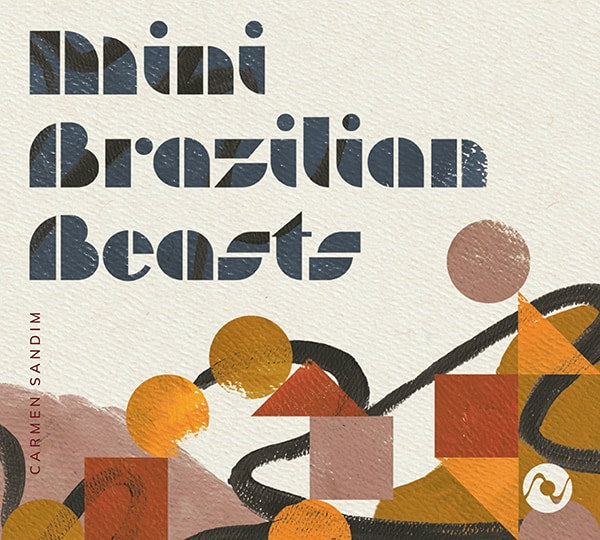
 

Mini Brazilian Beasts, album cover.

Mini Brazilian Beasts, album cover.


Mini Brazilian Beasts was recorded by Colin Bricker and Kevin Lee at Animal Lane Studios in Lyons, Colorado using Octave Records’ Pure DSD process and the Sonoma multi-track DSD recording system, and mastered by Gus Skinas. It features Octave’s premium gold disc formulation, and the disc is playable on any SACD, CD, DVD, or Blu-ray player. Mini Brazilian Beasts also has a high-resolution DSD layer that is accessible by using any SACD player, a PS Audio SACD transport, or by copying the DSD tracks on the included DVD data discs. In addition, the master DSD and PCM files are available for purchase and download (including DSD64, DSDDirect Mastered 192kHz/24-bit, 96kHz/24-bit and 44.1kHz/16-bit PCM), along with 24-karat gold CDs at standard resolution. These CDs have been cut directly off the DSD master using BitPerfect’s state-of-the-art Zephiir filter.

The musicians are captured with remarkable depth, presence and fidelity. It’s a sonic leap forward in musical realism and in bringing the emotional power and nuance of the performances to life.

We talked to Carmen about the making of the album.

Frank Doris: Tell me about your musical background.

Carmen Sandim: I grew up in Brazil. I moved to the US to go to Berklee College of Music. I grew up listening to a lot of Brazilian jazz – my parents were big listeners – and I played viola in orchestra, and piano. So [I heard] a lot of classical music as well. It’s such a wide variety of music we have [in Brazil], such rich rhythms and harmony. When I went to Berklee, I was exposed to American jazz and improvisation. I guess my generation of musicians didn’t have a choice – we heard the popular music of the Nineties too, and the whole [previous] era of rock.

FD: On the album, I hear musical influences from everywhere.

CS: I think just labeling it as “jazz” would be very hard to do. I used to play bass in a punk band growing up!

FD: How’d you come up with Mini Brazilian Beasts” as the title? It’s…different. (laughs).

CS: I have two kids, and when I drive, they like to say, “mom, drive like a, like a Brazilian beast!” (laughs) But really, they are the fast ones, just running around all the time. So the title of the song is for them. I’m the Brazilian beast, and they’re the mini-Brazilian beasts!

FD: What musicians have had a big effect on you?

CS: Milton Nascimento was really influential for me; his music is so “out,” it’s so weird and wonderful. It’s funny that I ended up in Colorado because Ron Miles was always a hero of mine. And then I moved here and discovered he lived here! Also, Art Landy. I teach jazz history, and of course all of the people I talk about are big influences too. Wayne Shorter, Herbie Hancock and Chick Corea.

FD: Your piano playing is just great, and so is Ron Miles. But the more l listened to (guitarist) Gilad Hekselman, the more I thought, this guy is out of this world. So, I Googled him and didn’t know he was such a heavyweight. The two of you fit together perfectly on the album. How did you find him?

CS: I was listening to Spotify, making sandwiches, and they were playing a bunch of Gilad. As I’m making these sandwiches, Ron Miles sends me a text. “I hear Gilad in your music a lot. You should get him for your next album.” And I was listening to Gilad right then! I’m like, I guess there couldn’t be a clearer sign. I thought, he’s a big deal, this guy. He’s never gonna wanna come to Colorado to play with this, you know, piano teacher (laughs). But I called Gilad, sent him my stuff from my first two albums, and he said “yeah, I’m in; I love it.”

FD: How do you write your music?

CS: It the beginning of the quarantine I was not inspired at all. And I felt, oh my God, these nice folks at Octave want to give me money to do something. What an amazing opportunity. And I have no inspiration whatsoever!

It was interesting to come from that kind of place and force inspiration to come up. What ended up being was that I would have these sensations about some topics, and was trying to find a sound that expressed that sensation. With “Mini Brazilian Beasts” [I wanted to express] that joyous thing of running around with my kids. I wrote “Magia Moderna” on the day I took the Moderna vaccine and was thinking, OK, there’s hope here.

I think the isolation affected a lot of musicians. There were no sounds in our heads because we were not out in the world that much; there wasn’t all this input of life and the vital energy wasn’t there. I almost had to be an actor a little bit and pretend that I had that particular energy very strongly. But I got the seed of an idea, then it was easy.


Carmen Sandim.

Carmen Sandim.


FD: Interesting. Did you record the album mostly live in the studio, or are there overdubs?

CS: There aren’t that many overdubs because the studio didn’t have isolation booths! It was intense. I remember feeling very nervous being surrounded by these world-class musicians and being like, oh I gotta deliver right now. I cannot redo it.

FD: How did you feel when you heard the music played back with high-resolution sound quality?

CS: It was a different experience, the warmth of the sound and that it sounds like you’re in the room with the musicians. It’s just amazing because it brings the music to the audience in a completely different way.

FD: I’m curious about some of the other song titles. They’re…unique.

CS: “Samsara’s Learning Curve” is about, what gets you through these tough times? “Disturbia Nervosa” – I guess the title talks for itself; the anxiety of, of living through these times. “Glen,” again, Ron Miles is such a big influence. This track was actually the last track he recorded before he died. Glen is his middle name. I dedicated the album to him. “Jumelandia”…my kids are [named] Julian and Melanie. So, [the song is about] the beauty and horror of having two kids stuck at home with you for two years!

“Cassandra Speaks” is based on the mythological [story] of Cassandra. The gods give her the power of seeing the future, but along with it, they, they give her the curse that nobody will believe her. Mm. So it’s a little bit about the times that we have now with women trying to get more equality. “Eventual Ocean”: I sold a house at the very beginning of the pandemic because I could see that with the pandemic, I wouldn’t be able to keep paying the mortgage. It was the day that my friend helped me move. We sat on the balcony of my new apartment. We were talking about how Colorado’s just perfect. But it would be even better if there was an ocean right behind that hill. And my friend said, oh, eventually there will be an ocean there [for me to look at]. I was in this moment of big transition and big changes, and thinking, yeah. Trying to be optimistic that eventually there will be an ocean for me to look at.

For “That’s Just the Way it Is, OK?,” my kids were fighting and my boy had the iPad and my daughter was like, “why do you always get the iPad? It’s my turn to get the iPad!” And he says, “well, that’s just the way it is, OK?” And the little melody of the way that he said it [made me think], oh, that that’s a cool little melody.

FD: The music sounds very hard to play.

CS: I couldn’t have done it without musicians that weren’t of [such a high] caliber.

FD: But the music doesn’t sound like some kind of intellectual noodling. It has feeling.

CS: Thank you so much.

More from Issue 166

View All Articles in Issue 166

Search Copper Magazine

#232 What came first: Art or Music? A Conversation With Artist Jose Acosta by Joe Caplan Jul 06, 2026 #232 Blow By Blow: The Jeff Beck Story: An Insightful Book About a Guitar Icon by Ray Chelstowski Jul 06, 2026 #232 Creed Over Camaraderie? by B. Jan Montana Jul 06, 2026 #232 Chronicles of a Sound Pilgrim at the 2026 Montreal Audiofest by Hugues Morin Jul 06, 2026 #232 The Vinyl Beat: Summer Grooves by Rudy Radelic Jul 06, 2026 #232 Hibbing Hillbilly Dylan's Acoustic Rock by Wayne Robins Jul 06, 2026 #232 Quad Quads and Plasmatronics Tweeters: An Extraordinary System Comes to Life by Frank Doris Jul 06, 2026 #232 In Praise of Live Music, Once Again by Ted Shafran Jul 06, 2026 #232 Allnic Audio’s L-9000 Preamplifier: Design and Engineering Innovation by Howard Kneller Jul 06, 2026 #232 “Best Of” Lists and Rage Bait: Enough Already by Frank Doris Jul 06, 2026 #232 Quick Takes: Bud Shank, Paulo Almeida, Jakob Dreyer, Tim Eriksen and Peter Irvine by Frank Doris Jul 06, 2026 #232 My Impressions of AXPONA 2026, Part 2 by Frank Doris Jul 06, 2026 #232 How to Play in a Rock Band, 25: Encounters With Famous Musicians, Part Three by Frank Doris Jul 06, 2026 #232 Budgets, and Systems From Small to Outrageous by Paul McGowan Jul 06, 2026 #232 PS Audio in the News by PS Audio Staff Jul 06, 2026 #232 Hand It Over by Frank Doris Jul 06, 2026 #232 Difference of Opinion by Peter Xeni Jul 06, 2026 #232 Wabi-sabi Tree by James Schrimpf Jul 06, 2026 #231 Piano Prodigy Jude Kofie Releases His Debut Album On Octave Records by Frank Doris Jun 01, 2026 #231 Underappreciated Artists, Part Two: City Boy by Rich Isaacs Jun 01, 2026 #231 Music and the Art of Creation: Talking With Saxophonist Rob Scheps by Joe Caplan Jun 01, 2026 #231 How to Play in a Rock Band, 24: Further Adventures at the 2026 Montauk Music Festival by Frank Doris Jun 01, 2026 #231 Courtney Barnett: Creature of Habit by Wayne Robins Jun 01, 2026 #231 Angine de Poitrine: Interstellar Guitar Rock Saviors Headed for Late-Night TV Pop Stardom? by Mark Lepage Jun 01, 2026 #231 My Impressions of AXPONA 2026, Part One by Frank Doris Jun 01, 2026 #231 2026 La Jolla Concours d'Elegance: Another Aesthetic Feast by B. Jan Montana Jun 01, 2026 #231 Country Music Icon Jo Dee Messina’s Bridges: A New Beginning by Ray Chelstowski Jun 01, 2026 #231 The Luxury Dispatch Hosts a Video Podcast With Ken Kessler by Ken Kessler Jun 01, 2026 #231 The Vinyl Beat: Tracking in the Motor City by Rudy Radelic Jun 01, 2026 #231 Lots of Fun With DSP: The Ferrum Audio WANDLA DAC and Its Tube Mode by Frank Doris Jun 01, 2026 #231 From The Audiophile's Guide: Digital Source Components and Streaming Audio by Paul McGowan Jun 01, 2026 #231 Onkyo’s Monster M-510 power amplifier by The Staff at Just Audio Jun 01, 2026 #231 PS Audio in the News by PS Audio Staff Jun 01, 2026 #231 Naming Convention by Peter Xeni Jun 01, 2026 #231 Les Invisibles by Frank Doris Jun 01, 2026 #231 Wildlife Scene by James Schrimpf Jun 01, 2026 #230 Camaraderie by B. Jan Montana May 04, 2026 #230 AXPONA 2026: A Family Gathering by Paul McGowan May 04, 2026 #230 Pianist Ryan Benthall Explores Jazz Realms and Far Beyond With Divine Sky by Frank Doris May 04, 2026 #230 The Vinyl Beat in AXPONA-Land by Rudy Radelic May 04, 2026 #230 Teddy Thompson’s Musical Growth Deepens With Never Be the Same by Ray Chelstowski May 04, 2026 #230 More Fun in the Sun: Florida Audio Expo, Part Two by Frank Doris May 04, 2026 #230 CanJam NYC 2026 Show Report: Heady Sound, Part Two by Frank Doris and Harris Fogel May 04, 2026 #230 Sonic Youth On Murray Street by Wayne Robins May 04, 2026 #230 Graffeo Coffee: A Symphony of Sensory Experience by Joe Caplan May 04, 2026 #230 The Saul Authority: The Story of Hi-Fi Pioneer Saul Marantz by Olivier Meunier-Plante May 04, 2026 #230 How to Play in a Rock Band, 23: Encounters With Famous Musicians, Part Two by Frank Doris May 04, 2026

The Latest from Octave Records: Mini Brazilian Beasts by Pianist Carmen Sandim

The Latest from Octave Records: Mini Brazilian Beasts by Pianist Carmen Sandim

The new Octave Records release, Mini Brazilian Beasts by jazz pianist Carmen Sandim, weaves a boundless wave of piano melodies, sophisticated harmonic concepts, and the musical rhythms and moods of Sandim’s native Brazil into a richly varied album. The recording features Octave Records’ Pure DSD high-resolution recording process, to capture the musicians with stunning warmth, clarity, and spaciousness.

Mini Brazilian Beasts is a captivating showcase for Sandim’s piano and keyboard virtuosity. Sandim, who composed all the music, is joined by world-class guitarist Gilad Hekselman on electric and acoustic guitar, the telepathic accompaniment of Greg Garrison on bass, and Colin Stranahan on drums. Renowned trumpeter Ron Miles makes a guest appearance on the lush, introspective ballad “Glen.” Carmen Sandim grew up in Brazil, studied at Berklee College of Music and is a composer, performer and teacher.

The title track leads off the album with its bouncy melodic leaps, unison piano and guitar melodies, and easygoing swing. Like much of the album, “Disturbia Nervosa” goes beyond postmodern and fusion jazz into new musical explorations. The ballad “Glen” features exquisite playing by trumpeter Miles – sadly, this was to be his last recorded performance. “Enemy” features soaring, virtuosic guitar work by Gilad Hekselman, whose chordal comping and melodic invention simply shines. The solo piano piece, “Eventual Ocean,” and the album’s closer, “Humdrum Heroe,” take listeners through deep, contemplative musical journeys.


Mini Brazilian Beasts, album cover.

Mini Brazilian Beasts, album cover.


Mini Brazilian Beasts was recorded by Colin Bricker and Kevin Lee at Animal Lane Studios in Lyons, Colorado using Octave Records’ Pure DSD process and the Sonoma multi-track DSD recording system, and mastered by Gus Skinas. It features Octave’s premium gold disc formulation, and the disc is playable on any SACD, CD, DVD, or Blu-ray player. Mini Brazilian Beasts also has a high-resolution DSD layer that is accessible by using any SACD player, a PS Audio SACD transport, or by copying the DSD tracks on the included DVD data discs. In addition, the master DSD and PCM files are available for purchase and download (including DSD64, DSDDirect Mastered 192kHz/24-bit, 96kHz/24-bit and 44.1kHz/16-bit PCM), along with 24-karat gold CDs at standard resolution. These CDs have been cut directly off the DSD master using BitPerfect’s state-of-the-art Zephiir filter.

The musicians are captured with remarkable depth, presence and fidelity. It’s a sonic leap forward in musical realism and in bringing the emotional power and nuance of the performances to life.

We talked to Carmen about the making of the album.

Frank Doris: Tell me about your musical background.

Carmen Sandim: I grew up in Brazil. I moved to the US to go to Berklee College of Music. I grew up listening to a lot of Brazilian jazz – my parents were big listeners – and I played viola in orchestra, and piano. So [I heard] a lot of classical music as well. It’s such a wide variety of music we have [in Brazil], such rich rhythms and harmony. When I went to Berklee, I was exposed to American jazz and improvisation. I guess my generation of musicians didn’t have a choice – we heard the popular music of the Nineties too, and the whole [previous] era of rock.

FD: On the album, I hear musical influences from everywhere.

CS: I think just labeling it as “jazz” would be very hard to do. I used to play bass in a punk band growing up!

FD: How’d you come up with Mini Brazilian Beasts” as the title? It’s…different. (laughs).

CS: I have two kids, and when I drive, they like to say, “mom, drive like a, like a Brazilian beast!” (laughs) But really, they are the fast ones, just running around all the time. So the title of the song is for them. I’m the Brazilian beast, and they’re the mini-Brazilian beasts!

FD: What musicians have had a big effect on you?

CS: Milton Nascimento was really influential for me; his music is so “out,” it’s so weird and wonderful. It’s funny that I ended up in Colorado because Ron Miles was always a hero of mine. And then I moved here and discovered he lived here! Also, Art Landy. I teach jazz history, and of course all of the people I talk about are big influences too. Wayne Shorter, Herbie Hancock and Chick Corea.

FD: Your piano playing is just great, and so is Ron Miles. But the more l listened to (guitarist) Gilad Hekselman, the more I thought, this guy is out of this world. So, I Googled him and didn’t know he was such a heavyweight. The two of you fit together perfectly on the album. How did you find him?

CS: I was listening to Spotify, making sandwiches, and they were playing a bunch of Gilad. As I’m making these sandwiches, Ron Miles sends me a text. “I hear Gilad in your music a lot. You should get him for your next album.” And I was listening to Gilad right then! I’m like, I guess there couldn’t be a clearer sign. I thought, he’s a big deal, this guy. He’s never gonna wanna come to Colorado to play with this, you know, piano teacher (laughs). But I called Gilad, sent him my stuff from my first two albums, and he said “yeah, I’m in; I love it.”

FD: How do you write your music?

CS: It the beginning of the quarantine I was not inspired at all. And I felt, oh my God, these nice folks at Octave want to give me money to do something. What an amazing opportunity. And I have no inspiration whatsoever!

It was interesting to come from that kind of place and force inspiration to come up. What ended up being was that I would have these sensations about some topics, and was trying to find a sound that expressed that sensation. With “Mini Brazilian Beasts” [I wanted to express] that joyous thing of running around with my kids. I wrote “Magia Moderna” on the day I took the Moderna vaccine and was thinking, OK, there’s hope here.

I think the isolation affected a lot of musicians. There were no sounds in our heads because we were not out in the world that much; there wasn’t all this input of life and the vital energy wasn’t there. I almost had to be an actor a little bit and pretend that I had that particular energy very strongly. But I got the seed of an idea, then it was easy.


Carmen Sandim.

Carmen Sandim.


FD: Interesting. Did you record the album mostly live in the studio, or are there overdubs?

CS: There aren’t that many overdubs because the studio didn’t have isolation booths! It was intense. I remember feeling very nervous being surrounded by these world-class musicians and being like, oh I gotta deliver right now. I cannot redo it.

FD: How did you feel when you heard the music played back with high-resolution sound quality?

CS: It was a different experience, the warmth of the sound and that it sounds like you’re in the room with the musicians. It’s just amazing because it brings the music to the audience in a completely different way.

FD: I’m curious about some of the other song titles. They’re…unique.

CS: “Samsara’s Learning Curve” is about, what gets you through these tough times? “Disturbia Nervosa” – I guess the title talks for itself; the anxiety of, of living through these times. “Glen,” again, Ron Miles is such a big influence. This track was actually the last track he recorded before he died. Glen is his middle name. I dedicated the album to him. “Jumelandia”…my kids are [named] Julian and Melanie. So, [the song is about] the beauty and horror of having two kids stuck at home with you for two years!

“Cassandra Speaks” is based on the mythological [story] of Cassandra. The gods give her the power of seeing the future, but along with it, they, they give her the curse that nobody will believe her. Mm. So it’s a little bit about the times that we have now with women trying to get more equality. “Eventual Ocean”: I sold a house at the very beginning of the pandemic because I could see that with the pandemic, I wouldn’t be able to keep paying the mortgage. It was the day that my friend helped me move. We sat on the balcony of my new apartment. We were talking about how Colorado’s just perfect. But it would be even better if there was an ocean right behind that hill. And my friend said, oh, eventually there will be an ocean there [for me to look at]. I was in this moment of big transition and big changes, and thinking, yeah. Trying to be optimistic that eventually there will be an ocean for me to look at.

For “That’s Just the Way it Is, OK?,” my kids were fighting and my boy had the iPad and my daughter was like, “why do you always get the iPad? It’s my turn to get the iPad!” And he says, “well, that’s just the way it is, OK?” And the little melody of the way that he said it [made me think], oh, that that’s a cool little melody.

FD: The music sounds very hard to play.

CS: I couldn’t have done it without musicians that weren’t of [such a high] caliber.

FD: But the music doesn’t sound like some kind of intellectual noodling. It has feeling.

CS: Thank you so much.

0 comments

Leave a comment

0 Comments

Your avatar

Loading comments...

🗑️ Delete Comment

Enter moderator password to delete this comment:

✏️ Edit Comment

Enter your email to verify ownership: