COPPER

A PS Audio Publication

Issue 176 • Free Online Magazine

Issue 176 Show Report

AES Fall 2022 New York – The Live Event Returns, Part One

AES Fall 2022 New York – The Live Event Returns, Part One

Since the pandemic erupted, many live trade shows and expos had their events suspended, or were forced to create a live streaming alternative. The Audio Engineering Society (AES) was no exception, so its popular New York City shows for 2020 and 2021 were available only as live streams and video on demand. AES did an exceptional job on these video events, which have been covered in past issues of Copper.

The excited anticipation in New York’s humongous Javits Center was palpable. As the first live, in-person AES Show in NYC since 2019, the initial idea was apparently to start slowly with only about 100 exhibitors, far fewer than normal, due to lingering fears over COVID-19. Also, presciently acknowledging how closely digital audio and video have now become intertwined, AES made arrangements to hold its Fall 2022 show concurrently and adjacent to The NAB (National Association of Broadcasters) show on the same floor with only a single, venue-long aisle separating the two, making reciprocal access for interested attendees a breeze.

As a result, both AES and NAB grossly underestimated the turnout level, creating a queue which covered more than the entire interior perimeter of the lobby, ticketing and vending areas, with wait times just for badge pick up exceeding 90 minutes. Thankfully, quick-thinking administrators went into the lines to check for pre-registration QR codes, and offered exhibit entry bracelets that let those waiting on line enter the main show floor area, while badges would still be required for the workshops and specialized private-room presentation events.

The large exhibitors at AES Fall 2022 wisely showcased their latest equipment. Among the noteworthy ones:

  • Solid State Logic debuted its 16-channel ORIGIN console, a scaled-down version of its popular 32-channel model, which combines the tactile feel, sound, and response of the company’s legendary analog SSL consoles with the digital configuration flexibility and workflow ease to interface with any modern DAW (digital audio workstation) software.
  • Universal Audio’s collaboration with mic designer David Bock showcased modernized twists on the popular Neumann U87, U67 and Telefunken ELA M251 microphones that offered improved features and specs over the originals.
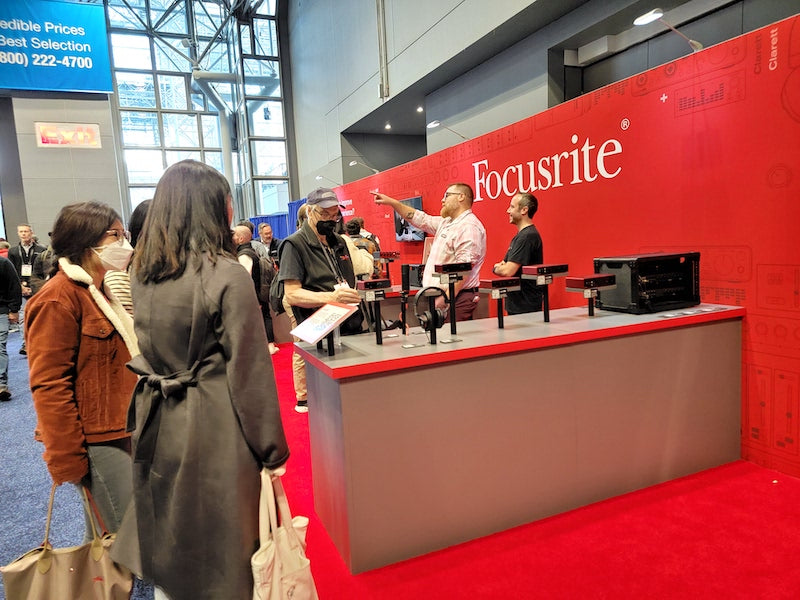
  • New DAW interfaces for mobile recording rigs from Avid, Focusrite, and others were introduced. These products constantly raised the bar and improved upon the specs to levels only dreamed about a mere few years ago.
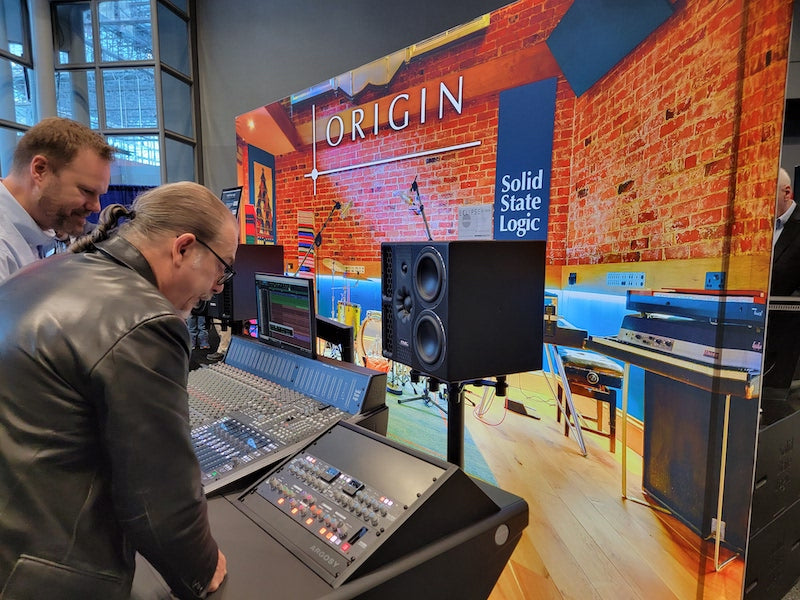
 

The Solid State Logic booth featuring the new ORIGIN 16-channel mixing console.

The Solid State Logic booth featuring the new ORIGIN 16-channel mixing console.


Ocean Way Audio, makers of highly-regarded loudspeakers for both professional and high-end consumer audio use.
Ocean Way Audio, makers of highly-regarded loudspeakers for both professional and high-end consumer audio use.


Focusrite offered new audio recording interfaces at AES 2022.

Focusrite offered new audio recording interfaces at AES 2022.


AES has a long and impressive history, and Day Two featured a special tribute to the late Al Schmitt (see my review of his book, The Magic Behind the Music, in Issue 160), whose contributions to recorded music are rivaled by only a handful of other legendary producers and engineers. The high-echelon producer and engineer club is relatively small, and the established professionals on the roster of those who give AES presentations usually includes those whose contributions date back to the 1970s or before, and often are from the same pool of ex-Record Plant or Hit Factory-trained experts.

For AES Fall 2022, two well-known producer/engineers made their keynote speech debuts: Susan Rogers and Jack Antonoff. They also delivered presentations for Mix With the Masters, which is one of the most popular events at AES.

Susan Rogers

Susan Rogers’ impressive credentials include a PhD in psychoacoustics from McGill University and a music production professorship at Berklee School of Music. Her discography credits include recordings by David Byrne, Barenaked Ladies, Robben Ford, Sheena Easton, Public Image Ltd., Tevin Campbell, Tricky, Toad the Wet Sprocket and others. However, her reputation was unquestionably built upon her iconic albums with Prince during his biggest hit making period, which includes: Sign O’ the Times, Around the World in a Day, Parade, Crystal Ball, and, of course, Purple Rain.
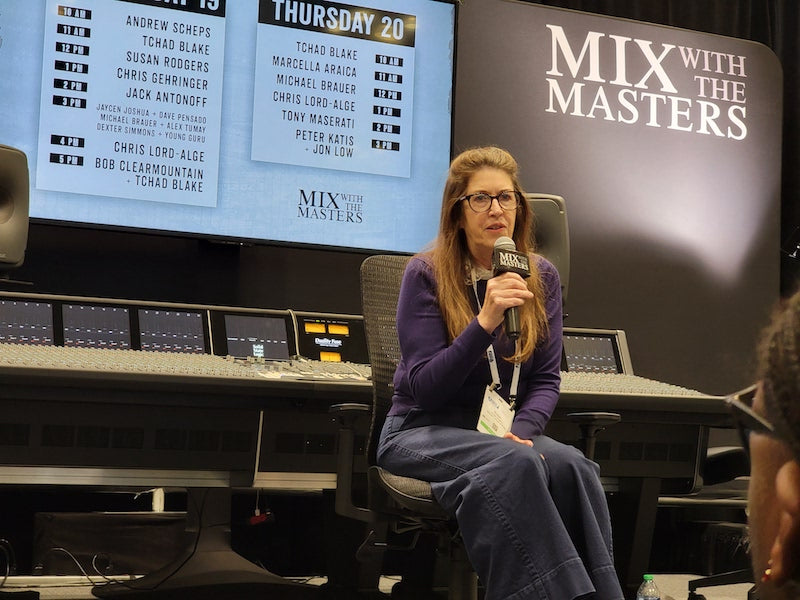
 

Susan Rogers.

Susan Rogers.


A former student of the well-known psychologist-author Daniel Levitin, Susan Rogers’ frame of reference and philosophy about her production and engineering work is informed by a combination of academic neurological studies, detailed scholarly analysis, and a wide range of music listening. Her presentation talks were especially fascinating when she deftly broke down her music mixing procedures and explanations for each step of the process.

She spoke about how sound is a special form of touch, and that sound is the fastest sensation that the human brain processes and is felt before it is intellectually processed. The hemispheric specialization in the brain that guides creative decision making in mixing music is comparable to how the brain also processes theater and painting.

“Hooks” and “Treats”

When explaining what makes a mix grasp a listener’s attention, Rogers broke down the components of what musical “hooks” or “treats,” as she referred to them, are, with most common aspects first:

Rhythm and Groove, which are the most universal music elements among all cultures;

Melody: as a form of musical communication, emotion should be communicated via melody – regardless of a lyric’s language, and also as a standalone central element.

Bass: Rogers holds that bass is the most important musical instrument, since it ties rhythm to melody via harmony and counterpoint. (Prince was one of the exceptions to this principle, as two of his biggest hits, “When Doves Cry” and “Kiss” have no bass on them.)

Lyrics: Rogers spoke of the historically universal regard for poetry and storytelling that is common in all cultures. She also noted that the writer Joseph Campbell was and still is a strong influence on lyricists via his examples of myth, legend, and universal truth.

Sound Design and Timbre: citing her psychoacoustic studies, Rogers explained how sound is a special form of touch.  As noted, sound is the fastest of the five senses that processes in the brain, and it is felt before it is intellectually processed.


Focus on the Strongest Elements

Once she has identified which of the above “treats” should be highlighted in a mix, Rogers selects the primary elements that should be the “lead actors” in the spotlight. While the majority of the time this will be the lead vocal, there are always exceptions. For example, with Robben Ford, the lead actor is his guitar. With Bob Dylan, it is his lyrics, more than his singing voice.

Rogers then uses the following steps to build her mixes:

  1. She starts listening first in mono to discern all of the spectral elements and levels to make her choices for mixing. She will often do a parametric EQ boost of 125 Hz for male vocals and 250 Hz for female vocals, being careful not to spotlight any weaknesses.
  2. She will then do preliminary equalization and panning. In her studies, Rogers has found that hard left and right panning determines a song’s level of emotion, versus its primary focus.
  3. For depth, acoustical physics has shown that what we initially hear in the real world is a delay before reverb, So for positioning elements in the mix, Rogers first works with short (10ms), then medium and long delays before ever adding reverb. This method develops the mix’s depth of field.

One trick that Rogers said she developed during her work with Prince was to send the synthesizer outputs to a stereo reverb unit and just mix the “wet” (effected) returns to create a sonic backdrop. She used the analogy of depth of field and positioning in film and photography to affect the listener ‘s experience.

  1. Rogers then adds the reverb last. Real-world reverb is in the 30 to 80 millisecond “pre-delay” range (any longer-duration sounds will be perceived as a delay), so she is meticulous about adding pre-delay unless there is an artificial effect intended.

Rogers also offered the following tips regarding signal processing and EQ:

Regarding compressors vs limiters (both are dynamic range processors; a compressor reduces the volume of loud signals while a limiter puts a ceiling on the highest-possible levels): limiters are more useful with experienced performers. They will know how to modify their playing and singing dynamics so there is less need for compression. Prince, in particular, was a master of mic dynamics in his singing. Additionally, the better the player, the less compression is needed. However, compression can be a boon in saving a mix when the track has sloppy players that need to sound tighter.

Rogers prefers to emphasize the chest frequencies for singers and cut some highs when EQing vocals, for intelligibility and separation from guitars, which can get more of their highs boosted for greater emotional energy.

Susan Rogers gave a live example of her procedures by doing a blind, first-time listening analysis of stems (groups of audio tracks in a multitrack recording) from a band called Midnight Cigarettes.

She methodically explained how she identified each of her aforementioned points and proceeded to demonstrate the ways to assemble a mix, offering these additional tips:

On the subject of lining up the timing of performances in a track: In her experience, it is easier for the listener to follow the melody when the harmonies are a few milliseconds behind. Lining up sound files exactly on the beat, which is often done in digital audio workstations on a visual grid in the quest for “perfect” productions, actually makes things sound less musical and more computerized.

Susan Rogers’ presentation was chock full of useful information for producers, engineers and musicians, and it was fascinating to learn how she logically explained what is often regarded heard as “intuition” and “uncategorizable genius” from an artist.

Jack Antonoff

Jack Antonoff has few rivals as a force in contemporary pop music,. His work with Taylor Swift, Lana Del Rey, The 1975, Lorde, Fun, Florence + the Machine and St. Vincent has garnered him a massive fan base, not to mention seven Grammy awards. Possibly the youngest-ever AES keynote speaker, Antonoff also conducted a Q&A at a Mix With the Masters session. He displayed an impressive knowledge and appreciation for music and audio production techniques that were well-established before he was even born (in 1984). He singled out engineer Michael Brauer, who mixed one of Antonoff’s earliest records, as someone whose work he greatly admired and sought to emulate.

Antonoff’s sensibilities echo those of many veteran producers, and he said it all became crystallized for him while working with Diana Ross. She came to the studio with her grandchildren in tow, and in spite of the distractions of having family around her, delivered a superb performance that could not have been matched in a more sterile recording booth environment. His conclusion: the performance is ultimately more important than the sound.
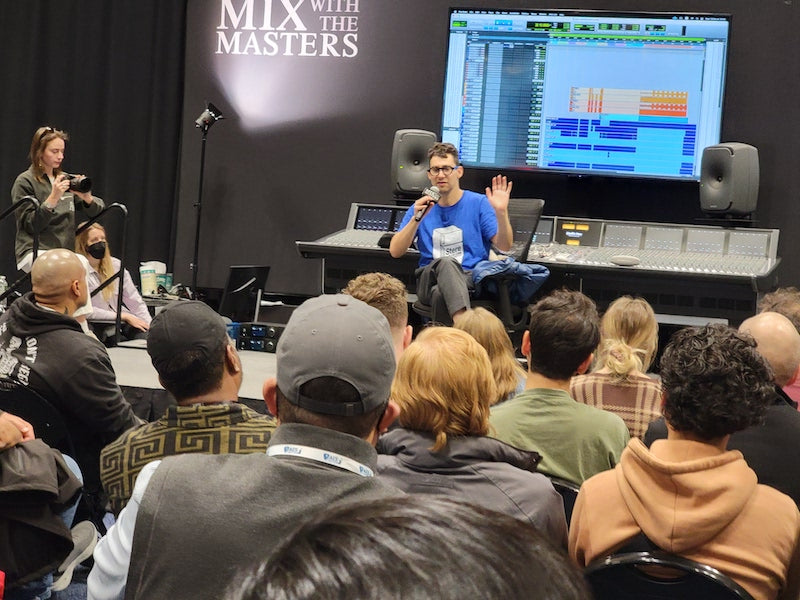
 

Jack Antonoff.

Jack Antonoff.


Another caution that he has found to be a plague for many producers, especially those who are DIYers:  Avoid “demo-itis.” Antonoff related the inordinate amount of time taken on Lana Del Rey’s Norman F*cking Rockwell, where repeatedly obsessing over lyrics and other details in demos created stagnation and indecision, obstacles to a completed record.

In this age of producers and musicians often recording their parts remotely on laptops, it was refreshing to learn that Antonoff prefers collaborating in the same room, rather than asynchronously. However, he was quick to point out that he is not into working crazy hours, unlike some legendary drug-fueled marathon recording sessions of the past. Antonoff indicated it was his preference to finish no later than 6 or 7 p.m. in order to get enough sleep and have fresh ears for the next session.

Being Funny in a Foreign Language, by The 1975, was produced by Antonoff and released earlier this year. The 1975’s vocalist/guitarist Matty Healy has been effusive in his praise for Antonoff in a number of interviews, citing that Antonoff is a “culture vulture…full of references.” That encyclopedic frame of reference is likely what led to Antonoff and The 1975 deciding to produce the album in a very old school way, using Lou Reed’s Street Hassle as a sonic and artistic influence. In particular, Antonoff cited the use of non-professional string players to create the imperfect effect that he was seeking, to add the right degree of dissonance and emphasize certain emotional moments in the music.


In order to trigger creative ideas when producing David Bowie and others, Brian Eno introduced his “Oblique Strategies” concept of choosing random cards from a deck that had assorted concepts and ideas written on them, which would be applied to songwriting and production. Jack Antonoff shared a few of his own creative resources, such as:

  • He will put effects on a master recording just for inspiration. Even changing a snare drum sound can spark a new approach to a song.
  • He is open to “creative shorthand” ideas from anyone in the room.
  • Brushes on a snare drum can sound bigger than using drumsticks, depending on the mics and reverb used.
  • Go for using limiting and heavy compression, like what was used on records by the Plastic Ono Band or the Cure to make something stand out.
  • Using similar studio tools for different songs and instruments can create a sonic signature for an album (but he cautioned the audience not to throw in the kitchen sink!)
  • He likes combining expensive and cheap gear for new sounds. For example, he cited using a Valhalla DSP reverb (expensive) combined with cheap plugin reverbs, as used on Dance Fever by Florence + the Machine).

On the subject of analog vs. digital, Antonoff, who grew up in the digital audio era, confessed that while he loved the sound of analog tape, he will use tape for certain effects and then manipulate the recording in Pro Tools, since he finds recording on tape too intimidating (physical tape splicing can be difficult and tedious).

As a die-hard Pro Tools DAW user, he also admitted to constantly bouncing (combining) tracks in Pro Tools to cut down the total track count. Keeping a theoretically unlimited number of tracks and alternate takes makes it harder to arrive at decisions and opens the door to the confusion of identifying the right tracks to use.

Finally, on the topic of immersive mixes and the growing popularity of Dolby Atmos surround sound, Antonoff felt that a hardware-compatibility nightmare was being created by streaming services pushing Atmos. Since Atmos is not compatible with headphones, he felt that mono and stereo will always exist. Additionally, in his opinion the artist community is not pushing Dolby Atmos nearly as much as the music labels, streaming outlets and equipment industry.

Jack Antonoff’s presentation brought a fresh perspective to AES and showed that a lot of the tried and true old-dog tricks can sit comfortably next to the latest whiz-bang techniques.

(Parts Two and Three will feature coverage of a number of AES educational workshops, an interview with mobile recording pioneer David W. Hewitt by record producer Warren Huart, and a conversation and Q&A between noted producer/engineers Tchad Blake and Bob Clearmountain.)


All photos courtesy of John Seetoo.

More from Issue 176

View All Articles in Issue 176

Search Copper Magazine

#234 A Life in High-End Audio: The Roy Hall Interview, Part One by Frank Doris Sep 07, 2026 #234 Jason Greenlaw Offers His Personal Perspective on Jazz Guitar in Vantage Point by Frank Doris Sep 07, 2026 #234 Transcendent Phoenix: Lucina Yue Brings the Ancient Konghou Into Modern Times by Frank Doris Sep 07, 2026 #234 We Must All Follow Our Bliss by B. Jan Montana Sep 07, 2026 #234 How to Play in a Rock Band, 27: Leveling Up by Frank Doris Sep 07, 2026 #234 Ross Valory: Traveling Into New Musical Territory With All of the Above by Ray Chelstowski Sep 07, 2026 #234 Singer/Songwriter John David Schrader: On the Need to Create by Joe Caplan Sep 07, 2026 #234 The People Who Make Audio Happen: More From T.H.E. Show SoCal 2026 by Harris Fogel Sep 07, 2026 #234 The Vinyl Beat Digs Into the Gadget Box by Rudy Radelic Sep 07, 2026 #234 The Rolling Stones: Foreign Tongues Spoken Loud by Wayne Robins Sep 07, 2026 #234 Musical Moments by Rich Isaacs Sep 07, 2026 #234 Rags for Solo Piano and a Dog: David Chesky's Ragtime Music for the Modern Age by Frankly Speaking Sep 07, 2026 #234 HIGH END 2026, Vienna: Here to Stay by Carsten Barnbeck Sep 07, 2026 #234 From The Audiophile’s Guide: The Two Main Types of Loudpeakers – Box and Panel by Paul McGowan Sep 07, 2026 #234 Letting it Slide by Frank Doris Sep 07, 2026 #234 PS Audio in the News by PS Audio Staff Sep 07, 2026 #234 Long Playing by Peter Xeni Sep 07, 2026 #234 La Mer by B. Jan Montana Sep 07, 2026 #233 A Report From The Total Hi-Fi Experience Show SoCal 2026 by B. Jan Montana Aug 03, 2026 #233 Bluegrass Meets Country, Folk, Jazz and More in All That We Carried by The Squid City Slingers by Frank Doris Aug 03, 2026 #233 Corey Glover and One Tribe Nation: A Variegated Musical Collective by Ray Chelstowski Aug 03, 2026 #233 Excursions with Clive: The Late Clive Davis, A Personal History by Wayne Robins Aug 03, 2026 #233 AI, Art, and Music: A Conversation With Synthography Art by Joe Caplan Aug 03, 2026 #233 New American Symphonies: A Rediscovered Gem and a Vital Contemporary Work by Frank Doris Aug 03, 2026 #233 The Vinyl Beat: Genesis, the Dave Clark Five, Antonio Carlos Jobim and More by Rudy Radelic Aug 03, 2026 #233 How to Play in a Rock Band, 26: When It's Time to Record Your Music by Frank Doris Aug 03, 2026 #233 More From T.H.E. Show 2026, and the People Who Made it Happen by Harris Fogel Aug 03, 2026 #233 Underappreciated Artists, Part Three: Icehouse by Rich Isaacs Aug 03, 2026 #233 The Surprisingly Rich and Varied Music of Somalia by Steve Kindig Aug 03, 2026 #233 A Remarkable Discographic Legacy: The LP Recordings of the Basel Symphony Orchestra by Stephan Haberthür Aug 03, 2026 #233 From The Audiophile’s Guide: The Importance of Loudspeakers by Paul McGowan Aug 03, 2026 #233 From Swimming Pool to New Listening Room: A Conversation with Norman Varney of AV RoomService by Gilles Laferrière Aug 03, 2026 #233 PS Audio in the News by PS Audio Staff Aug 03, 2026 #233 Audio Jewelry by Peter Xeni Aug 03, 2026 #233 Enrich Your Life by Frank Doris Aug 03, 2026 #233 The Searcher by James Schrimpf Aug 03, 2026 #232 What came first: Art or Music? A Conversation With Artist Jose Acosta by Joe Caplan Jul 06, 2026 #232 Blow By Blow: The Jeff Beck Story: An Insightful Book About a Guitar Icon by Ray Chelstowski Jul 06, 2026 #232 Creed Over Camaraderie? by B. Jan Montana Jul 06, 2026 #232 Chronicles of a Sound Pilgrim at the 2026 Montreal Audiofest by Hugues Morin Jul 06, 2026 #232 The Vinyl Beat: Summer Grooves by Rudy Radelic Jul 06, 2026 #232 Hibbing Hillbilly Dylan's Acoustic Rock by Wayne Robins Jul 06, 2026 #232 Quad Quads and Plasmatronics Tweeters: An Extraordinary System Comes to Life by Frank Doris Jul 06, 2026 #232 In Praise of Live Music, Once Again by Ted Shafran Jul 06, 2026 #232 Allnic Audio’s L-9000 Preamplifier: Design and Engineering Innovation by Howard Kneller Jul 06, 2026 #232 “Best Of” Lists and Rage Bait: Enough Already by Frank Doris Jul 06, 2026 #232 Quick Takes: Bud Shank, Paulo Almeida, Jakob Dreyer, Tim Eriksen and Peter Irvine by Frank Doris Jul 06, 2026

AES Fall 2022 New York – The Live Event Returns, Part One

AES Fall 2022 New York – The Live Event Returns, Part One

Since the pandemic erupted, many live trade shows and expos had their events suspended, or were forced to create a live streaming alternative. The Audio Engineering Society (AES) was no exception, so its popular New York City shows for 2020 and 2021 were available only as live streams and video on demand. AES did an exceptional job on these video events, which have been covered in past issues of Copper.

The excited anticipation in New York’s humongous Javits Center was palpable. As the first live, in-person AES Show in NYC since 2019, the initial idea was apparently to start slowly with only about 100 exhibitors, far fewer than normal, due to lingering fears over COVID-19. Also, presciently acknowledging how closely digital audio and video have now become intertwined, AES made arrangements to hold its Fall 2022 show concurrently and adjacent to The NAB (National Association of Broadcasters) show on the same floor with only a single, venue-long aisle separating the two, making reciprocal access for interested attendees a breeze.

As a result, both AES and NAB grossly underestimated the turnout level, creating a queue which covered more than the entire interior perimeter of the lobby, ticketing and vending areas, with wait times just for badge pick up exceeding 90 minutes. Thankfully, quick-thinking administrators went into the lines to check for pre-registration QR codes, and offered exhibit entry bracelets that let those waiting on line enter the main show floor area, while badges would still be required for the workshops and specialized private-room presentation events.

The large exhibitors at AES Fall 2022 wisely showcased their latest equipment. Among the noteworthy ones:

  • Solid State Logic debuted its 16-channel ORIGIN console, a scaled-down version of its popular 32-channel model, which combines the tactile feel, sound, and response of the company’s legendary analog SSL consoles with the digital configuration flexibility and workflow ease to interface with any modern DAW (digital audio workstation) software.
  • Universal Audio’s collaboration with mic designer David Bock showcased modernized twists on the popular Neumann U87, U67 and Telefunken ELA M251 microphones that offered improved features and specs over the originals.
  • New DAW interfaces for mobile recording rigs from Avid, Focusrite, and others were introduced. These products constantly raised the bar and improved upon the specs to levels only dreamed about a mere few years ago.


The Solid State Logic booth featuring the new ORIGIN 16-channel mixing console.

The Solid State Logic booth featuring the new ORIGIN 16-channel mixing console.


Ocean Way Audio, makers of highly-regarded loudspeakers for both professional and high-end consumer audio use.

Ocean Way Audio, makers of highly-regarded loudspeakers for both professional and high-end consumer audio use.


Focusrite offered new audio recording interfaces at AES 2022.

Focusrite offered new audio recording interfaces at AES 2022.


AES has a long and impressive history, and Day Two featured a special tribute to the late Al Schmitt (see my review of his book, The Magic Behind the Music, in Issue 160), whose contributions to recorded music are rivaled by only a handful of other legendary producers and engineers. The high-echelon producer and engineer club is relatively small, and the established professionals on the roster of those who give AES presentations usually includes those whose contributions date back to the 1970s or before, and often are from the same pool of ex-Record Plant or Hit Factory-trained experts.

For AES Fall 2022, two well-known producer/engineers made their keynote speech debuts: Susan Rogers and Jack Antonoff. They also delivered presentations for Mix With the Masters, which is one of the most popular events at AES.

Susan Rogers

Susan Rogers’ impressive credentials include a PhD in psychoacoustics from McGill University and a music production professorship at Berklee School of Music. Her discography credits include recordings by David Byrne, Barenaked Ladies, Robben Ford, Sheena Easton, Public Image Ltd., Tevin Campbell, Tricky, Toad the Wet Sprocket and others. However, her reputation was unquestionably built upon her iconic albums with Prince during his biggest hit making period, which includes: Sign O’ the Times, Around the World in a Day, Parade, Crystal Ball, and, of course, Purple Rain.


Susan Rogers.

Susan Rogers.


A former student of the well-known psychologist-author Daniel Levitin, Susan Rogers’ frame of reference and philosophy about her production and engineering work is informed by a combination of academic neurological studies, detailed scholarly analysis, and a wide range of music listening. Her presentation talks were especially fascinating when she deftly broke down her music mixing procedures and explanations for each step of the process.

She spoke about how sound is a special form of touch, and that sound is the fastest sensation that the human brain processes and is felt before it is intellectually processed. The hemispheric specialization in the brain that guides creative decision making in mixing music is comparable to how the brain also processes theater and painting.

“Hooks” and “Treats”

When explaining what makes a mix grasp a listener’s attention, Rogers broke down the components of what musical “hooks” or “treats,” as she referred to them, are, with most common aspects first:

Rhythm and Groove, which are the most universal music elements among all cultures;

Melody: as a form of musical communication, emotion should be communicated via melody – regardless of a lyric’s language, and also as a standalone central element.

Bass: Rogers holds that bass is the most important musical instrument, since it ties rhythm to melody via harmony and counterpoint. (Prince was one of the exceptions to this principle, as two of his biggest hits, “When Doves Cry” and “Kiss” have no bass on them.)

Lyrics: Rogers spoke of the historically universal regard for poetry and storytelling that is common in all cultures. She also noted that the writer Joseph Campbell was and still is a strong influence on lyricists via his examples of myth, legend, and universal truth.

Sound Design and Timbre: citing her psychoacoustic studies, Rogers explained how sound is a special form of touch.  As noted, sound is the fastest of the five senses that processes in the brain, and it is felt before it is intellectually processed.


Focus on the Strongest Elements

Once she has identified which of the above “treats” should be highlighted in a mix, Rogers selects the primary elements that should be the “lead actors” in the spotlight. While the majority of the time this will be the lead vocal, there are always exceptions. For example, with Robben Ford, the lead actor is his guitar. With Bob Dylan, it is his lyrics, more than his singing voice.

Rogers then uses the following steps to build her mixes:

  1. She starts listening first in mono to discern all of the spectral elements and levels to make her choices for mixing. She will often do a parametric EQ boost of 125 Hz for male vocals and 250 Hz for female vocals, being careful not to spotlight any weaknesses.
  2. She will then do preliminary equalization and panning. In her studies, Rogers has found that hard left and right panning determines a song’s level of emotion, versus its primary focus.
  3. For depth, acoustical physics has shown that what we initially hear in the real world is a delay before reverb, So for positioning elements in the mix, Rogers first works with short (10ms), then medium and long delays before ever adding reverb. This method develops the mix’s depth of field.

One trick that Rogers said she developed during her work with Prince was to send the synthesizer outputs to a stereo reverb unit and just mix the “wet” (effected) returns to create a sonic backdrop. She used the analogy of depth of field and positioning in film and photography to affect the listener ‘s experience.

  1. Rogers then adds the reverb last. Real-world reverb is in the 30 to 80 millisecond “pre-delay” range (any longer-duration sounds will be perceived as a delay), so she is meticulous about adding pre-delay unless there is an artificial effect intended.

Rogers also offered the following tips regarding signal processing and EQ:

Regarding compressors vs limiters (both are dynamic range processors; a compressor reduces the volume of loud signals while a limiter puts a ceiling on the highest-possible levels): limiters are more useful with experienced performers. They will know how to modify their playing and singing dynamics so there is less need for compression. Prince, in particular, was a master of mic dynamics in his singing. Additionally, the better the player, the less compression is needed. However, compression can be a boon in saving a mix when the track has sloppy players that need to sound tighter.

Rogers prefers to emphasize the chest frequencies for singers and cut some highs when EQing vocals, for intelligibility and separation from guitars, which can get more of their highs boosted for greater emotional energy.

Susan Rogers gave a live example of her procedures by doing a blind, first-time listening analysis of stems (groups of audio tracks in a multitrack recording) from a band called Midnight Cigarettes.

She methodically explained how she identified each of her aforementioned points and proceeded to demonstrate the ways to assemble a mix, offering these additional tips:

On the subject of lining up the timing of performances in a track: In her experience, it is easier for the listener to follow the melody when the harmonies are a few milliseconds behind. Lining up sound files exactly on the beat, which is often done in digital audio workstations on a visual grid in the quest for “perfect” productions, actually makes things sound less musical and more computerized.

Susan Rogers’ presentation was chock full of useful information for producers, engineers and musicians, and it was fascinating to learn how she logically explained what is often regarded heard as “intuition” and “uncategorizable genius” from an artist.

Jack Antonoff

Jack Antonoff has few rivals as a force in contemporary pop music,. His work with Taylor Swift, Lana Del Rey, The 1975, Lorde, Fun, Florence + the Machine and St. Vincent has garnered him a massive fan base, not to mention seven Grammy awards. Possibly the youngest-ever AES keynote speaker, Antonoff also conducted a Q&A at a Mix With the Masters session. He displayed an impressive knowledge and appreciation for music and audio production techniques that were well-established before he was even born (in 1984). He singled out engineer Michael Brauer, who mixed one of Antonoff’s earliest records, as someone whose work he greatly admired and sought to emulate.

Antonoff’s sensibilities echo those of many veteran producers, and he said it all became crystallized for him while working with Diana Ross. She came to the studio with her grandchildren in tow, and in spite of the distractions of having family around her, delivered a superb performance that could not have been matched in a more sterile recording booth environment. His conclusion: the performance is ultimately more important than the sound.


Jack Antonoff.

Jack Antonoff.


Another caution that he has found to be a plague for many producers, especially those who are DIYers:  Avoid “demo-itis.” Antonoff related the inordinate amount of time taken on Lana Del Rey’s Norman F*cking Rockwell, where repeatedly obsessing over lyrics and other details in demos created stagnation and indecision, obstacles to a completed record.

In this age of producers and musicians often recording their parts remotely on laptops, it was refreshing to learn that Antonoff prefers collaborating in the same room, rather than asynchronously. However, he was quick to point out that he is not into working crazy hours, unlike some legendary drug-fueled marathon recording sessions of the past. Antonoff indicated it was his preference to finish no later than 6 or 7 p.m. in order to get enough sleep and have fresh ears for the next session.

Being Funny in a Foreign Language, by The 1975, was produced by Antonoff and released earlier this year. The 1975’s vocalist/guitarist Matty Healy has been effusive in his praise for Antonoff in a number of interviews, citing that Antonoff is a “culture vulture…full of references.” That encyclopedic frame of reference is likely what led to Antonoff and The 1975 deciding to produce the album in a very old school way, using Lou Reed’s Street Hassle as a sonic and artistic influence. In particular, Antonoff cited the use of non-professional string players to create the imperfect effect that he was seeking, to add the right degree of dissonance and emphasize certain emotional moments in the music.


In order to trigger creative ideas when producing David Bowie and others, Brian Eno introduced his “Oblique Strategies” concept of choosing random cards from a deck that had assorted concepts and ideas written on them, which would be applied to songwriting and production. Jack Antonoff shared a few of his own creative resources, such as:

  • He will put effects on a master recording just for inspiration. Even changing a snare drum sound can spark a new approach to a song.
  • He is open to “creative shorthand” ideas from anyone in the room.
  • Brushes on a snare drum can sound bigger than using drumsticks, depending on the mics and reverb used.
  • Go for using limiting and heavy compression, like what was used on records by the Plastic Ono Band or the Cure to make something stand out.
  • Using similar studio tools for different songs and instruments can create a sonic signature for an album (but he cautioned the audience not to throw in the kitchen sink!)
  • He likes combining expensive and cheap gear for new sounds. For example, he cited using a Valhalla DSP reverb (expensive) combined with cheap plugin reverbs, as used on Dance Fever by Florence + the Machine).

On the subject of analog vs. digital, Antonoff, who grew up in the digital audio era, confessed that while he loved the sound of analog tape, he will use tape for certain effects and then manipulate the recording in Pro Tools, since he finds recording on tape too intimidating (physical tape splicing can be difficult and tedious).

As a die-hard Pro Tools DAW user, he also admitted to constantly bouncing (combining) tracks in Pro Tools to cut down the total track count. Keeping a theoretically unlimited number of tracks and alternate takes makes it harder to arrive at decisions and opens the door to the confusion of identifying the right tracks to use.

Finally, on the topic of immersive mixes and the growing popularity of Dolby Atmos surround sound, Antonoff felt that a hardware-compatibility nightmare was being created by streaming services pushing Atmos. Since Atmos is not compatible with headphones, he felt that mono and stereo will always exist. Additionally, in his opinion the artist community is not pushing Dolby Atmos nearly as much as the music labels, streaming outlets and equipment industry.

Jack Antonoff’s presentation brought a fresh perspective to AES and showed that a lot of the tried and true old-dog tricks can sit comfortably next to the latest whiz-bang techniques.

(Parts Two and Three will feature coverage of a number of AES educational workshops, an interview with mobile recording pioneer David W. Hewitt by record producer Warren Huart, and a conversation and Q&A between noted producer/engineers Tchad Blake and Bob Clearmountain.)


All photos courtesy of John Seetoo.

0 comments

Leave a comment

0 Comments

Your avatar

Loading comments...

🗑️ Delete Comment

Enter moderator password to delete this comment:

✏️ Edit Comment

Enter your email to verify ownership: