


 The Lachrimae are usually played by an ensemble of viols of different sizes (bowed instruments similar to violin/viola/cello, but with frets across the fingerboards). In the new recording by the Opera Prima Consort (Brilliant Classics), led by Cristiano Contadin, the viols are joined by baroque violin (Fiorenza de Donatis and Andrea Rognoni), lute (Miguel Rincon), and recorder (Giulia Genini).
The result is a layered and impassioned sound – ideal for this repertoire exploring sadness. The “Lacrimae antiquae” (Ancient Tears) movement is a rich tapestry of desolation, with the Contandin’s ensemble phrasing in great, sighing breaths. The added textures of the non-viol instruments bring a new rugged dimension to the music.
httpv://www.youtube.com/watch?v=jHALTuaZndU&list=OLAK5uy_mzBuZ_IMG3mDwcQSGjB8lE2-R30z1UMdQ
For those who want to understand Dowland in the context of other composers for viol, Brilliant Classics also offers this Lacrimae as the first disc in a collection called Viola da Gamba Edition, which features a historical range of composers reaching all the way to J.S. Bach in the 18th century.
Another segment of Dowland’s instrumental-only output are his pieces for solo lute. That repertoire is represented on Dowland: Works for Lute (Performed on Guitar), played by English guitarist Michael Butten and released by First Hand Records.
Butten is a winner of the Julian Bream Prize, which the groundbreaking guitarist/lutenist (now 77), first-generation early-music advocate, founded and still judges himself. I can’t think of a more promising recommendation for a recording of Dowland transcriptions.
My anticipation was indeed rewarded. Butten’s playing is as accurate as it is sensitive, communicating a complete idea with each sentence and phrase. He keeps the contrapuntal voices separate and clear while shaping them into an intentional whole. Here’s the stately “Frog Galliard”:
httpv://www.youtube.com/watch?v=P22WSzdGLt8&list=OLAK5uy_lEPQ36OG841VmY7gBRBIH-2BeHkU-VqoY&index=5
Parting caveat for those seeking further Dowland to stream: Beware a new two-volume set, The John Dowland Arrangements, by an entity called Nova Sonora Music. That’s not an early-music ensemble; turns out it’s a computer program. So, if you don’t like your Dowland played “in the robotic style,” you should steer well clear of this soulless digital travesty and spend your money on the work of musicians trained in early music who play physical, acoustic instruments!
The Lachrimae are usually played by an ensemble of viols of different sizes (bowed instruments similar to violin/viola/cello, but with frets across the fingerboards). In the new recording by the Opera Prima Consort (Brilliant Classics), led by Cristiano Contadin, the viols are joined by baroque violin (Fiorenza de Donatis and Andrea Rognoni), lute (Miguel Rincon), and recorder (Giulia Genini).
The result is a layered and impassioned sound – ideal for this repertoire exploring sadness. The “Lacrimae antiquae” (Ancient Tears) movement is a rich tapestry of desolation, with the Contandin’s ensemble phrasing in great, sighing breaths. The added textures of the non-viol instruments bring a new rugged dimension to the music.
httpv://www.youtube.com/watch?v=jHALTuaZndU&list=OLAK5uy_mzBuZ_IMG3mDwcQSGjB8lE2-R30z1UMdQ
For those who want to understand Dowland in the context of other composers for viol, Brilliant Classics also offers this Lacrimae as the first disc in a collection called Viola da Gamba Edition, which features a historical range of composers reaching all the way to J.S. Bach in the 18th century.
Another segment of Dowland’s instrumental-only output are his pieces for solo lute. That repertoire is represented on Dowland: Works for Lute (Performed on Guitar), played by English guitarist Michael Butten and released by First Hand Records.
Butten is a winner of the Julian Bream Prize, which the groundbreaking guitarist/lutenist (now 77), first-generation early-music advocate, founded and still judges himself. I can’t think of a more promising recommendation for a recording of Dowland transcriptions.
My anticipation was indeed rewarded. Butten’s playing is as accurate as it is sensitive, communicating a complete idea with each sentence and phrase. He keeps the contrapuntal voices separate and clear while shaping them into an intentional whole. Here’s the stately “Frog Galliard”:
httpv://www.youtube.com/watch?v=P22WSzdGLt8&list=OLAK5uy_lEPQ36OG841VmY7gBRBIH-2BeHkU-VqoY&index=5
Parting caveat for those seeking further Dowland to stream: Beware a new two-volume set, The John Dowland Arrangements, by an entity called Nova Sonora Music. That’s not an early-music ensemble; turns out it’s a computer program. So, if you don’t like your Dowland played “in the robotic style,” you should steer well clear of this soulless digital travesty and spend your money on the work of musicians trained in early music who play physical, acoustic instruments!
John Dowland: Renaissance Composer, Lutenist and Singer

If you’ve ever strummed a guitar while singing, you can thank English composer John Dowland (1563-1626) for helping to popularize the accompaniment of voice with a fretted string instrument. His preference was the lute, but it served the same purpose.
Many people are only familiar with this Renaissance composer because of Sting’s very nice album of Dowland pieces, Songs from the Labyrinth (2006). But from its inception in the 1960s, the classical early-music scene has loved Dowland and strived to capture his particular brand of melancholy in the studio (search for Julian Bream on your favorite streaming platform if you’re curious). That tradition continues, with several new recordings out in the past 12 months.
If he’s known at all, it’s for his vocal music, so let’s start there. Between 1597 and 1603 Dowland published three books of songs and airs (or Bookes of Songes and Ayres, as it was spelled at the time), each containing over 20 works for solo voice with lute accompaniment, a genre commonly known as “lute song.”
The concept seems simple enough, but sometimes when musical lines are more exposed, it’s easier to see their flaws. Case in point: Argentinian soprano Mariana Flores recently made a recording with lutenist Hopkinson Smith on Naïve Music, called Dowland: Whose Heavenly Touch. The lute part fares better than the vocal part in this case.
Here’s the buoyant “Come Again.” Flores and Smith manage dancelike ensemble motion that’s belies Dowland’s reputation for being dour. But the delightful energy is marred by Flores’ diction. While I fully understand that English is not her native tongue, the science of diction pedagogy using the International Phonetic Alphabet is now commonplace for voice students in music schools, so there’s no excuse for any language to be so mishandled by a professional singer.
httpv://www.youtube.com/watch?v=m0m52NSKzao
While the lithe melody of “Come Again” is a pleasure no matter how you sing it, the delivery of the more heart-wrenching stuff provides the real Dowland test. Unfortunately, Flores’ singing of the emotionally and harmonically complex “I Saw My Lady Weep” demonstrates her lack of a profound understanding of either aspect. I hear no evidence that she understands the meaning of the poem, nor does she take advantage of the juicy dissonances that Dowland provides to deepen the song’s sorrow. Smith provides a clean and well thought out accompaniment even if his partner doesn’t meet him halfway.
httpv://www.youtube.com/watch?v=ehG7qUswy_8
Simply titled Dowland, the new recording by Israeli countertenor Doron Schleifer, accompanied by lutenist Orí Harmelin, was self-published by the artists. Gone are the days when “self-published” automatically meant “low-quality.” Schleifer surely has his reasons to eschew the studio establishment, and he has put together an admirable collection of tracks.
“A Shepherd in a Shade” flows with charming rubato despite too-frequent slides into notes. That alone might be enough for more conservative labels to pass on signing Schleifer – the style is unashamedly theatrical and not obsessed with “authentic” early-music vocal technique. On the other hand, we’re living in a world where Sting had a best-selling Dowland album (well deserved!), so all approaches should be welcome for consideration. I think this works pretty well.
httpv://www.youtube.com/watch?v=4GXVIQAcKK8&list=OLAK5uy_kFfCUGk7YSDiyZDHGQIBwZOXD-f1dlPWw&index=5
Schleifer’s approach also works in the melancholic sphere when he sings “Flow My Teares” with intelligent phrasing, relying less on the swoops he used in the cheerier number. His clear voice is supported by Harmelin’s expressive playing.
httpv://www.youtube.com/watch?v=FdA__aS-AU0&list=OLAK5uy_kFfCUGk7YSDiyZDHGQIBwZOXD-f1dlPWw&index=16
Despite its title, the album also includes some non-Dowland material from the late 16th-century, such as Giulio Caccini’s “Amarilli mia bella” and a particularly fleet but fluid version of Pierre Guédron’s “Si le parler et le silence.”
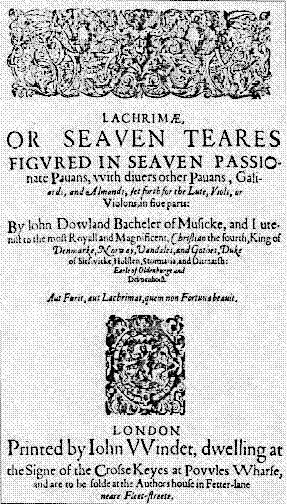
Dowland, who made his living by writing both for private patrons (the king of Denmark in particular) and for his publisher in London, found it lucrative to produce both vocal music and pieces just for instruments. The best known in that latter category are his Lachrimae (“Tears”), from 1604. This is a set of seven variations on a mournful melody called a pavan (classical music fans might recognize the more common French spelling, pavane).
The Lachrimae are usually played by an ensemble of viols of different sizes (bowed instruments similar to violin/viola/cello, but with frets across the fingerboards). In the new recording by the Opera Prima Consort (Brilliant Classics), led by Cristiano Contadin, the viols are joined by baroque violin (Fiorenza de Donatis and Andrea Rognoni), lute (Miguel Rincon), and recorder (Giulia Genini).
The result is a layered and impassioned sound – ideal for this repertoire exploring sadness. The “Lacrimae antiquae” (Ancient Tears) movement is a rich tapestry of desolation, with the Contandin’s ensemble phrasing in great, sighing breaths. The added textures of the non-viol instruments bring a new rugged dimension to the music.
httpv://www.youtube.com/watch?v=jHALTuaZndU&list=OLAK5uy_mzBuZ_IMG3mDwcQSGjB8lE2-R30z1UMdQ
For those who want to understand Dowland in the context of other composers for viol, Brilliant Classics also offers this Lacrimae as the first disc in a collection called Viola da Gamba Edition, which features a historical range of composers reaching all the way to J.S. Bach in the 18th century.
Another segment of Dowland’s instrumental-only output are his pieces for solo lute. That repertoire is represented on Dowland: Works for Lute (Performed on Guitar), played by English guitarist Michael Butten and released by First Hand Records.
Butten is a winner of the Julian Bream Prize, which the groundbreaking guitarist/lutenist (now 77), first-generation early-music advocate, founded and still judges himself. I can’t think of a more promising recommendation for a recording of Dowland transcriptions.
My anticipation was indeed rewarded. Butten’s playing is as accurate as it is sensitive, communicating a complete idea with each sentence and phrase. He keeps the contrapuntal voices separate and clear while shaping them into an intentional whole. Here’s the stately “Frog Galliard”:
httpv://www.youtube.com/watch?v=P22WSzdGLt8&list=OLAK5uy_lEPQ36OG841VmY7gBRBIH-2BeHkU-VqoY&index=5
Parting caveat for those seeking further Dowland to stream: Beware a new two-volume set, The John Dowland Arrangements, by an entity called Nova Sonora Music. That’s not an early-music ensemble; turns out it’s a computer program. So, if you don’t like your Dowland played “in the robotic style,” you should steer well clear of this soulless digital travesty and spend your money on the work of musicians trained in early music who play physical, acoustic instruments!
The Lachrimae are usually played by an ensemble of viols of different sizes (bowed instruments similar to violin/viola/cello, but with frets across the fingerboards). In the new recording by the Opera Prima Consort (Brilliant Classics), led by Cristiano Contadin, the viols are joined by baroque violin (Fiorenza de Donatis and Andrea Rognoni), lute (Miguel Rincon), and recorder (Giulia Genini).
The result is a layered and impassioned sound – ideal for this repertoire exploring sadness. The “Lacrimae antiquae” (Ancient Tears) movement is a rich tapestry of desolation, with the Contandin’s ensemble phrasing in great, sighing breaths. The added textures of the non-viol instruments bring a new rugged dimension to the music.
httpv://www.youtube.com/watch?v=jHALTuaZndU&list=OLAK5uy_mzBuZ_IMG3mDwcQSGjB8lE2-R30z1UMdQ
For those who want to understand Dowland in the context of other composers for viol, Brilliant Classics also offers this Lacrimae as the first disc in a collection called Viola da Gamba Edition, which features a historical range of composers reaching all the way to J.S. Bach in the 18th century.
Another segment of Dowland’s instrumental-only output are his pieces for solo lute. That repertoire is represented on Dowland: Works for Lute (Performed on Guitar), played by English guitarist Michael Butten and released by First Hand Records.
Butten is a winner of the Julian Bream Prize, which the groundbreaking guitarist/lutenist (now 77), first-generation early-music advocate, founded and still judges himself. I can’t think of a more promising recommendation for a recording of Dowland transcriptions.
My anticipation was indeed rewarded. Butten’s playing is as accurate as it is sensitive, communicating a complete idea with each sentence and phrase. He keeps the contrapuntal voices separate and clear while shaping them into an intentional whole. Here’s the stately “Frog Galliard”:
httpv://www.youtube.com/watch?v=P22WSzdGLt8&list=OLAK5uy_lEPQ36OG841VmY7gBRBIH-2BeHkU-VqoY&index=5
Parting caveat for those seeking further Dowland to stream: Beware a new two-volume set, The John Dowland Arrangements, by an entity called Nova Sonora Music. That’s not an early-music ensemble; turns out it’s a computer program. So, if you don’t like your Dowland played “in the robotic style,” you should steer well clear of this soulless digital travesty and spend your money on the work of musicians trained in early music who play physical, acoustic instruments!

0 comments