COPPER

A PS Audio Publication

Issue 172 • Free Online Magazine

Issue 172 Featured

Take a Walk in Wonderland: Revisiting the Musical Instrument Museum

Take a Walk in Wonderland: Revisiting the Musical Instrument Museum

In previous Copper articles (Issue 168 and Issue 169), I have discussed the Musical Instrument Museum (MIM) in Phoenix, Arizona and some of my favorite exhibits. Here I would like to tell you about some of the intriguing guests I have met and memorable experiences I have had as a volunteer tour guide at the museum.

As noted in Issue 168, there are three types of guided tours at MIM:

  • School tours: These are for school groups and are of two hours duration. A guide will typically work with an entire class.
  • Adult tours: These accommodate groups of adults and are about one hour long. Large groups are divided among multiple guides.
  • Orientation tours: They are scheduled at specific times each week and are open to all museum guests. They last 40 to 45 minutes.

Here are some examples of tour experiences:

Native Americans. During my first few months volunteering at the museum, I did a school tour for a fourth grade class from Guadalupe, AZ. Early in the tour, one of the adult chaperones informed me that most of the children were Yaqui Indians. That particular tour included one of the museum’s five geographic galleries and I would usually take a class to the Africa or Asia Gallery. There is also a large area dedicated to Native American and First Nations people, including Yaquis, in the United States/Canada Gallery, so I decided to take them there instead.
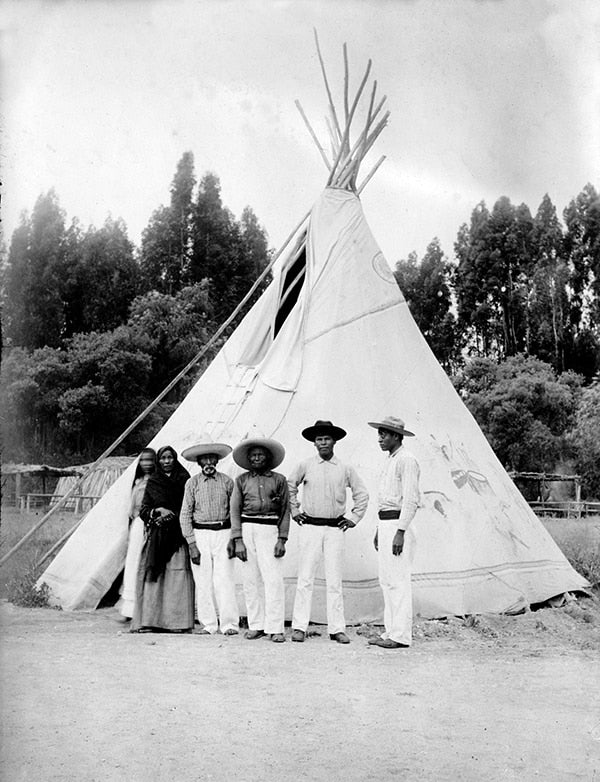
 

Yaqui Native Americans, circa 1910 – 1915. Courtesy of Wikimedia Commons/Library of Congress/public domain.

Yaqui Native Americans, circa 1910 – 1915. Courtesy of Wikimedia Commons/Library of Congress/public domain.


I brought the group to the Yaqui exhibit and was thrilled at what transpired. The class flocked around the exhibit and every one of them closely examined each instrument and artifact and excitedly viewed every video. I was standing a few feet away, basking in the moment, when one of the boys in the class came over to me, took me by the wrist, and led me closer to the exhibit. “Look, look Mr. Jeff. That comes from our town!” He was pointing at a coyote headdress and the descriptive information indicated that it was made in Guadalupe. He was beaming with pride.

A little later in the tour, I took the class to the Experience Gallery, where guests can play a large assortment of instruments. One of the boys in the class used one of the museum’s percussion instruments to demonstrate a Yaqui ceremonial dance.

A Cappella. I did a tour for half of a female a cappella singing group from New Zealand. Of course, I took them to the New Zealand exhibit. One of the videos at that exhibit depicts Maori (the indigenous people of New Zealand) music. Some of the people in the group were amused at my pronunciation of Maori and very politely corrected me. I was saying may-awe-ree when the correct pronunciation is mau-ree. Being a museum guide is a two-way street; I sometimes gain knowledge from our guests.

After the tour was finished, we got the entire group together and brought them to the museum’s rotunda, which we use to demonstrate the phenomenon of resonance. The dome shape of the rotunda is critical in amplifying the entire sound of music in a sonically pure manner. They sang a few songs and many other museum guests came to listen, giving a huge round of applause at the end.

Ghosts. I did a tour for a local social group consisting of people of Eastern European heritage. I took them to the Europe Gallery and, of course, spent time at some of the Eastern Europe exhibits. At one point during the tour, a woman suddenly let out a scream. I became frightened because I thought she was having a heart attack! To the contrary, she had spotted her deceased father playing an instrument in one of the videos. Tears of joy were running down her face.

The Piano. I often do the Saturday morning orientation tour. I mentioned earlier that this is available to all museum guests. We are asked to report to the museum a half hour prior to the tour to tell folks about it and otherwise assist the guests. Adjacent to the meeting area for this tour is a Steinway grand piano which is available for any guest to play. People of all levels of expertise (or lack thereof!) take pleasure in playing the piano.

A woman occasionally brings her 10-year-old son to the museum to play the Steinway. The boy is a true prodigy who plays only classical music. His sessions last 20 to 30 minutes, always attract a large crowd, and get enthusiastic applause when he’s done. There was one occasion when a white-haired woman sat down at the Steinway and played The Everly Brothers’ “All I have to Do is Dream.” I have no idea if she was a professional musician or someone’s piano-playing grandmother, but it was truly some of the most beautiful music I have ever heard!
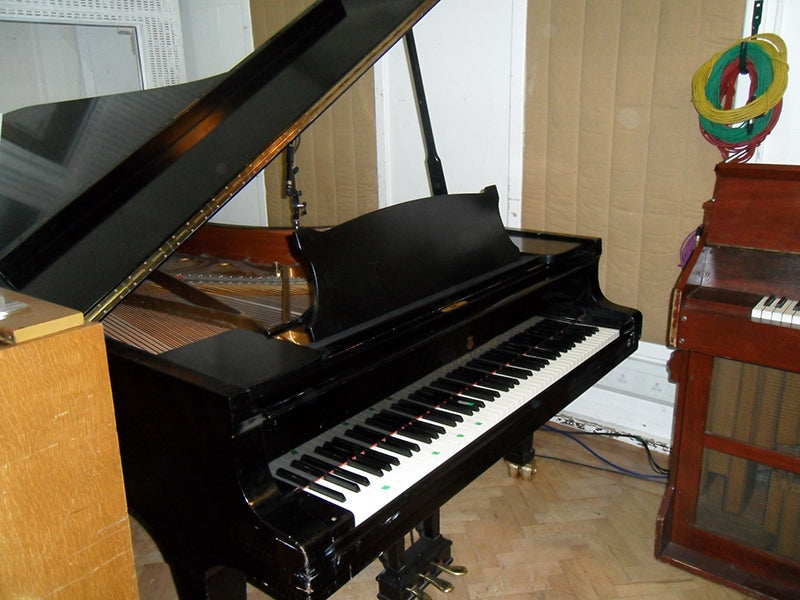
 

A Steinway grand piano similar to the one at the MIM. This one's at Abbey Road Studios, London. Courtesy of Wikimedia Commons/Josephenus P. Riley.

A Steinway grand piano similar to the one at the MIM. This one’s at Abbey Road Studios, London. Courtesy of Wikimedia Commons/Josephenus P. Riley.


Drumming. I conducted a school tour that included a drum circle for a sixth grade class. I divided the class into three groups with each drumming a different rhythm at first, and subsequently all playing in unison. Towards the end of the session we were “grooving.” The room we were in had a half-glass wall and there was another class waiting to do a drum session. I noticed that four or five girls from that class were dancing to what we were putting down. I pointed that out to my group and you should have seen them pounding those drums! Tito Puente would have been proud.

Cowboys. Red Steagall came to MIM with 30 of his people, all wearing cowboy hats. Red is a musician, actor, and poet who, for the last 31 years, has been hosting an annual three-day Cowboy Gathering in Fort Worth, Texas. He is the Official Cowboy Poet of Texas. I gave a tour to half the group, including Red.

Red’s folks were incredibly warm, friendly people and I heard several great stories. One person related some history of one of MIM’s guitars which he had owned at one point in time. As part of the tour, I took the group to the museum’s Jazz Exhibits. When I mentioned the word syncopation (a key element in jazz music), Red offered that Willie Nelson is a master of syncopation, and I have taken note of that every time I have heard Nelson sing since then.

I finished the tour in the Artist Gallery and personally took Red to view the country music artists on display: Johnny Cash, Glen Campbell, and others. Campbell suffered from Alzheimer’s disease and deteriorated very slowly until his death in 2017. When I brought him to that exhibit, Red got choked up and I thought I saw a tear in his eye as he said, “Glen Campbell was a very close friend of mine.”

Yes, Sir! A military institute came to MIM with a very large group of cadets, all involved with music in some way. These were mostly high school-aged people with some in junior college, all wearing their cadet uniforms. I conducted a school tour for about 20 cadets.

An important element in school tours is free exploration time in each gallery. The tour guide spends a few minutes with the entire group after entering a gallery, and then roams around interacting with various subsets of the group during free exploration. On this tour, there were two cadets who glued themselves to my hip the entire time, peppering me with really good questions (some of which I could not answer). Without exception, every sentence ended with the word “sir.” I am not exaggerating when I say that I was probably called “sir” more times on that two-hour tour than in all the years I have existed. I kept having flashbacks to growing up in the 1950s, when one of my favorite TV shows was Leave It To Beaver. That’s where the older brother, Wally, often addressed his father and other adult males as “sir.”

Famous People. I sometimes encounter individuals in the tours who are related to famous people. I met the daughter of Roy Rogers and Dale Evans. Rogers and Evans were wonderful people who had lost a very young child and, subsequently, adopted a number of children. She was one of them. I also met the wife of one of the members of Bill Haley’s group, The Comets. She told tales of lots of partying. On another tour, I met a woman who was extremely knowledgeable about jazz. I asked her how she knew so much about it and she replied, “My great uncle was Duke Ellington.”

Laos. During a fifth grade school tour, the class was engaged in free exploration of the Asia Gallery. One of the boys in the class sought me out and asked me to accompany him to the Laos Exhibit. He explained that his mother was Laotian and proceeded to tell me about his trips to and family in Laos. He was very proud that his grandfather was a musician who played a lanat, the traditional Lao xylophone. He made sure that I watched one of the Laos Exhibit’s videos which featured a lanat. However, the boy registered a complaint that most of the videos depicted the music of rich people, and we should have more videos of “regular people.” I think he may have been a little disappointed that we did not have a video of his grandfather.
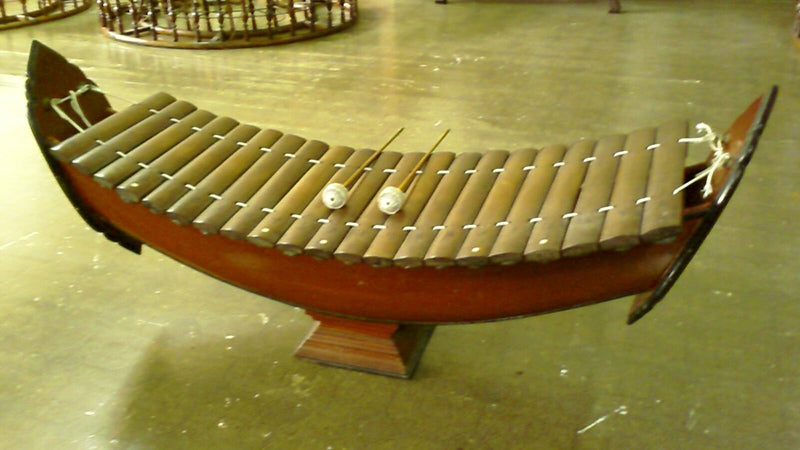
 

A ranat ek or traditional Thai xylophone, similar to a lanat. Courtesy of Wikimedia Commons/Paul_012.

A ranat ek or traditional Thai xylophone, similar to a lanat. Courtesy of Wikimedia Commons/Paul_012.


The Navy. I conducted a tour for a group of retired US Navy sailors who all served on a long since retired destroyer. Prior to the tour, they conducted a memorial service in the museum’s conference center for their deceased compatriots. The ceremony featured a color guard and a bugler. They read off the name of every person from their ship who was no longer with us and after each one, there was a single note from the bugle. The ceremony concluded with a playing of “Taps.” It was extremely moving. The lifelong camaraderie among these elderly people was quite apparent during the subsequent tour.

Ego Tripping. I sometimes get applause at the end of a tour. I conducted one for a group of retired CEOs from Southern California, about 10 people in all. These were bright, sophisticated people. At the end, I received as feverish a round of applause as I have ever had. One person said that it was the best tour he ever had. I was stunned and could barely get the words out as I thanked them. I conducted another tour for a local LGBT social club. After the tour, one of the participants told the museum’s coordinator for adult tours that I was “the Lamborghini of museum guides.”

Dementia. Various studies have found that music can be quite therapeutic for people with dementia. MIM has programs targeting that population and the museum has provided appropriate training. Accordingly, I have given a number of tours to people with dementia. One such tour was for a memory unit at an assisted living facility. Very shortly after that tour began, I realized that most of the participants were hardly listening to a word I was saying. This group was at a more severe dementia level than any I had previously encountered.

So, I changed my approach and spent less time talking and more time having them listen to music. There was one woman in the group who had the blankest of expressions on her face the entire time. She dutifully followed the group from exhibit to exhibit and never smiled, frowned, or said a word. I ended the tour in the Experience Gallery, where guests can play a wide variety of instruments. I brought the group to a large gong and had them engage in an activity where one person would hit the gong and others would put their hands on it to feel the vibrations. The expressionless woman did not engage in that activity but she watched it and smiled. I will never forget that moment!
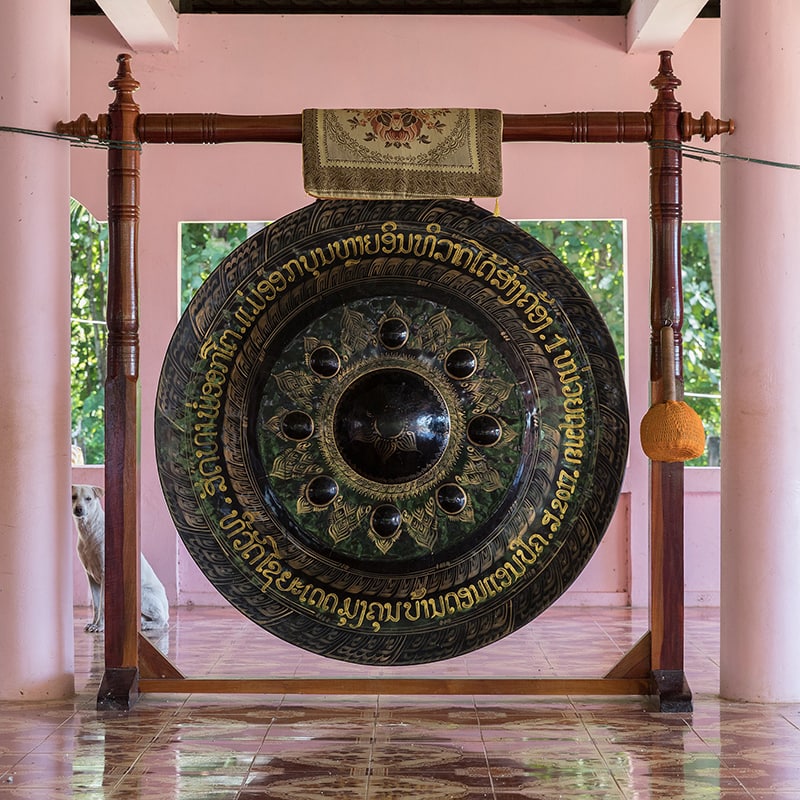
 

Gong at the temple of Don An, Laos. Courtesy of Wikimedia Commons/Basile Morin.

Gong at the temple of Don An, Laos. Courtesy of Wikimedia Commons/Basile Morin.


The late, great John Prine understood dementia:

“So if you’re walking down the street sometime
And spot some hollow ancient eyes
Please don’t just pass ’em by and stare
As if you didn’t care, say, ‘Hello in there, hello’”

The yellow brick road took me to the Musical Instrument Museum. I found my Wonderland.


Header image courtesy of the Musical Instrument Museum.

More from Issue 172

View All Articles in Issue 172

Search Copper Magazine

#228 Serita’s Black Rose Duo Shakes Your Soul With a Blend of Funk, Rock, Blues and a Whole Lot More by Frank Doris Mar 02, 2026 #228 Vinyl, A Love Story by Wayne Robins Mar 02, 2026 #228 Thrill Seeker by B. Jan Montana Mar 02, 2026 #228 The Vinyl Beat: Donald Byrd, Bill Evans, Wes Montgomery, Eddie Palmieri and Frank Sinatra by Rudy Radelic Mar 02, 2026 #228 Listening to Prestige: The History of a Vitally Important Jazz Record Label by Frank Doris Mar 02, 2026 #228 How to Play in a Rock Band, 21: Touring With James Lee Stanley by Frank Doris Mar 02, 2026 #228 The NAMM 2026 Show: The Music Industry’s Premier Event by John Volanski Mar 02, 2026 #228 The Earliest Stars of Country Music, Part Two by Jeff Weiner Mar 02, 2026 #228 From The Audiophile's Guide: A Brief History of Stereophonic Sound by Paul McGowan Mar 02, 2026 #228 A Bone to Pick With Streaming Audio by Frank Doris Mar 02, 2026 #228 Blast Off With Bluesman Duke Robillard by Ray Chelstowski Mar 02, 2026 #228 A Visit to the Marten Loudspeaker Factory in Göteborg, Sweden by Ingo Schulz and Sebastian Polcyn Mar 02, 2026 #228 Pure Distortion by Peter Xeni Mar 02, 2026 #228 A Nagra Factory Tour by Markus "Marsu" Manthey Mar 02, 2026 #228 Back to My Reel-to-Reel Roots, Part 27: Noodge and Ye Shall Receive, Part Two by Ken Kessler Mar 02, 2026 #228 PS Audio in the News by PS Audio Staff Mar 02, 2026 #228 90-Degree Stereo by Frank Doris Mar 02, 2026 #228 The Keys to Art by Rich Isaacs Mar 02, 2026 #227 Seth Lewis Gets in the Groove With Take a Look Around: a Tribute to the Meters by Frank Doris Feb 02, 2026 #227 Passport to Sound: May Anwar’s Audio Learning Experience for Young People by Frank Doris Feb 02, 2026 #227 Conjectures on Cosmic Consciousness by B. Jan Montana Feb 02, 2026 #227 The Big Takeover Turns 45 by Wayne Robins Feb 02, 2026 #227 Music and Chocolate: On the Sensory Connection by Joe Caplan Feb 02, 2026 #227 Singer/Songwriter Chris Berardo: Getting Wilder All the Time by Ray Chelstowski Feb 02, 2026 #227 The Earliest Stars of Country Music, Part One by Jeff Weiner Feb 02, 2026 #227 The Vinyl Beat Goes Down to Tijuana (By Way of Los Angeles), Part Two by Rudy Radelic Feb 02, 2026 #227 How to Play in a Rock Band, 20: On the Road With Blood, Sweat & Tears’ Guitarist Gabe Cummins by Frank Doris Feb 02, 2026 #227 From The Audiophile’s Guide: Audio Specs and Measuring by Paul McGowan Feb 02, 2026 #227 Our Brain is Always Listening by Peter Trübner Feb 02, 2026 #227 PS Audio in the News by PS Audio Staff Feb 02, 2026 #227 The Listening Chair: Sleek Style and Sound From the Luxman L3 by Howard Kneller Feb 02, 2026 #227 The Los Angeles and Orange County Audio Society Celebrates Its 32nd Anniversary, Honoring David and Sheryl Lee Wilson and Bernie Grundman by Harris Fogel Feb 02, 2026 #227 Back to My Reel-to-Reel Roots, Part 26: Half Full – Not Half Empty, Redux by Ken Kessler Feb 02, 2026 #227 That's What Puzzles Us... by Frank Doris Feb 02, 2026 #227 Record-Breaking by Peter Xeni Feb 02, 2026 #227 The Long and Winding Road by B. Jan Montana Feb 02, 2026 #226 JJ Murphy’s Sleep Paralysis is a Genre-Bending Musical Journey Through Jazz, Fusion and More by Frank Doris Jan 05, 2026 #226 Stewardship by Consent by B. Jan Montana Jan 05, 2026 #226 Food, Music, and Sensory Experience: An Interview With Professor Jonathan Zearfoss of the Culinary Institute of America by Joe Caplan Jan 05, 2026 #226 Studio Confidential: A Who’s Who of Recording Engineers Tell Their Stories by Frank Doris Jan 05, 2026 #226 Pilot Radio is Reborn, 50 Years Later: Talking With CEO Barak Epstein by Frank Doris Jan 05, 2026 #226 The Vinyl Beat Goes Down to Tijuana (By Way of Los Angeles), Part One by Rudy Radelic Jan 05, 2026 #226 Capital Audiofest 2025: Must-See Stereo, Part Two by Frank Doris Jan 05, 2026 #226 My Morning Jacket’s Carl Broemel and Tyler Ramsey Collaborate on Their Acoustic Guitar Album, Celestun by Ray Chelstowski Jan 05, 2026 #226 The People Who Make Audio Happen: CanJam SoCal 2025, Part Two by Harris Fogel Jan 05, 2026 #226 How to Play in a Rock Band, 19: Touring Can Make You Crazy, Part One by Frank Doris Jan 05, 2026 #226 Linda Ronstadt Goes Bigger by Wayne Robins Jan 05, 2026

Take a Walk in Wonderland: Revisiting the Musical Instrument Museum

Take a Walk in Wonderland: Revisiting the Musical Instrument Museum

In previous Copper articles (Issue 168 and Issue 169), I have discussed the Musical Instrument Museum (MIM) in Phoenix, Arizona and some of my favorite exhibits. Here I would like to tell you about some of the intriguing guests I have met and memorable experiences I have had as a volunteer tour guide at the museum.

As noted in Issue 168, there are three types of guided tours at MIM:

  • School tours: These are for school groups and are of two hours duration. A guide will typically work with an entire class.
  • Adult tours: These accommodate groups of adults and are about one hour long. Large groups are divided among multiple guides.
  • Orientation tours: They are scheduled at specific times each week and are open to all museum guests. They last 40 to 45 minutes.

Here are some examples of tour experiences:

Native Americans. During my first few months volunteering at the museum, I did a school tour for a fourth grade class from Guadalupe, AZ. Early in the tour, one of the adult chaperones informed me that most of the children were Yaqui Indians. That particular tour included one of the museum’s five geographic galleries and I would usually take a class to the Africa or Asia Gallery. There is also a large area dedicated to Native American and First Nations people, including Yaquis, in the United States/Canada Gallery, so I decided to take them there instead.


Yaqui Native Americans, circa 1910 – 1915. Courtesy of Wikimedia Commons/Library of Congress/public domain.

Yaqui Native Americans, circa 1910 – 1915. Courtesy of Wikimedia Commons/Library of Congress/public domain.


I brought the group to the Yaqui exhibit and was thrilled at what transpired. The class flocked around the exhibit and every one of them closely examined each instrument and artifact and excitedly viewed every video. I was standing a few feet away, basking in the moment, when one of the boys in the class came over to me, took me by the wrist, and led me closer to the exhibit. “Look, look Mr. Jeff. That comes from our town!” He was pointing at a coyote headdress and the descriptive information indicated that it was made in Guadalupe. He was beaming with pride.

A little later in the tour, I took the class to the Experience Gallery, where guests can play a large assortment of instruments. One of the boys in the class used one of the museum’s percussion instruments to demonstrate a Yaqui ceremonial dance.

A Cappella. I did a tour for half of a female a cappella singing group from New Zealand. Of course, I took them to the New Zealand exhibit. One of the videos at that exhibit depicts Maori (the indigenous people of New Zealand) music. Some of the people in the group were amused at my pronunciation of Maori and very politely corrected me. I was saying may-awe-ree when the correct pronunciation is mau-ree. Being a museum guide is a two-way street; I sometimes gain knowledge from our guests.

After the tour was finished, we got the entire group together and brought them to the museum’s rotunda, which we use to demonstrate the phenomenon of resonance. The dome shape of the rotunda is critical in amplifying the entire sound of music in a sonically pure manner. They sang a few songs and many other museum guests came to listen, giving a huge round of applause at the end.

Ghosts. I did a tour for a local social group consisting of people of Eastern European heritage. I took them to the Europe Gallery and, of course, spent time at some of the Eastern Europe exhibits. At one point during the tour, a woman suddenly let out a scream. I became frightened because I thought she was having a heart attack! To the contrary, she had spotted her deceased father playing an instrument in one of the videos. Tears of joy were running down her face.

The Piano. I often do the Saturday morning orientation tour. I mentioned earlier that this is available to all museum guests. We are asked to report to the museum a half hour prior to the tour to tell folks about it and otherwise assist the guests. Adjacent to the meeting area for this tour is a Steinway grand piano which is available for any guest to play. People of all levels of expertise (or lack thereof!) take pleasure in playing the piano.

A woman occasionally brings her 10-year-old son to the museum to play the Steinway. The boy is a true prodigy who plays only classical music. His sessions last 20 to 30 minutes, always attract a large crowd, and get enthusiastic applause when he’s done. There was one occasion when a white-haired woman sat down at the Steinway and played The Everly Brothers’ “All I have to Do is Dream.” I have no idea if she was a professional musician or someone’s piano-playing grandmother, but it was truly some of the most beautiful music I have ever heard!


A Steinway grand piano similar to the one at the MIM. This one's at Abbey Road Studios, London. Courtesy of Wikimedia Commons/Josephenus P. Riley.

A Steinway grand piano similar to the one at the MIM. This one’s at Abbey Road Studios, London. Courtesy of Wikimedia Commons/Josephenus P. Riley.


Drumming. I conducted a school tour that included a drum circle for a sixth grade class. I divided the class into three groups with each drumming a different rhythm at first, and subsequently all playing in unison. Towards the end of the session we were “grooving.” The room we were in had a half-glass wall and there was another class waiting to do a drum session. I noticed that four or five girls from that class were dancing to what we were putting down. I pointed that out to my group and you should have seen them pounding those drums! Tito Puente would have been proud.

Cowboys. Red Steagall came to MIM with 30 of his people, all wearing cowboy hats. Red is a musician, actor, and poet who, for the last 31 years, has been hosting an annual three-day Cowboy Gathering in Fort Worth, Texas. He is the Official Cowboy Poet of Texas. I gave a tour to half the group, including Red.

Red’s folks were incredibly warm, friendly people and I heard several great stories. One person related some history of one of MIM’s guitars which he had owned at one point in time. As part of the tour, I took the group to the museum’s Jazz Exhibits. When I mentioned the word syncopation (a key element in jazz music), Red offered that Willie Nelson is a master of syncopation, and I have taken note of that every time I have heard Nelson sing since then.

I finished the tour in the Artist Gallery and personally took Red to view the country music artists on display: Johnny Cash, Glen Campbell, and others. Campbell suffered from Alzheimer’s disease and deteriorated very slowly until his death in 2017. When I brought him to that exhibit, Red got choked up and I thought I saw a tear in his eye as he said, “Glen Campbell was a very close friend of mine.”

Yes, Sir! A military institute came to MIM with a very large group of cadets, all involved with music in some way. These were mostly high school-aged people with some in junior college, all wearing their cadet uniforms. I conducted a school tour for about 20 cadets.

An important element in school tours is free exploration time in each gallery. The tour guide spends a few minutes with the entire group after entering a gallery, and then roams around interacting with various subsets of the group during free exploration. On this tour, there were two cadets who glued themselves to my hip the entire time, peppering me with really good questions (some of which I could not answer). Without exception, every sentence ended with the word “sir.” I am not exaggerating when I say that I was probably called “sir” more times on that two-hour tour than in all the years I have existed. I kept having flashbacks to growing up in the 1950s, when one of my favorite TV shows was Leave It To Beaver. That’s where the older brother, Wally, often addressed his father and other adult males as “sir.”

Famous People. I sometimes encounter individuals in the tours who are related to famous people. I met the daughter of Roy Rogers and Dale Evans. Rogers and Evans were wonderful people who had lost a very young child and, subsequently, adopted a number of children. She was one of them. I also met the wife of one of the members of Bill Haley’s group, The Comets. She told tales of lots of partying. On another tour, I met a woman who was extremely knowledgeable about jazz. I asked her how she knew so much about it and she replied, “My great uncle was Duke Ellington.”

Laos. During a fifth grade school tour, the class was engaged in free exploration of the Asia Gallery. One of the boys in the class sought me out and asked me to accompany him to the Laos Exhibit. He explained that his mother was Laotian and proceeded to tell me about his trips to and family in Laos. He was very proud that his grandfather was a musician who played a lanat, the traditional Lao xylophone. He made sure that I watched one of the Laos Exhibit’s videos which featured a lanat. However, the boy registered a complaint that most of the videos depicted the music of rich people, and we should have more videos of “regular people.” I think he may have been a little disappointed that we did not have a video of his grandfather.


A ranat ek or traditional Thai xylophone, similar to a lanat. Courtesy of Wikimedia Commons/Paul_012.

A ranat ek or traditional Thai xylophone, similar to a lanat. Courtesy of Wikimedia Commons/Paul_012.


The Navy. I conducted a tour for a group of retired US Navy sailors who all served on a long since retired destroyer. Prior to the tour, they conducted a memorial service in the museum’s conference center for their deceased compatriots. The ceremony featured a color guard and a bugler. They read off the name of every person from their ship who was no longer with us and after each one, there was a single note from the bugle. The ceremony concluded with a playing of “Taps.” It was extremely moving. The lifelong camaraderie among these elderly people was quite apparent during the subsequent tour.

Ego Tripping. I sometimes get applause at the end of a tour. I conducted one for a group of retired CEOs from Southern California, about 10 people in all. These were bright, sophisticated people. At the end, I received as feverish a round of applause as I have ever had. One person said that it was the best tour he ever had. I was stunned and could barely get the words out as I thanked them. I conducted another tour for a local LGBT social club. After the tour, one of the participants told the museum’s coordinator for adult tours that I was “the Lamborghini of museum guides.”

Dementia. Various studies have found that music can be quite therapeutic for people with dementia. MIM has programs targeting that population and the museum has provided appropriate training. Accordingly, I have given a number of tours to people with dementia. One such tour was for a memory unit at an assisted living facility. Very shortly after that tour began, I realized that most of the participants were hardly listening to a word I was saying. This group was at a more severe dementia level than any I had previously encountered.

So, I changed my approach and spent less time talking and more time having them listen to music. There was one woman in the group who had the blankest of expressions on her face the entire time. She dutifully followed the group from exhibit to exhibit and never smiled, frowned, or said a word. I ended the tour in the Experience Gallery, where guests can play a wide variety of instruments. I brought the group to a large gong and had them engage in an activity where one person would hit the gong and others would put their hands on it to feel the vibrations. The expressionless woman did not engage in that activity but she watched it and smiled. I will never forget that moment!


Gong at the temple of Don An, Laos. Courtesy of Wikimedia Commons/Basile Morin.

Gong at the temple of Don An, Laos. Courtesy of Wikimedia Commons/Basile Morin.


The late, great John Prine understood dementia:

“So if you’re walking down the street sometime
And spot some hollow ancient eyes
Please don’t just pass ’em by and stare
As if you didn’t care, say, ‘Hello in there, hello’”

The yellow brick road took me to the Musical Instrument Museum. I found my Wonderland.


Header image courtesy of the Musical Instrument Museum.

0 comments

Leave a comment

0 Comments

Your avatar

Loading comments...

🗑️ Delete Comment

Enter moderator password to delete this comment:

✏️ Edit Comment

Enter your email to verify ownership: