COPPER

A PS Audio Publication

Issue 163 • Free Online Magazine

Issue 163 Featured

Rallying With Lemons, Part One

Rallying With Lemons, Part One

I’ve liked cars back since my days as a youngster and have been involved in various activities most of us perform with our cars – commuting, road trips, maintenance, detailing, and modifying. Road trips are the highlights of my year but beyond that, I’d never done anything else fun with cars. I had no classic car to cruise in or display at car shows, and I am not into racing. Road rallies seemed like fun, but many of them were high-dollar affairs, driving with exotic cars costing more than our houses, at triple-digit speeds that attract law enforcement.

I needed something the common man could do, on a typical household budget, driving a sensibly-priced automobile. The answer came to me a few years ago.

The Spirit of Lemons

I always got a chuckle out of the 24 Hours of Lemons. An obvious takeoff on the 24 Hours of Le Mans races, this series is a race that is driven, in the words of Lemons founder Jay Lamm, among “the thick scrum of crapcans.” In essence, piloting $500 cars in an endurance race to the finish. Simply finishing the race is the goal for many; actually winning a Lemons race is a lofty expectation.

The $500 budget is flexible – if you buy a $2,500 crapcan, and sell off $2,000 in parts to prepare it for racing, your net cost is $500, as long as you can prove it with documentation (and beg for mercy). Also, safety equipment is not part of the budget – items like fuel cells, fire extinguishing systems, roll cages, brakes, racing suits and so on are required to race safely, the total cost of which is as much as the team can afford. As silly as the event is, safety is taken dead seriously.

For a great account of a trio of 24 Hours of Lemons races, and the spirit of the Lemons organization, read about the late Rush drummer Neil Peart’s adventures in Lemons races: “Bamm Bamm and the Lemon Slug,” “The Adventures of Bamm Bamm – Part 1,” and “The Adventures of Bamm Bamm – Part 2.”

Given the fact that the race is growing in popularity, the organizers took the Lemons concept on the road. “Why break on track, when you can break on the side of the road?” They created the Lemons Rally. Unlike the race, there are no cost limits. You can even bring a daily driver or rental car, although it’s not quite as much fun. Driving an older or unusual car, especially if it is a questionable choice, ramps up the excitement. In essence, if your car is a hooptie, you can score major points.

Judging of the entries takes place before the driver’s meeting prior to the start of the rally, where points are assigned for various vehicle characteristics. For instance, cars are scored by country of origin. The least-reliable car-making countries (Italy, France, the UK, etc.) are judged with the most points, while some reliable Japanese brands have points deducted. Cars made in the 1980s or earlier receive extra points, and the car and occupants can get points for having a theme; the more outrageous the better. The themes often include drivers and co-pilots wearing costumes, although the costumes are sometimes saved only for the pre-rally judging and the finish line.

Aside from initial judging and events (roadside repairs) which happen en route, the rally is scored based on checkpoints along the way (posted to Instagram for proof), along with daily challenges for extra points. Acquiring the most points is how you win a Lemons Rally.

No budget. Possible mayhem. Hoopties, and unusual and classic cars. Gasoline fumes. Interesting locations. Tool bags. Tongues firmly in cheek. This seemed to be right up my alley.

I’m in!

Unfortunately, my choice of hooptie would be hampered by the weather – I had only six weeks to work on a theme and do some needed engine work. Yet, having no garage to work in (ours is used for storage), and having to deal with late winter/early spring weather that included rain, overcast skies, cold temperatures, and wind, this left me having to take a daily driver and abandon the theme I had in mind.

The Lemons Rally I participated in was the recent Rocky Mountain Breakdown, last month. Emphasis on “breakdown,” of course. An initial list of destinations included the starting point in Denver, travel to Santa Fe, Flagstaff and Moab, and returning to a spot near Denver for the “finish line.” The details that are provided to participants were scant ahead of time, only consisting of a list of recommended hotels and optional end-of-day get-togethers at nearby restaurants. This rally traveled through four of my favorite states in the country, the “Four Corners” states (Colorado, New Mexico, Arizona and Utah). Future Rocky Mountain Breakdown rallies will take different routes.

I left the Great Lakes area on April 18 loaded up with granola bars, caffeinated beverages, hydration, and a tool bag in case I needed to assist others along the way. Our pre-rally night location was Castle Rock, Colorado.

Rally Day 1: Training Day

The next morning, we had instructions to find the Rambler Ranch. I wasn’t sure what to expect, but the Rambler Ranch refers to the Nash Rambler, an automobile model and brand that were eventually merged into American Motors Corporation (AMC). The ranch is a small and notable museum of these cars. An appropriate place to start a rally.

Prior to our 8:00 am deadline, the hoopties rolled in. I could say I felt underdressed compared to the other vehicles!


Photo of "lemons" (old cars).

Photo of rally participants dressed like prisoners.

Photo of "lemons" (old cars).

Some of the lemons and their drivers.


After a driver’s meeting (basically “drive safe, don’t break the law, don’t do anything stupid, don’t die”), we were allowed some time to view the collection at the Rambler Ranch before heading out to find the day’s checkpoints.

Overall, a small number of the checkpoints were quite obvious, but many were not directly found on Google Maps. So, it is not a matter of just picking endpoints and driving to them. It requires some research and thinking to figure out the day’s stops. Driving alone, I had to do the work myself. But for other teams, the copilot(s) would be the one(s) assisting the driver.

Each day had a “Find It” clue to solve. The first: “Find the site of a famous physicist/inventor’s barely-used laboratory along the route.” This was Nikola Tesla’s laboratory in Colorado Springs. While the exact location is now in a residential neighborhood (a home, peppered with multiple “No Trespassing” signs), there is a historical marker in a park about a block away.

One of our first checkpoints would be one of three “muffler men,” this one located at the Copperhead Road Bar & Nightclub in Colorado Springs. The muffler man started in 1960 as a fiberglass mold for a large Paul Bunyan statue. By the mid-1960s, the statue was made in sizes from 14 to 25 feet tall as advertising props for gas stations, many along Route 66. They often sold mufflers or tires. The muffler men that remain are typically sporting different themes.


A muffler man at one of the checkpoints.

A muffler man at one of the checkpoints.


In Pueblo, Colorado, one of our checkpoints was the Grumman and Rohr TLRV (Tracked Levitation Research Vehicle), a prototype train designed to ride along a single rail on a cushion of compressed air.


Prototype Grumman and Rohr TLRV (Tracked Levitation Research Vehicle).

Prototype Grumman and Rohr TLRV (Tracked Levitation Research Vehicle).


A maglev (magnetic levitation) train also sat in the yard. Plans are in place to eventually restore these and turn the property into a museum.


The maglev train awaiting restoration.

The maglev train awaiting restoration.


Continuing the railway theme, we had to locate others in southern Colorado (the Denver and Rio Grande Western Railroad locomotives 169 and 494 in Alamosa and Antonito, respectively), as well as the Atchison, Topeka and Santa Fe locomotive 5030 in Santa Fe, along with an abandoned railroad water tower in Tres Piedras, New Mexico.

Our D&RGW #169 stop in Alamosa:


The Suzuki Every microvan.

The Suzuki Every microvan.


This was one of our fellow rally participants, driving a Suzuki Every microvan, right-hand drive, imported from Japan. The pink paint and tentacles were, of course, not on the factory option sheet. The tiny kei trucks are common work vehicles in Japan and feature a rear-engine design with an engine size of 660cc or less. (Kei trucks have restricted dimensions and engine displacements to qualify for tax and insurance benefits over larger vehicles.) This model had the four-wheel drive option.

Our goal for the evening was Santa Fe, New Mexico, and what visit to Santa Fe is complete without a visit to the oldest church in America? Built circa 1610, the San Miguel Chapel was constructed by Tlaxcalan Indians from Mexico, under the direction of Franciscan Padres.


San Miguel Chapel, Santa Fe, New Mexico.

San Miguel Chapel, Santa Fe, New Mexico.


Rally Day 2: Projectiles, Pie, and Antennas to the Sky

Departing Santa Fe the next morning, our route took us to the second muffler man in our checkpoints, this one in Albuquerque, attached to the May Café.


The muffler man at the May Café.

The muffler man at the May Café.


Once we located the Owl Bar & Café checkpoint in San Antonio, New Mexico, the next checkpoint took us to the historical marker for the Trinity Site, the location of the first detonation of an atomic bomb back in 1945.


Trinity Site, location of the first atom bomb detonation in 1945.

Trinity Site, location of the first atom bomb detonation in 1945.


We also visited the entrance to the Very Large Array in Socorro, New Mexico, an array of 27 radio antenna dishes in a “Y” configuration that are operated by the National Radio Astronomy Observatory. The VLA was closed, but the large dishes were visible throughout the area. The three arms of the “Y” are built of tracks, on which the dishes can be moved anywhere from two thirds of a mile to nearly 23 miles apart (end to end), depending on what the observatory chooses to focus on in space.


Site of the Very Large Array radio telescopes in Socorro, New Mexico.

Site of the Very Large Array radio telescopes in Socorro, New Mexic


After finding the checkpoint that sold pies in Pie Town, New Mexico, the next was Becker’s Transcontinental Garage. This was the site of the oldest continuously-running Ford dealership west of the Mississippi from 1910. The historical plaque was missing, but the building in Springerville, Arizona was not too difficult to find, with the Springerville Fire Department occupying the building on the right.


Becker's Transcontinental Garage, New Mexico.

Becker’s Transcontinental Garage, New Mexico.


Approaching Flagstaff meant that we were also nearing one of the nation’s most popular highways: Route 66. With Route 66 now having many sections abandoned, our next few checkpoints would be a series of ruins along the way. What remained of the Tonto Drive-In in Winslow, Arizona consisted of only the theater sign.


Tonto Drive-In, Winslow, Arizona.

Tonto Drive-In, Winslow, Arizona.


And not far away is located the old observation tower for the Meteor Crater in Winslow. The site of a meteorite impact approximately 10,000 years ago, this observation tower allowed travelers along Route 66 to view the site remotely. Today, a modern facility on the rim of the impact site caters to visitors, but the ruins of the old observation tower still remain. We were hampered by a portion of road (presumably an abandoned stretch of Route 66) being closed off to the public, so the best we could do, without trespassing, was a remote photo.


The old observation tower at the Meteor Crater, Winslow, Arizona.

The old observation tower at the Meteor Crater, Winslow, Arizona.


The Twin Arrows Trading Post on the eastern side of Flagstaff was another checkpoint along old Route 66, and like the Tonto Drive-In, was located just off to the side of Interstate 40.


Photo from the Twin Arrows Trading Post, Flagstaff, Arizona.

Photo from the Twin Arrows Trading Post, Flagstaff, Arizona.

Photos from the Twin Arrows Trading Post, Flagstaff, Arizona.


The day ended with a visit to the third and final muffler man on our list of checkpoints in Flagstaff, this one located at the Northern Arizona University, home of the Lumberjacks.


Muffler man at Northern Arizona University.

Muffler man at Northern Arizona University.


By this time, the elevation has gotten higher, and the weather has turned chilly, with snow and ice pellets lightly flying through the air as we pulled into the hotel.

Are we having fun yet?

Of course!

The second half of this travelogue will cover the third and fourth days of the Lemons Rally, along with some closing thoughts and observations.


All photos courtesy of the author.

More from Issue 163

View All Articles in Issue 163

Search Copper Magazine

#231 Piano Prodigy Jude Kofie Releases His Debut Album On Octave Records by Frank Doris Jun 01, 2026 #231 Underappreciated Artists, Part Two: City Boy by Rich Isaacs Jun 01, 2026 #231 Music and the Art of Creation: Talking With Saxophonist Rob Scheps by Joe Caplan Jun 01, 2026 #231 How to Play in a Rock Band, 24: Further Adventures at the 2026 Montauk Music Festival by Frank Doris Jun 01, 2026 #231 Courtney Barnett: Creature of Habit by Wayne Robins Jun 01, 2026 #231 Angine de Poitrine: Interstellar Guitar Rock Saviors Headed for Late-Night TV Pop Stardom? by Mark Lepage Jun 01, 2026 #231 My Impressions of AXPONA 2026, Part One by Frank Doris Jun 01, 2026 #231 2026 La Jolla Concours d'Elegance: Another Aesthetic Feast by B. Jan Montana Jun 01, 2026 #231 Country Music Icon Jo Dee Messina’s Bridges: A New Beginning by Ray Chelstowski Jun 01, 2026 #231 The Luxury Dispatch Hosts a Video Podcast With Ken Kessler by Ken Kessler Jun 01, 2026 #231 The Vinyl Beat: Tracking in the Motor City by Rudy Radelic Jun 01, 2026 #231 Lots of Fun With DSP: The Ferrum Audio WANDLA DAC and Its Tube Mode by Frank Doris Jun 01, 2026 #231 From The Audiophile's Guide: Digital Source Components and Streaming Audio by Paul McGowan Jun 01, 2026 #231 Onkyo’s Monster M-510 power amplifier by The Staff at Just Audio Jun 01, 2026 #231 PS Audio in the News by PS Audio Staff Jun 01, 2026 #231 Naming Convention by Peter Xeni Jun 01, 2026 #231 Les Invisibles by Frank Doris Jun 01, 2026 #231 Wildlife Scene by James Schrimpf Jun 01, 2026 #230 Camaraderie by B. Jan Montana May 04, 2026 #230 AXPONA 2026: A Family Gathering by Paul McGowan May 04, 2026 #230 Pianist Ryan Benthall Explores Jazz Realms and Far Beyond With Divine Sky by Frank Doris May 04, 2026 #230 The Vinyl Beat in AXPONA-Land by Rudy Radelic May 04, 2026 #230 Teddy Thompson’s Musical Growth Deepens With Never Be the Same by Ray Chelstowski May 04, 2026 #230 More Fun in the Sun: Florida Audio Expo, Part Two by Frank Doris May 04, 2026 #230 CanJam NYC 2026 Show Report: Heady Sound, Part Two by Frank Doris and Harris Fogel May 04, 2026 #230 Sonic Youth On Murray Street by Wayne Robins May 04, 2026 #230 Graffeo Coffee: A Symphony of Sensory Experience by Joe Caplan May 04, 2026 #230 The Saul Authority: The Story of Hi-Fi Pioneer Saul Marantz by Olivier Meunier-Plante May 04, 2026 #230 How to Play in a Rock Band, 23: Encounters With Famous Musicians, Part Two by Frank Doris May 04, 2026 #230 An Outlier in the Rack: A Vintage BIC Beam Box by The Staff at Just Audio May 04, 2026 #230 PS Audio in the News by PS Audio Staff May 04, 2026 #230 A Cautionary Tale by Rich Isaacs May 04, 2026 #230 Reel-to-Reel Roots, Part 33 (Revised): Ken Kessler Reports On the 2026 (British) AudioJumble by Ken Kessler May 04, 2026 #230 Text Messaging by Frank Doris May 04, 2026 #230 The Audiophile Rat Race by Peter Xeni May 04, 2026 #230 On the Rocks by Rich Isaacs May 04, 2026 #229 The Earliest Stars of Country Music, Part Three by Jeff Weiner Apr 06, 2026 #229 The Healing Power of Music and Sound at the Omega Institute by Joe Caplan Apr 06, 2026 #229 CanJam NYC 2026 Show Report: Heady Sound, Part One by Frank Doris Apr 06, 2026 #229 Florida Audio Expo 2026: Warming Up to High-End Audio, Part One by Frank Doris Apr 06, 2026 #229 Quick Takes: Anne Bisson, Sam Morrison, The Velvet Underground, and the Stooges by Frank Doris Apr 06, 2026 #229 The Vinyl Beat: New Arrivals, and Old Audio Show Demo Scores to Settle by Rudy Radelic Apr 06, 2026 #229 Harvard Gets a High-End Audio Education by Frank Doris Apr 06, 2026 #229 No Country for Old Knees by B. Jan Montana Apr 06, 2026 #229 How To Play in A Rock Band, 22: Encounters With Famous Musicians, Part 1 by Frank Doris Apr 06, 2026 #229 The Soulful Grooves of Guinea-Bissau by Steve Kindig Apr 06, 2026 #229 Four-Hand Piano Performance at Its Finest by Stephan Haberthür Apr 06, 2026

Rallying With Lemons, Part One

Rallying With Lemons, Part One

I’ve liked cars back since my days as a youngster and have been involved in various activities most of us perform with our cars – commuting, road trips, maintenance, detailing, and modifying. Road trips are the highlights of my year but beyond that, I’d never done anything else fun with cars. I had no classic car to cruise in or display at car shows, and I am not into racing. Road rallies seemed like fun, but many of them were high-dollar affairs, driving with exotic cars costing more than our houses, at triple-digit speeds that attract law enforcement.

I needed something the common man could do, on a typical household budget, driving a sensibly-priced automobile. The answer came to me a few years ago.

The Spirit of Lemons

I always got a chuckle out of the 24 Hours of Lemons. An obvious takeoff on the 24 Hours of Le Mans races, this series is a race that is driven, in the words of Lemons founder Jay Lamm, among “the thick scrum of crapcans.” In essence, piloting $500 cars in an endurance race to the finish. Simply finishing the race is the goal for many; actually winning a Lemons race is a lofty expectation.

The $500 budget is flexible – if you buy a $2,500 crapcan, and sell off $2,000 in parts to prepare it for racing, your net cost is $500, as long as you can prove it with documentation (and beg for mercy). Also, safety equipment is not part of the budget – items like fuel cells, fire extinguishing systems, roll cages, brakes, racing suits and so on are required to race safely, the total cost of which is as much as the team can afford. As silly as the event is, safety is taken dead seriously.

For a great account of a trio of 24 Hours of Lemons races, and the spirit of the Lemons organization, read about the late Rush drummer Neil Peart’s adventures in Lemons races: “Bamm Bamm and the Lemon Slug,” “The Adventures of Bamm Bamm – Part 1,” and “The Adventures of Bamm Bamm – Part 2.”

Given the fact that the race is growing in popularity, the organizers took the Lemons concept on the road. “Why break on track, when you can break on the side of the road?” They created the Lemons Rally. Unlike the race, there are no cost limits. You can even bring a daily driver or rental car, although it’s not quite as much fun. Driving an older or unusual car, especially if it is a questionable choice, ramps up the excitement. In essence, if your car is a hooptie, you can score major points.

Judging of the entries takes place before the driver’s meeting prior to the start of the rally, where points are assigned for various vehicle characteristics. For instance, cars are scored by country of origin. The least-reliable car-making countries (Italy, France, the UK, etc.) are judged with the most points, while some reliable Japanese brands have points deducted. Cars made in the 1980s or earlier receive extra points, and the car and occupants can get points for having a theme; the more outrageous the better. The themes often include drivers and co-pilots wearing costumes, although the costumes are sometimes saved only for the pre-rally judging and the finish line.

Aside from initial judging and events (roadside repairs) which happen en route, the rally is scored based on checkpoints along the way (posted to Instagram for proof), along with daily challenges for extra points. Acquiring the most points is how you win a Lemons Rally.

No budget. Possible mayhem. Hoopties, and unusual and classic cars. Gasoline fumes. Interesting locations. Tool bags. Tongues firmly in cheek. This seemed to be right up my alley.

I’m in!

Unfortunately, my choice of hooptie would be hampered by the weather – I had only six weeks to work on a theme and do some needed engine work. Yet, having no garage to work in (ours is used for storage), and having to deal with late winter/early spring weather that included rain, overcast skies, cold temperatures, and wind, this left me having to take a daily driver and abandon the theme I had in mind.

The Lemons Rally I participated in was the recent Rocky Mountain Breakdown, last month. Emphasis on “breakdown,” of course. An initial list of destinations included the starting point in Denver, travel to Santa Fe, Flagstaff and Moab, and returning to a spot near Denver for the “finish line.” The details that are provided to participants were scant ahead of time, only consisting of a list of recommended hotels and optional end-of-day get-togethers at nearby restaurants. This rally traveled through four of my favorite states in the country, the “Four Corners” states (Colorado, New Mexico, Arizona and Utah). Future Rocky Mountain Breakdown rallies will take different routes.

I left the Great Lakes area on April 18 loaded up with granola bars, caffeinated beverages, hydration, and a tool bag in case I needed to assist others along the way. Our pre-rally night location was Castle Rock, Colorado.

Rally Day 1: Training Day

The next morning, we had instructions to find the Rambler Ranch. I wasn’t sure what to expect, but the Rambler Ranch refers to the Nash Rambler, an automobile model and brand that were eventually merged into American Motors Corporation (AMC). The ranch is a small and notable museum of these cars. An appropriate place to start a rally.

Prior to our 8:00 am deadline, the hoopties rolled in. I could say I felt underdressed compared to the other vehicles!
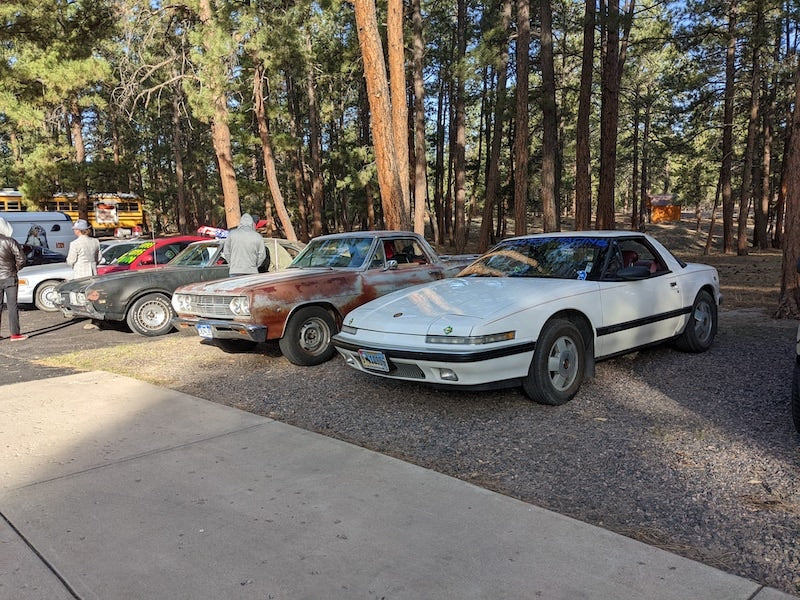
 

Photo of "lemons" (old cars).

Photo of rally participants dressed like prisoners.

Photo of "lemons" (old cars).

Some of the lemons and their drivers.


After a driver’s meeting (basically “drive safe, don’t break the law, don’t do anything stupid, don’t die”), we were allowed some time to view the collection at the Rambler Ranch before heading out to find the day’s checkpoints.

Overall, a small number of the checkpoints were quite obvious, but many were not directly found on Google Maps. So, it is not a matter of just picking endpoints and driving to them. It requires some research and thinking to figure out the day’s stops. Driving alone, I had to do the work myself. But for other teams, the copilot(s) would be the one(s) assisting the driver.

Each day had a “Find It” clue to solve. The first: “Find the site of a famous physicist/inventor’s barely-used laboratory along the route.” This was Nikola Tesla’s laboratory in Colorado Springs. While the exact location is now in a residential neighborhood (a home, peppered with multiple “No Trespassing” signs), there is a historical marker in a park about a block away.

One of our first checkpoints would be one of three “muffler men,” this one located at the Copperhead Road Bar & Nightclub in Colorado Springs. The muffler man started in 1960 as a fiberglass mold for a large Paul Bunyan statue. By the mid-1960s, the statue was made in sizes from 14 to 25 feet tall as advertising props for gas stations, many along Route 66. They often sold mufflers or tires. The muffler men that remain are typically sporting different themes.
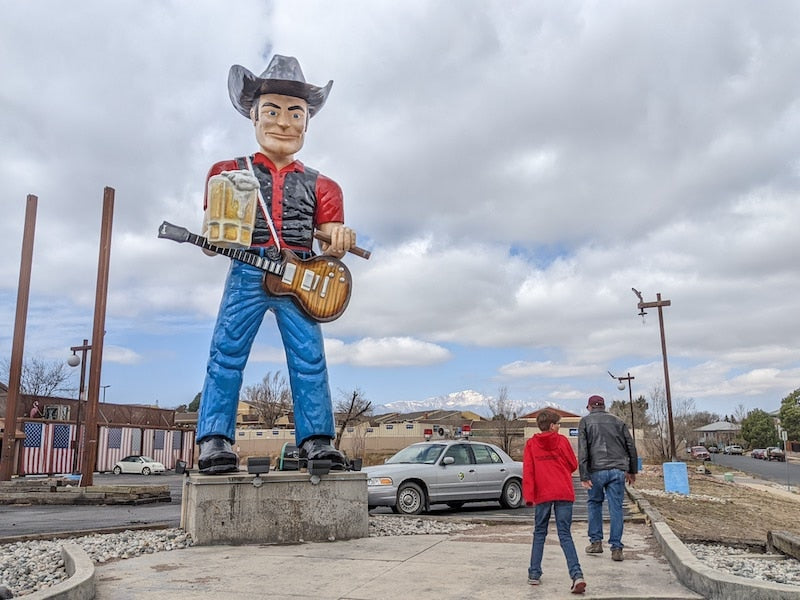
 

A muffler man at one of the checkpoints.

A muffler man at one of the checkpoints.


In Pueblo, Colorado, one of our checkpoints was the Grumman and Rohr TLRV (Tracked Levitation Research Vehicle), a prototype train designed to ride along a single rail on a cushion of compressed air.
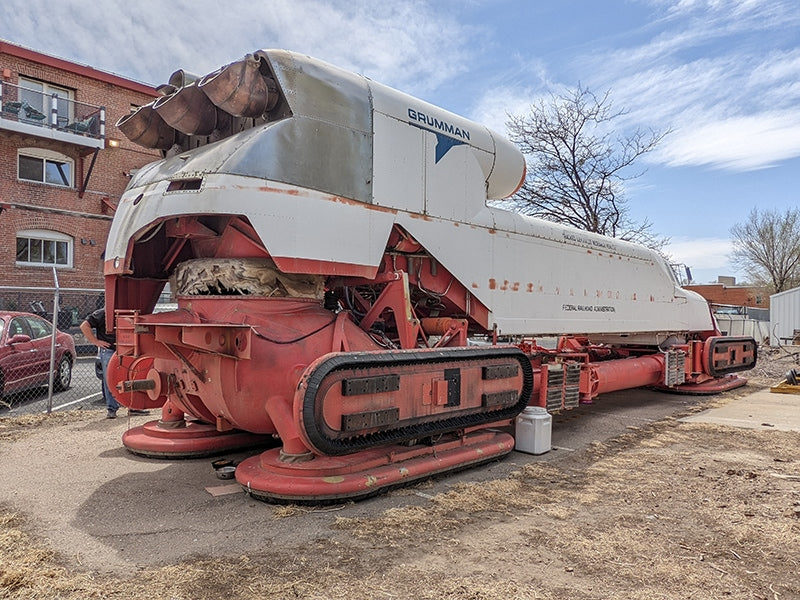
 

Prototype Grumman and Rohr TLRV (Tracked Levitation Research Vehicle).

Prototype Grumman and Rohr TLRV (Tracked Levitation Research Vehicle).


A maglev (magnetic levitation) train also sat in the yard. Plans are in place to eventually restore these and turn the property into a museum.
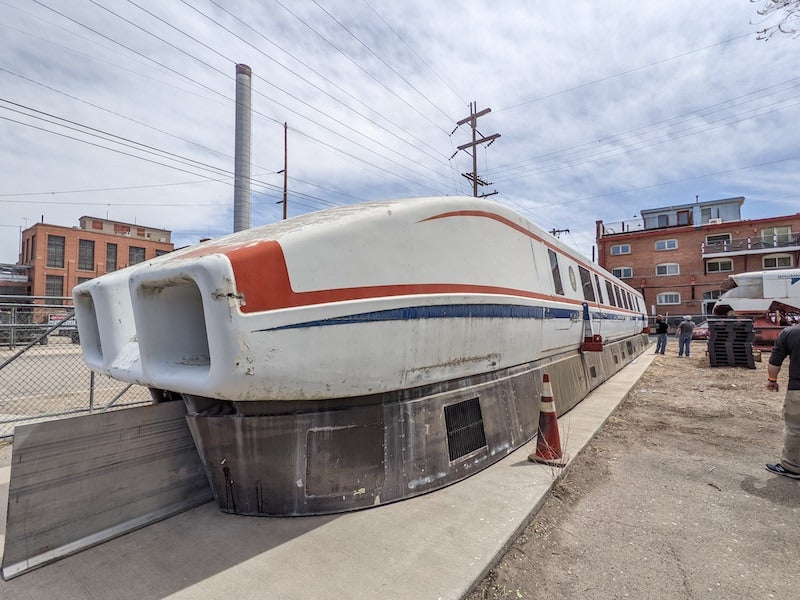
 

The maglev train awaiting restoration.

The maglev train awaiting restoration.


Continuing the railway theme, we had to locate others in southern Colorado (the Denver and Rio Grande Western Railroad locomotives 169 and 494 in Alamosa and Antonito, respectively), as well as the Atchison, Topeka and Santa Fe locomotive 5030 in Santa Fe, along with an abandoned railroad water tower in Tres Piedras, New Mexico.

Our D&RGW #169 stop in Alamosa:
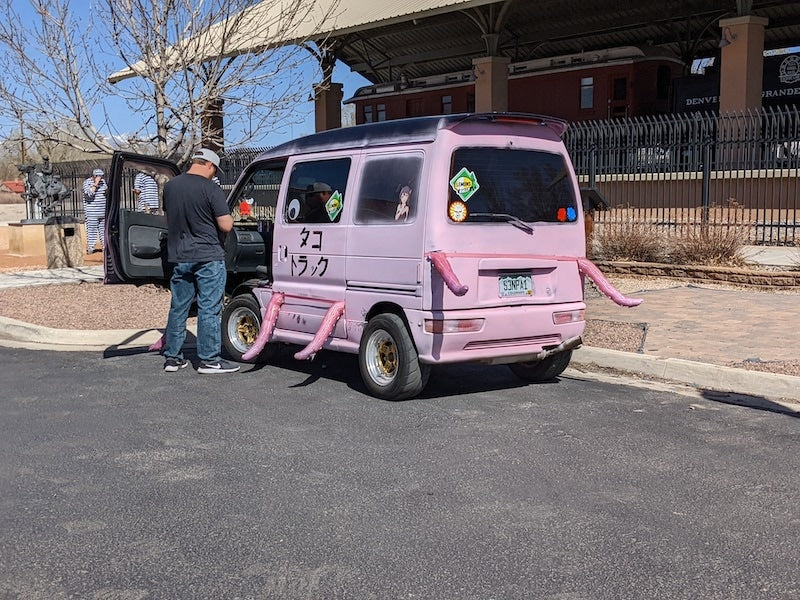
 

The Suzuki Every microvan.

The Suzuki Every microvan.


This was one of our fellow rally participants, driving a Suzuki Every microvan, right-hand drive, imported from Japan. The pink paint and tentacles were, of course, not on the factory option sheet. The tiny kei trucks are common work vehicles in Japan and feature a rear-engine design with an engine size of 660cc or less. (Kei trucks have restricted dimensions and engine displacements to qualify for tax and insurance benefits over larger vehicles.) This model had the four-wheel drive option.

Our goal for the evening was Santa Fe, New Mexico, and what visit to Santa Fe is complete without a visit to the oldest church in America? Built circa 1610, the San Miguel Chapel was constructed by Tlaxcalan Indians from Mexico, under the direction of Franciscan Padres.
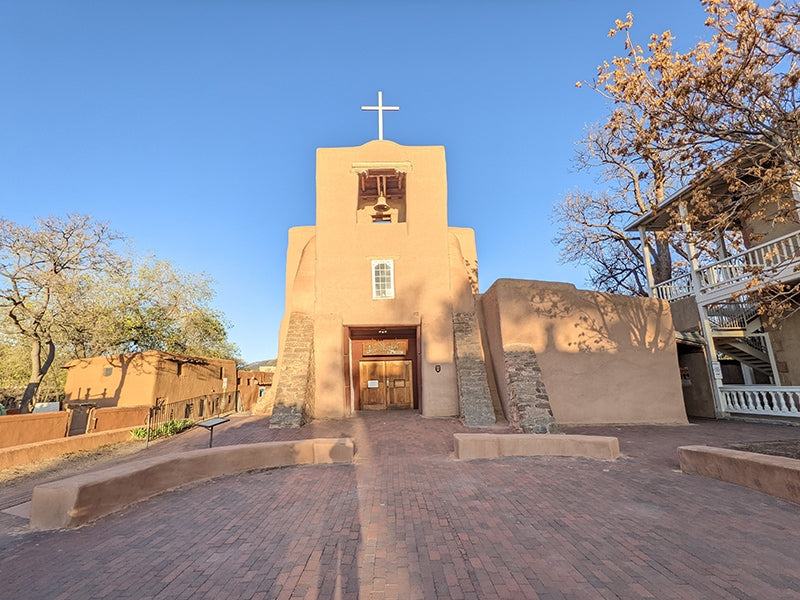
 

San Miguel Chapel, Santa Fe, New Mexico.

San Miguel Chapel, Santa Fe, New Mexico.


Rally Day 2: Projectiles, Pie, and Antennas to the Sky

Departing Santa Fe the next morning, our route took us to the second muffler man in our checkpoints, this one in Albuquerque, attached to the May Café.
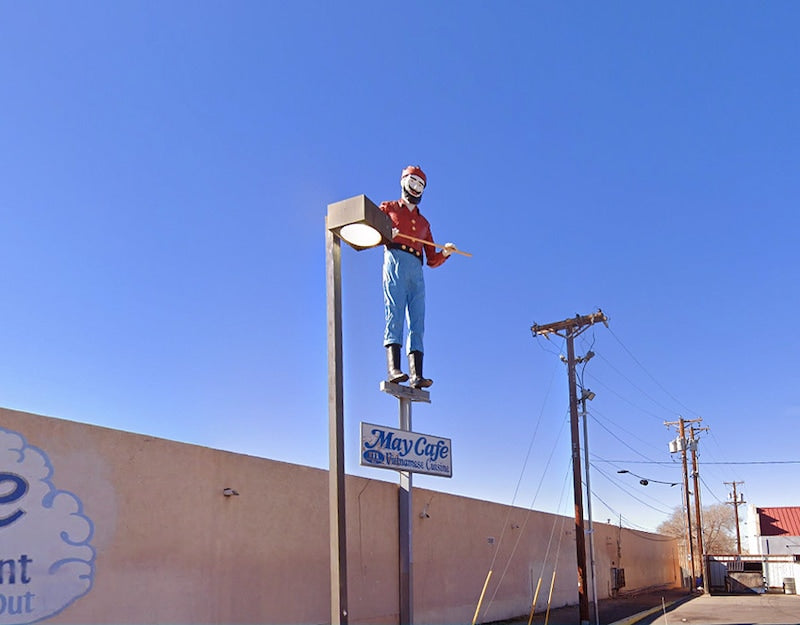
 

The muffler man at the May Café.

The muffler man at the May Café.


Once we located the Owl Bar & Café checkpoint in San Antonio, New Mexico, the next checkpoint took us to the historical marker for the Trinity Site, the location of the first detonation of an atomic bomb back in 1945.
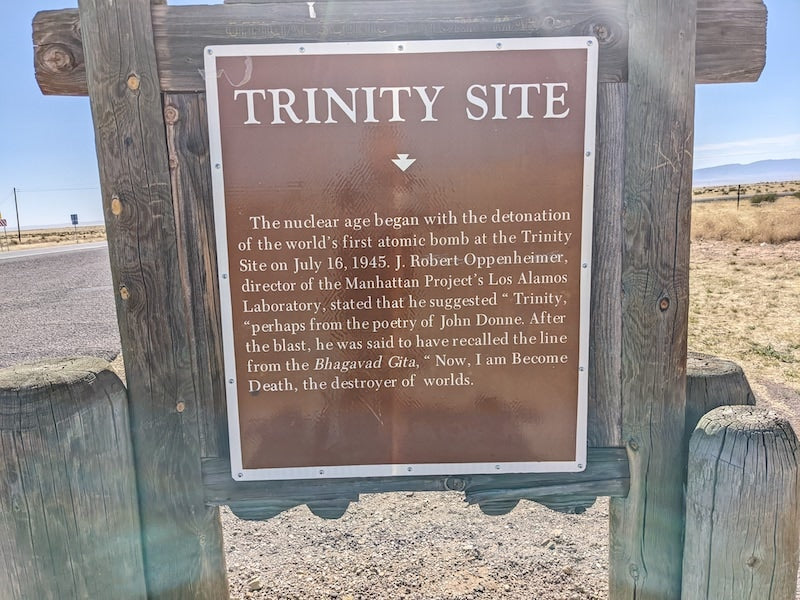


Trinity Site, location of the first atom bomb detonation in 1945.

Trinity Site, location of the first atom bomb detonation in 1945.


We also visited the entrance to the Very Large Array in Socorro, New Mexico, an array of 27 radio antenna dishes in a “Y” configuration that are operated by the National Radio Astronomy Observatory. The VLA was closed, but the large dishes were visible throughout the area. The three arms of the “Y” are built of tracks, on which the dishes can be moved anywhere from two thirds of a mile to nearly 23 miles apart (end to end), depending on what the observatory chooses to focus on in space.
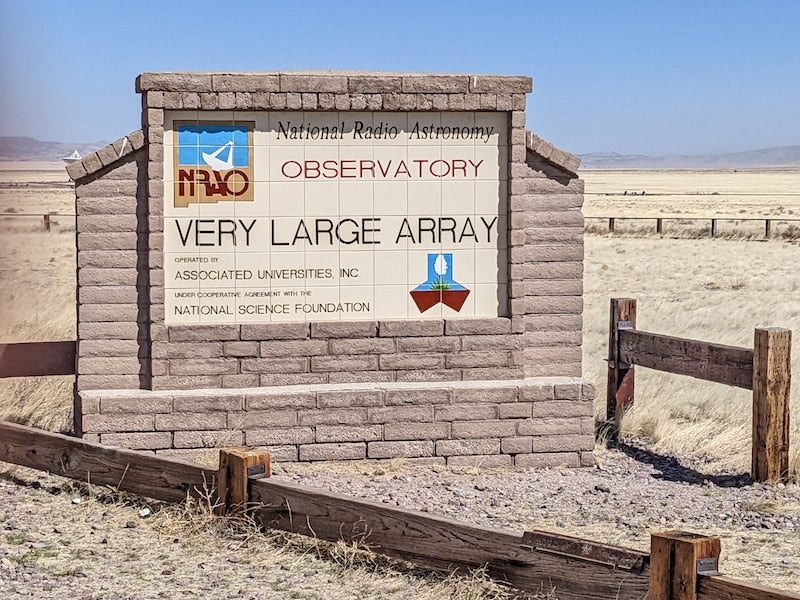
 

Site of the Very Large Array radio telescopes in Socorro, New Mexico.

Site of the Very Large Array radio telescopes in Socorro, New Mexic


After finding the checkpoint that sold pies in Pie Town, New Mexico, the next was Becker’s Transcontinental Garage. This was the site of the oldest continuously-running Ford dealership west of the Mississippi from 1910. The historical plaque was missing, but the building in Springerville, Arizona was not too difficult to find, with the Springerville Fire Department occupying the building on the right.
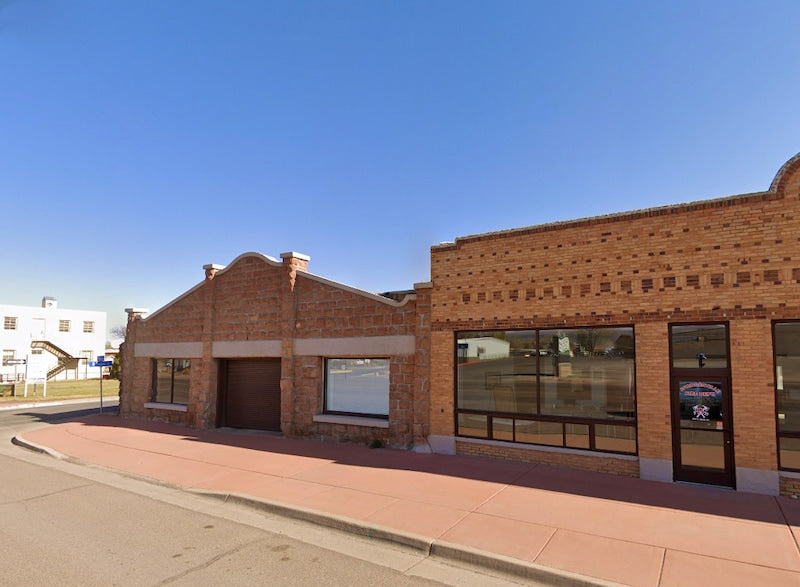
 

Becker's Transcontinental Garage, New Mexico.

Becker’s Transcontinental Garage, New Mexico.


Approaching Flagstaff meant that we were also nearing one of the nation’s most popular highways: Route 66. With Route 66 now having many sections abandoned, our next few checkpoints would be a series of ruins along the way. What remained of the Tonto Drive-In in Winslow, Arizona consisted of only the theater sign.
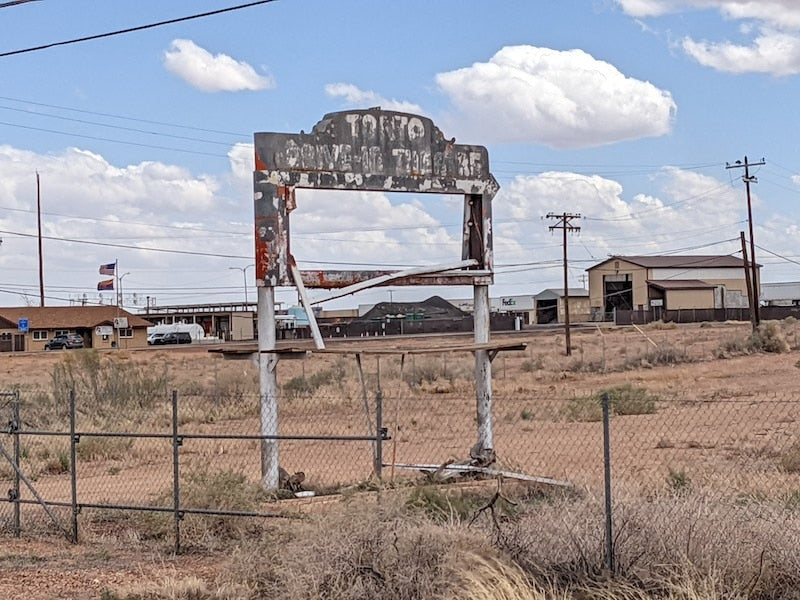
 

Tonto Drive-In, Winslow, Arizona.

Tonto Drive-In, Winslow, Arizona.


And not far away is located the old observation tower for the Meteor Crater in Winslow. The site of a meteorite impact approximately 10,000 years ago, this observation tower allowed travelers along Route 66 to view the site remotely. Today, a modern facility on the rim of the impact site caters to visitors, but the ruins of the old observation tower still remain. We were hampered by a portion of road (presumably an abandoned stretch of Route 66) being closed off to the public, so the best we could do, without trespassing, was a remote photo.
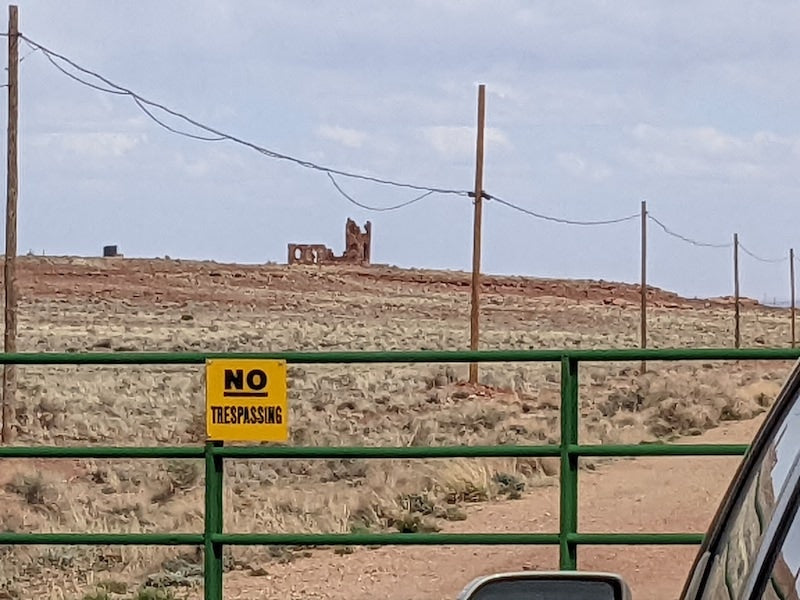
 

The old observation tower at the Meteor Crater, Winslow, Arizona.

The old observation tower at the Meteor Crater, Winslow, Arizona.


The Twin Arrows Trading Post on the eastern side of Flagstaff was another checkpoint along old Route 66, and like the Tonto Drive-In, was located just off to the side of Interstate 40.
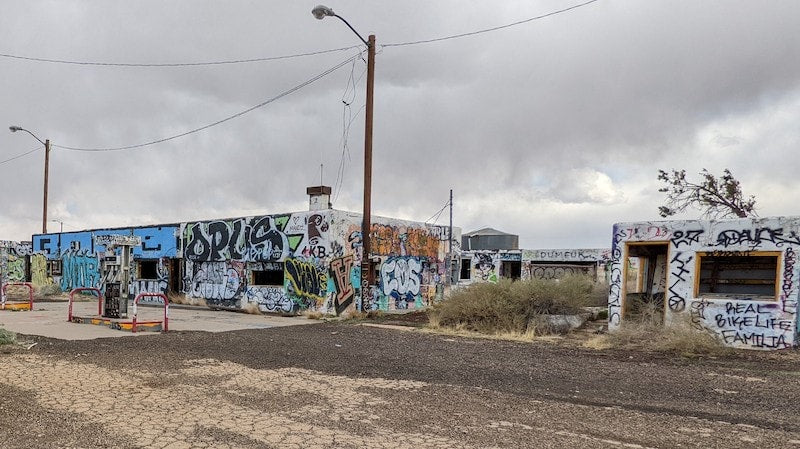
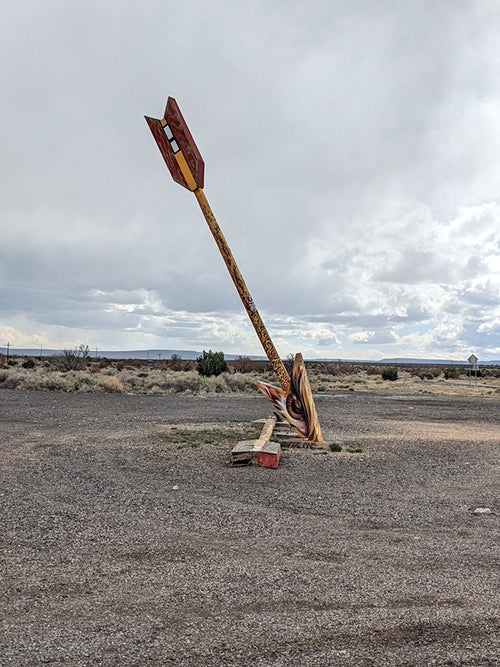
 

Photo from the Twin Arrows Trading Post, Flagstaff, Arizona.

Photo from the Twin Arrows Trading Post, Flagstaff, Arizona.

Photos from the Twin Arrows Trading Post, Flagstaff, Arizona.


The day ended with a visit to the third and final muffler man on our list of checkpoints in Flagstaff, this one located at the Northern Arizona University, home of the Lumberjacks.
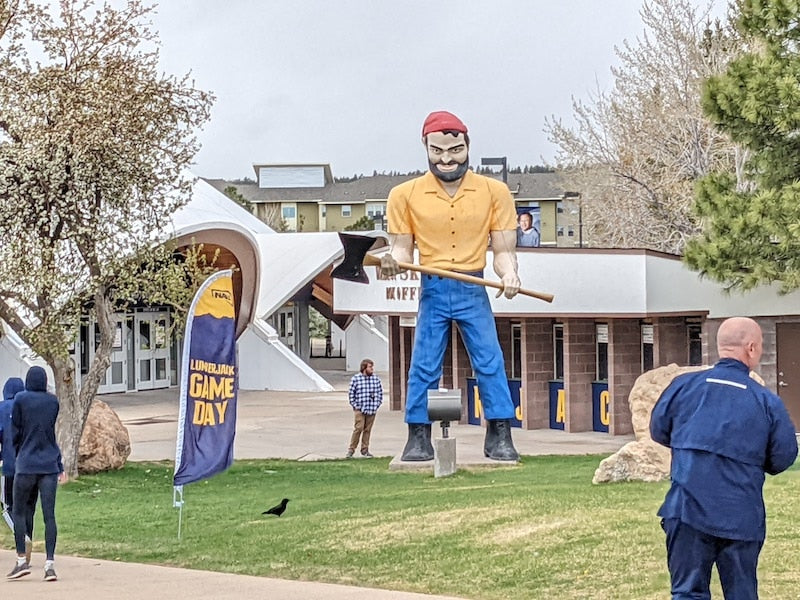
 

Muffler man at Northern Arizona University.

Muffler man at Northern Arizona University.


By this time, the elevation has gotten higher, and the weather has turned chilly, with snow and ice pellets lightly flying through the air as we pulled into the hotel.

Are we having fun yet?

Of course!

The second half of this travelogue will cover the third and fourth days of the Lemons Rally, along with some closing thoughts and observations.


All photos courtesy of the author.

0 comments

Leave a comment

0 Comments

Your avatar

Loading comments...

🗑️ Delete Comment

Enter moderator password to delete this comment:

✏️ Edit Comment

Enter your email to verify ownership: