COPPER

A PS Audio Publication

Issue 230 • Free Online Magazine

Issue 230 From The Listening Chair

An Outlier in the Rack: A Vintage BIC Beam Box

An Outlier in the Rack: A Vintage BIC Beam Box


Vintage Hi-Fi shops typically see a steady stream of gear pass through their doors. Over time, they develop a sense of the familiar. Some pieces appear with such regularity that they feel like old friends. Pioneer’s SX-1250 stereo receiver, with its brute power and unmistakable visual presence, is practically a rite of passage for vintage audio enthusiasts. Marantz’s 2270 receiver warm, musical, and endlessly collectible remains a perennial favorite. These components tell a familiar story: classic designs, proven performance, and a deep emotional connection to the golden era of hi-fi.

Every so often, though, something unexpected arrives on the counter. These pieces can stop a conversation mid-sentence and cause a double take. They don’t fit neatly into the usual receiver, turntable, or speaker categories. Instead, they occupy a curious space between utility, experimentation, and design ambition.

Enter the Beam Box

The Beam Box from BIC is a prime example of such a product. BIC, short for British Industries Corporation, has no relationship to the French pen manufacturer. It was established in America during the 1950s to import British and other audiophile products. Its lines included Garrard, Luxman, and Wharfedale.

In the early 1970s, BIC manufactured loudspeakers and the first belt-drive turntables under its own name. It became well known for patenting the famous “Venturi Port” vent design, which improved a speaker’s bass performance. Introduced by BIC in the late 1970s at prices of $49 to $165 depending on the model, the Beam Box is an electronically directable FM antenna. That description alone sets it apart from the tangle of folded dipole wires and roof-mounted Yagis that most people associate with FM reception. But what does “electronically directable” actually mean, and why would a manufacturer go to such lengths to solve a problem that even during FM’s heyday most listeners barely acknowledged?

To understand the Beam Box, one must first understand the role FM radio once played in home audio. In the mid-20th century, FM broadcasting represented a leap forward in sound quality. Compared to AM, FM offered a wider frequency response, lower noise, and the promise of high-fidelity music broadcasted straight into the living room. For many listeners, FM was not background noise it was a primary music source. Classical and jazz programming, live concerts, and carefully curated playlists made FM radio an essential part of the hi-fi experience.

However, FM reception was and still remains highly dependent on geography, building materials, and antenna placement. Urban listeners contend with multipath distortion as signals bounce off buildings. Suburban and rural listeners struggle with distance and terrain. To obtain a clear signal, many FM enthusiasts stapled a wire antenna along a baseboard or hidden behind a cabinet. The truly dedicated installed a large, roof-mounted outdoor antenna. Although these fixes often did the trick, they were mostly inelegant, inconvenient, and/or unavailable for apartment dwellers or those unwilling to modify their homes.

BIC designed the Beam Box with one audience in mind: audiophiles who deeply cared about FM sound quality but wanted a solution that matched the aesthetics and convenience of their hi-fi systems. Its form factor aligns with classic hi-fi components, often finished in wood veneer or neutral tones. Rather than hiding the antenna, the Beam Box placed it alongside existing receivers, amplifiers, and tape decks. Its design acknowledged that audio equipment is not merely functional it is part of a visual and tactile experience.

BIC Inside

At its core, the Beam Box takes advantage of clever analog circuitry that trickled down from professional and military communications. Specifically, it uses an array of internal antennas combined with electronic switching to “steer” its reception pattern. Instead of physically rotating an antenna or repositioning wires, the user electronically directs the Beam Box towards the strongest signal. This was no small feat in an era before digital signal processing and software-defined radios. In many ways, the Beam Box was an expression of optimism the belief that better sound could be achieved through clever hardware and user control. 

In Use

The Beam Box’s controls are straightforward and tactile, inviting hands-on interaction rather than digital automation. With the turn of a knob or press of a button, listeners can use this product to minimize noise, preserve stereo separation, reduce multipath interference, and lock onto a radio station’s FM signal with surprising clarity. FM stereo broadcasts are particularly sensitive to multipath interference, which can collapse the stereo image or introduce distortion. Many users found it deeply satisfying to manually adjust the controls as the noise floor dropped and the sound snapped into focus. Undoubtedly, the Beam Box can make a dramatic improvement in FM performance, especially in challenging reception environments. For listeners who prized FM broadcasts of orchestral music or live jazz, the improvements made by the Beam Box were not subtle they were transformative.  

Call it a Comeback?

The Beam Box was never a mass-market product. Many casual listeners were content with whatever reception they happened to get. Others migrated toward records and tapes. As FM radio’s prominence waned, so too did demand for specialized accessories like the Beam Box.

Today, listeners enjoy digital music streaming with near-perfect clarity, often unaware of the engineering battles once fought over signal strength and noise. Still, FM radio has experienced a quiet resurgence among enthusiasts who value local programming, human curation, and the serendipity of live broadcasts. In this context, the Beam Box feels relevant again not as a necessity, but as a symbol of intentional listening.

In the current market, a Beam Box typically fetches $25-$90, depending on condition and whether the user manual and original box have been preserved. What makes the Beam Box especially fascinating is how it reflects a time when manufacturers were willing to experiment. Companies like BIC weren’t just competing on a power rating or a features list; they were trying to creatively solve real-world listening problems.

When a Beam Box shows up at our shop, it sparks curiosity not only because it’s rare, but because it represents a forgotten chapter of hi-fi enthusiasm. It reminds us that interesting stories in audio aren’t always told by iconic vintage components and speakers, but by the unexpected ones that dared to solve problems differently.


All images courtesy of
The Listening Chair, a reviewing and news organization for all things audiophile.

Check out the latest from TLC on the web (www.thelisteningchair.net) and its YouTube channel (https://www.youtube.com/@thelisteningchair_).

Also note TLC’s growing social media ecosystem, including its Facebook group (https://www.facebook.com/groups/217745678009888), where members from around the world show off their gear; and LinkedIn group (https://www.linkedin.com/in/howard-kneller/), Instagram (www.instagram.com/howardkneller/), Threads (www.threads.net/@howardkneller) and X (www.x.com/HowardKneller) pages.

More from Issue 230

View All Articles in Issue 230

Search Copper Magazine

#233 A Report From The Total Hi-Fi Experience Show SoCal 2026 by B. Jan Montana Aug 03, 2026 #233 Bluegrass Meets Country, Folk, Jazz and More in All That We Carried by The Squid City Slingers by Frank Doris Aug 03, 2026 #233 Corey Glover and One Tribe Nation: A Variegated Musical Collective by Ray Chelstowski Aug 03, 2026 #233 Excursions with Clive: The Late Clive Davis, A Personal History by Wayne Robins Aug 03, 2026 #233 AI, Art, and Music: A Conversation With Synthography Art by Joe Caplan Aug 03, 2026 #233 New American Symphonies: A Rediscovered Gem and a Vital Contemporary Work by Frank Doris Aug 03, 2026 #233 The Vinyl Beat: Genesis, the Dave Clark Five, Antonio Carlos Jobim and More by Rudy Radelic Aug 03, 2026 #233 How to Play in a Rock Band, 26: When It's Time to Record Your Music by Frank Doris Aug 03, 2026 #233 More From T.H.E. Show 2026, and the People Who Made it Happen by Harris Fogel Aug 03, 2026 #233 Underappreciated Artists, Part Three: Icehouse by Rich Isaacs Aug 03, 2026 #233 The Surprisingly Rich and Varied Music of Somalia by Steve Kindig Aug 03, 2026 #233 A Remarkable Discographic Legacy: The LP Recordings of the Basel Symphony Orchestra by Stephan Haberthür Aug 03, 2026 #233 From The Audiophile’s Guide: The Importance of Loudspeakers by Paul McGowan Aug 03, 2026 #233 From Swimming Pool to New Listening Room: A Conversation with Norman Varney of AV RoomService by Gilles Laferrière Aug 03, 2026 #233 PS Audio in the News by PS Audio Staff Aug 03, 2026 #233 Audio Jewelry by Peter Xeni Aug 03, 2026 #233 Enrich Your Life by Frank Doris Aug 03, 2026 #233 The Searcher by James Schrimpf Aug 03, 2026 #232 What came first: Art or Music? A Conversation With Artist Jose Acosta by Joe Caplan Jul 06, 2026 #232 Blow By Blow: The Jeff Beck Story: An Insightful Book About a Guitar Icon by Ray Chelstowski Jul 06, 2026 #232 Creed Over Camaraderie? by B. Jan Montana Jul 06, 2026 #232 Chronicles of a Sound Pilgrim at the 2026 Montreal Audiofest by Hugues Morin Jul 06, 2026 #232 The Vinyl Beat: Summer Grooves by Rudy Radelic Jul 06, 2026 #232 Hibbing Hillbilly Dylan's Acoustic Rock by Wayne Robins Jul 06, 2026 #232 Quad Quads and Plasmatronics Tweeters: An Extraordinary System Comes to Life by Frank Doris Jul 06, 2026 #232 In Praise of Live Music, Once Again by Ted Shafran Jul 06, 2026 #232 Allnic Audio’s L-9000 Preamplifier: Design and Engineering Innovation by Howard Kneller Jul 06, 2026 #232 “Best Of” Lists and Rage Bait: Enough Already by Frank Doris Jul 06, 2026 #232 Quick Takes: Bud Shank, Paulo Almeida, Jakob Dreyer, Tim Eriksen and Peter Irvine by Frank Doris Jul 06, 2026 #232 My Impressions of AXPONA 2026, Part 2 by Frank Doris Jul 06, 2026 #232 How to Play in a Rock Band, 25: Encounters With Famous Musicians, Part Three by Frank Doris Jul 06, 2026 #232 Budgets, and Systems From Small to Outrageous by Paul McGowan Jul 06, 2026 #232 PS Audio in the News by PS Audio Staff Jul 06, 2026 #232 Hand It Over by Frank Doris Jul 06, 2026 #232 Difference of Opinion by Peter Xeni Jul 06, 2026 #232 Wabi-sabi Tree by James Schrimpf Jul 06, 2026 #231 Piano Prodigy Jude Kofie Releases His Debut Album On Octave Records by Frank Doris Jun 01, 2026 #231 Underappreciated Artists, Part Two: City Boy by Rich Isaacs Jun 01, 2026 #231 Music and the Art of Creation: Talking With Saxophonist Rob Scheps by Joe Caplan Jun 01, 2026 #231 How to Play in a Rock Band, 24: Further Adventures at the 2026 Montauk Music Festival by Frank Doris Jun 01, 2026 #231 Courtney Barnett: Creature of Habit by Wayne Robins Jun 01, 2026 #231 Angine de Poitrine: Interstellar Guitar Rock Saviors Headed for Late-Night TV Pop Stardom? by Mark Lepage Jun 01, 2026 #231 My Impressions of AXPONA 2026, Part One by Frank Doris Jun 01, 2026 #231 2026 La Jolla Concours d'Elegance: Another Aesthetic Feast by B. Jan Montana Jun 01, 2026 #231 Country Music Icon Jo Dee Messina’s Bridges: A New Beginning by Ray Chelstowski Jun 01, 2026 #231 The Luxury Dispatch Hosts a Video Podcast With Ken Kessler by Ken Kessler Jun 01, 2026 #231 The Vinyl Beat: Tracking in the Motor City by Rudy Radelic Jun 01, 2026

An Outlier in the Rack: A Vintage BIC Beam Box

An Outlier in the Rack: A Vintage BIC Beam Box


Vintage Hi-Fi shops typically see a steady stream of gear pass through their doors. Over time, they develop a sense of the familiar. Some pieces appear with such regularity that they feel like old friends. Pioneer’s SX-1250 stereo receiver, with its brute power and unmistakable visual presence, is practically a rite of passage for vintage audio enthusiasts. Marantz’s 2270 receiver warm, musical, and endlessly collectible remains a perennial favorite. These components tell a familiar story: classic designs, proven performance, and a deep emotional connection to the golden era of hi-fi.

Every so often, though, something unexpected arrives on the counter. These pieces can stop a conversation mid-sentence and cause a double take. They don’t fit neatly into the usual receiver, turntable, or speaker categories. Instead, they occupy a curious space between utility, experimentation, and design ambition.

Enter the Beam Box

The Beam Box from BIC is a prime example of such a product. BIC, short for British Industries Corporation, has no relationship to the French pen manufacturer. It was established in America during the 1950s to import British and other audiophile products. Its lines included Garrard, Luxman, and Wharfedale.

In the early 1970s, BIC manufactured loudspeakers and the first belt-drive turntables under its own name. It became well known for patenting the famous “Venturi Port” vent design, which improved a speaker’s bass performance. Introduced by BIC in the late 1970s at prices of $49 to $165 depending on the model, the Beam Box is an electronically directable FM antenna. That description alone sets it apart from the tangle of folded dipole wires and roof-mounted Yagis that most people associate with FM reception. But what does “electronically directable” actually mean, and why would a manufacturer go to such lengths to solve a problem that even during FM’s heyday most listeners barely acknowledged?

To understand the Beam Box, one must first understand the role FM radio once played in home audio. In the mid-20th century, FM broadcasting represented a leap forward in sound quality. Compared to AM, FM offered a wider frequency response, lower noise, and the promise of high-fidelity music broadcasted straight into the living room. For many listeners, FM was not background noise it was a primary music source. Classical and jazz programming, live concerts, and carefully curated playlists made FM radio an essential part of the hi-fi experience.

However, FM reception was and still remains highly dependent on geography, building materials, and antenna placement. Urban listeners contend with multipath distortion as signals bounce off buildings. Suburban and rural listeners struggle with distance and terrain. To obtain a clear signal, many FM enthusiasts stapled a wire antenna along a baseboard or hidden behind a cabinet. The truly dedicated installed a large, roof-mounted outdoor antenna. Although these fixes often did the trick, they were mostly inelegant, inconvenient, and/or unavailable for apartment dwellers or those unwilling to modify their homes.

BIC designed the Beam Box with one audience in mind: audiophiles who deeply cared about FM sound quality but wanted a solution that matched the aesthetics and convenience of their hi-fi systems. Its form factor aligns with classic hi-fi components, often finished in wood veneer or neutral tones. Rather than hiding the antenna, the Beam Box placed it alongside existing receivers, amplifiers, and tape decks. Its design acknowledged that audio equipment is not merely functional it is part of a visual and tactile experience.
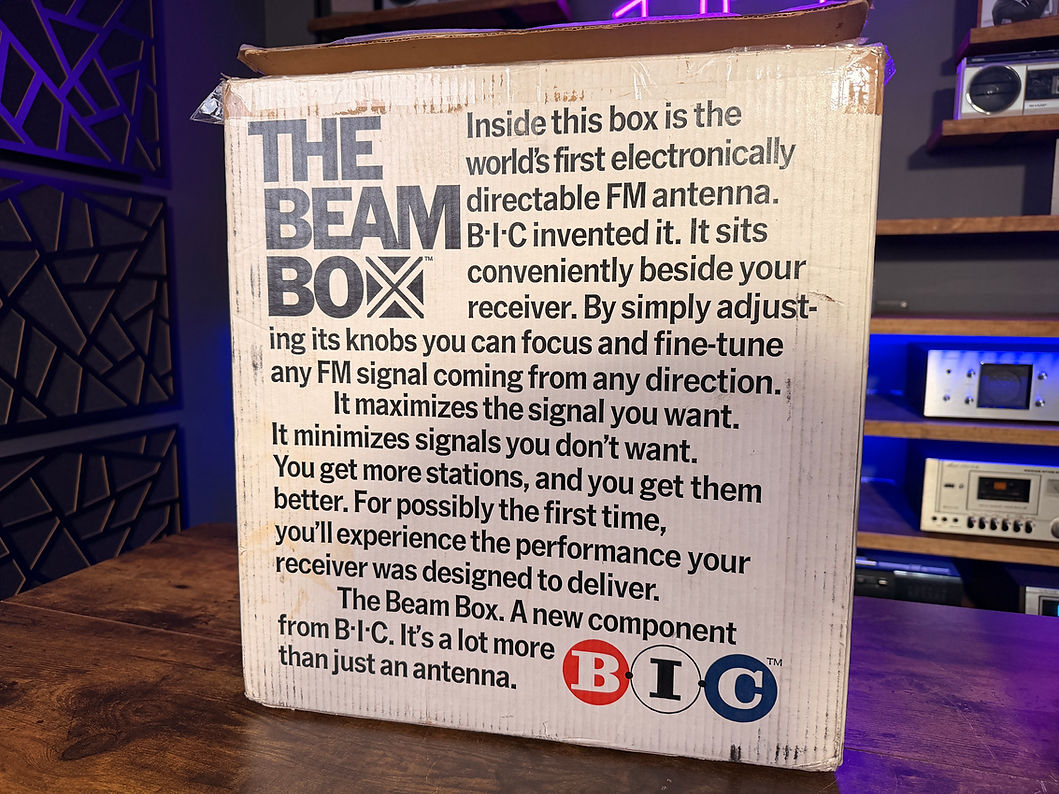
BIC Inside

At its core, the Beam Box takes advantage of clever analog circuitry that trickled down from professional and military communications. Specifically, it uses an array of internal antennas combined with electronic switching to “steer” its reception pattern. Instead of physically rotating an antenna or repositioning wires, the user electronically directs the Beam Box towards the strongest signal. This was no small feat in an era before digital signal processing and software-defined radios. In many ways, the Beam Box was an expression of optimism the belief that better sound could be achieved through clever hardware and user control. 

In Use

The Beam Box’s controls are straightforward and tactile, inviting hands-on interaction rather than digital automation. With the turn of a knob or press of a button, listeners can use this product to minimize noise, preserve stereo separation, reduce multipath interference, and lock onto a radio station’s FM signal with surprising clarity. FM stereo broadcasts are particularly sensitive to multipath interference, which can collapse the stereo image or introduce distortion. Many users found it deeply satisfying to manually adjust the controls as the noise floor dropped and the sound snapped into focus. Undoubtedly, the Beam Box can make a dramatic improvement in FM performance, especially in challenging reception environments. For listeners who prized FM broadcasts of orchestral music or live jazz, the improvements made by the Beam Box were not subtle they were transformative.  

Call it a Comeback?

The Beam Box was never a mass-market product. Many casual listeners were content with whatever reception they happened to get. Others migrated toward records and tapes. As FM radio’s prominence waned, so too did demand for specialized accessories like the Beam Box.

Today, listeners enjoy digital music streaming with near-perfect clarity, often unaware of the engineering battles once fought over signal strength and noise. Still, FM radio has experienced a quiet resurgence among enthusiasts who value local programming, human curation, and the serendipity of live broadcasts. In this context, the Beam Box feels relevant again not as a necessity, but as a symbol of intentional listening.

In the current market, a Beam Box typically fetches $25-$90, depending on condition and whether the user manual and original box have been preserved. What makes the Beam Box especially fascinating is how it reflects a time when manufacturers were willing to experiment. Companies like BIC weren’t just competing on a power rating or a features list; they were trying to creatively solve real-world listening problems.

When a Beam Box shows up at our shop, it sparks curiosity not only because it’s rare, but because it represents a forgotten chapter of hi-fi enthusiasm. It reminds us that interesting stories in audio aren’t always told by iconic vintage components and speakers, but by the unexpected ones that dared to solve problems differently.


All images courtesy of
The Listening Chair, a reviewing and news organization for all things audiophile.

Check out the latest from TLC on the web (www.thelisteningchair.net) and its YouTube channel (https://www.youtube.com/@thelisteningchair_).

Also note TLC’s growing social media ecosystem, including its Facebook group (https://www.facebook.com/groups/217745678009888), where members from around the world show off their gear; and LinkedIn group (https://www.linkedin.com/in/howard-kneller/), Instagram (www.instagram.com/howardkneller/), Threads (www.threads.net/@howardkneller) and X (www.x.com/HowardKneller) pages.

0 comments

Leave a comment

0 Comments

Your avatar

Loading comments...

🗑️ Delete Comment

Enter moderator password to delete this comment:

✏️ Edit Comment

Enter your email to verify ownership: