COPPER

A PS Audio Publication

Issue 86 • Free Online Magazine

Issue 86 FEATURED

Munich, Part 2

Munich, Part 2

For all its admirable efficiency, there are some peculiar oversights in the presentation of High End, as the Munich show is called. If you look at the show website, you’ll find brand lists and exhibitor lists, but no maps of the MOC (Munich Order Center, oddly) where the show is held. I don’t think you can get a feel for the show without understanding the layout. So—forgive the wrinkles in the diagram from the show brochure—as I said, the website’s got nothin’!

The diagram—übersicht means “overview”—makes it appear as though all the areas shown are on the same level. This is not the case. Halle 1 through Halle 4 (Halle, obviously, means “Hall”, with the plural being Hallen)—are all at ground level. Up one level are the first of the Atrium floors; A 3.1 is above Halle 3, and A 4.1 is above Halle 4. A 4.2 is, logically enough, one level above A 4.1. So: Hallen 1 and 2 are one level high; Halle 3 has two levels; and Halle 4 has three levels. Think of the Atriums (Atria?) as layers of a layer cake, stacked on top of Hallen 3 and 4, and you’ve got it, minus the buttercream frosting.

Now, the Hallen are open exhibit floors, as you’d see at most trade shows, or the main convention center at CES. Because of that, exhibitors have limited ability to present live demos without annoying the neighbors. Sprinkled throughout the Hallen are freestanding enclosed demo rooms quaintly called “cabins”—and that’s what they resemble. Acoustically, the cabins aren’t terrible, and most veteran exhibitors know how to best treat and utilize the space. Due to their limited size, cabins are generally utilized by smallish companies; for bigger demo rooms, one has to go to the Atrium levels.

Here you can see Finnish loudspeaker manufacturer Penaudio‘s open display and their cabin listening room —you can see the door peeking open on the right. It’s not a perfect arrangement, but it is better than most small hotel rooms as used at many audio shows.

The Atrium display rooms are bigger, but are greenhouse-like, with large windows that present acoustical challenges. Worst of all are rooms on A 4.2, with vaulted ceilings which can create a massive bass suck-out. Many of the higher-end companies exhibit on the Atrium levels due to the larger spaces, and most have to utilize extensive acoustical treatment in order to create decent listening environments. You’ll see a wide variety of diffusors, reflectors, and absorbers in pictures of those rooms. Here you’ll see big diffusor panels in the room of Troy Audio, which makes large, highly-efficient loudspeakers using modern versions of Altec drivers made by Great Plains Audio:

To summarize: there are three types of exhibit space at the show: open booth space in the Hallen; cabins in the Hallen; and the enclosed demo rooms on the Atrium levels. Moving on, let’s stroll around die Hallen….

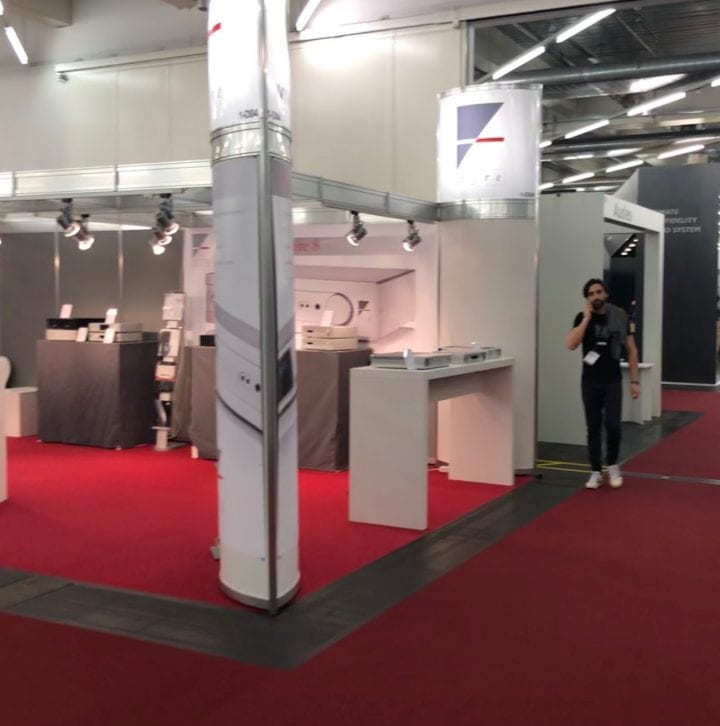
PS Audio is in Boulder, and a number of other manufacturers of high-end audio products are nearby. Sadly, we’re more likely to see our colleagues at shows, than we will while out for a beer. Here’s the booth of our Boulder friends at Ayre:
Around the corner in a cabin, Hungarian company Taylor Acoustic showed their lovely speakers powered by PS Audio gear. Those mice? They’re damping devices from Swedish company Entreq, filled with lead shot!

In another cabin nearby, the Aries Cerat folks showed their tube amps and horn loudspeakers. As you might guess, the cabins presented a tight squeeze which sometimes made photography awkward–not to mention the complete lack of natural light.

Outside in the “open” space, personal audio leaders Astell & Kern had an impressive display:

Chatting outside the Soundsmith cabin were owner/chief engineer Peter Ledermann and composer/pianist/record producer David Chesky. Inside the cabin, Peter gave his usual stunning demos using a system completely designed and built by him—from cartridge to preamp and amp and speakers. There’s some kind of magic in the tiny Dragonfly speakers—the power and low bass are startling. A highlight this time was an original lacquer of Blood Sweat & Tears’ “Spinning Wheel”—the dynamics were unbelievable.

Every show has several exhibits that are puzzling, for one reason or another. Reed, from Lithuania, showed their very attractive tonearms and turntables—but why on earth would they need that impressive diffusor wall on an open-air, static exhibit? And what should we make of their slogan, “For Painting on Silence”—?

Here’s another baffler: recently, SME, producer of world-class turntables and tonearms, purchased what was left of Garrard, reportedly including a stock of parts for the old 301 idler wheel table. At Munich the SME display included a number of impressive SME products, including a new model or two. And then, there under a big acrylic cover was a Garrard 301, with an apparent replica of an old SME 3009 tonearm. I was told the unit was 12,500–whether pounds or Euro was unclear, and the spokesperson seemed unsure of pretty much everything. Is it new? Well, uh…Is it assembled from old parts? Well, uh….

I’m guessing it’s made from old parts, as finish was not stunning. Perhaps at some point, we’ll get the straight story. Meanwhile, I was so rattled that I didn’t photograph the new SME products—which should’ve been the real story!

A company called Shenzhen Viborg (?) showed some impressive-looking tonearms which seemed to mimic elements of older, better-known arms. I see some Ikeda, some SME, maybe some EMT….

A company called Arya Audio Labs showed an interesting AMT-like driver licensed from an American designer. It can be arranged in segments to provide controlled dispersion all the way up to omni. I have no idea how it sounds: the display was open-air, with the drivers plunked unceremoniously atop some nondescript floorstanding speakers, and the crew seemed to be having a great deal of trouble with set-up. It may well be very promising, but sadly, I couldn’t tell from the display.

Italian amp makers Pathos have a full range of products, all featuring beautiful build-quality and a unique aesthetic. You either love it or hate it. The heatsinks which spell out “PATHOS” are a little amusing.

More collegial schmoozing: two from Part-Time Audiophile (Panagiotis Karavitis, left—“Dr. Pan”, if you can’t handle Greek; Publisher Scot Hull, right) with industry vet David Solomon, currently traipsing the world for Qobuz. Hull was nearly stuck in London due to a passport nearing expiration….

Speakers of all types, shapes and sizes could be seen on the main floor. The colorful little Danish Babushka Jern (“iron” in Danish) speakers featured cast-iron housings that were dead, dead, dead–and allowed a very big sound. I wonder about the new wall-hangers—a simple nail in sheetrock won’t hold them up! There’s also a cannonball-like subwoofer which wold break your foot, should you bump into it in a dark room. And, oh—see the hammer on the table? Attendees were encouraged to bang on a chunk of the cast iron enclosure material—though not the finished speakers.

You may recall the enormous ESD horn speakers with field-coil drivers from last year’s RMAF report. Shown in a big room there, I complained that the tinkly cocktail jazz demo music never conveyed the dynamic power these speakers are presumably capable of. Would you believe these were shown in one of the cabins at Munich? It’s probably a good thing that once again, they didn’t really let these things rip—it likely would’ve blown the walls off!

Rarely seen in the US, French brand Cabasse has…err…their own way of doing things. Most models feature coaxial drivers in a spherical enclosure. They range from mid-sized floorstanders…

—to big and even bigger eyeballs. Personally, if I were listening to these things I’d feel like I was being stared at all the time.

It was definitely interesting to see a cutaway of one of the big eyeballs. This looks like a triaxial driver arrangement.

Sooner than one would expect, the end of the show day comes. And then it’s back out into cold rain, with hopes that the next morning would be sunny and clear.

More from Issue 86

View All Articles in Issue 86

Search Copper Magazine

#225 Capital Audiofest 2025: Must-See Stereo, Part One by Frank Doris Dec 01, 2025 #225 Otis Taylor and the Electrics Delivers a Powerful Set of Hypnotic Modern Blues by Frank Doris Dec 01, 2025 #225 A Christmas Miracle by B. Jan Montana Dec 01, 2025 #225 T.H.E. Show New York 2025, Part Two: Plenty to See, Hear, and Enjoy by Frank Doris Dec 01, 2025 #225 Underappreciated Artists, Part One: Martin Briley by Rich Isaacs Dec 01, 2025 #225 Rock and Roll is Here to Stay by Wayne Robins Dec 01, 2025 #225 A Lifetime of Holiday Record (and CD) Listening by Rudy Radelic Dec 01, 2025 #225 Little Feat: Not Saying Goodbye, Not Yet by Ray Chelstowski Dec 01, 2025 #225 How to Play in a Rock Band, Part 18: Dealing With Burnout by Frank Doris Dec 01, 2025 #225 The People Who Make Audio Happen: CanJam SoCal 2025 by Harris Fogel Dec 01, 2025 #225 Chicago’s Sonic Sanctuaries: Four Hi‑Fi Listening Bars Channeling the Jazz‑Kissa Spirit by Olivier Meunier-Plante Dec 01, 2025 #225 From The Audiophile’s Guide: Controlling Bass Frequencies Through Membrane Absorbers (and How to Build Your Own) by Paul McGowan Dec 01, 2025 #225 Your Editor’s Tips for Attending Audio Shows by Frank Doris Dec 01, 2025 #225 PS Audio in the News by Frank Doris Dec 01, 2025 #225 Back to My Reel-to-Reel Roots, Part 24 by Ken Kessler Dec 01, 2025 #225 Holiday Music by Frank Doris Dec 01, 2025 #225 Puppy Prognostication by Peter Xeni Dec 01, 2025 #225 How to Post Comments on Copper by Frank Doris Dec 01, 2025 #225 Living Color by Rudy Radelic Dec 01, 2025 #224 T.H.E. Show New York 2025, Part One: A New Beginning by Frank Doris Nov 03, 2025 #224 Fool’s Leap of Faith is the Extraordinary Octave Records Debut from Singer/Songwriter Tyler Burba and Visit by Frank Doris Nov 03, 2025 #224 The Beatles’ “Aeolian Cadences.” What? by Wayne Robins Nov 03, 2025 #224 Persona Non Grata by B. Jan Montana Nov 03, 2025 #224 Talking With Recording Engineer Barry Diament of Soundkeeper Recordings, Part Two by Frank Doris Nov 03, 2025 #224 B Sides, B Movies, and Beware of Zombies by Rudy Radelic Nov 03, 2025 #224 The Burn-In Chronicles: 1,000 Hours to Sonic Salvation by Olivier Meunier-Plante Nov 03, 2025 #224 A Conversation With Mat Weisfeld of VPI Industries by Joe Caplan Nov 03, 2025 #224 Blues-Rocker Kenny Wayne Shepherd Celebrates 30 Years of Ledbetter Heights by Ray Chelstowski Nov 03, 2025 #224 Playing in a Rock Band, 17: When Good Gigs Go Bad, Part Two by Frank Doris Nov 03, 2025 #224 From The Audiophile’s Guide: Dealing with Odd-Shaped Rooms by Paul McGowan Nov 03, 2025 #224 TEAC’s TN-3B-SE Turntable Plays Bob Dylan by Howard Kneller Nov 03, 2025 #224 PS Audio in the News by Frank Doris Nov 03, 2025 #224 Lost in Translation by Peter Xeni Nov 03, 2025 #224 Reel-to-Reel Roots, Part 23: Better Than Rice Krispies by Ken Kessler Nov 03, 2025 #224 I Bring Joy! by Frank Doris Nov 03, 2025 #224 Screen Test by Rich Isaacs Nov 03, 2025 #224 How to Post Comments on Copper by Frank Doris Nov 03, 2025 #132 Dr. Patrick Gleeson: The Interview, Part Two by Rich Isaacs Oct 07, 2025 #223 World Fusion Meets Flamenco in Gratitude from Steve Mullins and Rim of the Well by Frank Doris Oct 06, 2025 #223 Judging Albums by Their Covers by Rich Isaacs Oct 06, 2025 #223 Recent Arrivals and 12-inch Royalty by Rudy Radelic Oct 06, 2025 #223 Summer of Creem, Part Two by Wayne Robins Oct 06, 2025 #223 Recording Engineer Barry Diament of Soundkeeper Recordings: Striving for Natural Sound by Frank Doris Oct 06, 2025 #223 Tea on the Terrace by B. Jan Montana Oct 06, 2025 #223 How Good Can Car Audio Get? by Joe Caplan Oct 06, 2025 #223 The Advantages of a Dedicated Listening Room by Paul McGowan Oct 06, 2025 #223 1! 2! 3! 4! Surrounded by the Ramones in Dolby Atmos! by Frank Doris Oct 06, 2025

Munich, Part 2

Munich, Part 2

For all its admirable efficiency, there are some peculiar oversights in the presentation of High End, as the Munich show is called. If you look at the show website, you’ll find brand lists and exhibitor lists, but no maps of the MOC (Munich Order Center, oddly) where the show is held. I don’t think you can get a feel for the show without understanding the layout. So—forgive the wrinkles in the diagram from the show brochure—as I said, the website’s got nothin’!

The diagram—übersicht means “overview”—makes it appear as though all the areas shown are on the same level. This is not the case. Halle 1 through Halle 4 (Halle, obviously, means “Hall”, with the plural being Hallen)—are all at ground level. Up one level are the first of the Atrium floors; A 3.1 is above Halle 3, and A 4.1 is above Halle 4. A 4.2 is, logically enough, one level above A 4.1. So: Hallen 1 and 2 are one level high; Halle 3 has two levels; and Halle 4 has three levels. Think of the Atriums (Atria?) as layers of a layer cake, stacked on top of Hallen 3 and 4, and you’ve got it, minus the buttercream frosting.

Now, the Hallen are open exhibit floors, as you’d see at most trade shows, or the main convention center at CES. Because of that, exhibitors have limited ability to present live demos without annoying the neighbors. Sprinkled throughout the Hallen are freestanding enclosed demo rooms quaintly called “cabins”—and that’s what they resemble. Acoustically, the cabins aren’t terrible, and most veteran exhibitors know how to best treat and utilize the space. Due to their limited size, cabins are generally utilized by smallish companies; for bigger demo rooms, one has to go to the Atrium levels.

Here you can see Finnish loudspeaker manufacturer Penaudio‘s open display and their cabin listening room —you can see the door peeking open on the right. It’s not a perfect arrangement, but it is better than most small hotel rooms as used at many audio shows.

The Atrium display rooms are bigger, but are greenhouse-like, with large windows that present acoustical challenges. Worst of all are rooms on A 4.2, with vaulted ceilings which can create a massive bass suck-out. Many of the higher-end companies exhibit on the Atrium levels due to the larger spaces, and most have to utilize extensive acoustical treatment in order to create decent listening environments. You’ll see a wide variety of diffusors, reflectors, and absorbers in pictures of those rooms. Here you’ll see big diffusor panels in the room of Troy Audio, which makes large, highly-efficient loudspeakers using modern versions of Altec drivers made by Great Plains Audio:

To summarize: there are three types of exhibit space at the show: open booth space in the Hallen; cabins in the Hallen; and the enclosed demo rooms on the Atrium levels. Moving on, let’s stroll around die Hallen….

PS Audio is in Boulder, and a number of other manufacturers of high-end audio products are nearby. Sadly, we’re more likely to see our colleagues at shows, than we will while out for a beer. Here’s the booth of our Boulder friends at Ayre:

Around the corner in a cabin, Hungarian company Taylor Acoustic showed their lovely speakers powered by PS Audio gear. Those mice? They’re damping devices from Swedish company Entreq, filled with lead shot!

In another cabin nearby, the Aries Cerat folks showed their tube amps and horn loudspeakers. As you might guess, the cabins presented a tight squeeze which sometimes made photography awkward–not to mention the complete lack of natural light.

Outside in the “open” space, personal audio leaders Astell & Kern had an impressive display:

Chatting outside the Soundsmith cabin were owner/chief engineer Peter Ledermann and composer/pianist/record producer David Chesky. Inside the cabin, Peter gave his usual stunning demos using a system completely designed and built by him—from cartridge to preamp and amp and speakers. There’s some kind of magic in the tiny Dragonfly speakers—the power and low bass are startling. A highlight this time was an original lacquer of Blood Sweat & Tears’ “Spinning Wheel”—the dynamics were unbelievable.

Every show has several exhibits that are puzzling, for one reason or another. Reed, from Lithuania, showed their very attractive tonearms and turntables—but why on earth would they need that impressive diffusor wall on an open-air, static exhibit? And what should we make of their slogan, “For Painting on Silence”—?

Here’s another baffler: recently, SME, producer of world-class turntables and tonearms, purchased what was left of Garrard, reportedly including a stock of parts for the old 301 idler wheel table. At Munich the SME display included a number of impressive SME products, including a new model or two. And then, there under a big acrylic cover was a Garrard 301, with an apparent replica of an old SME 3009 tonearm. I was told the unit was 12,500–whether pounds or Euro was unclear, and the spokesperson seemed unsure of pretty much everything. Is it new? Well, uh…Is it assembled from old parts? Well, uh….

I’m guessing it’s made from old parts, as finish was not stunning. Perhaps at some point, we’ll get the straight story. Meanwhile, I was so rattled that I didn’t photograph the new SME products—which should’ve been the real story!

A company called Shenzhen Viborg (?) showed some impressive-looking tonearms which seemed to mimic elements of older, better-known arms. I see some Ikeda, some SME, maybe some EMT….

A company called Arya Audio Labs showed an interesting AMT-like driver licensed from an American designer. It can be arranged in segments to provide controlled dispersion all the way up to omni. I have no idea how it sounds: the display was open-air, with the drivers plunked unceremoniously atop some nondescript floorstanding speakers, and the crew seemed to be having a great deal of trouble with set-up. It may well be very promising, but sadly, I couldn’t tell from the display.

Italian amp makers Pathos have a full range of products, all featuring beautiful build-quality and a unique aesthetic. You either love it or hate it. The heatsinks which spell out “PATHOS” are a little amusing.

More collegial schmoozing: two from Part-Time Audiophile (Panagiotis Karavitis, left—“Dr. Pan”, if you can’t handle Greek; Publisher Scot Hull, right) with industry vet David Solomon, currently traipsing the world for Qobuz. Hull was nearly stuck in London due to a passport nearing expiration….

Speakers of all types, shapes and sizes could be seen on the main floor. The colorful little Danish Babushka Jern (“iron” in Danish) speakers featured cast-iron housings that were dead, dead, dead–and allowed a very big sound. I wonder about the new wall-hangers—a simple nail in sheetrock won’t hold them up! There’s also a cannonball-like subwoofer which wold break your foot, should you bump into it in a dark room. And, oh—see the hammer on the table? Attendees were encouraged to bang on a chunk of the cast iron enclosure material—though not the finished speakers.

You may recall the enormous ESD horn speakers with field-coil drivers from last year’s RMAF report. Shown in a big room there, I complained that the tinkly cocktail jazz demo music never conveyed the dynamic power these speakers are presumably capable of. Would you believe these were shown in one of the cabins at Munich? It’s probably a good thing that once again, they didn’t really let these things rip—it likely would’ve blown the walls off!

Rarely seen in the US, French brand Cabasse has…err…their own way of doing things. Most models feature coaxial drivers in a spherical enclosure. They range from mid-sized floorstanders…

—to big and even bigger eyeballs. Personally, if I were listening to these things I’d feel like I was being stared at all the time.

It was definitely interesting to see a cutaway of one of the big eyeballs. This looks like a triaxial driver arrangement.

Sooner than one would expect, the end of the show day comes. And then it’s back out into cold rain, with hopes that the next morning would be sunny and clear.

0 comments

Leave a comment

0 Comments

Your avatar

Loading comments...

🗑️ Delete Comment

Enter moderator password to delete this comment: