COPPER

A PS Audio Publication

Issue 76 • Free Online Magazine

Issue 76 VINTAGE WHINE

Fairchild, Part 2

In Copper #75, we began the story of the remarkable business empire created by Sherman Fairchild. Fairchild started over 75 companies, and as much as possible, we’ll focus on those directly involved in pro and consumer audio. Given the interconnectedness of the companies and the timespan of many decades, that’s easier said than done.

We’ve already mentioned Fairchild’s pioneering work in the creation of the first aerial cameras capable of sharp, repeatable images—due largely to the shutter mechanism incorporated within the lens itself, as shown in the patent drawing below. The cameras led to creation of purpose-built aircraft to house and transport them—the first monoplane built by the company was designed by no less than Igor Sikorsky.

As the depression deepened and business slowed, Fairchild sought out sub-contract work to keep the metalworking shops at Fairchild Camera busy. He encountered a gentleman named Crook—wait for it—looking for a company with the technical chops and production capabilities to develop and build devices that would record sound on aluminum discs. Intrigued by the technical challenge and presented with ready suppliers of aluminum and signed contracts from waiting buyers, Fairchild took on the project—on the basis of payment upon delivery of working equipment.

You can guess the rest. Here’s how Fairchild himself told it, decades later: “We had just about completed the design of the equipment when we discovered that Crook was more than the man’s name. All those contracts he had were fraudulent, forged. He disappeared and left us with the almost-completed equipment for cutting aluminum records.”

Rather than a lost cause, Fairchild was presented with entree into the broadcast world, and creation of a new division of Fairchild Camera devoted to mechanical and electronic devices for recording and broadcast studios.

As World War II approached, Fairchild’s aerial cameras proved vital for surveying and reconnaissance, and the aircraft divisions boomed as well: over 8,000 trainer aircraft were built during the war, used for pilot training. Further details of Fairchild’s importance in the world of aircraft can be read here.


Fairchild’s K-8 aerial Gunsight was another important contribution to Allied efforts in World War II.

Post-war, the camera division continued to prosper, and Fairchild Camera’s management decided to sell off the unprofitable audio division: the company’s products were always built to be the best available, and were priced accordingly. Unable to find a buyer, Sherman Fairchild bought it personally, and named it Fairchild Recording Equipment. A fair jazz pianist, Fairchild frequently recorded well-known musicians in recording studios in his homes. Fairchild Recording Equipment was an early developer of tape recorders, and for several years continued to offer disk recorders and lathes in parallel with tape recorders.

In the pro audio world, today Fairchild is best known for its model 660 (mono) and 67(stereo) limiters (compressors), built to military spec and beyond—as you can see by the engraved faceplate of the 670, at the top of this page, and the photo below. Out of production for sixty years, the 660 and 670 are still regarded by many as the best ever built—six of the units are still in use at the Abbey Road Studios, and when units become available for sale, prices approach $40,000. You can read an in-depth account of these legendary devices here.

The 660 and 670 were designed by an Estonian refugee named Rein Narma, whose incredible story includes walking away from his homeland, and being chosen in a refugee camp by American troops who needed an English-speaking radio expert. Subsequently, Narma recorded the stories of fellow refugees, and was involved in handling the simultaneous translation and recording gear at the Nuremberg trials!

His path upon reaching the US was no less incredible: he designed a mixing board and rebuilt a defective Ampex multitrack recorder for Les Paul, and subsequently, Fairchild personally hired Narma to be chief engineer at Fairchild Recording Equipment, where he designed the 660 and 670. You can read Narma’s amazing story here, and can read the manual of the model 670 here.

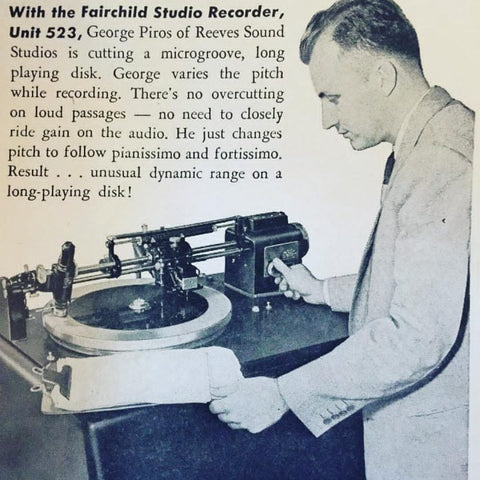
Fairchild studio gear was widely used by the most quality-conscious, including Robert Fine (of Mercury Living Presence recordings) and record-cutting legend George Piros, as shown below. In the next installment, we’ll go more into Fairchild’s studio gear, amazing projects they were involved in, their consumer gear, and more— in Copper #77.
More from Issue 76

View All Articles in Issue 76

Search Copper Magazine

#232 What came first: Art or Music? A Conversation With Artist Jose Acosta by Joe Caplan Jul 06, 2026 #232 Blow By Blow: The Jeff Beck Story: An Insightful Book About a Guitar Icon by Ray Chelstowski Jul 06, 2026 #232 Creed Over Camaraderie? by B. Jan Montana Jul 06, 2026 #232 Chronicles of a Sound Pilgrim at the 2026 Montreal Audiofest by Hugues Morin Jul 06, 2026 #232 The Vinyl Beat: Summer Grooves by Rudy Radelic Jul 06, 2026 #232 Hibbing Hillbilly Dylan's Acoustic Rock by Wayne Robins Jul 06, 2026 #232 Quad Quads and Plasmatronics Tweeters: An Extraordinary System Comes to Life by Frank Doris Jul 06, 2026 #232 In Praise of Live Music, Once Again by Ted Shafran Jul 06, 2026 #232 Allnic Audio’s L-9000 Preamplifier: Design and Engineering Innovation by Howard Kneller Jul 06, 2026 #232 “Best Of” Lists and Rage Bait: Enough Already by Frank Doris Jul 06, 2026 #232 Quick Takes: Bud Shank, Paulo Almeida, Jakob Dreyer, Tim Eriksen and Peter Irvine by Frank Doris Jul 06, 2026 #232 My Impressions of AXPONA 2026, Part 2 by Frank Doris Jul 06, 2026 #232 How to Play in a Rock Band, 25: Encounters With Famous Musicians, Part Three by Frank Doris Jul 06, 2026 #232 Budgets, and Systems From Small to Outrageous by Paul McGowan Jul 06, 2026 #232 PS Audio in the News by PS Audio Staff Jul 06, 2026 #232 Hand It Over by Frank Doris Jul 06, 2026 #232 Difference of Opinion by Peter Xeni Jul 06, 2026 #232 Wabi-sabi Tree by James Schrimpf Jul 06, 2026 #231 Piano Prodigy Jude Kofie Releases His Debut Album On Octave Records by Frank Doris Jun 01, 2026 #231 Underappreciated Artists, Part Two: City Boy by Rich Isaacs Jun 01, 2026 #231 Music and the Art of Creation: Talking With Saxophonist Rob Scheps by Joe Caplan Jun 01, 2026 #231 How to Play in a Rock Band, 24: Further Adventures at the 2026 Montauk Music Festival by Frank Doris Jun 01, 2026 #231 Courtney Barnett: Creature of Habit by Wayne Robins Jun 01, 2026 #231 Angine de Poitrine: Interstellar Guitar Rock Saviors Headed for Late-Night TV Pop Stardom? by Mark Lepage Jun 01, 2026 #231 My Impressions of AXPONA 2026, Part One by Frank Doris Jun 01, 2026 #231 2026 La Jolla Concours d'Elegance: Another Aesthetic Feast by B. Jan Montana Jun 01, 2026 #231 Country Music Icon Jo Dee Messina’s Bridges: A New Beginning by Ray Chelstowski Jun 01, 2026 #231 The Luxury Dispatch Hosts a Video Podcast With Ken Kessler by Ken Kessler Jun 01, 2026 #231 The Vinyl Beat: Tracking in the Motor City by Rudy Radelic Jun 01, 2026 #231 Lots of Fun With DSP: The Ferrum Audio WANDLA DAC and Its Tube Mode by Frank Doris Jun 01, 2026 #231 From The Audiophile's Guide: Digital Source Components and Streaming Audio by Paul McGowan Jun 01, 2026 #231 Onkyo’s Monster M-510 power amplifier by The Staff at Just Audio Jun 01, 2026 #231 PS Audio in the News by PS Audio Staff Jun 01, 2026 #231 Naming Convention by Peter Xeni Jun 01, 2026 #231 Les Invisibles by Frank Doris Jun 01, 2026 #231 Wildlife Scene by James Schrimpf Jun 01, 2026 #230 Camaraderie by B. Jan Montana May 04, 2026 #230 AXPONA 2026: A Family Gathering by Paul McGowan May 04, 2026 #230 Pianist Ryan Benthall Explores Jazz Realms and Far Beyond With Divine Sky by Frank Doris May 04, 2026 #230 The Vinyl Beat in AXPONA-Land by Rudy Radelic May 04, 2026 #230 Teddy Thompson’s Musical Growth Deepens With Never Be the Same by Ray Chelstowski May 04, 2026 #230 More Fun in the Sun: Florida Audio Expo, Part Two by Frank Doris May 04, 2026 #230 CanJam NYC 2026 Show Report: Heady Sound, Part Two by Frank Doris and Harris Fogel May 04, 2026 #230 Sonic Youth On Murray Street by Wayne Robins May 04, 2026 #230 Graffeo Coffee: A Symphony of Sensory Experience by Joe Caplan May 04, 2026 #230 The Saul Authority: The Story of Hi-Fi Pioneer Saul Marantz by Olivier Meunier-Plante May 04, 2026 #230 How to Play in a Rock Band, 23: Encounters With Famous Musicians, Part Two by Frank Doris May 04, 2026

Fairchild, Part 2

In Copper #75, we began the story of the remarkable business empire created by Sherman Fairchild. Fairchild started over 75 companies, and as much as possible, we’ll focus on those directly involved in pro and consumer audio. Given the interconnectedness of the companies and the timespan of many decades, that’s easier said than done.

We’ve already mentioned Fairchild’s pioneering work in the creation of the first aerial cameras capable of sharp, repeatable images—due largely to the shutter mechanism incorporated within the lens itself, as shown in the patent drawing below. The cameras led to creation of purpose-built aircraft to house and transport them—the first monoplane built by the company was designed by no less than Igor Sikorsky.

As the depression deepened and business slowed, Fairchild sought out sub-contract work to keep the metalworking shops at Fairchild Camera busy. He encountered a gentleman named Crook—wait for it—looking for a company with the technical chops and production capabilities to develop and build devices that would record sound on aluminum discs. Intrigued by the technical challenge and presented with ready suppliers of aluminum and signed contracts from waiting buyers, Fairchild took on the project—on the basis of payment upon delivery of working equipment.

You can guess the rest. Here’s how Fairchild himself told it, decades later: “We had just about completed the design of the equipment when we discovered that Crook was more than the man’s name. All those contracts he had were fraudulent, forged. He disappeared and left us with the almost-completed equipment for cutting aluminum records.”

Rather than a lost cause, Fairchild was presented with entree into the broadcast world, and creation of a new division of Fairchild Camera devoted to mechanical and electronic devices for recording and broadcast studios.

As World War II approached, Fairchild’s aerial cameras proved vital for surveying and reconnaissance, and the aircraft divisions boomed as well: over 8,000 trainer aircraft were built during the war, used for pilot training. Further details of Fairchild’s importance in the world of aircraft can be read here.


Fairchild’s K-8 aerial Gunsight was another important contribution to Allied efforts in World War II.

Post-war, the camera division continued to prosper, and Fairchild Camera’s management decided to sell off the unprofitable audio division: the company’s products were always built to be the best available, and were priced accordingly. Unable to find a buyer, Sherman Fairchild bought it personally, and named it Fairchild Recording Equipment. A fair jazz pianist, Fairchild frequently recorded well-known musicians in recording studios in his homes. Fairchild Recording Equipment was an early developer of tape recorders, and for several years continued to offer disk recorders and lathes in parallel with tape recorders.

In the pro audio world, today Fairchild is best known for its model 660 (mono) and 67(stereo) limiters (compressors), built to military spec and beyond—as you can see by the engraved faceplate of the 670, at the top of this page, and the photo below. Out of production for sixty years, the 660 and 670 are still regarded by many as the best ever built—six of the units are still in use at the Abbey Road Studios, and when units become available for sale, prices approach $40,000. You can read an in-depth account of these legendary devices here.

The 660 and 670 were designed by an Estonian refugee named Rein Narma, whose incredible story includes walking away from his homeland, and being chosen in a refugee camp by American troops who needed an English-speaking radio expert. Subsequently, Narma recorded the stories of fellow refugees, and was involved in handling the simultaneous translation and recording gear at the Nuremberg trials!

His path upon reaching the US was no less incredible: he designed a mixing board and rebuilt a defective Ampex multitrack recorder for Les Paul, and subsequently, Fairchild personally hired Narma to be chief engineer at Fairchild Recording Equipment, where he designed the 660 and 670. You can read Narma’s amazing story here, and can read the manual of the model 670 here.

Fairchild studio gear was widely used by the most quality-conscious, including Robert Fine (of Mercury Living Presence recordings) and record-cutting legend George Piros, as shown below. In the next installment, we’ll go more into Fairchild’s studio gear, amazing projects they were involved in, their consumer gear, and more— in Copper #77.

0 comments

Leave a comment

0 Comments

Your avatar

Loading comments...

🗑️ Delete Comment

Enter moderator password to delete this comment:

✏️ Edit Comment

Enter your email to verify ownership: