COPPER

A PS Audio Publication

Issue 175 • Free Online Magazine

Issue 175 Speaker Stories

Dealing With Small-Room Acoustics, Part One

Dealing With Small-Room Acoustics, Part One

Does this complaint sound familiar? “I have a small room and I just can’t get it to sound good.”

Many if not most of us have small to medium-sized listening rooms. One of the biggest problems of small room acoustics is that of the first reflections off of the walls, floors and ceilings. (For those who may be newer to the subject, first reflection points are just what the term implies – the indirect sound from the loudspeakers that reflects or bounces off the side walls, floor, and ceiling. These arrive later in time than the direct sound from the speakers, and can degrade the overall sound, frequency response, and imaging.) But there are many other considerations I’d also like to cover.

Put simply, small rooms encompass practically all domestic living spaces, with the exceedingly rare exception of someone’s domestic listening space being in a mansion or a barn, or rarer still, on par with an auditorium or hall. For most of us, our listening spaces constitute the “small” or “really small” category.

It’s helpful to realize that the bigger our room is, the more the speakers influence the overall sound, and conversely, the smaller the room, the greater the room’s effect on what we hear. (That said, it’s important to match the size of the speakers to the size of the room, a topic we’ll get into in a future installment. This also assumes you’re not doing near-field listening close to the speakers, which mitigates a lot of room issues but is not for everyone.) And when we talk about rooms, a big part of what we’re really talking about are the actual surfaces of the room, which define what we hear along with the effect of the room dimensions themselves.

One outstanding and mostly overlooked example of how to improve your room acoustics is that of installing a suspended or drop ceiling with absorptive tiles. (Metal ceiling tiles need not apply!) Because of the fibrous nature of acoustical tiles and the volume of air between the tiles and the ceiling, this acts as a huge ceiling-based bass trap, and is excellent for quelling unwanted vertically-traveling bass nodes (but not the horizontal ones). If floor footprint area is at a serious premium, installing a drop ceiling could be especially worth considering, albeit it’s a relatively expensive and not necessarily practical or aesthetically pleasing option – and you still have the issue of having to manage your horizontally-traveling reflection points and room nodes, areas of bass peaks and dips that compound and cancel each other. (See my articles, “Sub Missive” in Issue 137, “Subliminal or Sublime Bass?” in Issue 138, “Standing Room Only” in Issue 139, “The Audio Butterfly Effect” in Issue 143 and “Finding a Place for Bass” in Issue 144 for more insights.)

Okay, okay, you may well hate this suspended ceiling idea. Don’t worry; there are plenty of other ways to optimize the acoustics of smaller listening rooms. Another approach is the use of multiple subwoofers, rather than just one, or as in many peoples’ cases, none at all. The use of multiple subs can create a more even in-room bass response, as discussed in “Standing Room Only” and “The Audio Butterfly Effect.”
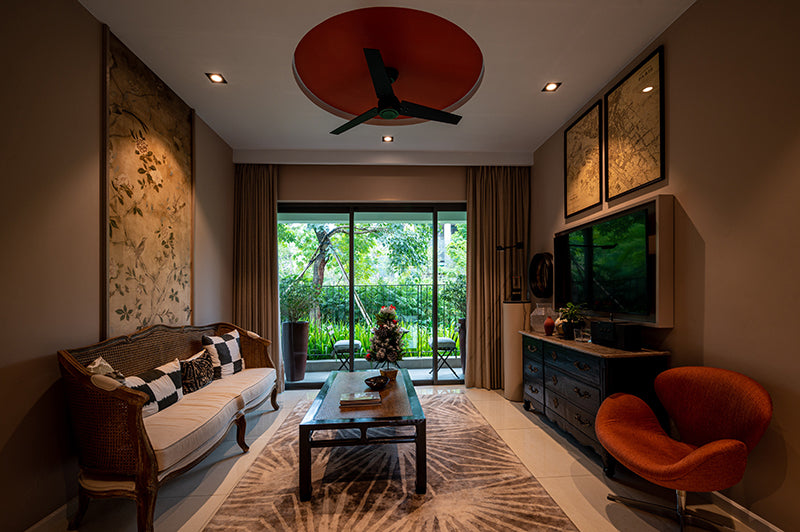
 

A small- to medium-sized listening space. Courtesy of Pexels.com/Huy Quang Nguyễn.

A small- to medium-sized listening space. Courtesy of Pexels.com/Huy Quang Nguyễn.


If you’re a veteran audio person, you may have heard about the room transition frequency, also known as the Schroeder frequency, and that making EQ adjustments to our room’s frequency response above this frequency doesn’t help our cause very much. Why? The short answer is that below the Schroeder frequency, typically between around 100 and 250 Hz, the room acts as a resonator, and above the Schroeder frequency, as a reflector and diffusor of sound.

Therefore, our room’s response can be broken down into two basic parts: the bass region where low-frequency room modes have a significant effect; and the stochastic or “random behavior” zone. The Schroeder frequency is the transition from the bass frequencies and the stochastic zone. (The Schroeder frequency is lower in a smaller room and higher in a larger room.)

The low-frequency region is where room modes create dips and peaks in the bass response, the result of areas of bass cancellation and reinforcement. When room response is measured you can see these peaks and troughs quite easily. (Today there are readily-available software utilities like REW Room EQ Wizard that make sophisticated measurements available to home users.)

The stochastic – midrange to treble – zone also contains modes, peaks and troughs, but they’re much less severe, perhaps more like a closed accordion with the bellows pressed flat up against each other, and the dips and peaks are now so close to each other that they are no longer distinguishable. (Note that because of the stochastic – random – nature of the room’s behavior, you might see subtle changes every time you take a room measurement, but from a practical standpoint, this won’t be anything that you might actually hear as a difference.

So, what can we do about these early reflections and tame our room’s response to them? The first thing is to identify where the points of first reflections are. There is a practical way of identifying them which has become a time-honored audiophile procedure. Get a friend to hold a mirror along the left wall while you sit in your listening position. He should hold the mirror at your eye level. Then ask your friend to move along the wall until you can see the reflection of your left speaker’s tweeter in the mirror. This will be your first reflection point for the left speaker. Mark this point, as this is where you’ll want to apply absorptive room treatment. Repeat the procedure for the right wall and speaker.
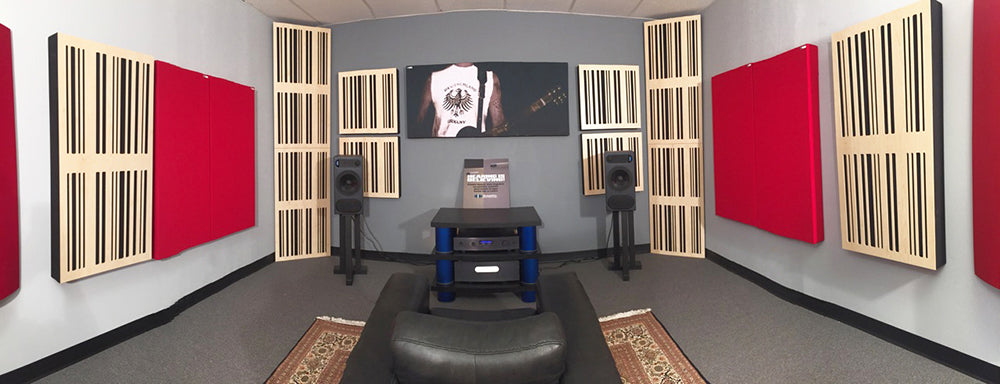
 

Absorptive material placed at the points of first reflections on the side walls. (Other room treatment is also shown.) Courtesy of GIK Acoustics.

Absorptive material placed at the points of first reflections on the side walls. (Other room treatment is also shown.) Courtesy of GIK Acoustics.


We will cover some suggested room treatment considerations in more depth in later installments. But addressing the first reflection points will go a long way in improving the sound of your listening room, right off the bat.

Making EQ adjustments to compensate for low-frequency room nodes is an effective technique for evening out in-room bass response. By why is it that making EQ adjustments in the stochastic zone’s frequencies is generally less significant for improving our sound? It’s because the amount of audio information here is so great that your brain operates as a filter, and ignores a lot of the information. It’s also because, as noted, the higher-frequency modes are very close together and not as severe. EQ can certainly be effective in the midrange and high frequencies to address other issues, like a speaker that’s overly bright, but it should be used judiciously so as not to degrade the overall signal integrity more than is really necessary. Be cautious to generally only adjust to reduce “gremlin peaks “rather than boost vacuous dips, for example.

Add to this the reality is the fact that the measurements obtained by the measurement microphone are not truly representative of what your ears are hearing. Your ears come in pairs, each in a different position to each other, whereas your measurement mic will most likely be a single omnidirectional microphone. The mic is only going to be able to give a representation of what audio signals are being put into the room. Your ears hear a much more sophistically processed and filtered stereo sound, compared to the microphone, which takes in everything and does not filter what it “hears.” (And keep in mind that different measurement mics can have different frequency responses.)

Also consider: microphones sample the sum total of a room’s direct and reflected sound, and off-axis response without differentiating between any of it, as opposed to what your ears hear. That said, measurement software and microphones are valuable tools in measuring the frequency response of rooms, something that can’t be done “by ear” alone!

In Part Two of this series, we’ll briefly look at what may compound the problem of the measurement microphone’s sampling limitations in making adjustments for something other than what we actually hear, and what you can do to help mitigate it in ways to produce great-sounding results. We’ll also cover some free and very inexpensive ways to test your room’s behavior so that you can choose how you wish to best address reflections; look at typical problem areas which very small rooms are blighted with; and identify some pitfalls to avoid. We will also consider some of the benefits of controlled-dispersion speakers, and circumstances where you may choose to use diffusion over absorption.


Header image: well, most of our rooms aren’t that small! Courtesy of Pexels.com/Mahdi Bafande.

More from Issue 175

View All Articles in Issue 175

Search Copper Magazine

#234 A Life in High-End Audio: The Roy Hall Interview, Part One by Frank Doris Sep 07, 2026 #234 Jason Greenlaw Offers His Personal Perspective on Jazz Guitar in Vantage Point by Frank Doris Sep 07, 2026 #234 Transcendent Phoenix: Lucina Yue Brings the Ancient Konghou Into Modern Times by Frank Doris Sep 07, 2026 #234 We Must All Follow Our Bliss by B. Jan Montana Sep 07, 2026 #234 How to Play in a Rock Band, 27: Leveling Up by Frank Doris Sep 07, 2026 #234 Ross Valory: Traveling Into New Musical Territory With All of the Above by Ray Chelstowski Sep 07, 2026 #234 Singer/Songwriter John David Schrader: On the Need to Create by Joe Caplan Sep 07, 2026 #234 The People Who Make Audio Happen: More From T.H.E. Show SoCal 2026 by Harris Fogel Sep 07, 2026 #234 The Vinyl Beat Digs Into the Gadget Box by Rudy Radelic Sep 07, 2026 #234 The Rolling Stones: Foreign Tongues Spoken Loud by Wayne Robins Sep 07, 2026 #234 Musical Moments by Rich Isaacs Sep 07, 2026 #234 Rags for Solo Piano and a Dog: David Chesky's Ragtime Music for the Modern Age by Frankly Speaking Sep 07, 2026 #234 HIGH END 2026, Vienna: Here to Stay by Carsten Barnbeck Sep 07, 2026 #234 From The Audiophile’s Guide: The Two Main Types of Loudpeakers – Box and Panel by Paul McGowan Sep 07, 2026 #234 Letting it Slide by Frank Doris Sep 07, 2026 #234 PS Audio in the News by PS Audio Staff Sep 07, 2026 #234 Long Playing by Peter Xeni Sep 07, 2026 #234 La Mer by B. Jan Montana Sep 07, 2026 #233 A Report From The Total Hi-Fi Experience Show SoCal 2026 by B. Jan Montana Aug 03, 2026 #233 Bluegrass Meets Country, Folk, Jazz and More in All That We Carried by The Squid City Slingers by Frank Doris Aug 03, 2026 #233 Corey Glover and One Tribe Nation: A Variegated Musical Collective by Ray Chelstowski Aug 03, 2026 #233 Excursions with Clive: The Late Clive Davis, A Personal History by Wayne Robins Aug 03, 2026 #233 AI, Art, and Music: A Conversation With Synthography Art by Joe Caplan Aug 03, 2026 #233 New American Symphonies: A Rediscovered Gem and a Vital Contemporary Work by Frank Doris Aug 03, 2026 #233 The Vinyl Beat: Genesis, the Dave Clark Five, Antonio Carlos Jobim and More by Rudy Radelic Aug 03, 2026 #233 How to Play in a Rock Band, 26: When It's Time to Record Your Music by Frank Doris Aug 03, 2026 #233 More From T.H.E. Show 2026, and the People Who Made it Happen by Harris Fogel Aug 03, 2026 #233 Underappreciated Artists, Part Three: Icehouse by Rich Isaacs Aug 03, 2026 #233 The Surprisingly Rich and Varied Music of Somalia by Steve Kindig Aug 03, 2026 #233 A Remarkable Discographic Legacy: The LP Recordings of the Basel Symphony Orchestra by Stephan Haberthür Aug 03, 2026 #233 From The Audiophile’s Guide: The Importance of Loudspeakers by Paul McGowan Aug 03, 2026 #233 From Swimming Pool to New Listening Room: A Conversation with Norman Varney of AV RoomService by Gilles Laferrière Aug 03, 2026 #233 PS Audio in the News by PS Audio Staff Aug 03, 2026 #233 Audio Jewelry by Peter Xeni Aug 03, 2026 #233 Enrich Your Life by Frank Doris Aug 03, 2026 #233 The Searcher by James Schrimpf Aug 03, 2026 #232 What came first: Art or Music? A Conversation With Artist Jose Acosta by Joe Caplan Jul 06, 2026 #232 Blow By Blow: The Jeff Beck Story: An Insightful Book About a Guitar Icon by Ray Chelstowski Jul 06, 2026 #232 Creed Over Camaraderie? by B. Jan Montana Jul 06, 2026 #232 Chronicles of a Sound Pilgrim at the 2026 Montreal Audiofest by Hugues Morin Jul 06, 2026 #232 The Vinyl Beat: Summer Grooves by Rudy Radelic Jul 06, 2026 #232 Hibbing Hillbilly Dylan's Acoustic Rock by Wayne Robins Jul 06, 2026 #232 Quad Quads and Plasmatronics Tweeters: An Extraordinary System Comes to Life by Frank Doris Jul 06, 2026 #232 In Praise of Live Music, Once Again by Ted Shafran Jul 06, 2026 #232 Allnic Audio’s L-9000 Preamplifier: Design and Engineering Innovation by Howard Kneller Jul 06, 2026 #232 “Best Of” Lists and Rage Bait: Enough Already by Frank Doris Jul 06, 2026 #232 Quick Takes: Bud Shank, Paulo Almeida, Jakob Dreyer, Tim Eriksen and Peter Irvine by Frank Doris Jul 06, 2026

Dealing With Small-Room Acoustics, Part One

Dealing With Small-Room Acoustics, Part One

Does this complaint sound familiar? “I have a small room and I just can’t get it to sound good.”

Many if not most of us have small to medium-sized listening rooms. One of the biggest problems of small room acoustics is that of the first reflections off of the walls, floors and ceilings. (For those who may be newer to the subject, first reflection points are just what the term implies – the indirect sound from the loudspeakers that reflects or bounces off the side walls, floor, and ceiling. These arrive later in time than the direct sound from the speakers, and can degrade the overall sound, frequency response, and imaging.) But there are many other considerations I’d also like to cover.

Put simply, small rooms encompass practically all domestic living spaces, with the exceedingly rare exception of someone’s domestic listening space being in a mansion or a barn, or rarer still, on par with an auditorium or hall. For most of us, our listening spaces constitute the “small” or “really small” category.

It’s helpful to realize that the bigger our room is, the more the speakers influence the overall sound, and conversely, the smaller the room, the greater the room’s effect on what we hear. (That said, it’s important to match the size of the speakers to the size of the room, a topic we’ll get into in a future installment. This also assumes you’re not doing near-field listening close to the speakers, which mitigates a lot of room issues but is not for everyone.) And when we talk about rooms, a big part of what we’re really talking about are the actual surfaces of the room, which define what we hear along with the effect of the room dimensions themselves.

One outstanding and mostly overlooked example of how to improve your room acoustics is that of installing a suspended or drop ceiling with absorptive tiles. (Metal ceiling tiles need not apply!) Because of the fibrous nature of acoustical tiles and the volume of air between the tiles and the ceiling, this acts as a huge ceiling-based bass trap, and is excellent for quelling unwanted vertically-traveling bass nodes (but not the horizontal ones). If floor footprint area is at a serious premium, installing a drop ceiling could be especially worth considering, albeit it’s a relatively expensive and not necessarily practical or aesthetically pleasing option – and you still have the issue of having to manage your horizontally-traveling reflection points and room nodes, areas of bass peaks and dips that compound and cancel each other. (See my articles, “Sub Missive” in Issue 137, “Subliminal or Sublime Bass?” in Issue 138, “Standing Room Only” in Issue 139, “The Audio Butterfly Effect” in Issue 143 and “Finding a Place for Bass” in Issue 144 for more insights.)

Okay, okay, you may well hate this suspended ceiling idea. Don’t worry; there are plenty of other ways to optimize the acoustics of smaller listening rooms. Another approach is the use of multiple subwoofers, rather than just one, or as in many peoples’ cases, none at all. The use of multiple subs can create a more even in-room bass response, as discussed in “Standing Room Only” and “The Audio Butterfly Effect.”


A small- to medium-sized listening space. Courtesy of Pexels.com/Huy Quang Nguyễn.

A small- to medium-sized listening space. Courtesy of Pexels.com/Huy Quang Nguyễn.


If you’re a veteran audio person, you may have heard about the room transition frequency, also known as the Schroeder frequency, and that making EQ adjustments to our room’s frequency response above this frequency doesn’t help our cause very much. Why? The short answer is that below the Schroeder frequency, typically between around 100 and 250 Hz, the room acts as a resonator, and above the Schroeder frequency, as a reflector and diffusor of sound.

Therefore, our room’s response can be broken down into two basic parts: the bass region where low-frequency room modes have a significant effect; and the stochastic or “random behavior” zone. The Schroeder frequency is the transition from the bass frequencies and the stochastic zone. (The Schroeder frequency is lower in a smaller room and higher in a larger room.)

The low-frequency region is where room modes create dips and peaks in the bass response, the result of areas of bass cancellation and reinforcement. When room response is measured you can see these peaks and troughs quite easily. (Today there are readily-available software utilities like REW Room EQ Wizard that make sophisticated measurements available to home users.)

The stochastic – midrange to treble – zone also contains modes, peaks and troughs, but they’re much less severe, perhaps more like a closed accordion with the bellows pressed flat up against each other, and the dips and peaks are now so close to each other that they are no longer distinguishable. (Note that because of the stochastic – random – nature of the room’s behavior, you might see subtle changes every time you take a room measurement, but from a practical standpoint, this won’t be anything that you might actually hear as a difference.

So, what can we do about these early reflections and tame our room’s response to them? The first thing is to identify where the points of first reflections are. There is a practical way of identifying them which has become a time-honored audiophile procedure. Get a friend to hold a mirror along the left wall while you sit in your listening position. He should hold the mirror at your eye level. Then ask your friend to move along the wall until you can see the reflection of your left speaker’s tweeter in the mirror. This will be your first reflection point for the left speaker. Mark this point, as this is where you’ll want to apply absorptive room treatment. Repeat the procedure for the right wall and speaker.


Absorptive material placed at the points of first reflections on the side walls. (Other room treatment is also shown.) Courtesy of GIK Acoustics.

Absorptive material placed at the points of first reflections on the side walls. (Other room treatment is also shown.) Courtesy of GIK Acoustics.


We will cover some suggested room treatment considerations in more depth in later installments. But addressing the first reflection points will go a long way in improving the sound of your listening room, right off the bat.

Making EQ adjustments to compensate for low-frequency room nodes is an effective technique for evening out in-room bass response. By why is it that making EQ adjustments in the stochastic zone’s frequencies is generally less significant for improving our sound? It’s because the amount of audio information here is so great that your brain operates as a filter, and ignores a lot of the information. It’s also because, as noted, the higher-frequency modes are very close together and not as severe. EQ can certainly be effective in the midrange and high frequencies to address other issues, like a speaker that’s overly bright, but it should be used judiciously so as not to degrade the overall signal integrity more than is really necessary. Be cautious to generally only adjust to reduce “gremlin peaks “rather than boost vacuous dips, for example.

Add to this the reality is the fact that the measurements obtained by the measurement microphone are not truly representative of what your ears are hearing. Your ears come in pairs, each in a different position to each other, whereas your measurement mic will most likely be a single omnidirectional microphone. The mic is only going to be able to give a representation of what audio signals are being put into the room. Your ears hear a much more sophistically processed and filtered stereo sound, compared to the microphone, which takes in everything and does not filter what it “hears.” (And keep in mind that different measurement mics can have different frequency responses.)

Also consider: microphones sample the sum total of a room’s direct and reflected sound, and off-axis response without differentiating between any of it, as opposed to what your ears hear. That said, measurement software and microphones are valuable tools in measuring the frequency response of rooms, something that can’t be done “by ear” alone!

In Part Two of this series, we’ll briefly look at what may compound the problem of the measurement microphone’s sampling limitations in making adjustments for something other than what we actually hear, and what you can do to help mitigate it in ways to produce great-sounding results. We’ll also cover some free and very inexpensive ways to test your room’s behavior so that you can choose how you wish to best address reflections; look at typical problem areas which very small rooms are blighted with; and identify some pitfalls to avoid. We will also consider some of the benefits of controlled-dispersion speakers, and circumstances where you may choose to use diffusion over absorption.


Header image: well, most of our rooms aren’t that small! Courtesy of Pexels.com/Mahdi Bafande.

0 comments

Leave a comment

0 Comments

Your avatar

Loading comments...

🗑️ Delete Comment

Enter moderator password to delete this comment:

✏️ Edit Comment

Enter your email to verify ownership: