COPPER

A PS Audio Publication

Issue 160 • Free Online Magazine

Issue 160 Revolutions Per Minute

Around the World In 80 Lathes, Part Ten

Around the World In 80 Lathes, Part Ten

Previous installments covered the earlier history of Neumann and Scully lathes.
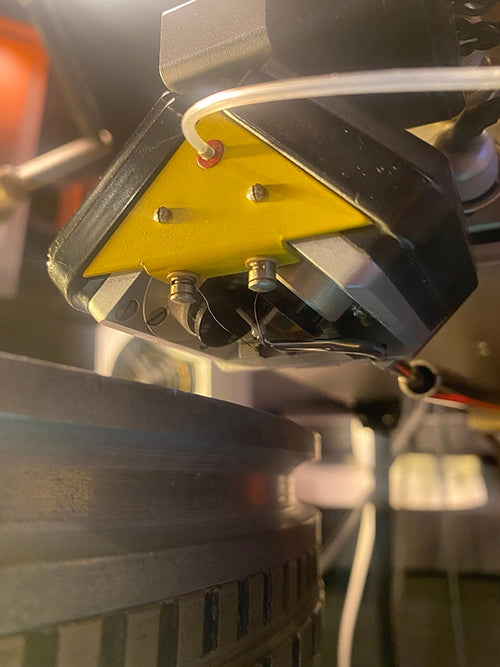
 

A Neumann SX-74 cutter head, with helium tub in the front. Courtesy of Greg Reierson, Rare Form Mastering in Minneapolis, Minnesota.

A Neumann SX-74 cutter head, with helium tub in the front. Courtesy of Greg Reierson, Rare Form Mastering, Minneapolis, Minnesota.


The Neumann SX-74 cutter head, introduced to accompany the company’s VMS-70 record cutting lathe, shared its external parts with the very similar Neumann SX-68. Both of these cutter heads were based on the long-established principle of motional feedback employed instead of mechanical damping, to create a transducer with a linear response across the audible spectrum. The earlier Teldec/Neumann ZS 90/45, SX-45, SX-15 cutter heads had also used motional feedback (but in a different configuration), as did their monophonic ES-59, and many competing products. The Westrex, HAECO, Ortofon and Fairchild stereophonic cutter heads, predating the SX-74, also all relied on motional feedback. So did a few monophonic cutter heads, apart from the aforementioned ES-59. The Westrex 2B used motional feedback, as well as some early Ortofon monophonic heads, but the originators of the idea were Leonard Vieth and Charles F. Wiebusch, who patented the concept for a vertical recording head in the 1930s. It was very similar in layout to one half of a Neumann SX-74 (or a Westrex 3D for that matter).
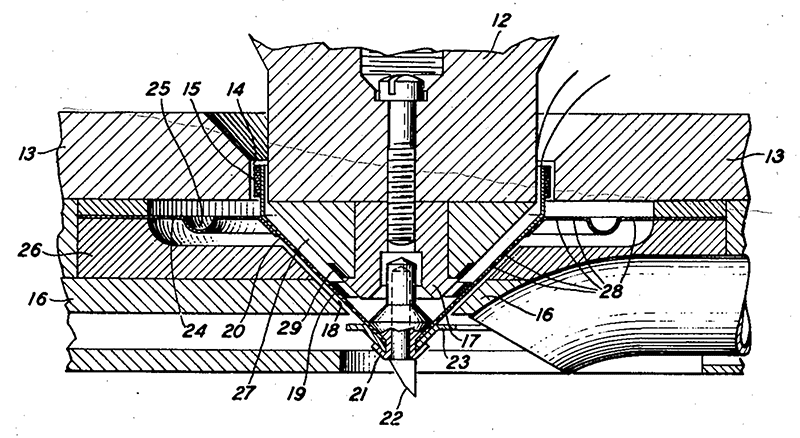
A drawing of the internal construction of Vieth and Wiebusch, from their patent, Vieth et. al Vibratory System, June 6, 1939.

A drawing of the internal construction of Vieth and Wiebusch, from their patent, Vieth et. al Vibratory System, June 6, 1939.


For pretty much the entire stereophonic era, vinyl records were cut using motional feedback cutter heads. While the concept has been encountered in loudspeaker design, its implementation in cutter heads warrants some explanation. We can begin by looking at a plain-vanilla woofer design. We have a magnet system where the magnetic field is concentrated in a gap, and in this gap is placed the voice coil, consisting of wire wound around a former. At the end of this former, the speaker cone is attached. At the narrow end of that cone (in the middle of the driver) is what is called a spider, a flexible membrane that allows linear motion in and out, but limits lateral or rotary motion.

At the wide end of the cone is the surround, which again is designed to permit linear motion in and out, but to limit lateral or rotary motion.

The spider and surround form the suspension system of the loudspeaker driver, guiding it along the range of its excursion. The suspension system is what keeps the coil centered in the gap of the magnetic circuit and provides the restoring (mechanical) force for the coil to return to its rest position after traveling in or out. In a typical loudspeaker driver, the suspension components are made of rubber, fabric, or other resilient materials, that also provide damping.

Loudspeaker drivers, cutter heads, microphones and other similar transducers are resonant systems (as are many musical instruments). Their resonant frequency depends on the moving mass and the stiffness of the system. A resonant system will grossly accentuate the resonant frequency and will therefore not have a linear frequency response. Unless, that is, some means of damping is provided, to reduce the amplitude of the resonance and flatten the response of the system. In loudspeaker drivers, this damping is provided primarily by the suspension components.

Early monophonic cutter heads employed similar concepts, all of which broadly fall under the category of mechanical damping.


A selection of Presto monophonic cutter heads, employing mechanical damping, in the author’s lab, where repairs and modifications of such equipment frequently takes place. Courtesy of Agnew Analog Reference Instruments.


Cutter heads do not have spiders and surrounds, and they do not have cones either, as they don’t need to move air; they need to move a microscopic cutting stylus. Typically, early cutter heads would rely on pieces of rubber attached to the moving armature to provide damping. If the damping material deteriorated with age or became damaged, the system’s response would no longer be flat.

Motional feedback cutter heads, on the other hand, don’t require any damping materials. They did away with mechanical damping entirely and replaced it with electrical damping. Here, the coil suspension is essentially a spring, with no damping properties other than some unintentional friction. The open-loop response of the system (with the motional feedback disconnected) is very far from flat, with an extremely pronounced resonant frequency. A typical example of such a system consists of two coils: a drive coil that sets the system in motion, driven by a cutting amplifier, and a feedback coil, which produces a signal proportional to the velocity of the moving system. At the system’s resonant frequency, the velocity of the drive coil is much greater than at other frequencies, for the same amount of power  to the drive coil. Conversely, the output of the feedback coil is also much greater. The feedback coil signal is inverted to be of opposite polarity to the signal going to the cutter head, and sent back to the cutting amplifier as negative feedback.
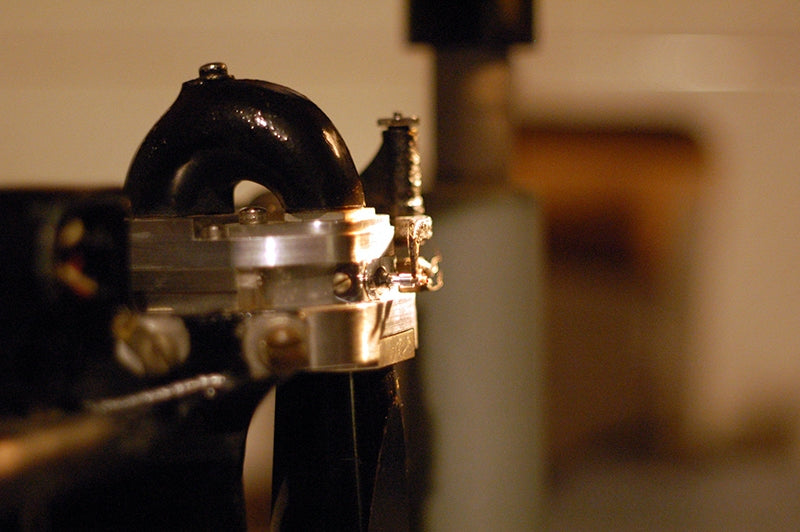
 

The Westrex 2B cutter head, one of the biggest, heaviest and best-sounding monophonic motional feedback cutter heads out there. Courtesy of Agnew Analog Reference Instruments.

The Westrex 2B cutter head, one of the biggest, heaviest and best-sounding monophonic motional feedback cutter heads out there. Courtesy of Agnew Analog Reference Instruments.


The negative feedback signal essentially regulates the output of the cutting amplifier, reducing its output at resonance and increasing it at other frequencies. The closed-loop response of the system (with motional feedback applied) is therefore flat. However, this flattening is only effective within the range of accurate operation of the feedback coil. Outside this range, the response falls off rapidly. There are several factors conspiring to reduce the accuracy of such a system, so it is not a trivial task to ensure stable operation. Instability can be quite dramatic. In the case of the SX-74, it is normally used with the Neuman SAL-74 cutting amplifier, which is capable of putting out 1200 watts of peak momentary power, which would melt the coils in milliseconds at that power dissipation! Instability can be caused by phase shift between the signal to the drive coil and the signal generated by the feedback coil, as a result of a combination of electromechanical system parameters. If any instability occurs, it can cause the system to oscillate at full power, at a very high frequency, instantly destroying the cutter head and sometimes also the amplifier electronics! By the time the smoke becomes visible there is not much left of the coils, and nothing you can do about it other than sending the head off for repair. This type of repair on a Neumann SX-74 can easily cost upwards of $5,000, along with significant downtime.
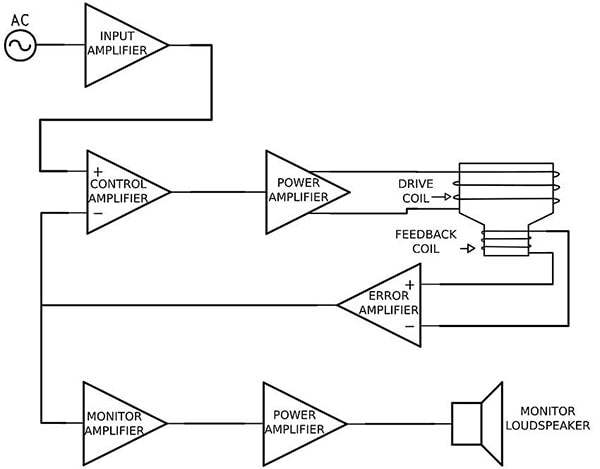
 

A block diagram of a motional feedback cutter head system, from "An Investigation of Motional Feedback Disk Recording System Design" by author J. I. Agnew, in the November 2018 issue of the Journal of the Audio Engineering Society.

A block diagram of a motional feedback cutter head system, from “An Investigation of Motional Feedback Disk Recording System Design” by author J. I. Agnew, in the November 2018 issue of the Journal of the Audio Engineering Society.


The feedback loop is comprised of not only the cutter head, but also the cutting amplifier electronics, which consist of the drive amplifier, feedback amplifier, current and temperature measuring instrumentation, cutter head protection devices, and even the wiring. Excessive wiring capacitance, for instance, can also cause instability. As such, the electronics are very much part of the entire cutter head system, as evidenced by the fact that even as far back as the 1930s, the patents of Vieth and Wiebusch covered both the cutter head and the associated electronics all working together.

In the next episode, we will navigate our time capsule deeper into the coiled paths of cutter head territory!

Previous installments appeared in Issues 159, 158, 157, 156, 155, 154153, 152, and 151.

Header image: Neumann SX-74 cutter head on a Neumann VMS-70 lathe. Courtesy of Greg Reierson, Rare Form Mastering.

More from Issue 160

View All Articles in Issue 160

Search Copper Magazine

#227 Seth Lewis Gets in the Groove With Take a Look Around: a Tribute to the Meters by Frank Doris Feb 02, 2026 #227 Passport to Sound: May Anwar’s Audio Learning Experience for Young People by Frank Doris Feb 02, 2026 #227 Conjectures on Cosmic Consciousness by B. Jan Montana Feb 02, 2026 #227 The Big Takeover Turns 45 by Wayne Robins Feb 02, 2026 #227 Music and Chocolate: On the Sensory Connection by Joe Caplan Feb 02, 2026 #227 Singer/Songwriter Chris Berardo: Getting Wilder All the Time by Ray Chelstowski Feb 02, 2026 #227 The Earliest Stars of Country Music, Part One by Jeff Weiner Feb 02, 2026 #227 The Vinyl Beat Goes Down to Tijuana (By Way of Los Angeles), Part Two by Rudy Radelic Feb 02, 2026 #227 How to Play in a Rock Band, 20: On the Road With Blood, Sweat & Tears’ Guitarist Gabe Cummins by Frank Doris Feb 02, 2026 #227 From The Audiophile’s Guide: Audio Specs and Measuring by Paul McGowan Feb 02, 2026 #227 Our Brain is Always Listening by Peter Trübner Feb 02, 2026 #227 PS Audio in the News by PS Audio Staff Feb 02, 2026 #227 The Listening Chair: Sleek Style and Sound From the Luxman L3 by Howard Kneller Feb 02, 2026 #227 The Los Angeles and Orange County Audio Society Celebrates Its 32nd Anniversary, Honoring David and Sheryl Lee Wilson and Bernie Grundman by Harris Fogel Feb 02, 2026 #227 Back to My Reel-to-Reel Roots, Part 26: Half Full – Not Half Empty, Redux by Ken Kessler Feb 02, 2026 #227 That's What Puzzles Us... by Frank Doris Feb 02, 2026 #227 Record-Breaking by Peter Xeni Feb 02, 2026 #227 The Long and Winding Road by B. Jan Montana Feb 02, 2026 #226 JJ Murphy’s Sleep Paralysis is a Genre-Bending Musical Journey Through Jazz, Fusion and More by Frank Doris Jan 05, 2026 #226 Stewardship by Consent by B. Jan Montana Jan 05, 2026 #226 Food, Music, and Sensory Experience: An Interview With Professor Jonathan Zearfoss of the Culinary Institute of America by Joe Caplan Jan 05, 2026 #226 Studio Confidential: A Who’s Who of Recording Engineers Tell Their Stories by Frank Doris Jan 05, 2026 #226 Pilot Radio is Reborn, 50 Years Later: Talking With CEO Barak Epstein by Frank Doris Jan 05, 2026 #226 The Vinyl Beat Goes Down to Tijuana (By Way of Los Angeles), Part One by Rudy Radelic Jan 05, 2026 #226 Capital Audiofest 2025: Must-See Stereo, Part Two by Frank Doris Jan 05, 2026 #226 My Morning Jacket’s Carl Broemel and Tyler Ramsey Collaborate on Their Acoustic Guitar Album, Celestun by Ray Chelstowski Jan 05, 2026 #226 The People Who Make Audio Happen: CanJam SoCal 2025, Part Two by Harris Fogel Jan 05, 2026 #226 How to Play in a Rock Band, 19: Touring Can Make You Crazy, Part One by Frank Doris Jan 05, 2026 #226 Linda Ronstadt Goes Bigger by Wayne Robins Jan 05, 2026 #226 From The Audiophile’s Guide: Active Room Correction and Digital Signal Processing by Paul McGowan Jan 05, 2026 #226 PS Audio in the News by Frank Doris Jan 05, 2026 #226 Back to My Reel-to-Reel Roots, Part 25: Half-Full, Not Empty by Ken Kessler Jan 05, 2026 #226 Happy New Year! by Frank Doris Jan 05, 2026 #226 Turn It Down! by Peter Xeni Jan 05, 2026 #226 Ghost Riders by James Schrimpf Jan 05, 2026 #226 A Factory Tour of Audio Manufacturer German Physiks by Markus "Marsu" Manthey Jan 04, 2026 #225 Capital Audiofest 2025: Must-See Stereo, Part One by Frank Doris Dec 01, 2025 #225 Otis Taylor and the Electrics Delivers a Powerful Set of Hypnotic Modern Blues by Frank Doris Dec 01, 2025 #225 A Christmas Miracle by B. Jan Montana Dec 01, 2025 #225 T.H.E. Show New York 2025, Part Two: Plenty to See, Hear, and Enjoy by Frank Doris Dec 01, 2025 #225 Underappreciated Artists, Part One: Martin Briley by Rich Isaacs Dec 01, 2025 #225 Rock and Roll is Here to Stay by Wayne Robins Dec 01, 2025 #225 A Lifetime of Holiday Record (and CD) Listening by Rudy Radelic Dec 01, 2025 #225 Little Feat: Not Saying Goodbye, Not Yet by Ray Chelstowski Dec 01, 2025 #225 How to Play in a Rock Band, Part 18: Dealing With Burnout by Frank Doris Dec 01, 2025 #225 The People Who Make Audio Happen: CanJam SoCal 2025 by Harris Fogel Dec 01, 2025 #225 Chicago’s Sonic Sanctuaries: Four Hi‑Fi Listening Bars Channeling the Jazz‑Kissa Spirit by Olivier Meunier-Plante Dec 01, 2025

Around the World In 80 Lathes, Part Ten

Around the World In 80 Lathes, Part Ten

Previous installments covered the earlier history of Neumann and Scully lathes.


A Neumann SX-74 cutter head, with helium tub in the front. Courtesy of Greg Reierson, Rare Form Mastering in Minneapolis, Minnesota.

A Neumann SX-74 cutter head, with helium tub in the front. Courtesy of Greg Reierson, Rare Form Mastering, Minneapolis, Minnesota.


The Neumann SX-74 cutter head, introduced to accompany the company’s VMS-70 record cutting lathe, shared its external parts with the very similar Neumann SX-68. Both of these cutter heads were based on the long-established principle of motional feedback employed instead of mechanical damping, to create a transducer with a linear response across the audible spectrum. The earlier Teldec/Neumann ZS 90/45, SX-45, SX-15 cutter heads had also used motional feedback (but in a different configuration), as did their monophonic ES-59, and many competing products. The Westrex, HAECO, Ortofon and Fairchild stereophonic cutter heads, predating the SX-74, also all relied on motional feedback. So did a few monophonic cutter heads, apart from the aforementioned ES-59. The Westrex 2B used motional feedback, as well as some early Ortofon monophonic heads, but the originators of the idea were Leonard Vieth and Charles F. Wiebusch, who patented the concept for a vertical recording head in the 1930s. It was very similar in layout to one half of a Neumann SX-74 (or a Westrex 3D for that matter).

A drawing of the internal construction of Vieth and Wiebusch, from their patent, Vieth et. al Vibratory System, June 6, 1939.

A drawing of the internal construction of Vieth and Wiebusch, from their patent, Vieth et. al Vibratory System, June 6, 1939.


For pretty much the entire stereophonic era, vinyl records were cut using motional feedback cutter heads. While the concept has been encountered in loudspeaker design, its implementation in cutter heads warrants some explanation. We can begin by looking at a plain-vanilla woofer design. We have a magnet system where the magnetic field is concentrated in a gap, and in this gap is placed the voice coil, consisting of wire wound around a former. At the end of this former, the speaker cone is attached. At the narrow end of that cone (in the middle of the driver) is what is called a spider, a flexible membrane that allows linear motion in and out, but limits lateral or rotary motion.

At the wide end of the cone is the surround, which again is designed to permit linear motion in and out, but to limit lateral or rotary motion.

The spider and surround form the suspension system of the loudspeaker driver, guiding it along the range of its excursion. The suspension system is what keeps the coil centered in the gap of the magnetic circuit and provides the restoring (mechanical) force for the coil to return to its rest position after traveling in or out. In a typical loudspeaker driver, the suspension components are made of rubber, fabric, or other resilient materials, that also provide damping.

Loudspeaker drivers, cutter heads, microphones and other similar transducers are resonant systems (as are many musical instruments). Their resonant frequency depends on the moving mass and the stiffness of the system. A resonant system will grossly accentuate the resonant frequency and will therefore not have a linear frequency response. Unless, that is, some means of damping is provided, to reduce the amplitude of the resonance and flatten the response of the system. In loudspeaker drivers, this damping is provided primarily by the suspension components.

Early monophonic cutter heads employed similar concepts, all of which broadly fall under the category of mechanical damping.


A selection of Presto monophonic cutter heads, employing mechanical damping, in the author’s lab, where repairs and modifications of such equipment frequently takes place. Courtesy of Agnew Analog Reference Instruments.


Cutter heads do not have spiders and surrounds, and they do not have cones either, as they don’t need to move air; they need to move a microscopic cutting stylus. Typically, early cutter heads would rely on pieces of rubber attached to the moving armature to provide damping. If the damping material deteriorated with age or became damaged, the system’s response would no longer be flat.

Motional feedback cutter heads, on the other hand, don’t require any damping materials. They did away with mechanical damping entirely and replaced it with electrical damping. Here, the coil suspension is essentially a spring, with no damping properties other than some unintentional friction. The open-loop response of the system (with the motional feedback disconnected) is very far from flat, with an extremely pronounced resonant frequency. A typical example of such a system consists of two coils: a drive coil that sets the system in motion, driven by a cutting amplifier, and a feedback coil, which produces a signal proportional to the velocity of the moving system. At the system’s resonant frequency, the velocity of the drive coil is much greater than at other frequencies, for the same amount of power  to the drive coil. Conversely, the output of the feedback coil is also much greater. The feedback coil signal is inverted to be of opposite polarity to the signal going to the cutter head, and sent back to the cutting amplifier as negative feedback.


The Westrex 2B cutter head, one of the biggest, heaviest and best-sounding monophonic motional feedback cutter heads out there. Courtesy of Agnew Analog Reference Instruments.

The Westrex 2B cutter head, one of the biggest, heaviest and best-sounding monophonic motional feedback cutter heads out there. Courtesy of Agnew Analog Reference Instruments.


The negative feedback signal essentially regulates the output of the cutting amplifier, reducing its output at resonance and increasing it at other frequencies. The closed-loop response of the system (with motional feedback applied) is therefore flat. However, this flattening is only effective within the range of accurate operation of the feedback coil. Outside this range, the response falls off rapidly. There are several factors conspiring to reduce the accuracy of such a system, so it is not a trivial task to ensure stable operation. Instability can be quite dramatic. In the case of the SX-74, it is normally used with the Neuman SAL-74 cutting amplifier, which is capable of putting out 1200 watts of peak momentary power, which would melt the coils in milliseconds at that power dissipation! Instability can be caused by phase shift between the signal to the drive coil and the signal generated by the feedback coil, as a result of a combination of electromechanical system parameters. If any instability occurs, it can cause the system to oscillate at full power, at a very high frequency, instantly destroying the cutter head and sometimes also the amplifier electronics! By the time the smoke becomes visible there is not much left of the coils, and nothing you can do about it other than sending the head off for repair. This type of repair on a Neumann SX-74 can easily cost upwards of $5,000, along with significant downtime.


A block diagram of a motional feedback cutter head system, from "An Investigation of Motional Feedback Disk Recording System Design" by author J. I. Agnew, in the November 2018 issue of the Journal of the Audio Engineering Society.

A block diagram of a motional feedback cutter head system, from “An Investigation of Motional Feedback Disk Recording System Design” by author J. I. Agnew, in the November 2018 issue of the Journal of the Audio Engineering Society.


The feedback loop is comprised of not only the cutter head, but also the cutting amplifier electronics, which consist of the drive amplifier, feedback amplifier, current and temperature measuring instrumentation, cutter head protection devices, and even the wiring. Excessive wiring capacitance, for instance, can also cause instability. As such, the electronics are very much part of the entire cutter head system, as evidenced by the fact that even as far back as the 1930s, the patents of Vieth and Wiebusch covered both the cutter head and the associated electronics all working together.

In the next episode, we will navigate our time capsule deeper into the coiled paths of cutter head territory!

Previous installments appeared in Issues 159, 158, 157, 156, 155, 154153, 152, and 151.

Header image: Neumann SX-74 cutter head on a Neumann VMS-70 lathe. Courtesy of Greg Reierson, Rare Form Mastering.

0 comments

Leave a comment

0 Comments

Your avatar

Loading comments...

🗑️ Delete Comment

Enter moderator password to delete this comment:

✏️ Edit Comment

Enter your email to verify ownership: