Copper Magazine · Issue 167 · A free PS Audio publication
Issue 167 Revolutions Per Minute

Around the World In 80 Lathes, Part 17

Around the World In 80 Lathes, Part 17

In the previous episode (Issue 166), we looked at the work of Flo Kaufmann of FloKaSon in Switzerland, the man who decided to preserve the Neumann disk recording legacy by keeping vintage Neumann lathes running. In Part 12 of this series (Issue 162) we had looked at Len Horowitz and his nephew, Jacob Horowitz, of the History of Recorded Sound in Los Angeles, California. Len was a Westrex employee who decided to preserve the Westrex disk recording legacy by purchasing their disk recording department in 1995, when it closed down.

As a result of the efforts of the aforementioned gentlemen, a number of Neumann and Westrex products are still in use to this day. There is also a whole other world of individuals who have been instrumental in preserving disk recording equipment and technology in a number of ways. It’s a bit of a grassroots movement, of people experimenting with ways of using disk recording equipment with relatively low resources and plenty of creativity. At this point, my dear readers, I must warn you that we will be exiting audiophile territory and entering a world where sound quality may not be a primary concern, or any concern at all! However, no discussion of disk recording at this stage could be considered complete without a mention of the individuals who never gave up on the vinyl record and kept making records with whatever means they had available, just to keep the medium alive.

It is largely through their efforts that a lot of equipment was rescued from the scrapyard and a lot of the know-how was preserved. In this respect, I believe that while the sound quality of the products of this scene may not always be up to my (admittedly high) standards, they are of major historical significance in the study of the disk record as a medium.

We could perhaps trace the history of this movement in the work of Emory Cook, who realized in the 1950s that certain underprivileged and distant small markets could not sustain a pressing plant in the traditional sense, which needs to produce a certain amount of output in order to be economically viable. These markets had historically been underserved in terms of the availability of recordings to the general public. One of the many innovations of Emory Cook was the development of a press that worked with sintered vinyl instead of extruded vinyl. It was slow, but it could be operated for very small runs. It did not require the usual complex industrial setup around the press, so the idea was that a record store could have one of these in the back room. They could display a catalog of available titles, but not carry any stock, and  would press the titles that the customer would choose on demand, while they waited. It was a groundbreaking idea and saw limited implementation in some Caribbean islands.

Pretty much at the opposite end of the world, in the 1980s Peter King in New Zealand put together a custom disk recording lathe and restored a couple of lathes he got from the BBC, using washing machine parts, with the aim of cutting records one by one directly on plastic. After much experimentation, he settled on the use of polycarbonate, of the type commonly used in roofing, and also used the same material to build the roof of the building that housed his workshop!
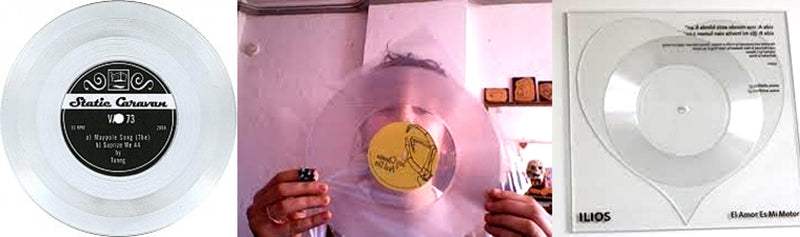
 

From Peter King's website: http://peterkinglathecutrecords.co.nz/history.htm.

From Peter King’s website: http://peterkinglathecutrecords.co.nz/history.htm.


Back to the other end of the world, sometime later, Michael Dixon, a lathe cutting artist, lathe restorer, and teacher based in Tucson, Arizona decided to restore vintage Presto (and sometimes other makes such as Rek-O-Kut) lathes. Inspired by the work of Peter King, Dixon cuts records one by one on plastic blanks. Some of these are works of visual as well as sonic art. He has become the Presto lathe expert, restoring and selling these machines and offering advice and training as well as using them himself.
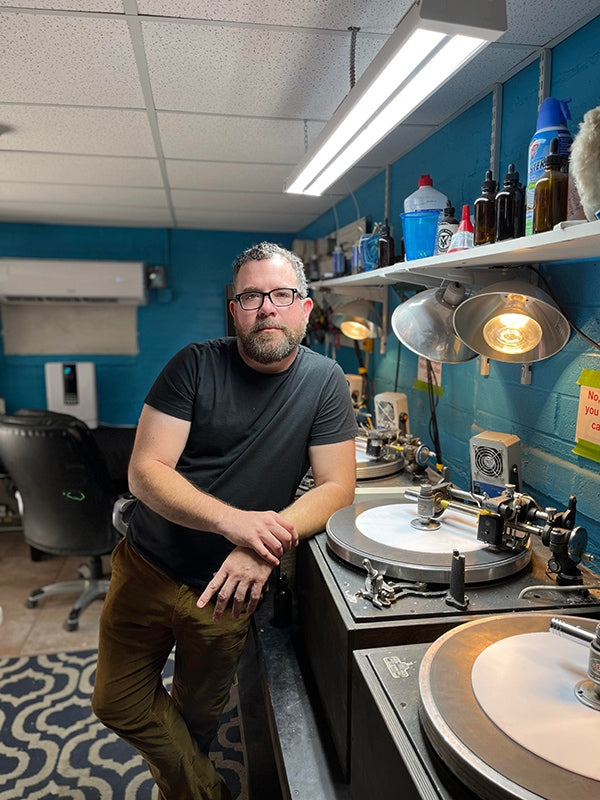
 

Michael Dixon of Tuscon, Arizona, lathe cutting artist, lathe restorer, and teacher. www.michaeldixonvinylart.com.

Michael Dixon of Tuscon, Arizona, lathe cutting artist, lathe restorer, and teacher. www.michaeldixonvinylart.com.


This revolution was promptly joined by several others, and coordinated through an internet forum called the Secret Society of Lathe Trolls, created by Steve Espinola, who is known as a restorer of vintage electric pianos under the name Doc Wurly. He started the forum hoping to get some information on a vintage lathe he had found, but it soon attracted every practitioner and expert of the art the world over, and expanded into a major resource of information and a place where ideas can be exchanged.

Others kept on joining in, and younger faces started appearing, thereby ensuring that there is indeed a younger generation interested in carrying the medium into the new millennium.
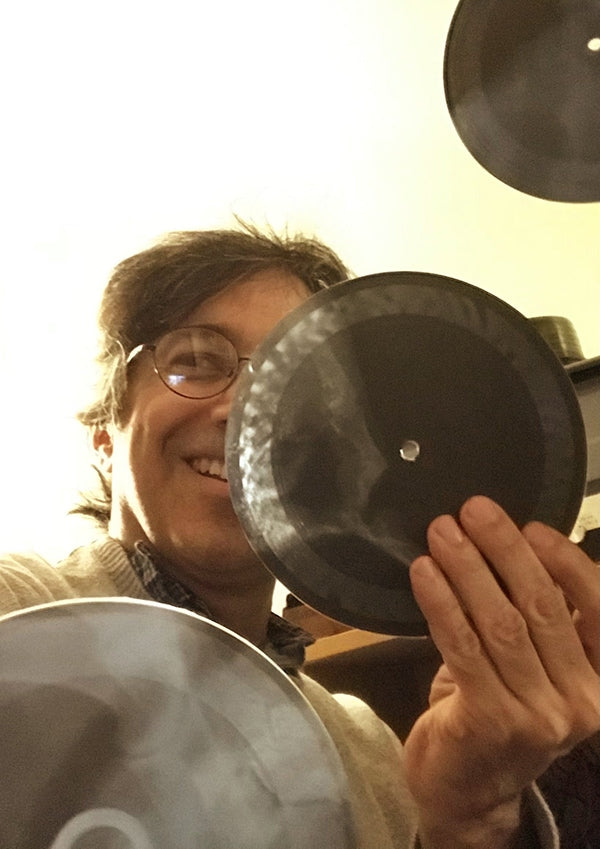
 

Steve Espinola, founder/administrator of Lathe Trolls (<a href="http://www.lathetrolls.com">www.lathetrolls.com</a>), Brooklyn, New York.

Steve Espinola, founder/administrator of Lathe Trolls (www.lathetrolls.com), Brooklyn, New York.


In Mexico City, Konstantin Tokarev started by building his own CNC milling machine. He used that machine to make parts from which he assembled two disk recording lathes of his own design, using a standard consumer turntable as a platter. He then went a few steps further and designed a low-cost stereophonic cutter head, which he is now selling to others.
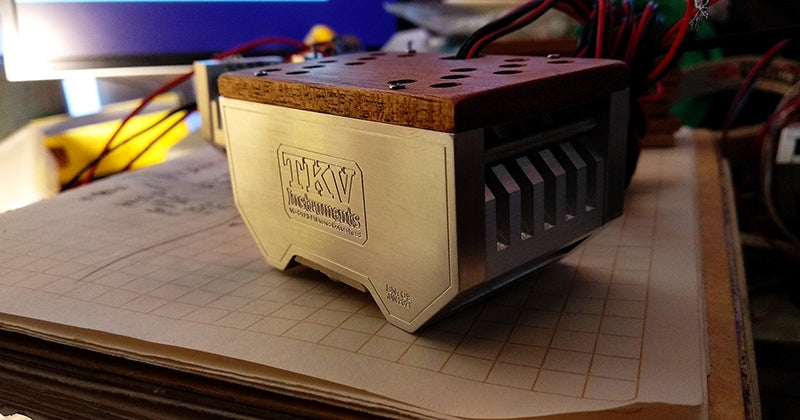
 

Hardware from Konstantin Tokarev Assatiani, Mexico City, Mexico. www.instagram.com/kostyantokarev.

Hardware from Konstantin Tokarev Assatiani, Mexico City, Mexico. www.instagram.com/kostyantokarev.


John Harris in New Zealand, obviously inspired by the work of Peter King, and located close to where King’s workshop has been for decades, decided to also build his own disk recording lathes, which he also uses to cut records one by one, entirely bypassing the need for pressing plants for small runs of records.
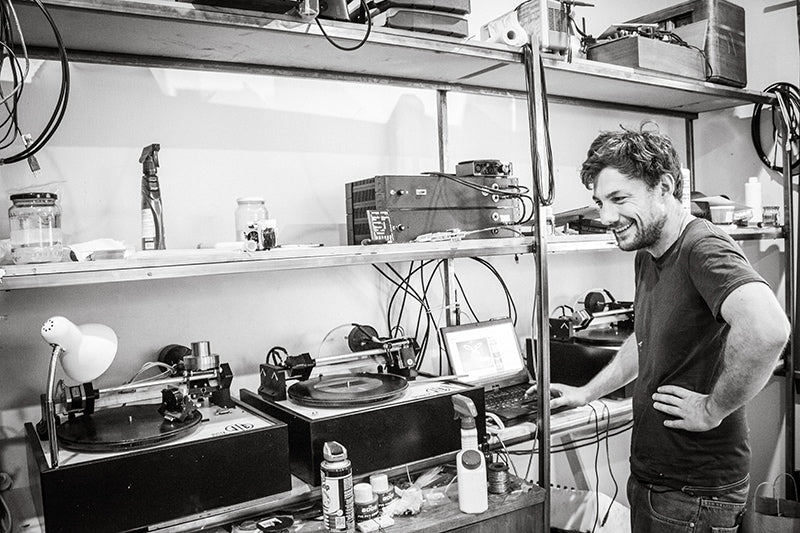
 

John Harris, Christchurch, New Zealand. www.johnnyelectric.co.nz.

John Harris, Christchurch, New Zealand. www.johnnyelectric.co.nz.


Germany’s Thorsten Scheffner, of Organic Music and its studio, has also built his own disk recording lathe, of a unique design, which he uses to cut master lacquer disks for the traditional process of vinyl record manufacturing. Unlike most designs, Thorsten’s lathe uses a stationary cutter head. It is the platter that advances under the head, in a similar manner to the early lathes of the acoustic era. Thorsten also owns and operates Neumann and Scully lathes, in a facility known for audiophile-grade mastering.


Thorsten Scheffner, Organic Music studio, Obing, Germany. www.organicmusic.de.

Thorsten Scheffner, Organic Music studio, Obing, Germany. www.organicmusic.de.


Evidently, by now the ecosystem of experimenters is extremely diverse. In the next episode, we will dive further into this world and present a few more of the individuals involved.


Header image courtesy of Konstantin Tokarev.

More from Issue 167

View All Articles in Issue 167

Search Copper Magazine

Favorites From T.H.E. Show SoCal 2026 by Cam Martin Oct 05, 2026 #235 Singer/Songwriter John David Schrader: On the Need to Create, Part Two by Joe Caplan Oct 05, 2026 #235 A Life in High-End Audio: The Roy Hall Interview, Part Two by Frank Doris Oct 05, 2026 #235 Grammy-Winning Producer, Songwriter, and Guitarist John Leventhal Goes Instrumental With National Drift by Ray Chelstowski Oct 05, 2026 #235 From Swimming Pool to New Listening Room—to Founding an Accidental Audio Company by Gilles Laferrière Oct 05, 2026 #235 The Vinyl Beat’s Size Matters Edition by Rudy Radelic Oct 05, 2026 #235 The Sublime Complexities of Nature by B. Jan Montana Oct 05, 2026 #235 How to Play In a Rock Band, 28: Growing Older and Dealing With It by Frank Doris Oct 05, 2026 #235 Young Rascals: From Bar Band to Stardom by Wayne Robins Oct 05, 2026 #235 Duncan Sheik: In Memoriam by Ray Chelstowski Oct 05, 2026 #235 From The Listening Chair: The Meze Audio 105 Silva Headphones by Howard Kneller Oct 05, 2026 #235 Checking Out Some NOLA Loudspeakers – and Some Thoughts About Audio Writing by Frank Doris Oct 05, 2026 #235 The Kanazawa Phonograph Museum: Music from a Time Capsule by Sebastian Polcyn Oct 05, 2026 #235 PS Audio in the News by PS Audio Staff Oct 05, 2026 #235 From The Audiophile’s Guide: Making the Most Critical Choice by Paul McGowan Oct 05, 2026 #235 Evolutionary Growth by Frank Doris Oct 05, 2026 #235 Speed Racer by Peter Xeni Oct 05, 2026 #235 Happy Halloween! by James Schrimpf Oct 05, 2026 #234 A Life in High-End Audio: The Roy Hall Interview, Part One by Frank Doris Sep 07, 2026 #234 Jason Greenlaw Offers His Personal Perspective on Jazz Guitar in Vantage Point by Frank Doris Sep 07, 2026 #234 Transcendent Phoenix: Lucina Yue Brings the Ancient Konghou Into Modern Times by Frank Doris Sep 07, 2026 #234 We Must All Follow Our Bliss by B. Jan Montana Sep 07, 2026 #234 How to Play in a Rock Band, 27: Leveling Up by Frank Doris Sep 07, 2026 #234 Ross Valory: Traveling Into New Musical Territory With All of the Above by Ray Chelstowski Sep 07, 2026 #234 Singer/Songwriter John David Schrader: On the Need to Create by Joe Caplan Sep 07, 2026 #234 The People Who Make Audio Happen: More From T.H.E. Show SoCal 2026 by Harris Fogel Sep 07, 2026 #234 The Vinyl Beat Digs Into the Gadget Box by Rudy Radelic Sep 07, 2026 #234 The Rolling Stones: Foreign Tongues Spoken Loud by Wayne Robins Sep 07, 2026 #234 Musical Moments by Rich Isaacs Sep 07, 2026 #234 Rags for Solo Piano and a Dog: David Chesky's Ragtime Music for the Modern Age by Frankly Speaking Sep 07, 2026 #234 HIGH END 2026, Vienna: Here to Stay by Carsten Barnbeck Sep 07, 2026 #234 From The Audiophile’s Guide: The Two Main Types of Loudpeakers – Box and Panel by Paul McGowan Sep 07, 2026 #234 Letting it Slide by Frank Doris Sep 07, 2026 #234 PS Audio in the News by PS Audio Staff Sep 07, 2026 #234 Long Playing by Peter Xeni Sep 07, 2026 #234 La Mer by B. Jan Montana Sep 07, 2026 #233 A Report From The Total Hi-Fi Experience Show SoCal 2026 by B. Jan Montana Aug 03, 2026 #233 Bluegrass Meets Country, Folk, Jazz and More in All That We Carried by The Squid City Slingers by Frank Doris Aug 03, 2026 #233 Corey Glover and One Tribe Nation: A Variegated Musical Collective by Ray Chelstowski Aug 03, 2026 #233 Excursions with Clive: The Late Clive Davis, A Personal History by Wayne Robins Aug 03, 2026 #233 AI, Art, and Music: A Conversation With Synthography Art by Joe Caplan Aug 03, 2026 #233 New American Symphonies: A Rediscovered Gem and a Vital Contemporary Work by Frank Doris Aug 03, 2026 #233 The Vinyl Beat: Genesis, the Dave Clark Five, Antonio Carlos Jobim and More by Rudy Radelic Aug 03, 2026 #233 How to Play in a Rock Band, 26: When It's Time to Record Your Music by Frank Doris Aug 03, 2026 #233 More From T.H.E. Show 2026, and the People Who Made it Happen by Harris Fogel Aug 03, 2026 #233 Underappreciated Artists, Part Three: Icehouse by Rich Isaacs Aug 03, 2026 #233 The Surprisingly Rich and Varied Music of Somalia by Steve Kindig Aug 03, 2026

Around the World In 80 Lathes, Part 17

Around the World In 80 Lathes, Part 17

In the previous episode (Issue 166), we looked at the work of Flo Kaufmann of FloKaSon in Switzerland, the man who decided to preserve the Neumann disk recording legacy by keeping vintage Neumann lathes running. In Part 12 of this series (Issue 162) we had looked at Len Horowitz and his nephew, Jacob Horowitz, of the History of Recorded Sound in Los Angeles, California. Len was a Westrex employee who decided to preserve the Westrex disk recording legacy by purchasing their disk recording department in 1995, when it closed down.

As a result of the efforts of the aforementioned gentlemen, a number of Neumann and Westrex products are still in use to this day. There is also a whole other world of individuals who have been instrumental in preserving disk recording equipment and technology in a number of ways. It’s a bit of a grassroots movement, of people experimenting with ways of using disk recording equipment with relatively low resources and plenty of creativity. At this point, my dear readers, I must warn you that we will be exiting audiophile territory and entering a world where sound quality may not be a primary concern, or any concern at all! However, no discussion of disk recording at this stage could be considered complete without a mention of the individuals who never gave up on the vinyl record and kept making records with whatever means they had available, just to keep the medium alive.

It is largely through their efforts that a lot of equipment was rescued from the scrapyard and a lot of the know-how was preserved. In this respect, I believe that while the sound quality of the products of this scene may not always be up to my (admittedly high) standards, they are of major historical significance in the study of the disk record as a medium.

We could perhaps trace the history of this movement in the work of Emory Cook, who realized in the 1950s that certain underprivileged and distant small markets could not sustain a pressing plant in the traditional sense, which needs to produce a certain amount of output in order to be economically viable. These markets had historically been underserved in terms of the availability of recordings to the general public. One of the many innovations of Emory Cook was the development of a press that worked with sintered vinyl instead of extruded vinyl. It was slow, but it could be operated for very small runs. It did not require the usual complex industrial setup around the press, so the idea was that a record store could have one of these in the back room. They could display a catalog of available titles, but not carry any stock, and  would press the titles that the customer would choose on demand, while they waited. It was a groundbreaking idea and saw limited implementation in some Caribbean islands.

Pretty much at the opposite end of the world, in the 1980s Peter King in New Zealand put together a custom disk recording lathe and restored a couple of lathes he got from the BBC, using washing machine parts, with the aim of cutting records one by one directly on plastic. After much experimentation, he settled on the use of polycarbonate, of the type commonly used in roofing, and also used the same material to build the roof of the building that housed his workshop!


From Peter King's website: http://peterkinglathecutrecords.co.nz/history.htm.

From Peter King’s website: http://peterkinglathecutrecords.co.nz/history.htm.


Back to the other end of the world, sometime later, Michael Dixon, a lathe cutting artist, lathe restorer, and teacher based in Tucson, Arizona decided to restore vintage Presto (and sometimes other makes such as Rek-O-Kut) lathes. Inspired by the work of Peter King, Dixon cuts records one by one on plastic blanks. Some of these are works of visual as well as sonic art. He has become the Presto lathe expert, restoring and selling these machines and offering advice and training as well as using them himself.


Michael Dixon of Tuscon, Arizona, lathe cutting artist, lathe restorer, and teacher. www.michaeldixonvinylart.com.

Michael Dixon of Tuscon, Arizona, lathe cutting artist, lathe restorer, and teacher. www.michaeldixonvinylart.com.


This revolution was promptly joined by several others, and coordinated through an internet forum called the Secret Society of Lathe Trolls, created by Steve Espinola, who is known as a restorer of vintage electric pianos under the name Doc Wurly. He started the forum hoping to get some information on a vintage lathe he had found, but it soon attracted every practitioner and expert of the art the world over, and expanded into a major resource of information and a place where ideas can be exchanged.

Others kept on joining in, and younger faces started appearing, thereby ensuring that there is indeed a younger generation interested in carrying the medium into the new millennium.


Steve Espinola, founder/administrator of Lathe Trolls (<a href="http://www.lathetrolls.com">www.lathetrolls.com</a>), Brooklyn, New York.

Steve Espinola, founder/administrator of Lathe Trolls (www.lathetrolls.com), Brooklyn, New York.


In Mexico City, Konstantin Tokarev started by building his own CNC milling machine. He used that machine to make parts from which he assembled two disk recording lathes of his own design, using a standard consumer turntable as a platter. He then went a few steps further and designed a low-cost stereophonic cutter head, which he is now selling to others.


Hardware from Konstantin Tokarev Assatiani, Mexico City, Mexico. www.instagram.com/kostyantokarev.

Hardware from Konstantin Tokarev Assatiani, Mexico City, Mexico. www.instagram.com/kostyantokarev.


John Harris in New Zealand, obviously inspired by the work of Peter King, and located close to where King’s workshop has been for decades, decided to also build his own disk recording lathes, which he also uses to cut records one by one, entirely bypassing the need for pressing plants for small runs of records.


John Harris, Christchurch, New Zealand. www.johnnyelectric.co.nz.

John Harris, Christchurch, New Zealand. www.johnnyelectric.co.nz.


Germany’s Thorsten Scheffner, of Organic Music and its studio, has also built his own disk recording lathe, of a unique design, which he uses to cut master lacquer disks for the traditional process of vinyl record manufacturing. Unlike most designs, Thorsten’s lathe uses a stationary cutter head. It is the platter that advances under the head, in a similar manner to the early lathes of the acoustic era. Thorsten also owns and operates Neumann and Scully lathes, in a facility known for audiophile-grade mastering.


Thorsten Scheffner, Organic Music studio, Obing, Germany. www.organicmusic.de.

Thorsten Scheffner, Organic Music studio, Obing, Germany. www.organicmusic.de.


Evidently, by now the ecosystem of experimenters is extremely diverse. In the next episode, we will dive further into this world and present a few more of the individuals involved.


Header image courtesy of Konstantin Tokarev.

0 comments

Leave a comment

0 Comments

Your avatar

Loading comments...

🗑️ Delete Comment

Enter moderator password to delete this comment:

✏️ Edit Comment

Enter your email to verify ownership: