COPPER

A PS Audio Publication

Issue 166 • Free Online Magazine

Issue 166 Disciples of Sound

A Visit to Legendary Jazz Club Arthur’s Tavern

A Visit to Legendary Jazz Club Arthur’s Tavern

Arthur’s Tavern is one of those New York City gems that have always been among the city’s best-kept secrets. It opened in 1937 as a speakeasy just after the end of Prohibition, and since then has remained a tight live music space with remarkable acoustics, and walls that drip with history, stories, and I’m sure quite a bit of great gossip. Arthur’s Tavern was closed for years, which ended a run that made the little jazz joint on the West Village’s Grove Street home to countless performances by Charlie Parker, among others, who considered Arthur’s his home court. It also was well-known for hosting artists like Mabel Godwin, Al Bundy, and Johnny Parker, and would later become the favorite place for modern-day musicians like Roy Hargrove to lay down some of their most memorable performances.

The venue was acquired by the Blue Note Entertainment Group, an outfit perfectly suited to bringing this wonderful spot to a new kind of glory. The updates they have made give the room just the right amount of sparkle, but leave its rustic roots intact. On June 8, 2022, the Blue Note Entertainment Group hosted a grand reopening/renovation reveal. New Orleans trumpeter Kermit Ruffins and his band The Barbeque Swingers ushered in the joint’s new era. As they made their way across an impromptu set of songs the room became filled with jump classics, Ruffins originals, and some songs that tipped the hat to Kermit’s idol, Louis Armstrong. The mood was festive, the vibe was light-hearted, and the sound just blistered with rollicking piano parts from Yoshitaka “Z2” Tsuji, dazzling drum fills from Jerry Anderson, deep pocket bass lines by Kevin Morris, and of course, rocketing horn howls and vocal hoots from Mr. Ruffins. It was the perfect launchpad for the reopening, and that night, Arthur’s left a mark on everyone.
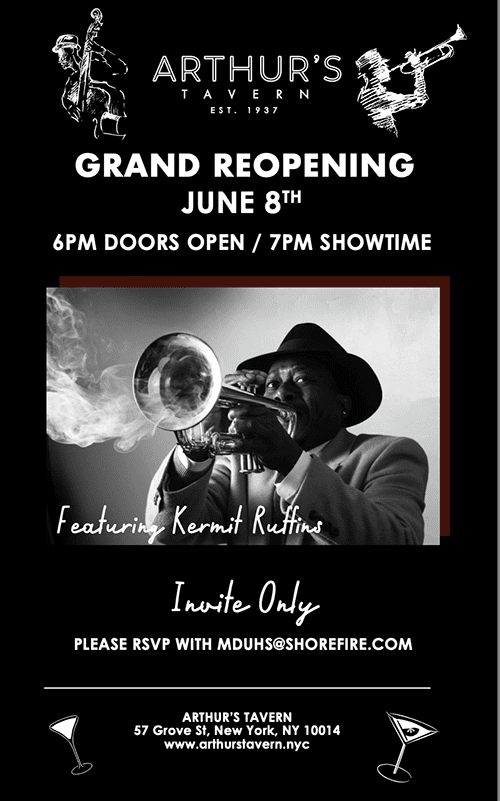
 

Invitation to reopening of Arthur's Tavern, June 8, 2022.


We had the opportunity to speak later with Blue Note Entertainment Group Chief Operating Officer Tsion Bensusan about why Arthur’s Tavern became a corporate priority, why its legacy matters, and what he sees ahead for this historic musical haunt.

Ray Chelstowski: What prompted the decision to invest in restoring Arthur’s Tavern, and why now?

Tsion Bensusan: The building was bought in the late 1980s by my father, and he kept it running as he wanted to preserve Arthur’s Tavern because it’s been a historic venue in the neighborhood for many years. When he purchased it, it was done [with the intention] to keep Arthur’s Tavern alive. But we weren’t operating it, we gave it to someone to operate. During COVID, the operator disappeared, and we saw that it wasn’t being kept in good condition; things were falling apart and not being fixed. We decided to take it upon ourselves to operate it, bring it back to life, and bring back some of the old musicians that have been performing there for many years.
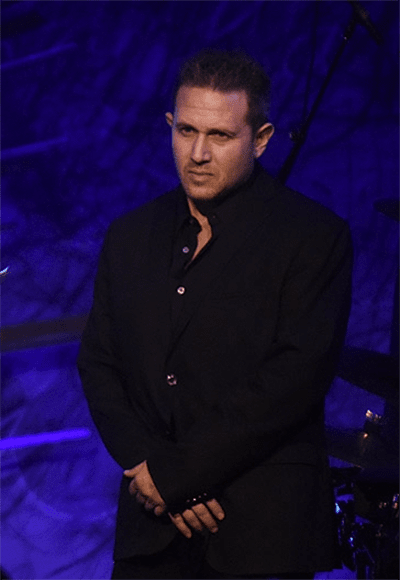
 

Tsion Bensusan.

Tsion Bensusan.


RC: When you were looking to restore the room, what guided the design, and were there any “off the table” items that wouldn’t be subject to discussion?

TB: We had the [interior] designer help us navigate through the [renovation]. When we were doing some demolition we discovered many old elements to Arthur’s that date back to the early 1940s and 1950s. So, we decided to either restore those elements or bring back some of the color elements that were there prior. We found the old ceiling, we found some old color schemes of what the place used to look like, and other hidden things that we discovered by knocking down a wall or two. We tried to bring back as many old elements as we could to preserve the history.

When we were repairing the bathrooms, we found a room. That room was an old storage room and it was covered with a sheetrock wall and there were even weeds growing in it. Inside that room was old glassware and flatware from the early ’40s. We didn’t [make the room part of the renovation] because of some piping issues, but we will in the near future figure out a way to expose it and share that with the public.

RC: When the company was considering buying the location, what drove that decision?

TB: With COVID, and [with] so many other [venues] closing, we wanted to do the opposite. We wanted to have a brand that preserves history. COVID forced a lot of places that have been around for such a long time to close, and it just wasn’t worth it to them to reopen, and we didn’t want that to happen to Arthur’s. We wanted to preserve it and bring it back because it’s a nice piece of history in New York.

RC: Rooms like Arthur’s have great stories to tell, and in speaking with Kermit we agreed that there are definitely “musical ghosts” present throughout 57 Grove Street. What’s the best story you’ve been told about the tavern?


Bassist Kevin Morris. Courtesy of Cathy Chelstowski.

Bassist Kevin Morris. Courtesy of Cathy Chelstowski.


TB: Arthur’s was home to Charlie Parker in the later period of his life. He used to like performing there, and Roy Hargrove was also frequent. Then you have some local acts like the Grove Street Stompers that have had one of New York City’s longest residencies.

Supposedly there’s a hidden passageway from Arthur’s to Marie’s Crisis Café and to the other townhouse next to it. We tried to look for it and we couldn’t find it but maybe we just didn’t break apart everything.

RC: Kermit Ruffins and his band were the perfect ensemble to reintroduce this great venue. How did securing him for this important night come about, and why was he the right person to first take that stage after the closure?

TB: Kermit has that old charm; he has an old school style that perfectly fits the venue. When we asked him to open it he jumped at the opportunity. He was also influenced by many old musicians from the ’40s and ’50s era. It just felt right. He’s a new generation preserving the old.

RC: Does Blue Note Entertainment Group have any plans to do something similar with like-sized historic clubs across the United States?

TB: Yeah, we’ve been talking about that. We’ve been looking into other old establishments that are also on their last legs. Maybe assisting them and helping them out or purchasing them in order to keep them alive.

RC: In the end, what does success look like for Arthur’s Tavern?

TB: To be there for another 85 years.
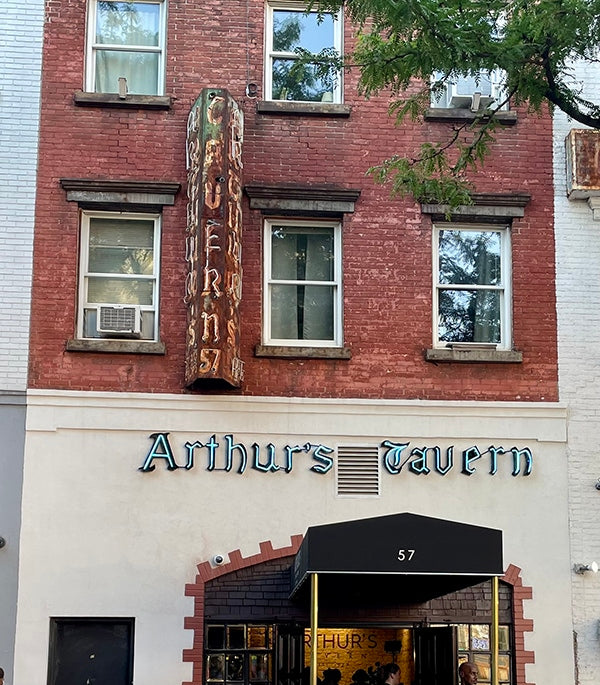
 

Courtesy of Cathy Chelstowski.

Courtesy of Cathy Chelstowski.


Header image courtesy of Cathy Chelstowski.

More from Issue 166

View All Articles in Issue 166

Search Copper Magazine

#234 A Life in High-End Audio: The Roy Hall Interview, Part One by Frank Doris Sep 07, 2026 #234 Jason Greenlaw Offers His Personal Perspective on Jazz Guitar in Vantage Point by Frank Doris Sep 07, 2026 #234 Transcendent Phoenix: Lucina Yue Brings the Ancient Konghou Into Modern Times by Frank Doris Sep 07, 2026 #234 We Must All Follow Our Bliss by B. Jan Montana Sep 07, 2026 #234 How to Play in a Rock Band, 27: Leveling Up by Frank Doris Sep 07, 2026 #234 Ross Valory: Traveling Into New Musical Territory With All of the Above by Ray Chelstowski Sep 07, 2026 #234 Singer/Songwriter John David Schrader: On the Need to Create by Joe Caplan Sep 07, 2026 #234 The People Who Make Audio Happen: More From T.H.E. Show SoCal 2026 by Harris Fogel Sep 07, 2026 #234 The Vinyl Beat Digs Into the Gadget Box by Rudy Radelic Sep 07, 2026 #234 The Rolling Stones: Foreign Tongues Spoken Loud by Wayne Robins Sep 07, 2026 #234 Musical Moments by Rich Isaacs Sep 07, 2026 #234 Rags for Solo Piano and a Dog: David Chesky's Ragtime Music for the Modern Age by Frankly Speaking Sep 07, 2026 #234 HIGH END 2026, Vienna: Here to Stay by Carsten Barnbeck Sep 07, 2026 #234 From The Audiophile’s Guide: The Two Main Types of Loudpeakers – Box and Panel by Paul McGowan Sep 07, 2026 #234 Letting it Slide by Frank Doris Sep 07, 2026 #234 PS Audio in the News by PS Audio Staff Sep 07, 2026 #234 Long Playing by Peter Xeni Sep 07, 2026 #234 La Mer by B. Jan Montana Sep 07, 2026 #233 A Report From The Total Hi-Fi Experience Show SoCal 2026 by B. Jan Montana Aug 03, 2026 #233 Bluegrass Meets Country, Folk, Jazz and More in All That We Carried by The Squid City Slingers by Frank Doris Aug 03, 2026 #233 Corey Glover and One Tribe Nation: A Variegated Musical Collective by Ray Chelstowski Aug 03, 2026 #233 Excursions with Clive: The Late Clive Davis, A Personal History by Wayne Robins Aug 03, 2026 #233 AI, Art, and Music: A Conversation With Synthography Art by Joe Caplan Aug 03, 2026 #233 New American Symphonies: A Rediscovered Gem and a Vital Contemporary Work by Frank Doris Aug 03, 2026 #233 The Vinyl Beat: Genesis, the Dave Clark Five, Antonio Carlos Jobim and More by Rudy Radelic Aug 03, 2026 #233 How to Play in a Rock Band, 26: When It's Time to Record Your Music by Frank Doris Aug 03, 2026 #233 More From T.H.E. Show 2026, and the People Who Made it Happen by Harris Fogel Aug 03, 2026 #233 Underappreciated Artists, Part Three: Icehouse by Rich Isaacs Aug 03, 2026 #233 The Surprisingly Rich and Varied Music of Somalia by Steve Kindig Aug 03, 2026 #233 A Remarkable Discographic Legacy: The LP Recordings of the Basel Symphony Orchestra by Stephan Haberthür Aug 03, 2026 #233 From The Audiophile’s Guide: The Importance of Loudspeakers by Paul McGowan Aug 03, 2026 #233 From Swimming Pool to New Listening Room: A Conversation with Norman Varney of AV RoomService by Gilles Laferrière Aug 03, 2026 #233 PS Audio in the News by PS Audio Staff Aug 03, 2026 #233 Audio Jewelry by Peter Xeni Aug 03, 2026 #233 Enrich Your Life by Frank Doris Aug 03, 2026 #233 The Searcher by James Schrimpf Aug 03, 2026 #232 What came first: Art or Music? A Conversation With Artist Jose Acosta by Joe Caplan Jul 06, 2026 #232 Blow By Blow: The Jeff Beck Story: An Insightful Book About a Guitar Icon by Ray Chelstowski Jul 06, 2026 #232 Creed Over Camaraderie? by B. Jan Montana Jul 06, 2026 #232 Chronicles of a Sound Pilgrim at the 2026 Montreal Audiofest by Hugues Morin Jul 06, 2026 #232 The Vinyl Beat: Summer Grooves by Rudy Radelic Jul 06, 2026 #232 Hibbing Hillbilly Dylan's Acoustic Rock by Wayne Robins Jul 06, 2026 #232 Quad Quads and Plasmatronics Tweeters: An Extraordinary System Comes to Life by Frank Doris Jul 06, 2026 #232 In Praise of Live Music, Once Again by Ted Shafran Jul 06, 2026 #232 Allnic Audio’s L-9000 Preamplifier: Design and Engineering Innovation by Howard Kneller Jul 06, 2026 #232 “Best Of” Lists and Rage Bait: Enough Already by Frank Doris Jul 06, 2026 #232 Quick Takes: Bud Shank, Paulo Almeida, Jakob Dreyer, Tim Eriksen and Peter Irvine by Frank Doris Jul 06, 2026

A Visit to Legendary Jazz Club Arthur’s Tavern

A Visit to Legendary Jazz Club Arthur’s Tavern

Arthur’s Tavern is one of those New York City gems that have always been among the city’s best-kept secrets. It opened in 1937 as a speakeasy just after the end of Prohibition, and since then has remained a tight live music space with remarkable acoustics, and walls that drip with history, stories, and I’m sure quite a bit of great gossip. Arthur’s Tavern was closed for years, which ended a run that made the little jazz joint on the West Village’s Grove Street home to countless performances by Charlie Parker, among others, who considered Arthur’s his home court. It also was well-known for hosting artists like Mabel Godwin, Al Bundy, and Johnny Parker, and would later become the favorite place for modern-day musicians like Roy Hargrove to lay down some of their most memorable performances.

The venue was acquired by the Blue Note Entertainment Group, an outfit perfectly suited to bringing this wonderful spot to a new kind of glory. The updates they have made give the room just the right amount of sparkle, but leave its rustic roots intact. On June 8, 2022, the Blue Note Entertainment Group hosted a grand reopening/renovation reveal. New Orleans trumpeter Kermit Ruffins and his band The Barbeque Swingers ushered in the joint’s new era. As they made their way across an impromptu set of songs the room became filled with jump classics, Ruffins originals, and some songs that tipped the hat to Kermit’s idol, Louis Armstrong. The mood was festive, the vibe was light-hearted, and the sound just blistered with rollicking piano parts from Yoshitaka “Z2” Tsuji, dazzling drum fills from Jerry Anderson, deep pocket bass lines by Kevin Morris, and of course, rocketing horn howls and vocal hoots from Mr. Ruffins. It was the perfect launchpad for the reopening, and that night, Arthur’s left a mark on everyone.


Invitation to reopening of Arthur's Tavern, June 8, 2022.


We had the opportunity to speak later with Blue Note Entertainment Group Chief Operating Officer Tsion Bensusan about why Arthur’s Tavern became a corporate priority, why its legacy matters, and what he sees ahead for this historic musical haunt.

Ray Chelstowski: What prompted the decision to invest in restoring Arthur’s Tavern, and why now?

Tsion Bensusan: The building was bought in the late 1980s by my father, and he kept it running as he wanted to preserve Arthur’s Tavern because it’s been a historic venue in the neighborhood for many years. When he purchased it, it was done [with the intention] to keep Arthur’s Tavern alive. But we weren’t operating it, we gave it to someone to operate. During COVID, the operator disappeared, and we saw that it wasn’t being kept in good condition; things were falling apart and not being fixed. We decided to take it upon ourselves to operate it, bring it back to life, and bring back some of the old musicians that have been performing there for many years.


Tsion Bensusan.

Tsion Bensusan.


RC: When you were looking to restore the room, what guided the design, and were there any “off the table” items that wouldn’t be subject to discussion?

TB: We had the [interior] designer help us navigate through the [renovation]. When we were doing some demolition we discovered many old elements to Arthur’s that date back to the early 1940s and 1950s. So, we decided to either restore those elements or bring back some of the color elements that were there prior. We found the old ceiling, we found some old color schemes of what the place used to look like, and other hidden things that we discovered by knocking down a wall or two. We tried to bring back as many old elements as we could to preserve the history.

When we were repairing the bathrooms, we found a room. That room was an old storage room and it was covered with a sheetrock wall and there were even weeds growing in it. Inside that room was old glassware and flatware from the early ’40s. We didn’t [make the room part of the renovation] because of some piping issues, but we will in the near future figure out a way to expose it and share that with the public.

RC: When the company was considering buying the location, what drove that decision?

TB: With COVID, and [with] so many other [venues] closing, we wanted to do the opposite. We wanted to have a brand that preserves history. COVID forced a lot of places that have been around for such a long time to close, and it just wasn’t worth it to them to reopen, and we didn’t want that to happen to Arthur’s. We wanted to preserve it and bring it back because it’s a nice piece of history in New York.

RC: Rooms like Arthur’s have great stories to tell, and in speaking with Kermit we agreed that there are definitely “musical ghosts” present throughout 57 Grove Street. What’s the best story you’ve been told about the tavern?


Bassist Kevin Morris. Courtesy of Cathy Chelstowski.

Bassist Kevin Morris. Courtesy of Cathy Chelstowski.


TB: Arthur’s was home to Charlie Parker in the later period of his life. He used to like performing there, and Roy Hargrove was also frequent. Then you have some local acts like the Grove Street Stompers that have had one of New York City’s longest residencies.

Supposedly there’s a hidden passageway from Arthur’s to Marie’s Crisis Café and to the other townhouse next to it. We tried to look for it and we couldn’t find it but maybe we just didn’t break apart everything.

RC: Kermit Ruffins and his band were the perfect ensemble to reintroduce this great venue. How did securing him for this important night come about, and why was he the right person to first take that stage after the closure?

TB: Kermit has that old charm; he has an old school style that perfectly fits the venue. When we asked him to open it he jumped at the opportunity. He was also influenced by many old musicians from the ’40s and ’50s era. It just felt right. He’s a new generation preserving the old.

RC: Does Blue Note Entertainment Group have any plans to do something similar with like-sized historic clubs across the United States?

TB: Yeah, we’ve been talking about that. We’ve been looking into other old establishments that are also on their last legs. Maybe assisting them and helping them out or purchasing them in order to keep them alive.

RC: In the end, what does success look like for Arthur’s Tavern?

TB: To be there for another 85 years.


Courtesy of Cathy Chelstowski.

Courtesy of Cathy Chelstowski.


Header image courtesy of Cathy Chelstowski.

0 comments

Leave a comment

0 Comments

Your avatar

Loading comments...

🗑️ Delete Comment

Enter moderator password to delete this comment:

✏️ Edit Comment

Enter your email to verify ownership: