COPPER

A PS Audio Publication

Issue 72 • Free Online Magazine

Issue 72 VINTAGE WHINE

50 Ways to Read a Record Part 7

50 Ways to Read a Record Part 7

We’ve looked at a variety of methods of making music—or at least generating a signal— from a record groove. We’ve seen phono cartridges that use coils and magnets, all kinds of armatures, and even condensers/capacitors.

What’s left?

There are still a number of methods left to be looked at, but in this brief installment, we’ll look at strain gauges. What are they? And what are the advantages of cartridges that utilize them as the generating system? To quote Omega, a prominent maker of such things, a strain gauge is “a sensor whose resistance varies with applied force; It converts force, pressure, tension, weight, etc., into a change in electrical resistance which can then be measured.”

Strain gauges are used to measure deflection of airplane wings and other critical structural elements. Strain gauge-based phono cartridges are displacement-sensing rather than velocity-sensing (like most magnetic cartridges), and thus don’t require RIAA compensation.  The advantages of strain gauge cartridges are eloquently described by Peter Ledermann of Soundsmith, maker of the only strain gauge cartridge in current production.

The first use of strain gauges as the generating elements in phono cartridges was, to the best of my knowledge, by a company called Euphonics, based in Puerto Rico in the early 1960s. Euphonics also manufactured inexpensive ceramic phono cartridges, and from all I can find, the Euphonics Miniconic system consisted of tonearm, cartridge, and power supply for the cart.

The Euphonics Miniconic system.

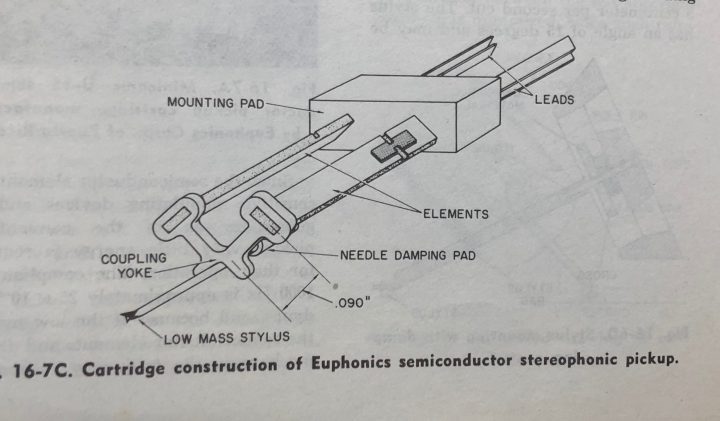
The generating system of the Euphonics cartridge is shown in this drawing (published in the venerable Audio Cyclopedia); to my knowledge, subsequent strain gauge cartridges have been constructed along similar lines.
The highest-production strain gauge cartridges were those of the EPC series, made by Panasonic in the early to mid-1970s. Some models were designed for Quadraphonic (four channel) playback, and required an external demodulator. Some models utilized a Shibata stylus, and were known to be excellent trackers.

The interesting thing about the Panasonic cartridges is not the cartridges by themselves, but the fact that their potential performance was limited by their associated electronics. Over the years, several gifted designers have come up with power supplies and EQ systems that have transformed the Panasonic carts to world-class. The cartridges are still available on the secondary market, and many hobbyists have tried their hands at improving their performance with homebrew electronics—as seen here and  here. 

So what “gifted designers” have worked with the Panasonic strain gauge cartridges? First and foremost was John Iverson, whose Electro Research and Electron Kinetics companies produced extraordinary companents that are still sought-after today—and in fact, some are still made in modified form by former associates. An interesting sidebar to Iverson’s story is that he disappeared—poof!— and that has created a whole rabbit’s hole of theories as to the how and why. (Sidebar to the sidebar: don’t confuse him with longtime Stereophile reviewer, Jon Iverson. Poor Jon has heard it all….)

In the early ’80s Electro Research made a tank-like power supply/pre for the Panasonic strain gauge cart; the EK-1 had a chassis made of 1/4″ stainless steel, and cost $4000, with the cart. $4000 in 1982. Think about that. The unit was made in Singapore; Iverson once claimed that the EK-1 would’ve cost $20,000 if made in the US.

The Electro Research EK-1.

These days the Panasonic strain gauges are the basis of a system designed by the versatile audio craftsmen Dave Slagle and Jeffrey Jackson, whose partnership is known as Emia. Dave and Jeffrey combine old school handwork and technology (mercury vapor rectifiers. anyone??) with some interesting modern twists. What they make utilizing the Panasonic cartridge is pretty extraordinary., as you can see here.

Back in the mid-’70s, a purpose-built strain gauge cartridge was made by Win Labs. Dr. Sao Win still appears every now and then in the audio world, and apparently still takes care of his SDT-10 strain gauge carts and later models (including a FET-based cartridge). The cartridge was known to have a rather penetrating high end, sometimes alleviated by use of tube-based power supplies, such as the one made by San Diego dealer Audio Dimensions.  Win also made stunning and expensive tonearms and turntables, still sought by collectors.

The lovely Win Labs turntable and arm---but oh, those fingerprints!
While Emia and others still work with the Panasonic strain gauge cartridges, the only scratch-built strain gauge cartridge systems made these days come from the aforementioned Soundsmith. I’ve heard the Soundsmith strain gauge many times, and its effortless quality is the closest thing I’ve heard to reel-to-reel. I’ll get a system one of these days….

More from Issue 72

View All Articles in Issue 72

Search Copper Magazine

#232 What came first: Art or Music? A Conversation With Artist Jose Acosta by Joe Caplan Jul 06, 2026 #232 Blow By Blow: The Jeff Beck Story: An Insightful Book About a Guitar Icon by Ray Chelstowski Jul 06, 2026 #232 Creed Over Camaraderie? by B. Jan Montana Jul 06, 2026 #232 Chronicles of a Sound Pilgrim at the 2026 Montreal Audiofest by Hugues Morin Jul 06, 2026 #232 The Vinyl Beat: Summer Grooves by Rudy Radelic Jul 06, 2026 #232 Hibbing Hillbilly Dylan's Acoustic Rock by Wayne Robins Jul 06, 2026 #232 Quad Quads and Plasmatronics Tweeters: An Extraordinary System Comes to Life by Frank Doris Jul 06, 2026 #232 In Praise of Live Music, Once Again by Ted Shafran Jul 06, 2026 #232 Allnic Audio’s L-9000 Preamplifier: Design and Engineering Innovation by Howard Kneller Jul 06, 2026 #232 “Best Of” Lists and Rage Bait: Enough Already by Frank Doris Jul 06, 2026 #232 Quick Takes: Bud Shank, Paulo Almeida, Jakob Dreyer, Tim Eriksen and Peter Irvine by Frank Doris Jul 06, 2026 #232 My Impressions of AXPONA 2026, Part 2 by Frank Doris Jul 06, 2026 #232 How to Play in a Rock Band, 25: Encounters With Famous Musicians, Part Three by Frank Doris Jul 06, 2026 #232 Budgets, and Systems From Small to Outrageous by Paul McGowan Jul 06, 2026 #232 PS Audio in the News by PS Audio Staff Jul 06, 2026 #232 Hand It Over by Frank Doris Jul 06, 2026 #232 Difference of Opinion by Peter Xeni Jul 06, 2026 #232 Wabi-sabi Tree by James Schrimpf Jul 06, 2026 #231 Piano Prodigy Jude Kofie Releases His Debut Album On Octave Records by Frank Doris Jun 01, 2026 #231 Underappreciated Artists, Part Two: City Boy by Rich Isaacs Jun 01, 2026 #231 Music and the Art of Creation: Talking With Saxophonist Rob Scheps by Joe Caplan Jun 01, 2026 #231 How to Play in a Rock Band, 24: Further Adventures at the 2026 Montauk Music Festival by Frank Doris Jun 01, 2026 #231 Courtney Barnett: Creature of Habit by Wayne Robins Jun 01, 2026 #231 Angine de Poitrine: Interstellar Guitar Rock Saviors Headed for Late-Night TV Pop Stardom? by Mark Lepage Jun 01, 2026 #231 My Impressions of AXPONA 2026, Part One by Frank Doris Jun 01, 2026 #231 2026 La Jolla Concours d'Elegance: Another Aesthetic Feast by B. Jan Montana Jun 01, 2026 #231 Country Music Icon Jo Dee Messina’s Bridges: A New Beginning by Ray Chelstowski Jun 01, 2026 #231 The Luxury Dispatch Hosts a Video Podcast With Ken Kessler by Ken Kessler Jun 01, 2026 #231 The Vinyl Beat: Tracking in the Motor City by Rudy Radelic Jun 01, 2026 #231 Lots of Fun With DSP: The Ferrum Audio WANDLA DAC and Its Tube Mode by Frank Doris Jun 01, 2026 #231 From The Audiophile's Guide: Digital Source Components and Streaming Audio by Paul McGowan Jun 01, 2026 #231 Onkyo’s Monster M-510 power amplifier by The Staff at Just Audio Jun 01, 2026 #231 PS Audio in the News by PS Audio Staff Jun 01, 2026 #231 Naming Convention by Peter Xeni Jun 01, 2026 #231 Les Invisibles by Frank Doris Jun 01, 2026 #231 Wildlife Scene by James Schrimpf Jun 01, 2026 #230 Camaraderie by B. Jan Montana May 04, 2026 #230 AXPONA 2026: A Family Gathering by Paul McGowan May 04, 2026 #230 Pianist Ryan Benthall Explores Jazz Realms and Far Beyond With Divine Sky by Frank Doris May 04, 2026 #230 The Vinyl Beat in AXPONA-Land by Rudy Radelic May 04, 2026 #230 Teddy Thompson’s Musical Growth Deepens With Never Be the Same by Ray Chelstowski May 04, 2026 #230 More Fun in the Sun: Florida Audio Expo, Part Two by Frank Doris May 04, 2026 #230 CanJam NYC 2026 Show Report: Heady Sound, Part Two by Frank Doris and Harris Fogel May 04, 2026 #230 Sonic Youth On Murray Street by Wayne Robins May 04, 2026 #230 Graffeo Coffee: A Symphony of Sensory Experience by Joe Caplan May 04, 2026 #230 The Saul Authority: The Story of Hi-Fi Pioneer Saul Marantz by Olivier Meunier-Plante May 04, 2026 #230 How to Play in a Rock Band, 23: Encounters With Famous Musicians, Part Two by Frank Doris May 04, 2026

50 Ways to Read a Record Part 7

50 Ways to Read a Record Part 7

We’ve looked at a variety of methods of making music—or at least generating a signal— from a record groove. We’ve seen phono cartridges that use coils and magnets, all kinds of armatures, and even condensers/capacitors.

What’s left?

There are still a number of methods left to be looked at, but in this brief installment, we’ll look at strain gauges. What are they? And what are the advantages of cartridges that utilize them as the generating system? To quote Omega, a prominent maker of such things, a strain gauge is “a sensor whose resistance varies with applied force; It converts force, pressure, tension, weight, etc., into a change in electrical resistance which can then be measured.”

Strain gauges are used to measure deflection of airplane wings and other critical structural elements. Strain gauge-based phono cartridges are displacement-sensing rather than velocity-sensing (like most magnetic cartridges), and thus don’t require RIAA compensation.  The advantages of strain gauge cartridges are eloquently described by Peter Ledermann of Soundsmith, maker of the only strain gauge cartridge in current production.

The first use of strain gauges as the generating elements in phono cartridges was, to the best of my knowledge, by a company called Euphonics, based in Puerto Rico in the early 1960s. Euphonics also manufactured inexpensive ceramic phono cartridges, and from all I can find, the Euphonics Miniconic system consisted of tonearm, cartridge, and power supply for the cart.

The Euphonics Miniconic system.

The generating system of the Euphonics cartridge is shown in this drawing (published in the venerable Audio Cyclopedia); to my knowledge, subsequent strain gauge cartridges have been constructed along similar lines.

The highest-production strain gauge cartridges were those of the EPC series, made by Panasonic in the early to mid-1970s. Some models were designed for Quadraphonic (four channel) playback, and required an external demodulator. Some models utilized a Shibata stylus, and were known to be excellent trackers.

The interesting thing about the Panasonic cartridges is not the cartridges by themselves, but the fact that their potential performance was limited by their associated electronics. Over the years, several gifted designers have come up with power supplies and EQ systems that have transformed the Panasonic carts to world-class. The cartridges are still available on the secondary market, and many hobbyists have tried their hands at improving their performance with homebrew electronics—as seen here and  here. 

So what “gifted designers” have worked with the Panasonic strain gauge cartridges? First and foremost was John Iverson, whose Electro Research and Electron Kinetics companies produced extraordinary companents that are still sought-after today—and in fact, some are still made in modified form by former associates. An interesting sidebar to Iverson’s story is that he disappeared—poof!— and that has created a whole rabbit’s hole of theories as to the how and why. (Sidebar to the sidebar: don’t confuse him with longtime Stereophile reviewer, Jon Iverson. Poor Jon has heard it all….)

In the early ’80s Electro Research made a tank-like power supply/pre for the Panasonic strain gauge cart; the EK-1 had a chassis made of 1/4″ stainless steel, and cost $4000, with the cart. $4000 in 1982. Think about that. The unit was made in Singapore; Iverson once claimed that the EK-1 would’ve cost $20,000 if made in the US.

The Electro Research EK-1.

These days the Panasonic strain gauges are the basis of a system designed by the versatile audio craftsmen Dave Slagle and Jeffrey Jackson, whose partnership is known as Emia. Dave and Jeffrey combine old school handwork and technology (mercury vapor rectifiers. anyone??) with some interesting modern twists. What they make utilizing the Panasonic cartridge is pretty extraordinary., as you can see here.

Back in the mid-’70s, a purpose-built strain gauge cartridge was made by Win Labs. Dr. Sao Win still appears every now and then in the audio world, and apparently still takes care of his SDT-10 strain gauge carts and later models (including a FET-based cartridge). The cartridge was known to have a rather penetrating high end, sometimes alleviated by use of tube-based power supplies, such as the one made by San Diego dealer Audio Dimensions.  Win also made stunning and expensive tonearms and turntables, still sought by collectors.

The lovely Win Labs turntable and arm---but oh, those fingerprints!
While Emia and others still work with the Panasonic strain gauge cartridges, the only scratch-built strain gauge cartridge systems made these days come from the aforementioned Soundsmith. I’ve heard the Soundsmith strain gauge many times, and its effortless quality is the closest thing I’ve heard to reel-to-reel. I’ll get a system one of these days….

0 comments

Leave a comment

0 Comments

Your avatar

Loading comments...

🗑️ Delete Comment

Enter moderator password to delete this comment:

✏️ Edit Comment

Enter your email to verify ownership: