COPPER

A PS Audio Publication

Issue 45 • Free Online Magazine

Issue 45 MUSIC AUDIO AND OTHER ILLNESSES

Why Doesn’t My System Sound Better? (Or: A Neurotic’s Confession)

By any objective measure, it sounds incredible.

But you know how people like us are: obsessive to a degree that’s way past the point of fault. Maybe I’m romanticizing how it used to sound. Maybe the placement of things makes a bigger difference than I suppose. Maybe I don’t care enough or can’t hear well enough anymore.

Currently, my set-up consists of a DirectStream DAC through an old PS Audio PS-IV preamp (always used with the line-amp out of circuit – so, really, just a source-selector and volume control), and then into a pair of Brown Electronic Labs 1001 Mk. IV/Vs[1], and then my speakers: an astonishing pair built for me over 20 years ago by Richard Marsh (after a pair he had built for himself), using Dynaudio speakers, cabs from somewhere in Canada, crossover components of his design, and Cardas and other internal wire. They’re roughly a D’Appolito design, with five drivers: two 10-inch woofers, two fairly large mid-range drivers, and Dynaudio’s most exotic tweeter per side. Many years ago, at the suggestion of Robert E. Greene, I got a pair of felt surrounds for the tweeters to minimize diffraction –– made for me by a man in Texas. Right now, the cabling is from Audioquest: Wind interconnects and Rocket 88 speaker cables have replaced my old Cardas.

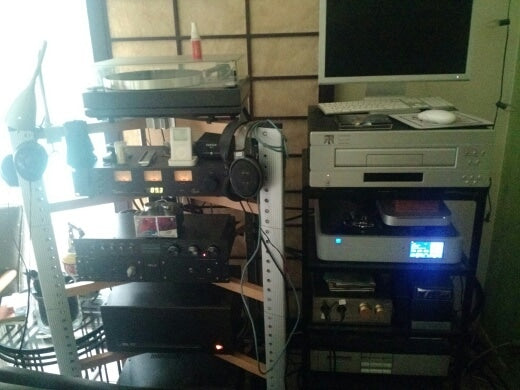
I regularly check the set-up for its IQ — its “Invisibility Quotient”. And as I said: objectively, it’s rarely been less “visible” — even sitting off axis, the speakers just about vanish. So why do I feel so unfulfilled?

I remember well the very first time I heard extraordinary digital. It was 2007 at a shop in LA where Scot Markwell worked. I went to hear the Antique Sound Lab Hurricane amps, but Scot was excited for me to hear something he had just gotten — The NovaPhysics Memory Player. And it was absolutely mind-blowing. Listening to records I had worked on was like being in the control room hearing the tape.

Ten years later, maybe I’ve just gotten used to good digital sound. And though I used to have a NovaPhysics Memory Player (courtesy of Mark Porzilli, its designer), I now have a DirectStream. Maybe the difference in what I hear is the difference in the design. It might be that somewhere in my pea brain, I still want the Memory Player’s sound — although, when I listen, as right now, the sound is just incredible. Maybe it’s just the never-ending quest of me being neurotic.

I’ve tried to discern why I hear almost no difference between 16/44.1 files and higher resolution ones. A series of emails with the eminent Ted Smith, while complicated with math, confirmed what I thought. Put simply: everything plays back as DSD, whether it’s 44.1 numerical stream or a 192k one, and that, in my simple way of putting it, minimizes the differences. For those not afraid of a little math, I’ll post Ted’s comments:

“Just to make things clear, everything is upsampled to 20 x the nominal DSD rate (which is 64 x the CD rate) = 56.448Mhz.  Not that it matters a lot to the end user but PCM is first upsampled to 352.8k or 384k (depending on whether it divides one or the other), then that is upsampled by 160 x or 147 x to get to 56.448Mhz.

“After that the signal is converted to a quad rate (11.2896MHz) single bit output with a sigma delta modulator.

“If his question was about how sigma delta modulators work, that’s pretty hard to explain accurately in a few words.  From the 30,000 ft. level, a sigma delta modulator outputs a 1 or 0 (which translate to a 1 or -1) depending on whether the low-pass filtered complete output stream so far is higher or lower than the input.  That amounts to a tight feedback loop around the decision about whether the next sample is a 1 or -1.  By construction it’s obvious that you get back the original signal with just a low pass filter since that’s what the feedback loop was driving the output to.  The devil is in the details.

“As Paul mentioned, there’s a much smaller difference than most people believe between a 16/44.1k signal and a 24/192k signal. In part, (that) is a natural result of a lot of oversamplers for 44.1k not being as good as they could be; with a 192k signal how the upsampler is designed/implemented isn’t as critical.”

So, since the output of the device is one-bit, i.e. the most spectacularly simple of filters, and we hear everything through this output, the great variety of lossless files are all driven towards this. And this is great. So what’s bugging me?

I don’t know. But I can speculate: the obvious thing is the different DACs, though that doesn’t answer just what the difference IS. Then there’s my hearing: maybe the tinnitus has really gotten worse and pervades listening, although I think I’d know that. Maybe after so many years of great sound, I’m just being more neurotic than I used to be.

But here’s what I think it is: I think the DirectStream DAC and the Memory Player do an equal but different job of decoding the signal — AND that difference is very slight, in the way-upper-mids to lower treble, AND I think I grew to love that presentation. As much as I love the DirectStream, I think I should add a touch of EQ to the signal to see about that.

But there’s another way to think about this. That’s that the slight elevation of upper-mids to lower-treble is false; that though we — or at least some of we — come to expect it of recording, and hear that slightly increased band as meaning greater presence, it only represents reality (we could even say it over-represents it). I wrote eons ago in the pages of TAS about walking in Pasadena with Allen Perkins and our wives and hearing a solo violinist echoing among the brickwork and noting how far removed it was from any recording. This comes to mind as I listen to a Water Lily recording done with the same equipment I own (Tim DeParavicini’s mics, mic amp and one-inch recorder) of the Philadelphia Orchestra, seated where Robert E. Greene suggests as an ideal listening spot, and wonder how anything could be more realistic.

Allegedly, I’ll be heading out to Porzilli’s in a month or so, and, allegedly, will return with another Memory Player. And if it hasn’t changed too drastically in the intervening years since I had one, I will get to resolve my neurosis.

PS – as you may know, Porzilli was the designer of the Pipedream speakers, and after that the Scaena. He has a new design — and it looks spectacular.


[1] The amps are vaguely for sale. Over 25 years ago, I realized that my whole system had been made by my friends, and with Richard’s death a few years back, and the purchase of BEL’s “assets”, the amps no longer feel quite like mine. When they sell, I’m planning on a pair of BHKs.

More from Issue 45

View All Articles in Issue 45

Search Copper Magazine

#227 Seth Lewis Gets in the Groove With Take a Look Around: a Tribute to the Meters by Frank Doris Feb 02, 2026 #227 Passport to Sound: May Anwar’s Audio Learning Experience for Young People by Frank Doris Feb 02, 2026 #227 Conjectures on Cosmic Consciousness by B. Jan Montana Feb 02, 2026 #227 The Big Takeover Turns 45 by Wayne Robins Feb 02, 2026 #227 Music and Chocolate: On the Sensory Connection by Joe Caplan Feb 02, 2026 #227 Singer/Songwriter Chris Berardo: Getting Wilder All the Time by Ray Chelstowski Feb 02, 2026 #227 The Earliest Stars of Country Music, Part One by Jeff Weiner Feb 02, 2026 #227 The Vinyl Beat Goes Down to Tijuana (By Way of Los Angeles), Part Two by Rudy Radelic Feb 02, 2026 #227 How to Play in a Rock Band, 20: On the Road With Blood, Sweat & Tears’ Guitarist Gabe Cummins by Frank Doris Feb 02, 2026 #227 From The Audiophile’s Guide: Audio Specs and Measuring by Paul McGowan Feb 02, 2026 #227 Our Brain is Always Listening by Peter Trübner Feb 02, 2026 #227 PS Audio in the News by PS Audio Staff Feb 02, 2026 #227 The Listening Chair: Sleek Style and Sound From the Luxman L3 by Howard Kneller Feb 02, 2026 #227 The Los Angeles and Orange County Audio Society Celebrates Its 32nd Anniversary, Honoring David and Sheryl Lee Wilson and Bernie Grundman by Harris Fogel Feb 02, 2026 #227 Back to My Reel-to-Reel Roots, Part 26: Half Full – Not Half Empty, Redux by Ken Kessler Feb 02, 2026 #227 That's What Puzzles Us... by Frank Doris Feb 02, 2026 #227 Record-Breaking by Peter Xeni Feb 02, 2026 #227 The Long and Winding Road by B. Jan Montana Feb 02, 2026 #226 JJ Murphy’s Sleep Paralysis is a Genre-Bending Musical Journey Through Jazz, Fusion and More by Frank Doris Jan 05, 2026 #226 Stewardship by Consent by B. Jan Montana Jan 05, 2026 #226 Food, Music, and Sensory Experience: An Interview With Professor Jonathan Zearfoss of the Culinary Institute of America by Joe Caplan Jan 05, 2026 #226 Studio Confidential: A Who’s Who of Recording Engineers Tell Their Stories by Frank Doris Jan 05, 2026 #226 Pilot Radio is Reborn, 50 Years Later: Talking With CEO Barak Epstein by Frank Doris Jan 05, 2026 #226 The Vinyl Beat Goes Down to Tijuana (By Way of Los Angeles), Part One by Rudy Radelic Jan 05, 2026 #226 Capital Audiofest 2025: Must-See Stereo, Part Two by Frank Doris Jan 05, 2026 #226 My Morning Jacket’s Carl Broemel and Tyler Ramsey Collaborate on Their Acoustic Guitar Album, Celestun by Ray Chelstowski Jan 05, 2026 #226 The People Who Make Audio Happen: CanJam SoCal 2025, Part Two by Harris Fogel Jan 05, 2026 #226 How to Play in a Rock Band, 19: Touring Can Make You Crazy, Part One by Frank Doris Jan 05, 2026 #226 Linda Ronstadt Goes Bigger by Wayne Robins Jan 05, 2026 #226 From The Audiophile’s Guide: Active Room Correction and Digital Signal Processing by Paul McGowan Jan 05, 2026 #226 PS Audio in the News by Frank Doris Jan 05, 2026 #226 Back to My Reel-to-Reel Roots, Part 25: Half-Full, Not Empty by Ken Kessler Jan 05, 2026 #226 Happy New Year! by Frank Doris Jan 05, 2026 #226 Turn It Down! by Peter Xeni Jan 05, 2026 #226 Ghost Riders by James Schrimpf Jan 05, 2026 #226 A Factory Tour of Audio Manufacturer German Physiks by Markus "Marsu" Manthey Jan 04, 2026 #225 Capital Audiofest 2025: Must-See Stereo, Part One by Frank Doris Dec 01, 2025 #225 Otis Taylor and the Electrics Delivers a Powerful Set of Hypnotic Modern Blues by Frank Doris Dec 01, 2025 #225 A Christmas Miracle by B. Jan Montana Dec 01, 2025 #225 T.H.E. Show New York 2025, Part Two: Plenty to See, Hear, and Enjoy by Frank Doris Dec 01, 2025 #225 Underappreciated Artists, Part One: Martin Briley by Rich Isaacs Dec 01, 2025 #225 Rock and Roll is Here to Stay by Wayne Robins Dec 01, 2025 #225 A Lifetime of Holiday Record (and CD) Listening by Rudy Radelic Dec 01, 2025 #225 Little Feat: Not Saying Goodbye, Not Yet by Ray Chelstowski Dec 01, 2025 #225 How to Play in a Rock Band, Part 18: Dealing With Burnout by Frank Doris Dec 01, 2025 #225 The People Who Make Audio Happen: CanJam SoCal 2025 by Harris Fogel Dec 01, 2025 #225 Chicago’s Sonic Sanctuaries: Four Hi‑Fi Listening Bars Channeling the Jazz‑Kissa Spirit by Olivier Meunier-Plante Dec 01, 2025

Why Doesn’t My System Sound Better? (Or: A Neurotic’s Confession)

By any objective measure, it sounds incredible.

But you know how people like us are: obsessive to a degree that’s way past the point of fault. Maybe I’m romanticizing how it used to sound. Maybe the placement of things makes a bigger difference than I suppose. Maybe I don’t care enough or can’t hear well enough anymore.

Currently, my set-up consists of a DirectStream DAC through an old PS Audio PS-IV preamp (always used with the line-amp out of circuit – so, really, just a source-selector and volume control), and then into a pair of Brown Electronic Labs 1001 Mk. IV/Vs[1], and then my speakers: an astonishing pair built for me over 20 years ago by Richard Marsh (after a pair he had built for himself), using Dynaudio speakers, cabs from somewhere in Canada, crossover components of his design, and Cardas and other internal wire. They’re roughly a D’Appolito design, with five drivers: two 10-inch woofers, two fairly large mid-range drivers, and Dynaudio’s most exotic tweeter per side. Many years ago, at the suggestion of Robert E. Greene, I got a pair of felt surrounds for the tweeters to minimize diffraction –– made for me by a man in Texas. Right now, the cabling is from Audioquest: Wind interconnects and Rocket 88 speaker cables have replaced my old Cardas.

I regularly check the set-up for its IQ — its “Invisibility Quotient”. And as I said: objectively, it’s rarely been less “visible” — even sitting off axis, the speakers just about vanish. So why do I feel so unfulfilled?

I remember well the very first time I heard extraordinary digital. It was 2007 at a shop in LA where Scot Markwell worked. I went to hear the Antique Sound Lab Hurricane amps, but Scot was excited for me to hear something he had just gotten — The NovaPhysics Memory Player. And it was absolutely mind-blowing. Listening to records I had worked on was like being in the control room hearing the tape.

Ten years later, maybe I’ve just gotten used to good digital sound. And though I used to have a NovaPhysics Memory Player (courtesy of Mark Porzilli, its designer), I now have a DirectStream. Maybe the difference in what I hear is the difference in the design. It might be that somewhere in my pea brain, I still want the Memory Player’s sound — although, when I listen, as right now, the sound is just incredible. Maybe it’s just the never-ending quest of me being neurotic.

I’ve tried to discern why I hear almost no difference between 16/44.1 files and higher resolution ones. A series of emails with the eminent Ted Smith, while complicated with math, confirmed what I thought. Put simply: everything plays back as DSD, whether it’s 44.1 numerical stream or a 192k one, and that, in my simple way of putting it, minimizes the differences. For those not afraid of a little math, I’ll post Ted’s comments:

“Just to make things clear, everything is upsampled to 20 x the nominal DSD rate (which is 64 x the CD rate) = 56.448Mhz.  Not that it matters a lot to the end user but PCM is first upsampled to 352.8k or 384k (depending on whether it divides one or the other), then that is upsampled by 160 x or 147 x to get to 56.448Mhz.

“After that the signal is converted to a quad rate (11.2896MHz) single bit output with a sigma delta modulator.

“If his question was about how sigma delta modulators work, that’s pretty hard to explain accurately in a few words.  From the 30,000 ft. level, a sigma delta modulator outputs a 1 or 0 (which translate to a 1 or -1) depending on whether the low-pass filtered complete output stream so far is higher or lower than the input.  That amounts to a tight feedback loop around the decision about whether the next sample is a 1 or -1.  By construction it’s obvious that you get back the original signal with just a low pass filter since that’s what the feedback loop was driving the output to.  The devil is in the details.

“As Paul mentioned, there’s a much smaller difference than most people believe between a 16/44.1k signal and a 24/192k signal. In part, (that) is a natural result of a lot of oversamplers for 44.1k not being as good as they could be; with a 192k signal how the upsampler is designed/implemented isn’t as critical.”

So, since the output of the device is one-bit, i.e. the most spectacularly simple of filters, and we hear everything through this output, the great variety of lossless files are all driven towards this. And this is great. So what’s bugging me?

I don’t know. But I can speculate: the obvious thing is the different DACs, though that doesn’t answer just what the difference IS. Then there’s my hearing: maybe the tinnitus has really gotten worse and pervades listening, although I think I’d know that. Maybe after so many years of great sound, I’m just being more neurotic than I used to be.

But here’s what I think it is: I think the DirectStream DAC and the Memory Player do an equal but different job of decoding the signal — AND that difference is very slight, in the way-upper-mids to lower treble, AND I think I grew to love that presentation. As much as I love the DirectStream, I think I should add a touch of EQ to the signal to see about that.

But there’s another way to think about this. That’s that the slight elevation of upper-mids to lower-treble is false; that though we — or at least some of we — come to expect it of recording, and hear that slightly increased band as meaning greater presence, it only represents reality (we could even say it over-represents it). I wrote eons ago in the pages of TAS about walking in Pasadena with Allen Perkins and our wives and hearing a solo violinist echoing among the brickwork and noting how far removed it was from any recording. This comes to mind as I listen to a Water Lily recording done with the same equipment I own (Tim DeParavicini’s mics, mic amp and one-inch recorder) of the Philadelphia Orchestra, seated where Robert E. Greene suggests as an ideal listening spot, and wonder how anything could be more realistic.

Allegedly, I’ll be heading out to Porzilli’s in a month or so, and, allegedly, will return with another Memory Player. And if it hasn’t changed too drastically in the intervening years since I had one, I will get to resolve my neurosis.

PS – as you may know, Porzilli was the designer of the Pipedream speakers, and after that the Scaena. He has a new design — and it looks spectacular.


[1] The amps are vaguely for sale. Over 25 years ago, I realized that my whole system had been made by my friends, and with Richard’s death a few years back, and the purchase of BEL’s “assets”, the amps no longer feel quite like mine. When they sell, I’m planning on a pair of BHKs.

0 comments

Leave a comment

0 Comments

Your avatar

Loading comments...

🗑️ Delete Comment

Enter moderator password to delete this comment:

✏️ Edit Comment

Enter your email to verify ownership: