COPPER

A PS Audio Publication

Issue 18 • Free Online Magazine

Issue 18 VINTAGE WHINE

The Once and Future Tweeter

Back in the day, I had many an asthma attack induced by musty old magazines purchased at yard sales and flea markets. I loved car magazines, hi-fi mags, and especially those thick catch-all mags like Popular Science, Popular Mechanics and Mechanix Illustrated, which managed to cover cars, electronics, and all types of technologies from lawnmowers to nuclear reactors with a sensationalist flair and fast-and-loose grasp of physics that seems quaintly charming in retrospect. Looking at them now, I often feel an involuntary wistful smile come on while reading Tom McCahill’s road tests, in which he measured a car’s trunk capacity by loading in his bird dogs; or stories about home-built hovercrafts or airplanes; or pronouncements from now-long-dead physicists of how lasers would eliminate the threat of Soviet missiles, and so on. If you love swoopy post-war dream-cars and the outer space paintings of Chesley Bonestell, you’ve probably read more than a few of these mags.

The holy grail of those magazines were the stories in which a nerdy guy in a plaid shirt built something in his garage which rendered Learned Scientists Baffled!! and which seemingly Violates the Laws of Physics!! In the automotive world that meant zillion-mile-per-gallon carburetors made out of cast iron pipe and a drinking straw, or engines like the Bourke two-stroke, a tiny two-cylinder engine which Beats Detroit’s Beefiest V-8s!! while going Miles on a Tea-cup of Gas!! (unfortunately, it did neither—I wasted a lot of time in college researching it).

Perpetual motion machines abounded in those magazines, and the audio equivalent of a perpetual motion machine was (and is) the massless loudspeaker, which promises flawless reproduction by moving air without the nasty physical jiu-jitsu of cones, domes, and panels. You might have just now discovered plasma tweeters and the like…but it ain’t a new idea. Not by a long shot.

English physicist William Duddell examined the “singing arc”, an annoying tone produced by carbon arc lighting. Duddell discovered in 1899 that by varying the voltage to the arc, he could produce a variety of tones, creating a Victorian-era steampunk synthesizer.

Other mostly-massless sound-reproducers include Oscar Messter’s Auxtephones from 1903, which used modulated compressed air to terrify listeners and sorta reproduce music.  Along the same lines but even more terrifying was the flame loudspeaker built in the ‘60’s by engineers at transformer company UTC, while trying to simulate the sound of rocket exhaust. Their system used a McIntosh amplifier to drive the flame from an oxy-acetylene welding torch to reproduce Beethoven’s Fifth. —No, really—take a look here.

Getting back to those musty magazines, Hugo Gernsback was as responsible as any single individual for America’s enthusiasm for radio and electronics. His magazines may have featured prose that was a little caffeinated, but they were technically-solid and educational. The long-running Gernsback magazine Radio Electronics ran two articles in the November and December 1951 issues which had been translated from French, following their original appearance in Toute la Radio (“All Radio”).

The articles described the creation of French physicist Siegfried Klein, the “Ionophone”, a loudspeaker with no moving parts. The “Ionophone” was an ionization unit contained within a quartz horn-throat, coupled to a large, standard exponential horn. A platinum wire seated in the quartz horn acted as a cathode, and a 10-12,000 volt/400 kHz field is established between the wire and a cylindrical shield surrounding it. The field generates ions—charged particles— and thus heat. An insulated vacuum enclosure which surrounded the quartz horn-throat prevented conductive heat-loss and loss of charge. By modulating the 400 kHz field at audio frequencies, sound was produced…along with UV and heat.

At this point, the prose becomes as purple as the plasma of the Ionophone. A frequency-response graph indicated relatively flat response of +/- 5db from 25-10,000 Hz; the text stated that the speaker could reach “much higher frequencies…however, its output diminishes in the supersonic range.” The articles concluded with the description of a future filled with massless loudspeakers directly coupled to radios, and stated, “the (unidentified) biggest French manufacturer of loudspeakers is tooling up for mass production of Ionophones.”

Sixty-five years later, it’s pretty clear that such never occurred. However, Klein did license his technology in the ‘50’s and 60’s to the DuKane company in America (and through them, to ElectroVoice) and to Fane in England. DuKane made a tweeter unit known as the Ionovac; Fane’s version was called the IonoFane (and was utilized in an early Bowers & Wilkins speaker system). The Stereo/HiFi Directory in 1962 (and 1964, the only issues I have) listed the add-on Ionovac tweeter as $69.00 each, including power supply and crossover (about $550 today); other models ranged from $79.50 each (the tweeter housed in a small enclosure) to full-range systems including the Ionovac tweeter for as much as $246.00 each. Response was said to extend from 3.5-20 kHz, with no mention of the flatness of response.

IMG_0175 (2)

Interestingly enough, that 1962 Stereo/HiFi Directory featured some pretty advanced speaker technology. Just before the Ionovac listings was the Kelly ribbon tweeter from the UK, marketed by Irving M. Fried under the brand IMF; after the Ionovac listings came Janszen electrostatic models, both add-ons and hybrid systems. Modern-day listings might look a trifle tame, in comparison.

Since the early ‘60’s, a number of companies have made, or attempted to make, massless/plasma loudspeakers. Klein himself developed a spherical ionic tweeter for the German company Magnat; that driver had a large and imposing flame structure, and despite the presence of a platinum screen that was supposed to act as a catalytic converter, was said to produce nasty amounts of ozone. Ozone is always a potential byproduct of a large plasma; the legendary Hill Plasmatronics dealt with ozone by piping in helium from a large tank! Given its Frankensteinian appearance and impracticality, it’s not surprising that only 50 pair were built, each pair supposedly sold at a loss, despite the hefty price ($7,000-$10,000 during the product’s lifetime, about $23-$25,000 today).

In the ‘80’s, the large and imposing French Tolteque plasma loudspeakers appeared at shows; I can’t even find a photograph, or state with certainty if they ever reached production. No less an eminence than Nelson Pass tried building a variant of the plasma speaker known as a corona wind speaker; Pass used electrode grids from copy machines. The device worked after a fashion, and was even shown on the cover of Stereophile (Vol. 6, No. 1). Unfortunately, it also produced large amounts of ozone, which caused some respiratory issues for Pass, who shelved the project.

A German named Otto Braun produced a plasma tweeter called the Corona Acoustic; subsequently, the design was sold to Lansche in Germany, who produces systems using the tweeter. Acapella in Germany also has a tweeter based upon the Braun design (which may or may not be the same as the Lansche unit).

Going full circle: Jim Jordan, designer of  Vaughn Loudspeakers, is now replicating the DuKane Ionovac tweeter.  Jim told me that he’s had molds made for the horn, and is producing new quartz cells and porcelain couplers, and has designed a new power supply. The Vaughn Plasma Signature speakers were recently shown at RMAF with electronics from Wavelength, and Stereophile’s Herb Reichert— a man known for enthusiasm, but not overstatement—wrote, “…it might be the best sound at any show, ever.”
RMAF-Wavelength-Vaughn-2949

The Plasma Signature model from Vaughn Loudspeakers, using their replica DuKane Ionovac tweeter. Photo: Lee Scoggins/Part-Time Audiophile, Vaughn/Wavelength room, RMAF 2016.

Given the advancements in materials science that have appeared during the 65 years since Klein’s papers, I have no doubt that we will continue to see further improvements and developments in massless tweeters. I can’t wait.

More from Issue 18

View All Articles in Issue 18

Search Copper Magazine

#232 What came first: Art or Music? A Conversation With Artist Jose Acosta by Joe Caplan Jul 06, 2026 #232 Blow By Blow: The Jeff Beck Story: An Insightful Book About a Guitar Icon by Ray Chelstowski Jul 06, 2026 #232 Creed Over Camaraderie? by B. Jan Montana Jul 06, 2026 #232 Chronicles of a Sound Pilgrim at the 2026 Montreal Audiofest by Hugues Morin Jul 06, 2026 #232 The Vinyl Beat: Summer Grooves by Rudy Radelic Jul 06, 2026 #232 Hibbing Hillbilly Dylan's Acoustic Rock by Wayne Robins Jul 06, 2026 #232 Quad Quads and Plasmatronics Tweeters: An Extraordinary System Comes to Life by Frank Doris Jul 06, 2026 #232 In Praise of Live Music, Once Again by Ted Shafran Jul 06, 2026 #232 Allnic Audio’s L-9000 Preamplifier: Design and Engineering Innovation by Howard Kneller Jul 06, 2026 #232 “Best Of” Lists and Rage Bait: Enough Already by Frank Doris Jul 06, 2026 #232 Quick Takes: Bud Shank, Paulo Almeida, Jakob Dreyer, Tim Eriksen and Peter Irvine by Frank Doris Jul 06, 2026 #232 My Impressions of AXPONA 2026, Part 2 by Frank Doris Jul 06, 2026 #232 How to Play in a Rock Band, 25: Encounters With Famous Musicians, Part Three by Frank Doris Jul 06, 2026 #232 Budgets, and Systems From Small to Outrageous by Paul McGowan Jul 06, 2026 #232 PS Audio in the News by PS Audio Staff Jul 06, 2026 #232 Hand It Over by Frank Doris Jul 06, 2026 #232 Difference of Opinion by Peter Xeni Jul 06, 2026 #232 Wabi-sabi Tree by James Schrimpf Jul 06, 2026 #231 Piano Prodigy Jude Kofie Releases His Debut Album On Octave Records by Frank Doris Jun 01, 2026 #231 Underappreciated Artists, Part Two: City Boy by Rich Isaacs Jun 01, 2026 #231 Music and the Art of Creation: Talking With Saxophonist Rob Scheps by Joe Caplan Jun 01, 2026 #231 How to Play in a Rock Band, 24: Further Adventures at the 2026 Montauk Music Festival by Frank Doris Jun 01, 2026 #231 Courtney Barnett: Creature of Habit by Wayne Robins Jun 01, 2026 #231 Angine de Poitrine: Interstellar Guitar Rock Saviors Headed for Late-Night TV Pop Stardom? by Mark Lepage Jun 01, 2026 #231 My Impressions of AXPONA 2026, Part One by Frank Doris Jun 01, 2026 #231 2026 La Jolla Concours d'Elegance: Another Aesthetic Feast by B. Jan Montana Jun 01, 2026 #231 Country Music Icon Jo Dee Messina’s Bridges: A New Beginning by Ray Chelstowski Jun 01, 2026 #231 The Luxury Dispatch Hosts a Video Podcast With Ken Kessler by Ken Kessler Jun 01, 2026 #231 The Vinyl Beat: Tracking in the Motor City by Rudy Radelic Jun 01, 2026 #231 Lots of Fun With DSP: The Ferrum Audio WANDLA DAC and Its Tube Mode by Frank Doris Jun 01, 2026 #231 From The Audiophile's Guide: Digital Source Components and Streaming Audio by Paul McGowan Jun 01, 2026 #231 Onkyo’s Monster M-510 power amplifier by The Staff at Just Audio Jun 01, 2026 #231 PS Audio in the News by PS Audio Staff Jun 01, 2026 #231 Naming Convention by Peter Xeni Jun 01, 2026 #231 Les Invisibles by Frank Doris Jun 01, 2026 #231 Wildlife Scene by James Schrimpf Jun 01, 2026 #230 Camaraderie by B. Jan Montana May 04, 2026 #230 AXPONA 2026: A Family Gathering by Paul McGowan May 04, 2026 #230 Pianist Ryan Benthall Explores Jazz Realms and Far Beyond With Divine Sky by Frank Doris May 04, 2026 #230 The Vinyl Beat in AXPONA-Land by Rudy Radelic May 04, 2026 #230 Teddy Thompson’s Musical Growth Deepens With Never Be the Same by Ray Chelstowski May 04, 2026 #230 More Fun in the Sun: Florida Audio Expo, Part Two by Frank Doris May 04, 2026 #230 CanJam NYC 2026 Show Report: Heady Sound, Part Two by Frank Doris and Harris Fogel May 04, 2026 #230 Sonic Youth On Murray Street by Wayne Robins May 04, 2026 #230 Graffeo Coffee: A Symphony of Sensory Experience by Joe Caplan May 04, 2026 #230 The Saul Authority: The Story of Hi-Fi Pioneer Saul Marantz by Olivier Meunier-Plante May 04, 2026 #230 How to Play in a Rock Band, 23: Encounters With Famous Musicians, Part Two by Frank Doris May 04, 2026

The Once and Future Tweeter

Back in the day, I had many an asthma attack induced by musty old magazines purchased at yard sales and flea markets. I loved car magazines, hi-fi mags, and especially those thick catch-all mags like Popular Science, Popular Mechanics and Mechanix Illustrated, which managed to cover cars, electronics, and all types of technologies from lawnmowers to nuclear reactors with a sensationalist flair and fast-and-loose grasp of physics that seems quaintly charming in retrospect. Looking at them now, I often feel an involuntary wistful smile come on while reading Tom McCahill’s road tests, in which he measured a car’s trunk capacity by loading in his bird dogs; or stories about home-built hovercrafts or airplanes; or pronouncements from now-long-dead physicists of how lasers would eliminate the threat of Soviet missiles, and so on. If you love swoopy post-war dream-cars and the outer space paintings of Chesley Bonestell, you’ve probably read more than a few of these mags.

The holy grail of those magazines were the stories in which a nerdy guy in a plaid shirt built something in his garage which rendered Learned Scientists Baffled!! and which seemingly Violates the Laws of Physics!! In the automotive world that meant zillion-mile-per-gallon carburetors made out of cast iron pipe and a drinking straw, or engines like the Bourke two-stroke, a tiny two-cylinder engine which Beats Detroit’s Beefiest V-8s!! while going Miles on a Tea-cup of Gas!! (unfortunately, it did neither—I wasted a lot of time in college researching it).

Perpetual motion machines abounded in those magazines, and the audio equivalent of a perpetual motion machine was (and is) the massless loudspeaker, which promises flawless reproduction by moving air without the nasty physical jiu-jitsu of cones, domes, and panels. You might have just now discovered plasma tweeters and the like…but it ain’t a new idea. Not by a long shot.

English physicist William Duddell examined the “singing arc”, an annoying tone produced by carbon arc lighting. Duddell discovered in 1899 that by varying the voltage to the arc, he could produce a variety of tones, creating a Victorian-era steampunk synthesizer.

Other mostly-massless sound-reproducers include Oscar Messter’s Auxtephones from 1903, which used modulated compressed air to terrify listeners and sorta reproduce music.  Along the same lines but even more terrifying was the flame loudspeaker built in the ‘60’s by engineers at transformer company UTC, while trying to simulate the sound of rocket exhaust. Their system used a McIntosh amplifier to drive the flame from an oxy-acetylene welding torch to reproduce Beethoven’s Fifth. —No, really—take a look here.

Getting back to those musty magazines, Hugo Gernsback was as responsible as any single individual for America’s enthusiasm for radio and electronics. His magazines may have featured prose that was a little caffeinated, but they were technically-solid and educational. The long-running Gernsback magazine Radio Electronics ran two articles in the November and December 1951 issues which had been translated from French, following their original appearance in Toute la Radio (“All Radio”).

The articles described the creation of French physicist Siegfried Klein, the “Ionophone”, a loudspeaker with no moving parts. The “Ionophone” was an ionization unit contained within a quartz horn-throat, coupled to a large, standard exponential horn. A platinum wire seated in the quartz horn acted as a cathode, and a 10-12,000 volt/400 kHz field is established between the wire and a cylindrical shield surrounding it. The field generates ions—charged particles— and thus heat. An insulated vacuum enclosure which surrounded the quartz horn-throat prevented conductive heat-loss and loss of charge. By modulating the 400 kHz field at audio frequencies, sound was produced…along with UV and heat.

At this point, the prose becomes as purple as the plasma of the Ionophone. A frequency-response graph indicated relatively flat response of +/- 5db from 25-10,000 Hz; the text stated that the speaker could reach “much higher frequencies…however, its output diminishes in the supersonic range.” The articles concluded with the description of a future filled with massless loudspeakers directly coupled to radios, and stated, “the (unidentified) biggest French manufacturer of loudspeakers is tooling up for mass production of Ionophones.”

Sixty-five years later, it’s pretty clear that such never occurred. However, Klein did license his technology in the ‘50’s and 60’s to the DuKane company in America (and through them, to ElectroVoice) and to Fane in England. DuKane made a tweeter unit known as the Ionovac; Fane’s version was called the IonoFane (and was utilized in an early Bowers & Wilkins speaker system). The Stereo/HiFi Directory in 1962 (and 1964, the only issues I have) listed the add-on Ionovac tweeter as $69.00 each, including power supply and crossover (about $550 today); other models ranged from $79.50 each (the tweeter housed in a small enclosure) to full-range systems including the Ionovac tweeter for as much as $246.00 each. Response was said to extend from 3.5-20 kHz, with no mention of the flatness of response.

IMG_0175 (2)

Interestingly enough, that 1962 Stereo/HiFi Directory featured some pretty advanced speaker technology. Just before the Ionovac listings was the Kelly ribbon tweeter from the UK, marketed by Irving M. Fried under the brand IMF; after the Ionovac listings came Janszen electrostatic models, both add-ons and hybrid systems. Modern-day listings might look a trifle tame, in comparison.

Since the early ‘60’s, a number of companies have made, or attempted to make, massless/plasma loudspeakers. Klein himself developed a spherical ionic tweeter for the German company Magnat; that driver had a large and imposing flame structure, and despite the presence of a platinum screen that was supposed to act as a catalytic converter, was said to produce nasty amounts of ozone. Ozone is always a potential byproduct of a large plasma; the legendary Hill Plasmatronics dealt with ozone by piping in helium from a large tank! Given its Frankensteinian appearance and impracticality, it’s not surprising that only 50 pair were built, each pair supposedly sold at a loss, despite the hefty price ($7,000-$10,000 during the product’s lifetime, about $23-$25,000 today).

In the ‘80’s, the large and imposing French Tolteque plasma loudspeakers appeared at shows; I can’t even find a photograph, or state with certainty if they ever reached production. No less an eminence than Nelson Pass tried building a variant of the plasma speaker known as a corona wind speaker; Pass used electrode grids from copy machines. The device worked after a fashion, and was even shown on the cover of Stereophile (Vol. 6, No. 1). Unfortunately, it also produced large amounts of ozone, which caused some respiratory issues for Pass, who shelved the project.

A German named Otto Braun produced a plasma tweeter called the Corona Acoustic; subsequently, the design was sold to Lansche in Germany, who produces systems using the tweeter. Acapella in Germany also has a tweeter based upon the Braun design (which may or may not be the same as the Lansche unit).

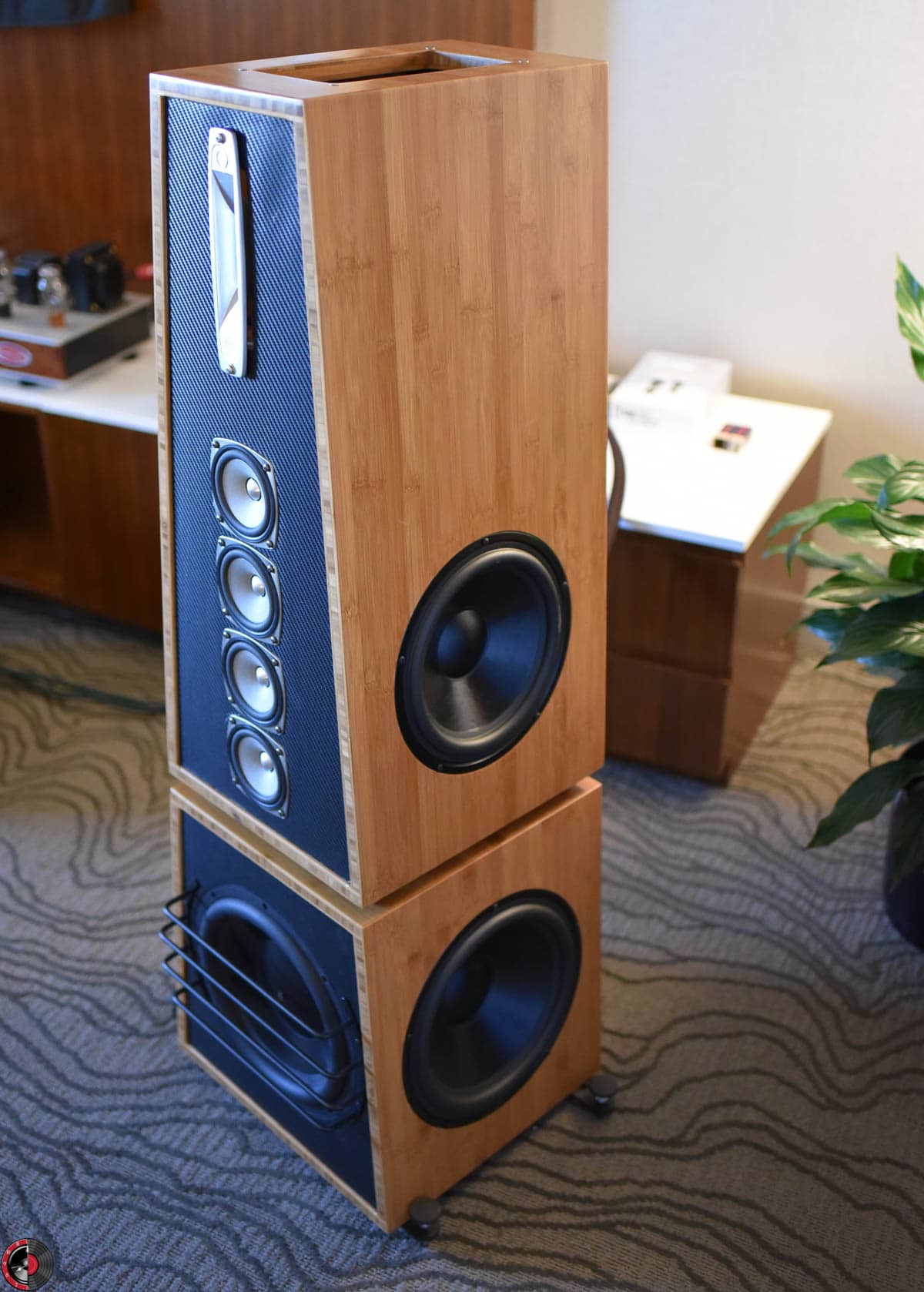
Going full circle: Jim Jordan, designer of  Vaughn Loudspeakers, is now replicating the DuKane Ionovac tweeter.  Jim told me that he’s had molds made for the horn, and is producing new quartz cells and porcelain couplers, and has designed a new power supply. The Vaughn Plasma Signature speakers were recently shown at RMAF with electronics from Wavelength, and Stereophile’s Herb Reichert— a man known for enthusiasm, but not overstatement—wrote, “…it might be the best sound at any show, ever.”

RMAF-Wavelength-Vaughn-2949

The Plasma Signature model from Vaughn Loudspeakers, using their replica DuKane Ionovac tweeter. Photo: Lee Scoggins/Part-Time Audiophile, Vaughn/Wavelength room, RMAF 2016.

Given the advancements in materials science that have appeared during the 65 years since Klein’s papers, I have no doubt that we will continue to see further improvements and developments in massless tweeters. I can’t wait.

0 comments

Leave a comment

0 Comments

Your avatar

Loading comments...

🗑️ Delete Comment

Enter moderator password to delete this comment:

✏️ Edit Comment

Enter your email to verify ownership: