COPPER

A PS Audio Publication

Issue 197 • Free Online Magazine

Issue 197 Speaker Stories

Standing Room Only

Standing Room Only

Wouldn’t you hate it if you went to the theatre and had purchased your higher-tier seats with guaranteed optimal views of everyone on stage, the sets and even a glimpse of the musicians in the pit below, only to find that your seat had been taken, or worse still, there were no seats in the house! When you pay for a good seat, you don’t want to be left hanging with standing room only.

Similarly, when you invest in high-quality musical equipment for your home, the last thing you want is a compromise in seating. Not because your listening chair or couch is uncomfortable, but because you have discovered that you can hear a better sound somewhere in the room other than in your main seating position. It can be frustrating to say the least. You could liken it to the awkwardness of asking that person who took your seat to move, in a polite yet firm way; “I’m sorry, I think you are sitting in my seat.” But what you’re really thinking is, “Just what do you think you are doing there? Get out of the way!”

Likewise, a sonic imposter is likely invading your listening room right now, except that this one is not brazen enough to impede your listening experience by making itself visibly known. Oh no, this interloper is invisible, but nonetheless is discernibly detracting from the enjoyment of your musical performance. We are talking about the presence of a standing wave (or waves).

Just what is a standing wave, what does it do to our sound, is it really that bad, and more important, what should you do about it?

In physics, a standing wave is one that varies in amplitude over time, but its peak amplitude profile doesn’t move in space. Standing waves are formed by the combination of two waves of the same amplitude and frequency moving in opposite directions.

Illustration of a standing wave. Courtesy of Wikimedia Commons/Lucas Vieira.


Why does this matter in acoustics, and in our listening rooms? Standing waves may create areas of undesirable resonances within a room and so produce some notes that will be louder than others in those areas, especially in the bass. (Conversely, there may be areas of cancellation, where certain frequencies may be attenuated in specific locations in the room. We touched on this in “Subliminal or Sublime Bass?” in Issue 138.)

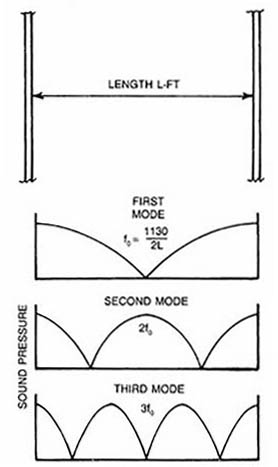
Standing waves happen because the dimensions of a room are the same or multiples of the wavelength of the sound at a particular frequency. The room dimensions, speaker position and listening position are what determine the amplitude of a sound waveform at a given frequency. Rather than decaying quickly, that sound wave is emphasised, and you hear it as an unwanted resonance or volume peak. Other frequencies are less prominent from where the same sound wave reflects back on itself over time, leaving a null or a part of the frequency response where there is little sound pressure, and a volume “suck out.”

What is the overall result? You have sound wave energy which is emphasized in some frequencies and nulled in others, which causes an in-room frequency response that is uneven and measurably imbalanced. If you think of a butterfly, the body part where there is no change in movement is the null sound, and the wings represent the sweep of the amplitude of the sound wave, where there are changes in movement – and peaks in the standing wave.

If you are a bass guitar player like me, you may have heard such resonances when trying out different-sized speaker cabinets. Depending on the note you play (the sound waveform) and the size of the cabinet (the “room dimensions”), you may notice that at certain frequencies the sound is no longer even and smooth, but instead, uneven in volume. I have even seen some smaller bass cabinets (a 1 x 10-inch model, for example) actually move around the floor because the cabinet wasn’t sturdy enough to compete with the standing waves created by the cabinet and floor and the note being played.

Standing waves can really mess with the low-frequency response in our music. This is part of the reason why, as you move around your room, some areas sound fuller and richer in bass, while others are lacking. The practical problem is that for most of us with “smaller” rooms (i.e., up to hundreds of square feet and not concert halls or stadiums), the bass, which comprises about 30 percent of what people like in an audio system, sets the context for our midrange and treble – and that in most home listening rooms, the bass is adversely affected up to and including about 150 Hz – right where our low end “lives.” The range of frequencies which are impacted decrease as the room size increases. Bigger rooms are affected up to about 90 Hz, and much bigger rooms are affected up until about 60 Hz.
Standing wave propagation in a room.


If there is any compensation in this, some of us can take consolation in the fact that we have listening rooms that are less than ideal in their shape and lack of symmetry. However, those “flawed” room shapes, like an “L”-shaped room, or a room which is open on one side or is asymmetrical, can help break up standing waves rather than reinforce them.

Standing waves are a fact of life. You can’t eliminate them, unless you plan to listen to music in an anechoic chamber, or outside, where there are no room boundaries that would create standing waves. (One interesting solution would be a listening room that opens out to the great outdoors on one side.) The bigger issue is how much control you have over them. In fact, to complain that you have standing waves is a bit like complaining that you have walls.

OK, rooms may not be perfect or even close, but the very fact that the room has such a massive influence over your sound means that you can do more to change your room’s behaviour, by addressing standing waves and correctly aligning your low frequencies, than swapping out your equipment or loudspeakers.

In a following article we will look into how we can tailor our room to taste by addressing standing waves, in our hunt for that sound – the sonic ideal we all strive for.


Header illustration of a standing wave courtesy of Wikimedia Commons/Vegar Ottesen.

This article was first published in Issue 139.

More from Issue 197

View All Articles in Issue 197

Search Copper Magazine

#232 What came first: Art or Music? A Conversation With Artist Jose Acosta by Joe Caplan Jul 06, 2026 #232 Blow By Blow: The Jeff Beck Story: An Insightful Book About a Guitar Icon by Ray Chelstowski Jul 06, 2026 #232 Creed Over Camaraderie? by B. Jan Montana Jul 06, 2026 #232 Chronicles of a Sound Pilgrim at the 2026 Montreal Audiofest by Hugues Morin Jul 06, 2026 #232 The Vinyl Beat: Summer Grooves by Rudy Radelic Jul 06, 2026 #232 Hibbing Hillbilly Dylan's Acoustic Rock by Wayne Robins Jul 06, 2026 #232 Quad Quads and Plasmatronics Tweeters: An Extraordinary System Comes to Life by Frank Doris Jul 06, 2026 #232 In Praise of Live Music, Once Again by Ted Shafran Jul 06, 2026 #232 Allnic Audio’s L-9000 Preamplifier: Design and Engineering Innovation by Howard Kneller Jul 06, 2026 #232 “Best Of” Lists and Rage Bait: Enough Already by Frank Doris Jul 06, 2026 #232 Quick Takes: Bud Shank, Paulo Almeida, Jakob Dreyer, Tim Eriksen and Peter Irvine by Frank Doris Jul 06, 2026 #232 My Impressions of AXPONA 2026, Part 2 by Frank Doris Jul 06, 2026 #232 How to Play in a Rock Band, 25: Encounters With Famous Musicians, Part Three by Frank Doris Jul 06, 2026 #232 Budgets, and Systems From Small to Outrageous by Paul McGowan Jul 06, 2026 #232 PS Audio in the News by PS Audio Staff Jul 06, 2026 #232 Hand It Over by Frank Doris Jul 06, 2026 #232 Difference of Opinion by Peter Xeni Jul 06, 2026 #232 Wabi-sabi Tree by James Schrimpf Jul 06, 2026 #231 Piano Prodigy Jude Kofie Releases His Debut Album On Octave Records by Frank Doris Jun 01, 2026 #231 Underappreciated Artists, Part Two: City Boy by Rich Isaacs Jun 01, 2026 #231 Music and the Art of Creation: Talking With Saxophonist Rob Scheps by Joe Caplan Jun 01, 2026 #231 How to Play in a Rock Band, 24: Further Adventures at the 2026 Montauk Music Festival by Frank Doris Jun 01, 2026 #231 Courtney Barnett: Creature of Habit by Wayne Robins Jun 01, 2026 #231 Angine de Poitrine: Interstellar Guitar Rock Saviors Headed for Late-Night TV Pop Stardom? by Mark Lepage Jun 01, 2026 #231 My Impressions of AXPONA 2026, Part One by Frank Doris Jun 01, 2026 #231 2026 La Jolla Concours d'Elegance: Another Aesthetic Feast by B. Jan Montana Jun 01, 2026 #231 Country Music Icon Jo Dee Messina’s Bridges: A New Beginning by Ray Chelstowski Jun 01, 2026 #231 The Luxury Dispatch Hosts a Video Podcast With Ken Kessler by Ken Kessler Jun 01, 2026 #231 The Vinyl Beat: Tracking in the Motor City by Rudy Radelic Jun 01, 2026 #231 Lots of Fun With DSP: The Ferrum Audio WANDLA DAC and Its Tube Mode by Frank Doris Jun 01, 2026 #231 From The Audiophile's Guide: Digital Source Components and Streaming Audio by Paul McGowan Jun 01, 2026 #231 Onkyo’s Monster M-510 power amplifier by The Staff at Just Audio Jun 01, 2026 #231 PS Audio in the News by PS Audio Staff Jun 01, 2026 #231 Naming Convention by Peter Xeni Jun 01, 2026 #231 Les Invisibles by Frank Doris Jun 01, 2026 #231 Wildlife Scene by James Schrimpf Jun 01, 2026 #230 Camaraderie by B. Jan Montana May 04, 2026 #230 AXPONA 2026: A Family Gathering by Paul McGowan May 04, 2026 #230 Pianist Ryan Benthall Explores Jazz Realms and Far Beyond With Divine Sky by Frank Doris May 04, 2026 #230 The Vinyl Beat in AXPONA-Land by Rudy Radelic May 04, 2026 #230 Teddy Thompson’s Musical Growth Deepens With Never Be the Same by Ray Chelstowski May 04, 2026 #230 More Fun in the Sun: Florida Audio Expo, Part Two by Frank Doris May 04, 2026 #230 CanJam NYC 2026 Show Report: Heady Sound, Part Two by Frank Doris and Harris Fogel May 04, 2026 #230 Sonic Youth On Murray Street by Wayne Robins May 04, 2026 #230 Graffeo Coffee: A Symphony of Sensory Experience by Joe Caplan May 04, 2026 #230 The Saul Authority: The Story of Hi-Fi Pioneer Saul Marantz by Olivier Meunier-Plante May 04, 2026 #230 How to Play in a Rock Band, 23: Encounters With Famous Musicians, Part Two by Frank Doris May 04, 2026

Standing Room Only

Standing Room Only

Wouldn’t you hate it if you went to the theatre and had purchased your higher-tier seats with guaranteed optimal views of everyone on stage, the sets and even a glimpse of the musicians in the pit below, only to find that your seat had been taken, or worse still, there were no seats in the house! When you pay for a good seat, you don’t want to be left hanging with standing room only.

Similarly, when you invest in high-quality musical equipment for your home, the last thing you want is a compromise in seating. Not because your listening chair or couch is uncomfortable, but because you have discovered that you can hear a better sound somewhere in the room other than in your main seating position. It can be frustrating to say the least. You could liken it to the awkwardness of asking that person who took your seat to move, in a polite yet firm way; “I’m sorry, I think you are sitting in my seat.” But what you’re really thinking is, “Just what do you think you are doing there? Get out of the way!”

Likewise, a sonic imposter is likely invading your listening room right now, except that this one is not brazen enough to impede your listening experience by making itself visibly known. Oh no, this interloper is invisible, but nonetheless is discernibly detracting from the enjoyment of your musical performance. We are talking about the presence of a standing wave (or waves).

Just what is a standing wave, what does it do to our sound, is it really that bad, and more important, what should you do about it?

In physics, a standing wave is one that varies in amplitude over time, but its peak amplitude profile doesn’t move in space. Standing waves are formed by the combination of two waves of the same amplitude and frequency moving in opposite directions.

Illustration of a standing wave. Courtesy of Wikimedia Commons/Lucas Vieira.


Why does this matter in acoustics, and in our listening rooms? Standing waves may create areas of undesirable resonances within a room and so produce some notes that will be louder than others in those areas, especially in the bass. (Conversely, there may be areas of cancellation, where certain frequencies may be attenuated in specific locations in the room. We touched on this in “Subliminal or Sublime Bass?” in Issue 138.)

Standing waves happen because the dimensions of a room are the same or multiples of the wavelength of the sound at a particular frequency. The room dimensions, speaker position and listening position are what determine the amplitude of a sound waveform at a given frequency. Rather than decaying quickly, that sound wave is emphasised, and you hear it as an unwanted resonance or volume peak. Other frequencies are less prominent from where the same sound wave reflects back on itself over time, leaving a null or a part of the frequency response where there is little sound pressure, and a volume “suck out.”

What is the overall result? You have sound wave energy which is emphasized in some frequencies and nulled in others, which causes an in-room frequency response that is uneven and measurably imbalanced. If you think of a butterfly, the body part where there is no change in movement is the null sound, and the wings represent the sweep of the amplitude of the sound wave, where there are changes in movement – and peaks in the standing wave.

If you are a bass guitar player like me, you may have heard such resonances when trying out different-sized speaker cabinets. Depending on the note you play (the sound waveform) and the size of the cabinet (the “room dimensions”), you may notice that at certain frequencies the sound is no longer even and smooth, but instead, uneven in volume. I have even seen some smaller bass cabinets (a 1 x 10-inch model, for example) actually move around the floor because the cabinet wasn’t sturdy enough to compete with the standing waves created by the cabinet and floor and the note being played.

Standing waves can really mess with the low-frequency response in our music. This is part of the reason why, as you move around your room, some areas sound fuller and richer in bass, while others are lacking. The practical problem is that for most of us with “smaller” rooms (i.e., up to hundreds of square feet and not concert halls or stadiums), the bass, which comprises about 30 percent of what people like in an audio system, sets the context for our midrange and treble – and that in most home listening rooms, the bass is adversely affected up to and including about 150 Hz – right where our low end “lives.” The range of frequencies which are impacted decrease as the room size increases. Bigger rooms are affected up to about 90 Hz, and much bigger rooms are affected up until about 60 Hz.

Standing wave propagation in a room.


If there is any compensation in this, some of us can take consolation in the fact that we have listening rooms that are less than ideal in their shape and lack of symmetry. However, those “flawed” room shapes, like an “L”-shaped room, or a room which is open on one side or is asymmetrical, can help break up standing waves rather than reinforce them.

Standing waves are a fact of life. You can’t eliminate them, unless you plan to listen to music in an anechoic chamber, or outside, where there are no room boundaries that would create standing waves. (One interesting solution would be a listening room that opens out to the great outdoors on one side.) The bigger issue is how much control you have over them. In fact, to complain that you have standing waves is a bit like complaining that you have walls.

OK, rooms may not be perfect or even close, but the very fact that the room has such a massive influence over your sound means that you can do more to change your room’s behaviour, by addressing standing waves and correctly aligning your low frequencies, than swapping out your equipment or loudspeakers.

In a following article we will look into how we can tailor our room to taste by addressing standing waves, in our hunt for that sound – the sonic ideal we all strive for.


Header illustration of a standing wave courtesy of Wikimedia Commons/Vegar Ottesen.

This article was first published in Issue 139.

0 comments

Leave a comment

0 Comments

Your avatar

Loading comments...

🗑️ Delete Comment

Enter moderator password to delete this comment:

✏️ Edit Comment

Enter your email to verify ownership: