COPPER

A PS Audio Publication

Issue 120 • Free Online Magazine

Issue 120 FEATURED

K-tel Records: Now That’s What We Call Music!

K-tel Records: Now That’s What We Call Music!

Since the late 1990s the Now That’s What I Call Music franchise has almost single-handedly kept compact disc sales from completely falling off the ledge. The concept is a simple one. Each album compiles a roster of current hit songs into a single release. For almost 40 years these music compilations have delivered the kind of sales performance that equaled what you might expect from a hit record back in the gravy days of vinyl. The most successful volume to date is 1999s Now That’s What I Call Music! 44. This edition has sold 2.3 million copies and remains the biggest-selling various artists compilation album in the UK. 2008s Now That’s What I Call Music! 70 sold 383,002 units in its first week of sales alone. Today the series is simply called Now and volumes are produced in over thirty countries worldwide.

What’s most surprising about the Now franchise is that it was never a new or novel concept, even if it was treated as one. The business model had made millions for others before Now arrived, with the most popular being the very concept’s own creator, K-tel Records.

K-tel was founded by Canadian Philip Kives, a salesman who started his career selling cookware, iceboxes and other items and pitching wares in Atlantic City. In 1962 he hit upon the idea of selling a Teflon-coated frying pan on TV in what would eventually become known as the “infomercial.” Kives later expanded into selling other items, including the famous Dial-O-Matic and Veg-O-Matic food choppers!

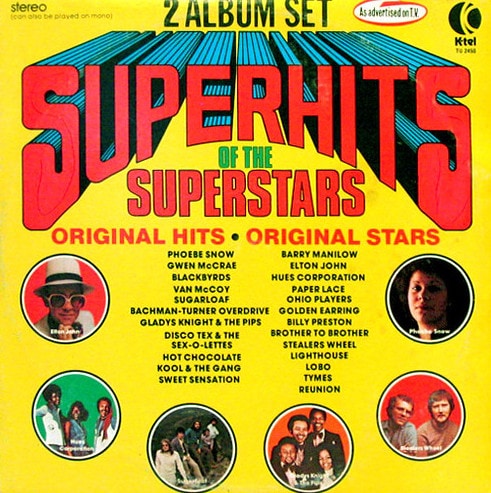
In 1966, K-tel released its first compilation album, 25 Country Hits. It quickly sold out and prompted the K-tel follow-up, 25 Polka Greats. This one sold 1.5 million copies in the United States alone. The hits kept coming and included The Super Hits series, The Dynamic Hits series and The Number One Hits series.  K-tel assembled greatest hits from the latest, greatest artists in one single package. There were even thematic compilations like Goofy Greats, Super Bad, Super Bad Is Back, Souled Out, Summer Cruisin’, and a 1950s look back,  Rock n Roll Show.

The K-tel music compilations were a quick, very cheap way to boost your music collection or hear your favorite pop hits on demand. A record could go for $3.99. The commercials were kitschy and brilliant. During the 1970s and 1980s these catchy broadcast advertising spots were impossible to miss, and they helped define that era’s television experience. For the voice overs, Kives hired Bob Washington, the morning man of CKRC-AM, one of Winnipeg’s three Top 40 stations. Back in the day Washington’s voice was as distinct as the K-tel ad copy he would read. I can still hear him voice, “Twenty-two original hits! Twenty-two original stars!” and the tagline which was always some variation of, “LP, $4.99! Tape or cassette, $5.99!” These ads remain one of the many great pop culture memories I have from my youth.

But it wasn’t all great. In order to squeeze as many hits as they did into a single record (often eleven per side) K-tel often cut songs down, making them shorter than their original run time. And no song would run any longer than 2:30. In order to secure the rights to the bona-fide hit records, many labels forced K-tel to also accept lesser-known songs as part of the licensing deal. That would always lead to some head scratching as you browsed through a particular record’s playlist. Even on some of the ads where the actual bands spoke about how “explosive” a collection was, you could see them grimace as they called out some of these wild card additions.

The records weren’t of high quality either. They were terribly thin so the grooves couldn’t be cut deep.  This impacted the sound quality. The bass was weak, the midrange was gritty, and the high end often entirely absent. The grooves were also cut very close to each other, making even the smallest scratch a guaranteed spot for the record to skip with each spin. In a way we all accepted the poor production quality because when you got right down to it, the record was really a sampler. Anything that caught your ear was probably going to prompt you to go out and buy that band’s actual record. Considering how important sound fidelity is to me to Copper readers it’s a wonder that even back then we would have been all that forgiving of the products’ shortcomings.

Competitors quickly emerged, with Ronco Records being perhaps the most noteworthy. Founded by fellow TV demonstration salesman Ron Popeil, Ronco was a company that was more diversified than K-tel, with a portfolio of household and other products that gave them better financial stability. (Who can forget classics like the Pocket Fisherman, GLH-9 spray-on hair and that favorite of budding audio engineers everywhere, Mr. Microphone?)


In 1972 Ronco released its first compilation, 20 Star Tracks. This was soon followed in 1973 by the That’ll Be the Day soundtrack. Rock worked for Ronco, but it was with disco where they would set themselves apart and really take off. Disco Daze and Disco Nites were among their best sellers. Maybe even more famous than their compilations was their announcer, Tommy Vance. A UK native, he was not only the voice for all Ronco products, he had an illustrious career as a radio broadcaster, and announced each act that took the stage at Wembley Stadium for Live Aid in 1985.

Even CBS records got in the game with their CSP (Columbia Special Products) division. To this day I find myself still spinning their compilation #1 Rock Hits of the 70s. It has very few “rock” songs but across eighteen tracks it delivers Freddy Fender, Billy Swan, Andy Kim, The O’Jays, The Manhattans and more. I love the mix so much that I had to make a digital playlist counterpart to back me up for that day when the record becomes completely played out.

Then there were the companies that recorded sound-alike covers of the actual hits. These sounded very close to the originals but as soon as you picked up what was really going on the record became unlistenable. It’s amazing how long this racket actually lasted.

The editor will not admit to having these records in his collection.

As competition from others like Ronco grew, K-tel diversified, forming subsidiaries in areas such as real estate and oil exploration. In 1980 they acquired rival Candlelite Records. This was a bit off-strategy asCandlelite focused on music from the 1940s and the easy listening genre. The audience for this music was older and this turned out to be a losing investment.

In the 1980s the tide continued to turn for K-tel International and in 1984 the company filed for Chapter 11 bankruptcy protection. K-tel would negotiate settlements with the banks and other creditors and seven years later, in 1991, Kives once again became K-tel’s owner. By then, the Now franchise had been well underway, having land-grabbed the compilation business from K-tel and all others in the market.

K-tel still exists, even if they are no longer the music powerhouse they once were. That said, they distribute more than 200,000 songs worldwide each year through digital platforms and receive revenue from licensing songs for commercials, TV and movies. But back in the day, they were as Forbes magazine once said, “the Spotify of the 70s.” K-tel records were easy go-to spins for those afternoons when friends came by to visit. Putting a K-tel record on was a sure-fire way to please almost anyone.

Years ago as an employee of Time Inc., I took advantage of the great deals they offered employees at their company bookstore. I decided to buy the entire 1970s series called AM Gold, 10 CDs of AM radio at its 1970s best. We also developed a similar compilation line at Entertainment Weekly that began as a subscription tool and then grew to be a fantastically successful business on its own. Curated by a former circulation manager named Vinny Vero, the collections caught fire quickly and proved that great mixes, whether on vinyl, cassette, CD, digital file or streaming, connect with us in ways that are physical, emotional, and in the undefinable region between both. This is something that Philip Kives picked up on and turned into a sensation.

As I look back now I realize that we all found bands through K-tel that we might not otherwise have paid much attention to. Foo Fighters frontman Dave Grohl famously said that he discovered Edgar Winter through a K-tel compilation record. I discovered Redbone (“Come and Get Your Love,” “The Witch Queen of New Orleans”). An entire generation discovered that sharing music was maybe K-tel’s greatest gift to us all. Better yet, that lesson came at the everyday low price of $3.99 per record. “Explosive” indeed!
More from Issue 120

View All Articles in Issue 120

Search Copper Magazine

#231 Piano Prodigy Jude Kofie Releases His Debut Album On Octave Records by Frank Doris Jun 01, 2026 #231 Underappreciated Artists, Part Two: City Boy by Rich Isaacs Jun 01, 2026 #231 Music and the Art of Creation: Talking With Saxophonist Rob Scheps by Joe Caplan Jun 01, 2026 #231 How to Play in a Rock Band, 24: Further Adventures at the 2026 Montauk Music Festival by Frank Doris Jun 01, 2026 #231 Courtney Barnett: Creature of Habit by Wayne Robins Jun 01, 2026 #231 Angine de Poitrine: Interstellar Guitar Rock Saviors Headed for Late-Night TV Pop Stardom? by Mark Lepage Jun 01, 2026 #231 My Impressions of AXPONA 2026, Part One by Frank Doris Jun 01, 2026 #231 2026 La Jolla Concours d'Elegance: Another Aesthetic Feast by B. Jan Montana Jun 01, 2026 #231 Country Music Icon Jo Dee Messina’s Bridges: A New Beginning by Ray Chelstowski Jun 01, 2026 #231 The Luxury Dispatch Hosts a Video Podcast With Ken Kessler by Ken Kessler Jun 01, 2026 #231 The Vinyl Beat: Tracking in the Motor City by Rudy Radelic Jun 01, 2026 #231 Lots of Fun With DSP: The Ferrum Audio WANDLA DAC and Its Tube Mode by Frank Doris Jun 01, 2026 #231 From The Audiophile's Guide: Digital Source Components and Streaming Audio by Paul McGowan Jun 01, 2026 #231 Onkyo’s Monster M-510 power amplifier by The Staff at Just Audio Jun 01, 2026 #231 PS Audio in the News by PS Audio Staff Jun 01, 2026 #231 Naming Convention by Peter Xeni Jun 01, 2026 #231 Les Invisibles by Frank Doris Jun 01, 2026 #231 Wildlife Scene by James Schrimpf Jun 01, 2026 #230 Camaraderie by B. Jan Montana May 04, 2026 #230 AXPONA 2026: A Family Gathering by Paul McGowan May 04, 2026 #230 Pianist Ryan Benthall Explores Jazz Realms and Far Beyond With Divine Sky by Frank Doris May 04, 2026 #230 The Vinyl Beat in AXPONA-Land by Rudy Radelic May 04, 2026 #230 Teddy Thompson’s Musical Growth Deepens With Never Be the Same by Ray Chelstowski May 04, 2026 #230 More Fun in the Sun: Florida Audio Expo, Part Two by Frank Doris May 04, 2026 #230 CanJam NYC 2026 Show Report: Heady Sound, Part Two by Frank Doris and Harris Fogel May 04, 2026 #230 Sonic Youth On Murray Street by Wayne Robins May 04, 2026 #230 Graffeo Coffee: A Symphony of Sensory Experience by Joe Caplan May 04, 2026 #230 The Saul Authority: The Story of Hi-Fi Pioneer Saul Marantz by Olivier Meunier-Plante May 04, 2026 #230 How to Play in a Rock Band, 23: Encounters With Famous Musicians, Part Two by Frank Doris May 04, 2026 #230 An Outlier in the Rack: A Vintage BIC Beam Box by The Staff at Just Audio May 04, 2026 #230 PS Audio in the News by PS Audio Staff May 04, 2026 #230 A Cautionary Tale by Rich Isaacs May 04, 2026 #230 Reel-to-Reel Roots, Part 33 (Revised): Ken Kessler Reports On the 2026 (British) AudioJumble by Ken Kessler May 04, 2026 #230 Text Messaging by Frank Doris May 04, 2026 #230 The Audiophile Rat Race by Peter Xeni May 04, 2026 #230 On the Rocks by Rich Isaacs May 04, 2026 #229 The Earliest Stars of Country Music, Part Three by Jeff Weiner Apr 06, 2026 #229 The Healing Power of Music and Sound at the Omega Institute by Joe Caplan Apr 06, 2026 #229 CanJam NYC 2026 Show Report: Heady Sound, Part One by Frank Doris Apr 06, 2026 #229 Florida Audio Expo 2026: Warming Up to High-End Audio, Part One by Frank Doris Apr 06, 2026 #229 Quick Takes: Anne Bisson, Sam Morrison, The Velvet Underground, and the Stooges by Frank Doris Apr 06, 2026 #229 The Vinyl Beat: New Arrivals, and Old Audio Show Demo Scores to Settle by Rudy Radelic Apr 06, 2026 #229 Harvard Gets a High-End Audio Education by Frank Doris Apr 06, 2026 #229 No Country for Old Knees by B. Jan Montana Apr 06, 2026 #229 How To Play in A Rock Band, 22: Encounters With Famous Musicians, Part 1 by Frank Doris Apr 06, 2026 #229 The Soulful Grooves of Guinea-Bissau by Steve Kindig Apr 06, 2026 #229 Four-Hand Piano Performance at Its Finest by Stephan Haberthür Apr 06, 2026

K-tel Records: Now That’s What We Call Music!

K-tel Records: Now That’s What We Call Music!

Since the late 1990s the Now That’s What I Call Music franchise has almost single-handedly kept compact disc sales from completely falling off the ledge. The concept is a simple one. Each album compiles a roster of current hit songs into a single release. For almost 40 years these music compilations have delivered the kind of sales performance that equaled what you might expect from a hit record back in the gravy days of vinyl. The most successful volume to date is 1999s Now That’s What I Call Music! 44. This edition has sold 2.3 million copies and remains the biggest-selling various artists compilation album in the UK. 2008s Now That’s What I Call Music! 70 sold 383,002 units in its first week of sales alone. Today the series is simply called Now and volumes are produced in over thirty countries worldwide.

What’s most surprising about the Now franchise is that it was never a new or novel concept, even if it was treated as one. The business model had made millions for others before Now arrived, with the most popular being the very concept’s own creator, K-tel Records.

K-tel was founded by Canadian Philip Kives, a salesman who started his career selling cookware, iceboxes and other items and pitching wares in Atlantic City. In 1962 he hit upon the idea of selling a Teflon-coated frying pan on TV in what would eventually become known as the “infomercial.” Kives later expanded into selling other items, including the famous Dial-O-Matic and Veg-O-Matic food choppers!

In 1966, K-tel released its first compilation album, 25 Country Hits. It quickly sold out and prompted the K-tel follow-up, 25 Polka Greats. This one sold 1.5 million copies in the United States alone. The hits kept coming and included The Super Hits series, The Dynamic Hits series and The Number One Hits series.  K-tel assembled greatest hits from the latest, greatest artists in one single package. There were even thematic compilations like Goofy Greats, Super Bad, Super Bad Is Back, Souled Out, Summer Cruisin’, and a 1950s look back,  Rock n Roll Show.

The K-tel music compilations were a quick, very cheap way to boost your music collection or hear your favorite pop hits on demand. A record could go for $3.99. The commercials were kitschy and brilliant. During the 1970s and 1980s these catchy broadcast advertising spots were impossible to miss, and they helped define that era’s television experience. For the voice overs, Kives hired Bob Washington, the morning man of CKRC-AM, one of Winnipeg’s three Top 40 stations. Back in the day Washington’s voice was as distinct as the K-tel ad copy he would read. I can still hear him voice, “Twenty-two original hits! Twenty-two original stars!” and the tagline which was always some variation of, “LP, $4.99! Tape or cassette, $5.99!” These ads remain one of the many great pop culture memories I have from my youth.

But it wasn’t all great. In order to squeeze as many hits as they did into a single record (often eleven per side) K-tel often cut songs down, making them shorter than their original run time. And no song would run any longer than 2:30. In order to secure the rights to the bona-fide hit records, many labels forced K-tel to also accept lesser-known songs as part of the licensing deal. That would always lead to some head scratching as you browsed through a particular record’s playlist. Even on some of the ads where the actual bands spoke about how “explosive” a collection was, you could see them grimace as they called out some of these wild card additions.

The records weren’t of high quality either. They were terribly thin so the grooves couldn’t be cut deep.  This impacted the sound quality. The bass was weak, the midrange was gritty, and the high end often entirely absent. The grooves were also cut very close to each other, making even the smallest scratch a guaranteed spot for the record to skip with each spin. In a way we all accepted the poor production quality because when you got right down to it, the record was really a sampler. Anything that caught your ear was probably going to prompt you to go out and buy that band’s actual record. Considering how important sound fidelity is to me to Copper readers it’s a wonder that even back then we would have been all that forgiving of the products’ shortcomings.

Competitors quickly emerged, with Ronco Records being perhaps the most noteworthy. Founded by fellow TV demonstration salesman Ron Popeil, Ronco was a company that was more diversified than K-tel, with a portfolio of household and other products that gave them better financial stability. (Who can forget classics like the Pocket Fisherman, GLH-9 spray-on hair and that favorite of budding audio engineers everywhere, Mr. Microphone?)


In 1972 Ronco released its first compilation, 20 Star Tracks. This was soon followed in 1973 by the That’ll Be the Day soundtrack. Rock worked for Ronco, but it was with disco where they would set themselves apart and really take off. Disco Daze and Disco Nites were among their best sellers. Maybe even more famous than their compilations was their announcer, Tommy Vance. A UK native, he was not only the voice for all Ronco products, he had an illustrious career as a radio broadcaster, and announced each act that took the stage at Wembley Stadium for Live Aid in 1985.

Even CBS records got in the game with their CSP (Columbia Special Products) division. To this day I find myself still spinning their compilation #1 Rock Hits of the 70s. It has very few “rock” songs but across eighteen tracks it delivers Freddy Fender, Billy Swan, Andy Kim, The O’Jays, The Manhattans and more. I love the mix so much that I had to make a digital playlist counterpart to back me up for that day when the record becomes completely played out.

Then there were the companies that recorded sound-alike covers of the actual hits. These sounded very close to the originals but as soon as you picked up what was really going on the record became unlistenable. It’s amazing how long this racket actually lasted.

The editor will not admit to having these records in his collection.

As competition from others like Ronco grew, K-tel diversified, forming subsidiaries in areas such as real estate and oil exploration. In 1980 they acquired rival Candlelite Records. This was a bit off-strategy asCandlelite focused on music from the 1940s and the easy listening genre. The audience for this music was older and this turned out to be a losing investment.

In the 1980s the tide continued to turn for K-tel International and in 1984 the company filed for Chapter 11 bankruptcy protection. K-tel would negotiate settlements with the banks and other creditors and seven years later, in 1991, Kives once again became K-tel’s owner. By then, the Now franchise had been well underway, having land-grabbed the compilation business from K-tel and all others in the market.

K-tel still exists, even if they are no longer the music powerhouse they once were. That said, they distribute more than 200,000 songs worldwide each year through digital platforms and receive revenue from licensing songs for commercials, TV and movies. But back in the day, they were as Forbes magazine once said, “the Spotify of the 70s.” K-tel records were easy go-to spins for those afternoons when friends came by to visit. Putting a K-tel record on was a sure-fire way to please almost anyone.

Years ago as an employee of Time Inc., I took advantage of the great deals they offered employees at their company bookstore. I decided to buy the entire 1970s series called AM Gold, 10 CDs of AM radio at its 1970s best. We also developed a similar compilation line at Entertainment Weekly that began as a subscription tool and then grew to be a fantastically successful business on its own. Curated by a former circulation manager named Vinny Vero, the collections caught fire quickly and proved that great mixes, whether on vinyl, cassette, CD, digital file or streaming, connect with us in ways that are physical, emotional, and in the undefinable region between both. This is something that Philip Kives picked up on and turned into a sensation.

As I look back now I realize that we all found bands through K-tel that we might not otherwise have paid much attention to. Foo Fighters frontman Dave Grohl famously said that he discovered Edgar Winter through a K-tel compilation record. I discovered Redbone (“Come and Get Your Love,” “The Witch Queen of New Orleans”). An entire generation discovered that sharing music was maybe K-tel’s greatest gift to us all. Better yet, that lesson came at the everyday low price of $3.99 per record. “Explosive” indeed!

0 comments

Leave a comment

0 Comments

Your avatar

Loading comments...

🗑️ Delete Comment

Enter moderator password to delete this comment:

✏️ Edit Comment

Enter your email to verify ownership: