COPPER

A PS Audio Publication

Issue 180 • Free Online Magazine

Issue 180 Twisted Systems

Jeff Beck: In Memoriam

Jeff Beck: In Memoriam

No, there is no cute way to begin this one.

There is no “another one bites the dust.”

Not even a “somewhere over the rainbow.”

I just don’t have it in me.

I’m too stunned…gobsmacked as the English would say, by Jeff Beck’s death on January 10.

If I meander, forgive me because I’m writing in total disbelief.

Our heroes are going to die. We know this intellectually. Many of them also have long drug, alcohol and/or medical issues that we, as fans, know about.

That means that we appreciate that many of our heroes are on borrowed time.

Paul will go someday, so will Ringo.

Keith? Well if that ever happens it’s not like we haven’t expected if for the last, say…50 years!

Eric had an alcohol and drug problem; no surprise when he goes.

When it comes to my guitar heroes, here is the score:

George Harrison – he was attacked in his home a couple of years before he succumbed to brain cancer brought about by his prodigious cigarette smoking. Those in the business knew what was going on.

B.B. King has myriad health issues as did Leslie West, as did Albert King and Eddie Van Halen.

Many of us knew about Eddie’s cancer diagnosis.

But Jeff? Jeff Beck was just fine. He never had a reputation for drugs or alcoholism. He just recorded constantly and played all the time. He had just finished his latest tour with Johnny Depp as his bandmate. I didn’t go but people tell me the Depp more than held his own.

Not just that.

Jeff was the archetype of the British guitar slinger with the perfect late 1960s shag haircut, the perfect jeans, the perfect T-shirt, the perfect stance and, above all, a playing style that left those who didn’t know guitar amazed and for those of us who did (the millions of guitar slingers around the world), plain dumbstruck.

He never, ever left one disappointed. No matter who he played with.

Eric Clapton could sound bored to death on some nights. Jimmy Page could be terribly sloppy on some nights. So could Jimi, who freaked out Beck, Eric and Pete Townshend the first night they witnessed his playing at the Bag O’Nails club in London on November 25, 1966, to the point that even Beck admitted that there was no reason to play anymore.

Beck soldiered on, however, but missed the big-money gravy train. He just did things his own way. From what I understand, he had either the longest (or next to longest) single record label relationship in history (Epic Records to be exact), Dylan being the other one with Columbia (which  along with Epic is part of the Sony Music Entertainment family as well).

I have read dozens of interviews with Jeff Beck over the years.

Clapton and Page, his guitar god contemporaries achieved much larger fame and fortune. Page was associated with a great singer (Robert Plant), and Clapton could sing very well.

Beck? Have you ever heard him sing? He actually had a hit in the UK in 1967 with a song called “Hi Ho Silver Lining.” I won’t bother commenting except that it is no surprise that he hooked up with Rod Stewart shortly after that!

Other non-singing guitar players of note who amassed a fortune, like Santana, needed to hook up with a vocalist, and in Santana’s case it was Rob Thomas of Matchbox 20. They recorded “Smooth,” which sold millions of albums and put Santana at the top of the charts in 1999.

Beck never had that. I would think that he could have. I mean, who wouldn’t want to work with Jeff? There is no higher pedigree of musician than Mr. Beck.

Jeff Beck at the Iridium in Manhattan, June 8, 2010. Courtesy of Rhino Media.

Jeff Beck at the Iridium in Manhattan, June 8, 2010. Courtesy of Rhino Media.

He traveled his own path and seemed very happy that he could do whatever he wanted, whenever he wanted, and would not be constrained by the personal cost of super fame. He had said as much in interviews.

My own personal fan history with Mr. Beck goes like this:

I first saw the Jeff Beck Group in 1969. On May 3rd and July 3rd to be exact, at the Fillmore East in New York City.

In between those dates I saw Led Zeppelin headline at the Fillmore East on May 30th with the Woody Herman Orchestra opening!

Both of the Jeff Beck group shows were epic. Rod was terrified on the first night in May. Famously, Beck had to coerce Rod to come out from behind the PA.
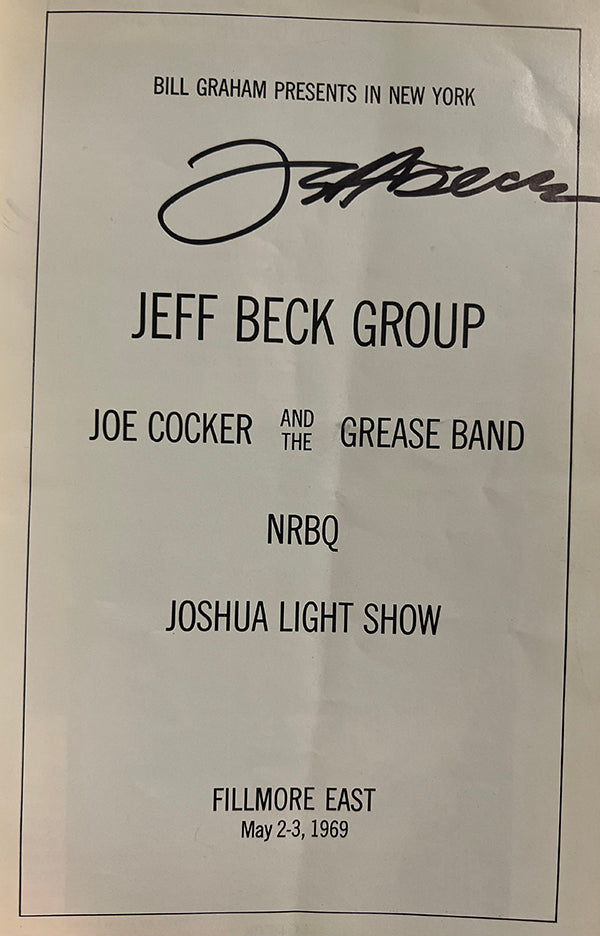
Program from the Fillmore East, May 3, 1969, signed by Jeff Beck. Courtesy of the author.

Program from the Fillmore East, May 3, 1969, signed by Jeff Beck. Courtesy of the author.

Beck broke up the Jeff Beck Group one month later, just prior to the Woodstock festival, where they had been asked to perform. It was one of the biggest mistakes Beck has ever admitted to.

But Jeff released two of the greatest proto-blues-metal classic albums ever recorded in 1968 and 1969:

Truth and Beck-Ola.

These albums are holy grail stuff to a generation of players like myself.

Beck mined a style that was wholly unique. He wasn’t Jimi (he was more precise); his playing was very controlled but stylistically explosive. He wasn’t Eric, as he was way more free-form and jazz-influenced where Eric was just steeped in the blues idiom. He wasn’t the songwriter that Page was (nor the producer) nor did he play acoustic guitar with the folk leanings of Page. Beck never had a real partner or foil either as he went from group to group.

Late In 1969 Jeff was injured in a car accident.

He returned to the US in 1971 and I saw him at the Academy of Music in NYC.

In what was seemingly a demonstration that his playing was not affected, he stood center stage and played a guitar solo with just his left arm and hand, letting the guitar slip through his fingers. I understood it as, “look, if you had any doubts, I’m still the baddest mofo on the planet!
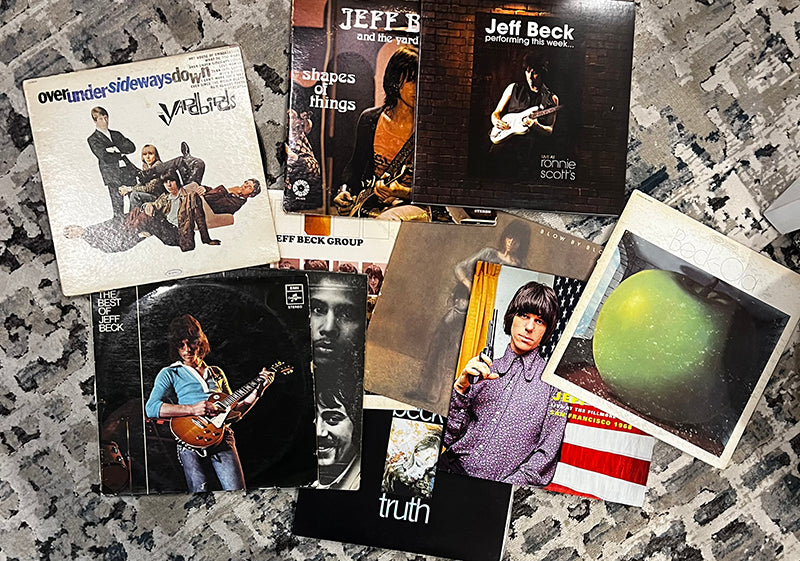
Jeff Beck albums from Jay Jay’s collection. Courtesy of the author.

Jeff Beck albums from Jay Jay’s collection. Courtesy of the author.

I took my brother to see Jeff in 1972 at Carnegie Hall. My brother is 10 years older than me and had missed all the Sixties greats. Except…Jeff…

My brother couldn’t believe Beck’s tone, speed and control of the guitar strings. He was in awe as was I!

Beck then joined up with two members of Vanilla Fudge, Tim Bogart and Carmine Appice in 1973 for a much anticipated supergroup, Beck, Bogart & Appice. The band didn’t last long and rumor had it that the manager of Bogart and Appice was so angry that Jeff ended the band that it kept Jeff out of the US for a while.

And then…the sea change happened with 1975’s George Martin-produced instrumental album Blow by Blow. This was Beck and his heavy guitar jazz leanings starting to flower. Guitar freaks couldn’t believe the sounds Jeff was coaxing out of his guitar, which was still a Gibson Les Paul. That was soon to change. Beck needed a guitar with a much wider tonal palette as well as a whammy bar.

The Fender Stratocaster replaced the Les Paul. The “Strat” is also much lighter and for some, easier to play as it gives the player access to more frets in the upper registers. This was a very big deal to those of us who felt that to get a really big, deep sustain, you need a much heavier guitar (i.e. a Gibson Les Paul).

Jeff’s playing continued to evolve.

The best way I can explain what Jeff created as a style is this: take the volume-control mastery of guitar legend Roy Buchanan, and also Roy’s understanding that the size of the guitar amplifier should be relative to the room you are playing in, its proximity to where you are standing, and that the guitar strings’ ability to respond to the touch of the fretboard, can create a mood by interacting with the sonic reflections and reverberation of the amp and the room. Trust me, Beck knew this and always had the correct amp for the job.

Add the picking and slide guitar style of Sonny Landreth and the vibrato and whammy control of Leslie West and the speed and imagination of Hendrix and…well that’s the best I can do.

Clapton and Beck toured together in 2010 and I took my girlfriend, now wife, to see the show. She had never seen Jeff Beck before. Beck opened the show and just about closed it down. On the big video screen, up close, one could fully understand and appreciate what Beck had become.

Page and Clapton had their playing styles frozen in time. We will never know what Hendrix would have evolved into, but we were able see what Beck had transformed into over the decades.

Beck’s fingerpicking, control of vibrato both with and without a whammy bar, and his total control of volume swells were finely merged into a breathtaking emotional aural palette.

My wife turned to me and commented that this was the greatest guitar playing she had ever experienced.

When Eric came out, first he played just with his band. He then invited Beck to join. This was an unfair fight and Beck, ever the classy guy, laid back but his brilliance and uniqueness broke through. Clapton just seemed beaten.

I saw Beck for the last time in 2010 at the tiny Iridium club in NYC in a tribute to Les Paul and Mary Ford. Les Paul had been playing at the iridium on Mondays for years prior to his death.

Jeff was accompanied by singer Imelda May and her band.

Later on at the show Jeff brought out a guest guitar player. I thought, who could it be?

None other than Brian Setzer. Nobody, but nobody plays rockabilly guitar as well as Brian and Beck knew it. Brian owned his part of the night and Beck just stayed out of the way (even when they went toe to toe).
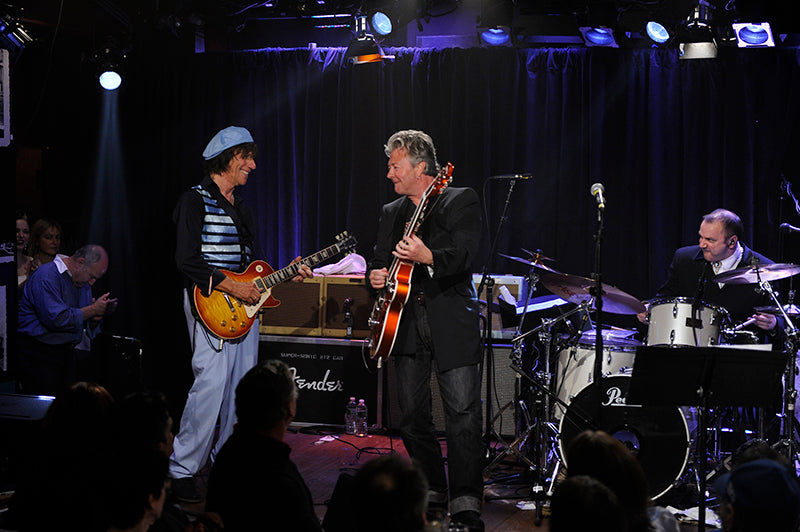
Jeff Beck and Brian Setzer at the Iridium. Courtesy of Rhino Media.

Jeff Beck and Brian Setzer at the Iridium. Courtesy of Rhino Media.

Besides that, Beck was again immaculate, aping Les’s style at every turn.

I sat with Jeff later that night after the show upstairs at Ellen’s Stardust Diner (at the record label’s after party) and showed him the Fillmore East programs I had kept from 1969. He signed them and seemed blown away at the Fillmore’s ticket prices (3,4 and 5 dollars).

Did I ever imagine that that would be the last time I would see him?

No way.

That is why this is such a shock.

Jeff’s death was not supposed to happen. Not now.

There was no warning. Nothing.

Just a seeming case of bad luck…bacterial meningitis.

All my guitar player friends blew up my phone in utter disbelief.

Jeff Beck is gone but he left a huge legacy of excellence behind.

The guitar world…let me rephrase that, the music world lost one of the greats.

Jeff, thank you for all you gave us.


Header image courtesy of Ross Halfin/Rhino Media.

More from Issue 180

View All Articles in Issue 180

Search Copper Magazine

#229 The Earliest Stars of Country Music, Part Three by Jeff Weiner Apr 06, 2026 #229 The Healing Power of Music and Sound at the Omega Institute by Joe Caplan Apr 06, 2026 #229 CanJam NYC 2026 Show Report: Heady Sound, Part One by Frank Doris Apr 06, 2026 #229 Florida Audio Expo 2026: Warming Up to High-End Audio, Part One by Frank Doris Apr 06, 2026 #229 Quick Takes: Anne Bisson, Sam Morrison, The Velvet Underground, and the Stooges by Frank Doris Apr 06, 2026 #229 The Vinyl Beat: New Arrivals, and Old Audio Show Demo Scores to Settle by Rudy Radelic Apr 06, 2026 #229 Harvard Gets a High-End Audio Education by Frank Doris Apr 06, 2026 #229 No Country for Old Knees by B. Jan Montana Apr 06, 2026 #229 How To Play in A Rock Band, 22: Encounters With Famous Musicians, Part 1 by Frank Doris Apr 06, 2026 #229 The Soulful Grooves of Guinea-Bissau by Steve Kindig Apr 06, 2026 #229 Four-Hand Piano Performance at Its Finest by Stephan Haberthür Apr 06, 2026 #229 The People Who Make Audio Happen: Supreme Acoustics Systems’ Las Vegas Grand Opening by Harris Fogel Apr 06, 2026 #229 Blue Öyster Cult: Tyranny and Expectations by Wayne Robins Apr 06, 2026 #229 Guitarist Rick Vito’s Cinematic New Album, Slidemaster by Ray Chelstowski Apr 06, 2026 #229 Measurements and Observational Listening by Paul McGowan Apr 06, 2026 #229 PS Audio in the News by PS Audio Staff Apr 06, 2026 #229 Back to My Reel-to-Reel Roots, Part 28: The Cassette Strikes Back by Ken Kessler Apr 06, 2026 #229 Are You Receiving Me? by Frank Doris Apr 06, 2026 #229 Hospitality by Peter Xeni Apr 06, 2026 #229 Cantina Gateway by James Schrimpf Apr 06, 2026 #228 Serita’s Black Rose Duo Shakes Your Soul With a Blend of Funk, Rock, Blues and a Whole Lot More by Frank Doris Mar 02, 2026 #228 Vinyl, A Love Story by Wayne Robins Mar 02, 2026 #228 Thrill Seeker by B. Jan Montana Mar 02, 2026 #228 The Vinyl Beat: Donald Byrd, Bill Evans, Wes Montgomery, Eddie Palmieri and Frank Sinatra by Rudy Radelic Mar 02, 2026 #228 Listening to Prestige: The History of a Vitally Important Jazz Record Label by Frank Doris Mar 02, 2026 #228 How to Play in a Rock Band, 21: Touring With James Lee Stanley by Frank Doris Mar 02, 2026 #228 The NAMM 2026 Show: The Music Industry’s Premier Event by John Volanski Mar 02, 2026 #228 The Earliest Stars of Country Music, Part Two by Jeff Weiner Mar 02, 2026 #228 From The Audiophile's Guide: A Brief History of Stereophonic Sound by Paul McGowan Mar 02, 2026 #228 A Bone to Pick With Streaming Audio by Frank Doris Mar 02, 2026 #228 Blast Off With Bluesman Duke Robillard by Ray Chelstowski Mar 02, 2026 #228 A Visit to the Marten Loudspeaker Factory in Göteborg, Sweden by Ingo Schulz and Sebastian Polcyn Mar 02, 2026 #228 Pure Distortion by Peter Xeni Mar 02, 2026 #228 A Nagra Factory Tour by Markus "Marsu" Manthey Mar 02, 2026 #228 Back to My Reel-to-Reel Roots, Part 27: Noodge and Ye Shall Receive, Part Two by Ken Kessler Mar 02, 2026 #228 PS Audio in the News by PS Audio Staff Mar 02, 2026 #228 90-Degree Stereo by Frank Doris Mar 02, 2026 #228 The Keys to Art by Rich Isaacs Mar 02, 2026 #227 Seth Lewis Gets in the Groove With Take a Look Around: a Tribute to the Meters by Frank Doris Feb 02, 2026 #227 Passport to Sound: May Anwar’s Audio Learning Experience for Young People by Frank Doris Feb 02, 2026 #227 Conjectures on Cosmic Consciousness by B. Jan Montana Feb 02, 2026 #227 The Big Takeover Turns 45 by Wayne Robins Feb 02, 2026 #227 Music and Chocolate: On the Sensory Connection by Joe Caplan Feb 02, 2026 #227 Singer/Songwriter Chris Berardo: Getting Wilder All the Time by Ray Chelstowski Feb 02, 2026 #227 The Earliest Stars of Country Music, Part One by Jeff Weiner Feb 02, 2026 #227 The Vinyl Beat Goes Down to Tijuana (By Way of Los Angeles), Part Two by Rudy Radelic Feb 02, 2026 #227 How to Play in a Rock Band, 20: On the Road With Blood, Sweat & Tears’ Guitarist Gabe Cummins by Frank Doris Feb 02, 2026

Jeff Beck: In Memoriam

Jeff Beck: In Memoriam

No, there is no cute way to begin this one.

There is no “another one bites the dust.”

Not even a “somewhere over the rainbow.”

I just don’t have it in me.

I’m too stunned…gobsmacked as the English would say, by Jeff Beck’s death on January 10.

If I meander, forgive me because I’m writing in total disbelief.

Our heroes are going to die. We know this intellectually. Many of them also have long drug, alcohol and/or medical issues that we, as fans, know about.

That means that we appreciate that many of our heroes are on borrowed time.

Paul will go someday, so will Ringo.

Keith? Well if that ever happens it’s not like we haven’t expected if for the last, say…50 years!

Eric had an alcohol and drug problem; no surprise when he goes.

When it comes to my guitar heroes, here is the score:

George Harrison – he was attacked in his home a couple of years before he succumbed to brain cancer brought about by his prodigious cigarette smoking. Those in the business knew what was going on.

B.B. King has myriad health issues as did Leslie West, as did Albert King and Eddie Van Halen.

Many of us knew about Eddie’s cancer diagnosis.

But Jeff? Jeff Beck was just fine. He never had a reputation for drugs or alcoholism. He just recorded constantly and played all the time. He had just finished his latest tour with Johnny Depp as his bandmate. I didn’t go but people tell me the Depp more than held his own.

Not just that.

Jeff was the archetype of the British guitar slinger with the perfect late 1960s shag haircut, the perfect jeans, the perfect T-shirt, the perfect stance and, above all, a playing style that left those who didn’t know guitar amazed and for those of us who did (the millions of guitar slingers around the world), plain dumbstruck.

He never, ever left one disappointed. No matter who he played with.

Eric Clapton could sound bored to death on some nights. Jimmy Page could be terribly sloppy on some nights. So could Jimi, who freaked out Beck, Eric and Pete Townshend the first night they witnessed his playing at the Bag O’Nails club in London on November 25, 1966, to the point that even Beck admitted that there was no reason to play anymore.

Beck soldiered on, however, but missed the big-money gravy train. He just did things his own way. From what I understand, he had either the longest (or next to longest) single record label relationship in history (Epic Records to be exact), Dylan being the other one with Columbia (which  along with Epic is part of the Sony Music Entertainment family as well).

I have read dozens of interviews with Jeff Beck over the years.

Clapton and Page, his guitar god contemporaries achieved much larger fame and fortune. Page was associated with a great singer (Robert Plant), and Clapton could sing very well.

Beck? Have you ever heard him sing? He actually had a hit in the UK in 1967 with a song called “Hi Ho Silver Lining.” I won’t bother commenting except that it is no surprise that he hooked up with Rod Stewart shortly after that!

Other non-singing guitar players of note who amassed a fortune, like Santana, needed to hook up with a vocalist, and in Santana’s case it was Rob Thomas of Matchbox 20. They recorded “Smooth,” which sold millions of albums and put Santana at the top of the charts in 1999.

Beck never had that. I would think that he could have. I mean, who wouldn’t want to work with Jeff? There is no higher pedigree of musician than Mr. Beck.

Jeff Beck at the Iridium in Manhattan, June 8, 2010. Courtesy of Rhino Media.

Jeff Beck at the Iridium in Manhattan, June 8, 2010. Courtesy of Rhino Media.

He traveled his own path and seemed very happy that he could do whatever he wanted, whenever he wanted, and would not be constrained by the personal cost of super fame. He had said as much in interviews.

My own personal fan history with Mr. Beck goes like this:

I first saw the Jeff Beck Group in 1969. On May 3rd and July 3rd to be exact, at the Fillmore East in New York City.

In between those dates I saw Led Zeppelin headline at the Fillmore East on May 30th with the Woody Herman Orchestra opening!

Both of the Jeff Beck group shows were epic. Rod was terrified on the first night in May. Famously, Beck had to coerce Rod to come out from behind the PA.

Program from the Fillmore East, May 3, 1969, signed by Jeff Beck. Courtesy of the author.

Program from the Fillmore East, May 3, 1969, signed by Jeff Beck. Courtesy of the author.

Beck broke up the Jeff Beck Group one month later, just prior to the Woodstock festival, where they had been asked to perform. It was one of the biggest mistakes Beck has ever admitted to.

But Jeff released two of the greatest proto-blues-metal classic albums ever recorded in 1968 and 1969:

Truth and Beck-Ola.

These albums are holy grail stuff to a generation of players like myself.

Beck mined a style that was wholly unique. He wasn’t Jimi (he was more precise); his playing was very controlled but stylistically explosive. He wasn’t Eric, as he was way more free-form and jazz-influenced where Eric was just steeped in the blues idiom. He wasn’t the songwriter that Page was (nor the producer) nor did he play acoustic guitar with the folk leanings of Page. Beck never had a real partner or foil either as he went from group to group.

Late In 1969 Jeff was injured in a car accident.

He returned to the US in 1971 and I saw him at the Academy of Music in NYC.

In what was seemingly a demonstration that his playing was not affected, he stood center stage and played a guitar solo with just his left arm and hand, letting the guitar slip through his fingers. I understood it as, “look, if you had any doubts, I’m still the baddest mofo on the planet!

Jeff Beck albums from Jay Jay’s collection. Courtesy of the author.

Jeff Beck albums from Jay Jay’s collection. Courtesy of the author.

I took my brother to see Jeff in 1972 at Carnegie Hall. My brother is 10 years older than me and had missed all the Sixties greats. Except…Jeff…

My brother couldn’t believe Beck’s tone, speed and control of the guitar strings. He was in awe as was I!

Beck then joined up with two members of Vanilla Fudge, Tim Bogart and Carmine Appice in 1973 for a much anticipated supergroup, Beck, Bogart & Appice. The band didn’t last long and rumor had it that the manager of Bogart and Appice was so angry that Jeff ended the band that it kept Jeff out of the US for a while.

And then…the sea change happened with 1975’s George Martin-produced instrumental album Blow by Blow. This was Beck and his heavy guitar jazz leanings starting to flower. Guitar freaks couldn’t believe the sounds Jeff was coaxing out of his guitar, which was still a Gibson Les Paul. That was soon to change. Beck needed a guitar with a much wider tonal palette as well as a whammy bar.

The Fender Stratocaster replaced the Les Paul. The “Strat” is also much lighter and for some, easier to play as it gives the player access to more frets in the upper registers. This was a very big deal to those of us who felt that to get a really big, deep sustain, you need a much heavier guitar (i.e. a Gibson Les Paul).

Jeff’s playing continued to evolve.

The best way I can explain what Jeff created as a style is this: take the volume-control mastery of guitar legend Roy Buchanan, and also Roy’s understanding that the size of the guitar amplifier should be relative to the room you are playing in, its proximity to where you are standing, and that the guitar strings’ ability to respond to the touch of the fretboard, can create a mood by interacting with the sonic reflections and reverberation of the amp and the room. Trust me, Beck knew this and always had the correct amp for the job.

Add the picking and slide guitar style of Sonny Landreth and the vibrato and whammy control of Leslie West and the speed and imagination of Hendrix and…well that’s the best I can do.

Clapton and Beck toured together in 2010 and I took my girlfriend, now wife, to see the show. She had never seen Jeff Beck before. Beck opened the show and just about closed it down. On the big video screen, up close, one could fully understand and appreciate what Beck had become.

Page and Clapton had their playing styles frozen in time. We will never know what Hendrix would have evolved into, but we were able see what Beck had transformed into over the decades.

Beck’s fingerpicking, control of vibrato both with and without a whammy bar, and his total control of volume swells were finely merged into a breathtaking emotional aural palette.

My wife turned to me and commented that this was the greatest guitar playing she had ever experienced.

When Eric came out, first he played just with his band. He then invited Beck to join. This was an unfair fight and Beck, ever the classy guy, laid back but his brilliance and uniqueness broke through. Clapton just seemed beaten.

I saw Beck for the last time in 2010 at the tiny Iridium club in NYC in a tribute to Les Paul and Mary Ford. Les Paul had been playing at the iridium on Mondays for years prior to his death.

Jeff was accompanied by singer Imelda May and her band.

Later on at the show Jeff brought out a guest guitar player. I thought, who could it be?

None other than Brian Setzer. Nobody, but nobody plays rockabilly guitar as well as Brian and Beck knew it. Brian owned his part of the night and Beck just stayed out of the way (even when they went toe to toe).

Jeff Beck and Brian Setzer at the Iridium. Courtesy of Rhino Media.

Jeff Beck and Brian Setzer at the Iridium. Courtesy of Rhino Media.

Besides that, Beck was again immaculate, aping Les’s style at every turn.

I sat with Jeff later that night after the show upstairs at Ellen’s Stardust Diner (at the record label’s after party) and showed him the Fillmore East programs I had kept from 1969. He signed them and seemed blown away at the Fillmore’s ticket prices (3,4 and 5 dollars).

Did I ever imagine that that would be the last time I would see him?

No way.

That is why this is such a shock.

Jeff’s death was not supposed to happen. Not now.

There was no warning. Nothing.

Just a seeming case of bad luck…bacterial meningitis.

All my guitar player friends blew up my phone in utter disbelief.

Jeff Beck is gone but he left a huge legacy of excellence behind.

The guitar world…let me rephrase that, the music world lost one of the greats.

Jeff, thank you for all you gave us.


Header image courtesy of Ross Halfin/Rhino Media.

0 comments

Leave a comment

0 Comments

Your avatar

Loading comments...

🗑️ Delete Comment

Enter moderator password to delete this comment:

✏️ Edit Comment

Enter your email to verify ownership: