COPPER

A PS Audio Publication

Issue 198 • Free Online Magazine

Issue 198 Featured

A Visit to Piega Loudspeakers

A Visit to Piega Loudspeakers


Copper has an exchange program with FIDELITY magazine (and others), where we share articles, including this one, between publications.
FIDELITY visit to Piega in Horgen, Switzerland
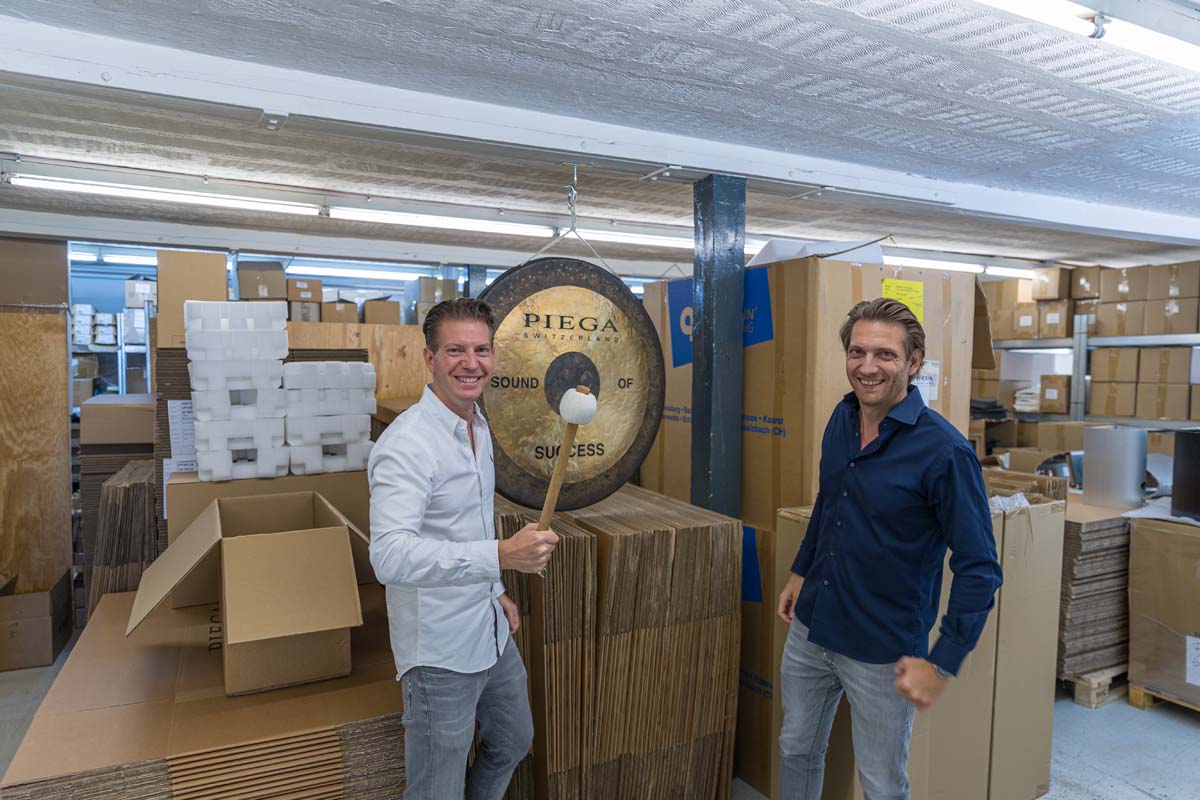
Every reason to be in a good mood: The two managing directors, Manuel and Alexander Greiner are now in charge of Piega, founded by their father Leo together with Kurt Scheuch. During my visit, I even got to hear the “Sound of Success,” which is usually only played on very special occasions. I’ll chalk that up as high praise for FIDELITY.


Horgen is a tranquil village on the western shore of Lake Zurich. It has everything that makes Switzerland Swiss for a tourist: a quaint village center on a gentle slope, traditional architecture, small stores, state-of-the-art infrastructure – and Piega. Anyone who knows just a little bit about Switzerland knows that the products of the loudspeaker manufacturer reflect many aspects of the Swiss Confederation. Exquisite ingredients such as resonance-calmed aluminum housings, high-tech adhesives and ribbon drivers meet as a matter of course with classic design approaches, loving craftsmanship and a team that has grown together. If you were also able to experience (I had the honor many years ago) how the cabinet strands are pulled in the aluminum factory under the pressure of several thousand tons, then you know that a hefty portion of natural force is slumbering in the speakers: “Next to the press, it feels like a loaded freight train is hitting,” developer Kurt Scheuch had promised us at the time – and was absolutely right.

But the purpose of my visit was not to describe the country and its people to you. Everything revolved around the profound change of the company: in the past years, Piega mastered a process that is currently causing headaches for many hi-fi manufacturers. The manufactory founded by Kurt Scheuch and Leo Greiner had to be transferred to the next generation. Of course, this requires more than just visiting a notary. In 1986, the founders were still among the first front of hi-fi innovators. While tinkerer Scheuch initially took care of the recognizable sound signature of the loudspeakers in a small garage and gradually discovered his interest in aluminum, Leo Greiner represented the company both internally and externally. The two did not have to analyze the concept of their manufactory to understand it; they designed it.
FIDELITY visit to Piega in Horgen, Switzerland

Greiner’s sons Alexander and Manuel, who today manage Piega in a commercial and sales capacity, faced greater challenges: they had to internalize the brand’s signature and “footprint,” find a potent replacement for Kurt Scheuch, and unite everything with their own ideas and visions in such a way that Piega still remained Piega in the end.

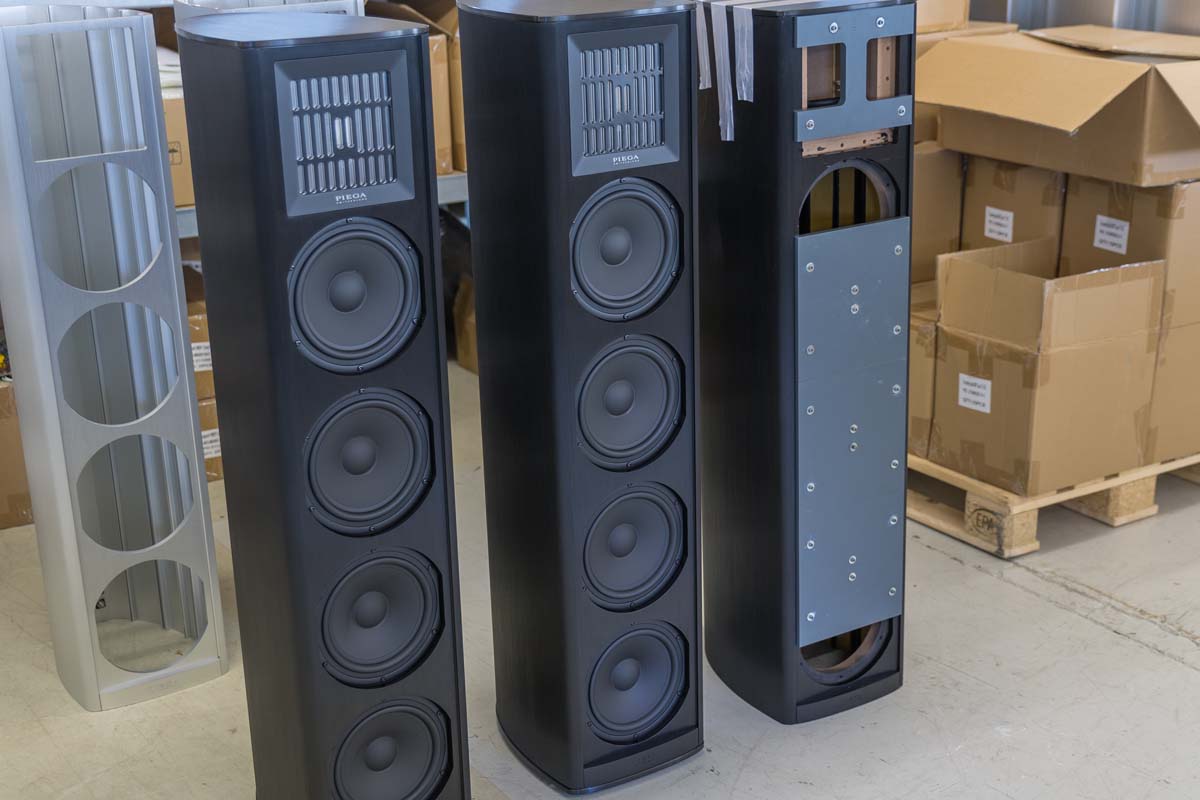
The manifestation of the successful transition stands physically in the listening room during my visit to Horgen: the brand new Master Line Source (MLS), the ultimate top model and so fresh that it had not even found its way onto the homepage yet. The name addition “MK-II” marks a generation leap and explains my initial irritation – in the run-up I had assumed an improved version of the next smaller MLS 2. Piega can be quite indifferent to the risk of confusion between the models. At the cost of a single-family house in a decent location, the four-piece colossus is such an exclusive temptation that series production was not even planned. The “MLS MK-II LTD Edition” is a thoroughbred technology carrier, a flagship, and is to be custom-made in this capacity only a few times: “This unique speaker was made especially for you with love, care and attention to detail at Piega in Switzerland,” announces a bronze-colored plaque on the back of serial number 002, which I meet in the listening room. It is a pure stroke of luck that I experience it at all: the customer from England wanted to combine his new box with an experience and a trip to Zurich. He will come to hear them in Horgen before the black gems are carefully packed for their journey. 
FIDELITY visit to Piega in Horgen, Switzerland

But first it’s my turn! Barely an hour after my arrival, development manager Roger Kessler thrusts an iPad into my hand. “I’d suggest you take this and have a good romp,” he says, and is gone shortly thereafter. Alone, I don’t feel. The two huge bass cabinets, only slightly lower than me at 178 centimeters, and two monolithic walls of ribbon tell me that everyone in the house will be there when I step on the gas right away. I lean back in my chair and kick things off with Fleetwood Mac’s “The Chain.” Guitar sounds ripple before the first hit on the bass drum jerks me back into an upright sitting position. Not what you’re thinking now: of course the kick sounds [deep], authoritative and digs comfortably into the pit of your stomach via huge speakers with an efficiency of around 94 decibels. Turn up T+A’s HV electronics and the low end can get downright brutal. What startles me, however, is the fact that I can perceive the drum in the room for a moment. From the center, a few centimeters to the right and barely two meters behind the speakers, a circular object flickers before my eyes with every pedal stroke of Mick Fleetwood – a shadowy image, in dimension and position so comprehensible that I suddenly get goose bumps. Probably the best imaging I’ve experienced so far – and the perfect prelude to an exclusive two hours with the MLS MK-II.

It continues with Led Zeppelin’s “Dazed And Confused,” which takes over the listening room with its atmosphere and coolness. The voice of Robert Plant announces tangibly and vividly the qualities of the newly-developed coax ribbon. The multi-part nature of the MLS ensures perfect localization of sound events: The Piega team sought out the spots in the room for the bass cabinets, each weighing 200 kilograms, where they would work perfectly, and then aligned the slim midrange/tweeter units (no less heavy, though, at 100 kilograms each). As a conglomerate of four perfectly-balanced line arrays, the MLS MK-II radiates sound in the form of line waves. Several times I bend over, duck in my chair, some times even stand up completely. No matter in which vertical position I hold my head, the total of 30 drivers remain “in phase” and sound identical in every sitting position without a trace of interference. The quite large Piega listening room is at the lower limit of what is possible, as I later learn. A loudspeaker of this size and performance class requires a lot of room to breathe. 
FIDELITY visit to Piega in Horgen, Switzerland

My listening tour leads me on to Kraftwerk’s “Radioactivity,” a Beethoven Allegretto, Holst’s “Mars,” and finally to the wonderfully woody organ of Philip Glass’ “Prophecies” – at this point I’m no longer alone, as marketing manager Roman Walser has joined me and is listening in curiously. Afterwards I feel like more “solid” material; I listen to an intermezzo of ambient-electro (Boards of Canada, Aphex Twin, Louisahhh) and finally work my way up to some alternative rock by Rage Against the Machine and then on to some snappy pop à la Eagle-Eye Cherry. The MLS plays along confidently, because as a sophisticated all-rounder it can handle everything on a comparably high level. The only limits are the quality of some recordings.

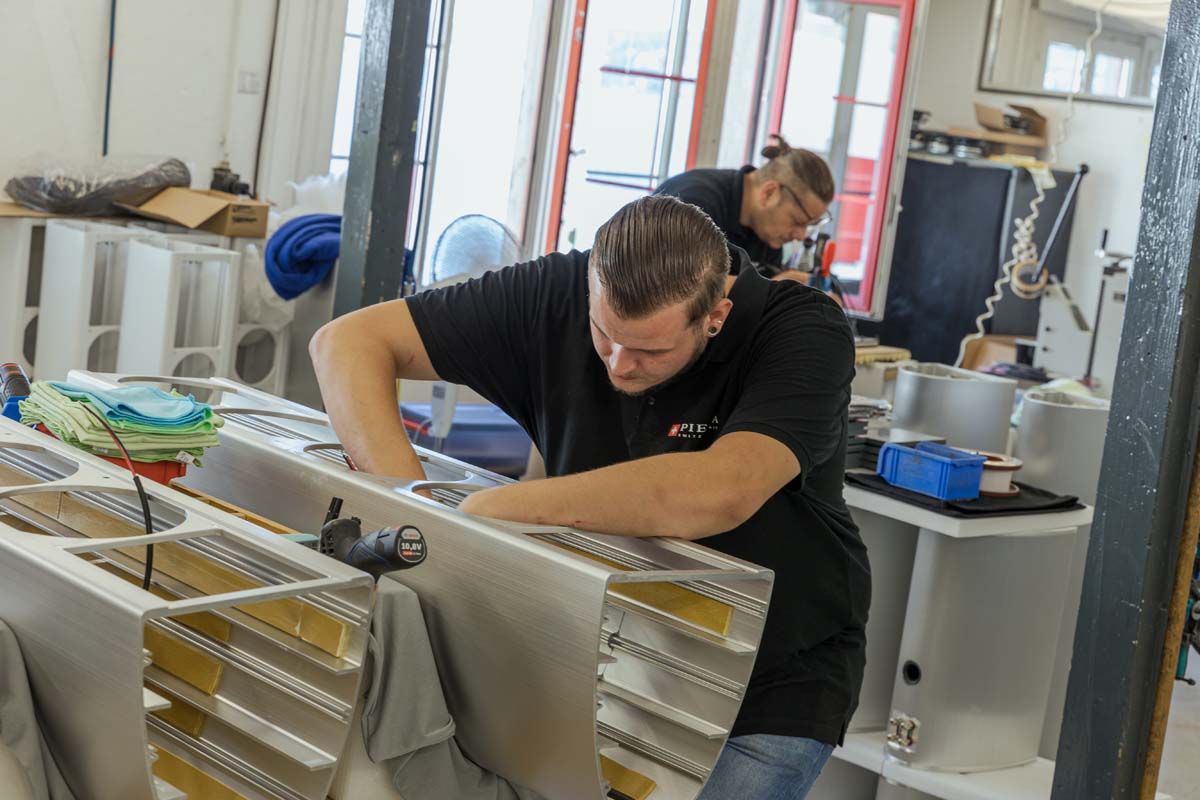
After tearing myself away from the MLS, I take a tour of the house. Employee Mario Ballabio explains to me all the steps that he, his colleague Jasmine Keller, and daughter Ailina Ballabio, who works at Piega while studying, have to take into account. I have already been able to follow his explanations on several occasions, but I am always surprised anew at the precision with which the three of them go about their work: the supplied wafer-thin Kapton foils are processed with concentration, a sense of proportion and a thousand-times-rehearsed hand movements. I witness Jasmine Keller gluing elongated damping strips to the back of tweeters, which – once near the ribbon – find their way to the foil as if by themselves. This has to be right the first time. She then uses a scalpel to make four small incisions on the edge of the tweeter, giving them more freedom of movement and bandwidth. “For that reason alone, we’ll never be a big mass producer,” Ballabio explains. There is a physical upper limit to the number of ribbons that can be produced each day, he says. This is especially true, he says, for the complex coaxial midrange/tweeters.

fidelity-zu-gast-bei-piega-13

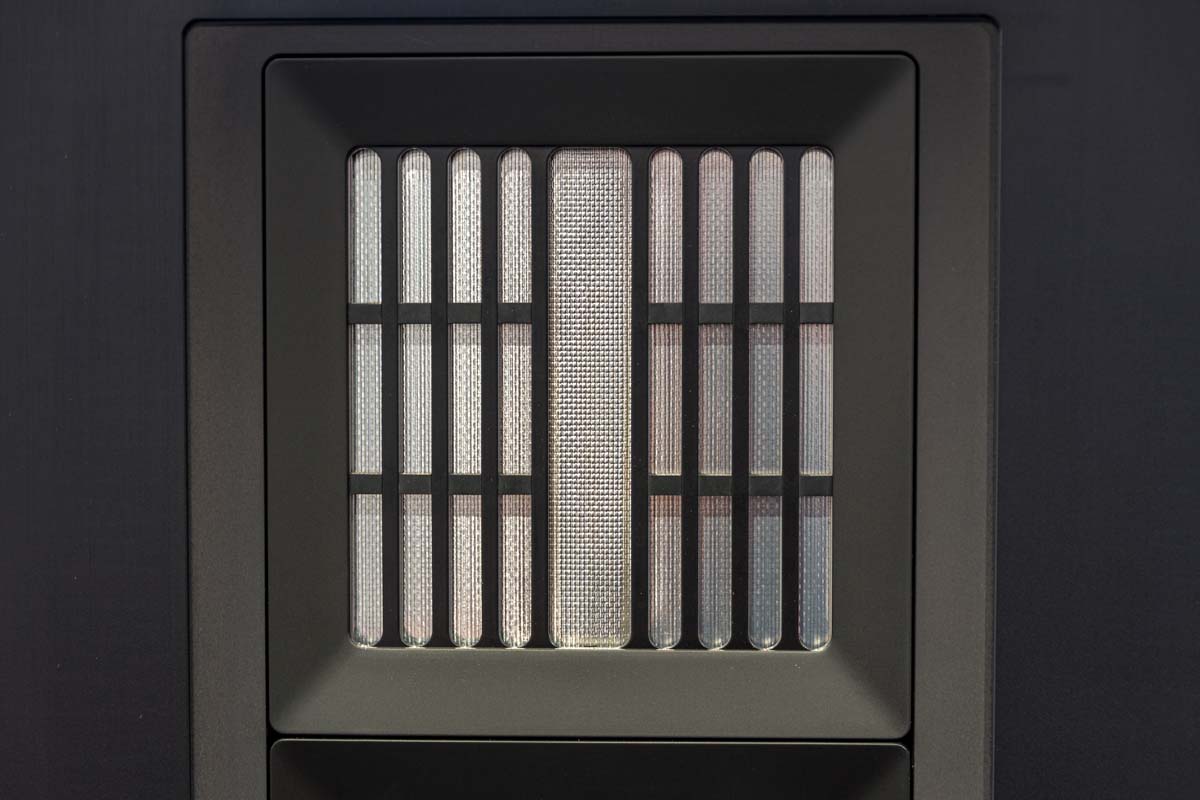
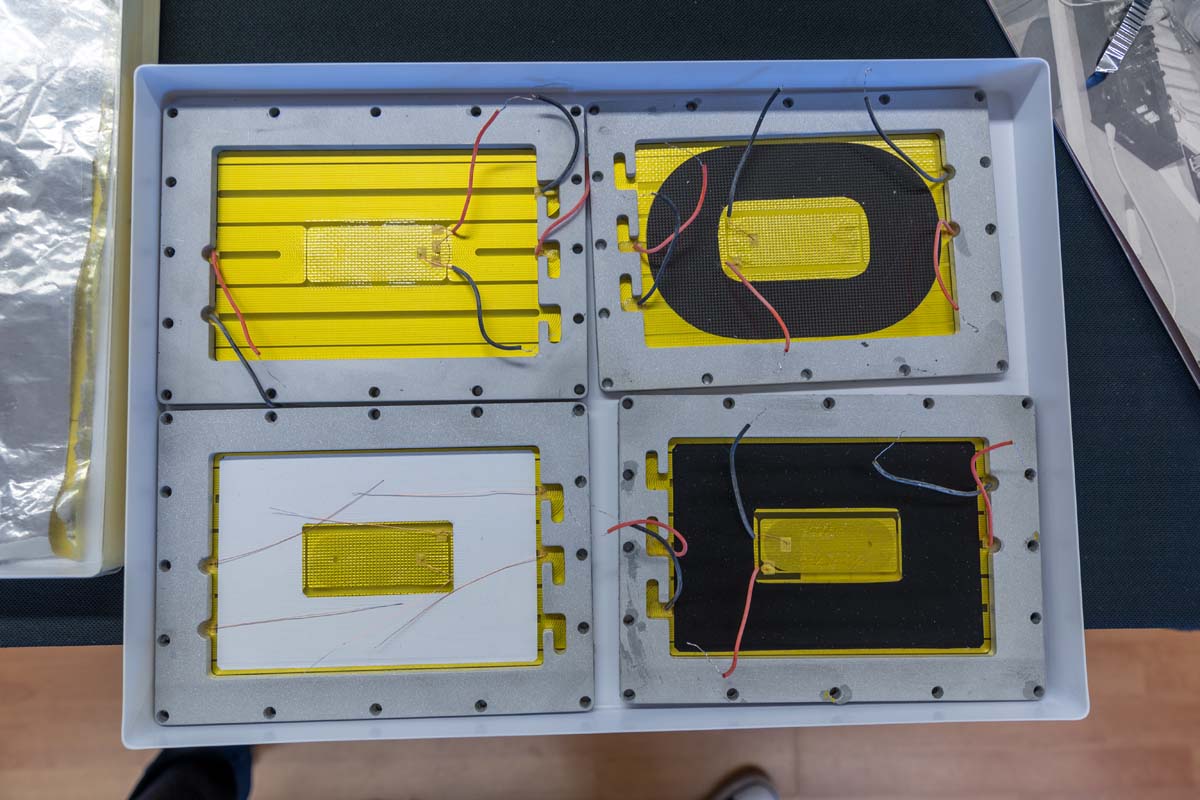
On this occasion, I learn a detail that had completely escaped me until now: in fact, they do not manufacture a state-of-the-art coaxial ribbon (as I always thought), but rather an adapted version for practically every loudspeaker model. The widths of the counter-phase wired traces, magnets, and the size and freedom of movement of the tweeter are adapted to the variables of the particular model and its cabinet. Actually logical: the coaxial drivers must match the number and efficiency of the bass drivers used. On shelves I discover a good dozen mounting frames for different variants and generations of the complex ribbons.

A little later, I’m sitting in the listening room with development manager Roger Kessler, reflecting on the experience. He is one of the “newcomers” to the company. Previously, he worked as an audio engineer in the automotive industry, integrating car hi-fi systems for BMW. The fact that different approaches apply in such an environment is evident from the answer to my first question: I tell him that I think it’s a huge challenge to improve a loudspeaker like the MLS in the first place. Where do you start? Analysis and troubleshooting, Kessler replies, adding that you can actually always find something to refine. The MLS MK-II was developed as a joint effort between the old and new guard. Kurt Scheuch developed it together with Daniel Raymann. He himself had brought to the company above all his knowledge of measurement technology, analysis and computer-aided simulations. Only this made Piega capable of realizing a product like their Ace [series] wireless speakers. Since their active modules are manufactured in the Far East, trial and error was virtually impossible. So Roger Kessler and his team simulated all the parameters of the three [Ace series] models in the computer. Only when all the individual components had been delivered did it become apparent that the calculations were correct. The wireless speakers are therefore not only a new product in the Swiss company’s portfolio – their development history is also unique.
FIDELITY visit to Piega in Horgen, Switzerland

With the MLS, on the other hand, the development team had looked at countless parameters of the enclosures and drivers on the measuring table and discovered a number of small, sometimes tiny points of attack. However, underlying problems of the previous designs were not brought to light: “the times when you screw on an adjusting wheel and achieve unbelievable changes are over,” he explains to me. But the many details also resulted in a noticeable step forward.

Thus, the UHQD graphene woofers from SEAS were better tuned for the enclosure parameters. The change in weight by coating the diaphragms was enough to optimize the behavior of the 12 drivers. In addition, Kessler replaced the previously separate midrange and tweeter ribbons with an identical number of coax ribbons. For more control, the nearly massless drivers are covered with a foil on the back. Meanwhile, their enormous bandwidth remains intact: the new Model 211 tweeters also play up to 50 kilohertz. Kessler then retuned the crossovers. With a 24 decibel per octave slope, they are quite drastic, but in a line source, despite a total of 30 drivers, only two crossover frequencies are required at 460 and 2,800 Hertz. The final tuning was the biggest challenge with the MLS MK-II. After all, the microphone of the measurement software does not know that it is a line source. And so – as always – the constant listening, checking and enjoyable music listening still remains the decisive step…

FIDELITY visit to Piega in Horgen, Switzerland


PIEGA SA
Bahnhofstrasse 29
8810 Horgen
Schweiz
Telefon +41 44 725 90 42
mail@piega.ch
www.piega.ch

More from Issue 198

View All Articles in Issue 198

Search Copper Magazine

#225 Capital Audiofest 2025: Must-See Stereo, Part One by Frank Doris Dec 01, 2025 #225 Otis Taylor and the Electrics Delivers a Powerful Set of Hypnotic Modern Blues by Frank Doris Dec 01, 2025 #225 A Christmas Miracle by B. Jan Montana Dec 01, 2025 #225 T.H.E. Show New York 2025, Part Two: Plenty to See, Hear, and Enjoy by Frank Doris Dec 01, 2025 #225 Underappreciated Artists, Part One: Martin Briley by Rich Isaacs Dec 01, 2025 #225 Rock and Roll is Here to Stay by Wayne Robins Dec 01, 2025 #225 A Lifetime of Holiday Record (and CD) Listening by Rudy Radelic Dec 01, 2025 #225 Little Feat: Not Saying Goodbye, Not Yet by Ray Chelstowski Dec 01, 2025 #225 How to Play in a Rock Band, Part 18: Dealing With Burnout by Frank Doris Dec 01, 2025 #225 The People Who Make Audio Happen: CanJam SoCal 2025 by Harris Fogel Dec 01, 2025 #225 Chicago’s Sonic Sanctuaries: Four Hi‑Fi Listening Bars Channeling the Jazz‑Kissa Spirit by Olivier Meunier-Plante Dec 01, 2025 #225 From The Audiophile’s Guide: Controlling Bass Frequencies Through Membrane Absorbers (and How to Build Your Own) by Paul McGowan Dec 01, 2025 #225 Your Editor’s Tips for Attending Audio Shows by Frank Doris Dec 01, 2025 #225 PS Audio in the News by Frank Doris Dec 01, 2025 #225 Back to My Reel-to-Reel Roots, Part 24 by Ken Kessler Dec 01, 2025 #225 Holiday Music by Frank Doris Dec 01, 2025 #225 Puppy Prognostication by Peter Xeni Dec 01, 2025 #225 How to Post Comments on Copper by Frank Doris Dec 01, 2025 #225 Living Color by Rudy Radelic Dec 01, 2025 #224 T.H.E. Show New York 2025, Part One: A New Beginning by Frank Doris Nov 03, 2025 #224 Fool’s Leap of Faith is the Extraordinary Octave Records Debut from Singer/Songwriter Tyler Burba and Visit by Frank Doris Nov 03, 2025 #224 The Beatles’ “Aeolian Cadences.” What? by Wayne Robins Nov 03, 2025 #224 Persona Non Grata by B. Jan Montana Nov 03, 2025 #224 Talking With Recording Engineer Barry Diament of Soundkeeper Recordings, Part Two by Frank Doris Nov 03, 2025 #224 B Sides, B Movies, and Beware of Zombies by Rudy Radelic Nov 03, 2025 #224 The Burn-In Chronicles: 1,000 Hours to Sonic Salvation by Olivier Meunier-Plante Nov 03, 2025 #224 A Conversation With Mat Weisfeld of VPI Industries by Joe Caplan Nov 03, 2025 #224 Blues-Rocker Kenny Wayne Shepherd Celebrates 30 Years of Ledbetter Heights by Ray Chelstowski Nov 03, 2025 #224 Playing in a Rock Band, 17: When Good Gigs Go Bad, Part Two by Frank Doris Nov 03, 2025 #224 From The Audiophile’s Guide: Dealing with Odd-Shaped Rooms by Paul McGowan Nov 03, 2025 #224 TEAC’s TN-3B-SE Turntable Plays Bob Dylan by Howard Kneller Nov 03, 2025 #224 PS Audio in the News by Frank Doris Nov 03, 2025 #224 Lost in Translation by Peter Xeni Nov 03, 2025 #224 Reel-to-Reel Roots, Part 23: Better Than Rice Krispies by Ken Kessler Nov 03, 2025 #224 I Bring Joy! by Frank Doris Nov 03, 2025 #224 Screen Test by Rich Isaacs Nov 03, 2025 #224 How to Post Comments on Copper by Frank Doris Nov 03, 2025 #132 Dr. Patrick Gleeson: The Interview, Part Two by Rich Isaacs Oct 07, 2025 #223 World Fusion Meets Flamenco in Gratitude from Steve Mullins and Rim of the Well by Frank Doris Oct 06, 2025 #223 Judging Albums by Their Covers by Rich Isaacs Oct 06, 2025 #223 Recent Arrivals and 12-inch Royalty by Rudy Radelic Oct 06, 2025 #223 Summer of Creem, Part Two by Wayne Robins Oct 06, 2025 #223 Recording Engineer Barry Diament of Soundkeeper Recordings: Striving for Natural Sound by Frank Doris Oct 06, 2025 #223 Tea on the Terrace by B. Jan Montana Oct 06, 2025 #223 How Good Can Car Audio Get? by Joe Caplan Oct 06, 2025 #223 The Advantages of a Dedicated Listening Room by Paul McGowan Oct 06, 2025 #223 1! 2! 3! 4! Surrounded by the Ramones in Dolby Atmos! by Frank Doris Oct 06, 2025

A Visit to Piega Loudspeakers

A Visit to Piega Loudspeakers


Copper has an exchange program with FIDELITY magazine (and others), where we share articles, including this one, between publications.

FIDELITY visit to Piega in Horgen, Switzerland
Every reason to be in a good mood: The two managing directors, Manuel and Alexander Greiner are now in charge of Piega, founded by their father Leo together with Kurt Scheuch. During my visit, I even got to hear the “Sound of Success,” which is usually only played on very special occasions. I’ll chalk that up as high praise for FIDELITY.


Horgen is a tranquil village on the western shore of Lake Zurich. It has everything that makes Switzerland Swiss for a tourist: a quaint village center on a gentle slope, traditional architecture, small stores, state-of-the-art infrastructure – and Piega. Anyone who knows just a little bit about Switzerland knows that the products of the loudspeaker manufacturer reflect many aspects of the Swiss Confederation. Exquisite ingredients such as resonance-calmed aluminum housings, high-tech adhesives and ribbon drivers meet as a matter of course with classic design approaches, loving craftsmanship and a team that has grown together. If you were also able to experience (I had the honor many years ago) how the cabinet strands are pulled in the aluminum factory under the pressure of several thousand tons, then you know that a hefty portion of natural force is slumbering in the speakers: “Next to the press, it feels like a loaded freight train is hitting,” developer Kurt Scheuch had promised us at the time – and was absolutely right.

But the purpose of my visit was not to describe the country and its people to you. Everything revolved around the profound change of the company: in the past years, Piega mastered a process that is currently causing headaches for many hi-fi manufacturers. The manufactory founded by Kurt Scheuch and Leo Greiner had to be transferred to the next generation. Of course, this requires more than just visiting a notary. In 1986, the founders were still among the first front of hi-fi innovators. While tinkerer Scheuch initially took care of the recognizable sound signature of the loudspeakers in a small garage and gradually discovered his interest in aluminum, Leo Greiner represented the company both internally and externally. The two did not have to analyze the concept of their manufactory to understand it; they designed it.

FIDELITY visit to Piega in Horgen, Switzerland

Greiner’s sons Alexander and Manuel, who today manage Piega in a commercial and sales capacity, faced greater challenges: they had to internalize the brand’s signature and “footprint,” find a potent replacement for Kurt Scheuch, and unite everything with their own ideas and visions in such a way that Piega still remained Piega in the end.

The manifestation of the successful transition stands physically in the listening room during my visit to Horgen: the brand new Master Line Source (MLS), the ultimate top model and so fresh that it had not even found its way onto the homepage yet. The name addition “MK-II” marks a generation leap and explains my initial irritation – in the run-up I had assumed an improved version of the next smaller MLS 2. Piega can be quite indifferent to the risk of confusion between the models. At the cost of a single-family house in a decent location, the four-piece colossus is such an exclusive temptation that series production was not even planned. The “MLS MK-II LTD Edition” is a thoroughbred technology carrier, a flagship, and is to be custom-made in this capacity only a few times: “This unique speaker was made especially for you with love, care and attention to detail at Piega in Switzerland,” announces a bronze-colored plaque on the back of serial number 002, which I meet in the listening room. It is a pure stroke of luck that I experience it at all: the customer from England wanted to combine his new box with an experience and a trip to Zurich. He will come to hear them in Horgen before the black gems are carefully packed for their journey. 

FIDELITY visit to Piega in Horgen, Switzerland

But first it’s my turn! Barely an hour after my arrival, development manager Roger Kessler thrusts an iPad into my hand. “I’d suggest you take this and have a good romp,” he says, and is gone shortly thereafter. Alone, I don’t feel. The two huge bass cabinets, only slightly lower than me at 178 centimeters, and two monolithic walls of ribbon tell me that everyone in the house will be there when I step on the gas right away. I lean back in my chair and kick things off with Fleetwood Mac’s “The Chain.” Guitar sounds ripple before the first hit on the bass drum jerks me back into an upright sitting position. Not what you’re thinking now: of course the kick sounds [deep], authoritative and digs comfortably into the pit of your stomach via huge speakers with an efficiency of around 94 decibels. Turn up T+A’s HV electronics and the low end can get downright brutal. What startles me, however, is the fact that I can perceive the drum in the room for a moment. From the center, a few centimeters to the right and barely two meters behind the speakers, a circular object flickers before my eyes with every pedal stroke of Mick Fleetwood – a shadowy image, in dimension and position so comprehensible that I suddenly get goose bumps. Probably the best imaging I’ve experienced so far – and the perfect prelude to an exclusive two hours with the MLS MK-II.

It continues with Led Zeppelin’s “Dazed And Confused,” which takes over the listening room with its atmosphere and coolness. The voice of Robert Plant announces tangibly and vividly the qualities of the newly-developed coax ribbon. The multi-part nature of the MLS ensures perfect localization of sound events: The Piega team sought out the spots in the room for the bass cabinets, each weighing 200 kilograms, where they would work perfectly, and then aligned the slim midrange/tweeter units (no less heavy, though, at 100 kilograms each). As a conglomerate of four perfectly-balanced line arrays, the MLS MK-II radiates sound in the form of line waves. Several times I bend over, duck in my chair, some times even stand up completely. No matter in which vertical position I hold my head, the total of 30 drivers remain “in phase” and sound identical in every sitting position without a trace of interference. The quite large Piega listening room is at the lower limit of what is possible, as I later learn. A loudspeaker of this size and performance class requires a lot of room to breathe. 

FIDELITY visit to Piega in Horgen, Switzerland

My listening tour leads me on to Kraftwerk’s “Radioactivity,” a Beethoven Allegretto, Holst’s “Mars,” and finally to the wonderfully woody organ of Philip Glass’ “Prophecies” – at this point I’m no longer alone, as marketing manager Roman Walser has joined me and is listening in curiously. Afterwards I feel like more “solid” material; I listen to an intermezzo of ambient-electro (Boards of Canada, Aphex Twin, Louisahhh) and finally work my way up to some alternative rock by Rage Against the Machine and then on to some snappy pop à la Eagle-Eye Cherry. The MLS plays along confidently, because as a sophisticated all-rounder it can handle everything on a comparably high level. The only limits are the quality of some recordings.

After tearing myself away from the MLS, I take a tour of the house. Employee Mario Ballabio explains to me all the steps that he, his colleague Jasmine Keller, and daughter Ailina Ballabio, who works at Piega while studying, have to take into account. I have already been able to follow his explanations on several occasions, but I am always surprised anew at the precision with which the three of them go about their work: the supplied wafer-thin Kapton foils are processed with concentration, a sense of proportion and a thousand-times-rehearsed hand movements. I witness Jasmine Keller gluing elongated damping strips to the back of tweeters, which – once near the ribbon – find their way to the foil as if by themselves. This has to be right the first time. She then uses a scalpel to make four small incisions on the edge of the tweeter, giving them more freedom of movement and bandwidth. “For that reason alone, we’ll never be a big mass producer,” Ballabio explains. There is a physical upper limit to the number of ribbons that can be produced each day, he says. This is especially true, he says, for the complex coaxial midrange/tweeters.

fidelity-zu-gast-bei-piega-13

On this occasion, I learn a detail that had completely escaped me until now: in fact, they do not manufacture a state-of-the-art coaxial ribbon (as I always thought), but rather an adapted version for practically every loudspeaker model. The widths of the counter-phase wired traces, magnets, and the size and freedom of movement of the tweeter are adapted to the variables of the particular model and its cabinet. Actually logical: the coaxial drivers must match the number and efficiency of the bass drivers used. On shelves I discover a good dozen mounting frames for different variants and generations of the complex ribbons.

A little later, I’m sitting in the listening room with development manager Roger Kessler, reflecting on the experience. He is one of the “newcomers” to the company. Previously, he worked as an audio engineer in the automotive industry, integrating car hi-fi systems for BMW. The fact that different approaches apply in such an environment is evident from the answer to my first question: I tell him that I think it’s a huge challenge to improve a loudspeaker like the MLS in the first place. Where do you start? Analysis and troubleshooting, Kessler replies, adding that you can actually always find something to refine. The MLS MK-II was developed as a joint effort between the old and new guard. Kurt Scheuch developed it together with Daniel Raymann. He himself had brought to the company above all his knowledge of measurement technology, analysis and computer-aided simulations. Only this made Piega capable of realizing a product like their Ace [series] wireless speakers. Since their active modules are manufactured in the Far East, trial and error was virtually impossible. So Roger Kessler and his team simulated all the parameters of the three [Ace series] models in the computer. Only when all the individual components had been delivered did it become apparent that the calculations were correct. The wireless speakers are therefore not only a new product in the Swiss company’s portfolio – their development history is also unique.

FIDELITY visit to Piega in Horgen, Switzerland

With the MLS, on the other hand, the development team had looked at countless parameters of the enclosures and drivers on the measuring table and discovered a number of small, sometimes tiny points of attack. However, underlying problems of the previous designs were not brought to light: “the times when you screw on an adjusting wheel and achieve unbelievable changes are over,” he explains to me. But the many details also resulted in a noticeable step forward.

Thus, the UHQD graphene woofers from SEAS were better tuned for the enclosure parameters. The change in weight by coating the diaphragms was enough to optimize the behavior of the 12 drivers. In addition, Kessler replaced the previously separate midrange and tweeter ribbons with an identical number of coax ribbons. For more control, the nearly massless drivers are covered with a foil on the back. Meanwhile, their enormous bandwidth remains intact: the new Model 211 tweeters also play up to 50 kilohertz. Kessler then retuned the crossovers. With a 24 decibel per octave slope, they are quite drastic, but in a line source, despite a total of 30 drivers, only two crossover frequencies are required at 460 and 2,800 Hertz. The final tuning was the biggest challenge with the MLS MK-II. After all, the microphone of the measurement software does not know that it is a line source. And so – as always – the constant listening, checking and enjoyable music listening still remains the decisive step…

FIDELITY visit to Piega in Horgen, Switzerland


PIEGA SA
Bahnhofstrasse 29
8810 Horgen
Schweiz
Telefon +41 44 725 90 42
mail@piega.ch
www.piega.ch

0 comments

Leave a comment

0 Comments

Your avatar

Loading comments...

🗑️ Delete Comment

Enter moderator password to delete this comment: