COPPER

A PS Audio Publication

Issue 198 • Free Online Magazine

Issue 198 Featured

The Next Voice You Hear

The Next Voice You Hear

So you had better do as you are told/you better listen to the radio.”

(Elvis Costello, “Radio Radio”)

Sanyo catalogued the MR2810 2-Band Radio Cassette Recorder in 1982. I received mine about 1984, when my friend Lee, who had invited me to join his family for dinner, stuffed it into my briefcase. Lee was a generous guy. Or maybe, after several hours of my company, he was bribing me to leave. I know I needed a radio.
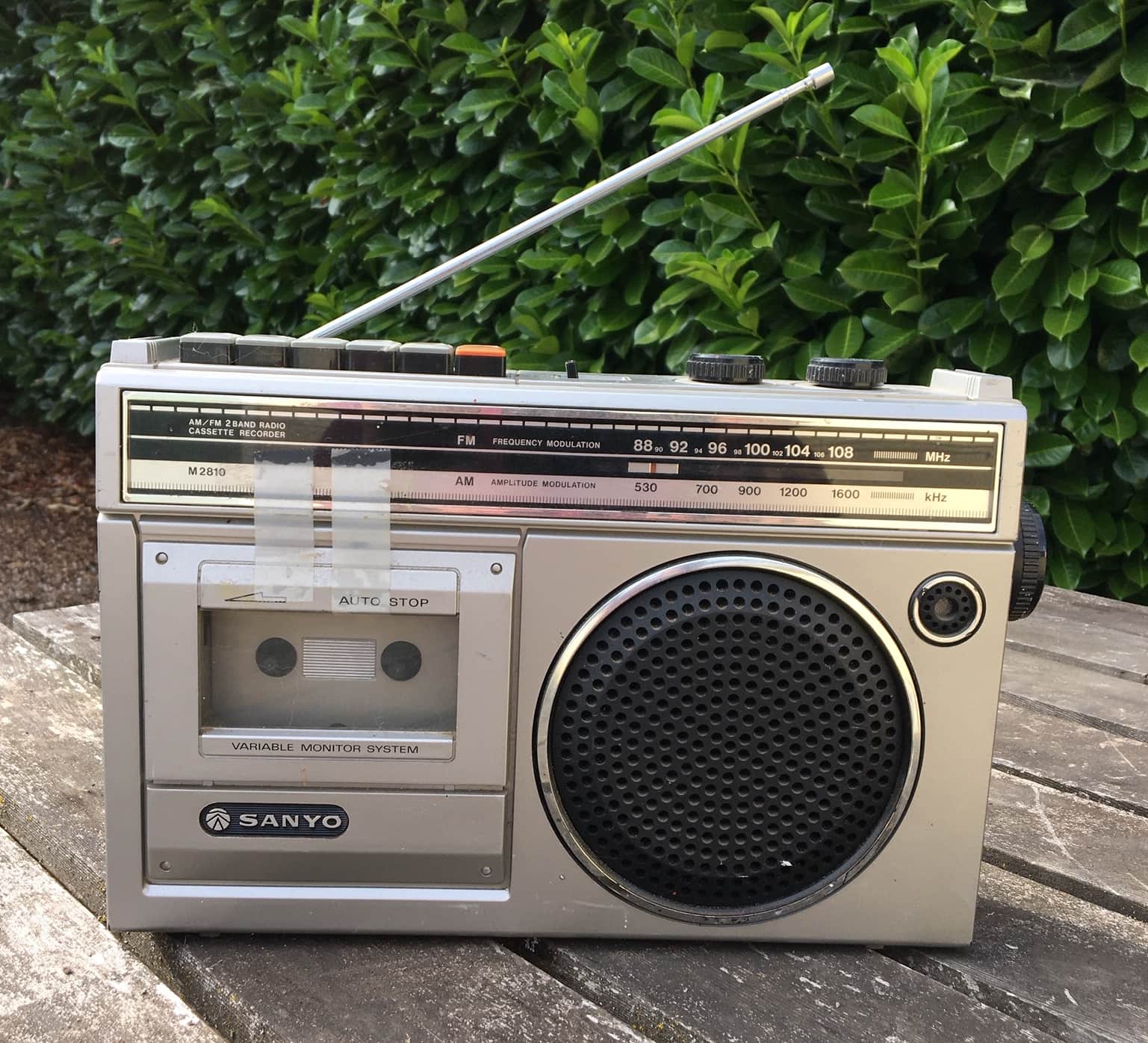


I have now completed the 35th year of my field test of the Sanyo MR2810. My conclusions thus far: This unit surpasses all other audio systems in the areas of sound quality, ease of use, durability, and cost-effectiveness. Let’s look at each factor and learn why my Sanyo is red hot and your whatever ain’t doodly-squat.

Sound Quality

When I lived in Seattle, the MR2810 had no trouble coping with alt rock, classic rock, jazz, big band, music of the Baroque era, and 11 out of 17 losing seasons by the Seattle Mariners.

When I lived in Boise, the MR2810 was pummeled by a radio environment almost entirely composed of news, talk, head-banging, wall-to-wall Boise State Broncos, and “fun oldies to make ya feel good” among other things. And yet the radio continued to function at the same high level, threading this minefield to bring in what few hours of jazz and blues were available each week.

Now I live in Portland, Oregon, and with the exception of the Mariners, who I no longer follow, I am back in a Seattle-like spectrum. The MR2810 had no problem readjusting.

Purists might question the aural quality of a device with one speaker and no provision for such exotica as “tweeters” and “woofers.” Chill, purists. My radio has always lived above my workbench in a garage. I am too busy drillin’ holes, drivin’ screws, rippin’ planks, and other proofs of my manhood for fripperies such as the midrange. Everything from Miles to Mozart to Moby rocks.


As an example of the life-like sound quality the MR2810 delivers, I refer you to my first dog, Emma, who guarded the open door of whatever garage I was working in. In the 1990s, whenever the DJ cued up “Been Caught Stealing” by Jane’s Addiction, I knew I had less than five seconds to sprint to the radio and hit the kill switch before the song’s barking began and Emma erupted.

And all this on an energy budget of 5 hard-working watts.

Ease of Use

The kill switch is an excellent example of the simplicity built into the MR2810. It’s a single-pole, single-throw paddle switch; it’s either on or off. The AM/FM selector is a similar switch on the back of the device. The microphone and headphone jacks are also tucked away in back, preserving the sleek 1980s styling up-front.

The radio has been further simplified by time thanks to the demise of the cassette player. With no cassettes, there’s nothing for the microphone to record to. As for headphones – why would I want to hear the MR2810 at a range as close as just outside my ears?

The recording button was red but has faded to orange. I’ve considered repainting it, but I don’t want to ruin the collector value.

Durability

My radio has spent most of its life in dusty environments tinged by car exhaust and paint fumes. In Boise, the radio had to withstand summertime temperatures of more than 110 degrees Fahrenheit. In Seattle and Portland, the air is wet and cold for half the year. The MR2810 has survived a lack of climate control, enterprising spiders, two long-haul moving trucks, and inquisitive party guests.


Cost-effectiveness

You can’t beat a radio someone gave you just to get rid of you. But here’s something I’m sure Sanyo never intended: I haven’t had to change the batteries in this century.

That’s right. My sound system costs nothing to run.

The MR2810 came with a power cord, which I lost a couple of houses ago. Without the cord, it requires five D cell batteries to function. Somewhere in the late 1990s, I realized I couldn’t remember the last time I had changed the batteries. I started paying attention. I have yet to change the batteries.

I asked Justanswers.com what might be happening inside my MR2810. This cost me a non-refundable trial membership fee of $5. “That’s pretty strange,” Dustin S., my trial membership electrician, said. Today’s D cell batteries last up to 10 years, he told me, but only if unused and kept in their original packaging, not as part of a live circuit.

He asked me what brand of batteries I was using. How should I know? No way was I going to pop the hatch on the battery compartment and expose the toxic soufflé I suspect is back there. You know that if I disturb this thing, it will never speak again. “Eveready,” I guessed.

“Well,” Dustin said. “What you are describing is possible. It all just depends on the exact type of battery. It’s possible that you bought an early D cell lithium battery. And that you’ve gotten some incredible life out of it.”

Dustin said I have a good advertisement for Sanyo. But the field test of the MR2810 is not over. See you in 2055.

Postscript: 14 months after I immortalized my radio in Copper, it died. When I opened the battery compartment, I found five Energizer batteries. Energizer promises their batteries won’t leak, and these didn’t, but they were heavily crystallized. I cleaned everything and inserted new batteries, but the patient did not respond. In April of 2021, I brought my old friend to Best Buy. The young man on duty listened patiently as I told him of my Sanyo’s service. Many thanks to Best Buy for recycling old audio components and for providing a grief counselor.


They worked...for a while.


Farewell, faithful friend.


This article first appeared in Issue 120. All images courtesy of the author.

More from Issue 198

View All Articles in Issue 198

Search Copper Magazine

#225 Capital Audiofest 2025: Must-See Stereo, Part One by Frank Doris Dec 01, 2025 #225 Otis Taylor and the Electrics Delivers a Powerful Set of Hypnotic Modern Blues by Frank Doris Dec 01, 2025 #225 A Christmas Miracle by B. Jan Montana Dec 01, 2025 #225 T.H.E. Show New York 2025, Part Two: Plenty to See, Hear, and Enjoy by Frank Doris Dec 01, 2025 #225 Underappreciated Artists, Part One: Martin Briley by Rich Isaacs Dec 01, 2025 #225 Rock and Roll is Here to Stay by Wayne Robins Dec 01, 2025 #225 A Lifetime of Holiday Record (and CD) Listening by Rudy Radelic Dec 01, 2025 #225 Little Feat: Not Saying Goodbye, Not Yet by Ray Chelstowski Dec 01, 2025 #225 How to Play in a Rock Band, Part 18: Dealing With Burnout by Frank Doris Dec 01, 2025 #225 The People Who Make Audio Happen: CanJam SoCal 2025 by Harris Fogel Dec 01, 2025 #225 Chicago’s Sonic Sanctuaries: Four Hi‑Fi Listening Bars Channeling the Jazz‑Kissa Spirit by Olivier Meunier-Plante Dec 01, 2025 #225 From The Audiophile’s Guide: Controlling Bass Frequencies Through Membrane Absorbers (and How to Build Your Own) by Paul McGowan Dec 01, 2025 #225 Your Editor’s Tips for Attending Audio Shows by Frank Doris Dec 01, 2025 #225 PS Audio in the News by Frank Doris Dec 01, 2025 #225 Back to My Reel-to-Reel Roots, Part 24 by Ken Kessler Dec 01, 2025 #225 Holiday Music by Frank Doris Dec 01, 2025 #225 Puppy Prognostication by Peter Xeni Dec 01, 2025 #225 How to Post Comments on Copper by Frank Doris Dec 01, 2025 #225 Living Color by Rudy Radelic Dec 01, 2025 #224 T.H.E. Show New York 2025, Part One: A New Beginning by Frank Doris Nov 03, 2025 #224 Fool’s Leap of Faith is the Extraordinary Octave Records Debut from Singer/Songwriter Tyler Burba and Visit by Frank Doris Nov 03, 2025 #224 The Beatles’ “Aeolian Cadences.” What? by Wayne Robins Nov 03, 2025 #224 Persona Non Grata by B. Jan Montana Nov 03, 2025 #224 Talking With Recording Engineer Barry Diament of Soundkeeper Recordings, Part Two by Frank Doris Nov 03, 2025 #224 B Sides, B Movies, and Beware of Zombies by Rudy Radelic Nov 03, 2025 #224 The Burn-In Chronicles: 1,000 Hours to Sonic Salvation by Olivier Meunier-Plante Nov 03, 2025 #224 A Conversation With Mat Weisfeld of VPI Industries by Joe Caplan Nov 03, 2025 #224 Blues-Rocker Kenny Wayne Shepherd Celebrates 30 Years of Ledbetter Heights by Ray Chelstowski Nov 03, 2025 #224 Playing in a Rock Band, 17: When Good Gigs Go Bad, Part Two by Frank Doris Nov 03, 2025 #224 From The Audiophile’s Guide: Dealing with Odd-Shaped Rooms by Paul McGowan Nov 03, 2025 #224 TEAC’s TN-3B-SE Turntable Plays Bob Dylan by Howard Kneller Nov 03, 2025 #224 PS Audio in the News by Frank Doris Nov 03, 2025 #224 Lost in Translation by Peter Xeni Nov 03, 2025 #224 Reel-to-Reel Roots, Part 23: Better Than Rice Krispies by Ken Kessler Nov 03, 2025 #224 I Bring Joy! by Frank Doris Nov 03, 2025 #224 Screen Test by Rich Isaacs Nov 03, 2025 #224 How to Post Comments on Copper by Frank Doris Nov 03, 2025 #132 Dr. Patrick Gleeson: The Interview, Part Two by Rich Isaacs Oct 07, 2025 #223 World Fusion Meets Flamenco in Gratitude from Steve Mullins and Rim of the Well by Frank Doris Oct 06, 2025 #223 Judging Albums by Their Covers by Rich Isaacs Oct 06, 2025 #223 Recent Arrivals and 12-inch Royalty by Rudy Radelic Oct 06, 2025 #223 Summer of Creem, Part Two by Wayne Robins Oct 06, 2025 #223 Recording Engineer Barry Diament of Soundkeeper Recordings: Striving for Natural Sound by Frank Doris Oct 06, 2025 #223 Tea on the Terrace by B. Jan Montana Oct 06, 2025 #223 How Good Can Car Audio Get? by Joe Caplan Oct 06, 2025 #223 The Advantages of a Dedicated Listening Room by Paul McGowan Oct 06, 2025 #223 1! 2! 3! 4! Surrounded by the Ramones in Dolby Atmos! by Frank Doris Oct 06, 2025

The Next Voice You Hear

The Next Voice You Hear

So you had better do as you are told/you better listen to the radio.”

(Elvis Costello, “Radio Radio”)

Sanyo catalogued the MR2810 2-Band Radio Cassette Recorder in 1982. I received mine about 1984, when my friend Lee, who had invited me to join his family for dinner, stuffed it into my briefcase. Lee was a generous guy. Or maybe, after several hours of my company, he was bribing me to leave. I know I needed a radio.


I have now completed the 35th year of my field test of the Sanyo MR2810. My conclusions thus far: This unit surpasses all other audio systems in the areas of sound quality, ease of use, durability, and cost-effectiveness. Let’s look at each factor and learn why my Sanyo is red hot and your whatever ain’t doodly-squat.

Sound Quality

When I lived in Seattle, the MR2810 had no trouble coping with alt rock, classic rock, jazz, big band, music of the Baroque era, and 11 out of 17 losing seasons by the Seattle Mariners.

When I lived in Boise, the MR2810 was pummeled by a radio environment almost entirely composed of news, talk, head-banging, wall-to-wall Boise State Broncos, and “fun oldies to make ya feel good” among other things. And yet the radio continued to function at the same high level, threading this minefield to bring in what few hours of jazz and blues were available each week.

Now I live in Portland, Oregon, and with the exception of the Mariners, who I no longer follow, I am back in a Seattle-like spectrum. The MR2810 had no problem readjusting.

Purists might question the aural quality of a device with one speaker and no provision for such exotica as “tweeters” and “woofers.” Chill, purists. My radio has always lived above my workbench in a garage. I am too busy drillin’ holes, drivin’ screws, rippin’ planks, and other proofs of my manhood for fripperies such as the midrange. Everything from Miles to Mozart to Moby rocks.


As an example of the life-like sound quality the MR2810 delivers, I refer you to my first dog, Emma, who guarded the open door of whatever garage I was working in. In the 1990s, whenever the DJ cued up “Been Caught Stealing” by Jane’s Addiction, I knew I had less than five seconds to sprint to the radio and hit the kill switch before the song’s barking began and Emma erupted.

And all this on an energy budget of 5 hard-working watts.

Ease of Use

The kill switch is an excellent example of the simplicity built into the MR2810. It’s a single-pole, single-throw paddle switch; it’s either on or off. The AM/FM selector is a similar switch on the back of the device. The microphone and headphone jacks are also tucked away in back, preserving the sleek 1980s styling up-front.

The radio has been further simplified by time thanks to the demise of the cassette player. With no cassettes, there’s nothing for the microphone to record to. As for headphones – why would I want to hear the MR2810 at a range as close as just outside my ears?

The recording button was red but has faded to orange. I’ve considered repainting it, but I don’t want to ruin the collector value.

Durability

My radio has spent most of its life in dusty environments tinged by car exhaust and paint fumes. In Boise, the radio had to withstand summertime temperatures of more than 110 degrees Fahrenheit. In Seattle and Portland, the air is wet and cold for half the year. The MR2810 has survived a lack of climate control, enterprising spiders, two long-haul moving trucks, and inquisitive party guests.


Cost-effectiveness

You can’t beat a radio someone gave you just to get rid of you. But here’s something I’m sure Sanyo never intended: I haven’t had to change the batteries in this century.

That’s right. My sound system costs nothing to run.

The MR2810 came with a power cord, which I lost a couple of houses ago. Without the cord, it requires five D cell batteries to function. Somewhere in the late 1990s, I realized I couldn’t remember the last time I had changed the batteries. I started paying attention. I have yet to change the batteries.

I asked Justanswers.com what might be happening inside my MR2810. This cost me a non-refundable trial membership fee of $5. “That’s pretty strange,” Dustin S., my trial membership electrician, said. Today’s D cell batteries last up to 10 years, he told me, but only if unused and kept in their original packaging, not as part of a live circuit.

He asked me what brand of batteries I was using. How should I know? No way was I going to pop the hatch on the battery compartment and expose the toxic soufflé I suspect is back there. You know that if I disturb this thing, it will never speak again. “Eveready,” I guessed.

“Well,” Dustin said. “What you are describing is possible. It all just depends on the exact type of battery. It’s possible that you bought an early D cell lithium battery. And that you’ve gotten some incredible life out of it.”

Dustin said I have a good advertisement for Sanyo. But the field test of the MR2810 is not over. See you in 2055.

Postscript: 14 months after I immortalized my radio in Copper, it died. When I opened the battery compartment, I found five Energizer batteries. Energizer promises their batteries won’t leak, and these didn’t, but they were heavily crystallized. I cleaned everything and inserted new batteries, but the patient did not respond. In April of 2021, I brought my old friend to Best Buy. The young man on duty listened patiently as I told him of my Sanyo’s service. Many thanks to Best Buy for recycling old audio components and for providing a grief counselor.


They worked...for a while.


Farewell, faithful friend.


This article first appeared in Issue 120. All images courtesy of the author.

0 comments

Leave a comment

0 Comments

Your avatar

Loading comments...

🗑️ Delete Comment

Enter moderator password to delete this comment: