COPPER

A PS Audio Publication

Issue 108 • Free Online Magazine

Issue 108 EUREKA MOMENTS

Jersey Boys Find Hi-Fi

Jersey Boys Find Hi-Fi

My passion for audio was ignited in the 1960s (are we really that old?). Like most of my peers I listened to a lot of music. My two older brothers helped fuel my enthusiasm. My oldest brother loves classical music and opera (he is an expert on the subject) and played me lots of fabulous music on his KLH all-in-one system. (I think it was a Model 11 variant.) You could pull out the second speaker to hear a wider stereo spread to get the best sound we had at the time. Henry Kloss, founder of Acoustic Research (AR), KLH and Advent, was involved in that product series. Sadly, that item left with him for college, leaving my brother and I with a system much lower sound quality.


A KLH Model 11 portable stereo audio system.

My other brother introduced me to rock music, which took be beyond the pop sounds I had been listening to previously. Of course, the Beatles changed our lives a whole lot, followed by the British Invasion. Fortunately, my parents were also music lovers. They were dancers and enjoyed a lot of dance music and jazz, played on the Victrola record player they used. It was powered by electricity (early Victrolas were wind-up) and had a built-in speaker.

I followed the Top 40 AM radio countdowns, owned 45RPM records and bought a few albums. I remember my brother playing bands like the Young Rascals loud enough and often enough to bring the neighbors and the police in to ask what the racket was all about!

Then my other brother moved off to college. Both brothers are quite a bit older than me. I was left with my GE hi-fi with a flip-over stylus (some of you may remember those – one side for 33 and 45 RPM records and the other side to play 78 RPM discs), hinged swing-out speakers and a fold-down turntable. I knew it was crap as the KLH sounded much better, but I did not know a thing about the actual technology of audio and why the KLH had superior fidelity. However, I’d had a taste of hi-fi sound, and that was all I needed to be motivated to hear more.

I began to read about it in magazines like Audio and Popular Science and what I took from my friend’s Dad, who had magazines in his home office. My friend’s dad was a doctor and had a mono McIntosh system with a big Klipsch speaker. His dad later went stereo and had the first HH Scott stereo tuner I’d ever seen or heard, along with an early Dual turntable. The fuse was lit. I now had some idea of what was really possible.

 Audio magazine, August 1969.

At the time, I was 13, living in New Jersey and allowed to go into New York City on the bus, on my own or with friends. We went to museums and concerts (my older brother took me to the Met, Carnegie Hall and then Avery Fisher Hall). I was buying records and became interested in recording. Early tape recorders were available then, and my dad got me one that took little 3-inch reels. I went about recording inside and outside the house. The tape and technology were fascinating. I had read about wire recording during World War II times and this of course got me recording birds and animals and my friends and I trying badly to play instruments. Although, my oldest brother was an excellent pianist and we had a Steinway he would only play for me. I recorded him playing some Liszt and Chopin pieces and we both enjoyed the experience though not many of my friends appreciated Classical music then.


Avery Fisher Hall/Lincoln Center, Manhattan. Photo courtesy of Wikimedia Commons/Zeb Martin.

Later this led to me and my friends having a pirate radio station. We pre-recorded our programs and mixes and could be heard for about three miles all around, enough for our friends to know about us and for some parents to complain. My show was called “Markus and the Robot” after my friend Mark and me. It’s another tale for another time. Our friend Fred had the transmitter and his dad heard from another friend in the FCC that they knew but didn’t care.

During this time I  was earning a good deal of money for a kid, from things like snow shoveling, leaf raking, summer jobs and so on.

At that time, Acoustic Research had a small demo room facility right in Grand Central Station in Manhattan. This was not long after the introduction of the AR XA turntable and AR’s early series of acoustic suspension speakers (which use a sealed enclosure to produce more bass from a smaller cabinet, although at the expense of efficiency) . I had heard about them and wanted a listen. Big horn speakers, like what my friend’s dad had at home, were far too large for me to get my mother to accept in our home, but the AR speakers were small bookshelf models.

On the day I first heard AR speakers, my friends and I started the day out just loitering around, being typical tween and teen hooligans, but eventually, in we went to Grand Central. It didn’t take much to convince my friends to go to the AR facility for a demonstration. Amazingly, they did not throw us out, but gave us a demo, which far exceeded our expectations. Who knew you could get that much volume and bass from a cabinet that size?

Listening to these, demos, we realized how much sound we were missing. Background vocals became individual voices rather than just a blurred chorus. You could tell the difference between instruments rather than just heading a wall of sound (though a lot of record production was that way at the time). The sound of the bass was amazing to us, since all the systems we ever listened too previously lost all of that. We had no idea how low you could go. And finally, we heard actual stereo imaging, and this was the point. We could hear what seemed to be bands spread across the image. For the first time, we heard what we considered to be immersive sound. (Yes, certainly not at the level of spatial detail and quality of sound of today, but the change from what was basically highly distorted mono was dramatic.)

Acoustic suspension loudspeakers were a real innovation then and while AR speakers were a lot of money for me, it was still possible for me to afford them as I was ready to commit most of the money I had saved for them and the rig I wanted to buy.

Once I heard the mighty AR3 speakers at that demo, my mind expanded with possibilities. The speakers could fit in my room, sort of. Though they were large, they were much smaller than most others I’d heard, and had much better output and bass. I convinced my mother they were alright to buy, and she did like the look of the walnut cabinets, so I got a pass. She did not care that they were so large as they would be residing my room, and they were “not ugly,” in her words. I was sold! I thought about creating my new stereo system, and schemed on how to get it all paid for and in my room.

Acoustic Research AR3 loudspeakers.
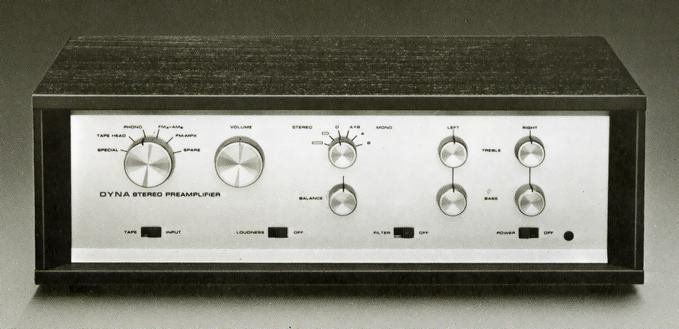
After doing some research, I bought and built two Dynaco kits, a Stereo 70 amp and a PAS-3X preamp. Then I saved up some more, and bought those AR3s, an AR XA turntable and an ADC cartridge if memory serves. Building the electronics myself was not that hard, though my soldering skills are still very lacking to this day, and saving money on kit building made enough of a financial difference to make it all work. (By the way, one of my friends became interested in hi-fi also and bought a pair of smaller AR speakers and a Dual turntable along with other gear.
Dynaco PAS-3X preamplifier.

The two of us had the best damn stereos around. Friends came over to listen. It boosted my social worth and I luxuriated in the sound, especially when my mother let me blast it. In many ways, this system gave me as much pleasure as the many more that would follow, even though the quality of the gear and the refinement of the sound continued to improve greatly over the decades.

These Golden Age stereo components were really some of the greatest audio products ever to become available. They made a big difference in not only my listening enjoyment but an entire generation, thanks to their superior performance, relatively accessible pricing, and form factors that enabled them to fit into a home environment. My components were also rugged enough to take the full force of a teenager’s abuse and still put out some great sound.

To this day, I recall them more than fondly.

My passion for audio equipment led to me getting an after school job at Sam Goody (the former large music retailer) which was my entry into the audio industry, but that is another story for another time. And I continue to keep trying to get more people to just take a listen. If they do, then maybe they’ll be as affected by the music and the sound as I continue to be.

Sam Goody record and music stores used to be everywhere, including this one in Hollywood. Photo courtesy of Wikimedia Commons/BrokenSphere.

More from Issue 108

View All Articles in Issue 108

Search Copper Magazine

#232 What came first: Art or Music? A Conversation With Artist Jose Acosta by Joe Caplan Jul 06, 2026 #232 Blow By Blow: The Jeff Beck Story: An Insightful Book About a Guitar Icon by Ray Chelstowski Jul 06, 2026 #232 Creed Over Camaraderie? by B. Jan Montana Jul 06, 2026 #232 Chronicles of a Sound Pilgrim at the 2026 Montreal Audiofest by Hugues Morin Jul 06, 2026 #232 The Vinyl Beat: Summer Grooves by Rudy Radelic Jul 06, 2026 #232 Hibbing Hillbilly Dylan's Acoustic Rock by Wayne Robins Jul 06, 2026 #232 Quad Quads and Plasmatronics Tweeters: An Extraordinary System Comes to Life by Frank Doris Jul 06, 2026 #232 In Praise of Live Music, Once Again by Ted Shafran Jul 06, 2026 #232 Allnic Audio’s L-9000 Preamplifier: Design and Engineering Innovation by Howard Kneller Jul 06, 2026 #232 “Best Of” Lists and Rage Bait: Enough Already by Frank Doris Jul 06, 2026 #232 Quick Takes: Bud Shank, Paulo Almeida, Jakob Dreyer, Tim Eriksen and Peter Irvine by Frank Doris Jul 06, 2026 #232 My Impressions of AXPONA 2026, Part 2 by Frank Doris Jul 06, 2026 #232 How to Play in a Rock Band, 25: Encounters With Famous Musicians, Part Three by Frank Doris Jul 06, 2026 #232 Budgets, and Systems From Small to Outrageous by Paul McGowan Jul 06, 2026 #232 PS Audio in the News by PS Audio Staff Jul 06, 2026 #232 Hand It Over by Frank Doris Jul 06, 2026 #232 Difference of Opinion by Peter Xeni Jul 06, 2026 #232 Wabi-sabi Tree by James Schrimpf Jul 06, 2026 #231 Piano Prodigy Jude Kofie Releases His Debut Album On Octave Records by Frank Doris Jun 01, 2026 #231 Underappreciated Artists, Part Two: City Boy by Rich Isaacs Jun 01, 2026 #231 Music and the Art of Creation: Talking With Saxophonist Rob Scheps by Joe Caplan Jun 01, 2026 #231 How to Play in a Rock Band, 24: Further Adventures at the 2026 Montauk Music Festival by Frank Doris Jun 01, 2026 #231 Courtney Barnett: Creature of Habit by Wayne Robins Jun 01, 2026 #231 Angine de Poitrine: Interstellar Guitar Rock Saviors Headed for Late-Night TV Pop Stardom? by Mark Lepage Jun 01, 2026 #231 My Impressions of AXPONA 2026, Part One by Frank Doris Jun 01, 2026 #231 2026 La Jolla Concours d'Elegance: Another Aesthetic Feast by B. Jan Montana Jun 01, 2026 #231 Country Music Icon Jo Dee Messina’s Bridges: A New Beginning by Ray Chelstowski Jun 01, 2026 #231 The Luxury Dispatch Hosts a Video Podcast With Ken Kessler by Ken Kessler Jun 01, 2026 #231 The Vinyl Beat: Tracking in the Motor City by Rudy Radelic Jun 01, 2026 #231 Lots of Fun With DSP: The Ferrum Audio WANDLA DAC and Its Tube Mode by Frank Doris Jun 01, 2026 #231 From The Audiophile's Guide: Digital Source Components and Streaming Audio by Paul McGowan Jun 01, 2026 #231 Onkyo’s Monster M-510 power amplifier by The Staff at Just Audio Jun 01, 2026 #231 PS Audio in the News by PS Audio Staff Jun 01, 2026 #231 Naming Convention by Peter Xeni Jun 01, 2026 #231 Les Invisibles by Frank Doris Jun 01, 2026 #231 Wildlife Scene by James Schrimpf Jun 01, 2026 #230 Camaraderie by B. Jan Montana May 04, 2026 #230 AXPONA 2026: A Family Gathering by Paul McGowan May 04, 2026 #230 Pianist Ryan Benthall Explores Jazz Realms and Far Beyond With Divine Sky by Frank Doris May 04, 2026 #230 The Vinyl Beat in AXPONA-Land by Rudy Radelic May 04, 2026 #230 Teddy Thompson’s Musical Growth Deepens With Never Be the Same by Ray Chelstowski May 04, 2026 #230 More Fun in the Sun: Florida Audio Expo, Part Two by Frank Doris May 04, 2026 #230 CanJam NYC 2026 Show Report: Heady Sound, Part Two by Frank Doris and Harris Fogel May 04, 2026 #230 Sonic Youth On Murray Street by Wayne Robins May 04, 2026 #230 Graffeo Coffee: A Symphony of Sensory Experience by Joe Caplan May 04, 2026 #230 The Saul Authority: The Story of Hi-Fi Pioneer Saul Marantz by Olivier Meunier-Plante May 04, 2026 #230 How to Play in a Rock Band, 23: Encounters With Famous Musicians, Part Two by Frank Doris May 04, 2026

Jersey Boys Find Hi-Fi

Jersey Boys Find Hi-Fi

My passion for audio was ignited in the 1960s (are we really that old?). Like most of my peers I listened to a lot of music. My two older brothers helped fuel my enthusiasm. My oldest brother loves classical music and opera (he is an expert on the subject) and played me lots of fabulous music on his KLH all-in-one system. (I think it was a Model 11 variant.) You could pull out the second speaker to hear a wider stereo spread to get the best sound we had at the time. Henry Kloss, founder of Acoustic Research (AR), KLH and Advent, was involved in that product series. Sadly, that item left with him for college, leaving my brother and I with a system much lower sound quality.


A KLH Model 11 portable stereo audio system.

My other brother introduced me to rock music, which took be beyond the pop sounds I had been listening to previously. Of course, the Beatles changed our lives a whole lot, followed by the British Invasion. Fortunately, my parents were also music lovers. They were dancers and enjoyed a lot of dance music and jazz, played on the Victrola record player they used. It was powered by electricity (early Victrolas were wind-up) and had a built-in speaker.

I followed the Top 40 AM radio countdowns, owned 45RPM records and bought a few albums. I remember my brother playing bands like the Young Rascals loud enough and often enough to bring the neighbors and the police in to ask what the racket was all about!

Then my other brother moved off to college. Both brothers are quite a bit older than me. I was left with my GE hi-fi with a flip-over stylus (some of you may remember those – one side for 33 and 45 RPM records and the other side to play 78 RPM discs), hinged swing-out speakers and a fold-down turntable. I knew it was crap as the KLH sounded much better, but I did not know a thing about the actual technology of audio and why the KLH had superior fidelity. However, I’d had a taste of hi-fi sound, and that was all I needed to be motivated to hear more.

I began to read about it in magazines like Audio and Popular Science and what I took from my friend’s Dad, who had magazines in his home office. My friend’s dad was a doctor and had a mono McIntosh system with a big Klipsch speaker. His dad later went stereo and had the first HH Scott stereo tuner I’d ever seen or heard, along with an early Dual turntable. The fuse was lit. I now had some idea of what was really possible.

 Audio magazine, August 1969.

At the time, I was 13, living in New Jersey and allowed to go into New York City on the bus, on my own or with friends. We went to museums and concerts (my older brother took me to the Met, Carnegie Hall and then Avery Fisher Hall). I was buying records and became interested in recording. Early tape recorders were available then, and my dad got me one that took little 3-inch reels. I went about recording inside and outside the house. The tape and technology were fascinating. I had read about wire recording during World War II times and this of course got me recording birds and animals and my friends and I trying badly to play instruments. Although, my oldest brother was an excellent pianist and we had a Steinway he would only play for me. I recorded him playing some Liszt and Chopin pieces and we both enjoyed the experience though not many of my friends appreciated Classical music then.


Avery Fisher Hall/Lincoln Center, Manhattan. Photo courtesy of Wikimedia Commons/Zeb Martin.

Later this led to me and my friends having a pirate radio station. We pre-recorded our programs and mixes and could be heard for about three miles all around, enough for our friends to know about us and for some parents to complain. My show was called “Markus and the Robot” after my friend Mark and me. It’s another tale for another time. Our friend Fred had the transmitter and his dad heard from another friend in the FCC that they knew but didn’t care.

During this time I  was earning a good deal of money for a kid, from things like snow shoveling, leaf raking, summer jobs and so on.

At that time, Acoustic Research had a small demo room facility right in Grand Central Station in Manhattan. This was not long after the introduction of the AR XA turntable and AR’s early series of acoustic suspension speakers (which use a sealed enclosure to produce more bass from a smaller cabinet, although at the expense of efficiency) . I had heard about them and wanted a listen. Big horn speakers, like what my friend’s dad had at home, were far too large for me to get my mother to accept in our home, but the AR speakers were small bookshelf models.

On the day I first heard AR speakers, my friends and I started the day out just loitering around, being typical tween and teen hooligans, but eventually, in we went to Grand Central. It didn’t take much to convince my friends to go to the AR facility for a demonstration. Amazingly, they did not throw us out, but gave us a demo, which far exceeded our expectations. Who knew you could get that much volume and bass from a cabinet that size?

Listening to these, demos, we realized how much sound we were missing. Background vocals became individual voices rather than just a blurred chorus. You could tell the difference between instruments rather than just heading a wall of sound (though a lot of record production was that way at the time). The sound of the bass was amazing to us, since all the systems we ever listened too previously lost all of that. We had no idea how low you could go. And finally, we heard actual stereo imaging, and this was the point. We could hear what seemed to be bands spread across the image. For the first time, we heard what we considered to be immersive sound. (Yes, certainly not at the level of spatial detail and quality of sound of today, but the change from what was basically highly distorted mono was dramatic.)

Acoustic suspension loudspeakers were a real innovation then and while AR speakers were a lot of money for me, it was still possible for me to afford them as I was ready to commit most of the money I had saved for them and the rig I wanted to buy.

Once I heard the mighty AR3 speakers at that demo, my mind expanded with possibilities. The speakers could fit in my room, sort of. Though they were large, they were much smaller than most others I’d heard, and had much better output and bass. I convinced my mother they were alright to buy, and she did like the look of the walnut cabinets, so I got a pass. She did not care that they were so large as they would be residing my room, and they were “not ugly,” in her words. I was sold! I thought about creating my new stereo system, and schemed on how to get it all paid for and in my room.

Acoustic Research AR3 loudspeakers.
After doing some research, I bought and built two Dynaco kits, a Stereo 70 amp and a PAS-3X preamp. Then I saved up some more, and bought those AR3s, an AR XA turntable and an ADC cartridge if memory serves. Building the electronics myself was not that hard, though my soldering skills are still very lacking to this day, and saving money on kit building made enough of a financial difference to make it all work. (By the way, one of my friends became interested in hi-fi also and bought a pair of smaller AR speakers and a Dual turntable along with other gear.
Dynaco PAS-3X preamplifier.

The two of us had the best damn stereos around. Friends came over to listen. It boosted my social worth and I luxuriated in the sound, especially when my mother let me blast it. In many ways, this system gave me as much pleasure as the many more that would follow, even though the quality of the gear and the refinement of the sound continued to improve greatly over the decades.

These Golden Age stereo components were really some of the greatest audio products ever to become available. They made a big difference in not only my listening enjoyment but an entire generation, thanks to their superior performance, relatively accessible pricing, and form factors that enabled them to fit into a home environment. My components were also rugged enough to take the full force of a teenager’s abuse and still put out some great sound.

To this day, I recall them more than fondly.

My passion for audio equipment led to me getting an after school job at Sam Goody (the former large music retailer) which was my entry into the audio industry, but that is another story for another time. And I continue to keep trying to get more people to just take a listen. If they do, then maybe they’ll be as affected by the music and the sound as I continue to be.

Sam Goody record and music stores used to be everywhere, including this one in Hollywood. Photo courtesy of Wikimedia Commons/BrokenSphere.

0 comments

Leave a comment

0 Comments

Your avatar

Loading comments...

🗑️ Delete Comment

Enter moderator password to delete this comment:

✏️ Edit Comment

Enter your email to verify ownership: