COPPER

A PS Audio Publication

Issue 109 • Free Online Magazine

Issue 109 REVOLUTIONS PER MINUTE

How to Lie with Measurements

How to Lie with Measurements

In view of my recent series on linearity and other technical topics before that, the time is perhaps now ripe to discuss audio measurements.

I will focus on what is probably familiar to most audiophiles and hopefully even more familiar to equipment designers: frequency response plots!

A few days ago, I was designing some audio electronics in the deepest corner of my cavely lab and was testing the performance of the prototype with a rather expensive transformer, intended for audiophile use. Something wasn’t right so I ended up testing a bunch of transformers I had lying around the bench, measuring the transformers on their own (rather than installed in the product).

The results for this particular and expensive unit were shockingly bad, but the severity of what looks like “a bit of a ripple around 20 kHz” would be better appreciated if we change the display from 10 dB per vertical division to 1 dB/div, all other settings maintained as before.

This is a 20 Hz – 43 kHz plot and the 1 dB/div resolution reveals a dramatic resonance, caused by unintentional aspects within the transformer: leakage inductance and winding capacitances. An unfortunate combination of such parameters renders this massively built transformer practically useless for serious audio use.

The difference in the display between the 10 dB/div and 1 dB/div settings demonstrates the first thing to look out for when trying to correlate measurements with performance: what are we actually looking at? Is a tiny blip in the middle of the plot really as tiny as it looks, or are the scale and smoothing settings “artistically selected” for a more flattering display?

This leads to a second question: all transformers contain the aforementioned unintentional components and therefore, they must all exhibit resonance at some frequency.

But how is the above plot, of a different, better transformer, possible?

Where is the resonance? As mentioned earlier, these plots are all 20 Hz – 43 kHz in a logarithmic scale along the horizontal axis. Any anomalies occurring below 20 Hz and above 43 kHz are not going to be displayed on this plot! We could pretend they are not there, since anything outside this frequency range is outside the traditional concept of the “audible range” anyway. But as mentioned in Issue #107, frequency response errors outside the 20 Hz to 20 kHz range could cause phase response errors within this range!

In practice, excellent audio transformers are designed and constructed in ways that push these resonances so high up in frequency, and compensate for them to derive a gentle roll-off rather than out-of-control peaks and dips, as to be of little to no practical consequence in audio applications. Such transformers can exhibit a smooth frequency and phase response over an even wider range than 20 Hz – 20 kHz.
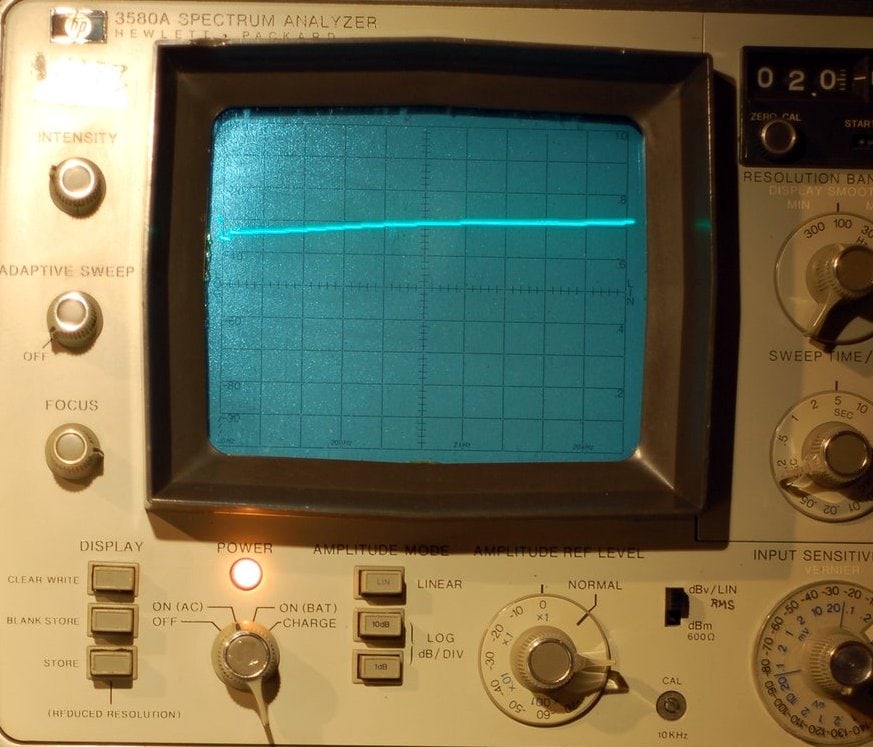
That same transformer maintains a respectable plot even at 1 dB/div resolution, being 0.5 dB down at 20 Hz, correctly terminated… wait… did I just say “terminated”…?
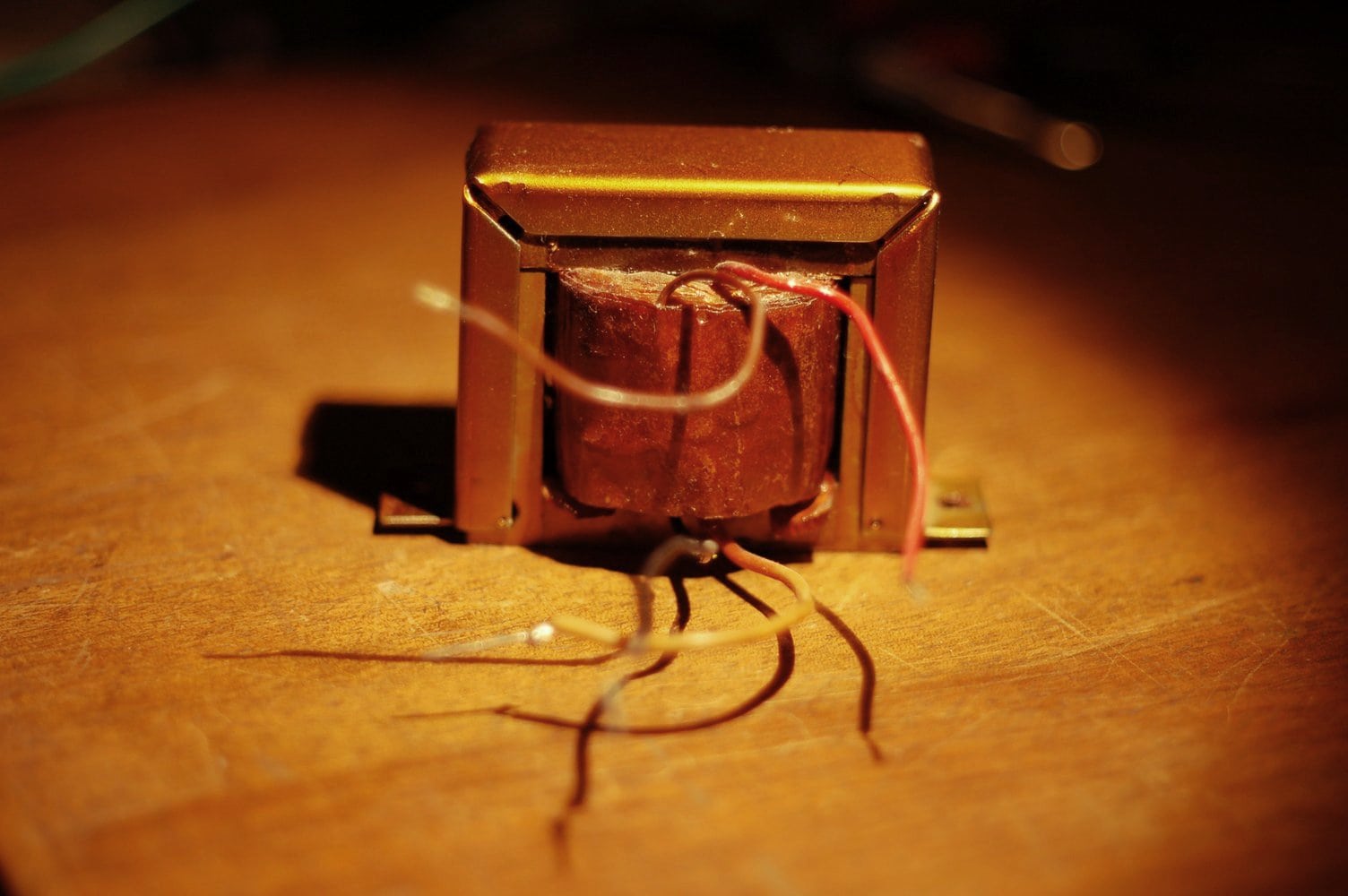
Several years ago I found this cheap single-ended output transformer in a vacuum tube table radio made behind the Iron Curtain. Nothing to expect outstanding performance from. So, here’s how to lie with measurements:

Isn’t this one of the most outstanding single-ended transformers ever?

Begs to be used with the finest example of a 300B output tube…or not?

This was at 10 dB/div, terminated in a 1 megohm resistor, which is to say, nowhere near its real-life operating conditions.

This is the same but 1 dB/div. Already a bit less flattering. In actual use, this output transformer would be expected to drive a loudspeaker. So we should try terminating it in a more realistic loudspeaker impedance value, say 8 ohm, 1dB/div:

Oops! How about 4 ohm, 1 dB/div?

We’re 5 dB down at 20 kHz, and 3.5 dB down with an 8 ohm load. In an actual circuit, driving an actual loudspeaker, this is likely to be slightly worse, but given what this came from, it is certainly better than expected.

A 50 Hz to 8 kHz bandwidth was a typical design aim for AM table radios in the late 1940s. But we would most likely be able to sell it for 10 times as much if we conveniently set the analyzer for 10 dB/div, still keeping the 4 ohm termination:

Still 5 dB down at 20 kHz, but looks better, doesn’t it?

But what is so special about audio transformers? Can’t we just use a much cheaper power transformer as an output transformer?

Audio transformers need to operate over a very wide frequency and dynamic range. This calls for special core materials, special winding techniques, special insulation materials, tight parameter control and attention to detail.

There are certain power applications which may have similar requirements, but audio is on a whole different level. As an example, this is the 1 dB/div plot of a special industrial transformer I designed a while ago:

Not really audio-grade, but maybe acceptable in a guitar amplifier, though the cost might put you off. It does what it was designed for very well, and it certainly isn’t audio.

As for the average off-the-shelf, mass-produced power transformer? Judge for yourself (1 dB/div, 8 Ohm termination)!

More from Issue 109

View All Articles in Issue 109

Search Copper Magazine

#234 A Life in High-End Audio: The Roy Hall Interview, Part One by Frank Doris Sep 07, 2026 #234 Jason Greenlaw Offers His Personal Perspective on Jazz Guitar in Vantage Point by Frank Doris Sep 07, 2026 #234 Transcendent Phoenix: Lucina Yue Brings the Ancient Konghou Into Modern Times by Frank Doris Sep 07, 2026 #234 We Must All Follow Our Bliss by B. Jan Montana Sep 07, 2026 #234 How to Play in a Rock Band, 27: Leveling Up by Frank Doris Sep 07, 2026 #234 Ross Valory: Traveling Into New Musical Territory With All of the Above by Ray Chelstowski Sep 07, 2026 #234 Singer/Songwriter John David Schrader: On the Need to Create by Joe Caplan Sep 07, 2026 #234 The People Who Make Audio Happen: More From T.H.E. Show SoCal 2026 by Harris Fogel Sep 07, 2026 #234 The Vinyl Beat Digs Into the Gadget Box by Rudy Radelic Sep 07, 2026 #234 The Rolling Stones: Foreign Tongues Spoken Loud by Wayne Robins Sep 07, 2026 #234 Musical Moments by Rich Isaacs Sep 07, 2026 #234 Rags for Solo Piano and a Dog: David Chesky's Ragtime Music for the Modern Age by Frankly Speaking Sep 07, 2026 #234 HIGH END 2026, Vienna: Here to Stay by Carsten Barnbeck Sep 07, 2026 #234 From The Audiophile’s Guide: The Two Main Types of Loudpeakers – Box and Panel by Paul McGowan Sep 07, 2026 #234 Letting it Slide by Frank Doris Sep 07, 2026 #234 PS Audio in the News by PS Audio Staff Sep 07, 2026 #234 Long Playing by Peter Xeni Sep 07, 2026 #234 La Mer by B. Jan Montana Sep 07, 2026 #233 A Report From The Total Hi-Fi Experience Show SoCal 2026 by B. Jan Montana Aug 03, 2026 #233 Bluegrass Meets Country, Folk, Jazz and More in All That We Carried by The Squid City Slingers by Frank Doris Aug 03, 2026 #233 Corey Glover and One Tribe Nation: A Variegated Musical Collective by Ray Chelstowski Aug 03, 2026 #233 Excursions with Clive: The Late Clive Davis, A Personal History by Wayne Robins Aug 03, 2026 #233 AI, Art, and Music: A Conversation With Synthography Art by Joe Caplan Aug 03, 2026 #233 New American Symphonies: A Rediscovered Gem and a Vital Contemporary Work by Frank Doris Aug 03, 2026 #233 The Vinyl Beat: Genesis, the Dave Clark Five, Antonio Carlos Jobim and More by Rudy Radelic Aug 03, 2026 #233 How to Play in a Rock Band, 26: When It's Time to Record Your Music by Frank Doris Aug 03, 2026 #233 More From T.H.E. Show 2026, and the People Who Made it Happen by Harris Fogel Aug 03, 2026 #233 Underappreciated Artists, Part Three: Icehouse by Rich Isaacs Aug 03, 2026 #233 The Surprisingly Rich and Varied Music of Somalia by Steve Kindig Aug 03, 2026 #233 A Remarkable Discographic Legacy: The LP Recordings of the Basel Symphony Orchestra by Stephan Haberthür Aug 03, 2026 #233 From The Audiophile’s Guide: The Importance of Loudspeakers by Paul McGowan Aug 03, 2026 #233 From Swimming Pool to New Listening Room: A Conversation with Norman Varney of AV RoomService by Gilles Laferrière Aug 03, 2026 #233 PS Audio in the News by PS Audio Staff Aug 03, 2026 #233 Audio Jewelry by Peter Xeni Aug 03, 2026 #233 Enrich Your Life by Frank Doris Aug 03, 2026 #233 The Searcher by James Schrimpf Aug 03, 2026 #232 What came first: Art or Music? A Conversation With Artist Jose Acosta by Joe Caplan Jul 06, 2026 #232 Blow By Blow: The Jeff Beck Story: An Insightful Book About a Guitar Icon by Ray Chelstowski Jul 06, 2026 #232 Creed Over Camaraderie? by B. Jan Montana Jul 06, 2026 #232 Chronicles of a Sound Pilgrim at the 2026 Montreal Audiofest by Hugues Morin Jul 06, 2026 #232 The Vinyl Beat: Summer Grooves by Rudy Radelic Jul 06, 2026 #232 Hibbing Hillbilly Dylan's Acoustic Rock by Wayne Robins Jul 06, 2026 #232 Quad Quads and Plasmatronics Tweeters: An Extraordinary System Comes to Life by Frank Doris Jul 06, 2026 #232 In Praise of Live Music, Once Again by Ted Shafran Jul 06, 2026 #232 Allnic Audio’s L-9000 Preamplifier: Design and Engineering Innovation by Howard Kneller Jul 06, 2026 #232 “Best Of” Lists and Rage Bait: Enough Already by Frank Doris Jul 06, 2026 #232 Quick Takes: Bud Shank, Paulo Almeida, Jakob Dreyer, Tim Eriksen and Peter Irvine by Frank Doris Jul 06, 2026

How to Lie with Measurements

How to Lie with Measurements

In view of my recent series on linearity and other technical topics before that, the time is perhaps now ripe to discuss audio measurements.

I will focus on what is probably familiar to most audiophiles and hopefully even more familiar to equipment designers: frequency response plots!

A few days ago, I was designing some audio electronics in the deepest corner of my cavely lab and was testing the performance of the prototype with a rather expensive transformer, intended for audiophile use. Something wasn’t right so I ended up testing a bunch of transformers I had lying around the bench, measuring the transformers on their own (rather than installed in the product).

The results for this particular and expensive unit were shockingly bad, but the severity of what looks like “a bit of a ripple around 20 kHz” would be better appreciated if we change the display from 10 dB per vertical division to 1 dB/div, all other settings maintained as before.

This is a 20 Hz – 43 kHz plot and the 1 dB/div resolution reveals a dramatic resonance, caused by unintentional aspects within the transformer: leakage inductance and winding capacitances. An unfortunate combination of such parameters renders this massively built transformer practically useless for serious audio use.

The difference in the display between the 10 dB/div and 1 dB/div settings demonstrates the first thing to look out for when trying to correlate measurements with performance: what are we actually looking at? Is a tiny blip in the middle of the plot really as tiny as it looks, or are the scale and smoothing settings “artistically selected” for a more flattering display?

This leads to a second question: all transformers contain the aforementioned unintentional components and therefore, they must all exhibit resonance at some frequency.

But how is the above plot, of a different, better transformer, possible?

Where is the resonance? As mentioned earlier, these plots are all 20 Hz – 43 kHz in a logarithmic scale along the horizontal axis. Any anomalies occurring below 20 Hz and above 43 kHz are not going to be displayed on this plot! We could pretend they are not there, since anything outside this frequency range is outside the traditional concept of the “audible range” anyway. But as mentioned in Issue #107, frequency response errors outside the 20 Hz to 20 kHz range could cause phase response errors within this range!

In practice, excellent audio transformers are designed and constructed in ways that push these resonances so high up in frequency, and compensate for them to derive a gentle roll-off rather than out-of-control peaks and dips, as to be of little to no practical consequence in audio applications. Such transformers can exhibit a smooth frequency and phase response over an even wider range than 20 Hz – 20 kHz.

That same transformer maintains a respectable plot even at 1 dB/div resolution, being 0.5 dB down at 20 Hz, correctly terminated… wait… did I just say “terminated”…?

Several years ago I found this cheap single-ended output transformer in a vacuum tube table radio made behind the Iron Curtain. Nothing to expect outstanding performance from. So, here’s how to lie with measurements:

Isn’t this one of the most outstanding single-ended transformers ever?

Begs to be used with the finest example of a 300B output tube…or not?

This was at 10 dB/div, terminated in a 1 megohm resistor, which is to say, nowhere near its real-life operating conditions.

This is the same but 1 dB/div. Already a bit less flattering. In actual use, this output transformer would be expected to drive a loudspeaker. So we should try terminating it in a more realistic loudspeaker impedance value, say 8 ohm, 1dB/div:

Oops! How about 4 ohm, 1 dB/div?

We’re 5 dB down at 20 kHz, and 3.5 dB down with an 8 ohm load. In an actual circuit, driving an actual loudspeaker, this is likely to be slightly worse, but given what this came from, it is certainly better than expected.

A 50 Hz to 8 kHz bandwidth was a typical design aim for AM table radios in the late 1940s. But we would most likely be able to sell it for 10 times as much if we conveniently set the analyzer for 10 dB/div, still keeping the 4 ohm termination:

Still 5 dB down at 20 kHz, but looks better, doesn’t it?

But what is so special about audio transformers? Can’t we just use a much cheaper power transformer as an output transformer?

Audio transformers need to operate over a very wide frequency and dynamic range. This calls for special core materials, special winding techniques, special insulation materials, tight parameter control and attention to detail.

There are certain power applications which may have similar requirements, but audio is on a whole different level. As an example, this is the 1 dB/div plot of a special industrial transformer I designed a while ago:

Not really audio-grade, but maybe acceptable in a guitar amplifier, though the cost might put you off. It does what it was designed for very well, and it certainly isn’t audio.

As for the average off-the-shelf, mass-produced power transformer? Judge for yourself (1 dB/div, 8 Ohm termination)!

0 comments

Leave a comment

0 Comments

Your avatar

Loading comments...

🗑️ Delete Comment

Enter moderator password to delete this comment:

✏️ Edit Comment

Enter your email to verify ownership: