COPPER

A PS Audio Publication

Issue 133 • Free Online Magazine

Issue 133 DEEP DIVE

United Recording Studios: An Industry Legend

United Recording Studios: An Industry Legend

This year’s AES Fall Show 2020 was conducted virtually, due to COVID-19 restrictions in New York, which prevented the convention from being held in the Javits Center, its usual venue. However, the online workshops and conferences afforded participants a unique opportunity to experience certain events in a more in-depth fashion than normally, albeit without the ability to touch any actual gear. The unquestionable main event was “7 Audio Wonders of the World,” a video tour covering some of the world’s most historic and iconic recording studios. Previously Skywalker Sound, Galaxy Studios, The Village, Blackbird Studio, and Abbey Road have been covered in Copper Issues 123 through 126. Number six on the “7 Audio Wonders” list is United Recording Studios.

It is interesting to note that while all of the top recording studios in the series have preferences for different recording consoles and speakers, when it comes to compressors, the UREI/Universal Audio 1176 transistor compressors and LA-2A tube compressors are omnipresent. These pro studio standard units are just a small bit of the recording legacy of Bill Putnam, a man of many design, engineering and production talents who has been called the “father of modern recording.”
United Recording Studios. United Recording Studios.

Les Paul is often credited with inventing multitrack tape recording. However, Les Paul got the original idea from his good buddy, the late Bill Putnam, who successfully executed the first commercially successful sound-on-sound overdub recording in 1947 with Patti Page and George Barnes. The song, “Confess” contained Page’s double-tracked vocal, utilizing a disc combined with a wire recorder.

In the annals of audio recording history, Bill Putnam is a titan. He is credited with the first use of echo chambers in the US, designed and built the first modular recording console and the first isolation booth, is credited with the first use of tape echo and delay lines, and founded Universal Audio, which later became UREI, an audio company best known for its outboard processing equipment and speakers.

Putnam and his Universal Recording Studio had recorded Duke Ellington, Count Basie, Patti Page and Sarah Vaughan, and became so in-demand that Frank Sinatra and Bing Crosby bankrolled his move to Los Angeles in 1957 to create United Recording Corporation.

United continued as a highly-sought recording studio over the next two decades. In 1969, 16 year old intern and budding loudspeaker designer Allen Sides began his association with United, later catching the attention of Bill Putnam by negotiating an insanely low price for a large cache of mothballed vintage gear from Putnam’s previous United Western facility for Sides’ new Santa Monica-based Ocean Way Studios. Impressed by Sides’ technical knowledge, ears and business savvy, they would become friends and partners, with Putnam selling United to Sides in the 1980s to become part of Ocean Way. Sides went on to continue upgrading and innovating United until selling it in 2013 to Hudson Pacific. Since 2015 it has been known as United Recording Studios.

Robin Goodchild, Director of United Recording, stresses that having a good staff is even more important than having great gear. United’s reputation for professionalism and taking care of clients all adhere to the Putnam philosophy and aesthetic for creating the optimum atmosphere in which to record and produce music.

Studio B Live Room

Although designated “B,” this was Bill Putnam’s first room, built to his specifications. Studio B quickly gained a reputation as an excellent tracking room, and still holds the distinction as one of the finest ever built. It is renowned for enhancing the sound of almost anything recorded there.

Studio B. Studio B.

With a high ceiling divided into angled sections, and no parallel wall surfaces. Studio B is an old-school engineering marvel, likely built as much to Bill Putnam’s ears as his blueprints.

Studio B’s live room measures 60 feet by 50 feet. There is also a separate isolation room that is 60 feet by 54 feet, custom-built to Putnam’s specs. Originally it was part of an adjacent building, and was used for jingles. It was added to Studio B by Allen Sides in 1978.

Studio B’s live room is particularly famous for drum sounds. A unique feature of Studio B is the “drumbrella,” a variable-height ceiling baffle installed by Allen Sides in 1978 that contains a mystery sound absorption material known only to Allen Sides. It’s mounted on a winch to tailor the acoustics when recording drums, and it’s useful for recording upright bass and other instruments as well.

The first project cut at United in 1958 was Ricky Nelson’s “Poor Little Fool”. Since then, United has been a premier recording location for Bing Crosby, Frank Sinatra, Crosby, Stills and Nash, the Everly Brothers, Adele, Paul McCartney, Queens of the Stone Age, Bob Dylan, Iggy Pop, James Taylor and many others. The Studio B live room has been basically unchanged since 1958.

The enormous speaker cabinet isolation boxes currently residing in in Studio B were designed specifically for Queens of the Stone Age. The custom cabinet iso booths cut the rumble by 52 dB and managed to keep sound within the building.

Studio B’s vocal booth was built by Bill Putnam, who, among his many accomplishments, invented the standalone vocal booth. This was the first of its kind and is still in use today.

Studio B Control Room

The centerpiece of Studio B’s control room is a custom-built vintage Neve 68-channel 8068/8088 console. It was originally owned by RPM Studios in New York and later sold to The Document Room in Malibu, then acquired in 2010 by Allen Sides for Ocean Way. It has Fred Hill mods and every channel sports a Neve 31102 preamp. This desk replaced the famous but rare Dalcon console, which was sold to producer/engineer/musician Nigel Godrich (Radiohead) after decades of service and countless platinum and gold hit records.

The studio’s main speakers are Allen Sides’ custom Ocean Way monitors, and it’s equipped with Dynaudio nearfield monitors. Pro Tools HDX2 is used for recording.

Studio B’s outboard gear includes a collection of Fairchild 670, Teletronix LA-2A,UREI 1176 and  Pultec EQ-1 compressors and equalizers. There is also a separate rack of vintage API 550A shelving equalizers. Users can switch between Neve 31102 or API 550A equalizers with a button. The studio’s acoustics and gear deliver vintage sounds but can also do contemporary styles, as a host of modern gear is also available.

Studio A Live Room:

Studio A is the second live room designed by Bill Putnam. It has more of an open, warm, natural sound with less “enhancement” than in Studio B – Studio A is truer to the actual sound of the instruments while Studio B has a reputation for making everything sound “better.” Studio A is considered to be especially good for strings Other than a newer parquet floor and a control room extension done in the 1970s, the room is unchanged since its original construction. Measuring 1,575. square feet, Studio A is larger than B. Its angled walls have acoustic panels that provide a combination of sound absorption and/or refraction where needed. There are no “bad” or dead spots in the room.

According to Grammy Award-winning musician/producer Gregg Field, Studio A’s live room has been basically untouched since Bill Putnam created it. Once Field started engineering there, he noticed how accurate the room was. What Field recorded to tape captured exactly how things sounded in real life, as opposed to some rooms, where a kick drum might need to be enhanced in the mix, for example.

Studio A. Studio A.

Producer and composer Rickey Minor noted that the room doesn’t color the sound to a point where highs or lows are cut off; it just sounds organically natural and warm. Minor built a smaller room in an adjacent building ,with a similar design that captured much of the same vibe; the building itself apparently has a certain constructional magic. “The [recording] technology can change, but the way our ears hear and how it sounds in the room is something special,” Minor noted.

A 1960s Steinway D concert grand bought by Allen Sides in the late 1990s from Motown’s LA studios sits in Studio A. The large iso booth houses another Steinway, which was used by Bruce Hornsby on “The Way It Is.” It also stores Frank Sinatra’s famous podium, from where he would cut his vocals with a big band orchestra.

Studio A Control Room

Although Studio B no longer has its distinctive yellow Dalcon console, Studio A has kept its super-rare 72-channel Focusrite console, number four or only 10 ever made, and Focusrite preamps, modified for a more open sound. Originally formed by designer Rupert Neve in 1985 as a side company, Focusrite is currently best known for its computer audio interfaces. The desk is loaded with Focusrite-designed ISA 110 dynamic processors, and in 1989 was acquired from Phil Dudderidge, co-founder of Soundcraft and former live sound mixer for Led Zeppelin.


Mixing console, Studio A control room. Mixing console, Studio A control room.

Studio A’s main speakers are Ocean Way custom monitors designed by Allen Sides. Studio A also has ATC SCM45, Yamaha NS-10, and Genelec 1032 monitor speakers for cross-referencing mixes. The outboard gear racks contain vintage LA-2A, Fairchild, Lang and UREI 1176 compressors, Pultec EQs and a Neve BCM10 console. This studio also uses Pro Tools HDX2 for recording.

Up the staircase, management offices are located on the second floor. These were the original offices of Reprise Records and Frank Sinatra, Reprise’s founder.

Long a trade secret, Robin Goodchild confessed that Allen Sides would probably kill him for revealing United’s echo chambers on the AES virtual tour, if Sides still owned the studio. The echo chambers were used on records by the Beach Boys, Sinatra, Ray Charles, The Mamas and the Papas and others, and never before revealed to the public.

Echo Chamber A is a cavernous-sounding space of cinder block construction. Bill Putnam was the first acoustic designer to bring artificial reverb to the US (it was created in the UK) at Universal Studios in Chicago, where he initially used a tiled bathroom. Later, Les Paul took Putnam’s Universal model to build the echo chambers at Capitol Studios.

A separate plate reverb room holds six EMT 140 units. (Plate reverb is created by running the signal through an actual large metal plate. It has a distinctive sound.)

Echo Chamber D, accessible through the storage room, is built in a similar manner as chamber A, but smaller. Sound is fed into the chamber from an old Altec speaker and the reverberations are captured with a PZM (pressure zone mic) on the floor.

The nearby microphone locker stores 300 mics for every conceivable application, all hand-picked by Bill Putnam and Allen Sides. Most of them are vintage tube mics, though there are also large and small condenser, dynamic and ribbon mics from Neumann, Telefunken, AKG and other manufacturers.

Studio D

Allen Sides installed Studio D in 2003 when United was still Ocean Way. It was designed as a standalone mixing room with a vocal booth (large enough to hold a piano and a bass amp) and a separate iso booth for overdubs. Studio D has been used by Willie Nelson and Kris Kristofferson, and notable producer Jack Joseph Puig reportedly had a long-term block booking for Studio D at one time. It is not an original Putnam room.

Studio D’s console is a Neve 88R. There are 16 (!) racks of outboard gear filled with a mix of vintage and modern equipment.

United Archiving is a separate division on the second floor of the building. Bill Smith is the chief archiving engineer. The archives hold reels of analog and digital tape in almost every conceivable format. All of the material is transferred to hi-res audio files and/or broadcast quality .WAV files.

The facility allows clients to have access to older assets (including original multitrack tapes) that are archived into high-resolution digital audio for future use. The archiving division also serves to preserve original material in order to avoid degradation once digitized. Thus, the new files can be re-done for 5.1 or Dolby Atmos remixes and so on. The facility is in almost constant use.


Archiving room at United Recording. Archiving room at United Recording.

The formats are transferred using a host of appropriate playback equipment, from a 24-track Studer multitrack analog recorder to an original 1980 digital-2 track Mitsubishi X-80 PCM recorder, an Alesis ADAT recorder, a Sony PCM 3348 48-track digital recorder and many other machines.

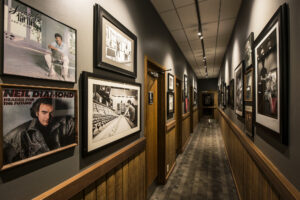
Unlike The Village, which experienced a temporary downturn in business in the 1990s because of younger artists avoiding the facility due to its close association with classic rock icons like Fleetwood Mac and Tom Petty, United Recording has always been in demand from musicians of all genres. Its client list includes an impressive mix of seasoned and new artists. Alabama Shakes, Avicii, Mitchell Yoshida, Nat King Cole, most of the Reprise Records Rat Pack (Frank Sinatra, Sammy Davis Jr. and Dean Martin), Beck, Radiohead, 21 Pilots, Lizzo, Ray Charles, Lionel Ritchie, Red Hot Chili Peppers, and Phil Collins are just a small sample from the last 60 years. A recent photo collection curated by pro audio journalist Mr. Bonzai contains thousands of shots documenting sessions at United and now adorns the halls. The photos present a fascinating look at United’s history and its continuation of the legacy of Bill Putnam and Allen Sides.


All images courtesy of United Recording Studios/photography by Zane Roessell.


More from Issue 133

View All Articles in Issue 133

Search Copper Magazine

#229 The Earliest Stars of Country Music, Part Three by Jeff Weiner Apr 06, 2026 #229 The Healing Power of Music and Sound at the Omega Institute by Joe Caplan Apr 06, 2026 #229 CanJam NYC 2026 Show Report: Heady Sound, Part One by Frank Doris Apr 06, 2026 #229 Florida Audio Expo 2026: Warming Up to High-End Audio, Part One by Frank Doris Apr 06, 2026 #229 Quick Takes: Anne Bisson, Sam Morrison, The Velvet Underground, and the Stooges by Frank Doris Apr 06, 2026 #229 The Vinyl Beat: New Arrivals, and Old Audio Show Demo Scores to Settle by Rudy Radelic Apr 06, 2026 #229 Harvard Gets a High-End Audio Education by Frank Doris Apr 06, 2026 #229 No Country for Old Knees by B. Jan Montana Apr 06, 2026 #229 How To Play in A Rock Band, 22: Encounters With Famous Musicians, Part 1 by Frank Doris Apr 06, 2026 #229 The Soulful Grooves of Guinea-Bissau by Steve Kindig Apr 06, 2026 #229 Four-Hand Piano Performance at Its Finest by Stephan Haberthür Apr 06, 2026 #229 The People Who Make Audio Happen: Supreme Acoustics Systems’ Las Vegas Grand Opening by Harris Fogel Apr 06, 2026 #229 Blue Öyster Cult: Tyranny and Expectations by Wayne Robins Apr 06, 2026 #229 Guitarist Rick Vito’s Cinematic New Album, Slidemaster by Ray Chelstowski Apr 06, 2026 #229 Measurements and Observational Listening by Paul McGowan Apr 06, 2026 #229 PS Audio in the News by PS Audio Staff Apr 06, 2026 #229 Back to My Reel-to-Reel Roots, Part 28: The Cassette Strikes Back by Ken Kessler Apr 06, 2026 #229 Are You Receiving Me? by Frank Doris Apr 06, 2026 #229 Hospitality by Peter Xeni Apr 06, 2026 #229 Cantina Gateway by James Schrimpf Apr 06, 2026 #228 Serita’s Black Rose Duo Shakes Your Soul With a Blend of Funk, Rock, Blues and a Whole Lot More by Frank Doris Mar 02, 2026 #228 Vinyl, A Love Story by Wayne Robins Mar 02, 2026 #228 Thrill Seeker by B. Jan Montana Mar 02, 2026 #228 The Vinyl Beat: Donald Byrd, Bill Evans, Wes Montgomery, Eddie Palmieri and Frank Sinatra by Rudy Radelic Mar 02, 2026 #228 Listening to Prestige: The History of a Vitally Important Jazz Record Label by Frank Doris Mar 02, 2026 #228 How to Play in a Rock Band, 21: Touring With James Lee Stanley by Frank Doris Mar 02, 2026 #228 The NAMM 2026 Show: The Music Industry’s Premier Event by John Volanski Mar 02, 2026 #228 The Earliest Stars of Country Music, Part Two by Jeff Weiner Mar 02, 2026 #228 From The Audiophile's Guide: A Brief History of Stereophonic Sound by Paul McGowan Mar 02, 2026 #228 A Bone to Pick With Streaming Audio by Frank Doris Mar 02, 2026 #228 Blast Off With Bluesman Duke Robillard by Ray Chelstowski Mar 02, 2026 #228 A Visit to the Marten Loudspeaker Factory in Göteborg, Sweden by Ingo Schulz and Sebastian Polcyn Mar 02, 2026 #228 Pure Distortion by Peter Xeni Mar 02, 2026 #228 A Nagra Factory Tour by Markus "Marsu" Manthey Mar 02, 2026 #228 Back to My Reel-to-Reel Roots, Part 27: Noodge and Ye Shall Receive, Part Two by Ken Kessler Mar 02, 2026 #228 PS Audio in the News by PS Audio Staff Mar 02, 2026 #228 90-Degree Stereo by Frank Doris Mar 02, 2026 #228 The Keys to Art by Rich Isaacs Mar 02, 2026 #227 Seth Lewis Gets in the Groove With Take a Look Around: a Tribute to the Meters by Frank Doris Feb 02, 2026 #227 Passport to Sound: May Anwar’s Audio Learning Experience for Young People by Frank Doris Feb 02, 2026 #227 Conjectures on Cosmic Consciousness by B. Jan Montana Feb 02, 2026 #227 The Big Takeover Turns 45 by Wayne Robins Feb 02, 2026 #227 Music and Chocolate: On the Sensory Connection by Joe Caplan Feb 02, 2026 #227 Singer/Songwriter Chris Berardo: Getting Wilder All the Time by Ray Chelstowski Feb 02, 2026 #227 The Earliest Stars of Country Music, Part One by Jeff Weiner Feb 02, 2026 #227 The Vinyl Beat Goes Down to Tijuana (By Way of Los Angeles), Part Two by Rudy Radelic Feb 02, 2026 #227 How to Play in a Rock Band, 20: On the Road With Blood, Sweat & Tears’ Guitarist Gabe Cummins by Frank Doris Feb 02, 2026

United Recording Studios: An Industry Legend

United Recording Studios: An Industry Legend

This year’s AES Fall Show 2020 was conducted virtually, due to COVID-19 restrictions in New York, which prevented the convention from being held in the Javits Center, its usual venue. However, the online workshops and conferences afforded participants a unique opportunity to experience certain events in a more in-depth fashion than normally, albeit without the ability to touch any actual gear. The unquestionable main event was “7 Audio Wonders of the World,” a video tour covering some of the world’s most historic and iconic recording studios. Previously Skywalker Sound, Galaxy Studios, The Village, Blackbird Studio, and Abbey Road have been covered in Copper Issues 123 through 126. Number six on the “7 Audio Wonders” list is United Recording Studios.

It is interesting to note that while all of the top recording studios in the series have preferences for different recording consoles and speakers, when it comes to compressors, the UREI/Universal Audio 1176 transistor compressors and LA-2A tube compressors are omnipresent. These pro studio standard units are just a small bit of the recording legacy of Bill Putnam, a man of many design, engineering and production talents who has been called the “father of modern recording.”

United Recording Studios. United Recording Studios.

Les Paul is often credited with inventing multitrack tape recording. However, Les Paul got the original idea from his good buddy, the late Bill Putnam, who successfully executed the first commercially successful sound-on-sound overdub recording in 1947 with Patti Page and George Barnes. The song, “Confess” contained Page’s double-tracked vocal, utilizing a disc combined with a wire recorder.

In the annals of audio recording history, Bill Putnam is a titan. He is credited with the first use of echo chambers in the US, designed and built the first modular recording console and the first isolation booth, is credited with the first use of tape echo and delay lines, and founded Universal Audio, which later became UREI, an audio company best known for its outboard processing equipment and speakers.

Putnam and his Universal Recording Studio had recorded Duke Ellington, Count Basie, Patti Page and Sarah Vaughan, and became so in-demand that Frank Sinatra and Bing Crosby bankrolled his move to Los Angeles in 1957 to create United Recording Corporation.

United continued as a highly-sought recording studio over the next two decades. In 1969, 16 year old intern and budding loudspeaker designer Allen Sides began his association with United, later catching the attention of Bill Putnam by negotiating an insanely low price for a large cache of mothballed vintage gear from Putnam’s previous United Western facility for Sides’ new Santa Monica-based Ocean Way Studios. Impressed by Sides’ technical knowledge, ears and business savvy, they would become friends and partners, with Putnam selling United to Sides in the 1980s to become part of Ocean Way. Sides went on to continue upgrading and innovating United until selling it in 2013 to Hudson Pacific. Since 2015 it has been known as United Recording Studios.

Robin Goodchild, Director of United Recording, stresses that having a good staff is even more important than having great gear. United’s reputation for professionalism and taking care of clients all adhere to the Putnam philosophy and aesthetic for creating the optimum atmosphere in which to record and produce music.

Studio B Live Room

Although designated “B,” this was Bill Putnam’s first room, built to his specifications. Studio B quickly gained a reputation as an excellent tracking room, and still holds the distinction as one of the finest ever built. It is renowned for enhancing the sound of almost anything recorded there.

Studio B. Studio B.

With a high ceiling divided into angled sections, and no parallel wall surfaces. Studio B is an old-school engineering marvel, likely built as much to Bill Putnam’s ears as his blueprints.

Studio B’s live room measures 60 feet by 50 feet. There is also a separate isolation room that is 60 feet by 54 feet, custom-built to Putnam’s specs. Originally it was part of an adjacent building, and was used for jingles. It was added to Studio B by Allen Sides in 1978.

Studio B’s live room is particularly famous for drum sounds. A unique feature of Studio B is the “drumbrella,” a variable-height ceiling baffle installed by Allen Sides in 1978 that contains a mystery sound absorption material known only to Allen Sides. It’s mounted on a winch to tailor the acoustics when recording drums, and it’s useful for recording upright bass and other instruments as well.

The first project cut at United in 1958 was Ricky Nelson’s “Poor Little Fool”. Since then, United has been a premier recording location for Bing Crosby, Frank Sinatra, Crosby, Stills and Nash, the Everly Brothers, Adele, Paul McCartney, Queens of the Stone Age, Bob Dylan, Iggy Pop, James Taylor and many others. The Studio B live room has been basically unchanged since 1958.

The enormous speaker cabinet isolation boxes currently residing in in Studio B were designed specifically for Queens of the Stone Age. The custom cabinet iso booths cut the rumble by 52 dB and managed to keep sound within the building.

Studio B’s vocal booth was built by Bill Putnam, who, among his many accomplishments, invented the standalone vocal booth. This was the first of its kind and is still in use today.

Studio B Control Room

The centerpiece of Studio B’s control room is a custom-built vintage Neve 68-channel 8068/8088 console. It was originally owned by RPM Studios in New York and later sold to The Document Room in Malibu, then acquired in 2010 by Allen Sides for Ocean Way. It has Fred Hill mods and every channel sports a Neve 31102 preamp. This desk replaced the famous but rare Dalcon console, which was sold to producer/engineer/musician Nigel Godrich (Radiohead) after decades of service and countless platinum and gold hit records.

The studio’s main speakers are Allen Sides’ custom Ocean Way monitors, and it’s equipped with Dynaudio nearfield monitors. Pro Tools HDX2 is used for recording.

Studio B’s outboard gear includes a collection of Fairchild 670, Teletronix LA-2A,UREI 1176 and  Pultec EQ-1 compressors and equalizers. There is also a separate rack of vintage API 550A shelving equalizers. Users can switch between Neve 31102 or API 550A equalizers with a button. The studio’s acoustics and gear deliver vintage sounds but can also do contemporary styles, as a host of modern gear is also available.

Studio A Live Room:

Studio A is the second live room designed by Bill Putnam. It has more of an open, warm, natural sound with less “enhancement” than in Studio B – Studio A is truer to the actual sound of the instruments while Studio B has a reputation for making everything sound “better.” Studio A is considered to be especially good for strings Other than a newer parquet floor and a control room extension done in the 1970s, the room is unchanged since its original construction. Measuring 1,575. square feet, Studio A is larger than B. Its angled walls have acoustic panels that provide a combination of sound absorption and/or refraction where needed. There are no “bad” or dead spots in the room.

According to Grammy Award-winning musician/producer Gregg Field, Studio A’s live room has been basically untouched since Bill Putnam created it. Once Field started engineering there, he noticed how accurate the room was. What Field recorded to tape captured exactly how things sounded in real life, as opposed to some rooms, where a kick drum might need to be enhanced in the mix, for example.

Studio A. Studio A.

Producer and composer Rickey Minor noted that the room doesn’t color the sound to a point where highs or lows are cut off; it just sounds organically natural and warm. Minor built a smaller room in an adjacent building ,with a similar design that captured much of the same vibe; the building itself apparently has a certain constructional magic. “The [recording] technology can change, but the way our ears hear and how it sounds in the room is something special,” Minor noted.

A 1960s Steinway D concert grand bought by Allen Sides in the late 1990s from Motown’s LA studios sits in Studio A. The large iso booth houses another Steinway, which was used by Bruce Hornsby on “The Way It Is.” It also stores Frank Sinatra’s famous podium, from where he would cut his vocals with a big band orchestra.

Studio A Control Room

Although Studio B no longer has its distinctive yellow Dalcon console, Studio A has kept its super-rare 72-channel Focusrite console, number four or only 10 ever made, and Focusrite preamps, modified for a more open sound. Originally formed by designer Rupert Neve in 1985 as a side company, Focusrite is currently best known for its computer audio interfaces. The desk is loaded with Focusrite-designed ISA 110 dynamic processors, and in 1989 was acquired from Phil Dudderidge, co-founder of Soundcraft and former live sound mixer for Led Zeppelin.


Mixing console, Studio A control room. Mixing console, Studio A control room.

Studio A’s main speakers are Ocean Way custom monitors designed by Allen Sides. Studio A also has ATC SCM45, Yamaha NS-10, and Genelec 1032 monitor speakers for cross-referencing mixes. The outboard gear racks contain vintage LA-2A, Fairchild, Lang and UREI 1176 compressors, Pultec EQs and a Neve BCM10 console. This studio also uses Pro Tools HDX2 for recording.

Up the staircase, management offices are located on the second floor. These were the original offices of Reprise Records and Frank Sinatra, Reprise’s founder.

Long a trade secret, Robin Goodchild confessed that Allen Sides would probably kill him for revealing United’s echo chambers on the AES virtual tour, if Sides still owned the studio. The echo chambers were used on records by the Beach Boys, Sinatra, Ray Charles, The Mamas and the Papas and others, and never before revealed to the public.

Echo Chamber A is a cavernous-sounding space of cinder block construction. Bill Putnam was the first acoustic designer to bring artificial reverb to the US (it was created in the UK) at Universal Studios in Chicago, where he initially used a tiled bathroom. Later, Les Paul took Putnam’s Universal model to build the echo chambers at Capitol Studios.

A separate plate reverb room holds six EMT 140 units. (Plate reverb is created by running the signal through an actual large metal plate. It has a distinctive sound.)

Echo Chamber D, accessible through the storage room, is built in a similar manner as chamber A, but smaller. Sound is fed into the chamber from an old Altec speaker and the reverberations are captured with a PZM (pressure zone mic) on the floor.

The nearby microphone locker stores 300 mics for every conceivable application, all hand-picked by Bill Putnam and Allen Sides. Most of them are vintage tube mics, though there are also large and small condenser, dynamic and ribbon mics from Neumann, Telefunken, AKG and other manufacturers.

Studio D

Allen Sides installed Studio D in 2003 when United was still Ocean Way. It was designed as a standalone mixing room with a vocal booth (large enough to hold a piano and a bass amp) and a separate iso booth for overdubs. Studio D has been used by Willie Nelson and Kris Kristofferson, and notable producer Jack Joseph Puig reportedly had a long-term block booking for Studio D at one time. It is not an original Putnam room.

Studio D’s console is a Neve 88R. There are 16 (!) racks of outboard gear filled with a mix of vintage and modern equipment.

United Archiving is a separate division on the second floor of the building. Bill Smith is the chief archiving engineer. The archives hold reels of analog and digital tape in almost every conceivable format. All of the material is transferred to hi-res audio files and/or broadcast quality .WAV files.

The facility allows clients to have access to older assets (including original multitrack tapes) that are archived into high-resolution digital audio for future use. The archiving division also serves to preserve original material in order to avoid degradation once digitized. Thus, the new files can be re-done for 5.1 or Dolby Atmos remixes and so on. The facility is in almost constant use.


Archiving room at United Recording. Archiving room at United Recording.

The formats are transferred using a host of appropriate playback equipment, from a 24-track Studer multitrack analog recorder to an original 1980 digital-2 track Mitsubishi X-80 PCM recorder, an Alesis ADAT recorder, a Sony PCM 3348 48-track digital recorder and many other machines.

Unlike The Village, which experienced a temporary downturn in business in the 1990s because of younger artists avoiding the facility due to its close association with classic rock icons like Fleetwood Mac and Tom Petty, United Recording has always been in demand from musicians of all genres. Its client list includes an impressive mix of seasoned and new artists. Alabama Shakes, Avicii, Mitchell Yoshida, Nat King Cole, most of the Reprise Records Rat Pack (Frank Sinatra, Sammy Davis Jr. and Dean Martin), Beck, Radiohead, 21 Pilots, Lizzo, Ray Charles, Lionel Ritchie, Red Hot Chili Peppers, and Phil Collins are just a small sample from the last 60 years. A recent photo collection curated by pro audio journalist Mr. Bonzai contains thousands of shots documenting sessions at United and now adorns the halls. The photos present a fascinating look at United’s history and its continuation of the legacy of Bill Putnam and Allen Sides.


All images courtesy of United Recording Studios/photography by Zane Roessell.


0 comments

Leave a comment

0 Comments

Your avatar

Loading comments...

🗑️ Delete Comment

Enter moderator password to delete this comment:

✏️ Edit Comment

Enter your email to verify ownership: