COPPER

A PS Audio Publication

Issue 165 • Free Online Magazine

Issue 165 Featured

The Secret History of Tribute Albums, Part Two

The Secret History of Tribute Albums, Part Two

The news occasionally carries a story about the World’s Worst Record Collection. The journalistic ball gets rolling when a blood clot of ancient LPs is offered to a record shop or a second-hand store and the alarmed proprietor runs to Twitter. These collections often include some combination of David Cassidy and the Partridge Family.

If my sister has read this far, she’s gone ballistic. “David’s records are the cornerstone of any serious music library,” she says, in a quote I just wrote for her. My sister was in grade school when The Partridge Family debuted on TV. That’s all the explanation you need.

Mr. Cassidy’s frequent appearances among World’s Worst Record Collection contenders makes me wonder what records were in his collection. He was born in 1950; based on his discography, I’d guess his musically formative years were dominated by crewcut guys in sweaters, beach boys with surfboards, the British Invasion (the Beatles and the Hollies, not the Rolling Stones and the Animals), and the show tunes his stepmother, Shirley Jones, had mastered. I think he admired the blues – from a safe distance. His solo albums hint at his exposure to some pretentious arena rock. All that isn’t so bad. But the result – the music he made – was something I couldn’t tolerate.

It’s easy for me to make fun of Cassidy (when my sister isn’t around), but even if you consider him one of the Four White Male Horsemen of the Apocalypse (along with Sting, Barry Manilow, and Kenny G), there are plenty of people who would tell you to Shut. Up. These men have tens of millions of fans, people who are impervious to the opinions of critics and snobs like me. Pick your poison. There’s always somebody who will drink it and call it chardonnay.

How then can we define the World’s Worst Record Collection (hereinafter referred to as the WWRC)? The answer lies in a garage sale I stumbled across one recent summer in Portland, Oregon. There I found dozens of LPs (a true WWRC is hefty) which I’ve documented in this unretouched photo:
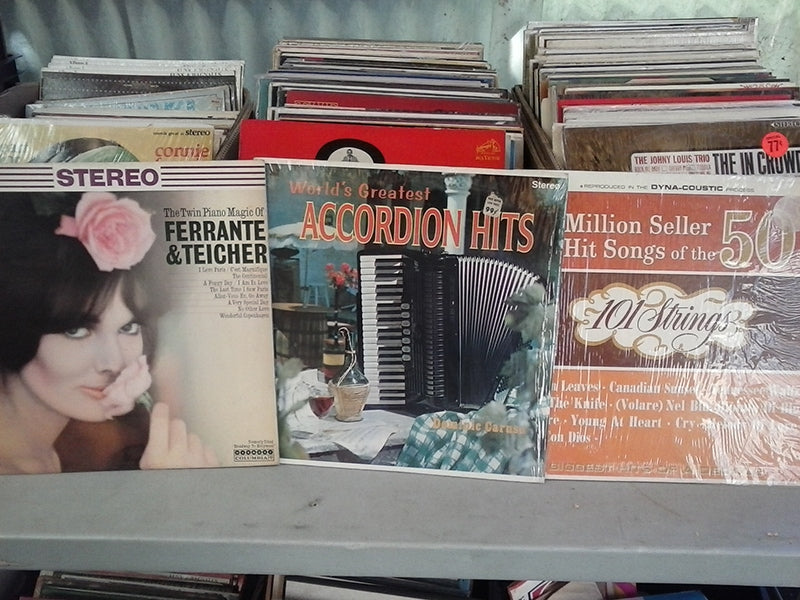
 

The records Steven Bryan Bieler encountered at a garage sale.


What you can see: Arthur Ferrante and Louis Teicher, The Twin Piano Magic of Ferrante & Teicher (1964); Dominic Caruso, World’s Greatest Accordion Hits (1968); 101 Strings, Million Seller Hit Songs of the 50s (1964); and the Johny Louis Trio, The In Crowd (1965), at one point in its existence on sale for 77¢. (Was “Johny” a typo? Inquiring minds want to know.)


What you can’t see: Various artists, Percussion for Playboys (1959); Ann Corio, Sonny Lester & His Orchestra, How to Strip for Your Husband (1963); and at that point I stopped taking notes because I was afraid the earth was about to open beneath my feet.

This may have been the worst record collection in the history of records. Hoping for a scoop, I ventured from the driveway where the records were outgassing in the sun into the garage and the house. There was a room full of gleaming, vintage accordions. If I had also found a room full of banjos and another with bagpipes, I would’ve hit the trifecta. The part of the house that was open to the public was devoted to music, but though I saw many boom boxes and turntables, no one was playing any. I tried to find the owner, but I was told by the cheerful folks running the sale that he had “moved away.” Had he hired a company to do the clearing he couldn’t bring himself to do? Were his children ridding themselves of the objects they were afraid would end up at their houses or land them on Twitter?

The answer, my friend, is blowin’ in the wind. But the ranks of these rank records made me realize that you can’t judge a WWRC by the number of David Cassidy or Christopher Cross albums or by the presence or absence of “The Purple People Eater” or “Who Let the Dogs Out?” What you need for a true WWRC are uninspired interpreters of the original music as well as the themes that people pitch when they’re drunk, such as 101 violinists playing together like an army on maneuvers, or music to convince your wife to take off her clothes, which she was probably going to do anyway.


In short, what you need is a bunch of ill-conceived tribute albums. Welcome back to Lawrence Welk country.

They Don’t Make Life Like They Used To

We can always argue about the true nature of a WWRC, but one thing’s for sure: That era is over. Sure, in this century LPs have been resurrected, but given the increased costs of making them and purchasing them, no one is going to lay down on vinyl the contemporary equivalent of the debris I found at that yard sale. Crud like that will be downloads only. The WWRCs that will be unearthed in the coming decades will all be from the 20th century, when it seemed that anyone could throw a half-baked idea together and press it onto a petroleum by-product.

In “Only a Moment Ago,” David Cassidy asked, “Why has the music stopped? Where did all the happy people go?”


It’s not the music that’s stopped, David, it’s the vinyl avalanche of new bad records.

My sister would add, “Thank you for your service.”


Header image: from the editor’s collection.

More from Issue 165

View All Articles in Issue 165

Search Copper Magazine

#227 Seth Lewis Gets in the Groove With Take a Look Around: a Tribute to the Meters by Frank Doris Feb 02, 2026 #227 Passport to Sound: May Anwar’s Audio Learning Experience for Young People by Frank Doris Feb 02, 2026 #227 Conjectures on Cosmic Consciousness by B. Jan Montana Feb 02, 2026 #227 The Big Takeover Turns 45 by Wayne Robins Feb 02, 2026 #227 Music and Chocolate: On the Sensory Connection by Joe Caplan Feb 02, 2026 #227 Singer/Songwriter Chris Berardo: Getting Wilder All the Time by Ray Chelstowski Feb 02, 2026 #227 The Earliest Stars of Country Music, Part One by Jeff Weiner Feb 02, 2026 #227 The Vinyl Beat Goes Down to Tijuana (By Way of Los Angeles), Part Two by Rudy Radelic Feb 02, 2026 #227 How to Play in a Rock Band, 20: On the Road With Blood, Sweat & Tears’ Guitarist Gabe Cummins by Frank Doris Feb 02, 2026 #227 From The Audiophile’s Guide: Audio Specs and Measuring by Paul McGowan Feb 02, 2026 #227 Our Brain is Always Listening by Peter Trübner Feb 02, 2026 #227 PS Audio in the News by PS Audio Staff Feb 02, 2026 #227 The Listening Chair: Sleek Style and Sound From the Luxman L3 by Howard Kneller Feb 02, 2026 #227 The Los Angeles and Orange County Audio Society Celebrates Its 32nd Anniversary, Honoring David and Sheryl Lee Wilson and Bernie Grundman by Harris Fogel Feb 02, 2026 #227 Back to My Reel-to-Reel Roots, Part 26: Half Full – Not Half Empty, Redux by Ken Kessler Feb 02, 2026 #227 That's What Puzzles Us... by Frank Doris Feb 02, 2026 #227 Record-Breaking by Peter Xeni Feb 02, 2026 #227 The Long and Winding Road by B. Jan Montana Feb 02, 2026 #226 JJ Murphy’s Sleep Paralysis is a Genre-Bending Musical Journey Through Jazz, Fusion and More by Frank Doris Jan 05, 2026 #226 Stewardship by Consent by B. Jan Montana Jan 05, 2026 #226 Food, Music, and Sensory Experience: An Interview With Professor Jonathan Zearfoss of the Culinary Institute of America by Joe Caplan Jan 05, 2026 #226 Studio Confidential: A Who’s Who of Recording Engineers Tell Their Stories by Frank Doris Jan 05, 2026 #226 Pilot Radio is Reborn, 50 Years Later: Talking With CEO Barak Epstein by Frank Doris Jan 05, 2026 #226 The Vinyl Beat Goes Down to Tijuana (By Way of Los Angeles), Part One by Rudy Radelic Jan 05, 2026 #226 Capital Audiofest 2025: Must-See Stereo, Part Two by Frank Doris Jan 05, 2026 #226 My Morning Jacket’s Carl Broemel and Tyler Ramsey Collaborate on Their Acoustic Guitar Album, Celestun by Ray Chelstowski Jan 05, 2026 #226 The People Who Make Audio Happen: CanJam SoCal 2025, Part Two by Harris Fogel Jan 05, 2026 #226 How to Play in a Rock Band, 19: Touring Can Make You Crazy, Part One by Frank Doris Jan 05, 2026 #226 Linda Ronstadt Goes Bigger by Wayne Robins Jan 05, 2026 #226 From The Audiophile’s Guide: Active Room Correction and Digital Signal Processing by Paul McGowan Jan 05, 2026 #226 PS Audio in the News by Frank Doris Jan 05, 2026 #226 Back to My Reel-to-Reel Roots, Part 25: Half-Full, Not Empty by Ken Kessler Jan 05, 2026 #226 Happy New Year! by Frank Doris Jan 05, 2026 #226 Turn It Down! by Peter Xeni Jan 05, 2026 #226 Ghost Riders by James Schrimpf Jan 05, 2026 #226 A Factory Tour of Audio Manufacturer German Physiks by Markus "Marsu" Manthey Jan 04, 2026 #225 Capital Audiofest 2025: Must-See Stereo, Part One by Frank Doris Dec 01, 2025 #225 Otis Taylor and the Electrics Delivers a Powerful Set of Hypnotic Modern Blues by Frank Doris Dec 01, 2025 #225 A Christmas Miracle by B. Jan Montana Dec 01, 2025 #225 T.H.E. Show New York 2025, Part Two: Plenty to See, Hear, and Enjoy by Frank Doris Dec 01, 2025 #225 Underappreciated Artists, Part One: Martin Briley by Rich Isaacs Dec 01, 2025 #225 Rock and Roll is Here to Stay by Wayne Robins Dec 01, 2025 #225 A Lifetime of Holiday Record (and CD) Listening by Rudy Radelic Dec 01, 2025 #225 Little Feat: Not Saying Goodbye, Not Yet by Ray Chelstowski Dec 01, 2025 #225 How to Play in a Rock Band, Part 18: Dealing With Burnout by Frank Doris Dec 01, 2025 #225 The People Who Make Audio Happen: CanJam SoCal 2025 by Harris Fogel Dec 01, 2025 #225 Chicago’s Sonic Sanctuaries: Four Hi‑Fi Listening Bars Channeling the Jazz‑Kissa Spirit by Olivier Meunier-Plante Dec 01, 2025

The Secret History of Tribute Albums, Part Two

The Secret History of Tribute Albums, Part Two

The news occasionally carries a story about the World’s Worst Record Collection. The journalistic ball gets rolling when a blood clot of ancient LPs is offered to a record shop or a second-hand store and the alarmed proprietor runs to Twitter. These collections often include some combination of David Cassidy and the Partridge Family.

If my sister has read this far, she’s gone ballistic. “David’s records are the cornerstone of any serious music library,” she says, in a quote I just wrote for her. My sister was in grade school when The Partridge Family debuted on TV. That’s all the explanation you need.

Mr. Cassidy’s frequent appearances among World’s Worst Record Collection contenders makes me wonder what records were in his collection. He was born in 1950; based on his discography, I’d guess his musically formative years were dominated by crewcut guys in sweaters, beach boys with surfboards, the British Invasion (the Beatles and the Hollies, not the Rolling Stones and the Animals), and the show tunes his stepmother, Shirley Jones, had mastered. I think he admired the blues – from a safe distance. His solo albums hint at his exposure to some pretentious arena rock. All that isn’t so bad. But the result – the music he made – was something I couldn’t tolerate.

It’s easy for me to make fun of Cassidy (when my sister isn’t around), but even if you consider him one of the Four White Male Horsemen of the Apocalypse (along with Sting, Barry Manilow, and Kenny G), there are plenty of people who would tell you to Shut. Up. These men have tens of millions of fans, people who are impervious to the opinions of critics and snobs like me. Pick your poison. There’s always somebody who will drink it and call it chardonnay.

How then can we define the World’s Worst Record Collection (hereinafter referred to as the WWRC)? The answer lies in a garage sale I stumbled across one recent summer in Portland, Oregon. There I found dozens of LPs (a true WWRC is hefty) which I’ve documented in this unretouched photo:


The records Steven Bryan Bieler encountered at a garage sale.


What you can see: Arthur Ferrante and Louis Teicher, The Twin Piano Magic of Ferrante & Teicher (1964); Dominic Caruso, World’s Greatest Accordion Hits (1968); 101 Strings, Million Seller Hit Songs of the 50s (1964); and the Johny Louis Trio, The In Crowd (1965), at one point in its existence on sale for 77¢. (Was “Johny” a typo? Inquiring minds want to know.)


What you can’t see: Various artists, Percussion for Playboys (1959); Ann Corio, Sonny Lester & His Orchestra, How to Strip for Your Husband (1963); and at that point I stopped taking notes because I was afraid the earth was about to open beneath my feet.

This may have been the worst record collection in the history of records. Hoping for a scoop, I ventured from the driveway where the records were outgassing in the sun into the garage and the house. There was a room full of gleaming, vintage accordions. If I had also found a room full of banjos and another with bagpipes, I would’ve hit the trifecta. The part of the house that was open to the public was devoted to music, but though I saw many boom boxes and turntables, no one was playing any. I tried to find the owner, but I was told by the cheerful folks running the sale that he had “moved away.” Had he hired a company to do the clearing he couldn’t bring himself to do? Were his children ridding themselves of the objects they were afraid would end up at their houses or land them on Twitter?

The answer, my friend, is blowin’ in the wind. But the ranks of these rank records made me realize that you can’t judge a WWRC by the number of David Cassidy or Christopher Cross albums or by the presence or absence of “The Purple People Eater” or “Who Let the Dogs Out?” What you need for a true WWRC are uninspired interpreters of the original music as well as the themes that people pitch when they’re drunk, such as 101 violinists playing together like an army on maneuvers, or music to convince your wife to take off her clothes, which she was probably going to do anyway.


In short, what you need is a bunch of ill-conceived tribute albums. Welcome back to Lawrence Welk country.

They Don’t Make Life Like They Used To

We can always argue about the true nature of a WWRC, but one thing’s for sure: That era is over. Sure, in this century LPs have been resurrected, but given the increased costs of making them and purchasing them, no one is going to lay down on vinyl the contemporary equivalent of the debris I found at that yard sale. Crud like that will be downloads only. The WWRCs that will be unearthed in the coming decades will all be from the 20th century, when it seemed that anyone could throw a half-baked idea together and press it onto a petroleum by-product.

In “Only a Moment Ago,” David Cassidy asked, “Why has the music stopped? Where did all the happy people go?”


It’s not the music that’s stopped, David, it’s the vinyl avalanche of new bad records.

My sister would add, “Thank you for your service.”


Header image: from the editor’s collection.

0 comments

Leave a comment

0 Comments

Your avatar

Loading comments...

🗑️ Delete Comment

Enter moderator password to delete this comment:

✏️ Edit Comment

Enter your email to verify ownership: