Copper Magazine · Issue 139 · A free PS Audio publication
Issue 139 FROM THE SWEET SPOT

The Return of T.H.E. Show

The Return of T.H.E. Show

B. Jan Montana. Kids used to go to the carnival to have fun. They didn’t go there to make a living, network, or scope out the competition. For me, audio shows are like a carnival. I’ve always attended for one reason only – to have fun. I love meeting old friends, making new ones, and sharing music, opinions, and scotch. By that standard, The Home Entertainment (T.H.E.) Show for 2021 was a huge success. It started at noon on Friday, June 11 at the Hilton Long Beach Hotel in Los Angeles, and I was surprised to see a line at registration in the middle of a weekday. Doesn’t anybody work anymore?


While perusing the signage that showed where exhibitors were located, there looked to be only 35 demo rooms or so in total, which made me wonder if we should have booked hotel rooms. Perhaps we could have seen the whole show in a day. I drove down with a couple of buddies from the San Diego Music and Audio Guild in a Maserati Quatroporte. The thing goes like hell when there’s space, but in gridlocked traffic, it’s slower than my vintage airhead motorcycle (which can split lanes).

The folks at registration had no problem finding my press pass, but they couldn’t find the extra registration I’d bought for my friend, so after a lot of searching and waiting, we ended up having to pay twice in order to get him in. Bit of a downer right at the start of the event. Unfortunately, I didn’t see Kyle Robertson anywhere (the former event organizer). He’d have sorted this problem out in a few minutes. I missed his constant supervision and monitoring of the event, which seemed to make everything go smoother.

It had been two years since we attended an audio show at this hotel and the place was as attractive, clean, and friendly as I remembered. Like last time, I asked for a room with a view of the Queen Mary, but this time, the field of vision had changed (note the header image at the top of the article). Long Beach is growing up.

I’ve spent the last 20 years explaining to audiophiles that a listening room’s acoustics are as important as their equipment in determining the final sound. It’s a hard sell. They seem to prefer spending money on more equipment (or expensive tweaks) over using EQ devices or disturbing the aesthetics of their listening rooms with room treatment (even after I show them their skewed in-room response on my frequency analyzer).

So I’m particularly sensitive to the problems of exhibitors. They have to demo their equipment in long, narrow rooms that resemble a hallway more than a living room. This was a disaster for some exhibitors, and having heard their products sound great in better environments, I’ve declined to review them here. Furthermore, exhibitors were asked to limit their volume to 84 dB – fine for stand-mount monitors but hardly loud enough to exercise large speakers. This makes the job of a reviewer like me difficult. I’m asked to judge the sound of a system in an environment for which it was not designed. It’s like testing a Maserati in gridlocked traffic. Any old motorcycle will work better.

It was nice to see some younger people starting to enjoy these shows as they move up from EarPods and headphones. This shot was taken from a considerable distance so as not to disturb the conversation.

Cultural diversity was also in evidence. This interview was conducted in Spanish.

Merryl Jaye (left) was back with the latest collection of her remarkable paintings of musicians. Her website address is merryljaye.com.

Rick Schultz from High Fidelity Cables presented a series of fascinating lectures on the theories surrounding electromagnetism, quantum physics, and how they might be related. He got off topic and suggested that the more he learns about quantum physics, the more he’s coming to understand the Bible. I approached him after his lecture to suggest that I was finding the same thing, but not just for the Bible, for Eastern philosophies as well. He responded with a comment on the irony of science is making us more religious – the opposite of the split Descartes formulated.

Part of the lecture was the demonstration of a Tesla coil. The noise and visuals these things produce always gets attention. They even got it to play a tune (with dramatic graphics), but no one volunteered to get near the coil’s terminals to demonstrate the body’s conductivity. For years, a giant Tesla coil was part of The Burning Man Experience (slated to resume in 2022). A victim would stand about ten feet away clothed in a wired suit and conduct the high voltage/low current energy to the ground, appearing to be conducting it through his body. This night display was breathtaking.

Those torpedo-looking things on the ground are High Fidelity's top cables. They cost $100,000 each but we were told they are not for sale – they were merely an experiment taken to extremes (something to do with induction; I didn’t really understand Schultz’ theory). He did make an interesting comment on cables in general. He suggested that they were often used as tone controls. That might explain why cables which sound good on one system don’t on another.

High Fidelity’s loudspeakers are dipoles designed by Rick Schultz. This 3-way system features top-of-the-line drivers from Audio Nirvana and the excellent Aurum Cantus tweeters – a great match. They list for somewhere around $100,000. The big metal boxes are dipole subs. I was afraid to ask for the price on those. The whole system was in a very large room and I enjoyed the sound. Embarrassingly, the guy disturbing the audition was from the San Diego Music and Audio Guild. His phone was confiscated for the balance of T.H.E. Show and he was required to pay for lunch.

An amiable chap named Oz Turan from Virginia was in the Cake Audio room, featuring Alsyvox planar magnetic speakers ($92,000 per pair). They are claimed to be 94 dB efficient and were powered by a 50-watt Class A amp from Vitus Audio. This 3-way system had a sparkling top end, Magnepan-like midrange, and is claimed to produce 22 Hz fundamentals, though I didn’t hear anything approaching that. Oz invited us to return that evening for a private audition, which we were happy to do. Oz is a real music enthusiast and introduced us to some new ethnic music. I was reminded why we chose to book rooms for the evening. I’m sorry I didn’t get a photo of Oz – perhaps because he kept moving around so much. The room included other equipment from retailer Cake Audio, including Purist Audio Design cables, a Computer Audio Design server and DAC, Kuzma turntables and Dynavector cartridges.

This flash-less shot was taken in almost total darkness. With an ISO of 51,200, my Pentax K-S1 sees more than I do. It has a Night Scene HDR setting which takes three consecutive images at three different exposure levels to create a single composite image! Not great clarity, but I’m printing it anyway because I was so impressed with the appearance of Oz’ turntable. It’s a Kuzma XL DC with VTA adjustment. There are some arguments about the efficacy of VTA adjustment among audiophiles, but on the occasion I’ve heard it demonstrated, it made a significant improvement to the mid-bass.

Wayne Carter (of Wayne Carter Audio) set up this room featuring vintage equipment for only one purpose – to have fun. He reminded me of the doctors who sponsored the “Déjà Vu" room so popular at the CES for many years. These classic Waveform Research speakers sounded bright to my ears, as they did 25 years ago when I first heard them. The box on the right is a giant JBL Professional subwoofer.

Here’s a shot of the vintage electronic equipment Wayne was using. The Nikko amplifier evoked many memories from listeners.
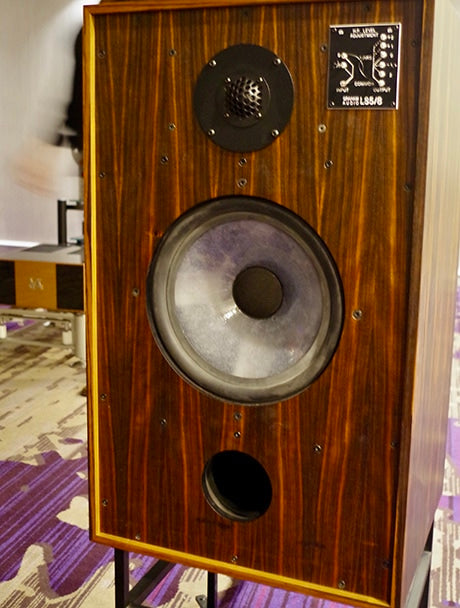
T.H.E. Show offered a preponderance of fine stand-mount monitors. These Spendor-like Graham Audio LS/58 speakers ($16,000 per pair) in the Voss room were dynamic and produced a great soundstage.

The reel to reel tape player behind the Grahams is a Revox PR99. Power is supplied by Vitra. The Gryphon speaker cables list for $4,000 more than the speakers.

These Heavenly Soundworks FIVE17 speakers produced a natural, full, uncolored sound for $10,000 per pair. It’s an active, 3-way system with two 8-inch passive radiators. No system matching or expensive speaker cables required.

The best deal of the show might have been these Tonian Labs Oriaco G6 monitors. Paired with mid-fi electronics, these dynamic, ported speakers exhibited superb resolution, great bass, and a clean, neutral midrange for $3,500 per pair. They made the highly reviewed KEF LS50 monitors next to them sound like a table radio covered with a blanket – admittedly, at over twice the price. It’s hard to imagine any stand-mount speaker fans not being pleased with these.

I’ve liked every Ocean Way Audio speaker I’ve heard over the years. Alan Sides’ owns five recording studios across the country, and started Ocean Way in order to produce loudspeakers in search of the perfect studio monitor. I heard his first product at a CES over a decade ago, a large 3-way horn system, and still feel it’s the best system I’ve ever heard. It’s WAF (wife acceptance factor) was zero, and its price has skyrocketed, but I’ve yet to hear dynamics as life-like. This stand-mount Eureka monitor is built in that tradition. It seems to have the bass of a full-range system, the mids and highs are flawless, and the dynamics are unbelievable for a speaker this size. It was powered by 85-watt AGD Productions Audion monoblocks (on top of each speaker) which feature what they call their GaNTube, a gallium nitride MOSFET power stage that is fully enclosed in a vacuum tube. The amps and speakers were offered for $17,500 per pair, with stands – one of the best audiophile deals at the show in my opinion (retail for the package is $23,350).

The gallium nitride tubes are packed with components, but barely get warm to the touch, even at high volumes.

The marketplace area was busy every time we entered the room.

Gentleman Peter Noerbaek of PBN Audio is just too darn polite. Every time we entered the huge room in which he had his giant MR!777 speakers, he was playing them at 84 dB, the volume requested by the show organizers. “You can sit in the Maserati sir, you can idle the engine, but that’s as far as we can allow you to test drive this vehicle.” What good is that? It’s not that they don’t sound right at low volumes, they do. But they are capable of so much more. At concert hall volumes, these speakers are about as close as one can get to a live orchestra without buying tickets. I know, I’ve heard them in Peter’s studio. However, I’d never felt that way about Peter’s speakers till he upgraded them with Dutch-made Stage Accompany tweeters (shown). They were designed to reinforce the sound of European concert halls, but Peter took the path less travelled and incorporated them into his speaker systems – and that made all the difference. They seemed impossible to overdrive or compress (Peter crosses them over at 1,200 Hz). Finally, a tweeter to match the rest of the system. I was so impressed, I bought the company. Sorry, I meant, I bought a pair of these tweeters for my home system. Peter is the importer for these exceptional units. The speaker system shown retails for $85,000 per pair and sounds far cleaner and more “live” to my ears than another pair of popular, well-known speakers that retail for just over $200,000 per pair.

The guys at Wyred 4 Sound weren’t nearly as constrained as Peter. They were at the end of the hall and took liberties with their volume control. These $32,000K per pair prototype speakers rocked. Nowhere in the show did I hear dynamics as startling as I did in their hotel room. The bass was deep and tight, thanks to a powered, down-facing woofer. These are thrilling speakers for rock fans, but classical listeners need not apply. Ironically, they were using Kimber speaker cables, not their own.

The Margules complete audio system from Mexico City was also remarkably dynamic and exhibited an excellent soundstage. The sound was neutral, natural, and strain-free. The amps and speakers sell for $10,000 per pair, and I could easily live with them as my main system.

The elegant Margules turntable sells for $4,000.

This system from Laughlin, Nevada dealer Audio Limits also featured speakers with a down-firing woofer and powerful bass – along with great imaging and a natural, non-fatiguing sound signature. The large room was exceptionally well set up; these guys know what they are doing. The components were Audiovector R8 speakers with Thrax electronics. The fit and finish of the equipment was several steps above the Margules system, but at over $200K for the amps, pre-amp and speakers, it ought to be. I’m sure this system would have killed the Margules, or most systems at the show had it been allowed to flex its wings, but Audio Limits (like Peter Noerbaek) were too polite to subject their neighbors to any disruption. I’d hoped they would be available for an audition after hours when the rules were relaxed, but that was not to be. Despite the small size of the show, the attendees I talked to from the San Diego Music and Audio Guild agreed that it was well worth attending. Had one arrived when it opened on Saturday morning, they could have covered T.H.E. Show in a single day. However, we really enjoyed the unadvertised after-hours events, which we accessed by simply wandering the halls. I’ve got to bring more single malt next time.

More from Issue 139

View All Articles in Issue 139

Search Copper Magazine

Favorites From T.H.E. Show SoCal 2026 by Cam Martin Oct 05, 2026 #235 Singer/Songwriter John David Schrader: On the Need to Create, Part Two by Joe Caplan Oct 05, 2026 #235 A Life in High-End Audio: The Roy Hall Interview, Part Two by Frank Doris Oct 05, 2026 #235 Grammy-Winning Producer, Songwriter, and Guitarist John Leventhal Goes Instrumental With National Drift by Ray Chelstowski Oct 05, 2026 #235 From Swimming Pool to New Listening Room—to Founding an Accidental Audio Company by Gilles Laferrière Oct 05, 2026 #235 The Vinyl Beat’s Size Matters Edition by Rudy Radelic Oct 05, 2026 #235 The Sublime Complexities of Nature by B. Jan Montana Oct 05, 2026 #235 How to Play In a Rock Band, 28: Growing Older and Dealing With It by Frank Doris Oct 05, 2026 #235 Young Rascals: From Bar Band to Stardom by Wayne Robins Oct 05, 2026 #235 Duncan Sheik: In Memoriam by Ray Chelstowski Oct 05, 2026 #235 From The Listening Chair: The Meze Audio 105 Silva Headphones by Howard Kneller Oct 05, 2026 #235 Checking Out Some NOLA Loudspeakers – and Some Thoughts About Audio Writing by Frank Doris Oct 05, 2026 #235 The Kanazawa Phonograph Museum: Music from a Time Capsule by Sebastian Polcyn Oct 05, 2026 #235 PS Audio in the News by PS Audio Staff Oct 05, 2026 #235 From The Audiophile’s Guide: Making the Most Critical Choice by Paul McGowan Oct 05, 2026 #235 Evolutionary Growth by Frank Doris Oct 05, 2026 #235 Speed Racer by Peter Xeni Oct 05, 2026 #235 Happy Halloween! by James Schrimpf Oct 05, 2026 #234 A Life in High-End Audio: The Roy Hall Interview, Part One by Frank Doris Sep 07, 2026 #234 Jason Greenlaw Offers His Personal Perspective on Jazz Guitar in Vantage Point by Frank Doris Sep 07, 2026 #234 Transcendent Phoenix: Lucina Yue Brings the Ancient Konghou Into Modern Times by Frank Doris Sep 07, 2026 #234 We Must All Follow Our Bliss by B. Jan Montana Sep 07, 2026 #234 How to Play in a Rock Band, 27: Leveling Up by Frank Doris Sep 07, 2026 #234 Ross Valory: Traveling Into New Musical Territory With All of the Above by Ray Chelstowski Sep 07, 2026 #234 Singer/Songwriter John David Schrader: On the Need to Create by Joe Caplan Sep 07, 2026 #234 The People Who Make Audio Happen: More From T.H.E. Show SoCal 2026 by Harris Fogel Sep 07, 2026 #234 The Vinyl Beat Digs Into the Gadget Box by Rudy Radelic Sep 07, 2026 #234 The Rolling Stones: Foreign Tongues Spoken Loud by Wayne Robins Sep 07, 2026 #234 Musical Moments by Rich Isaacs Sep 07, 2026 #234 Rags for Solo Piano and a Dog: David Chesky's Ragtime Music for the Modern Age by Frankly Speaking Sep 07, 2026 #234 HIGH END 2026, Vienna: Here to Stay by Carsten Barnbeck Sep 07, 2026 #234 From The Audiophile’s Guide: The Two Main Types of Loudpeakers – Box and Panel by Paul McGowan Sep 07, 2026 #234 Letting it Slide by Frank Doris Sep 07, 2026 #234 PS Audio in the News by PS Audio Staff Sep 07, 2026 #234 Long Playing by Peter Xeni Sep 07, 2026 #234 La Mer by B. Jan Montana Sep 07, 2026 #233 A Report From The Total Hi-Fi Experience Show SoCal 2026 by B. Jan Montana Aug 03, 2026 #233 Bluegrass Meets Country, Folk, Jazz and More in All That We Carried by The Squid City Slingers by Frank Doris Aug 03, 2026 #233 Corey Glover and One Tribe Nation: A Variegated Musical Collective by Ray Chelstowski Aug 03, 2026 #233 Excursions with Clive: The Late Clive Davis, A Personal History by Wayne Robins Aug 03, 2026 #233 AI, Art, and Music: A Conversation With Synthography Art by Joe Caplan Aug 03, 2026 #233 New American Symphonies: A Rediscovered Gem and a Vital Contemporary Work by Frank Doris Aug 03, 2026 #233 The Vinyl Beat: Genesis, the Dave Clark Five, Antonio Carlos Jobim and More by Rudy Radelic Aug 03, 2026 #233 How to Play in a Rock Band, 26: When It's Time to Record Your Music by Frank Doris Aug 03, 2026 #233 More From T.H.E. Show 2026, and the People Who Made it Happen by Harris Fogel Aug 03, 2026 #233 Underappreciated Artists, Part Three: Icehouse by Rich Isaacs Aug 03, 2026 #233 The Surprisingly Rich and Varied Music of Somalia by Steve Kindig Aug 03, 2026

The Return of T.H.E. Show

The Return of T.H.E. Show

B. Jan Montana. Kids used to go to the carnival to have fun. They didn’t go there to make a living, network, or scope out the competition. For me, audio shows are like a carnival. I’ve always attended for one reason only – to have fun. I love meeting old friends, making new ones, and sharing music, opinions, and scotch. By that standard, The Home Entertainment (T.H.E.) Show for 2021 was a huge success. It started at noon on Friday, June 11 at the Hilton Long Beach Hotel in Los Angeles, and I was surprised to see a line at registration in the middle of a weekday. Doesn’t anybody work anymore?


While perusing the signage that showed where exhibitors were located, there looked to be only 35 demo rooms or so in total, which made me wonder if we should have booked hotel rooms. Perhaps we could have seen the whole show in a day. I drove down with a couple of buddies from the San Diego Music and Audio Guild in a Maserati Quatroporte. The thing goes like hell when there’s space, but in gridlocked traffic, it’s slower than my vintage airhead motorcycle (which can split lanes).

The folks at registration had no problem finding my press pass, but they couldn’t find the extra registration I’d bought for my friend, so after a lot of searching and waiting, we ended up having to pay twice in order to get him in. Bit of a downer right at the start of the event. Unfortunately, I didn’t see Kyle Robertson anywhere (the former event organizer). He’d have sorted this problem out in a few minutes. I missed his constant supervision and monitoring of the event, which seemed to make everything go smoother.

It had been two years since we attended an audio show at this hotel and the place was as attractive, clean, and friendly as I remembered. Like last time, I asked for a room with a view of the Queen Mary, but this time, the field of vision had changed (note the header image at the top of the article). Long Beach is growing up.

I’ve spent the last 20 years explaining to audiophiles that a listening room’s acoustics are as important as their equipment in determining the final sound. It’s a hard sell. They seem to prefer spending money on more equipment (or expensive tweaks) over using EQ devices or disturbing the aesthetics of their listening rooms with room treatment (even after I show them their skewed in-room response on my frequency analyzer).

So I’m particularly sensitive to the problems of exhibitors. They have to demo their equipment in long, narrow rooms that resemble a hallway more than a living room. This was a disaster for some exhibitors, and having heard their products sound great in better environments, I’ve declined to review them here. Furthermore, exhibitors were asked to limit their volume to 84 dB – fine for stand-mount monitors but hardly loud enough to exercise large speakers. This makes the job of a reviewer like me difficult. I’m asked to judge the sound of a system in an environment for which it was not designed. It’s like testing a Maserati in gridlocked traffic. Any old motorcycle will work better.

It was nice to see some younger people starting to enjoy these shows as they move up from EarPods and headphones. This shot was taken from a considerable distance so as not to disturb the conversation.

Cultural diversity was also in evidence. This interview was conducted in Spanish.

Merryl Jaye (left) was back with the latest collection of her remarkable paintings of musicians. Her website address is merryljaye.com.

Rick Schultz from High Fidelity Cables presented a series of fascinating lectures on the theories surrounding electromagnetism, quantum physics, and how they might be related. He got off topic and suggested that the more he learns about quantum physics, the more he’s coming to understand the Bible. I approached him after his lecture to suggest that I was finding the same thing, but not just for the Bible, for Eastern philosophies as well. He responded with a comment on the irony of science is making us more religious – the opposite of the split Descartes formulated.

Part of the lecture was the demonstration of a Tesla coil. The noise and visuals these things produce always gets attention. They even got it to play a tune (with dramatic graphics), but no one volunteered to get near the coil’s terminals to demonstrate the body’s conductivity. For years, a giant Tesla coil was part of The Burning Man Experience (slated to resume in 2022). A victim would stand about ten feet away clothed in a wired suit and conduct the high voltage/low current energy to the ground, appearing to be conducting it through his body. This night display was breathtaking.

Those torpedo-looking things on the ground are High Fidelity's top cables. They cost $100,000 each but we were told they are not for sale – they were merely an experiment taken to extremes (something to do with induction; I didn’t really understand Schultz’ theory). He did make an interesting comment on cables in general. He suggested that they were often used as tone controls. That might explain why cables which sound good on one system don’t on another.

High Fidelity’s loudspeakers are dipoles designed by Rick Schultz. This 3-way system features top-of-the-line drivers from Audio Nirvana and the excellent Aurum Cantus tweeters – a great match. They list for somewhere around $100,000. The big metal boxes are dipole subs. I was afraid to ask for the price on those. The whole system was in a very large room and I enjoyed the sound. Embarrassingly, the guy disturbing the audition was from the San Diego Music and Audio Guild. His phone was confiscated for the balance of T.H.E. Show and he was required to pay for lunch.

An amiable chap named Oz Turan from Virginia was in the Cake Audio room, featuring Alsyvox planar magnetic speakers ($92,000 per pair). They are claimed to be 94 dB efficient and were powered by a 50-watt Class A amp from Vitus Audio. This 3-way system had a sparkling top end, Magnepan-like midrange, and is claimed to produce 22 Hz fundamentals, though I didn’t hear anything approaching that. Oz invited us to return that evening for a private audition, which we were happy to do. Oz is a real music enthusiast and introduced us to some new ethnic music. I was reminded why we chose to book rooms for the evening. I’m sorry I didn’t get a photo of Oz – perhaps because he kept moving around so much. The room included other equipment from retailer Cake Audio, including Purist Audio Design cables, a Computer Audio Design server and DAC, Kuzma turntables and Dynavector cartridges.

This flash-less shot was taken in almost total darkness. With an ISO of 51,200, my Pentax K-S1 sees more than I do. It has a Night Scene HDR setting which takes three consecutive images at three different exposure levels to create a single composite image! Not great clarity, but I’m printing it anyway because I was so impressed with the appearance of Oz’ turntable. It’s a Kuzma XL DC with VTA adjustment. There are some arguments about the efficacy of VTA adjustment among audiophiles, but on the occasion I’ve heard it demonstrated, it made a significant improvement to the mid-bass.

Wayne Carter (of Wayne Carter Audio) set up this room featuring vintage equipment for only one purpose – to have fun. He reminded me of the doctors who sponsored the “Déjà Vu" room so popular at the CES for many years. These classic Waveform Research speakers sounded bright to my ears, as they did 25 years ago when I first heard them. The box on the right is a giant JBL Professional subwoofer.

Here’s a shot of the vintage electronic equipment Wayne was using. The Nikko amplifier evoked many memories from listeners.

T.H.E. Show offered a preponderance of fine stand-mount monitors. These Spendor-like Graham Audio LS/58 speakers ($16,000 per pair) in the Voss room were dynamic and produced a great soundstage.

The reel to reel tape player behind the Grahams is a Revox PR99. Power is supplied by Vitra. The Gryphon speaker cables list for $4,000 more than the speakers.

These Heavenly Soundworks FIVE17 speakers produced a natural, full, uncolored sound for $10,000 per pair. It’s an active, 3-way system with two 8-inch passive radiators. No system matching or expensive speaker cables required.

The best deal of the show might have been these Tonian Labs Oriaco G6 monitors. Paired with mid-fi electronics, these dynamic, ported speakers exhibited superb resolution, great bass, and a clean, neutral midrange for $3,500 per pair. They made the highly reviewed KEF LS50 monitors next to them sound like a table radio covered with a blanket – admittedly, at over twice the price. It’s hard to imagine any stand-mount speaker fans not being pleased with these.

I’ve liked every Ocean Way Audio speaker I’ve heard over the years. Alan Sides’ owns five recording studios across the country, and started Ocean Way in order to produce loudspeakers in search of the perfect studio monitor. I heard his first product at a CES over a decade ago, a large 3-way horn system, and still feel it’s the best system I’ve ever heard. It’s WAF (wife acceptance factor) was zero, and its price has skyrocketed, but I’ve yet to hear dynamics as life-like. This stand-mount Eureka monitor is built in that tradition. It seems to have the bass of a full-range system, the mids and highs are flawless, and the dynamics are unbelievable for a speaker this size. It was powered by 85-watt AGD Productions Audion monoblocks (on top of each speaker) which feature what they call their GaNTube, a gallium nitride MOSFET power stage that is fully enclosed in a vacuum tube. The amps and speakers were offered for $17,500 per pair, with stands – one of the best audiophile deals at the show in my opinion (retail for the package is $23,350).

The gallium nitride tubes are packed with components, but barely get warm to the touch, even at high volumes.

The marketplace area was busy every time we entered the room.

Gentleman Peter Noerbaek of PBN Audio is just too darn polite. Every time we entered the huge room in which he had his giant MR!777 speakers, he was playing them at 84 dB, the volume requested by the show organizers. “You can sit in the Maserati sir, you can idle the engine, but that’s as far as we can allow you to test drive this vehicle.” What good is that? It’s not that they don’t sound right at low volumes, they do. But they are capable of so much more. At concert hall volumes, these speakers are about as close as one can get to a live orchestra without buying tickets. I know, I’ve heard them in Peter’s studio. However, I’d never felt that way about Peter’s speakers till he upgraded them with Dutch-made Stage Accompany tweeters (shown). They were designed to reinforce the sound of European concert halls, but Peter took the path less travelled and incorporated them into his speaker systems – and that made all the difference. They seemed impossible to overdrive or compress (Peter crosses them over at 1,200 Hz). Finally, a tweeter to match the rest of the system. I was so impressed, I bought the company. Sorry, I meant, I bought a pair of these tweeters for my home system. Peter is the importer for these exceptional units. The speaker system shown retails for $85,000 per pair and sounds far cleaner and more “live” to my ears than another pair of popular, well-known speakers that retail for just over $200,000 per pair.

The guys at Wyred 4 Sound weren’t nearly as constrained as Peter. They were at the end of the hall and took liberties with their volume control. These $32,000K per pair prototype speakers rocked. Nowhere in the show did I hear dynamics as startling as I did in their hotel room. The bass was deep and tight, thanks to a powered, down-facing woofer. These are thrilling speakers for rock fans, but classical listeners need not apply. Ironically, they were using Kimber speaker cables, not their own.

The Margules complete audio system from Mexico City was also remarkably dynamic and exhibited an excellent soundstage. The sound was neutral, natural, and strain-free. The amps and speakers sell for $10,000 per pair, and I could easily live with them as my main system.

The elegant Margules turntable sells for $4,000.

This system from Laughlin, Nevada dealer Audio Limits also featured speakers with a down-firing woofer and powerful bass – along with great imaging and a natural, non-fatiguing sound signature. The large room was exceptionally well set up; these guys know what they are doing. The components were Audiovector R8 speakers with Thrax electronics. The fit and finish of the equipment was several steps above the Margules system, but at over $200K for the amps, pre-amp and speakers, it ought to be. I’m sure this system would have killed the Margules, or most systems at the show had it been allowed to flex its wings, but Audio Limits (like Peter Noerbaek) were too polite to subject their neighbors to any disruption. I’d hoped they would be available for an audition after hours when the rules were relaxed, but that was not to be. Despite the small size of the show, the attendees I talked to from the San Diego Music and Audio Guild agreed that it was well worth attending. Had one arrived when it opened on Saturday morning, they could have covered T.H.E. Show in a single day. However, we really enjoyed the unadvertised after-hours events, which we accessed by simply wandering the halls. I’ve got to bring more single malt next time.

0 comments

Leave a comment

0 Comments

Your avatar

Loading comments...

🗑️ Delete Comment

Enter moderator password to delete this comment:

✏️ Edit Comment

Enter your email to verify ownership: