COPPER

A PS Audio Publication

Issue 168 • Free Online Magazine

Issue 168 Featured

The Musical Instrument Museum: A National Treasure

The Musical Instrument Museum: A National Treasure

Jeff Weiner has been a volunteer museum guide/docent at Phoenix, Arizona’s Musical Instrument Museum for the last five years. Some of the content of this article has been adapted from material on the museum’s website.

Introduction

Realizing that most musical museums feature historic, primarily Western classical instruments, the founder of Phoenix, Arizona’s Musical Instrument Museum (MIM), Robert J. Ulrich (then CEO of Target Corporation), began with a vision to create a museum that would be global in scope. He wanted to develop a new kind of museum that would showcase the kind of instruments played by people worldwide. From its beginnings in 2010, the goal was to deliver an educational and inspiring musical experience.

The Musical Instrument Museum has a collection of over 8,000 instruments from more than 200 countries. The galleries reflect the diversity and history of many world cultures. As the museum’s website notes: “music and instruments also show us what we have in common…music is the language of the soul.” A visit to MIM is also about experiencing the sensory nature of music and how it affects our emotions. Through interactive media, guests can see the instruments, hear their sounds, and see them being played in their original contexts.

MIM’s collection was assembled by five curators, with consultation from distinguished ethnomusicologists, organologists, and other field experts. The bulk of the collection is highlighted in a series of Geographic Galleries that divide the world into five major global regions. There are also exhibition spaces such as the Target Gallery, which hosts traveling and special exhibitions, and the Artist Gallery, which includes noteworthy musical instruments and artifacts associated with some of the world’s leading musicians.

Why is the museum located in Phoenix? It’s one of the largest metropolitan areas in the United States, with a culturally diverse population. Drawn by the Grand Canyon and other natural wonders of the Southwest as well as by the city itself, many national and international visitors travel to and through Phoenix. 

The Architecture

The Musical Instrument Museum is a 200,000 square foot building across two levels. It was designed by architect Rich Varda, in conjunction with the firm of RSP Architects. MIM’s distinctive architecture pays homage to the desert landscape, the rhythms of musical composition, and the design of musical instruments. Indian sandstone is the primary element on the building’s façade. To quote Varda, “the design team is most proud of the fact that the spaces of the building are comfortable, friendly, and supportive of the desired immersive experience in the galleries. Moving through the building is intuitive and relaxing.”
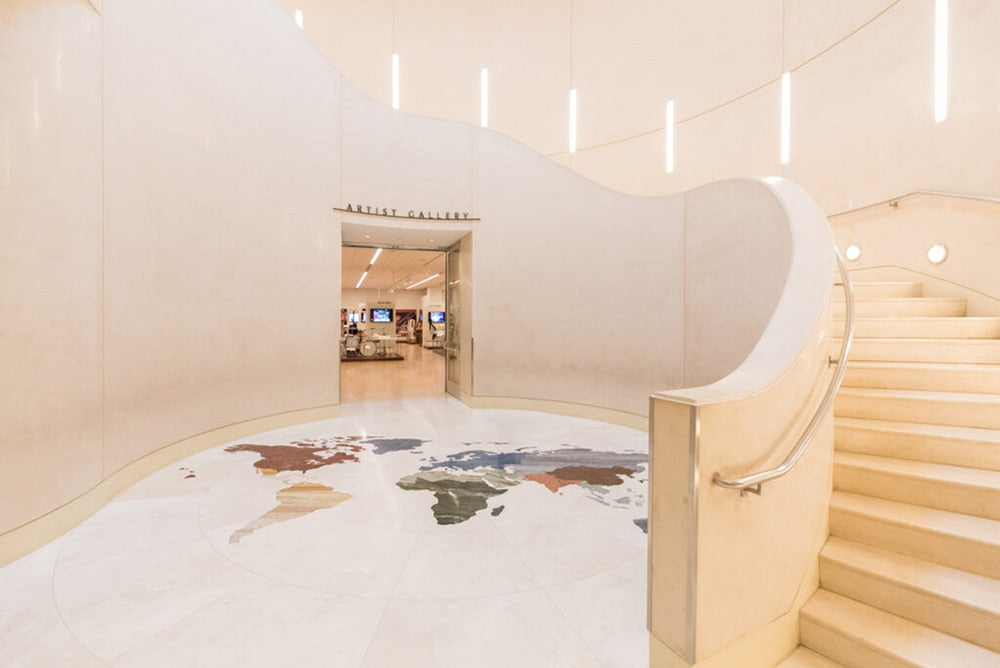
 

Interior architecture of the Musical Instrument Museum.

Interior architecture of the Musical Instrument Museum.


These are some of the highlights of MIM’s architecture:

  • The sandstone walls evoke the topography of the Southwest, while raised key shapes in the exterior stonework evoke musical notes.
  • A “piano key” pattern plays across MIM’s walls in clusters of windows.
  • Patterns that evoke music can be found throughout the building on staircase railings, lighting, and floor tiles.
  • The “meandering river” of the central corridor, El Río, is another reference to the region’s landscape.
  • The rotunda’s inlaid world map is formed with stones from the world regions they represent.
  • The rotunda’s elegant curve is reminiscent of the shape of a grand piano.

The Galleries

MIM presently displays more than 5,300 instruments representing all the world’s countries, and many territories. The Geographic Galleries focus on major world regions: Africa/Middle East, Asia and Oceania, Latin America, Europe, and the United States/Canada. Many of the instruments displayed are rare examples, the finest of their kind, historically significant, or part of distinctive musical cultures. Video monitors with footage of musical performances show instruments played in their original contexts.

The United States/Canada Gallery has a specific focus on musical genres such as jazz, rock and roll, Appalachian, and Hawaiian music. A large area at the gallery entrance showcases Native American and First Nations instruments.
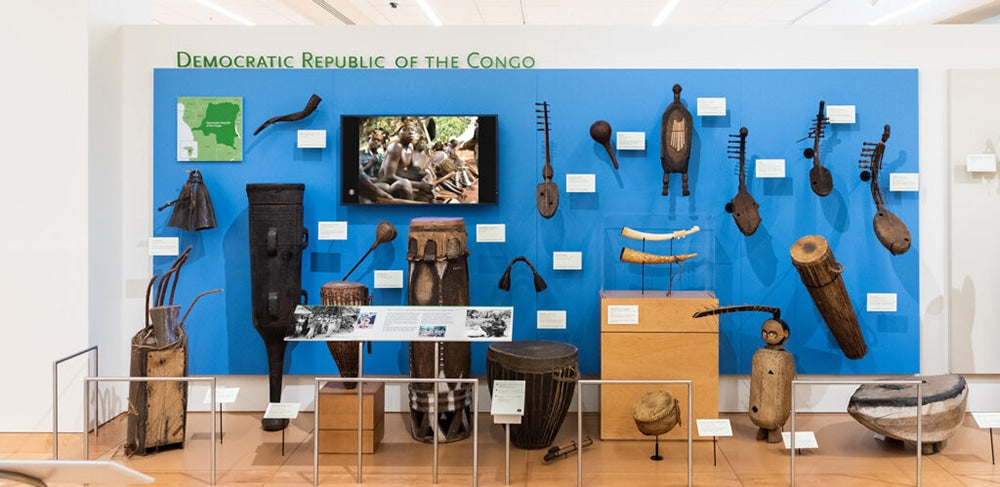
 

An exhibition of musical instruments from the Democratic Republic of the Congo.
An exhibition of musical instruments from the Democratic Republic of the Congo.


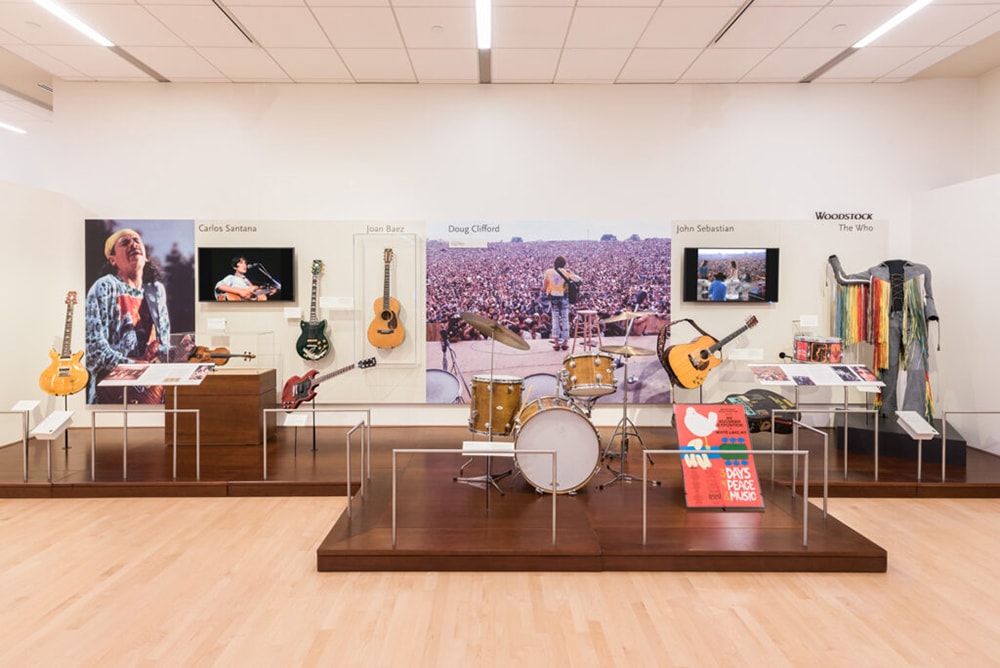
Woodstock at 50 exhibition.

Woodstock at 50 exhibition.


The Musical Instrument Museum’s Artist Gallery highlights a broad cross-section of world musicians with ever-changing exhibits that span sounds, styles, and eras. Through generous partnerships, MIM features historic instruments owned, played, and loved by noted musicians. Nearly 40 displays showcase instruments and artifacts from artists such as Elvis Presley, Tito Puente, the Carter Family and Johnny Cash, Roberta Flack, Glen Campbell, Joan Baez, Maroon 5, and others.

MIM’s Mechanical Music Gallery features a selection of mechanical musical instruments, such as barrel organs, mechanical zithers, cylinder music boxes, disc players, and automatons. The period between the late 19th and early 20th centuries is considered to be the golden age of automatic musical instruments. During this time, there was a surge in the creation of self-playing instruments. In the Mechanical Music Gallery, guests can see a range of instruments from this era that use technologies such as punched cards and discs, paper rolls, pinned cylinders, and electromagnets.

The Collier STEM Gallery explores the important connections between music and science, technology, engineering, and mathematics. Guests learn about the science behind musical instruments, and how humans experience sound. The gallery’s themes include sound creation, technological innovation, the human ear, and hearing safety. Multiple displays within the gallery introduce key concepts in the physics of sound creation through video, interactive technology, and instruments from all over the globe.

In the interactive Experience Gallery, guests can play instruments from around the world similar to the ones on display throughout the museum. This gallery is a place to explore self-made musical sounds, and to let loose and have a little fun. Attendees can play a Javanese gamelan, a West African djembe, a Peruvian harp, a theremin, and more.

Exhibitions in the Target Gallery complement the museum’s permanent collection with traveling shows, special engagements, and changing exhibitions. The current exhibition is Treasures: Legendary Musical Instruments, and spans 6,000 years of musical instrument history. There are one-of-a-kind and rare instruments that combine beauty, craftsmanship, and cultural significance. Past special exhibitions have included Congo Masks and Music, The Electric Guitar, and Ancient Musical Treasures from Central China.

The Theater

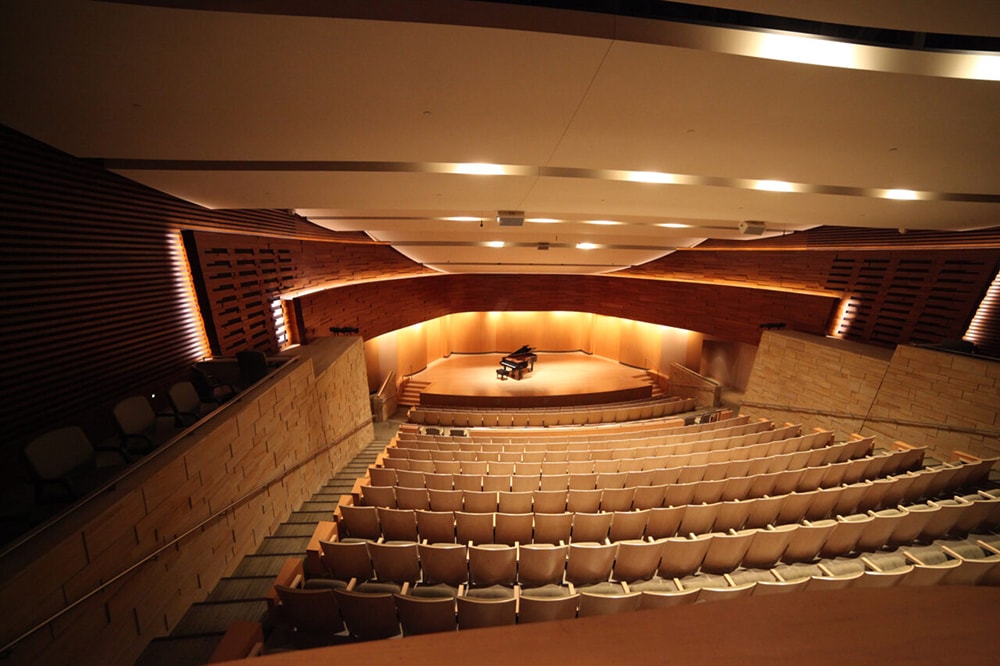
The Musical Instrument Museum’s theater has 300 seats and hosts a diverse range of concerts and global artists in an intimate environment. MIM hosts more than 200 shows per year across all genres in an acoustically superb theater. These are some of the more memorable concerts I have attended:

  • John Mayall
  • Charles Lloyd
  • The Milk Carton Kids
  • Patricia Barber
  • Dave Alvin and Jimmie Dale Gilmore


The theater at the MIM.

The theater at the MIM.


Education

MIM provides a multi-faceted educational program. In a typical year, over 70,000 students, teachers, and chaperones visit the museum. There are five different types of school tours tailored for age groups from pre-kindergarten through 12th grade, and teacher-guided school tours are also available. One of the true joys of volunteering at MIM is sharing the wonderment that many of the students experience. There are also “MIMkids” programs, one for children up to five years old and another for ages 6 to 10.

MIM also offers tours for adults, groups looking for a little more from their MIM visit. There are two flavors of adult tours: one takes visitors through the museum galleries, and the VIP Tour goes behind the scenes to give guests insights into how exhibits are created, what goes on backstage at the theater, what kind of storage is needed for MIM’s diverse collection, and other aspects of the museum’s operation.

MIM has also developed a variety of virtual education programs for school and youths, kids and family, and seniors. MIM has collaborated with the Arizona State University Music Therapy program to create the seniors program.

MIM provides additional amenities including the museum store with items from around the world, the Beats Coffee Bar, Café Allegro (features a rotating lunch menu of global cuisine), and various indoor and outdoor event spaces. They even host weddings.

The Musical Instrument Museum is rated on Tripadvisor as the number one attraction in the Phoenix area and one of the top museums in the United States. Having had the opportunity to volunteer and give tours these last five years, the museum has become a second home for me. I find myself regularly reminding myself how fortunate I am that I get to hang out at MIM. Music really is the language of the soul.

Note: this article was reviewed by museum personnel prior to submission to Copper. All images courtesy of the Musical Instrument Museum.

More from Issue 168

View All Articles in Issue 168

Search Copper Magazine

#227 Seth Lewis Gets in the Groove With Take a Look Around: a Tribute to the Meters by Frank Doris Feb 02, 2026 #227 Passport to Sound: May Anwar’s Audio Learning Experience for Young People by Frank Doris Feb 02, 2026 #227 Conjectures on Cosmic Consciousness by B. Jan Montana Feb 02, 2026 #227 The Big Takeover Turns 45 by Wayne Robins Feb 02, 2026 #227 Music and Chocolate: On the Sensory Connection by Joe Caplan Feb 02, 2026 #227 Singer/Songwriter Chris Berardo: Getting Wilder All the Time by Ray Chelstowski Feb 02, 2026 #227 The Earliest Stars of Country Music, Part One by Jeff Weiner Feb 02, 2026 #227 The Vinyl Beat Goes Down to Tijuana (By Way of Los Angeles), Part Two by Rudy Radelic Feb 02, 2026 #227 How to Play in a Rock Band, 20: On the Road With Blood, Sweat & Tears’ Guitarist Gabe Cummins by Frank Doris Feb 02, 2026 #227 From The Audiophile’s Guide: Audio Specs and Measuring by Paul McGowan Feb 02, 2026 #227 Our Brain is Always Listening by Peter Trübner Feb 02, 2026 #227 PS Audio in the News by PS Audio Staff Feb 02, 2026 #227 The Listening Chair: Sleek Style and Sound From the Luxman L3 by Howard Kneller Feb 02, 2026 #227 The Los Angeles and Orange County Audio Society Celebrates Its 32nd Anniversary, Honoring David and Sheryl Lee Wilson and Bernie Grundman by Harris Fogel Feb 02, 2026 #227 Back to My Reel-to-Reel Roots, Part 26: Half Full – Not Half Empty, Redux by Ken Kessler Feb 02, 2026 #227 That's What Puzzles Us... by Frank Doris Feb 02, 2026 #227 Record-Breaking by Peter Xeni Feb 02, 2026 #227 The Long and Winding Road by B. Jan Montana Feb 02, 2026 #226 JJ Murphy’s Sleep Paralysis is a Genre-Bending Musical Journey Through Jazz, Fusion and More by Frank Doris Jan 05, 2026 #226 Stewardship by Consent by B. Jan Montana Jan 05, 2026 #226 Food, Music, and Sensory Experience: An Interview With Professor Jonathan Zearfoss of the Culinary Institute of America by Joe Caplan Jan 05, 2026 #226 Studio Confidential: A Who’s Who of Recording Engineers Tell Their Stories by Frank Doris Jan 05, 2026 #226 Pilot Radio is Reborn, 50 Years Later: Talking With CEO Barak Epstein by Frank Doris Jan 05, 2026 #226 The Vinyl Beat Goes Down to Tijuana (By Way of Los Angeles), Part One by Rudy Radelic Jan 05, 2026 #226 Capital Audiofest 2025: Must-See Stereo, Part Two by Frank Doris Jan 05, 2026 #226 My Morning Jacket’s Carl Broemel and Tyler Ramsey Collaborate on Their Acoustic Guitar Album, Celestun by Ray Chelstowski Jan 05, 2026 #226 The People Who Make Audio Happen: CanJam SoCal 2025, Part Two by Harris Fogel Jan 05, 2026 #226 How to Play in a Rock Band, 19: Touring Can Make You Crazy, Part One by Frank Doris Jan 05, 2026 #226 Linda Ronstadt Goes Bigger by Wayne Robins Jan 05, 2026 #226 From The Audiophile’s Guide: Active Room Correction and Digital Signal Processing by Paul McGowan Jan 05, 2026 #226 PS Audio in the News by Frank Doris Jan 05, 2026 #226 Back to My Reel-to-Reel Roots, Part 25: Half-Full, Not Empty by Ken Kessler Jan 05, 2026 #226 Happy New Year! by Frank Doris Jan 05, 2026 #226 Turn It Down! by Peter Xeni Jan 05, 2026 #226 Ghost Riders by James Schrimpf Jan 05, 2026 #226 A Factory Tour of Audio Manufacturer German Physiks by Markus "Marsu" Manthey Jan 04, 2026 #225 Capital Audiofest 2025: Must-See Stereo, Part One by Frank Doris Dec 01, 2025 #225 Otis Taylor and the Electrics Delivers a Powerful Set of Hypnotic Modern Blues by Frank Doris Dec 01, 2025 #225 A Christmas Miracle by B. Jan Montana Dec 01, 2025 #225 T.H.E. Show New York 2025, Part Two: Plenty to See, Hear, and Enjoy by Frank Doris Dec 01, 2025 #225 Underappreciated Artists, Part One: Martin Briley by Rich Isaacs Dec 01, 2025 #225 Rock and Roll is Here to Stay by Wayne Robins Dec 01, 2025 #225 A Lifetime of Holiday Record (and CD) Listening by Rudy Radelic Dec 01, 2025 #225 Little Feat: Not Saying Goodbye, Not Yet by Ray Chelstowski Dec 01, 2025 #225 How to Play in a Rock Band, Part 18: Dealing With Burnout by Frank Doris Dec 01, 2025 #225 The People Who Make Audio Happen: CanJam SoCal 2025 by Harris Fogel Dec 01, 2025 #225 Chicago’s Sonic Sanctuaries: Four Hi‑Fi Listening Bars Channeling the Jazz‑Kissa Spirit by Olivier Meunier-Plante Dec 01, 2025

The Musical Instrument Museum: A National Treasure

The Musical Instrument Museum: A National Treasure

Jeff Weiner has been a volunteer museum guide/docent at Phoenix, Arizona’s Musical Instrument Museum for the last five years. Some of the content of this article has been adapted from material on the museum’s website.

Introduction

Realizing that most musical museums feature historic, primarily Western classical instruments, the founder of Phoenix, Arizona’s Musical Instrument Museum (MIM), Robert J. Ulrich (then CEO of Target Corporation), began with a vision to create a museum that would be global in scope. He wanted to develop a new kind of museum that would showcase the kind of instruments played by people worldwide. From its beginnings in 2010, the goal was to deliver an educational and inspiring musical experience.

The Musical Instrument Museum has a collection of over 8,000 instruments from more than 200 countries. The galleries reflect the diversity and history of many world cultures. As the museum’s website notes: “music and instruments also show us what we have in common…music is the language of the soul.” A visit to MIM is also about experiencing the sensory nature of music and how it affects our emotions. Through interactive media, guests can see the instruments, hear their sounds, and see them being played in their original contexts.

MIM’s collection was assembled by five curators, with consultation from distinguished ethnomusicologists, organologists, and other field experts. The bulk of the collection is highlighted in a series of Geographic Galleries that divide the world into five major global regions. There are also exhibition spaces such as the Target Gallery, which hosts traveling and special exhibitions, and the Artist Gallery, which includes noteworthy musical instruments and artifacts associated with some of the world’s leading musicians.

Why is the museum located in Phoenix? It’s one of the largest metropolitan areas in the United States, with a culturally diverse population. Drawn by the Grand Canyon and other natural wonders of the Southwest as well as by the city itself, many national and international visitors travel to and through Phoenix. 

The Architecture

The Musical Instrument Museum is a 200,000 square foot building across two levels. It was designed by architect Rich Varda, in conjunction with the firm of RSP Architects. MIM’s distinctive architecture pays homage to the desert landscape, the rhythms of musical composition, and the design of musical instruments. Indian sandstone is the primary element on the building’s façade. To quote Varda, “the design team is most proud of the fact that the spaces of the building are comfortable, friendly, and supportive of the desired immersive experience in the galleries. Moving through the building is intuitive and relaxing.”


Interior architecture of the Musical Instrument Museum.

Interior architecture of the Musical Instrument Museum.


These are some of the highlights of MIM’s architecture:

  • The sandstone walls evoke the topography of the Southwest, while raised key shapes in the exterior stonework evoke musical notes.
  • A “piano key” pattern plays across MIM’s walls in clusters of windows.
  • Patterns that evoke music can be found throughout the building on staircase railings, lighting, and floor tiles.
  • The “meandering river” of the central corridor, El Río, is another reference to the region’s landscape.
  • The rotunda’s inlaid world map is formed with stones from the world regions they represent.
  • The rotunda’s elegant curve is reminiscent of the shape of a grand piano.

The Galleries

MIM presently displays more than 5,300 instruments representing all the world’s countries, and many territories. The Geographic Galleries focus on major world regions: Africa/Middle East, Asia and Oceania, Latin America, Europe, and the United States/Canada. Many of the instruments displayed are rare examples, the finest of their kind, historically significant, or part of distinctive musical cultures. Video monitors with footage of musical performances show instruments played in their original contexts.

The United States/Canada Gallery has a specific focus on musical genres such as jazz, rock and roll, Appalachian, and Hawaiian music. A large area at the gallery entrance showcases Native American and First Nations instruments.


An exhibition of musical instruments from the Democratic Republic of the Congo.

An exhibition of musical instruments from the Democratic Republic of the Congo.


Woodstock at 50 exhibition.

Woodstock at 50 exhibition.


The Musical Instrument Museum’s Artist Gallery highlights a broad cross-section of world musicians with ever-changing exhibits that span sounds, styles, and eras. Through generous partnerships, MIM features historic instruments owned, played, and loved by noted musicians. Nearly 40 displays showcase instruments and artifacts from artists such as Elvis Presley, Tito Puente, the Carter Family and Johnny Cash, Roberta Flack, Glen Campbell, Joan Baez, Maroon 5, and others.

MIM’s Mechanical Music Gallery features a selection of mechanical musical instruments, such as barrel organs, mechanical zithers, cylinder music boxes, disc players, and automatons. The period between the late 19th and early 20th centuries is considered to be the golden age of automatic musical instruments. During this time, there was a surge in the creation of self-playing instruments. In the Mechanical Music Gallery, guests can see a range of instruments from this era that use technologies such as punched cards and discs, paper rolls, pinned cylinders, and electromagnets.

The Collier STEM Gallery explores the important connections between music and science, technology, engineering, and mathematics. Guests learn about the science behind musical instruments, and how humans experience sound. The gallery’s themes include sound creation, technological innovation, the human ear, and hearing safety. Multiple displays within the gallery introduce key concepts in the physics of sound creation through video, interactive technology, and instruments from all over the globe.

In the interactive Experience Gallery, guests can play instruments from around the world similar to the ones on display throughout the museum. This gallery is a place to explore self-made musical sounds, and to let loose and have a little fun. Attendees can play a Javanese gamelan, a West African djembe, a Peruvian harp, a theremin, and more.

Exhibitions in the Target Gallery complement the museum’s permanent collection with traveling shows, special engagements, and changing exhibitions. The current exhibition is Treasures: Legendary Musical Instruments, and spans 6,000 years of musical instrument history. There are one-of-a-kind and rare instruments that combine beauty, craftsmanship, and cultural significance. Past special exhibitions have included Congo Masks and Music, The Electric Guitar, and Ancient Musical Treasures from Central China.

The Theater

The Musical Instrument Museum’s theater has 300 seats and hosts a diverse range of concerts and global artists in an intimate environment. MIM hosts more than 200 shows per year across all genres in an acoustically superb theater. These are some of the more memorable concerts I have attended:

  • John Mayall
  • Charles Lloyd
  • The Milk Carton Kids
  • Patricia Barber
  • Dave Alvin and Jimmie Dale Gilmore


The theater at the MIM.

The theater at the MIM.


Education

MIM provides a multi-faceted educational program. In a typical year, over 70,000 students, teachers, and chaperones visit the museum. There are five different types of school tours tailored for age groups from pre-kindergarten through 12th grade, and teacher-guided school tours are also available. One of the true joys of volunteering at MIM is sharing the wonderment that many of the students experience. There are also “MIMkids” programs, one for children up to five years old and another for ages 6 to 10.

MIM also offers tours for adults, groups looking for a little more from their MIM visit. There are two flavors of adult tours: one takes visitors through the museum galleries, and the VIP Tour goes behind the scenes to give guests insights into how exhibits are created, what goes on backstage at the theater, what kind of storage is needed for MIM’s diverse collection, and other aspects of the museum’s operation.

MIM has also developed a variety of virtual education programs for school and youths, kids and family, and seniors. MIM has collaborated with the Arizona State University Music Therapy program to create the seniors program.

MIM provides additional amenities including the museum store with items from around the world, the Beats Coffee Bar, Café Allegro (features a rotating lunch menu of global cuisine), and various indoor and outdoor event spaces. They even host weddings.

The Musical Instrument Museum is rated on Tripadvisor as the number one attraction in the Phoenix area and one of the top museums in the United States. Having had the opportunity to volunteer and give tours these last five years, the museum has become a second home for me. I find myself regularly reminding myself how fortunate I am that I get to hang out at MIM. Music really is the language of the soul.

Note: this article was reviewed by museum personnel prior to submission to Copper. All images courtesy of the Musical Instrument Museum.

0 comments

Leave a comment

0 Comments

Your avatar

Loading comments...

🗑️ Delete Comment

Enter moderator password to delete this comment:

✏️ Edit Comment

Enter your email to verify ownership: