COPPER

A PS Audio Publication

Issue 125 • Free Online Magazine

Issue 125 FRANKLY SPEAKING

Steve Guttenberg: the Audiophiliac, Part One

Steve Guttenberg: the Audiophiliac, Part One

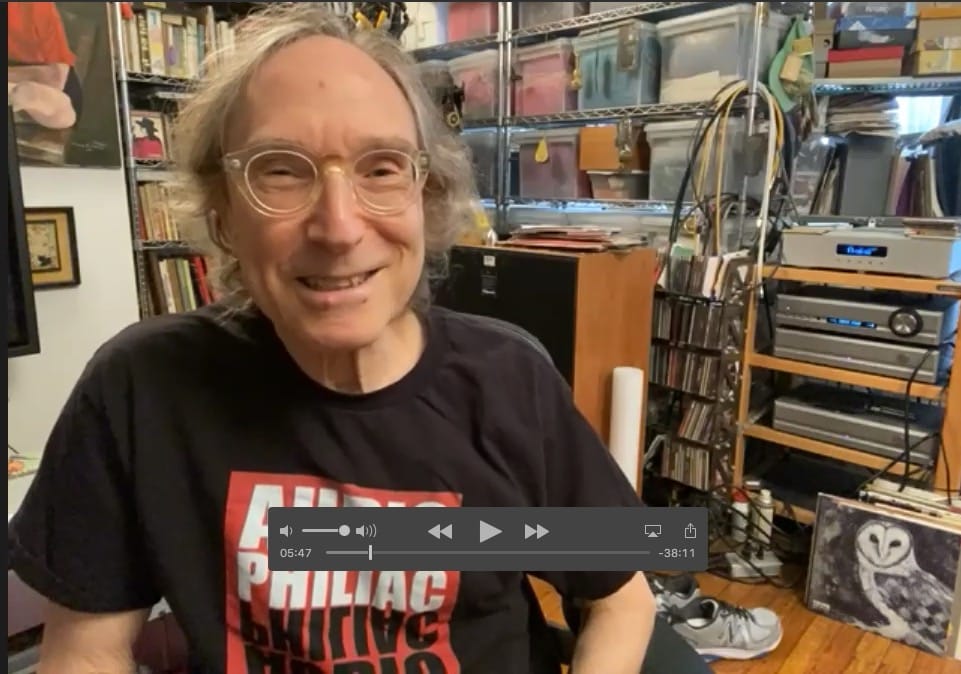
Steve Guttenberg is the host of The Audiophiliac Daily Show, a popular YouTube channel with more than 157,000 subscribers. Steve has written for numerous audio and mainstream publications and websites including CNET, The Absolute Sound, Home Theater, E-Town and many more, was a projectionist in Times Square and worked as a salesperson at Sound by Singer. Following is Part One of our talk.


Steve Guttenberg.

Frank Doris: What is your first memory of hearing music?

Steve Guttenberg: It was a cowboy record or something. I was maybe four years old and it was a yellow 78, a children’s record. I played it over and over and over and over. One day I took a nap as young children do. I woke up and thought, “let me hear the record again!” And my mother said, “oh, it’s broken!” She broke my 78 because it was driving her crazy. So held up the pieces and said, “oh, Steve, we can’t play this anymore.” And it was a childhood trauma that I’ve never recovered from. And that’s what started me in looking for that sound, that lost sound.

FD: I bet you treat your records with great care now! (laughter)

SG: But when I was older, like 10 or something, my parents had a big jukebox and I would just lay on the floor in front of the jukebox and feel the bass rolling over me. This was, huge for me, a really visceral physical experience of listening to music.

I also had one of those little six-transistor radios, and I’d hold it up to my ear and listen to it. But I would also tune between the AM stations and listen to the static, and I could modulate the static by mis-tuning in different directions and stuff. So I was always very aware of sound and it’s been a huge part of my life. And I have very poor vision. So my sound obsession was sort of making up for my lack of visual acuity. I’m aurally interactive!

FD: Was there a specific experience with audio that like kind of made the light bulb go off and made you realize how good a high-end audio system could sound?

SG: An epiphany came when I met (recording engineer) Bob Katz at a New York Audio Show. I had just met Bob and he started to tell me about his system. This is about 1976 and he had Dahlquist DQ-10 speakers, an Ampzilla amp, a Linn turntable and so on. He invited me to his apartment and I sat down and listened and it was life-changing. Everything started with that moment. I can nail it to that. Bob and I became friends and that led to me working on sessions at Chesky Records for a long time.

I was also a movie theater projectionist in Times Square. So I had theater-sized sound systems at my disposal for decades! Really, really big speakers that I got to play with before the audience was there.

FD: The bad old days of Times Square…

SG: Hey! I worked in Times Square in the bad old days. That’s a video for another time! I’m actually slowly, extremely slowly, writing my biography of my 25 years as a projectionist. It was a big part of my life, but it ended 21 years ago.

But having big sound systems that I could play before the audience was in the theater was something I did. I would make a recording on reel-to-reel, then later on cassette, maybe even sometimes on an 8-track. I had this music that I knew well, and then would play it over a 600-seat movie theater sound system. And when you do that, when you play music you know really well over a big system in a theater-size room, you know what happens? It sounds more real. That’s because the space, the theater-sized space is more appropriately sized for the music, and you can just crank it. It doesn’t sound literally like a band, but it sounds more like a band than it does in your living room.
FD: I sometimes play music through a PA system (like the kind a rock band would use) to get the same effect. Let me hear what Nirvana sounds like at ungodly volume. You’d never call it high-fidelity, but man!

SG: In terms of feeling, you know?

FD: Yeah.

SG: One of my closest friends, Gene, is a musician. In the late seventies he had Klipsch Heresy [home audio speakers] as his PA speakers when he played in small clubs and those Heresies were also his home speakers. And one day we listened to Exile On Main St. at freaking loud volume in his West Village apartment. And it was another one of those moments of, wow, that sounds so good. Not “audiophile” good but just thrilling good.

FD: A whole generation listening on their iPhones and earbuds is literally missing that. They’re the lost generation! Hopefully we can bring them back.

SG: I try to bring younger listeners into audio every day.

FD: How do we get younger people into audio?

SG: Turntables, ironically, are one of the main ways to bring them into it, turntables and headphones.

FD: How did you get started as a writer? It doesn’t seem like you had an epiphany when you were two years old, reading a book or something. How did you go from being a projectionist to writing?

SG: I was also working at Sound by Singer [in Manhattan] selling high-end audio from about 1978 to around 1994.

FD: No pressure there! Working for Andy Singer selling to Manhattan audiophiles.

SG: But it was the golden age for you at The Absolute Sound. And for me, at Sound By Singer and some of that period overlapping with my working as a record producer at Chesky Records. But how I came to write was, I loved reading The Absolute Sound. I loved Stereophile. I loved all the other audio magazines. The Audio Critic was huge in its influence, like today what we call what I do. I’m an influencer. [Editor] Peter Aczel, this was around 1980 or so, was a massive influencer. Harry Pearson was probably the most influential of them all.

FD: Peter Aczel and Harry Pearson would really go at each other in print, really nasty stuff, and then they’d see each other at a party and it would be, “hey, Peter, how are you doing?” I thought they hated each other from reading their magazines but it was just the opposite.


The later Peter Aczel, editor and publisher of The Audio Critic.

SG: Anyway, I wrote a piece called, “Are We Not Audiophiles?” for Positive Feedback. That was the first thing I ever wrote. It was based on audiophiles denying the fact that they were audiophiles. I was at a party and a lot of audiophiles were there. I walked up to each one and I just asked them, “are you an audiophile?” And maybe four out of five of them would say, “no, no, I’m not! I like music…” And this one guy at the party, David, he had a big Rockport [Technologies] turntable, you know, even then it was a $30,000 or $40,000 turntable. And I said, “David, you know you don’t need to own a $40,000 turntable to play records. But apparently what your records sound like is really important. So I guess, maybe, maybe, you’re an audiophile. And he said, “no, no, no, no. I just like music!”

So it got to be a thing for me, which continues to this day, about audiophiles hating that word “audiophile.” And many of them, most of them, deny that they’re audiophiles. Maybe they just don’t like being called that; they think it’s too nerdy, they think it’s too introverted. It’s too something or other. And they’re just not comfortable using that word to describe themselves.

Anyway, I was working for David and Norman Chesky [at Chesky Records] and they had a new record coming out, a classical re-issue. And David said to me, “why don’t you go out to Sea Cliff and see Harry and bring the record to them and just hang out?” And I agreed. In fact, you were my contact. I went out, and you met me at the train station and picked me up. This had to have been around 1987?

It was the only day I ever spent with Harry where things went well. No, there was one other day.

At one point Harry he said to me, “would you like to write for the magazine?” And I said, “yeah. Wow, thanks. That’s incredible!” But then Harry being Harry, he asked the best follow-up question: “what do you want to write about?” And I said, “I want to write about new LPs that are coming out,” because vinyl was going downhill at that point. And he said OK, and it was the start of the “Vinyl Rules” column.

The thing that was great about the “Vinyl Rules” column was that it wasn’t actually writing. It was basically making a list and going around to record stores in Manhattan to see what was happening. I wrote down interesting titles and the name of the band and stuff. And that was kind of it.

And then you called me one day and said, “do you want to interview Gavin Bryars?” He had a hip avant-garde record called The Sinking Of The Titanic. So we had this phone call and we really hit it off. I was kind of intimidated by him, but it was a fun interview. So I recorded the interview and now I had about an hour and a half or two hours of me talking to Gavin Bryars. And I started to do a word for word transcription of that interview. Then I realized that it didn’t actually work as a word-for-word transcription. So I had to make it read better. As I was doing that, I was basically learning how to write.

It really all started with going to see Harry and delivering these records and hitting it off with him.

FD: After that you wrote for many other people and really got established. We’re fast-forwarding decades now, but you got to the point where you are now, doing YouTube videos. I was actually a little surprised when I’d heard you had given up working for CNET in favor of doing nothing but YouTube. You’re almost a pioneer of that.

SG: I had my CNET blog, The Audiophiliac, for 12 years. When I started it, there were, I don’t know, 30 other blogs at the same time because blogs were a thing. And one by one, those blogs dropped away because the people writing the blogs just ran out of things to say, and there I am chugging away year after year, year after year.

At one point one of the big shots at CNET said “we’re going to kill all the blogs.” And I said, “oh, well, that’s sad; I like doing the blog.” And then he said, “oh, Steve, not you! We call your blog a ‘personality blog’ because it’s not about the product or the thing you’re writing about that day. It’s more about Steve talking about or expressing interest or being excited about those things. So when people read it, it might not because you’ll have something interesting to say that day; it’s just, they want to hear from you. You’re their daily friend or something like that.” And that’s kind of what my YouTube channel is. I wanted to do exactly what I was doing for CNET but on video.

And I would make pilot episodes for CNET that never went anywhere. Then I said, screw it. I’ll just start my YouTube channel, make a bunch of videos really fast and then show them to CNET and then they would understand what I wanted to do. Maybe two months into doing that, I realized I didn’t want to do that for CNET; I wanted to do it for myself so I would have control over what I was doing.

FD: And now you have more than 150,000 subscribers. (starts laughing): I’m laughing now because my pug is now snoring very loudly.

SG: I put him to sleep! Well, I have that effect on people. People tell me my voice is very relaxing and I guess dogs find that relaxing too.

FD: Do you like to wrangle with tweaking and trying to get the ultimate amount of performance out of a piece of gear?

SG: No! No, I don’t. I’m not a tweaker per se.

FD: System tweaking is a tough one. I’ve heard tweaks work. I’ve heard them do absolutely nothing. I’ve heard them degrade the sound. A lot of time it really defies conventional “audiophile wisdom.” Art Dudley [the late editor for Stereophile] was a proponent of taking all the tweaks out of your system with the goal of having it sound better.

SG: Personally, I think reviewers using tweaks and stuff is kind of misleading. Let’s say you’re reviewing a preamplifier. But then you use it with a power conditioner on it and you put special feet underneath it, and then you do all these other things. And then you say you’re reviewing the Product X Preamp. Well, how do I know whether what you’re describing is the sound of the preamp or it’s the sound of the preamp or the power conditioner or the feet? Or if you’re describing the sound of some other thing that you’ve done?

So maybe it just makes sense for a reviewer to use a few or no tweaks, so that you’re actually doing your best to hear the thing itself. Otherwise it’s kind of muddying the waters. It’s hard enough to describe the sound of something with words!


Part Two of our interview will appear in Issue 126.

More from Issue 125

View All Articles in Issue 125

Search Copper Magazine

#226 JJ Murphy’s Sleep Paralysis is a Genre-Bending Musical Journey Through Jazz, Fusion and More by Frank Doris Jan 05, 2026 #226 Stewardship by Consent by B. Jan Montana Jan 05, 2026 #226 Food, Music, and Sensory Experience: An Interview With Professor Jonathan Zearfoss of the Culinary Institute of America by Joe Caplan Jan 05, 2026 #226 Studio Confidential: A Who’s Who of Recording Engineers Tell Their Stories by Frank Doris Jan 05, 2026 #226 Pilot Radio is Reborn, 50 Years Later: Talking With CEO Barak Epstein by Frank Doris Jan 05, 2026 #226 The Vinyl Beat Goes Down to Tijuana (By Way of Los Angeles), Part One by Rudy Radelic Jan 05, 2026 #226 Capital Audiofest 2025: Must-See Stereo, Part Two by Frank Doris Jan 05, 2026 #226 My Morning Jacket’s Carl Broemel and Tyler Ramsey Collaborate on Their Acoustic Guitar Album, Celestun by Ray Chelstowski Jan 05, 2026 #226 The People Who Make Audio Happen: CanJam SoCal 2025, Part Two by Harris Fogel Jan 05, 2026 #226 How to Play in a Rock Band, 19: Touring Can Make You Crazy, Part One by Frank Doris Jan 05, 2026 #226 Linda Ronstadt Goes Bigger by Wayne Robins Jan 05, 2026 #226 From The Audiophile’s Guide: Active Room Correction and Digital Signal Processing by Paul McGowan Jan 05, 2026 #226 PS Audio in the News by Frank Doris Jan 05, 2026 #226 Back to My Reel-to-Reel Roots, Part 25: Half-Full, Not Empty by Ken Kessler Jan 05, 2026 #226 Happy New Year! by Frank Doris Jan 05, 2026 #226 Turn It Down! by Peter Xeni Jan 05, 2026 #226 Ghost Riders by James Schrimpf Jan 05, 2026 #226 A Factory Tour of Audio Manufacturer German Physiks by Markus "Marsu" Manthey Jan 04, 2026 #225 Capital Audiofest 2025: Must-See Stereo, Part One by Frank Doris Dec 01, 2025 #225 Otis Taylor and the Electrics Delivers a Powerful Set of Hypnotic Modern Blues by Frank Doris Dec 01, 2025 #225 A Christmas Miracle by B. Jan Montana Dec 01, 2025 #225 T.H.E. Show New York 2025, Part Two: Plenty to See, Hear, and Enjoy by Frank Doris Dec 01, 2025 #225 Underappreciated Artists, Part One: Martin Briley by Rich Isaacs Dec 01, 2025 #225 Rock and Roll is Here to Stay by Wayne Robins Dec 01, 2025 #225 A Lifetime of Holiday Record (and CD) Listening by Rudy Radelic Dec 01, 2025 #225 Little Feat: Not Saying Goodbye, Not Yet by Ray Chelstowski Dec 01, 2025 #225 How to Play in a Rock Band, Part 18: Dealing With Burnout by Frank Doris Dec 01, 2025 #225 The People Who Make Audio Happen: CanJam SoCal 2025 by Harris Fogel Dec 01, 2025 #225 Chicago’s Sonic Sanctuaries: Four Hi‑Fi Listening Bars Channeling the Jazz‑Kissa Spirit by Olivier Meunier-Plante Dec 01, 2025 #225 From The Audiophile’s Guide: Controlling Bass Frequencies Through Membrane Absorbers (and How to Build Your Own) by Paul McGowan Dec 01, 2025 #225 Your Editor’s Tips for Attending Audio Shows by Frank Doris Dec 01, 2025 #225 PS Audio in the News by Frank Doris Dec 01, 2025 #225 Back to My Reel-to-Reel Roots, Part 24 by Ken Kessler Dec 01, 2025 #225 Holiday Music by Frank Doris Dec 01, 2025 #225 Puppy Prognostication by Peter Xeni Dec 01, 2025 #225 How to Post Comments on Copper by Frank Doris Dec 01, 2025 #225 Living Color by Rudy Radelic Dec 01, 2025 #224 T.H.E. Show New York 2025, Part One: A New Beginning by Frank Doris Nov 03, 2025 #224 Fool’s Leap of Faith is the Extraordinary Octave Records Debut from Singer/Songwriter Tyler Burba and Visit by Frank Doris Nov 03, 2025 #224 The Beatles’ “Aeolian Cadences.” What? by Wayne Robins Nov 03, 2025 #224 Persona Non Grata by B. Jan Montana Nov 03, 2025 #224 Talking With Recording Engineer Barry Diament of Soundkeeper Recordings, Part Two by Frank Doris Nov 03, 2025 #224 B Sides, B Movies, and Beware of Zombies by Rudy Radelic Nov 03, 2025 #224 The Burn-In Chronicles: 1,000 Hours to Sonic Salvation by Olivier Meunier-Plante Nov 03, 2025 #224 A Conversation With Mat Weisfeld of VPI Industries by Joe Caplan Nov 03, 2025 #224 Blues-Rocker Kenny Wayne Shepherd Celebrates 30 Years of Ledbetter Heights by Ray Chelstowski Nov 03, 2025 #224 Playing in a Rock Band, 17: When Good Gigs Go Bad, Part Two by Frank Doris Nov 03, 2025

Steve Guttenberg: the Audiophiliac, Part One

Steve Guttenberg: the Audiophiliac, Part One

Steve Guttenberg is the host of The Audiophiliac Daily Show, a popular YouTube channel with more than 157,000 subscribers. Steve has written for numerous audio and mainstream publications and websites including CNET, The Absolute Sound, Home Theater, E-Town and many more, was a projectionist in Times Square and worked as a salesperson at Sound by Singer. Following is Part One of our talk.


Steve Guttenberg.

Frank Doris: What is your first memory of hearing music?

Steve Guttenberg: It was a cowboy record or something. I was maybe four years old and it was a yellow 78, a children’s record. I played it over and over and over and over. One day I took a nap as young children do. I woke up and thought, “let me hear the record again!” And my mother said, “oh, it’s broken!” She broke my 78 because it was driving her crazy. So held up the pieces and said, “oh, Steve, we can’t play this anymore.” And it was a childhood trauma that I’ve never recovered from. And that’s what started me in looking for that sound, that lost sound.

FD: I bet you treat your records with great care now! (laughter)

SG: But when I was older, like 10 or something, my parents had a big jukebox and I would just lay on the floor in front of the jukebox and feel the bass rolling over me. This was, huge for me, a really visceral physical experience of listening to music.

I also had one of those little six-transistor radios, and I’d hold it up to my ear and listen to it. But I would also tune between the AM stations and listen to the static, and I could modulate the static by mis-tuning in different directions and stuff. So I was always very aware of sound and it’s been a huge part of my life. And I have very poor vision. So my sound obsession was sort of making up for my lack of visual acuity. I’m aurally interactive!

FD: Was there a specific experience with audio that like kind of made the light bulb go off and made you realize how good a high-end audio system could sound?

SG: An epiphany came when I met (recording engineer) Bob Katz at a New York Audio Show. I had just met Bob and he started to tell me about his system. This is about 1976 and he had Dahlquist DQ-10 speakers, an Ampzilla amp, a Linn turntable and so on. He invited me to his apartment and I sat down and listened and it was life-changing. Everything started with that moment. I can nail it to that. Bob and I became friends and that led to me working on sessions at Chesky Records for a long time.

I was also a movie theater projectionist in Times Square. So I had theater-sized sound systems at my disposal for decades! Really, really big speakers that I got to play with before the audience was there.

FD: The bad old days of Times Square…

SG: Hey! I worked in Times Square in the bad old days. That’s a video for another time! I’m actually slowly, extremely slowly, writing my biography of my 25 years as a projectionist. It was a big part of my life, but it ended 21 years ago.

But having big sound systems that I could play before the audience was in the theater was something I did. I would make a recording on reel-to-reel, then later on cassette, maybe even sometimes on an 8-track. I had this music that I knew well, and then would play it over a 600-seat movie theater sound system. And when you do that, when you play music you know really well over a big system in a theater-size room, you know what happens? It sounds more real. That’s because the space, the theater-sized space is more appropriately sized for the music, and you can just crank it. It doesn’t sound literally like a band, but it sounds more like a band than it does in your living room.

FD: I sometimes play music through a PA system (like the kind a rock band would use) to get the same effect. Let me hear what Nirvana sounds like at ungodly volume. You’d never call it high-fidelity, but man!

SG: In terms of feeling, you know?

FD: Yeah.

SG: One of my closest friends, Gene, is a musician. In the late seventies he had Klipsch Heresy [home audio speakers] as his PA speakers when he played in small clubs and those Heresies were also his home speakers. And one day we listened to Exile On Main St. at freaking loud volume in his West Village apartment. And it was another one of those moments of, wow, that sounds so good. Not “audiophile” good but just thrilling good.

FD: A whole generation listening on their iPhones and earbuds is literally missing that. They’re the lost generation! Hopefully we can bring them back.

SG: I try to bring younger listeners into audio every day.

FD: How do we get younger people into audio?

SG: Turntables, ironically, are one of the main ways to bring them into it, turntables and headphones.

FD: How did you get started as a writer? It doesn’t seem like you had an epiphany when you were two years old, reading a book or something. How did you go from being a projectionist to writing?

SG: I was also working at Sound by Singer [in Manhattan] selling high-end audio from about 1978 to around 1994.

FD: No pressure there! Working for Andy Singer selling to Manhattan audiophiles.

SG: But it was the golden age for you at The Absolute Sound. And for me, at Sound By Singer and some of that period overlapping with my working as a record producer at Chesky Records. But how I came to write was, I loved reading The Absolute Sound. I loved Stereophile. I loved all the other audio magazines. The Audio Critic was huge in its influence, like today what we call what I do. I’m an influencer. [Editor] Peter Aczel, this was around 1980 or so, was a massive influencer. Harry Pearson was probably the most influential of them all.

FD: Peter Aczel and Harry Pearson would really go at each other in print, really nasty stuff, and then they’d see each other at a party and it would be, “hey, Peter, how are you doing?” I thought they hated each other from reading their magazines but it was just the opposite.


The later Peter Aczel, editor and publisher of The Audio Critic.

SG: Anyway, I wrote a piece called, “Are We Not Audiophiles?” for Positive Feedback. That was the first thing I ever wrote. It was based on audiophiles denying the fact that they were audiophiles. I was at a party and a lot of audiophiles were there. I walked up to each one and I just asked them, “are you an audiophile?” And maybe four out of five of them would say, “no, no, I’m not! I like music…” And this one guy at the party, David, he had a big Rockport [Technologies] turntable, you know, even then it was a $30,000 or $40,000 turntable. And I said, “David, you know you don’t need to own a $40,000 turntable to play records. But apparently what your records sound like is really important. So I guess, maybe, maybe, you’re an audiophile. And he said, “no, no, no, no. I just like music!”

So it got to be a thing for me, which continues to this day, about audiophiles hating that word “audiophile.” And many of them, most of them, deny that they’re audiophiles. Maybe they just don’t like being called that; they think it’s too nerdy, they think it’s too introverted. It’s too something or other. And they’re just not comfortable using that word to describe themselves.

Anyway, I was working for David and Norman Chesky [at Chesky Records] and they had a new record coming out, a classical re-issue. And David said to me, “why don’t you go out to Sea Cliff and see Harry and bring the record to them and just hang out?” And I agreed. In fact, you were my contact. I went out, and you met me at the train station and picked me up. This had to have been around 1987?

It was the only day I ever spent with Harry where things went well. No, there was one other day.

At one point Harry he said to me, “would you like to write for the magazine?” And I said, “yeah. Wow, thanks. That’s incredible!” But then Harry being Harry, he asked the best follow-up question: “what do you want to write about?” And I said, “I want to write about new LPs that are coming out,” because vinyl was going downhill at that point. And he said OK, and it was the start of the “Vinyl Rules” column.

The thing that was great about the “Vinyl Rules” column was that it wasn’t actually writing. It was basically making a list and going around to record stores in Manhattan to see what was happening. I wrote down interesting titles and the name of the band and stuff. And that was kind of it.

And then you called me one day and said, “do you want to interview Gavin Bryars?” He had a hip avant-garde record called The Sinking Of The Titanic. So we had this phone call and we really hit it off. I was kind of intimidated by him, but it was a fun interview. So I recorded the interview and now I had about an hour and a half or two hours of me talking to Gavin Bryars. And I started to do a word for word transcription of that interview. Then I realized that it didn’t actually work as a word-for-word transcription. So I had to make it read better. As I was doing that, I was basically learning how to write.

It really all started with going to see Harry and delivering these records and hitting it off with him.

FD: After that you wrote for many other people and really got established. We’re fast-forwarding decades now, but you got to the point where you are now, doing YouTube videos. I was actually a little surprised when I’d heard you had given up working for CNET in favor of doing nothing but YouTube. You’re almost a pioneer of that.

SG: I had my CNET blog, The Audiophiliac, for 12 years. When I started it, there were, I don’t know, 30 other blogs at the same time because blogs were a thing. And one by one, those blogs dropped away because the people writing the blogs just ran out of things to say, and there I am chugging away year after year, year after year.

At one point one of the big shots at CNET said “we’re going to kill all the blogs.” And I said, “oh, well, that’s sad; I like doing the blog.” And then he said, “oh, Steve, not you! We call your blog a ‘personality blog’ because it’s not about the product or the thing you’re writing about that day. It’s more about Steve talking about or expressing interest or being excited about those things. So when people read it, it might not because you’ll have something interesting to say that day; it’s just, they want to hear from you. You’re their daily friend or something like that.” And that’s kind of what my YouTube channel is. I wanted to do exactly what I was doing for CNET but on video.

And I would make pilot episodes for CNET that never went anywhere. Then I said, screw it. I’ll just start my YouTube channel, make a bunch of videos really fast and then show them to CNET and then they would understand what I wanted to do. Maybe two months into doing that, I realized I didn’t want to do that for CNET; I wanted to do it for myself so I would have control over what I was doing.

FD: And now you have more than 150,000 subscribers. (starts laughing): I’m laughing now because my pug is now snoring very loudly.

SG: I put him to sleep! Well, I have that effect on people. People tell me my voice is very relaxing and I guess dogs find that relaxing too.

FD: Do you like to wrangle with tweaking and trying to get the ultimate amount of performance out of a piece of gear?

SG: No! No, I don’t. I’m not a tweaker per se.

FD: System tweaking is a tough one. I’ve heard tweaks work. I’ve heard them do absolutely nothing. I’ve heard them degrade the sound. A lot of time it really defies conventional “audiophile wisdom.” Art Dudley [the late editor for Stereophile] was a proponent of taking all the tweaks out of your system with the goal of having it sound better.

SG: Personally, I think reviewers using tweaks and stuff is kind of misleading. Let’s say you’re reviewing a preamplifier. But then you use it with a power conditioner on it and you put special feet underneath it, and then you do all these other things. And then you say you’re reviewing the Product X Preamp. Well, how do I know whether what you’re describing is the sound of the preamp or it’s the sound of the preamp or the power conditioner or the feet? Or if you’re describing the sound of some other thing that you’ve done?

So maybe it just makes sense for a reviewer to use a few or no tweaks, so that you’re actually doing your best to hear the thing itself. Otherwise it’s kind of muddying the waters. It’s hard enough to describe the sound of something with words!


Part Two of our interview will appear in Issue 126.

0 comments

Leave a comment

0 Comments

Your avatar

Loading comments...

🗑️ Delete Comment

Enter moderator password to delete this comment: