COPPER

A PS Audio Publication

Issue 144 • Free Online Magazine

Issue 144 Octave Pitch

Ragtime World by Augustus: New Rock from Octave Records

Ragtime World by Augustus: New Rock from Octave Records

Octave Records’ latest release, Ragtime World by Augustus, offers the band’s distinctive blend of melodic indie, alt-rock, post-rock and other not-quite-categorizable music. Since 2014, Augustus has toured the US and recorded five previous studio albums. Their core two-guitars-bass-drums-vocals sound is spiced with a variety of electric and acoustic guitars and amps (vintage guitar heads will have a lot of fun identifying the various gear, all plain to hear on this high-resolution recording) and additional sounds including lap steel guitar, mandolin and even a Mellotron.

Featuring Colin Kelly (guitars, keyboards, vocals) and Jim Herlihy (guitars, mandolin, Mellotron) with John Demitro (bass, lap steel, percussion) and Forrest Raup (drums and percussion), Ragtime World offers an ear-catching and thoughtful variety of songs, reflecting what the band was feeling during the onslaught of the pandemic, when, like every other band, their touring schedule came to a complete stop.


Jim Herlihy and Colin Kelly of Augustus. Jim Herlihy and Colin Kelly of Augustus.


Ragtime World was recorded at Animal Lane in Lyons, Colorado in pure DSD using the Sonoma recording system. It’s available as a limited-edition release of 1,000 hybrid SACD discs with the master DSD layer and a CD layer. In addition, the album is available as a download bundle including DSD64, DSDDirect Mastered 192kHz/24-bit, 96kHz/24-bit and 44.1kHz/16-bit PCM. Ragtime World was produced by Nate Cook and recorded and mixed by Jay Elliott, with Giselle Collazo co-recording and co-mixing and Jessica Carson as executive producer.

The music spans a variety of moods, from the rockers “Carry All the Weight,” “Past Life” and “Leave the Lights On” to the ethereal “Daisies,” and the spare, fingerpicked acoustic guitar of the title track. The instruments and equipment included a 1975 Gibson Les Paul Deluxe, 1997 Fender Stratocaster electric and Guild and Martin acoustic guitars, a Hammond organ, Yamaha DX-7 and Roland JD-XI synthesizers and a Yamaha grand piano, Fender Princeton, Vox AC-15 and Silvertone amps, and more.

I spoke with Colin and Jim about the making of Ragtime World.

Frank Doris: How did you guys get together? How did you decide to do the album? Did you have any kind of concept or did it just kind of come together spontaneously?

Jim Herlihy: One day we were both at a show, a friend’s show at a real kind of divey bar in town. And [after a few] drinks we decided that how great would it be to like start our own band together. There was another friend who had a similar vision, and we got together and started hammering out what was the very first incarnation of Augustus, which has morphed considerably from [around 2013] then to now. Fast forward to 2019, and we’re wrapping up three years of consistent touring. Then the pandemic hit. Late last year we got approached by Octave about doing a record. Ragtime World came together much differently than previous records.

Colin Kelly: The normal thing we do is bring songs to the table and then we tour on them. This record was different in that we basically wrote everything right before we went into the studio, rehearsed a couple of times and then just captured it on the record, as opposed to just touring [the songs] for months and months and really living within those tunes. We had to make decisions on the fly and they’re now just permanently out there!

FD: Was it different recording in an “audiophile” studio where you were extremely conscious of getting the sound a certain way, as opposed to typical multitracking and mixing?


Forrest Raup, John Demitro, Colin Kelly and Jim Herlihy.

CK: Definitely. It was eye-opening. Even just mixing in analog. It was a slower process and we’d always worked really quickly, making a record over a weekend or in 10 days. Also, [with] having to work within a certain number of tracks, there was only so much we could do [as opposed to having unlimited tracks to work with]. That was really cool, to be kind of held back from taking things too far and maybe compromising the tune.

FD: Did you work out the arrangements right on the spot?

JH: Over years of touring in a four-piece, two guitars, bass, drums lineup and the way Colin writes songs, we had worked out a consistent sort of guitar blend through the years. We typically have specific ideas of, if this guitar does this, the other guitar should do something else. If one guitar is texturally this way, this other guitar should maybe be texturally another way. There’s latitude within that for interpretation, but [we have an] underlying framework that carried over into this session.

FD: I hate to use the words “post-rock” or “postmodern rock,” but I get the sense that your music is borne out of everything that’s come before it. It really sounds like your own thing.


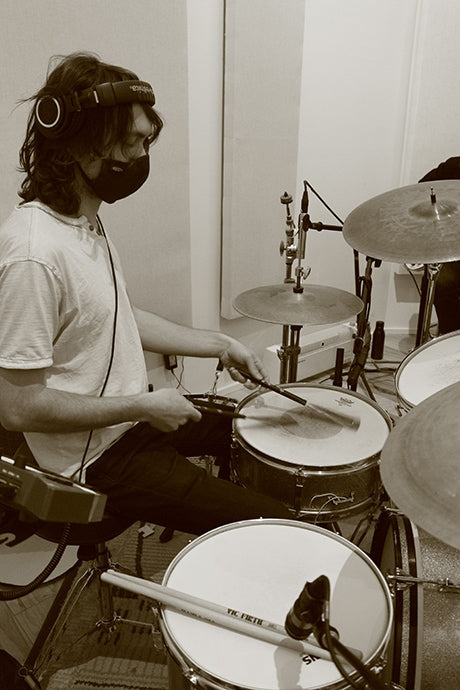
Forrest Raup.
Forrest Raup.

JH: Thank you. We appreciate being uncategorizable! We try for that.

FD: How do you come up with lyrics?

CK: There are definitely some pandemic kinds of feelings on this record. [For example,] “Daisies” is about wanting to protect your partner and dealing with those anxieties. Another song is about feeling like you’re feeling guilty over a past life.

I don’t know how other people dealt with all the free time [we had during] the pandemic, but I got very contemplative and realized that certain things that seemed under our control weren’t, and [the other way around].

FD: Who are your influences and what bands do you like?

JH: I’ve thought about this a lot. And I think my all-time favorite band is the Beatles. Maybe that’s a common answer, but you just can’t take away [the impact of] their entire catalog. I like modern stuff too. Let me call on our big Radiohead fans.


John Dimitro. John Dimitro.

FD: What are your plans for touring once that starts up again?

CK: We’re going to slowly try and get back to playing again. We have some big gigs coming up and in Denver we’re playing an underground music showcase this month. We’re going to kinda see how things are going, and maybe we’ll have to through the next year. We kind of got burned out on touring before the pandemic hit.

JH: We were basically doing the DIY thing, doing everything, making all the arrangements, and it’s hard to stay creative and stay present, stay positive when so much of one’s energy is put into sending e-mails and booking and [things like that] and not playing your instrument. But we’d love to get back into playing when the world is ready to have us.

CK: This is definitely a time for rebalancing.

FD: There’s the title of your next album!

Click here to order Ragtime World by Augustus.

More from Issue 144

View All Articles in Issue 144

Search Copper Magazine

#233 A Report From The Total Hi-Fi Experience Show SoCal 2026 by B. Jan Montana Aug 03, 2026 #233 Bluegrass Meets Country, Folk, Jazz and More in All That We Carried by The Squid City Slingers by Frank Doris Aug 03, 2026 #233 Corey Glover and One Tribe Nation: A Variegated Musical Collective by Ray Chelstowski Aug 03, 2026 #233 Excursions with Clive: The Late Clive Davis, A Personal History by Wayne Robins Aug 03, 2026 #233 AI, Art, and Music: A Conversation With Synthography Art by Joe Caplan Aug 03, 2026 #233 New American Symphonies: A Rediscovered Gem and a Vital Contemporary Work by Frank Doris Aug 03, 2026 #233 The Vinyl Beat: Genesis, the Dave Clark Five, Antonio Carlos Jobim and More by Rudy Radelic Aug 03, 2026 #233 How to Play in a Rock Band, 26: When It's Time to Record Your Music by Frank Doris Aug 03, 2026 #233 More From T.H.E. Show 2026, and the People Who Made it Happen by Harris Fogel Aug 03, 2026 #233 Underappreciated Artists, Part Three: Icehouse by Rich Isaacs Aug 03, 2026 #233 The Surprisingly Rich and Varied Music of Somalia by Steve Kindig Aug 03, 2026 #233 A Remarkable Discographic Legacy: The LP Recordings of the Basel Symphony Orchestra by Stephan Haberthür Aug 03, 2026 #233 From The Audiophile’s Guide: The Importance of Loudspeakers by Paul McGowan Aug 03, 2026 #233 From Swimming Pool to New Listening Room: A Conversation with Norman Varney of AV RoomService by Gilles Laferrière Aug 03, 2026 #233 PS Audio in the News by PS Audio Staff Aug 03, 2026 #233 Audio Jewelry by Peter Xeni Aug 03, 2026 #233 Enrich Your Life by Frank Doris Aug 03, 2026 #233 The Searcher by James Schrimpf Aug 03, 2026 #232 What came first: Art or Music? A Conversation With Artist Jose Acosta by Joe Caplan Jul 06, 2026 #232 Blow By Blow: The Jeff Beck Story: An Insightful Book About a Guitar Icon by Ray Chelstowski Jul 06, 2026 #232 Creed Over Camaraderie? by B. Jan Montana Jul 06, 2026 #232 Chronicles of a Sound Pilgrim at the 2026 Montreal Audiofest by Hugues Morin Jul 06, 2026 #232 The Vinyl Beat: Summer Grooves by Rudy Radelic Jul 06, 2026 #232 Hibbing Hillbilly Dylan's Acoustic Rock by Wayne Robins Jul 06, 2026 #232 Quad Quads and Plasmatronics Tweeters: An Extraordinary System Comes to Life by Frank Doris Jul 06, 2026 #232 In Praise of Live Music, Once Again by Ted Shafran Jul 06, 2026 #232 Allnic Audio’s L-9000 Preamplifier: Design and Engineering Innovation by Howard Kneller Jul 06, 2026 #232 “Best Of” Lists and Rage Bait: Enough Already by Frank Doris Jul 06, 2026 #232 Quick Takes: Bud Shank, Paulo Almeida, Jakob Dreyer, Tim Eriksen and Peter Irvine by Frank Doris Jul 06, 2026 #232 My Impressions of AXPONA 2026, Part 2 by Frank Doris Jul 06, 2026 #232 How to Play in a Rock Band, 25: Encounters With Famous Musicians, Part Three by Frank Doris Jul 06, 2026 #232 Budgets, and Systems From Small to Outrageous by Paul McGowan Jul 06, 2026 #232 PS Audio in the News by PS Audio Staff Jul 06, 2026 #232 Hand It Over by Frank Doris Jul 06, 2026 #232 Difference of Opinion by Peter Xeni Jul 06, 2026 #232 Wabi-sabi Tree by James Schrimpf Jul 06, 2026 #231 Piano Prodigy Jude Kofie Releases His Debut Album On Octave Records by Frank Doris Jun 01, 2026 #231 Underappreciated Artists, Part Two: City Boy by Rich Isaacs Jun 01, 2026 #231 Music and the Art of Creation: Talking With Saxophonist Rob Scheps by Joe Caplan Jun 01, 2026 #231 How to Play in a Rock Band, 24: Further Adventures at the 2026 Montauk Music Festival by Frank Doris Jun 01, 2026 #231 Courtney Barnett: Creature of Habit by Wayne Robins Jun 01, 2026 #231 Angine de Poitrine: Interstellar Guitar Rock Saviors Headed for Late-Night TV Pop Stardom? by Mark Lepage Jun 01, 2026 #231 My Impressions of AXPONA 2026, Part One by Frank Doris Jun 01, 2026 #231 2026 La Jolla Concours d'Elegance: Another Aesthetic Feast by B. Jan Montana Jun 01, 2026 #231 Country Music Icon Jo Dee Messina’s Bridges: A New Beginning by Ray Chelstowski Jun 01, 2026 #231 The Luxury Dispatch Hosts a Video Podcast With Ken Kessler by Ken Kessler Jun 01, 2026 #231 The Vinyl Beat: Tracking in the Motor City by Rudy Radelic Jun 01, 2026

Ragtime World by Augustus: New Rock from Octave Records

Ragtime World by Augustus: New Rock from Octave Records

Octave Records’ latest release, Ragtime World by Augustus, offers the band’s distinctive blend of melodic indie, alt-rock, post-rock and other not-quite-categorizable music. Since 2014, Augustus has toured the US and recorded five previous studio albums. Their core two-guitars-bass-drums-vocals sound is spiced with a variety of electric and acoustic guitars and amps (vintage guitar heads will have a lot of fun identifying the various gear, all plain to hear on this high-resolution recording) and additional sounds including lap steel guitar, mandolin and even a Mellotron.

Featuring Colin Kelly (guitars, keyboards, vocals) and Jim Herlihy (guitars, mandolin, Mellotron) with John Demitro (bass, lap steel, percussion) and Forrest Raup (drums and percussion), Ragtime World offers an ear-catching and thoughtful variety of songs, reflecting what the band was feeling during the onslaught of the pandemic, when, like every other band, their touring schedule came to a complete stop.


Jim Herlihy and Colin Kelly of Augustus. Jim Herlihy and Colin Kelly of Augustus.


Ragtime World was recorded at Animal Lane in Lyons, Colorado in pure DSD using the Sonoma recording system. It’s available as a limited-edition release of 1,000 hybrid SACD discs with the master DSD layer and a CD layer. In addition, the album is available as a download bundle including DSD64, DSDDirect Mastered 192kHz/24-bit, 96kHz/24-bit and 44.1kHz/16-bit PCM. Ragtime World was produced by Nate Cook and recorded and mixed by Jay Elliott, with Giselle Collazo co-recording and co-mixing and Jessica Carson as executive producer.

The music spans a variety of moods, from the rockers “Carry All the Weight,” “Past Life” and “Leave the Lights On” to the ethereal “Daisies,” and the spare, fingerpicked acoustic guitar of the title track. The instruments and equipment included a 1975 Gibson Les Paul Deluxe, 1997 Fender Stratocaster electric and Guild and Martin acoustic guitars, a Hammond organ, Yamaha DX-7 and Roland JD-XI synthesizers and a Yamaha grand piano, Fender Princeton, Vox AC-15 and Silvertone amps, and more.

I spoke with Colin and Jim about the making of Ragtime World.

Frank Doris: How did you guys get together? How did you decide to do the album? Did you have any kind of concept or did it just kind of come together spontaneously?

Jim Herlihy: One day we were both at a show, a friend’s show at a real kind of divey bar in town. And [after a few] drinks we decided that how great would it be to like start our own band together. There was another friend who had a similar vision, and we got together and started hammering out what was the very first incarnation of Augustus, which has morphed considerably from [around 2013] then to now. Fast forward to 2019, and we’re wrapping up three years of consistent touring. Then the pandemic hit. Late last year we got approached by Octave about doing a record. Ragtime World came together much differently than previous records.

Colin Kelly: The normal thing we do is bring songs to the table and then we tour on them. This record was different in that we basically wrote everything right before we went into the studio, rehearsed a couple of times and then just captured it on the record, as opposed to just touring [the songs] for months and months and really living within those tunes. We had to make decisions on the fly and they’re now just permanently out there!

FD: Was it different recording in an “audiophile” studio where you were extremely conscious of getting the sound a certain way, as opposed to typical multitracking and mixing?


Forrest Raup, John Demitro, Colin Kelly and Jim Herlihy.
CK: Definitely. It was eye-opening. Even just mixing in analog. It was a slower process and we’d always worked really quickly, making a record over a weekend or in 10 days. Also, [with] having to work within a certain number of tracks, there was only so much we could do [as opposed to having unlimited tracks to work with]. That was really cool, to be kind of held back from taking things too far and maybe compromising the tune.

FD: Did you work out the arrangements right on the spot?

JH: Over years of touring in a four-piece, two guitars, bass, drums lineup and the way Colin writes songs, we had worked out a consistent sort of guitar blend through the years. We typically have specific ideas of, if this guitar does this, the other guitar should do something else. If one guitar is texturally this way, this other guitar should maybe be texturally another way. There’s latitude within that for interpretation, but [we have an] underlying framework that carried over into this session.

FD: I hate to use the words “post-rock” or “postmodern rock,” but I get the sense that your music is borne out of everything that’s come before it. It really sounds like your own thing.


Forrest Raup.
Forrest Raup.

JH: Thank you. We appreciate being uncategorizable! We try for that.

FD: How do you come up with lyrics?

CK: There are definitely some pandemic kinds of feelings on this record. [For example,] “Daisies” is about wanting to protect your partner and dealing with those anxieties. Another song is about feeling like you’re feeling guilty over a past life.

I don’t know how other people dealt with all the free time [we had during] the pandemic, but I got very contemplative and realized that certain things that seemed under our control weren’t, and [the other way around].

FD: Who are your influences and what bands do you like?

JH: I’ve thought about this a lot. And I think my all-time favorite band is the Beatles. Maybe that’s a common answer, but you just can’t take away [the impact of] their entire catalog. I like modern stuff too. Let me call on our big Radiohead fans.


John Dimitro. John Dimitro.

FD: What are your plans for touring once that starts up again?

CK: We’re going to slowly try and get back to playing again. We have some big gigs coming up and in Denver we’re playing an underground music showcase this month. We’re going to kinda see how things are going, and maybe we’ll have to through the next year. We kind of got burned out on touring before the pandemic hit.

JH: We were basically doing the DIY thing, doing everything, making all the arrangements, and it’s hard to stay creative and stay present, stay positive when so much of one’s energy is put into sending e-mails and booking and [things like that] and not playing your instrument. But we’d love to get back into playing when the world is ready to have us.

CK: This is definitely a time for rebalancing.

FD: There’s the title of your next album!

Click here to order Ragtime World by Augustus.

0 comments

Leave a comment

0 Comments

Your avatar

Loading comments...

🗑️ Delete Comment

Enter moderator password to delete this comment:

✏️ Edit Comment

Enter your email to verify ownership: