COPPER

A PS Audio Publication

Issue 168 • Free Online Magazine

Issue 168 New Vistas

Pilgrimage to Sturgis, Part 26

Pilgrimage to Sturgis, Part 26


After a delightful breakfast, Evelyn had to rush off to work. As we parted, she urged me to spend some time visiting the Minneapolis Institute of Art on Third Avenue.  I’d been to most of the large art galleries in Europe during the 15 months I toured there, and also the Art Institute of Chicago (which is as good as any of them). Art has always interested me, so she didn’t have to suggest it twice.

But now I was in a bit of a dilemma. I’d promised Melody to be back in South Dakota the next day to visit the Bhagwan for his last session of the year. Perhaps if I left early enough the next morning, I could see the Art Institute today and hear the Bhagwan’s talk late the next day.

Evelyn said the facility didn’t open till 10, so I rode north a few miles along the Mississippi River. As we’d seen heading south the day before, there were lots of green spaces between the road and the river, very scenic. The river itself was flush with boats, both pleasure craft and commercial shipping. I stopped at overlooks several times to enjoy the scene. Couldn’t help but think of Tom Sawyer and Huck Finn’s adventures, and Mark Twain learning to negotiate the shallow banks.

I got to the Art Institute assuming I’d visit for a couple of hours, but ended up staying all afternoon. A professor was giving lessons as he toured his class around the facility so I just tagged behind and listened in. It was a fascinating afternoon. There were paintings by such luminaries as Rembrandt, Reynolds, Murillo, El Greco, Manet, Van Gogh, Pissarro, and Gauguin. For pure enjoyment, this place rivaled the one in Chicago.
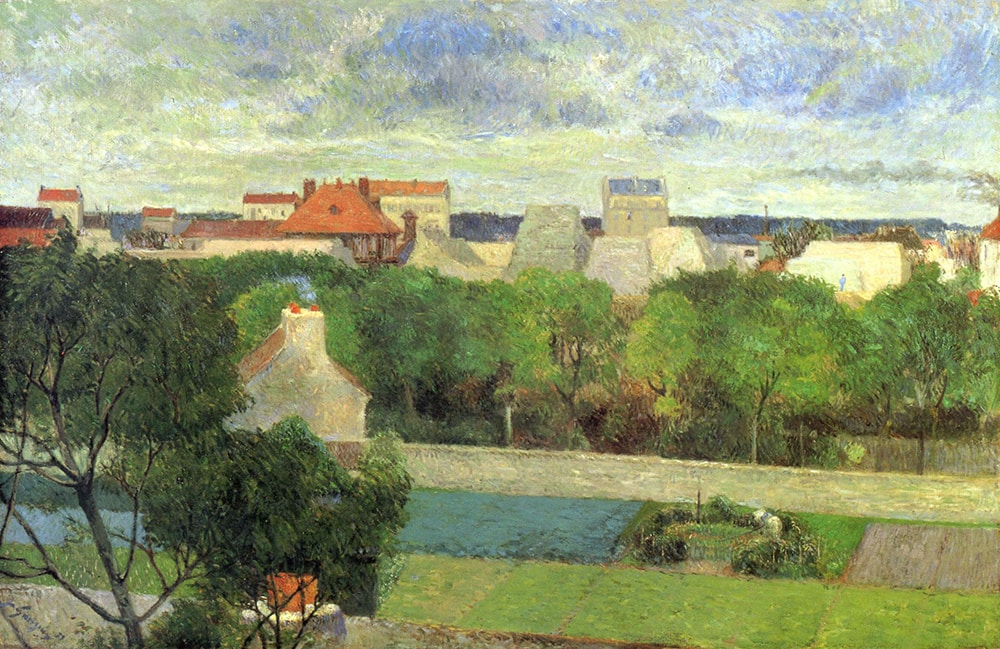
 

Paul Gauguin, The Market Gardens of Vaugirard. Courtesy of Wikimedia Commons/public domain.

Paul Gauguin, The Market Gardens of Vaugirard. Courtesy of Wikimedia Commons/public domain.


Chip’s garage was full of after-work renegades by the time I got back to his place. They greeted me with a beer and smiles. Candy approached and asked how I had gotten along with Evelyn. She had that concerned look in her eye, like a mother questioning her kid about his first day in school.

“You look distressed, Candy, what do you expect me to say?”

“Well, it’s not that she isn’t a sweet girl; it’s just that, well, I was worried how you’d react the to the fact that she’s quite Catholic.”

I smiled. “I think she’s quite spiritual, and finds expression of her spirituality through the Catholic Church.”

“I’m not sure how anyone can find spirituality in all those rituals.” KP piped up.

“It’s not the rituals that enrapture her, KP, it’s the music. I share that with her.” I responded.

“Church music!” he exclaimed.

“Musicians have to make a living from wherever the money is, KP. Today, the money is in popular music and movie scores. Back then, the church and the nobility had all the money, so that’s where the best musicians went, like Handel and Bach.”

“That music sounds very boring to me. I prefer Pink Floyd or the Eagles.”

“Have you ever heard classical music live, KP?” I asked.

“I heard a guy singing Frank Sinatra tunes in a bar one time. That was pretty boring too.”

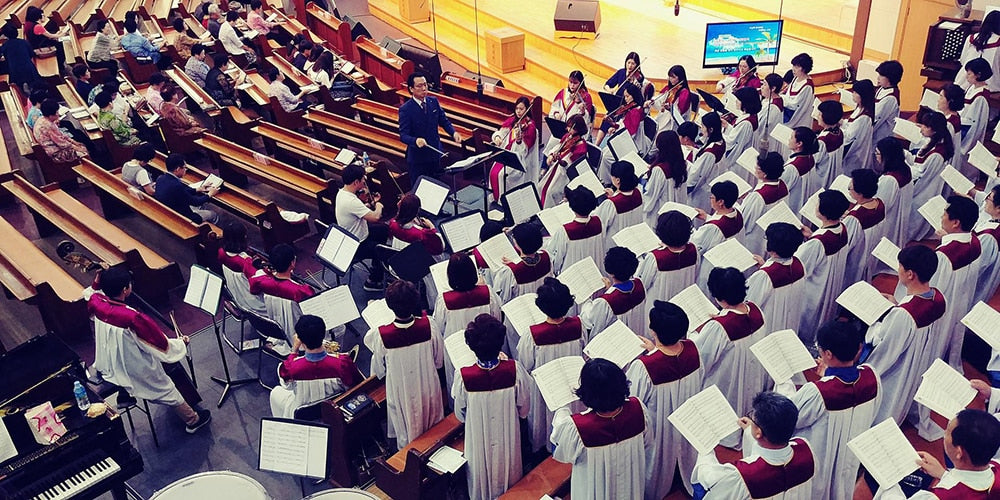
“Different strokes for different folks man; I share Evelyn’s love for church music,” I responded. “I’ve heard it live in many of the great cathedrals of Europe and it is truly a mesmerizing experience. Just imagine how it must have been for the peasants of the day. They live in shacks with dirt floors, work in the dirt from sun-up to sunset, and spend Sundays in these grand cathedrals listening to some of the finest music ever written. That must have seemed like heaven on earth to them.”

“When did you fall in love with classical music?” Candy asked.

“When I was a little kid. I remember listening to it on the radio while sitting on my mother’s lap. At age six, the neighbor girl talked me into going to her Catholic Church. It had a huge organ and a great choir. I was immediately hooked on choral music and have been listening to it ever since.”


“Well, there’s a side of you we never knew,” Chip commented.

“There’s a lot of sides to me, Chip, just like everyone else. I’ve also enjoyed reading too, and spent many evenings discussing books I’d read with my mother after my father went to bed.”

“You didn’t discuss it with your father?”

“My mother and father were diametrical opposites. She came from a family of CEOs, professionals, and scholars. He came from a family of tradesmen. She was an educated thinker; he was a technician. He didn’t know Nietzsche from Buddha, and she didn’t know a nut from a bolt.

“So why did she marry him?” Tina asked.

“He was extraordinarily good looking; he had the face and physique of a Greek statue. He was always the best-looking guy at family gatherings, and she was very proud of that.”

“When I came along, I think he was hoping for a chip off the old block, but unlike the kids who came later, I preferred biographies to bandsaws.”

“That couldn’t have made you popular with him.”

“He could never bring himself to warm up to me, Chip, so he focused his attention on my three siblings. If there was any conflict between us, he always blamed me first. He never laughed at my jokes even if the rest of the family did, didn’t spend any private time with me, and never gave me credit for anything – even those things on which I’d worked hard to please him. Nothing I did was ever good enough. When I told him I wanted to go to college, he wished me luck and walked off.”

“That must have been tough,” Chip probed.

“By the age of 17, I’d had enough. The week I finished high school, I moved to another town to work in a rubber factory in order to make enough money to start college. During my first semester, I learned about the student loan program and that’s what financed the rest of my education. Before I graduated, my father died from heart disease. I never got the chance to confront him as an adult. I was the only person at the funeral not to shed a tear.”

“So why did he have it out for you and not the other kids?” Chip asked.

“When I visited my uncle in Europe, he told me my parents got married by proxy before my father returned from his overseas engagement. When I got home, I asked my mother about it. She told me they were so in love, they just couldn’t wait till he got out of the army. I accepted that because I trusted her. That was dumb!”

“Oh, oh, I have a feeling about what’s coming.” Candy said.

“I didn’t figure it out till I saw a photo of us four kids as adults standing next to each other. All three of my younger siblings resemble each other more than me, all are taller than me, they are lanky and I am not, and all have much more hair.”

“Hell, you must be a bastard!” KP blurted out as everyone burst out laughing. Fortunately, that broke the tension.

“Exactly KP, but I’m not angry at my father anymore. He fulfilled what he felt was his duty, though not happily. I’m mad at my mother for not telling me this when I was a kid. If she had, I’d have understood his behavior instead of spending my youth wondering what the hell was wrong with me.”

“That’s just tragic. I feel terrible for you,” Candy sympathized.

“It is what it is Candy, can’t change anything now.”

“Did you ever approach your mother about it?”

“She became a very religious person in the latter half of her life, so she would have been profoundly embarrassed. I loved her too much for that, so I just let it go. Just before she died, she admitted to my sister that I’d been treated unfairly as a child, but she never elaborated.”

“It probably wouldn’t be a stretch to say that everyone in this garage was treated unfairly as a child, Montana,” Chip asserted, “Maybe that’s what bonds us together.”

As I looked around, I saw the majority nod in agreement, some with tears in their eyes.

“Yah, maybe it is Chip.”


Header image courtesy of Pixabay.com/Peter H.

Previous installments appeared in Issues 143144145146147148149150151152153154155156157158, 159, 160,  161, 162, 163164165, 166 and 167.

More from Issue 168

View All Articles in Issue 168

Search Copper Magazine

#227 Seth Lewis Gets in the Groove With Take a Look Around: a Tribute to the Meters by Frank Doris Feb 02, 2026 #227 Passport to Sound: May Anwar’s Audio Learning Experience for Young People by Frank Doris Feb 02, 2026 #227 Conjectures on Cosmic Consciousness by B. Jan Montana Feb 02, 2026 #227 The Big Takeover Turns 45 by Wayne Robins Feb 02, 2026 #227 Music and Chocolate: On the Sensory Connection by Joe Caplan Feb 02, 2026 #227 Singer/Songwriter Chris Berardo: Getting Wilder All the Time by Ray Chelstowski Feb 02, 2026 #227 The Earliest Stars of Country Music, Part One by Jeff Weiner Feb 02, 2026 #227 The Vinyl Beat Goes Down to Tijuana (By Way of Los Angeles), Part Two by Rudy Radelic Feb 02, 2026 #227 How to Play in a Rock Band, 20: On the Road With Blood, Sweat & Tears’ Guitarist Gabe Cummins by Frank Doris Feb 02, 2026 #227 From The Audiophile’s Guide: Audio Specs and Measuring by Paul McGowan Feb 02, 2026 #227 Our Brain is Always Listening by Peter Trübner Feb 02, 2026 #227 PS Audio in the News by PS Audio Staff Feb 02, 2026 #227 The Listening Chair: Sleek Style and Sound From the Luxman L3 by Howard Kneller Feb 02, 2026 #227 The Los Angeles and Orange County Audio Society Celebrates Its 32nd Anniversary, Honoring David and Sheryl Lee Wilson and Bernie Grundman by Harris Fogel Feb 02, 2026 #227 Back to My Reel-to-Reel Roots, Part 26: Half Full – Not Half Empty, Redux by Ken Kessler Feb 02, 2026 #227 That's What Puzzles Us... by Frank Doris Feb 02, 2026 #227 Record-Breaking by Peter Xeni Feb 02, 2026 #227 The Long and Winding Road by B. Jan Montana Feb 02, 2026 #226 JJ Murphy’s Sleep Paralysis is a Genre-Bending Musical Journey Through Jazz, Fusion and More by Frank Doris Jan 05, 2026 #226 Stewardship by Consent by B. Jan Montana Jan 05, 2026 #226 Food, Music, and Sensory Experience: An Interview With Professor Jonathan Zearfoss of the Culinary Institute of America by Joe Caplan Jan 05, 2026 #226 Studio Confidential: A Who’s Who of Recording Engineers Tell Their Stories by Frank Doris Jan 05, 2026 #226 Pilot Radio is Reborn, 50 Years Later: Talking With CEO Barak Epstein by Frank Doris Jan 05, 2026 #226 The Vinyl Beat Goes Down to Tijuana (By Way of Los Angeles), Part One by Rudy Radelic Jan 05, 2026 #226 Capital Audiofest 2025: Must-See Stereo, Part Two by Frank Doris Jan 05, 2026 #226 My Morning Jacket’s Carl Broemel and Tyler Ramsey Collaborate on Their Acoustic Guitar Album, Celestun by Ray Chelstowski Jan 05, 2026 #226 The People Who Make Audio Happen: CanJam SoCal 2025, Part Two by Harris Fogel Jan 05, 2026 #226 How to Play in a Rock Band, 19: Touring Can Make You Crazy, Part One by Frank Doris Jan 05, 2026 #226 Linda Ronstadt Goes Bigger by Wayne Robins Jan 05, 2026 #226 From The Audiophile’s Guide: Active Room Correction and Digital Signal Processing by Paul McGowan Jan 05, 2026 #226 PS Audio in the News by Frank Doris Jan 05, 2026 #226 Back to My Reel-to-Reel Roots, Part 25: Half-Full, Not Empty by Ken Kessler Jan 05, 2026 #226 Happy New Year! by Frank Doris Jan 05, 2026 #226 Turn It Down! by Peter Xeni Jan 05, 2026 #226 Ghost Riders by James Schrimpf Jan 05, 2026 #226 A Factory Tour of Audio Manufacturer German Physiks by Markus "Marsu" Manthey Jan 04, 2026 #225 Capital Audiofest 2025: Must-See Stereo, Part One by Frank Doris Dec 01, 2025 #225 Otis Taylor and the Electrics Delivers a Powerful Set of Hypnotic Modern Blues by Frank Doris Dec 01, 2025 #225 A Christmas Miracle by B. Jan Montana Dec 01, 2025 #225 T.H.E. Show New York 2025, Part Two: Plenty to See, Hear, and Enjoy by Frank Doris Dec 01, 2025 #225 Underappreciated Artists, Part One: Martin Briley by Rich Isaacs Dec 01, 2025 #225 Rock and Roll is Here to Stay by Wayne Robins Dec 01, 2025 #225 A Lifetime of Holiday Record (and CD) Listening by Rudy Radelic Dec 01, 2025 #225 Little Feat: Not Saying Goodbye, Not Yet by Ray Chelstowski Dec 01, 2025 #225 How to Play in a Rock Band, Part 18: Dealing With Burnout by Frank Doris Dec 01, 2025 #225 The People Who Make Audio Happen: CanJam SoCal 2025 by Harris Fogel Dec 01, 2025 #225 Chicago’s Sonic Sanctuaries: Four Hi‑Fi Listening Bars Channeling the Jazz‑Kissa Spirit by Olivier Meunier-Plante Dec 01, 2025

Pilgrimage to Sturgis, Part 26

Pilgrimage to Sturgis, Part 26


After a delightful breakfast, Evelyn had to rush off to work. As we parted, she urged me to spend some time visiting the Minneapolis Institute of Art on Third Avenue.  I’d been to most of the large art galleries in Europe during the 15 months I toured there, and also the Art Institute of Chicago (which is as good as any of them). Art has always interested me, so she didn’t have to suggest it twice.

But now I was in a bit of a dilemma. I’d promised Melody to be back in South Dakota the next day to visit the Bhagwan for his last session of the year. Perhaps if I left early enough the next morning, I could see the Art Institute today and hear the Bhagwan’s talk late the next day.

Evelyn said the facility didn’t open till 10, so I rode north a few miles along the Mississippi River. As we’d seen heading south the day before, there were lots of green spaces between the road and the river, very scenic. The river itself was flush with boats, both pleasure craft and commercial shipping. I stopped at overlooks several times to enjoy the scene. Couldn’t help but think of Tom Sawyer and Huck Finn’s adventures, and Mark Twain learning to negotiate the shallow banks.

I got to the Art Institute assuming I’d visit for a couple of hours, but ended up staying all afternoon. A professor was giving lessons as he toured his class around the facility so I just tagged behind and listened in. It was a fascinating afternoon. There were paintings by such luminaries as Rembrandt, Reynolds, Murillo, El Greco, Manet, Van Gogh, Pissarro, and Gauguin. For pure enjoyment, this place rivaled the one in Chicago.


Paul Gauguin, The Market Gardens of Vaugirard. Courtesy of Wikimedia Commons/public domain.

Paul Gauguin, The Market Gardens of Vaugirard. Courtesy of Wikimedia Commons/public domain.


Chip’s garage was full of after-work renegades by the time I got back to his place. They greeted me with a beer and smiles. Candy approached and asked how I had gotten along with Evelyn. She had that concerned look in her eye, like a mother questioning her kid about his first day in school.

“You look distressed, Candy, what do you expect me to say?”

“Well, it’s not that she isn’t a sweet girl; it’s just that, well, I was worried how you’d react the to the fact that she’s quite Catholic.”

I smiled. “I think she’s quite spiritual, and finds expression of her spirituality through the Catholic Church.”

“I’m not sure how anyone can find spirituality in all those rituals.” KP piped up.

“It’s not the rituals that enrapture her, KP, it’s the music. I share that with her.” I responded.

“Church music!” he exclaimed.

“Musicians have to make a living from wherever the money is, KP. Today, the money is in popular music and movie scores. Back then, the church and the nobility had all the money, so that’s where the best musicians went, like Handel and Bach.”

“That music sounds very boring to me. I prefer Pink Floyd or the Eagles.”

“Have you ever heard classical music live, KP?” I asked.

“I heard a guy singing Frank Sinatra tunes in a bar one time. That was pretty boring too.”

“Different strokes for different folks man; I share Evelyn’s love for church music,” I responded. “I’ve heard it live in many of the great cathedrals of Europe and it is truly a mesmerizing experience. Just imagine how it must have been for the peasants of the day. They live in shacks with dirt floors, work in the dirt from sun-up to sunset, and spend Sundays in these grand cathedrals listening to some of the finest music ever written. That must have seemed like heaven on earth to them.”

“When did you fall in love with classical music?” Candy asked.

“When I was a little kid. I remember listening to it on the radio while sitting on my mother’s lap. At age six, the neighbor girl talked me into going to her Catholic Church. It had a huge organ and a great choir. I was immediately hooked on choral music and have been listening to it ever since.”


“Well, there’s a side of you we never knew,” Chip commented.

“There’s a lot of sides to me, Chip, just like everyone else. I’ve also enjoyed reading too, and spent many evenings discussing books I’d read with my mother after my father went to bed.”

“You didn’t discuss it with your father?”

“My mother and father were diametrical opposites. She came from a family of CEOs, professionals, and scholars. He came from a family of tradesmen. She was an educated thinker; he was a technician. He didn’t know Nietzsche from Buddha, and she didn’t know a nut from a bolt.

“So why did she marry him?” Tina asked.

“He was extraordinarily good looking; he had the face and physique of a Greek statue. He was always the best-looking guy at family gatherings, and she was very proud of that.”

“When I came along, I think he was hoping for a chip off the old block, but unlike the kids who came later, I preferred biographies to bandsaws.”

“That couldn’t have made you popular with him.”

“He could never bring himself to warm up to me, Chip, so he focused his attention on my three siblings. If there was any conflict between us, he always blamed me first. He never laughed at my jokes even if the rest of the family did, didn’t spend any private time with me, and never gave me credit for anything – even those things on which I’d worked hard to please him. Nothing I did was ever good enough. When I told him I wanted to go to college, he wished me luck and walked off.”

“That must have been tough,” Chip probed.

“By the age of 17, I’d had enough. The week I finished high school, I moved to another town to work in a rubber factory in order to make enough money to start college. During my first semester, I learned about the student loan program and that’s what financed the rest of my education. Before I graduated, my father died from heart disease. I never got the chance to confront him as an adult. I was the only person at the funeral not to shed a tear.”

“So why did he have it out for you and not the other kids?” Chip asked.

“When I visited my uncle in Europe, he told me my parents got married by proxy before my father returned from his overseas engagement. When I got home, I asked my mother about it. She told me they were so in love, they just couldn’t wait till he got out of the army. I accepted that because I trusted her. That was dumb!”

“Oh, oh, I have a feeling about what’s coming.” Candy said.

“I didn’t figure it out till I saw a photo of us four kids as adults standing next to each other. All three of my younger siblings resemble each other more than me, all are taller than me, they are lanky and I am not, and all have much more hair.”

“Hell, you must be a bastard!” KP blurted out as everyone burst out laughing. Fortunately, that broke the tension.

“Exactly KP, but I’m not angry at my father anymore. He fulfilled what he felt was his duty, though not happily. I’m mad at my mother for not telling me this when I was a kid. If she had, I’d have understood his behavior instead of spending my youth wondering what the hell was wrong with me.”

“That’s just tragic. I feel terrible for you,” Candy sympathized.

“It is what it is Candy, can’t change anything now.”

“Did you ever approach your mother about it?”

“She became a very religious person in the latter half of her life, so she would have been profoundly embarrassed. I loved her too much for that, so I just let it go. Just before she died, she admitted to my sister that I’d been treated unfairly as a child, but she never elaborated.”

“It probably wouldn’t be a stretch to say that everyone in this garage was treated unfairly as a child, Montana,” Chip asserted, “Maybe that’s what bonds us together.”

As I looked around, I saw the majority nod in agreement, some with tears in their eyes.

“Yah, maybe it is Chip.”


Header image courtesy of Pixabay.com/Peter H.

Previous installments appeared in Issues 143144145146147148149150151152153154155156157158, 159, 160,  161, 162, 163164165, 166 and 167.

0 comments

Leave a comment

0 Comments

Your avatar

Loading comments...

🗑️ Delete Comment

Enter moderator password to delete this comment:

✏️ Edit Comment

Enter your email to verify ownership: