COPPER

A PS Audio Publication

Issue 134 • Free Online Magazine

Issue 134 FRANKLY SPEAKING

Living With Electromagnetic Hypersensitivity: Davinder Bedi of RadiAsian.London

Living With Electromagnetic Hypersensitivity: Davinder Bedi of RadiAsian.London

Electromagnetic fields (EMF) are all around us. We’re constantly bombarded by low-level EMF from computer screens, Wi-Fi, cell phones and other devices. However, since EMF is invisible, most of us never give it a second thought.

But what if you were not only aware of low-level electromagnetic radiation, but physically reacted to it, to the point where it made you feel ill? This is known as electromagnetic hypersensitivity, or EHS. It’s also categorized as idiopathic environmental intolerance attributed to electromagnetic fields, or IEI-IMF.

While EHS isn’t an accepted medical diagnosis, and pooh-poohed in some studies or attributed to other environmental factors, there are those who will tell you it’s real, from experience.

Davinder Bedi knows it first-hand. He’s the host of online radio station RadiAsian.London, “The No. 1 Station for the Asian Invasion.” The channel plays a wide range of music from around the world. He also lives with EHS. We asked Dav to talk about his experiences.

Davinder Bedi of radio station RadiAsian.London. Davinder Bedi of radio station RadiAsian.London.


Frank Doris: What is electromagnetic hypersensitivity and what are its symptoms?

Dav Bedi: PubMed.gov, which is part of the National Library of Medicine, does a decent job of defining EHS (excerpted; click here for the full article):

“Electromagnetic hypersensitivity (EHS), known in the past as ‘microwave syndrome,’ is a clinical syndrome characterized by the presence of a wide spectrum of non-specific multiple organ symptoms, typically including central nervous system symptoms, that occur following the patient’s acute or chronic exposure to electromagnetic fields in the environment or in occupational settings.”

I find the work of Alasdair and Jean Philips extremely informative. They provide a more detailed list of symptoms at the Powerwatch website. 

FD: How does it affect you?

DB: For a long time it made my days unbearable. I would get sharp headaches, and would feel pains in my heart. However, nowadays I have found methods to minimize the impact on my body.

FD: When did you first think you had it, and how was it diagnosed?

DB: Twenty years ago I was in the car with a female friend. I was in the passenger seat with my eyes closed with the car doing between 50-70 MPH, and I told her where I felt the mobile phone towers were, judging by the pain in my head.

Time after time I was correct and she was amazed. And back then the mobile phone towers were nowhere near as powerful in their emission of radio frequencies (RF) as they are today.

A ten-minute conversation on a mobile telephone would give me a headache which lasted hours, ruining my day. I just knew something wasn’t right.

Diagnosis was another matter. I saw my general practitioner, who tried to downplay it to stress and dehydration. He wouldn’t even refer me to some kind of specialist. Back then, a diagnosis for EHS was out of the question.

FD: We live in a world where we’re bombarded with wireless and electromagnetic radiation. How has it affected your functioning in the modern world?


DB: People of my age group look at me as a bit odd or behind the times, especially when they ask for my mobile phone number and I give them a land line number. However, they are the ones glued to their smartphone or tablet. I appreciate the birds in the trees and the clouds in the sky, as I’m not constantly looking down at a screen.

I tend to avoid built-up areas, especially those in close proximity to mobile phone masts. I don’t visit other peoples’ houses much, and if I must, they may find me odd in that I ask them to switch off their Wi-Fi router temporarily. That really starts a conversation!

Being in a car with somebody with a mobile phone results in me getting out of the car if possible, especially during a call. Bluetooth audio connectivity is not an option. Bluetooth really gives me headaches quickly.

I avoid most people who I know can’t live without their tech. I have walked out of jobs where the RF levels were too high.

At home I have a hard-wired landline. I don’t use cordless phones.

There was no Wi-Fi near my house, until recently when a new couple moved in next door with their high-speed Wi-Fi. They kindly agreed to switch it off at night. Regardless, I was feeling pains my head and heart while it was on during the day. I found it difficult to focus. I ended up wrapping myself in special RF sheeting just to minimize the pain. I was dressed like a sheikh, which family and friends found hilarious initially, but they soon accepted it.

Thanks to the understanding and kindness of my landlord, I painted the dividing wall between the apartments with a special carbon-based paint which I grounded by connecting via a wire to the ground pin of an AC wall plug. Don’t try it this you don’t know what you are doing; call a qualified electrician. Over the window I have an enhanced version of a net curtain, which reduces frequencies by up to 36 dB at 40 GHz. It is actually an EMF radiation-protection fabric, which can be used to shield windows, your bedding or even your body. These sheets have silver and copper in them, which can block EMF and RF. That very same sheet formed my sheikh outfit. I made a video demonstrating the effectiveness of this sheeting:


The Alasdair and Jean Philips study raises an interesting point, which I also have personal experience of. To quote: “Many electrically sensitive people seem to have quite dry skin and can carry high electrostatic charges on their body. Not only can other people experience a ‘zap’ when touching the person, but the electrostatic charges can also be transferred to electronic equipment causing equipment to malfunction. If you experience these problems, then you should wear clothes and shoes made of natural materials or even special conductive clothing and footwear that is made for workers in the electronics semiconductor industry. You need to have flooring that is made of natural material, as you build up static charges every time you move your feet.”

I have literally shocked my partner a few times but nowadays I wear a silver chain around my neck and silver bracelet on my wrist. Luckily, I haven’t frazzled any equipment as of yet.

During my daily walk, I place my hands on the bark of an old oak tree before I head home. My partner, Claire, thinks it’s a bit odd, but is used to it by now.

FD: You’re a radio broadcaster. How can you work in an environment where EMF must be prevalent?

DB: I am tactical in the sense that I only switch on what I need for the show and switch if off straight after the show is done.

One of the biggest culprits in the studio which caused a painful burning sensation in my hands was a MacBook Pro. So, I can only use it with an external wired keyboard and mouse. I use a wired Ethernet connection.

The studio is full of transformers, but I only switch on what is needed, for a limited duration. Headphones always have to be wired, not wireless. In the studio I usually use a set of AKG K271 MKIIs which give me a reading of 3 mG (magnetic) and around 100 V/m (electric) on the EMF meter. My Beyer DT150s measure significantly lower at 1 mG (magnetic) and around 30 V/m (electric). To minimize exposure while listening to music, I much prefer to use an old speaker system here at low volume.

What also helped was installing an EMFields DE2 Dirty Electricity (AC) Filter. I was a little dubious when I purchased it but within the first few minutes of plugging it into the wall, I felt more relaxed. I keep my cables as short as possible and always opt for the shielded and grounded variety. I am lucky in the sense that I feel the effects of RF way more on my body than EMI.

After twenty years of dealing with skeptical family and friends, I spent a bit of money, which would have gone towards studio gear, and invested in accurate metering. For around £310 I bought two meters, an EMFields Acousticom 2 to measure RF and an EMFields PF5 Pocket Power Frequencies Meter, which is an EMF detector. You need to understand the significance of the day the meters arrived. It was my day to prove people who doubted me wrong.

EMFields Pocket PF Meter.


FD: What about microwave ovens? I had one that would interfere with Wi-Fi reception when it was on.

DB: I rush straight out of the kitchen when someone switches one of those horrid contraptions on. The hilariously poor shielding used in microwaves to stop the RF leakage is in no way up to the job. My partner Claire taunted me one day by putting her head near the blasted thing while watching her food being nuked. I could literally feel the tension in my heart. Check out the following video on the RadiAsian YouTube channel. I rest my case.


FD: Is there anything else that alleviates EMF for you?

DB: The importance of getting out to a rural area can’t be stressed enough. One which is densely populated by trees, such as a forest, is even better. Going to the forest for me was the equivalent of someone releasing a tight grip around my skull. My headaches vanished.

Buy yourself some decent RF and EMF metering; don’t cheap out and try and use a mobile phone app. That will help you locate the RF and EMF danger spots you encounter throughout your day. Plus, you will also be able to test the effectiveness of shielding should you decide to try that.

I avoid walking anywhere near electrical substations which house huge transformers. Don’t even get me started on SAR, (Specific Absorption Rate), which is a measure of the amount of RF energy absorbed by the human body according to its weight. SAR standards have been breached long ago.

I have tested orgonite material, but not shungite yet. Orgonite is weak compared to a physically-grounded barrier between you and the device emitting the RF.

I know the locations of most mobile phone masts and try and work out routes to avoid the main ones. I do wrap that radiation sheet around me, also covering my head, like a cloak, then put my coat over the top. The first time I did this, the pain was significantly reduced being near the main cell towers. I will invest in a hoodie made of similar material. To my knowledge, the material used to make this clothing doesn’t provide the same level of protection as the sheeting material I have. However, it is still very good.

Trees are your friends (and also some of the biggest enemies to the communications industry). Don’t complain if you have a poor mobile phone signal at home; it’s a good thing.

You need to be sleeping in the most RF-dead spot of your house, if practical. You can purchase or make a bed canopy from EMF material. Switching off Wi-Fi and mobile phones helps too, or get a wired landline, but I’m not sure many people could go back to my 1980s communication methods. Cook using the stove or oven as opposed to the microwave.

As I noted, carbon paint works wonders, especially two layers, and if the paint is grounded to your electrical system and the walls and doors are all connected to each other. You can apply a top coat of decorative paint.

FD: Is there a threshold where one type of equipment might just be mildly annoying and some other type of equipment is unbearable?

DB: The MacBook Pro is intolerable without an external wired keyboard and wired mouse. Slightly annoying equipment can result in headaches after a few hours. Switching off computer screens when not in use helps a lot. However, I would only really feel them if I was right up close.

In the past I had many days where I couldn’t work due to headaches. Those days are gone because I invested in metering, screening materials and carbon paint. Bluetooth exposure for just 15 minutes gives me the most severe headaches.

I can feel powerful hazards from maybe 250 meters away depending on whether we are in a built-up area or not. It feels like a dull ache in my head and heart.

I guess I need to stop treating it as a disability and look at it as a blessing, as my body’s defense mechanism is warning me of nearby hazards.

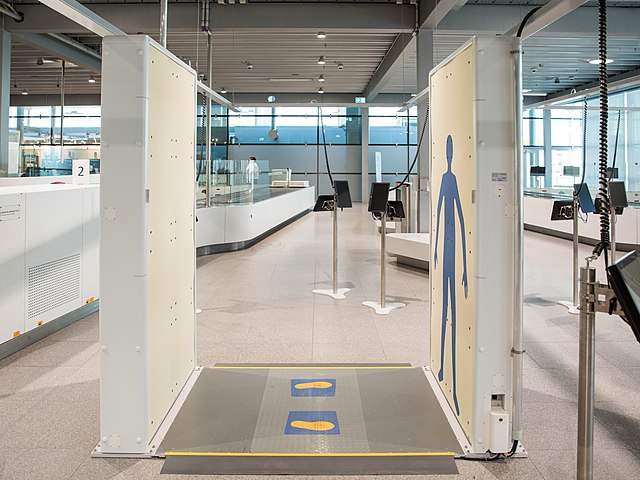
FD: Are you bothered by things like airport scanners, tanning lights or the kind of ultrasound used in medical diagnosis?

DB: Airport scanners are a major hazard so I avoid flying. And if you try rushing though the scanners, security will collar you like some sort of narcotics smuggler. On the bright side, I’m brown-skinned, so I’ve saved considerable money on tanning sessions. Couldn’t resist a bit of humor there.

Airport full-body millimeter wave scanner. Courtesy of Wikimedia Commons/Raimond Spekking. Airport full-body millimeter wave scanner. Courtesy of Wikimedia Commons/Raimond Spekking.


I avoid X-rays and ultrasound, so much so that I had a fractured elbow last year but let it heal naturally without visiting the doctor in order to avoid the X-ray machine.

FD: Are there any medications or homeopathic remedies that help?

DB: I think a healthy diet with good natural healthy greens is paramount. Think about it, chlorophyll is a transducer. It converts light energy into energy to be utilized by plants to grow. Chlorophyll is similar to the way melanin works for us. Spend time in the sun, as a lack of sunlight over time can lead to a myriad of health conditions. Learn to cook – I mean, really cook, from raw ingredients. Avoid processed foods and drink distilled water. Your level of hydration has a correlation to your conductivity and energy levels too.

FD: Do you know anyone else with this condition? Are there support groups?

DB: My housemate also suffers from EHS. It affects his sleep, so he has painted and treated his whole room, including installing a special gold membrane over the windows so his room is RF-dead. It feels even better than my room to be in. Now he sleeps amazingly well and is happier and less tired.

In August 2019, eleven American claimants filed a class action lawsuit against Samsung and Apple for problems related to RF exposure from mobile phones. I’m not sure of the outcome of the case as of yet. If in favor of the claimants, it will be a landmark decision. I’m not holding my breath, as there is way too much money tied up in the telecommunications industry and the Internet of Things infrastructure.

These webpages are useful: for shielding products and meters, EMF Protection, https://emf-protection.co.uk. For a wealth of information on the subject go to https://www.powerwatch.org.uk/library/.

There are community pages on social media, but be careful not to be branded a conspiracy theorist, and take what practical information you can from these pages.

FD: What would you say to skeptics? No definitive studies exist, at least according to Wikipedia as of this writing. What about people who would say it’s all in your imagination?

DB: For almost two decades I dealt with the criticism of skeptics, many my own family and friends. I’ve heard the most hilarious statements, such as, “they would never release a product which wasn’t safe for humans.” Above everything you hear from everyone, including me, trust your own body. And trust a good-quality meter. Skeptics, even the most vehement deniers, stay quiet when a meter is in operation showing actual readings. Of course, there are those who will say that what the meter is measuring doesn’t really affect you. I disagree.

If you must use a mobile phone, use the hands-free facility and limit your conversation time. Texting is better than calling, and voice calling is better than video chatting, which has the highest data transfer rates.

Don’t take chances with your health, or especially where children are involved. They won’t like it, but see if you can temporarily swap your children’s iPads for real books for a few hours a day.

I’ll conclude on a lighter note. For those of you who are fans of Stranger Things and such: who knows, this electro smog may even be inhibiting your psychic ability.

I hope this interview has provided some useful information or at least mere food for thought, regardless of which side of the fence you sit on.


Header image courtesy of Wikimedia Commons/SuperManu.

More from Issue 134

View All Articles in Issue 134

Search Copper Magazine

#228 Serita’s Black Rose Duo Shakes Your Soul With a Blend of Funk, Rock, Blues and a Whole Lot More by Frank Doris Mar 02, 2026 #228 Vinyl, A Love Story by Wayne Robins Mar 02, 2026 #228 Thrill Seeker by B. Jan Montana Mar 02, 2026 #228 The Vinyl Beat: Donald Byrd, Bill Evans, Wes Montgomery, Eddie Palmieri and Frank Sinatra by Rudy Radelic Mar 02, 2026 #228 Listening to Prestige: The History of a Vitally Important Jazz Record Label by Frank Doris Mar 02, 2026 #228 How to Play in a Rock Band, 21: Touring With James Lee Stanley by Frank Doris Mar 02, 2026 #228 The NAMM 2026 Show: The Music Industry’s Premier Event by John Volanski Mar 02, 2026 #228 The Earliest Stars of Country Music, Part Two by Jeff Weiner Mar 02, 2026 #228 From The Audiophile's Guide: A Brief History of Stereophonic Sound by Paul McGowan Mar 02, 2026 #228 A Bone to Pick With Streaming Audio by Frank Doris Mar 02, 2026 #228 Blast Off With Bluesman Duke Robillard by Ray Chelstowski Mar 02, 2026 #228 A Visit to the Marten Loudspeaker Factory in Göteborg, Sweden by Ingo Schulz and Sebastian Polcyn Mar 02, 2026 #228 Pure Distortion by Peter Xeni Mar 02, 2026 #228 A Nagra Factory Tour by Markus "Marsu" Manthey Mar 02, 2026 #228 Back to My Reel-to-Reel Roots, Part 27: Noodge and Ye Shall Receive, Part Two by Ken Kessler Mar 02, 2026 #228 PS Audio in the News by PS Audio Staff Mar 02, 2026 #228 90-Degree Stereo by Frank Doris Mar 02, 2026 #228 The Keys to Art by Rich Isaacs Mar 02, 2026 #227 Seth Lewis Gets in the Groove With Take a Look Around: a Tribute to the Meters by Frank Doris Feb 02, 2026 #227 Passport to Sound: May Anwar’s Audio Learning Experience for Young People by Frank Doris Feb 02, 2026 #227 Conjectures on Cosmic Consciousness by B. Jan Montana Feb 02, 2026 #227 The Big Takeover Turns 45 by Wayne Robins Feb 02, 2026 #227 Music and Chocolate: On the Sensory Connection by Joe Caplan Feb 02, 2026 #227 Singer/Songwriter Chris Berardo: Getting Wilder All the Time by Ray Chelstowski Feb 02, 2026 #227 The Earliest Stars of Country Music, Part One by Jeff Weiner Feb 02, 2026 #227 The Vinyl Beat Goes Down to Tijuana (By Way of Los Angeles), Part Two by Rudy Radelic Feb 02, 2026 #227 How to Play in a Rock Band, 20: On the Road With Blood, Sweat & Tears’ Guitarist Gabe Cummins by Frank Doris Feb 02, 2026 #227 From The Audiophile’s Guide: Audio Specs and Measuring by Paul McGowan Feb 02, 2026 #227 Our Brain is Always Listening by Peter Trübner Feb 02, 2026 #227 PS Audio in the News by PS Audio Staff Feb 02, 2026 #227 The Listening Chair: Sleek Style and Sound From the Luxman L3 by Howard Kneller Feb 02, 2026 #227 The Los Angeles and Orange County Audio Society Celebrates Its 32nd Anniversary, Honoring David and Sheryl Lee Wilson and Bernie Grundman by Harris Fogel Feb 02, 2026 #227 Back to My Reel-to-Reel Roots, Part 26: Half Full – Not Half Empty, Redux by Ken Kessler Feb 02, 2026 #227 That's What Puzzles Us... by Frank Doris Feb 02, 2026 #227 Record-Breaking by Peter Xeni Feb 02, 2026 #227 The Long and Winding Road by B. Jan Montana Feb 02, 2026 #226 JJ Murphy’s Sleep Paralysis is a Genre-Bending Musical Journey Through Jazz, Fusion and More by Frank Doris Jan 05, 2026 #226 Stewardship by Consent by B. Jan Montana Jan 05, 2026 #226 Food, Music, and Sensory Experience: An Interview With Professor Jonathan Zearfoss of the Culinary Institute of America by Joe Caplan Jan 05, 2026 #226 Studio Confidential: A Who’s Who of Recording Engineers Tell Their Stories by Frank Doris Jan 05, 2026 #226 Pilot Radio is Reborn, 50 Years Later: Talking With CEO Barak Epstein by Frank Doris Jan 05, 2026 #226 The Vinyl Beat Goes Down to Tijuana (By Way of Los Angeles), Part One by Rudy Radelic Jan 05, 2026 #226 Capital Audiofest 2025: Must-See Stereo, Part Two by Frank Doris Jan 05, 2026 #226 My Morning Jacket’s Carl Broemel and Tyler Ramsey Collaborate on Their Acoustic Guitar Album, Celestun by Ray Chelstowski Jan 05, 2026 #226 The People Who Make Audio Happen: CanJam SoCal 2025, Part Two by Harris Fogel Jan 05, 2026 #226 How to Play in a Rock Band, 19: Touring Can Make You Crazy, Part One by Frank Doris Jan 05, 2026 #226 Linda Ronstadt Goes Bigger by Wayne Robins Jan 05, 2026

Living With Electromagnetic Hypersensitivity: Davinder Bedi of RadiAsian.London

Living With Electromagnetic Hypersensitivity: Davinder Bedi of RadiAsian.London

Electromagnetic fields (EMF) are all around us. We’re constantly bombarded by low-level EMF from computer screens, Wi-Fi, cell phones and other devices. However, since EMF is invisible, most of us never give it a second thought.

But what if you were not only aware of low-level electromagnetic radiation, but physically reacted to it, to the point where it made you feel ill? This is known as electromagnetic hypersensitivity, or EHS. It’s also categorized as idiopathic environmental intolerance attributed to electromagnetic fields, or IEI-IMF.

While EHS isn’t an accepted medical diagnosis, and pooh-poohed in some studies or attributed to other environmental factors, there are those who will tell you it’s real, from experience.

Davinder Bedi knows it first-hand. He’s the host of online radio station RadiAsian.London, “The No. 1 Station for the Asian Invasion.” The channel plays a wide range of music from around the world. He also lives with EHS. We asked Dav to talk about his experiences.

Davinder Bedi of radio station RadiAsian.London. Davinder Bedi of radio station RadiAsian.London.


Frank Doris: What is electromagnetic hypersensitivity and what are its symptoms?

Dav Bedi: PubMed.gov, which is part of the National Library of Medicine, does a decent job of defining EHS (excerpted; click here for the full article):

“Electromagnetic hypersensitivity (EHS), known in the past as ‘microwave syndrome,’ is a clinical syndrome characterized by the presence of a wide spectrum of non-specific multiple organ symptoms, typically including central nervous system symptoms, that occur following the patient’s acute or chronic exposure to electromagnetic fields in the environment or in occupational settings.”

I find the work of Alasdair and Jean Philips extremely informative. They provide a more detailed list of symptoms at the Powerwatch website. 

FD: How does it affect you?

DB: For a long time it made my days unbearable. I would get sharp headaches, and would feel pains in my heart. However, nowadays I have found methods to minimize the impact on my body.

FD: When did you first think you had it, and how was it diagnosed?

DB: Twenty years ago I was in the car with a female friend. I was in the passenger seat with my eyes closed with the car doing between 50-70 MPH, and I told her where I felt the mobile phone towers were, judging by the pain in my head.

Time after time I was correct and she was amazed. And back then the mobile phone towers were nowhere near as powerful in their emission of radio frequencies (RF) as they are today.

A ten-minute conversation on a mobile telephone would give me a headache which lasted hours, ruining my day. I just knew something wasn’t right.

Diagnosis was another matter. I saw my general practitioner, who tried to downplay it to stress and dehydration. He wouldn’t even refer me to some kind of specialist. Back then, a diagnosis for EHS was out of the question.

FD: We live in a world where we’re bombarded with wireless and electromagnetic radiation. How has it affected your functioning in the modern world?


DB: People of my age group look at me as a bit odd or behind the times, especially when they ask for my mobile phone number and I give them a land line number. However, they are the ones glued to their smartphone or tablet. I appreciate the birds in the trees and the clouds in the sky, as I’m not constantly looking down at a screen.

I tend to avoid built-up areas, especially those in close proximity to mobile phone masts. I don’t visit other peoples’ houses much, and if I must, they may find me odd in that I ask them to switch off their Wi-Fi router temporarily. That really starts a conversation!

Being in a car with somebody with a mobile phone results in me getting out of the car if possible, especially during a call. Bluetooth audio connectivity is not an option. Bluetooth really gives me headaches quickly.

I avoid most people who I know can’t live without their tech. I have walked out of jobs where the RF levels were too high.

At home I have a hard-wired landline. I don’t use cordless phones.

There was no Wi-Fi near my house, until recently when a new couple moved in next door with their high-speed Wi-Fi. They kindly agreed to switch it off at night. Regardless, I was feeling pains my head and heart while it was on during the day. I found it difficult to focus. I ended up wrapping myself in special RF sheeting just to minimize the pain. I was dressed like a sheikh, which family and friends found hilarious initially, but they soon accepted it.

Thanks to the understanding and kindness of my landlord, I painted the dividing wall between the apartments with a special carbon-based paint which I grounded by connecting via a wire to the ground pin of an AC wall plug. Don’t try it this you don’t know what you are doing; call a qualified electrician. Over the window I have an enhanced version of a net curtain, which reduces frequencies by up to 36 dB at 40 GHz. It is actually an EMF radiation-protection fabric, which can be used to shield windows, your bedding or even your body. These sheets have silver and copper in them, which can block EMF and RF. That very same sheet formed my sheikh outfit. I made a video demonstrating the effectiveness of this sheeting:


The Alasdair and Jean Philips study raises an interesting point, which I also have personal experience of. To quote: “Many electrically sensitive people seem to have quite dry skin and can carry high electrostatic charges on their body. Not only can other people experience a ‘zap’ when touching the person, but the electrostatic charges can also be transferred to electronic equipment causing equipment to malfunction. If you experience these problems, then you should wear clothes and shoes made of natural materials or even special conductive clothing and footwear that is made for workers in the electronics semiconductor industry. You need to have flooring that is made of natural material, as you build up static charges every time you move your feet.”

I have literally shocked my partner a few times but nowadays I wear a silver chain around my neck and silver bracelet on my wrist. Luckily, I haven’t frazzled any equipment as of yet.

During my daily walk, I place my hands on the bark of an old oak tree before I head home. My partner, Claire, thinks it’s a bit odd, but is used to it by now.

FD: You’re a radio broadcaster. How can you work in an environment where EMF must be prevalent?

DB: I am tactical in the sense that I only switch on what I need for the show and switch if off straight after the show is done.

One of the biggest culprits in the studio which caused a painful burning sensation in my hands was a MacBook Pro. So, I can only use it with an external wired keyboard and mouse. I use a wired Ethernet connection.

The studio is full of transformers, but I only switch on what is needed, for a limited duration. Headphones always have to be wired, not wireless. In the studio I usually use a set of AKG K271 MKIIs which give me a reading of 3 mG (magnetic) and around 100 V/m (electric) on the EMF meter. My Beyer DT150s measure significantly lower at 1 mG (magnetic) and around 30 V/m (electric). To minimize exposure while listening to music, I much prefer to use an old speaker system here at low volume.

What also helped was installing an EMFields DE2 Dirty Electricity (AC) Filter. I was a little dubious when I purchased it but within the first few minutes of plugging it into the wall, I felt more relaxed. I keep my cables as short as possible and always opt for the shielded and grounded variety. I am lucky in the sense that I feel the effects of RF way more on my body than EMI.

After twenty years of dealing with skeptical family and friends, I spent a bit of money, which would have gone towards studio gear, and invested in accurate metering. For around £310 I bought two meters, an EMFields Acousticom 2 to measure RF and an EMFields PF5 Pocket Power Frequencies Meter, which is an EMF detector. You need to understand the significance of the day the meters arrived. It was my day to prove people who doubted me wrong.

EMFields Pocket PF Meter.


FD: What about microwave ovens? I had one that would interfere with Wi-Fi reception when it was on.

DB: I rush straight out of the kitchen when someone switches one of those horrid contraptions on. The hilariously poor shielding used in microwaves to stop the RF leakage is in no way up to the job. My partner Claire taunted me one day by putting her head near the blasted thing while watching her food being nuked. I could literally feel the tension in my heart. Check out the following video on the RadiAsian YouTube channel. I rest my case.


FD: Is there anything else that alleviates EMF for you?

DB: The importance of getting out to a rural area can’t be stressed enough. One which is densely populated by trees, such as a forest, is even better. Going to the forest for me was the equivalent of someone releasing a tight grip around my skull. My headaches vanished.

Buy yourself some decent RF and EMF metering; don’t cheap out and try and use a mobile phone app. That will help you locate the RF and EMF danger spots you encounter throughout your day. Plus, you will also be able to test the effectiveness of shielding should you decide to try that.

I avoid walking anywhere near electrical substations which house huge transformers. Don’t even get me started on SAR, (Specific Absorption Rate), which is a measure of the amount of RF energy absorbed by the human body according to its weight. SAR standards have been breached long ago.

I have tested orgonite material, but not shungite yet. Orgonite is weak compared to a physically-grounded barrier between you and the device emitting the RF.

I know the locations of most mobile phone masts and try and work out routes to avoid the main ones. I do wrap that radiation sheet around me, also covering my head, like a cloak, then put my coat over the top. The first time I did this, the pain was significantly reduced being near the main cell towers. I will invest in a hoodie made of similar material. To my knowledge, the material used to make this clothing doesn’t provide the same level of protection as the sheeting material I have. However, it is still very good.

Trees are your friends (and also some of the biggest enemies to the communications industry). Don’t complain if you have a poor mobile phone signal at home; it’s a good thing.

You need to be sleeping in the most RF-dead spot of your house, if practical. You can purchase or make a bed canopy from EMF material. Switching off Wi-Fi and mobile phones helps too, or get a wired landline, but I’m not sure many people could go back to my 1980s communication methods. Cook using the stove or oven as opposed to the microwave.

As I noted, carbon paint works wonders, especially two layers, and if the paint is grounded to your electrical system and the walls and doors are all connected to each other. You can apply a top coat of decorative paint.

FD: Is there a threshold where one type of equipment might just be mildly annoying and some other type of equipment is unbearable?

DB: The MacBook Pro is intolerable without an external wired keyboard and wired mouse. Slightly annoying equipment can result in headaches after a few hours. Switching off computer screens when not in use helps a lot. However, I would only really feel them if I was right up close.

In the past I had many days where I couldn’t work due to headaches. Those days are gone because I invested in metering, screening materials and carbon paint. Bluetooth exposure for just 15 minutes gives me the most severe headaches.

I can feel powerful hazards from maybe 250 meters away depending on whether we are in a built-up area or not. It feels like a dull ache in my head and heart.

I guess I need to stop treating it as a disability and look at it as a blessing, as my body’s defense mechanism is warning me of nearby hazards.

FD: Are you bothered by things like airport scanners, tanning lights or the kind of ultrasound used in medical diagnosis?

DB: Airport scanners are a major hazard so I avoid flying. And if you try rushing though the scanners, security will collar you like some sort of narcotics smuggler. On the bright side, I’m brown-skinned, so I’ve saved considerable money on tanning sessions. Couldn’t resist a bit of humor there.

Airport full-body millimeter wave scanner. Courtesy of Wikimedia Commons/Raimond Spekking. Airport full-body millimeter wave scanner. Courtesy of Wikimedia Commons/Raimond Spekking.


I avoid X-rays and ultrasound, so much so that I had a fractured elbow last year but let it heal naturally without visiting the doctor in order to avoid the X-ray machine.

FD: Are there any medications or homeopathic remedies that help?

DB: I think a healthy diet with good natural healthy greens is paramount. Think about it, chlorophyll is a transducer. It converts light energy into energy to be utilized by plants to grow. Chlorophyll is similar to the way melanin works for us. Spend time in the sun, as a lack of sunlight over time can lead to a myriad of health conditions. Learn to cook – I mean, really cook, from raw ingredients. Avoid processed foods and drink distilled water. Your level of hydration has a correlation to your conductivity and energy levels too.

FD: Do you know anyone else with this condition? Are there support groups?

DB: My housemate also suffers from EHS. It affects his sleep, so he has painted and treated his whole room, including installing a special gold membrane over the windows so his room is RF-dead. It feels even better than my room to be in. Now he sleeps amazingly well and is happier and less tired.

In August 2019, eleven American claimants filed a class action lawsuit against Samsung and Apple for problems related to RF exposure from mobile phones. I’m not sure of the outcome of the case as of yet. If in favor of the claimants, it will be a landmark decision. I’m not holding my breath, as there is way too much money tied up in the telecommunications industry and the Internet of Things infrastructure.

These webpages are useful: for shielding products and meters, EMF Protection, https://emf-protection.co.uk. For a wealth of information on the subject go to https://www.powerwatch.org.uk/library/.

There are community pages on social media, but be careful not to be branded a conspiracy theorist, and take what practical information you can from these pages.

FD: What would you say to skeptics? No definitive studies exist, at least according to Wikipedia as of this writing. What about people who would say it’s all in your imagination?

DB: For almost two decades I dealt with the criticism of skeptics, many my own family and friends. I’ve heard the most hilarious statements, such as, “they would never release a product which wasn’t safe for humans.” Above everything you hear from everyone, including me, trust your own body. And trust a good-quality meter. Skeptics, even the most vehement deniers, stay quiet when a meter is in operation showing actual readings. Of course, there are those who will say that what the meter is measuring doesn’t really affect you. I disagree.

If you must use a mobile phone, use the hands-free facility and limit your conversation time. Texting is better than calling, and voice calling is better than video chatting, which has the highest data transfer rates.

Don’t take chances with your health, or especially where children are involved. They won’t like it, but see if you can temporarily swap your children’s iPads for real books for a few hours a day.

I’ll conclude on a lighter note. For those of you who are fans of Stranger Things and such: who knows, this electro smog may even be inhibiting your psychic ability.

I hope this interview has provided some useful information or at least mere food for thought, regardless of which side of the fence you sit on.


Header image courtesy of Wikimedia Commons/SuperManu.
0 comments

Leave a comment

0 Comments

Your avatar

Loading comments...

🗑️ Delete Comment

Enter moderator password to delete this comment:

✏️ Edit Comment

Enter your email to verify ownership: