COPPER

A PS Audio Publication

Issue 113 • Free Online Magazine

Issue 113 FRANKLY SPEAKING

Introducing Octave Records: Audiophile Sound, Benefiting Musicians

Introducing Octave Records: Audiophile Sound, Benefiting Musicians

Hope you don’t mind if I put on my proud-family-member hat here, to announce that PS Audio has just launched a new record label, Octave Records. As you might expect, Octave is dedicated to audiophile-quality sound – but the label is also doing something unique in terms of artist compensation.

Octave is covering 100% of all studio, mixing, mastering, production, distribution and marketing expenses – so that artists may directly share in retain sales revenues. The artists will also retain ownership of their music. The label’s intent is to give artists a creative as well as financially supportive environment.

Octave Records’ first release is Out of Thin Air by musician/composer Don Grusin. It’s a jazz-tinged solo piano recording, now available as a limited-edition two-disc set with a DSD pure stereo and multichannel hybrid SACD, plus a DVD data disc containing hi-res stereo 192kHz/24-bit PCM and DSD files.

Gus Skinas is the recording and mastering engineer behind Octave Records and its studio, located in PS Audio’s Boulder, Colorado facility. He’s worked on hundreds of recordings from the Rolling Stones to Nat King Cole. We took the opportunity to talk about the technology and philosophy behind Octave and Gus’ approach to recording, and ask Don Grusin for his thoughts.

Frank Doris: What kind of recording and mastering equipment are you using?

Gus Skinas: We’re using the Sonoma DSD system. One part of it is a recorder, and the other part is a DSD processor. The recorder can be used for up to 32-track recording. We have that hooked to a Studer analog mixing console. If we’re recording here in Boulder we’ll generally go direct into the recorder using Forsell mic preamps, and use the Studer to mix. [If recording on location, Gus takes the Sonoma units with him – Ed.]
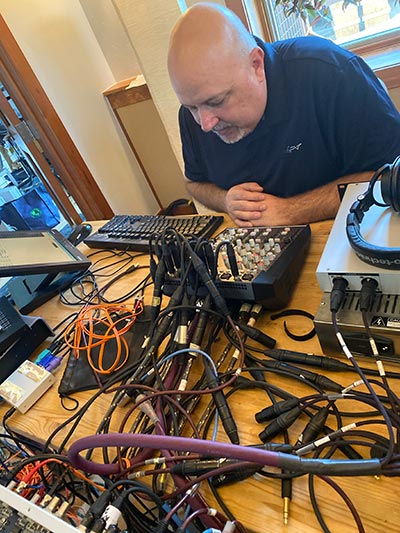
Gus Skinas

The other part of the Sonoma system is a DSD signal processor where you can mix and do dynamic processing, all at the DSD sample rate. I think the important thing is that you stay at that high sample rate and if you do that, the system lets you do all your processing at that [native] rate and it doesn’t sound “digital.” It sounds very authentic and there’s an emotional connection.

The Sonoma recorder sounds, and more importantly it feels like it’s going to analog tape. If we’re going to keep this analog feeling, we have to do pretty much everything in the analog domain (other than the initial DSD recording).

FD: Don, What was the inspiration for Out of Thin Air? How did you go about composing it?

Don Grusin: I wanted to make a statement with our first recording in my new Moose Sound studio. Also, I wanted to explore the acoustics of the studios and work with [Five/Four Productions recording engineer] Robert Friedrich and Gus, super-pro guys.

Don Grusin

I’ve always been impressed by my heroes, and wrote a theme for them, “Keyroes,” on the record. My favorite players are Herbie Hancock, Keith Jarrett, Oscar Peterson, Bill Evans, Marian McPartland, Art Tatum, Thelonious Monk, my brother Dave Grusin and maybe most importantly Joe Zawinul if I had to choose one. And then the new guys like Russell Ferrante, Alan Pasqua, Mitch Forman, Eliane Elias, Otmaro Ruiz, Brad Mehldau – there are so many I admire!

I’m listening now to Arthur Rubenstein doing all the Chopin catalogue and am newly-amazed at his sense of touch and physical grasp of the piano, a not very forgiving instrument played at that level.

FD: What would you call your music – inspired by jazz, life experiences, or something else?

DG: After Paul McGowan and Gus Skinas suggested I do this project up here in the mountains, I started thinking and writing, influenced by the beauty of the place. In a couple of cases I drew on music that I had already written or recorded on previous albums; for example, “Carência” and “The Last Train.”

For a time I didn’t want to be called a jazz musician but when I was [a young kid] in school, when learning classical, the girls in the class kicked my butt! So I went in a different direction. I’m not a trained musician – I play all street stuff.

Inspiration for me comes from so many years traveling to other countries, living in LA and in Mexico, the ocean, and the amazing lineup of music friends I’ve made through music. Also, their friends who run restaurants or gas stations, or radio people, the attorneys, the movie guys – it all adds to a hefty collection of experiences which almost unconsciously guide my playing and composing. It’s like having a world of consultants from every corner and every part of life.

FD: Gus, how did you record the Out of Thin Air album?

GS: We recorded it at Don’s Moose Sound facility, live to stereo. We also recorded it live to surround for SACD. Robert did the recording and mixing and I did the editing and mastering.

Don has a seven and a half-foot Yamaha C7FII grand piano. We used three Sanken CO-100K mics near the piano – very high bandwidth; they go up to 100 kHz. We used a stereo ribbon AEA R88 mic to get the room sound, both for the surround-sound version and we also added some of that into the stereo mix. We ran the Forsell mic preamps into a tiny little SSL SiX console. Live to stereo. It’s the way records should be made.


A view from the Yamaha C7FII piano.

FD: Did you use any compression or plug-ins?

GS: We had a compressor inserted in case of overloads, but it never triggered.

Our philosophy [at Octave] is that we’re going to be recording pretty much everything using DSD recorders and DSD and analog signal processing. Fairly simple projects in terms of the complexity of the production. We have a small main recording space but we can put the drums out into the warehouse [adjoining the main studio] and get this giant big warehouse sound for the drums. It sounds really great with the natural reverb in the warehouse. We’ll do that on the weekends or evenings when the factory’s not in operation.

Mostly when we record here we’ll go through the Forsell or Grace mic preamps straight to the [Sonoma] machine. We try to stay away from compression but if we need it the compressors in the Studer console are very good. I’m monitoring using three PS Audio BHK Mono 300 amplifiers, power conditioners and a DirectStream DAC to monitor the Red Book CD when mastering. In the control room, we are monitoring on ATC-SCM50 loudspeakers, and in the mastering room, we are monitoring on the Sony ES SS-M9ED speakers that go up to 100 kHz.


A view from the Moose Studios control room.

FD: What do you think of the “loudness wars” and all that?

GS: I’m not a part of it. We don’t participate in that at all. Pop music…it’s what all the pop mastering engineers are doing. But it’s not as bad as it used to be. If it’s not loud enough, just turn up the volume!

I just want it to sound natural. I want it to sound real. And the whole thing with DSD is, it sounds, and more importantly feels authentic. With PCM [digital] you can have something that sounds great, but it doesn’t necessarily feel authentic. There’s something wrong with it, your brain knows that there’s something wrong with it, and it kind of pushes you away a little bit. I believe that the authenticity is directly related to the sample rate. DSD is in the millions. PCM is in the thousands.

The common belief is that we can only hear sound between 20Hz and 20kHz. I’m not sure this is correct. I believe we perceive sound much further up even if we can’t hear a tone above 20 kHz. And we definitely perceive [problems] in the timing of things. These might be very small and pretty much unmeasurable but we do perceive them. And it affects the believability of what we hear. I believe these timing problems are greater as the sample rate goes lower. The higher the sample rate, the closer we get to analog.

I want to mention something John Hiatt said after we finished recording Master of Disaster. An interviewer asked him, “why do you go through the trouble to record to this new technology when you could just run Pro Tools and be done with it?” [Pro Tools is an industry-standard computer recording program – Ed.]

Hiatt replied, “what the ear hears, the heart must believe.”

To me, that’s it in a nutshell!

FD: Don, what was it like to record the music?

DG: Such great fun. The ears of both Gus and Robert are astounding. They would point out something and describe what they heard, and only then in some cases could I “hear” it. I’ve recorded with many giant engineers including Roger Nichols and Don Murray, but this one was a new experience for me.

And to [be able to] play freely, enabled me to get “out of body and mind” at times and just let the essential “artist” part of me come through. It’s a feeling I really like and it doesn’t always happen that way.

FD: Gus, for future releases are you going to stick to this kind of live-in-the-studio, minimalist kind of recording concept or are you open to, say a Steely Dan kind of big production thing?

GS: We’re not doing heavily processed and produced projects. It’ll be pretty much simple recordings of small bands, duos, trios, maybe some jazz quartets, stuff like that. Good musicians and very simple micing and recording to DSD. We want to keep that believability thing in everything we do.

More from Issue 113

View All Articles in Issue 113

Search Copper Magazine

#225 Capital Audiofest 2025: Must-See Stereo, Part One by Frank Doris Dec 01, 2025 #225 Otis Taylor and the Electrics Delivers a Powerful Set of Hypnotic Modern Blues by Frank Doris Dec 01, 2025 #225 A Christmas Miracle by B. Jan Montana Dec 01, 2025 #225 T.H.E. Show New York 2025, Part Two: Plenty to See, Hear, and Enjoy by Frank Doris Dec 01, 2025 #225 Underappreciated Artists, Part One: Martin Briley by Rich Isaacs Dec 01, 2025 #225 Rock and Roll is Here to Stay by Wayne Robins Dec 01, 2025 #225 A Lifetime of Holiday Record (and CD) Listening by Rudy Radelic Dec 01, 2025 #225 Little Feat: Not Saying Goodbye, Not Yet by Ray Chelstowski Dec 01, 2025 #225 How to Play in a Rock Band, Part 18: Dealing With Burnout by Frank Doris Dec 01, 2025 #225 The People Who Make Audio Happen: CanJam SoCal 2025 by Harris Fogel Dec 01, 2025 #225 Chicago’s Sonic Sanctuaries: Four Hi‑Fi Listening Bars Channeling the Jazz‑Kissa Spirit by Olivier Meunier-Plante Dec 01, 2025 #225 From The Audiophile’s Guide: Controlling Bass Frequencies Through Membrane Absorbers (and How to Build Your Own) by Paul McGowan Dec 01, 2025 #225 Your Editor’s Tips for Attending Audio Shows by Frank Doris Dec 01, 2025 #225 PS Audio in the News by Frank Doris Dec 01, 2025 #225 Back to My Reel-to-Reel Roots, Part 24 by Ken Kessler Dec 01, 2025 #225 Holiday Music by Frank Doris Dec 01, 2025 #225 Puppy Prognostication by Peter Xeni Dec 01, 2025 #225 How to Post Comments on Copper by Frank Doris Dec 01, 2025 #225 Living Color by Rudy Radelic Dec 01, 2025 #224 T.H.E. Show New York 2025, Part One: A New Beginning by Frank Doris Nov 03, 2025 #224 Fool’s Leap of Faith is the Extraordinary Octave Records Debut from Singer/Songwriter Tyler Burba and Visit by Frank Doris Nov 03, 2025 #224 The Beatles’ “Aeolian Cadences.” What? by Wayne Robins Nov 03, 2025 #224 Persona Non Grata by B. Jan Montana Nov 03, 2025 #224 Talking With Recording Engineer Barry Diament of Soundkeeper Recordings, Part Two by Frank Doris Nov 03, 2025 #224 B Sides, B Movies, and Beware of Zombies by Rudy Radelic Nov 03, 2025 #224 The Burn-In Chronicles: 1,000 Hours to Sonic Salvation by Olivier Meunier-Plante Nov 03, 2025 #224 A Conversation With Mat Weisfeld of VPI Industries by Joe Caplan Nov 03, 2025 #224 Blues-Rocker Kenny Wayne Shepherd Celebrates 30 Years of Ledbetter Heights by Ray Chelstowski Nov 03, 2025 #224 Playing in a Rock Band, 17: When Good Gigs Go Bad, Part Two by Frank Doris Nov 03, 2025 #224 From The Audiophile’s Guide: Dealing with Odd-Shaped Rooms by Paul McGowan Nov 03, 2025 #224 TEAC’s TN-3B-SE Turntable Plays Bob Dylan by Howard Kneller Nov 03, 2025 #224 PS Audio in the News by Frank Doris Nov 03, 2025 #224 Lost in Translation by Peter Xeni Nov 03, 2025 #224 Reel-to-Reel Roots, Part 23: Better Than Rice Krispies by Ken Kessler Nov 03, 2025 #224 I Bring Joy! by Frank Doris Nov 03, 2025 #224 Screen Test by Rich Isaacs Nov 03, 2025 #224 How to Post Comments on Copper by Frank Doris Nov 03, 2025 #132 Dr. Patrick Gleeson: The Interview, Part Two by Rich Isaacs Oct 07, 2025 #223 World Fusion Meets Flamenco in Gratitude from Steve Mullins and Rim of the Well by Frank Doris Oct 06, 2025 #223 Judging Albums by Their Covers by Rich Isaacs Oct 06, 2025 #223 Recent Arrivals and 12-inch Royalty by Rudy Radelic Oct 06, 2025 #223 Summer of Creem, Part Two by Wayne Robins Oct 06, 2025 #223 Recording Engineer Barry Diament of Soundkeeper Recordings: Striving for Natural Sound by Frank Doris Oct 06, 2025 #223 Tea on the Terrace by B. Jan Montana Oct 06, 2025 #223 How Good Can Car Audio Get? by Joe Caplan Oct 06, 2025 #223 The Advantages of a Dedicated Listening Room by Paul McGowan Oct 06, 2025 #223 1! 2! 3! 4! Surrounded by the Ramones in Dolby Atmos! by Frank Doris Oct 06, 2025

Introducing Octave Records: Audiophile Sound, Benefiting Musicians

Introducing Octave Records: Audiophile Sound, Benefiting Musicians

Hope you don’t mind if I put on my proud-family-member hat here, to announce that PS Audio has just launched a new record label, Octave Records. As you might expect, Octave is dedicated to audiophile-quality sound – but the label is also doing something unique in terms of artist compensation.

Octave is covering 100% of all studio, mixing, mastering, production, distribution and marketing expenses – so that artists may directly share in retain sales revenues. The artists will also retain ownership of their music. The label’s intent is to give artists a creative as well as financially supportive environment.

Octave Records’ first release is Out of Thin Air by musician/composer Don Grusin. It’s a jazz-tinged solo piano recording, now available as a limited-edition two-disc set with a DSD pure stereo and multichannel hybrid SACD, plus a DVD data disc containing hi-res stereo 192kHz/24-bit PCM and DSD files.

Gus Skinas is the recording and mastering engineer behind Octave Records and its studio, located in PS Audio’s Boulder, Colorado facility. He’s worked on hundreds of recordings from the Rolling Stones to Nat King Cole. We took the opportunity to talk about the technology and philosophy behind Octave and Gus’ approach to recording, and ask Don Grusin for his thoughts.

Frank Doris: What kind of recording and mastering equipment are you using?

Gus Skinas: We’re using the Sonoma DSD system. One part of it is a recorder, and the other part is a DSD processor. The recorder can be used for up to 32-track recording. We have that hooked to a Studer analog mixing console. If we’re recording here in Boulder we’ll generally go direct into the recorder using Forsell mic preamps, and use the Studer to mix. [If recording on location, Gus takes the Sonoma units with him – Ed.]

Gus Skinas

The other part of the Sonoma system is a DSD signal processor where you can mix and do dynamic processing, all at the DSD sample rate. I think the important thing is that you stay at that high sample rate and if you do that, the system lets you do all your processing at that [native] rate and it doesn’t sound “digital.” It sounds very authentic and there’s an emotional connection.

The Sonoma recorder sounds, and more importantly it feels like it’s going to analog tape. If we’re going to keep this analog feeling, we have to do pretty much everything in the analog domain (other than the initial DSD recording).

FD: Don, What was the inspiration for Out of Thin Air? How did you go about composing it?

Don Grusin: I wanted to make a statement with our first recording in my new Moose Sound studio. Also, I wanted to explore the acoustics of the studios and work with [Five/Four Productions recording engineer] Robert Friedrich and Gus, super-pro guys.

Don Grusin

I’ve always been impressed by my heroes, and wrote a theme for them, “Keyroes,” on the record. My favorite players are Herbie Hancock, Keith Jarrett, Oscar Peterson, Bill Evans, Marian McPartland, Art Tatum, Thelonious Monk, my brother Dave Grusin and maybe most importantly Joe Zawinul if I had to choose one. And then the new guys like Russell Ferrante, Alan Pasqua, Mitch Forman, Eliane Elias, Otmaro Ruiz, Brad Mehldau – there are so many I admire!

I’m listening now to Arthur Rubenstein doing all the Chopin catalogue and am newly-amazed at his sense of touch and physical grasp of the piano, a not very forgiving instrument played at that level.

FD: What would you call your music – inspired by jazz, life experiences, or something else?

DG: After Paul McGowan and Gus Skinas suggested I do this project up here in the mountains, I started thinking and writing, influenced by the beauty of the place. In a couple of cases I drew on music that I had already written or recorded on previous albums; for example, “Carência” and “The Last Train.”

For a time I didn’t want to be called a jazz musician but when I was [a young kid] in school, when learning classical, the girls in the class kicked my butt! So I went in a different direction. I’m not a trained musician – I play all street stuff.

Inspiration for me comes from so many years traveling to other countries, living in LA and in Mexico, the ocean, and the amazing lineup of music friends I’ve made through music. Also, their friends who run restaurants or gas stations, or radio people, the attorneys, the movie guys – it all adds to a hefty collection of experiences which almost unconsciously guide my playing and composing. It’s like having a world of consultants from every corner and every part of life.

FD: Gus, how did you record the Out of Thin Air album?

GS: We recorded it at Don’s Moose Sound facility, live to stereo. We also recorded it live to surround for SACD. Robert did the recording and mixing and I did the editing and mastering.

Don has a seven and a half-foot Yamaha C7FII grand piano. We used three Sanken CO-100K mics near the piano – very high bandwidth; they go up to 100 kHz. We used a stereo ribbon AEA R88 mic to get the room sound, both for the surround-sound version and we also added some of that into the stereo mix. We ran the Forsell mic preamps into a tiny little SSL SiX console. Live to stereo. It’s the way records should be made.


A view from the Yamaha C7FII piano.

FD: Did you use any compression or plug-ins?

GS: We had a compressor inserted in case of overloads, but it never triggered.

Our philosophy [at Octave] is that we’re going to be recording pretty much everything using DSD recorders and DSD and analog signal processing. Fairly simple projects in terms of the complexity of the production. We have a small main recording space but we can put the drums out into the warehouse [adjoining the main studio] and get this giant big warehouse sound for the drums. It sounds really great with the natural reverb in the warehouse. We’ll do that on the weekends or evenings when the factory’s not in operation.

Mostly when we record here we’ll go through the Forsell or Grace mic preamps straight to the [Sonoma] machine. We try to stay away from compression but if we need it the compressors in the Studer console are very good. I’m monitoring using three PS Audio BHK Mono 300 amplifiers, power conditioners and a DirectStream DAC to monitor the Red Book CD when mastering. In the control room, we are monitoring on ATC-SCM50 loudspeakers, and in the mastering room, we are monitoring on the Sony ES SS-M9ED speakers that go up to 100 kHz.


A view from the Moose Studios control room.

FD: What do you think of the “loudness wars” and all that?

GS: I’m not a part of it. We don’t participate in that at all. Pop music…it’s what all the pop mastering engineers are doing. But it’s not as bad as it used to be. If it’s not loud enough, just turn up the volume!

I just want it to sound natural. I want it to sound real. And the whole thing with DSD is, it sounds, and more importantly feels authentic. With PCM [digital] you can have something that sounds great, but it doesn’t necessarily feel authentic. There’s something wrong with it, your brain knows that there’s something wrong with it, and it kind of pushes you away a little bit. I believe that the authenticity is directly related to the sample rate. DSD is in the millions. PCM is in the thousands.

The common belief is that we can only hear sound between 20Hz and 20kHz. I’m not sure this is correct. I believe we perceive sound much further up even if we can’t hear a tone above 20 kHz. And we definitely perceive [problems] in the timing of things. These might be very small and pretty much unmeasurable but we do perceive them. And it affects the believability of what we hear. I believe these timing problems are greater as the sample rate goes lower. The higher the sample rate, the closer we get to analog.

I want to mention something John Hiatt said after we finished recording Master of Disaster. An interviewer asked him, “why do you go through the trouble to record to this new technology when you could just run Pro Tools and be done with it?” [Pro Tools is an industry-standard computer recording program – Ed.]

Hiatt replied, “what the ear hears, the heart must believe.”

To me, that’s it in a nutshell!

FD: Don, what was it like to record the music?

DG: Such great fun. The ears of both Gus and Robert are astounding. They would point out something and describe what they heard, and only then in some cases could I “hear” it. I’ve recorded with many giant engineers including Roger Nichols and Don Murray, but this one was a new experience for me.

And to [be able to] play freely, enabled me to get “out of body and mind” at times and just let the essential “artist” part of me come through. It’s a feeling I really like and it doesn’t always happen that way.

FD: Gus, for future releases are you going to stick to this kind of live-in-the-studio, minimalist kind of recording concept or are you open to, say a Steely Dan kind of big production thing?

GS: We’re not doing heavily processed and produced projects. It’ll be pretty much simple recordings of small bands, duos, trios, maybe some jazz quartets, stuff like that. Good musicians and very simple micing and recording to DSD. We want to keep that believability thing in everything we do.

0 comments

Leave a comment

0 Comments

Your avatar

Loading comments...

🗑️ Delete Comment

Enter moderator password to delete this comment: