COPPER

A PS Audio Publication

Issue 144 • Free Online Magazine

Issue 144 Deep Dive

Cassette Multitrack Recorders: the Original DIY Studios in a Box

Cassette Multitrack Recorders: the Original DIY Studios in a Box

During the 1960s and 1970s the notion of a personal studio for an artist to record demos or possibly masters of their songs was still an expensive prospect, involving reel-to-reel multitrack recorders, mixing consoles, and other equipment. Artists who recorded at home to fine-tune their material were all famous musicians. Les Paul, Pete Townshend, Paul McCartney, Stevie Wonder, and Todd Rundgren are among the few who decided to play all of the instruments, and engineer and produce records from those home studio efforts during that era.

However, when Bruce Springsteen released his highly acclaimed 1982 solo acoustic record, Nebraska, much publicity was made over the fact that Springsteen had recorded it at home on a TASCAM 144 Portastudio cassette 4-track unit with a couple of Shure SM57 microphones. Thus, instant credibility was achieved for a novel invention by TEAC’s TASCAM division and an entirely new DIY market was born.

Essentially, the Portastudio used the two left and right channels on each side of a standard audio cassette tape, with its recording head configured to allow for all four tracks to be recorded upon in the same direction (as opposed to flipping over the tape to play both “sides” of cassette on a standard stereo playback machine). With its four VU meters and basic two-band equalization, panning, gain and volume controls all built into a single small desktop unit, the Portastudio 144 made DIY bedroom recording finally available to thousands of musicians, songwriters and producers. (Although home-use four-track reel to reel tape machines like the classic TEAC 2340, A-3340 and A-3340S had been available since the 1970s, their cost put them out of reach for most musicians.)

Three years after the unit’s 1979 debut at AES, TASCAM released the Portastudio 244, which had parametric EQ, DBX noise reduction, varispeed, and simultaneous recording capability on all four tracks.
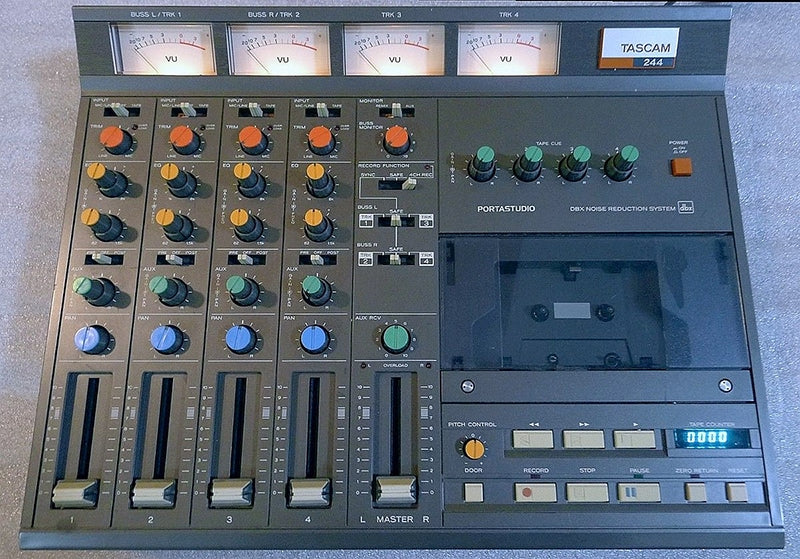
 

Tascam Portastudio 244. Many budding musicians and recordists got their start on this machine. Courtesy of Wikimedia Commons/CountrySkyStudio.

Portastudios were the ideal songwriting tool for home experimentation or for bands on the road. Cassettes were relatively cheap, easy to store, and delivered good-enough sound to be used for commercial music releases, and to be used in conjunction with more professional recording formats. Rival manufacturers including Fostex, Yamaha, Marantz, Akai and Vesta would soon follow, hot on TASCAM’s heels with their own portable multitrack studio-in-a-box offerings.

In 1986, TASCAM released the Portastudio 246, featuring six channels and a higher 3.75 ips (inches per second) tape speed for better sound quality.

TASCAM Portastudio-recorded tracks would subsequently pop up on many singles and albums from artists throughout the 1980s and 1990s. Some of the better-known ones include:

“Kiss From A Rose” – Seal

New York (various tracks and original demos) – Lou Reed

Smile From The Streets You Hold – John Frusciante

Enter the Wu-Tang (36 Chambers) – Wu-Tang Clan

Fostex had its own line of compact 4-track cassette recording units that competed with TASCAM. In 1983 Fostex launched the X-15, which was about the size of a hardcover book and pared down the controls to a bare minimum, while still maintaining the primary recording and playback functions required by most users. Its main advantage over the Portastudio was its genuine portability – it also worked on batteries, thus making it an excellent multitrack field recording unit. TASCAM’s Porta One, a competing battery-powered unit, would not reach the market until the 1990s.

Apart from their cassette multitrack units, Fostex also created the first 16-track half-inch reel-to-reel deck designed for home studio recording: the B-16. Its popularity was so great that at one point, Ampex had a problem meeting demand for the half-inch-format 456 recording tape that the B-16 used. The B-16 became the cornerstone of Be-Bop Deluxe founder Bill Nelson’s home studio in the UK. He used it to record and release some two dozen or more albums.
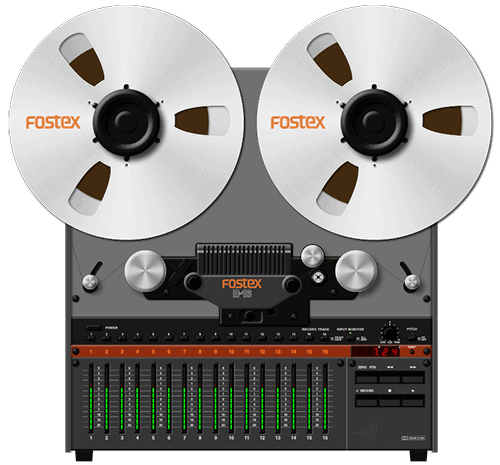
 

Fostex B-16 multitrack recorder. Fostex B-16 multitrack recorder.

Yamaha’s MT2X, MT50 and other MT Series multitrack cassette recorders competed head-to-head with the Fostex X-15 as battery-powered studio-in-a-box field recorders. However, Yamaha also decided to compete with the desktop form factor Portastudios by offering a mixer designed to work with Yamaha’s MT multitrack units: the MG10/2 Series. Sporting RCA jacks for easy connections, individual effects sends on each channel, and several extra inputs for adding additional sounds on the fly in a mix, the Yamaha MG 10/2 instilled a degree of mixing flexibility that superseded both TASCAM’s and Fostex’s products at the time.

At the height of the 4-track cassette recording boom, one of the more popular ads at the time for these machines featured the cover of the Beatles’ Sgt. Pepper album with the caption, “it was recorded on a 4-track machine…and now you can have one too!”
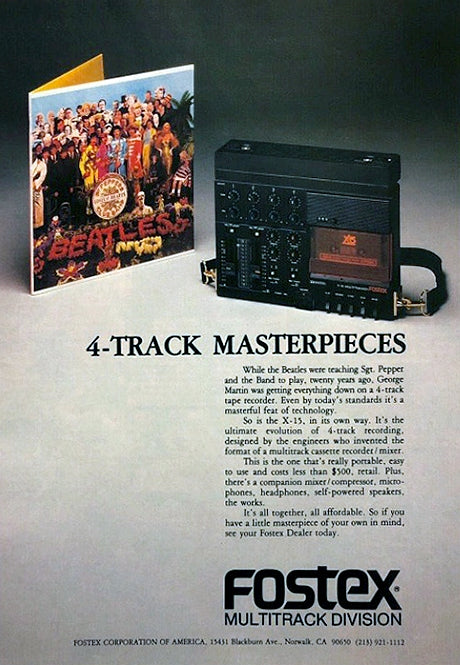
Fostex ad featuring the X-15 cassette multitrack recorder.

Technology continued to push the envelope in the 1990s, and features like balanced XLR input jacks with phantom power, LED and LCD meters, and higher input channel counts on more expensive models became more prevalent. Also, cheaper models with fewer features, like shelving instead of parametric EQ, and the reduction of four separate input busses to two L/R busses, lowered the entry point for buying a multitrack recorder. With the awareness that MIDI (Musical Instrument Digital Interface) had become the key factor in syncing drum machines and keyboards with digital sequencers, TASCAM released its 644 (4-track) and 688 (8-track) MIDIstudio recorders, which were essentially Portastudios with MIDI routing capability.

TASCAM unveiled its 488, the first 8-track Portastudio, at a time when DAT (Digital Audio Tape) had already hit the market, and digital sampling was becoming popular. Despite squeezing eight tracks onto a cassette at roughly 0.25mm track width per track, the 488 Portastudio specs touted a 40Hz-14 kHz bandwidth and a 90dB S/N ratio with less than 70dB crosstalk. One drawback was that the parametric EQ of the 244 had been replaced by a simpler low- (100 Hz) and high- (10 kHz) 12dB cut/boost configuration. Although there were two effects sends, only one or the other could be engaged in a channel strip, not both.

Acknowledging the need for syncing to MIDI, the 488 had automatic bypass routing to track 8 in order to record a MIDI sync tone.

The biggest drawback of the 488 was its lack of outputs for use with external amps and speakers. It only had a headphone output, which meant that working with other musicians and any kind of serious mixing would require feeding the headphone output into an amplifier via some kind of adapter or outboard unit.

Inevitably, analog cassette-based multitrack recorders would be superseded by digital technology. In 1992 Alesis introduced the first (relatively) compact multitrack digital recorder, the 8-track ADAT, which used the then-new DAT (Digital Audio Tape). Tascam followed in 1993 with its DA-88, which recorded on 8 mm videotape. Companies like Korg, Zoom, Roland and others followed. Analog cassette tapes as a medium were eclipsed by compact multitrack recorders with internal hard disc drives and the ability to record onto recordable CD burners, and later onto SD Cards and flash drives.

Although so much recording today is done using computers running DAW (Digital Audio Workstation) software, many musicians and producers still want the ease of use and workflow of using actual recording machines. While it’s true that the flexibility and features of a DAW with plug-ins are widening the technology and functionality gap compared to standalone compact recorders, the latter still retain a loyal following and now boast vastly superior sound quality and storage capability, in the same-sized packages as their predecessors from 40 years ago. Units such as the TASCAM Portastudio DP-32SD can also connect to a DAW via USB and can seamlessly merge tracks via direct uploads, or create files that can then be emailed to other musicians for remote collaboration. The compact recorders of today also sport DSP reverb, delay, chorus, compression, distortion, and other effects, that often are quieter than outboard rack-mounted gear.
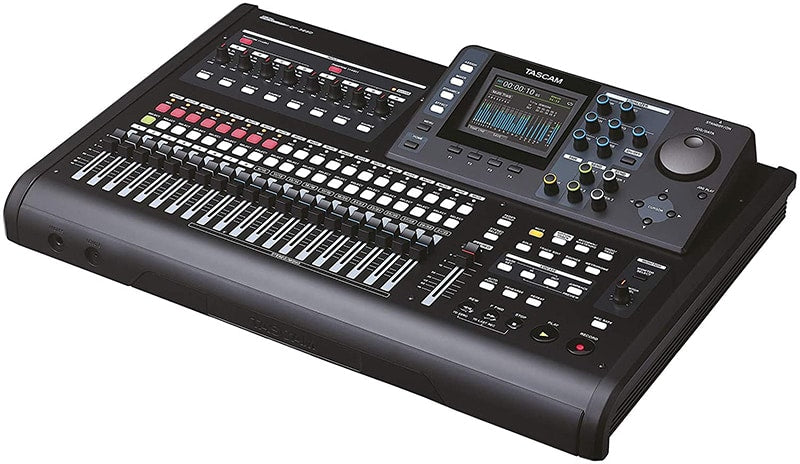
 

TASCAM DR-32SD digital multitrack recorder. TASCAM DP-32SD digital multitrack recorder.

Perhaps the full-circle irony of the Portastudio saga is that in 2010, TASCAM released an iPad app of the Portastudio 144.

The book isn’t closed on those old analog machines. With over one million units sold since 1979, multitrack cassette recorders will likely be around for a long time. Dozens are advertised on eBay and other outlets every day. Artists from Springsteen to Lady Gaga, who received a Portastudio as a gift from her father while in her teens, are fans, and still use them for the creative mojo and inspiration they deliver.

Header image: Fostex 250 cassette multitrack recorder.

More from Issue 144

View All Articles in Issue 144

Search Copper Magazine

#233 A Report From The Total Hi-Fi Experience Show SoCal 2026 by B. Jan Montana Aug 03, 2026 #233 Bluegrass Meets Country, Folk, Jazz and More in All That We Carried by The Squid City Slingers by Frank Doris Aug 03, 2026 #233 Corey Glover and One Tribe Nation: A Variegated Musical Collective by Ray Chelstowski Aug 03, 2026 #233 Excursions with Clive: The Late Clive Davis, A Personal History by Wayne Robins Aug 03, 2026 #233 AI, Art, and Music: A Conversation With Synthography Art by Joe Caplan Aug 03, 2026 #233 New American Symphonies: A Rediscovered Gem and a Vital Contemporary Work by Frank Doris Aug 03, 2026 #233 The Vinyl Beat: Genesis, the Dave Clark Five, Antonio Carlos Jobim and More by Rudy Radelic Aug 03, 2026 #233 How to Play in a Rock Band, 26: When It's Time to Record Your Music by Frank Doris Aug 03, 2026 #233 More From T.H.E. Show 2026, and the People Who Made it Happen by Harris Fogel Aug 03, 2026 #233 Underappreciated Artists, Part Three: Icehouse by Rich Isaacs Aug 03, 2026 #233 The Surprisingly Rich and Varied Music of Somalia by Steve Kindig Aug 03, 2026 #233 A Remarkable Discographic Legacy: The LP Recordings of the Basel Symphony Orchestra by Stephan Haberthür Aug 03, 2026 #233 From The Audiophile’s Guide: The Importance of Loudspeakers by Paul McGowan Aug 03, 2026 #233 From Swimming Pool to New Listening Room: A Conversation with Norman Varney of AV RoomService by Gilles Laferrière Aug 03, 2026 #233 PS Audio in the News by PS Audio Staff Aug 03, 2026 #233 Audio Jewelry by Peter Xeni Aug 03, 2026 #233 Enrich Your Life by Frank Doris Aug 03, 2026 #233 The Searcher by James Schrimpf Aug 03, 2026 #232 What came first: Art or Music? A Conversation With Artist Jose Acosta by Joe Caplan Jul 06, 2026 #232 Blow By Blow: The Jeff Beck Story: An Insightful Book About a Guitar Icon by Ray Chelstowski Jul 06, 2026 #232 Creed Over Camaraderie? by B. Jan Montana Jul 06, 2026 #232 Chronicles of a Sound Pilgrim at the 2026 Montreal Audiofest by Hugues Morin Jul 06, 2026 #232 The Vinyl Beat: Summer Grooves by Rudy Radelic Jul 06, 2026 #232 Hibbing Hillbilly Dylan's Acoustic Rock by Wayne Robins Jul 06, 2026 #232 Quad Quads and Plasmatronics Tweeters: An Extraordinary System Comes to Life by Frank Doris Jul 06, 2026 #232 In Praise of Live Music, Once Again by Ted Shafran Jul 06, 2026 #232 Allnic Audio’s L-9000 Preamplifier: Design and Engineering Innovation by Howard Kneller Jul 06, 2026 #232 “Best Of” Lists and Rage Bait: Enough Already by Frank Doris Jul 06, 2026 #232 Quick Takes: Bud Shank, Paulo Almeida, Jakob Dreyer, Tim Eriksen and Peter Irvine by Frank Doris Jul 06, 2026 #232 My Impressions of AXPONA 2026, Part 2 by Frank Doris Jul 06, 2026 #232 How to Play in a Rock Band, 25: Encounters With Famous Musicians, Part Three by Frank Doris Jul 06, 2026 #232 Budgets, and Systems From Small to Outrageous by Paul McGowan Jul 06, 2026 #232 PS Audio in the News by PS Audio Staff Jul 06, 2026 #232 Hand It Over by Frank Doris Jul 06, 2026 #232 Difference of Opinion by Peter Xeni Jul 06, 2026 #232 Wabi-sabi Tree by James Schrimpf Jul 06, 2026 #231 Piano Prodigy Jude Kofie Releases His Debut Album On Octave Records by Frank Doris Jun 01, 2026 #231 Underappreciated Artists, Part Two: City Boy by Rich Isaacs Jun 01, 2026 #231 Music and the Art of Creation: Talking With Saxophonist Rob Scheps by Joe Caplan Jun 01, 2026 #231 How to Play in a Rock Band, 24: Further Adventures at the 2026 Montauk Music Festival by Frank Doris Jun 01, 2026 #231 Courtney Barnett: Creature of Habit by Wayne Robins Jun 01, 2026 #231 Angine de Poitrine: Interstellar Guitar Rock Saviors Headed for Late-Night TV Pop Stardom? by Mark Lepage Jun 01, 2026 #231 My Impressions of AXPONA 2026, Part One by Frank Doris Jun 01, 2026 #231 2026 La Jolla Concours d'Elegance: Another Aesthetic Feast by B. Jan Montana Jun 01, 2026 #231 Country Music Icon Jo Dee Messina’s Bridges: A New Beginning by Ray Chelstowski Jun 01, 2026 #231 The Luxury Dispatch Hosts a Video Podcast With Ken Kessler by Ken Kessler Jun 01, 2026 #231 The Vinyl Beat: Tracking in the Motor City by Rudy Radelic Jun 01, 2026

Cassette Multitrack Recorders: the Original DIY Studios in a Box

Cassette Multitrack Recorders: the Original DIY Studios in a Box

During the 1960s and 1970s the notion of a personal studio for an artist to record demos or possibly masters of their songs was still an expensive prospect, involving reel-to-reel multitrack recorders, mixing consoles, and other equipment. Artists who recorded at home to fine-tune their material were all famous musicians. Les Paul, Pete Townshend, Paul McCartney, Stevie Wonder, and Todd Rundgren are among the few who decided to play all of the instruments, and engineer and produce records from those home studio efforts during that era.

However, when Bruce Springsteen released his highly acclaimed 1982 solo acoustic record, Nebraska, much publicity was made over the fact that Springsteen had recorded it at home on a TASCAM 144 Portastudio cassette 4-track unit with a couple of Shure SM57 microphones. Thus, instant credibility was achieved for a novel invention by TEAC’s TASCAM division and an entirely new DIY market was born.

Essentially, the Portastudio used the two left and right channels on each side of a standard audio cassette tape, with its recording head configured to allow for all four tracks to be recorded upon in the same direction (as opposed to flipping over the tape to play both “sides” of cassette on a standard stereo playback machine). With its four VU meters and basic two-band equalization, panning, gain and volume controls all built into a single small desktop unit, the Portastudio 144 made DIY bedroom recording finally available to thousands of musicians, songwriters and producers. (Although home-use four-track reel to reel tape machines like the classic TEAC 2340, A-3340 and A-3340S had been available since the 1970s, their cost put them out of reach for most musicians.)

Three years after the unit’s 1979 debut at AES, TASCAM released the Portastudio 244, which had parametric EQ, DBX noise reduction, varispeed, and simultaneous recording capability on all four tracks.


Tascam Portastudio 244. Many budding musicians and recordists got their start on this machine. Courtesy of Wikimedia Commons/CountrySkyStudio.

Portastudios were the ideal songwriting tool for home experimentation or for bands on the road. Cassettes were relatively cheap, easy to store, and delivered good-enough sound to be used for commercial music releases, and to be used in conjunction with more professional recording formats. Rival manufacturers including Fostex, Yamaha, Marantz, Akai and Vesta would soon follow, hot on TASCAM’s heels with their own portable multitrack studio-in-a-box offerings.

In 1986, TASCAM released the Portastudio 246, featuring six channels and a higher 3.75 ips (inches per second) tape speed for better sound quality.

TASCAM Portastudio-recorded tracks would subsequently pop up on many singles and albums from artists throughout the 1980s and 1990s. Some of the better-known ones include:

“Kiss From A Rose” – Seal

New York (various tracks and original demos) – Lou Reed

Smile From The Streets You Hold – John Frusciante

Enter the Wu-Tang (36 Chambers) – Wu-Tang Clan

Fostex had its own line of compact 4-track cassette recording units that competed with TASCAM. In 1983 Fostex launched the X-15, which was about the size of a hardcover book and pared down the controls to a bare minimum, while still maintaining the primary recording and playback functions required by most users. Its main advantage over the Portastudio was its genuine portability – it also worked on batteries, thus making it an excellent multitrack field recording unit. TASCAM’s Porta One, a competing battery-powered unit, would not reach the market until the 1990s.

Apart from their cassette multitrack units, Fostex also created the first 16-track half-inch reel-to-reel deck designed for home studio recording: the B-16. Its popularity was so great that at one point, Ampex had a problem meeting demand for the half-inch-format 456 recording tape that the B-16 used. The B-16 became the cornerstone of Be-Bop Deluxe founder Bill Nelson’s home studio in the UK. He used it to record and release some two dozen or more albums.


Fostex B-16 multitrack recorder. Fostex B-16 multitrack recorder.

Yamaha’s MT2X, MT50 and other MT Series multitrack cassette recorders competed head-to-head with the Fostex X-15 as battery-powered studio-in-a-box field recorders. However, Yamaha also decided to compete with the desktop form factor Portastudios by offering a mixer designed to work with Yamaha’s MT multitrack units: the MG10/2 Series. Sporting RCA jacks for easy connections, individual effects sends on each channel, and several extra inputs for adding additional sounds on the fly in a mix, the Yamaha MG 10/2 instilled a degree of mixing flexibility that superseded both TASCAM’s and Fostex’s products at the time.

At the height of the 4-track cassette recording boom, one of the more popular ads at the time for these machines featured the cover of the Beatles’ Sgt. Pepper album with the caption, “it was recorded on a 4-track machine…and now you can have one too!”

Fostex ad featuring the X-15 cassette multitrack recorder.

Technology continued to push the envelope in the 1990s, and features like balanced XLR input jacks with phantom power, LED and LCD meters, and higher input channel counts on more expensive models became more prevalent. Also, cheaper models with fewer features, like shelving instead of parametric EQ, and the reduction of four separate input busses to two L/R busses, lowered the entry point for buying a multitrack recorder. With the awareness that MIDI (Musical Instrument Digital Interface) had become the key factor in syncing drum machines and keyboards with digital sequencers, TASCAM released its 644 (4-track) and 688 (8-track) MIDIstudio recorders, which were essentially Portastudios with MIDI routing capability.

TASCAM unveiled its 488, the first 8-track Portastudio, at a time when DAT (Digital Audio Tape) had already hit the market, and digital sampling was becoming popular. Despite squeezing eight tracks onto a cassette at roughly 0.25mm track width per track, the 488 Portastudio specs touted a 40Hz-14 kHz bandwidth and a 90dB S/N ratio with less than 70dB crosstalk. One drawback was that the parametric EQ of the 244 had been replaced by a simpler low- (100 Hz) and high- (10 kHz) 12dB cut/boost configuration. Although there were two effects sends, only one or the other could be engaged in a channel strip, not both.

Acknowledging the need for syncing to MIDI, the 488 had automatic bypass routing to track 8 in order to record a MIDI sync tone.

The biggest drawback of the 488 was its lack of outputs for use with external amps and speakers. It only had a headphone output, which meant that working with other musicians and any kind of serious mixing would require feeding the headphone output into an amplifier via some kind of adapter or outboard unit.

Inevitably, analog cassette-based multitrack recorders would be superseded by digital technology. In 1992 Alesis introduced the first (relatively) compact multitrack digital recorder, the 8-track ADAT, which used the then-new DAT (Digital Audio Tape). Tascam followed in 1993 with its DA-88, which recorded on 8 mm videotape. Companies like Korg, Zoom, Roland and others followed. Analog cassette tapes as a medium were eclipsed by compact multitrack recorders with internal hard disc drives and the ability to record onto recordable CD burners, and later onto SD Cards and flash drives.

Although so much recording today is done using computers running DAW (Digital Audio Workstation) software, many musicians and producers still want the ease of use and workflow of using actual recording machines. While it’s true that the flexibility and features of a DAW with plug-ins are widening the technology and functionality gap compared to standalone compact recorders, the latter still retain a loyal following and now boast vastly superior sound quality and storage capability, in the same-sized packages as their predecessors from 40 years ago. Units such as the TASCAM Portastudio DP-32SD can also connect to a DAW via USB and can seamlessly merge tracks via direct uploads, or create files that can then be emailed to other musicians for remote collaboration. The compact recorders of today also sport DSP reverb, delay, chorus, compression, distortion, and other effects, that often are quieter than outboard rack-mounted gear.


TASCAM DR-32SD digital multitrack recorder. TASCAM DP-32SD digital multitrack recorder.

Perhaps the full-circle irony of the Portastudio saga is that in 2010, TASCAM released an iPad app of the Portastudio 144.

The book isn’t closed on those old analog machines. With over one million units sold since 1979, multitrack cassette recorders will likely be around for a long time. Dozens are advertised on eBay and other outlets every day. Artists from Springsteen to Lady Gaga, who received a Portastudio as a gift from her father while in her teens, are fans, and still use them for the creative mojo and inspiration they deliver.

Header image: Fostex 250 cassette multitrack recorder.

0 comments

Leave a comment

0 Comments

Your avatar

Loading comments...

🗑️ Delete Comment

Enter moderator password to delete this comment:

✏️ Edit Comment

Enter your email to verify ownership: