Copper Magazine · Issue 158 · A free PS Audio publication
Issue 158 Natural Born Kessler

Back to My Reel-to Reel-Roots, Part 10

Back to My Reel-to Reel-Roots, Part 10

In which Ken Kessler makes a discovery linked to his dad.

Only the churlish would deny that there’s an element of nostalgia in the Reel-to-Reel Revival, however much the inescapably superior sound quality motivates us to return to a costly, inconvenient, niche format. And while I admit that it was nostalgia rather than sonic merit which led me to buying five ostensibly useless tapes, a recent incident in a record store also informed the experience. It reminded me how quickly things are forgotten, like mimeographs and fax machines.

What happened was almost as much a shock about the passage of time as those YouTube clips in which someone hands a cassette to a child or Gen Z-er and they have no idea what it is. I dropped into the relocated HMV store in Canterbury, part of what was the UK’s biggest chain of record shops, which has been downsizing post-pandemic. As it turned out, the smaller store was much nicer than the old one, and – hot damn! – did they have a superb vinyl selection!

As is the staff’s wont, a hipster-ish twenty- or thirty-something approached me to ask if I was able to find what I was looking for, totally helpful and with not a hint of derision on espying a septuagenarian in the store. I told him I was OK, but could he answer one question for me: Is the Vinyl Revolution sustaining itself, or was it a flash-in-the-pan, a mere marketing myth?

“No, sir – it’s doing really well. But it is not without problems.”

“How so?” I asked.

“We get a lot of customers coming back saying their records won’t play. So, we look at them and they’re scratched to hell, covered in food, liquids, whatever. They think they’re like CDs, and that you can wipe ’em off.”

What this reminded me of were the myriad expletives I’ve uttered upon curating tapes which were owned by idiots. Some of you will say that’s not fair, but I must express my dismay at the treatment of tapes which always cost more than LPs, and the users I’m cursing do not have the passage of time as an excuse: they owned them from new. As for the “kids” turning up in record stores with ruined LPs, they simply didn’t know any better because they never experienced vinyl records, or perhaps their parents might have been just as innocent – not a stretch when you consider that CD has been with us for 39 years.

I’ll save the catalogue of tape horrors for another column, but I wanted to use the ignorance of vinyl etiquette as an indicator of my own unawareness of certain open-reel-tape-related matters, and not just the host of unfamiliar labels or artists. This latest revelation came about because of a logo, which caused me to swiftly post a high bid on eBay to secure a pile of tapes, which included five from Voice of Music.

Blame my father for this. He owned a Voice of Music 700 half-track mono all-tube deck (which you can observe him using in Part One of this series, in Issue 146). I hadn’t seen it since the late 1960s, and have no idea what became of it, but I remember it as vividly as our Electrolux vacuum cleaner. The manufacturer is long gone, but it’s supported by a website worth visiting if you’re fascinated by brands lost in the mists of time. (https://www.thevoiceofmusic.com)

When the pile of 5-inch-spool tapes appeared on eBay, among them five with “The Voice of Music” emblazoned on their covers and the burned-into-my-memory-banks V-over-M logo and – more enticingly – four with the legend “The Voice of Music Stereo Tape Library” and one a demo tape with “Not For Resale” on the back, I couldn’t stop myself. By this stage in my return to open-reel tape, I had acquired demonstration tapes and samplers from RadioShack, Ampex, Bel Canto, Capitol, Columbia, and other record labels or hardware manufacturers, tapes with Tandberg’s participation, etc., so why not Voice of Music?


How the Voice of Music tapes will appear on KK’s shelves.


Before playing them, I went through the usual procedure with each one of adding leader tape, fast-forwarding the tape, adding a tail and returning it to its spool in the speed at which it would play. All were 7-1/2 ips 1/2-track tapes, but – unlike LPs and yet unfortunately a condition all-too-common with open-reel-tapes – there were no dates to reveal their vintage.

I started with the sampler, titled Pleasure’s New Sound, with the tempting subtitle, “A Thrilling Demonstration of Stereophonic Sound.” The recordings included spoken introductions and sound effects, with music ranging from easy listening to a taste of Tchaikovsky’s 1812 Overture.

Because I’m anally-retentive, a completist who must own everything by an artist or author, I was dismayed to find that the other four comprised Volumes 1, 2, 4, and 5 of the aforementioned Voice of Music Stereo Tape Library. As Voice of Music’s otherwise-comprehensive website doesn’t yet carry a list of the titles that were issued (and I saw one or two more online), I have no idea what the missing Vol. 3 contains. [Note: I am now in contact with the website, and will report back if a list is forthcoming.]

As for the other four, Vol. 1 is titled Silk Satin & Strings, performed by Wayne Robinson and His Orchestra, with standards such as “Jalousie” and “From This Moment On.” Vol. 2, Big Beat With Mike, gives us Mike Simpson and His Big Band delivering “Cherokee,” “Take the ‘A’ Train” and others. The Musical Arts Symphony Orchestra conducted by Leonard Sorkin performs on Vol. 4, Symphony of Dance, with compositions from Bizet, Rimsky-Korsakov, Glière, and Sibelius. Lastly, Vol. 5, Christmas In Stereo, finds Sorkin again, this time conducting the John Halloran Chorus and the Sorkin Strings, with five seasonal selections.

So far, so good. The boxes were intact, the tapes properly spooled and playing through without snapping when I gave them their initial cleaning. Time to sit down and listen. Feverishly, I threaded the demonstration tape onto my TASCAM 22-2 1/2-track deck. The sound was nothing short of spectacular, as good as the early Jackie Gleason tapes on Capitol, or any of the other 1/2-track 7-1/2 ips in my experience. “Dazzling” doesn’t begin to describe the clarity, fidelity, transient attack or spatial concerns. But something was seriously amiss.

Way back when – 1973 to be precise – Sony or someone else promoting quadraphonic sound issued a 4-channel open-reel demo tape to stores which featured two marching bands fighting each other, performing different material, one band in the front channels, the other in the rear, all the better to convey the surround experience. I was working in a store in Bangor, Maine, and we played it enough times to tire of it, the problem being the disparity in two competing bands, an issue that had nothing to do with truly discrete four-channel sound via a 4-track tape deck, because quadrophonic sound worked perfectly in that format, however much it failed on when “matrixed” onto an LP.

What reminded me of this battle of the bands, and how their disparate performances were so confusing, was a time lag between the right and left channels on the Voice of Music tapes. I thought I had a pretty good handle on open-reel terminology, and knew that “stacked heads” were the same as “in-line heads” or that 4-track and 1/4-track aren’t the same thing. But nobody told me about “offset” or “staggered” heads. Those of you familiar with the format, please bear with me and try not to laugh.

Of course, a quick Google revealed all, how staggered or offset heads formed a short-lived, early stereo format. Prior to the arrival of conventional (a.k.a. stacked or inline) stereo heads, machines could be converted from 2-track mono layouts (like my dad’s 700) to stereo with a second “staggered” head installed next to the original mono head. These addressed the lower half, or track of the tape. They were not, however, aligned in time.

What I was hearing from the Voice of Music tapes via my TASCAM was the 0.167 ms delay between one channel and the next, and it was just enough to drive the listener crazy, like watching a DVD or Blu-ray with slightly out-of-sync dialogue. It was breaking my heart, because – delayed channel notwithstanding – the sound was breathtaking. The bad news was the scarcity of machines from (roughly) 1954 – 1957. But even if I was predisposed toward finding one, it would have been a waste of money. Seriously: Why would anyone buy a tape deck just to play five tapes?

But God bless the advice of the tape geeks! One solution is to record the tapes onto one’s computer and sort out the channel delay with software. Even better was an example of lateral-thinking, which suggested playing them on an Otari MX-5050 and monitoring one channel from the playback head and one from the record monitor head. Apparently, the spacing is precisely the same as those on a deck with offset heads.

Either that, or find myself a Voice of Music 714.
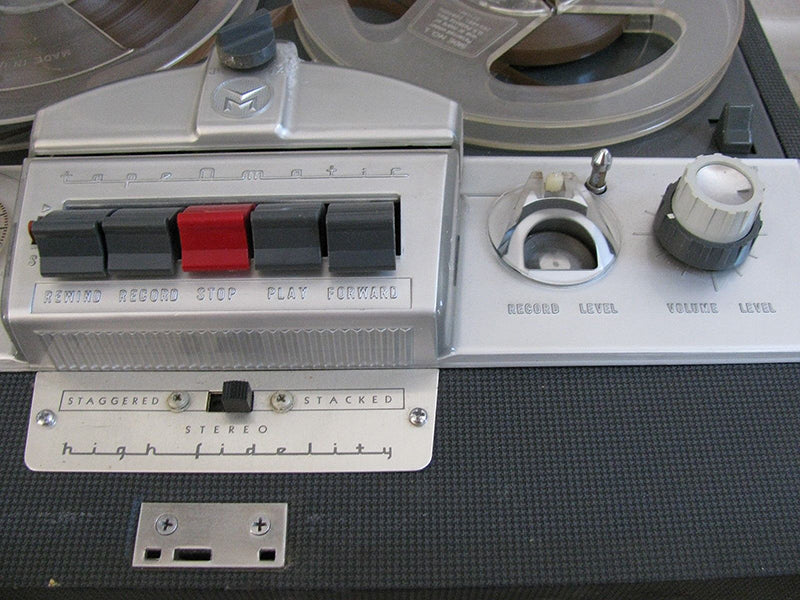
 

Voice of Music Model 714 tape recorder control panel showing its "Staggered/Stacked" switch. From Reel-Reel.com.

Voice of Music Model 714 tape recorder control panel showing its “Staggered/Stacked” switch. From Reel-Reel.com.

More from Issue 158

View All Articles in Issue 158

Search Copper Magazine

#236 Magic Boy: The Jimi Hendrix Experience, Live and Rediscovered by Frank Doris Nov 02, 2026 #236 The Great Rhythmic Divide: Composer David Chesky Asks, Why Doesn't the Symphony Orchestra Groove? by David Chesky Nov 02, 2026 #236 More Record Reviews: Roni Eytan’s Microtonal Harmonica, Jane Ira Bloom, and a Frank Zappa Freak Out by Frank Doris Nov 02, 2026 #236 An Album of Inviting Beauty: Goodnight Moon from Acoustic Eidolon, And an Interview With the Artists Who Created it by Frank Doris Nov 02, 2026 #236 Never Ignore Your Inner Voice by B. Jan Montana Nov 02, 2026 #236 Composer Joseph Bertolozzi Uses Bridges, Structures and the World as Musical Instruments, Part One by Joe Caplan Nov 02, 2026 #236 Transmission: A Powerful Horn-Loaded Album from the Huntertones by Ray Chelstowski Nov 02, 2026 #236 Les Quatre Saisons du Québec: a New “Four Seasons” on Tour and on ATMA Classique by Robert Schryer Nov 02, 2026 #236 From The Audiophile's Guide: A Glossary of Terms for Today's Audio Systems, A – M by Paul McGowan Nov 02, 2026 #236 From The Listening Chair: An Introduction to Audiophile Tweaks by Howard Kneller Nov 02, 2026 #236 The Vinyl Beat Grew Two Inches Since October! by Rudy Radelic Nov 02, 2026 #236 How to Play in a Rock Band, Part 29: Figuring Out How to Play the Songs by Frank Doris Nov 02, 2026 #236 The Return of the Residents: Eskimo is On the Road by Wayne Robins Nov 02, 2026 #236 PS Audio in the News by PS Audio Staff Nov 02, 2026 #236 The People Who Make Audio Happen – Fun In Las Vegas at…CES 2026? by Harris Fogel Nov 02, 2026 #236 The Forms of Things Unknown by Frank Doris Nov 02, 2026 #236 Prophetic by Peter Xeni Nov 02, 2026 #236 Here's Looking at You, Kid by Rich Isaacs Nov 02, 2026 Favorites From T.H.E. Show SoCal 2026 by Cam Martin Oct 05, 2026 #235 Singer/Songwriter John David Schrader: On the Need to Create, Part Two by Joe Caplan Oct 05, 2026 #235 A Life in High-End Audio: The Roy Hall Interview, Part Two by Frank Doris Oct 05, 2026 #235 Grammy-Winning Producer, Songwriter, and Guitarist John Leventhal Goes Instrumental With National Drift by Ray Chelstowski Oct 05, 2026 #235 From Swimming Pool to New Listening Room—to Founding an Accidental Audio Company by Gilles Laferrière Oct 05, 2026 #235 The Vinyl Beat’s Size Matters Edition by Rudy Radelic Oct 05, 2026 #235 The Sublime Complexities of Nature by B. Jan Montana Oct 05, 2026 #235 How to Play In a Rock Band, 28: Growing Older and Dealing With It by Frank Doris Oct 05, 2026 #235 Young Rascals: From Bar Band to Stardom by Wayne Robins Oct 05, 2026 #235 Duncan Sheik: In Memoriam by Ray Chelstowski Oct 05, 2026 #235 From The Listening Chair: The Meze Audio 105 Silva Headphones by Howard Kneller Oct 05, 2026 #235 Checking Out Some NOLA Loudspeakers – and Some Thoughts About Audio Writing by Frank Doris Oct 05, 2026 #235 The Kanazawa Phonograph Museum: Music from a Time Capsule by Sebastian Polcyn Oct 05, 2026 #235 PS Audio in the News by PS Audio Staff Oct 05, 2026 #235 From The Audiophile’s Guide: Making the Most Critical Choice by Paul McGowan Oct 05, 2026 #235 Evolutionary Growth by Frank Doris Oct 05, 2026 #235 Speed Racer by Peter Xeni Oct 05, 2026 #235 Happy Halloween! by James Schrimpf Oct 05, 2026 #234 A Life in High-End Audio: The Roy Hall Interview, Part One by Frank Doris Sep 07, 2026 #234 Jason Greenlaw Offers His Personal Perspective on Jazz Guitar in Vantage Point by Frank Doris Sep 07, 2026 #234 Transcendent Phoenix: Lucina Yue Brings the Ancient Konghou Into Modern Times by Frank Doris Sep 07, 2026 #234 We Must All Follow Our Bliss by B. Jan Montana Sep 07, 2026 #234 How to Play in a Rock Band, 27: Leveling Up by Frank Doris Sep 07, 2026 #234 Ross Valory: Traveling Into New Musical Territory With All of the Above by Ray Chelstowski Sep 07, 2026 #234 Singer/Songwriter John David Schrader: On the Need to Create by Joe Caplan Sep 07, 2026 #234 The People Who Make Audio Happen: More From T.H.E. Show SoCal 2026 by Harris Fogel Sep 07, 2026 #234 The Vinyl Beat Digs Into the Gadget Box by Rudy Radelic Sep 07, 2026 #234 The Rolling Stones: Foreign Tongues Spoken Loud by Wayne Robins Sep 07, 2026 #234 Musical Moments by Rich Isaacs Sep 07, 2026

Back to My Reel-to Reel-Roots, Part 10

Back to My Reel-to Reel-Roots, Part 10

In which Ken Kessler makes a discovery linked to his dad.

Only the churlish would deny that there’s an element of nostalgia in the Reel-to-Reel Revival, however much the inescapably superior sound quality motivates us to return to a costly, inconvenient, niche format. And while I admit that it was nostalgia rather than sonic merit which led me to buying five ostensibly useless tapes, a recent incident in a record store also informed the experience. It reminded me how quickly things are forgotten, like mimeographs and fax machines.

What happened was almost as much a shock about the passage of time as those YouTube clips in which someone hands a cassette to a child or Gen Z-er and they have no idea what it is. I dropped into the relocated HMV store in Canterbury, part of what was the UK’s biggest chain of record shops, which has been downsizing post-pandemic. As it turned out, the smaller store was much nicer than the old one, and – hot damn! – did they have a superb vinyl selection!

As is the staff’s wont, a hipster-ish twenty- or thirty-something approached me to ask if I was able to find what I was looking for, totally helpful and with not a hint of derision on espying a septuagenarian in the store. I told him I was OK, but could he answer one question for me: Is the Vinyl Revolution sustaining itself, or was it a flash-in-the-pan, a mere marketing myth?

“No, sir – it’s doing really well. But it is not without problems.”

“How so?” I asked.

“We get a lot of customers coming back saying their records won’t play. So, we look at them and they’re scratched to hell, covered in food, liquids, whatever. They think they’re like CDs, and that you can wipe ’em off.”

What this reminded me of were the myriad expletives I’ve uttered upon curating tapes which were owned by idiots. Some of you will say that’s not fair, but I must express my dismay at the treatment of tapes which always cost more than LPs, and the users I’m cursing do not have the passage of time as an excuse: they owned them from new. As for the “kids” turning up in record stores with ruined LPs, they simply didn’t know any better because they never experienced vinyl records, or perhaps their parents might have been just as innocent – not a stretch when you consider that CD has been with us for 39 years.

I’ll save the catalogue of tape horrors for another column, but I wanted to use the ignorance of vinyl etiquette as an indicator of my own unawareness of certain open-reel-tape-related matters, and not just the host of unfamiliar labels or artists. This latest revelation came about because of a logo, which caused me to swiftly post a high bid on eBay to secure a pile of tapes, which included five from Voice of Music.

Blame my father for this. He owned a Voice of Music 700 half-track mono all-tube deck (which you can observe him using in Part One of this series, in Issue 146). I hadn’t seen it since the late 1960s, and have no idea what became of it, but I remember it as vividly as our Electrolux vacuum cleaner. The manufacturer is long gone, but it’s supported by a website worth visiting if you’re fascinated by brands lost in the mists of time. (https://www.thevoiceofmusic.com)

When the pile of 5-inch-spool tapes appeared on eBay, among them five with “The Voice of Music” emblazoned on their covers and the burned-into-my-memory-banks V-over-M logo and – more enticingly – four with the legend “The Voice of Music Stereo Tape Library” and one a demo tape with “Not For Resale” on the back, I couldn’t stop myself. By this stage in my return to open-reel tape, I had acquired demonstration tapes and samplers from RadioShack, Ampex, Bel Canto, Capitol, Columbia, and other record labels or hardware manufacturers, tapes with Tandberg’s participation, etc., so why not Voice of Music?


How the Voice of Music tapes will appear on KK’s shelves.


Before playing them, I went through the usual procedure with each one of adding leader tape, fast-forwarding the tape, adding a tail and returning it to its spool in the speed at which it would play. All were 7-1/2 ips 1/2-track tapes, but – unlike LPs and yet unfortunately a condition all-too-common with open-reel-tapes – there were no dates to reveal their vintage.

I started with the sampler, titled Pleasure’s New Sound, with the tempting subtitle, “A Thrilling Demonstration of Stereophonic Sound.” The recordings included spoken introductions and sound effects, with music ranging from easy listening to a taste of Tchaikovsky’s 1812 Overture.

Because I’m anally-retentive, a completist who must own everything by an artist or author, I was dismayed to find that the other four comprised Volumes 1, 2, 4, and 5 of the aforementioned Voice of Music Stereo Tape Library. As Voice of Music’s otherwise-comprehensive website doesn’t yet carry a list of the titles that were issued (and I saw one or two more online), I have no idea what the missing Vol. 3 contains. [Note: I am now in contact with the website, and will report back if a list is forthcoming.]

As for the other four, Vol. 1 is titled Silk Satin & Strings, performed by Wayne Robinson and His Orchestra, with standards such as “Jalousie” and “From This Moment On.” Vol. 2, Big Beat With Mike, gives us Mike Simpson and His Big Band delivering “Cherokee,” “Take the ‘A’ Train” and others. The Musical Arts Symphony Orchestra conducted by Leonard Sorkin performs on Vol. 4, Symphony of Dance, with compositions from Bizet, Rimsky-Korsakov, Glière, and Sibelius. Lastly, Vol. 5, Christmas In Stereo, finds Sorkin again, this time conducting the John Halloran Chorus and the Sorkin Strings, with five seasonal selections.

So far, so good. The boxes were intact, the tapes properly spooled and playing through without snapping when I gave them their initial cleaning. Time to sit down and listen. Feverishly, I threaded the demonstration tape onto my TASCAM 22-2 1/2-track deck. The sound was nothing short of spectacular, as good as the early Jackie Gleason tapes on Capitol, or any of the other 1/2-track 7-1/2 ips in my experience. “Dazzling” doesn’t begin to describe the clarity, fidelity, transient attack or spatial concerns. But something was seriously amiss.

Way back when – 1973 to be precise – Sony or someone else promoting quadraphonic sound issued a 4-channel open-reel demo tape to stores which featured two marching bands fighting each other, performing different material, one band in the front channels, the other in the rear, all the better to convey the surround experience. I was working in a store in Bangor, Maine, and we played it enough times to tire of it, the problem being the disparity in two competing bands, an issue that had nothing to do with truly discrete four-channel sound via a 4-track tape deck, because quadrophonic sound worked perfectly in that format, however much it failed on when “matrixed” onto an LP.

What reminded me of this battle of the bands, and how their disparate performances were so confusing, was a time lag between the right and left channels on the Voice of Music tapes. I thought I had a pretty good handle on open-reel terminology, and knew that “stacked heads” were the same as “in-line heads” or that 4-track and 1/4-track aren’t the same thing. But nobody told me about “offset” or “staggered” heads. Those of you familiar with the format, please bear with me and try not to laugh.

Of course, a quick Google revealed all, how staggered or offset heads formed a short-lived, early stereo format. Prior to the arrival of conventional (a.k.a. stacked or inline) stereo heads, machines could be converted from 2-track mono layouts (like my dad’s 700) to stereo with a second “staggered” head installed next to the original mono head. These addressed the lower half, or track of the tape. They were not, however, aligned in time.

What I was hearing from the Voice of Music tapes via my TASCAM was the 0.167 ms delay between one channel and the next, and it was just enough to drive the listener crazy, like watching a DVD or Blu-ray with slightly out-of-sync dialogue. It was breaking my heart, because – delayed channel notwithstanding – the sound was breathtaking. The bad news was the scarcity of machines from (roughly) 1954 – 1957. But even if I was predisposed toward finding one, it would have been a waste of money. Seriously: Why would anyone buy a tape deck just to play five tapes?

But God bless the advice of the tape geeks! One solution is to record the tapes onto one’s computer and sort out the channel delay with software. Even better was an example of lateral-thinking, which suggested playing them on an Otari MX-5050 and monitoring one channel from the playback head and one from the record monitor head. Apparently, the spacing is precisely the same as those on a deck with offset heads.

Either that, or find myself a Voice of Music 714.


Voice of Music Model 714 tape recorder control panel showing its "Staggered/Stacked" switch. From Reel-Reel.com.

Voice of Music Model 714 tape recorder control panel showing its “Staggered/Stacked” switch. From Reel-Reel.com.

0 comments

Leave a comment

0 Comments

Your avatar

Loading comments...

🗑️ Delete Comment

Enter moderator password to delete this comment:

✏️ Edit Comment

Enter your email to verify ownership: