COPPER

A PS Audio Publication

Issue 171 • Free Online Magazine

Issue 171 Revolutions Per Minute

Around the World In 80 Lathes, Part 21

Around the World In 80 Lathes, Part 21

In the previous episode (Issue 170), we looked at the Hara disk recording lathes, manufactured in Japan in the 1970s.

The Vanrock E-101 and the Atom A-101 came a bit later, in the early 1980s. Although similar in terms of portability, the Vanrock and Atom machines were very different to the Hara products. The Vanrock and Atom are essentially the same machine, manufactured by the same factory and having identical manuals, but branded differently, for reasons beyond my comprehension. The Vanrock/Atom has a belt-driven platter that could record on 7-inch blanks. The head was stationary, and the platter would move under the head, in a manner similar to the disk recording lathes of the early acoustical recording era (although in more recent times, the concept has been revived, first by Phonocut and later by Thorsten Scheffner of Organic Music in Germany, who made a few custom lathes based on this principle).

The only similarity to the Hara machines was that the Vanrock/Atom was also built into a briefcase and had built-in electronics, including a microphone preamplifier. Designed with a notably modern approach to aesthetics, perhaps more so than any other disk recording lathe ever made, it resembled some kind of space-technology gadget right out of a science fiction movie. As with the Hara lathes, its sound quality left a lot to be desired, but it did contain everything you would need to cut a record in a fairly lightweight, portable package! The built-in audio electronics even included a simple compressor, to keep the dynamics under control even when the level was incorrectly set, or to accommodate difficult recordings with no need for dedicated studio equipment. In a sense, these machines were to a professional disk mastering lathe what a Swiss Army knife is to a fully-equipped machine shop.
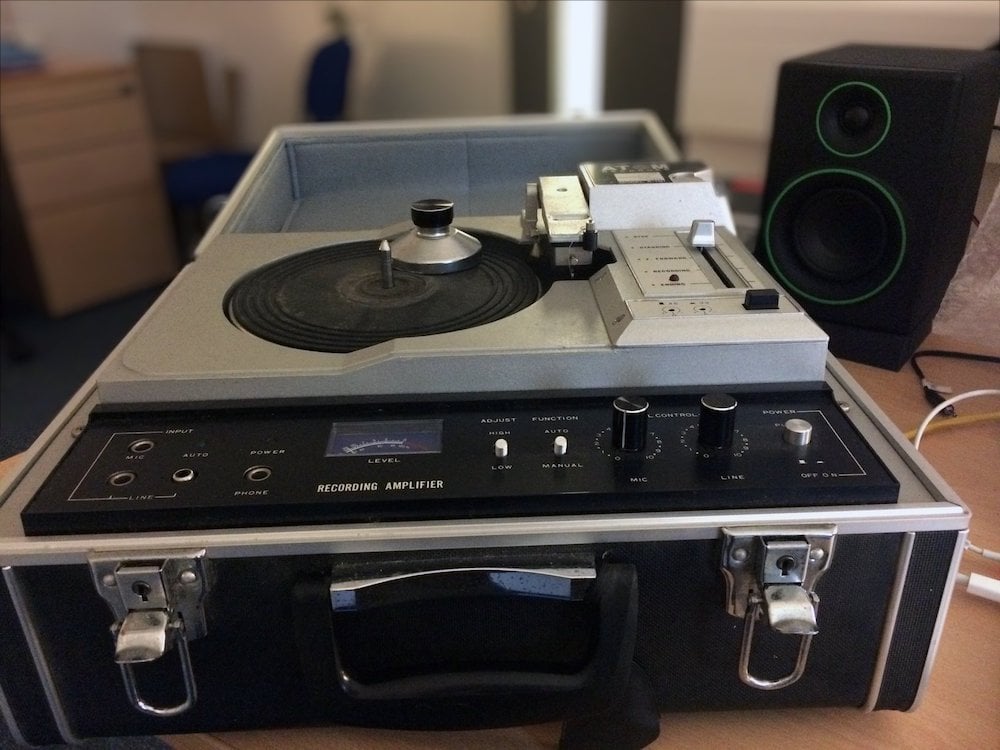
 

Atom A-101 disk recorder. Courtesy of Dylan Beattie, Sussex, England, https://furrowedsound.co.uk.

Atom A-101 disk recorder. Courtesy of Dylan Beattie, Sussex, England, https://furrowedsound.co.uk.


Another view of the Atom A-101. Courtesy of Dylan Beattie.

Another view of the Atom A-101. Courtesy of Dylan Beattie.


Fast forward to the late 1990s and early aughts: the vinyl record is no longer king, sales were plummeting, the major record labels didn’t want anything to do with it, record stores didn’t want to stock records, pressing plants were either going bankrupt or sending all their equipment to the scrapyard to make space for optical disk manufacturing equipment, and consumers around the world had started throwing entire record collections in the trash, convinced by clever marketing that they were now worthless, having been rendered obsolete by the promise of “perfect sound forever” in the form of digital media.

Just when pretty much the entire rest of the world was getting rid of everything related to vinyl records, a company in Japan decided to introduce yet another consumer-oriented disk recording lathe! This time it was a fairly large, export-oriented company, with a strong foothold in the DJ market, internationally. It was an ambitious move and the result was even capable of cutting stereophonic records! We are talking about Vestax, which introduced the VRX-2000 lathe in 2001! It retailed for around $10,000 in US dollars, and was not exactly successful. It was aimed at the consumer market, or perhaps the “prosumer” market, and lacked many of the essential features of a professional disk mastering system. It was the only stereophonic recording lathe at the time that was not aimed at professional mastering facilities, and at the same time, the only lathe in active production, with an international network of dealers. However, the price was perhaps higher than what the consumer market would accept, and came at the lowest point in history for vinyl record sales and appreciation. Although it did look quite impressive, compared to pretty much all other attempts at consumer disk recording equipment, it was still a beefed-up version of a DJ turntable with a cutting attachment on top and built-in audio electronics of questionable performance. It had a fixed-pitch system, giving a recording time of approximately 14 minutes per side of a 12-inch record.
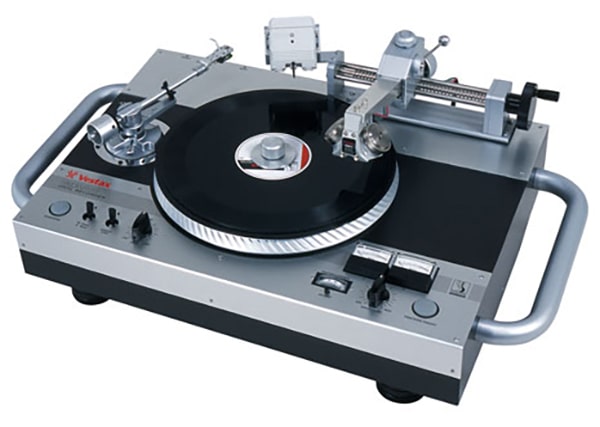
 

Vestax VRX-2000 record cutting machine.
Vestax VRX-2000 record cutting machine.


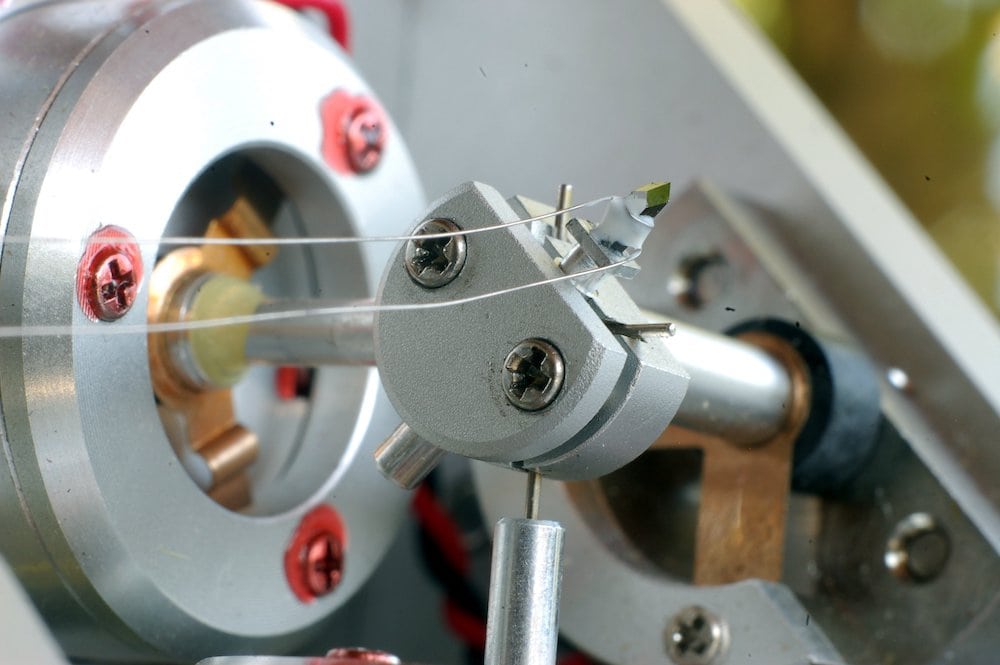
Macrophotography of a Vestax VRX-2000 cutter head, repaired and modified by the author to accept a Neumann-type stylus. Courtesy of Agnew Analog Reference Instruments.
Macrophotography of a Vestax VRX-2000 cutter head, repaired and modified by the author to accept a Neumann-type stylus. Courtesy of Agnew Analog Reference Instruments.


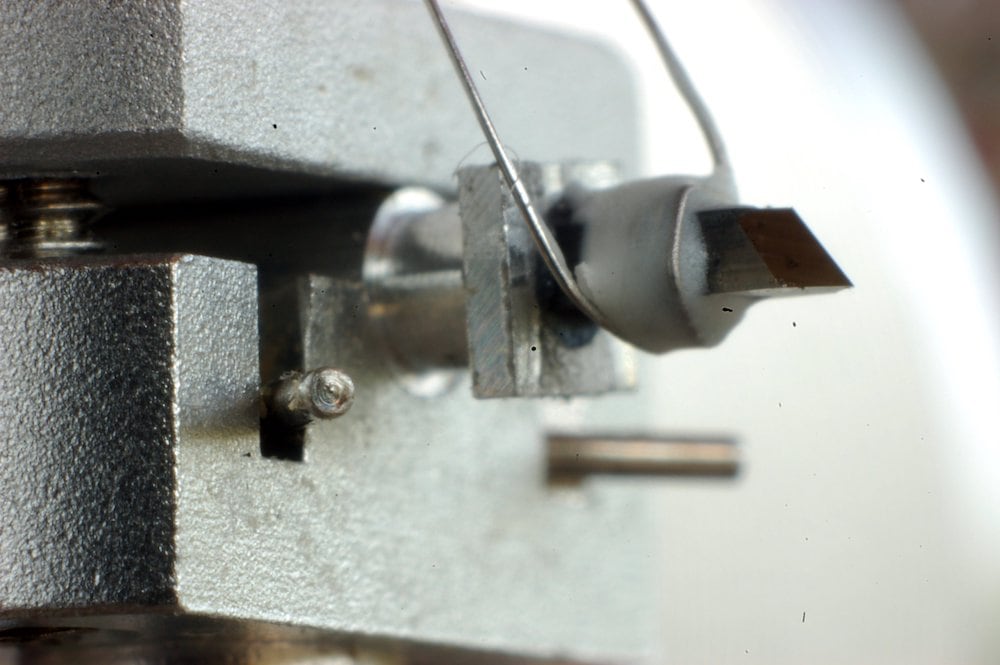
Close-up of the Neumann-type stylus, seated on a modified Vestax VRX-2000 cutter head. Courtesy of Agnew Analog Reference Instruments.

Close-up of the Neumann-type stylus, seated on a modified Vestax VRX-2000 cutter head. Courtesy of Agnew Analog Reference Instruments.


The stereophonic cutter head borrowed heavily in design from the established professional cutter heads, but with all the difficult-to-implement features trimmed out. It did not have motional feedback, relying entirely on mechanical damping instead. The idea was actually quite good, but rather poorly executed. The materials and configuration chosen in its design did not age well, and users of these machines complained of poor reliability. Despite this, there are still a few in operation nowadays, but they have been repaired and often modified, to be kept running. Very few of these were ever made, and Vestax went bankrupt in 2014.
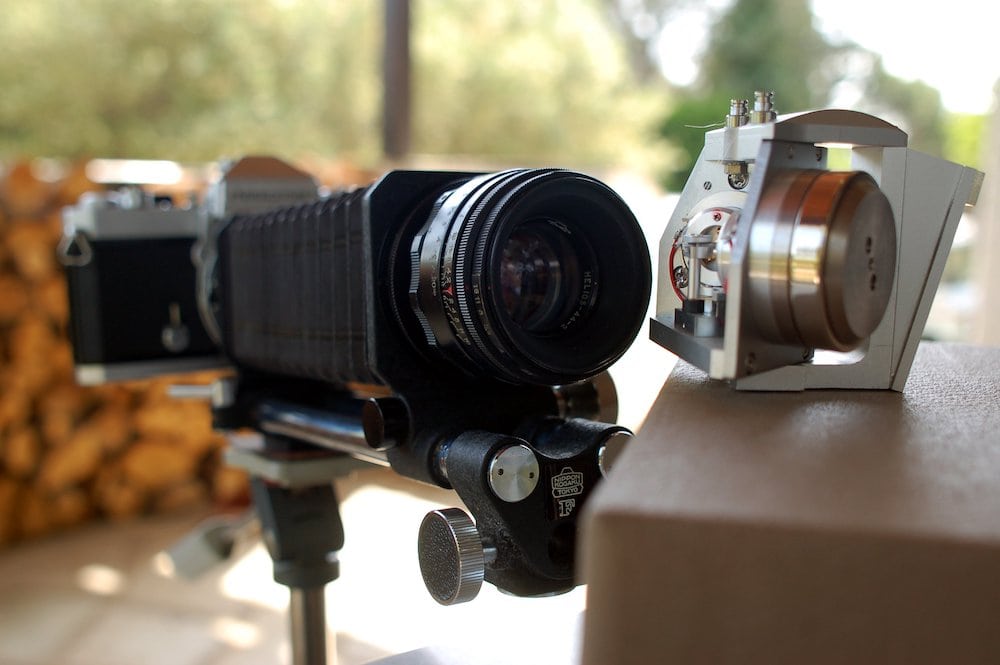
 

The Vestax VRX-299 cutter head and J.I. Agnew's macrophotography setup, with a Nikon bellows attachment, as a symbolic gesture in honor of Japanese engineering. Courtesy of Agnew Analog Reference Instruments.

The Vestax VRX-299 cutter head and J.I. Agnew’s macrophotography setup, with a Nikon bellows attachment, as a symbolic gesture in honor of Japanese engineering. Courtesy of Agnew Analog Reference Instruments.


While a few Japanese companies have been quite industrious in (repeatedly) trying to establish the notion of a consumer-grade disk recording lathe over the years (starting in the 1960’s, but information is difficult to find), there was never a professional disk mastering lathe made in Japan. However, Japan does currently hold the global monopoly in the manufacture of lacquer master disks, disk-mastering sapphire cutting styli, and perhaps also the mass-manufacture of diamond playback styli for phono cartridge manufacturers.

Perhaps if things change yet again and the vinyl record resurgence comes to an end, some company in Japan will decide that the timing is wrong enough to introduce a professional disk mastering system, or even yet another consumer-oriented disk recording lathe. For the time being, their focus is on the consumables side of the market.

Regardless of what lathe is being used and where it was manufactured, all currently-manufactured records mastered on lacquer are cut on Japanese lacquer disks with Japanese styli. DMM (direct metal mastering) remains an exception, with both the blanks and the styli for the process still being manufactured in Germany. As for the consumer market for disk recording equipment, it is presently bigger than ever, with a supply of vintage and usually fairly primitive machines serving it, along with an increasingly growing scene of people attempting (with varying degrees of success) to build their own disk recording lathes from scratch.
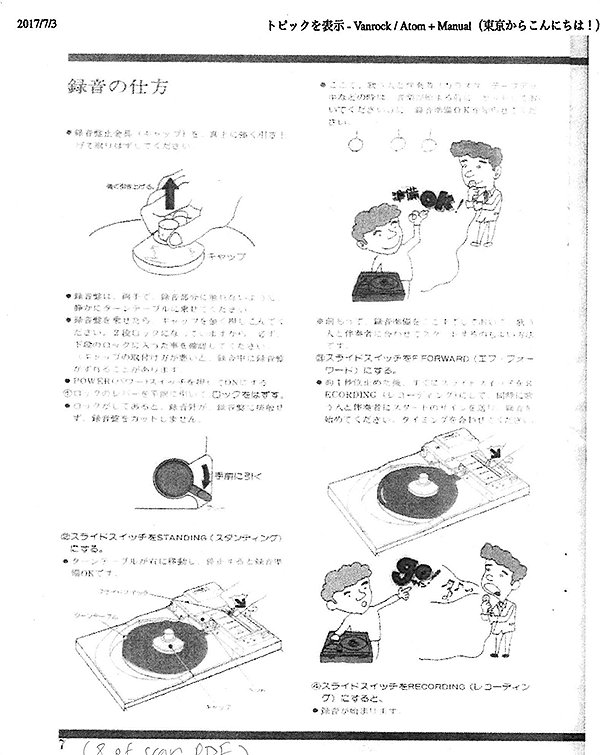
 

A page from the Japanese Vestax VRX-2000 manual.

A page from the Japanese Vestax VRX-2000 manual.


Header image: Atom A-101 disk recorder being used in live performance. Courtesy of Dylan Beattie.

More from Issue 171

View All Articles in Issue 171

Search Copper Magazine

#227 Seth Lewis Gets in the Groove With Take a Look Around: a Tribute to the Meters by Frank Doris Feb 02, 2026 #227 Passport to Sound: May Anwar’s Audio Learning Experience for Young People by Frank Doris Feb 02, 2026 #227 Conjectures on Cosmic Consciousness by B. Jan Montana Feb 02, 2026 #227 The Big Takeover Turns 45 by Wayne Robins Feb 02, 2026 #227 Music and Chocolate: On the Sensory Connection by Joe Caplan Feb 02, 2026 #227 Singer/Songwriter Chris Berardo: Getting Wilder All the Time by Ray Chelstowski Feb 02, 2026 #227 The Earliest Stars of Country Music, Part One by Jeff Weiner Feb 02, 2026 #227 The Vinyl Beat Goes Down to Tijuana (By Way of Los Angeles), Part Two by Rudy Radelic Feb 02, 2026 #227 How to Play in a Rock Band, 20: On the Road With Blood, Sweat & Tears’ Guitarist Gabe Cummins by Frank Doris Feb 02, 2026 #227 From The Audiophile’s Guide: Audio Specs and Measuring by Paul McGowan Feb 02, 2026 #227 Our Brain is Always Listening by Peter Trübner Feb 02, 2026 #227 PS Audio in the News by PS Audio Staff Feb 02, 2026 #227 The Listening Chair: Sleek Style and Sound From the Luxman L3 by Howard Kneller Feb 02, 2026 #227 The Los Angeles and Orange County Audio Society Celebrates Its 32nd Anniversary, Honoring David and Sheryl Lee Wilson and Bernie Grundman by Harris Fogel Feb 02, 2026 #227 Back to My Reel-to-Reel Roots, Part 26: Half Full – Not Half Empty, Redux by Ken Kessler Feb 02, 2026 #227 That's What Puzzles Us... by Frank Doris Feb 02, 2026 #227 Record-Breaking by Peter Xeni Feb 02, 2026 #227 The Long and Winding Road by B. Jan Montana Feb 02, 2026 #226 JJ Murphy’s Sleep Paralysis is a Genre-Bending Musical Journey Through Jazz, Fusion and More by Frank Doris Jan 05, 2026 #226 Stewardship by Consent by B. Jan Montana Jan 05, 2026 #226 Food, Music, and Sensory Experience: An Interview With Professor Jonathan Zearfoss of the Culinary Institute of America by Joe Caplan Jan 05, 2026 #226 Studio Confidential: A Who’s Who of Recording Engineers Tell Their Stories by Frank Doris Jan 05, 2026 #226 Pilot Radio is Reborn, 50 Years Later: Talking With CEO Barak Epstein by Frank Doris Jan 05, 2026 #226 The Vinyl Beat Goes Down to Tijuana (By Way of Los Angeles), Part One by Rudy Radelic Jan 05, 2026 #226 Capital Audiofest 2025: Must-See Stereo, Part Two by Frank Doris Jan 05, 2026 #226 My Morning Jacket’s Carl Broemel and Tyler Ramsey Collaborate on Their Acoustic Guitar Album, Celestun by Ray Chelstowski Jan 05, 2026 #226 The People Who Make Audio Happen: CanJam SoCal 2025, Part Two by Harris Fogel Jan 05, 2026 #226 How to Play in a Rock Band, 19: Touring Can Make You Crazy, Part One by Frank Doris Jan 05, 2026 #226 Linda Ronstadt Goes Bigger by Wayne Robins Jan 05, 2026 #226 From The Audiophile’s Guide: Active Room Correction and Digital Signal Processing by Paul McGowan Jan 05, 2026 #226 PS Audio in the News by Frank Doris Jan 05, 2026 #226 Back to My Reel-to-Reel Roots, Part 25: Half-Full, Not Empty by Ken Kessler Jan 05, 2026 #226 Happy New Year! by Frank Doris Jan 05, 2026 #226 Turn It Down! by Peter Xeni Jan 05, 2026 #226 Ghost Riders by James Schrimpf Jan 05, 2026 #226 A Factory Tour of Audio Manufacturer German Physiks by Markus "Marsu" Manthey Jan 04, 2026 #225 Capital Audiofest 2025: Must-See Stereo, Part One by Frank Doris Dec 01, 2025 #225 Otis Taylor and the Electrics Delivers a Powerful Set of Hypnotic Modern Blues by Frank Doris Dec 01, 2025 #225 A Christmas Miracle by B. Jan Montana Dec 01, 2025 #225 T.H.E. Show New York 2025, Part Two: Plenty to See, Hear, and Enjoy by Frank Doris Dec 01, 2025 #225 Underappreciated Artists, Part One: Martin Briley by Rich Isaacs Dec 01, 2025 #225 Rock and Roll is Here to Stay by Wayne Robins Dec 01, 2025 #225 A Lifetime of Holiday Record (and CD) Listening by Rudy Radelic Dec 01, 2025 #225 Little Feat: Not Saying Goodbye, Not Yet by Ray Chelstowski Dec 01, 2025 #225 How to Play in a Rock Band, Part 18: Dealing With Burnout by Frank Doris Dec 01, 2025 #225 The People Who Make Audio Happen: CanJam SoCal 2025 by Harris Fogel Dec 01, 2025 #225 Chicago’s Sonic Sanctuaries: Four Hi‑Fi Listening Bars Channeling the Jazz‑Kissa Spirit by Olivier Meunier-Plante Dec 01, 2025

Around the World In 80 Lathes, Part 21

Around the World In 80 Lathes, Part 21

In the previous episode (Issue 170), we looked at the Hara disk recording lathes, manufactured in Japan in the 1970s.

The Vanrock E-101 and the Atom A-101 came a bit later, in the early 1980s. Although similar in terms of portability, the Vanrock and Atom machines were very different to the Hara products. The Vanrock and Atom are essentially the same machine, manufactured by the same factory and having identical manuals, but branded differently, for reasons beyond my comprehension. The Vanrock/Atom has a belt-driven platter that could record on 7-inch blanks. The head was stationary, and the platter would move under the head, in a manner similar to the disk recording lathes of the early acoustical recording era (although in more recent times, the concept has been revived, first by Phonocut and later by Thorsten Scheffner of Organic Music in Germany, who made a few custom lathes based on this principle).

The only similarity to the Hara machines was that the Vanrock/Atom was also built into a briefcase and had built-in electronics, including a microphone preamplifier. Designed with a notably modern approach to aesthetics, perhaps more so than any other disk recording lathe ever made, it resembled some kind of space-technology gadget right out of a science fiction movie. As with the Hara lathes, its sound quality left a lot to be desired, but it did contain everything you would need to cut a record in a fairly lightweight, portable package! The built-in audio electronics even included a simple compressor, to keep the dynamics under control even when the level was incorrectly set, or to accommodate difficult recordings with no need for dedicated studio equipment. In a sense, these machines were to a professional disk mastering lathe what a Swiss Army knife is to a fully-equipped machine shop.


Atom A-101 disk recorder. Courtesy of Dylan Beattie, Sussex, England, https://furrowedsound.co.uk.

Atom A-101 disk recorder. Courtesy of Dylan Beattie, Sussex, England, https://furrowedsound.co.uk.


Another view of the Atom A-101. Courtesy of Dylan Beattie.

Another view of the Atom A-101. Courtesy of Dylan Beattie.


Fast forward to the late 1990s and early aughts: the vinyl record is no longer king, sales were plummeting, the major record labels didn’t want anything to do with it, record stores didn’t want to stock records, pressing plants were either going bankrupt or sending all their equipment to the scrapyard to make space for optical disk manufacturing equipment, and consumers around the world had started throwing entire record collections in the trash, convinced by clever marketing that they were now worthless, having been rendered obsolete by the promise of “perfect sound forever” in the form of digital media.

Just when pretty much the entire rest of the world was getting rid of everything related to vinyl records, a company in Japan decided to introduce yet another consumer-oriented disk recording lathe! This time it was a fairly large, export-oriented company, with a strong foothold in the DJ market, internationally. It was an ambitious move and the result was even capable of cutting stereophonic records! We are talking about Vestax, which introduced the VRX-2000 lathe in 2001! It retailed for around $10,000 in US dollars, and was not exactly successful. It was aimed at the consumer market, or perhaps the “prosumer” market, and lacked many of the essential features of a professional disk mastering system. It was the only stereophonic recording lathe at the time that was not aimed at professional mastering facilities, and at the same time, the only lathe in active production, with an international network of dealers. However, the price was perhaps higher than what the consumer market would accept, and came at the lowest point in history for vinyl record sales and appreciation. Although it did look quite impressive, compared to pretty much all other attempts at consumer disk recording equipment, it was still a beefed-up version of a DJ turntable with a cutting attachment on top and built-in audio electronics of questionable performance. It had a fixed-pitch system, giving a recording time of approximately 14 minutes per side of a 12-inch record.


Vestax VRX-2000 record cutting machine.

Vestax VRX-2000 record cutting machine.


Macrophotography of a Vestax VRX-2000 cutter head, repaired and modified by the author to accept a Neumann-type stylus. Courtesy of Agnew Analog Reference Instruments.

Macrophotography of a Vestax VRX-2000 cutter head, repaired and modified by the author to accept a Neumann-type stylus. Courtesy of Agnew Analog Reference Instruments.


Close-up of the Neumann-type stylus, seated on a modified Vestax VRX-2000 cutter head. Courtesy of Agnew Analog Reference Instruments.

Close-up of the Neumann-type stylus, seated on a modified Vestax VRX-2000 cutter head. Courtesy of Agnew Analog Reference Instruments.


The stereophonic cutter head borrowed heavily in design from the established professional cutter heads, but with all the difficult-to-implement features trimmed out. It did not have motional feedback, relying entirely on mechanical damping instead. The idea was actually quite good, but rather poorly executed. The materials and configuration chosen in its design did not age well, and users of these machines complained of poor reliability. Despite this, there are still a few in operation nowadays, but they have been repaired and often modified, to be kept running. Very few of these were ever made, and Vestax went bankrupt in 2014.


The Vestax VRX-299 cutter head and J.I. Agnew's macrophotography setup, with a Nikon bellows attachment, as a symbolic gesture in honor of Japanese engineering. Courtesy of Agnew Analog Reference Instruments.

The Vestax VRX-299 cutter head and J.I. Agnew’s macrophotography setup, with a Nikon bellows attachment, as a symbolic gesture in honor of Japanese engineering. Courtesy of Agnew Analog Reference Instruments.


While a few Japanese companies have been quite industrious in (repeatedly) trying to establish the notion of a consumer-grade disk recording lathe over the years (starting in the 1960’s, but information is difficult to find), there was never a professional disk mastering lathe made in Japan. However, Japan does currently hold the global monopoly in the manufacture of lacquer master disks, disk-mastering sapphire cutting styli, and perhaps also the mass-manufacture of diamond playback styli for phono cartridge manufacturers.

Perhaps if things change yet again and the vinyl record resurgence comes to an end, some company in Japan will decide that the timing is wrong enough to introduce a professional disk mastering system, or even yet another consumer-oriented disk recording lathe. For the time being, their focus is on the consumables side of the market.

Regardless of what lathe is being used and where it was manufactured, all currently-manufactured records mastered on lacquer are cut on Japanese lacquer disks with Japanese styli. DMM (direct metal mastering) remains an exception, with both the blanks and the styli for the process still being manufactured in Germany. As for the consumer market for disk recording equipment, it is presently bigger than ever, with a supply of vintage and usually fairly primitive machines serving it, along with an increasingly growing scene of people attempting (with varying degrees of success) to build their own disk recording lathes from scratch.


A page from the Japanese Vestax VRX-2000 manual.

A page from the Japanese Vestax VRX-2000 manual.


Header image: Atom A-101 disk recorder being used in live performance. Courtesy of Dylan Beattie.

0 comments

Leave a comment

0 Comments

Your avatar

Loading comments...

🗑️ Delete Comment

Enter moderator password to delete this comment:

✏️ Edit Comment

Enter your email to verify ownership: