COPPER

A PS Audio Publication

Issue 46 • Free Online Magazine

Issue 46 TWISTED SYSTEMS

The '67 Psychedelic Shootout Continues!

Let it not be said that journalists don’t pay attention to their readers.

The responses to my contenders to the Psychedelic Shootout of 1967 has persuaded me to add 4 additional artists.

1.The Move:   I am a huge fan and ironically I was supposed to see them live at the Fillmore East in November 1967 with Pink Floyd headlining (this was the the US Floyd tour cut short due to Syd’s deteriorating mental condition).

The Move did not release an album in 1967 but their first single, “Flowers in the Rain”  was a shot fired across the bow!

2.The Yardbirds:  First though, a small bend in the rules:

The word from the UK in 1966, following the US hit “For Your Love”, had us all buzzing because of the addition of Jeff Beck replacing Eric Clapton. The album, Having A Rave Up (US  release: Over Under Sideways Down) was startling in its departure from straight Clapton era blues. However, by the time the 1967 Yardbirds contribution came around, Beck had departed and studio wizard Jimmy Page, moved over from bass to lead and the 1967 release, Little Games.

Little Games came out in April of “67 BUT….for the purposes of this shoot out I am actually going to focus on the 1966 release Over Under Sideways Down for reasons that will become obvious.

3.Love:  They were omitted because I forgot to drink my coffee that day. I mean, really, how could I have missed this one. I only have 4 different pressings beginning with the original 1967 Elektra release.

4.Procol Harum:  debut album.

“Whiter Shade of Pale” ‘nuff said

Let us begin!

In general, and now with 50 years of hindsight, musical history as well as my own experiences of spending lots of time in the UK and having been signed to my record deal in the UK by Phil Carson, Sr. VP of Atlantic Records, UK in the 80’s, it has become apparent that  the great distinction between the British and US Psych scenes was that the British artists were still forced by the “British Hit Record System” that made the artists conform to certain rules of the game.

Remember, the whole of Great Britain is smaller than the size of Texas. In those days if you didn’t get on the BBC radio pop charts,  then no one heard you. If you didn’t get on the Top Of The Pops TV show then no one really saw you.

The “hit factor pressure” was huge.  Even if you were trying to bend the rules, the Hit Men of the industry put enormous pressure on you to have a hit. The US, on the other hand, especially in the 60’s, had always had the enviable position of creating local or regional artists. What went on in the midwest or the south was not always known to NYers ,for example.

FM Freeform radio hit the US at just the right time as rules were about to be not just  broken but demolished! The population and diversity of the US greatly factored into the unique differences between the two countries even though the same mind altering drug was careening through our collective craniums. What make this even more interesting is that the British groups who are part of this shootout started out mostly as American Blues cover bands  (Pink Floyd, Yardbirds, Rolling Stones, Cream)  or, in the case of the Beatles, an American Rock ‘n’ Roll cover band.

The Move were really post-invasion. Kind of like 1st generation .2 in that their influences were strained through the prism of the pop music of their peers plus west coast rock and Motown.

The American bands were segregated by regional influences.

The Dead, the Airplane, and Moby Grape were heavily folk influenced. The Doors and Hendrix, by heavy blues;  and Love, the archetype LA proto-garage band, greatly influenced by all of the above with a large dose of Dylan and classical music.

At the end of each review I will render it’s Psychedelic value from 1 (meaning just a slight hallucination tremor-the equivalent to the kind of halos of an ocular migraine all the way to a 10 (full blown “get out the net and send the band to Bellevue”)

With all of that said, these 5 are the first group of contenders:

The Doors, The Jefferson Airplane, The Grateful Dead,  Moby Grape & Love

Although released in January of ‘67,  it took months for the debut single “Light My Fire” to take off. When it did, the power of the imagery compounded with the eastern sounding raga guitar lead and the incredible vocals of Jim Morrison shattered the newly minted freeform FM stations and then crossed over, however lamely edited, to American Top 40 dominance.

The  haunting, dark and sexually perverse insinuation of the lyrics for the closing song “The End” brought to me at the time, an American version of the Stones. Dark, heavy and sexually charged. Finally though, we had our own Mick Jagger.

Strong, jazzed tinged playing throughout with just enough reverb to sound menacing. Jim Morrison’s poetry brought super literary analysis- he was the thinking man’s sex symbol. He seemed like a cross between Elvis and Henry Miller.

I had not yet smoked weed so my mental wandering went only as far the the actual time I spent listening to the album. I have a feeling that the Doors were looking at their stable mate Love and feeling that the pressure was on as to who got Elektra Records’ president Jac Holzman’s “love” more…

One thing for sure, This wasn’t the LA folk rock of Ronstadt, Eagles, Jackson Browne, Neil Young or the Mamas & Papas. This was a whole ‘nother thing. The Doors’ debut was really commercial danger on vinyl.

Verdict:   Stellar hard rock debut,  Psychedelic Factor (scale 1-10): 4.

The Jefferson Airplane, Surrealistic Pillow 
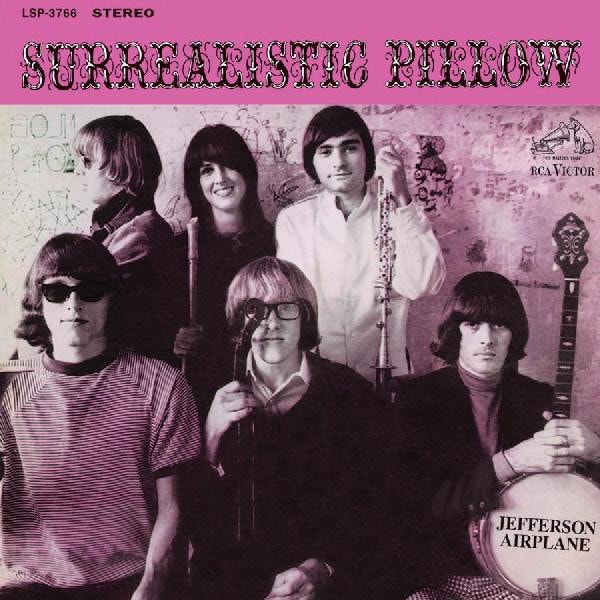
 

Well now, the memories of listening to this album at a junior high dance/make-out party brings back the greatest of memories. I had read about this band and wasn’t sure what to expect but what I got was a beautifully recorded and sung example of how commercial the San Francisco sound could get. 2 monster singles, “White Rabbit” & “Somebody to Love” reached out and coalesced around acoustic gems like The Spoonful/Mamas & Papas-sounding “My Best Friend” and the real make out ballad “Today”.

“White Rabbit” was also all about the imagery of Alice through the looking glass and all the seeming drug references. So cool, and yet quite scary to parents and to me and my friends. We felt we were listening to something forbidden.

Having Jerry Garcia listed on the the back of the album jacket as a “Spiritual Advisor” in the studio sounded just oh so damn cool.

What did that actually mean? Their guru?, their drug dealer? I hadn’t heard the Dead yet but this just made me crazy to want to know what he (Jerry)  knew.

As it turned out there is very little consensus as to what, if anything Jerry did have to do with the final product, some say he advised on arrangements, some say he did some production but recently that was debunked. In any case, to me, at the time it was a very impressive credit…

This band could really sing and write. The combined vocals of Grace Slick & Marty Balin remain as fresh and distinctive as any music being made at that time. I noticed that the stereo version (which I owned) is dripping with reverb. The mono version, not so much. Lots of reverb was the sauce that flavored a lot of Psychedelic music, apparently.

Verdict: on this album The Airplane reached heights never again attained with a focus and sure footedness that was unaffected by the political sturm und drang that was coming. Psychedelic Factor: 5.


Truth be told, I couldn’t wait. I read about the Dead in Ramparts magazine and man, was I ready for it. Still not getting high but everything about the cover of the album alone screamed Dr. Timothy Leary!!

As I start to relisten for the purpose of this contest, I’m stunned at the total lack of focus that this album suffers from. I’m sure that the band had no real idea going into the studio as to who and what they were. Part R&B band, part jam band. One thing for sure, their singing was nowhere close to the Doors, The Airplane, Love, Moby Grape, or just about any band on this list.

This, simply put,  is an example of West Coast garage rock, without the musical hooks or sexual tension. Garcia’s guitar playing was sloppy, and his tone was mealy-mouthed and reed thin. Sonically, the entire album sounds like a demo tape.

At the time, I guess it didn’t really matter much to me based on how much I played it but because the stylings were so diffuse and the lack of reverb hadn’t held much together, the entire project wasn’t very good and from a Psychedelic Factor, Viola Lee Blues was the only single psychedelic moment.

Mostly because of the cover,  I give it a Psychedelic Factor: 4.


OMG. I saw them once at the Fillmore, and they may have been one of the greatest live bands of all. In fact,  I’ll put money on the fact the Moby Grape was what the Grateful Dead wished they could play like at the time.

4 great singers, 3 great guitarists, and Bob Mosley, maybe the finest bass player at the time in San Francisco.

The only problem is that this ain’t much of a psychedelic musical experience. Don’t get me wrong. It’s a solid record. It’s almost as if The Buffalo Springfield were more aggressive.

Great songs (“8:05” is a classic), well played (with the controversial cover photo of the middle finger of Don Stevenson airbrushed out – a real vinyl collectors gem!) and one excellent rock band with a very trippy name but sadly, a Psychedelic Factor: 1.


And in the midst of all the sonic experimentation made by the blues & folk based rock bands that had become newly minted psychedelic mouthpieces,  comes this sonic and lyrical masterpiece.

Forever Changes is truly an outlier. The kind of record that one used, back in the day, to show off their stereo and, in a way, almost an American Sgt. Pepper with its carefully homogenized aural landscape. Beautifully recorded, stunning songs and melodies.  Is it any wonder that it has become one of the greatest albums of all time?

The addition of the classically-arranged strings only enhanced this album and gave you the feeling that you were really listening to something “heavy”.  The album came out in November… so I had already started smoking weed and the effect of that confluence made the impact of this album even greater.

The album cover alone raise the psychedelic factor but the transcendent heaviness and its long term impact leaves a palpable impression that this  is the greatest of all American psychedelic entries.

Psychedelic Factor: 8. 

Stay tuned for more of the ’67 Psychedelic Shootout!

More from Issue 46

View All Articles in Issue 46

Search Copper Magazine

#231 Piano Prodigy Jude Kofie Releases His Debut Album On Octave Records by Frank Doris Jun 01, 2026 #231 Underappreciated Artists, Part Two: City Boy by Rich Isaacs Jun 01, 2026 #231 Music and the Art of Creation: Talking With Saxophonist Rob Scheps by Joe Caplan Jun 01, 2026 #231 How to Play in a Rock Band, 24: Further Adventures at the 2026 Montauk Music Festival by Frank Doris Jun 01, 2026 #231 Courtney Barnett: Creature of Habit by Wayne Robins Jun 01, 2026 #231 Angine de Poitrine: Interstellar Guitar Rock Saviors Headed for Late-Night TV Pop Stardom? by Mark Lepage Jun 01, 2026 #231 My Impressions of AXPONA 2026, Part One by Frank Doris Jun 01, 2026 #231 2026 La Jolla Concours d'Elegance: Another Aesthetic Feast by B. Jan Montana Jun 01, 2026 #231 Country Music Icon Jo Dee Messina’s Bridges: A New Beginning by Ray Chelstowski Jun 01, 2026 #231 The Luxury Dispatch Hosts a Video Podcast With Ken Kessler by Ken Kessler Jun 01, 2026 #231 The Vinyl Beat: Tracking in the Motor City by Rudy Radelic Jun 01, 2026 #231 Lots of Fun With DSP: The Ferrum Audio WANDLA DAC and Its Tube Mode by Frank Doris Jun 01, 2026 #231 From The Audiophile's Guide: Digital Source Components and Streaming Audio by Paul McGowan Jun 01, 2026 #231 Onkyo’s Monster M-510 power amplifier by The Staff at Just Audio Jun 01, 2026 #231 PS Audio in the News by PS Audio Staff Jun 01, 2026 #231 Naming Convention by Peter Xeni Jun 01, 2026 #231 Les Invisibles by Frank Doris Jun 01, 2026 #231 Wildlife Scene by James Schrimpf Jun 01, 2026 #230 Camaraderie by B. Jan Montana May 04, 2026 #230 AXPONA 2026: A Family Gathering by Paul McGowan May 04, 2026 #230 Pianist Ryan Benthall Explores Jazz Realms and Far Beyond With Divine Sky by Frank Doris May 04, 2026 #230 The Vinyl Beat in AXPONA-Land by Rudy Radelic May 04, 2026 #230 Teddy Thompson’s Musical Growth Deepens With Never Be the Same by Ray Chelstowski May 04, 2026 #230 More Fun in the Sun: Florida Audio Expo, Part Two by Frank Doris May 04, 2026 #230 CanJam NYC 2026 Show Report: Heady Sound, Part Two by Frank Doris and Harris Fogel May 04, 2026 #230 Sonic Youth On Murray Street by Wayne Robins May 04, 2026 #230 Graffeo Coffee: A Symphony of Sensory Experience by Joe Caplan May 04, 2026 #230 The Saul Authority: The Story of Hi-Fi Pioneer Saul Marantz by Olivier Meunier-Plante May 04, 2026 #230 How to Play in a Rock Band, 23: Encounters With Famous Musicians, Part Two by Frank Doris May 04, 2026 #230 An Outlier in the Rack: A Vintage BIC Beam Box by The Staff at Just Audio May 04, 2026 #230 PS Audio in the News by PS Audio Staff May 04, 2026 #230 A Cautionary Tale by Rich Isaacs May 04, 2026 #230 Reel-to-Reel Roots, Part 33 (Revised): Ken Kessler Reports On the 2026 (British) AudioJumble by Ken Kessler May 04, 2026 #230 Text Messaging by Frank Doris May 04, 2026 #230 The Audiophile Rat Race by Peter Xeni May 04, 2026 #230 On the Rocks by Rich Isaacs May 04, 2026 #229 The Earliest Stars of Country Music, Part Three by Jeff Weiner Apr 06, 2026 #229 The Healing Power of Music and Sound at the Omega Institute by Joe Caplan Apr 06, 2026 #229 CanJam NYC 2026 Show Report: Heady Sound, Part One by Frank Doris Apr 06, 2026 #229 Florida Audio Expo 2026: Warming Up to High-End Audio, Part One by Frank Doris Apr 06, 2026 #229 Quick Takes: Anne Bisson, Sam Morrison, The Velvet Underground, and the Stooges by Frank Doris Apr 06, 2026 #229 The Vinyl Beat: New Arrivals, and Old Audio Show Demo Scores to Settle by Rudy Radelic Apr 06, 2026 #229 Harvard Gets a High-End Audio Education by Frank Doris Apr 06, 2026 #229 No Country for Old Knees by B. Jan Montana Apr 06, 2026 #229 How To Play in A Rock Band, 22: Encounters With Famous Musicians, Part 1 by Frank Doris Apr 06, 2026 #229 The Soulful Grooves of Guinea-Bissau by Steve Kindig Apr 06, 2026 #229 Four-Hand Piano Performance at Its Finest by Stephan Haberthür Apr 06, 2026

The '67 Psychedelic Shootout Continues!

Let it not be said that journalists don’t pay attention to their readers.

The responses to my contenders to the Psychedelic Shootout of 1967 has persuaded me to add 4 additional artists.

1.The Move:   I am a huge fan and ironically I was supposed to see them live at the Fillmore East in November 1967 with Pink Floyd headlining (this was the the US Floyd tour cut short due to Syd’s deteriorating mental condition).

The Move did not release an album in 1967 but their first single, “Flowers in the Rain”  was a shot fired across the bow!

2.The Yardbirds:  First though, a small bend in the rules:

The word from the UK in 1966, following the US hit “For Your Love”, had us all buzzing because of the addition of Jeff Beck replacing Eric Clapton. The album, Having A Rave Up (US  release: Over Under Sideways Down) was startling in its departure from straight Clapton era blues. However, by the time the 1967 Yardbirds contribution came around, Beck had departed and studio wizard Jimmy Page, moved over from bass to lead and the 1967 release, Little Games.

Little Games came out in April of “67 BUT….for the purposes of this shoot out I am actually going to focus on the 1966 release Over Under Sideways Down for reasons that will become obvious.

3.Love:  They were omitted because I forgot to drink my coffee that day. I mean, really, how could I have missed this one. I only have 4 different pressings beginning with the original 1967 Elektra release.

4.Procol Harum:  debut album.

“Whiter Shade of Pale” ‘nuff said

Let us begin!

In general, and now with 50 years of hindsight, musical history as well as my own experiences of spending lots of time in the UK and having been signed to my record deal in the UK by Phil Carson, Sr. VP of Atlantic Records, UK in the 80’s, it has become apparent that  the great distinction between the British and US Psych scenes was that the British artists were still forced by the “British Hit Record System” that made the artists conform to certain rules of the game.

Remember, the whole of Great Britain is smaller than the size of Texas. In those days if you didn’t get on the BBC radio pop charts,  then no one heard you. If you didn’t get on the Top Of The Pops TV show then no one really saw you.

The “hit factor pressure” was huge.  Even if you were trying to bend the rules, the Hit Men of the industry put enormous pressure on you to have a hit. The US, on the other hand, especially in the 60’s, had always had the enviable position of creating local or regional artists. What went on in the midwest or the south was not always known to NYers ,for example.

FM Freeform radio hit the US at just the right time as rules were about to be not just  broken but demolished! The population and diversity of the US greatly factored into the unique differences between the two countries even though the same mind altering drug was careening through our collective craniums. What make this even more interesting is that the British groups who are part of this shootout started out mostly as American Blues cover bands  (Pink Floyd, Yardbirds, Rolling Stones, Cream)  or, in the case of the Beatles, an American Rock ‘n’ Roll cover band.

The Move were really post-invasion. Kind of like 1st generation .2 in that their influences were strained through the prism of the pop music of their peers plus west coast rock and Motown.

The American bands were segregated by regional influences.

The Dead, the Airplane, and Moby Grape were heavily folk influenced. The Doors and Hendrix, by heavy blues;  and Love, the archetype LA proto-garage band, greatly influenced by all of the above with a large dose of Dylan and classical music.

At the end of each review I will render it’s Psychedelic value from 1 (meaning just a slight hallucination tremor-the equivalent to the kind of halos of an ocular migraine all the way to a 10 (full blown “get out the net and send the band to Bellevue”)

With all of that said, these 5 are the first group of contenders:

The Doors, The Jefferson Airplane, The Grateful Dead,  Moby Grape & Love

Although released in January of ‘67,  it took months for the debut single “Light My Fire” to take off. When it did, the power of the imagery compounded with the eastern sounding raga guitar lead and the incredible vocals of Jim Morrison shattered the newly minted freeform FM stations and then crossed over, however lamely edited, to American Top 40 dominance.

The  haunting, dark and sexually perverse insinuation of the lyrics for the closing song “The End” brought to me at the time, an American version of the Stones. Dark, heavy and sexually charged. Finally though, we had our own Mick Jagger.

Strong, jazzed tinged playing throughout with just enough reverb to sound menacing. Jim Morrison’s poetry brought super literary analysis- he was the thinking man’s sex symbol. He seemed like a cross between Elvis and Henry Miller.

I had not yet smoked weed so my mental wandering went only as far the the actual time I spent listening to the album. I have a feeling that the Doors were looking at their stable mate Love and feeling that the pressure was on as to who got Elektra Records’ president Jac Holzman’s “love” more…

One thing for sure, This wasn’t the LA folk rock of Ronstadt, Eagles, Jackson Browne, Neil Young or the Mamas & Papas. This was a whole ‘nother thing. The Doors’ debut was really commercial danger on vinyl.

Verdict:   Stellar hard rock debut,  Psychedelic Factor (scale 1-10): 4.

The Jefferson Airplane, Surrealistic Pillow 


Well now, the memories of listening to this album at a junior high dance/make-out party brings back the greatest of memories. I had read about this band and wasn’t sure what to expect but what I got was a beautifully recorded and sung example of how commercial the San Francisco sound could get. 2 monster singles, “White Rabbit” & “Somebody to Love” reached out and coalesced around acoustic gems like The Spoonful/Mamas & Papas-sounding “My Best Friend” and the real make out ballad “Today”.

“White Rabbit” was also all about the imagery of Alice through the looking glass and all the seeming drug references. So cool, and yet quite scary to parents and to me and my friends. We felt we were listening to something forbidden.

Having Jerry Garcia listed on the the back of the album jacket as a “Spiritual Advisor” in the studio sounded just oh so damn cool.

What did that actually mean? Their guru?, their drug dealer? I hadn’t heard the Dead yet but this just made me crazy to want to know what he (Jerry)  knew.

As it turned out there is very little consensus as to what, if anything Jerry did have to do with the final product, some say he advised on arrangements, some say he did some production but recently that was debunked. In any case, to me, at the time it was a very impressive credit…

This band could really sing and write. The combined vocals of Grace Slick & Marty Balin remain as fresh and distinctive as any music being made at that time. I noticed that the stereo version (which I owned) is dripping with reverb. The mono version, not so much. Lots of reverb was the sauce that flavored a lot of Psychedelic music, apparently.

Verdict: on this album The Airplane reached heights never again attained with a focus and sure footedness that was unaffected by the political sturm und drang that was coming. Psychedelic Factor: 5.


Truth be told, I couldn’t wait. I read about the Dead in Ramparts magazine and man, was I ready for it. Still not getting high but everything about the cover of the album alone screamed Dr. Timothy Leary!!

As I start to relisten for the purpose of this contest, I’m stunned at the total lack of focus that this album suffers from. I’m sure that the band had no real idea going into the studio as to who and what they were. Part R&B band, part jam band. One thing for sure, their singing was nowhere close to the Doors, The Airplane, Love, Moby Grape, or just about any band on this list.

This, simply put,  is an example of West Coast garage rock, without the musical hooks or sexual tension. Garcia’s guitar playing was sloppy, and his tone was mealy-mouthed and reed thin. Sonically, the entire album sounds like a demo tape.

At the time, I guess it didn’t really matter much to me based on how much I played it but because the stylings were so diffuse and the lack of reverb hadn’t held much together, the entire project wasn’t very good and from a Psychedelic Factor, Viola Lee Blues was the only single psychedelic moment.

Mostly because of the cover,  I give it a Psychedelic Factor: 4.


OMG. I saw them once at the Fillmore, and they may have been one of the greatest live bands of all. In fact,  I’ll put money on the fact the Moby Grape was what the Grateful Dead wished they could play like at the time.

4 great singers, 3 great guitarists, and Bob Mosley, maybe the finest bass player at the time in San Francisco.

The only problem is that this ain’t much of a psychedelic musical experience. Don’t get me wrong. It’s a solid record. It’s almost as if The Buffalo Springfield were more aggressive.

Great songs (“8:05” is a classic), well played (with the controversial cover photo of the middle finger of Don Stevenson airbrushed out – a real vinyl collectors gem!) and one excellent rock band with a very trippy name but sadly, a Psychedelic Factor: 1.


And in the midst of all the sonic experimentation made by the blues & folk based rock bands that had become newly minted psychedelic mouthpieces,  comes this sonic and lyrical masterpiece.

Forever Changes is truly an outlier. The kind of record that one used, back in the day, to show off their stereo and, in a way, almost an American Sgt. Pepper with its carefully homogenized aural landscape. Beautifully recorded, stunning songs and melodies.  Is it any wonder that it has become one of the greatest albums of all time?

The addition of the classically-arranged strings only enhanced this album and gave you the feeling that you were really listening to something “heavy”.  The album came out in November… so I had already started smoking weed and the effect of that confluence made the impact of this album even greater.

The album cover alone raise the psychedelic factor but the transcendent heaviness and its long term impact leaves a palpable impression that this  is the greatest of all American psychedelic entries.

Psychedelic Factor: 8. 

Stay tuned for more of the ’67 Psychedelic Shootout!

0 comments

Leave a comment

0 Comments

Your avatar

Loading comments...

🗑️ Delete Comment

Enter moderator password to delete this comment:

✏️ Edit Comment

Enter your email to verify ownership: