COPPER

A PS Audio Publication

Issue 163 • Free Online Magazine

Issue 163 Featured

Live Versus Recorded Music

Live Versus Recorded Music

I went to a rock concert a couple of weeks ago. This was only my second such show since the pandemic began (not counting a few bar gigs involving local bands), in stark contrast to the over 50 shows I wrote about attending in 1977 (see my article in Issue 161). I was instantly reminded of the problems one can encounter in the “concert hall” environment.

Stereophile editor Jim Austin, having recently been to a classical piano performance at Carnegie Hall, wrote about some of those problems in his editorial “On Live Music” in the May 2022 issue. He tackled the accepted notion that audiophiles should attend live, preferably acoustic, music events in order to have a point of reference for how “accurate” or “realistic” one’s system sounds at home. His conclusion was that there were distinct advantages to experiencing well-recorded music in a domestic setting, most notably fewer aural distractions emanating from other concertgoers. Austin mentioned cell phones going off, items being dropped and clattering on the floor, and the crinkling of paper programs, along with people who wear excessive amounts of scented products. To that list I would add other peoples’ conversations and – my all-time pet peeve – the person behind me who can’t manage to keep their foot or knee from bumping the back of my chair over and over. Have these folks never experienced any of this, or are they alone on the planet?

The show I saw was a performance by an Australian band, the Church, whose heyday was decades ago. I will admit to being a casual fan – I only own two of their albums – but the chance to see them locally in a relatively small setting was the draw. The concert took place in an old, run-down converted movie theatre, a venue that normally features punk and metal bands where volume trumps sound quality. In the hope of getting what should have been the best possible sound, I was able to put a folding chair ten feet behind the mixing board. My first thought as the performance began (with one of my favorite tracks of theirs, “Destination,” from their best-selling album, Starfish) was, “they sound so much better at home!” Vocals were almost unintelligible, and a general boominess muddied the other instruments. It was loud enough that earplugs were necessary, which added to the dulling effect.
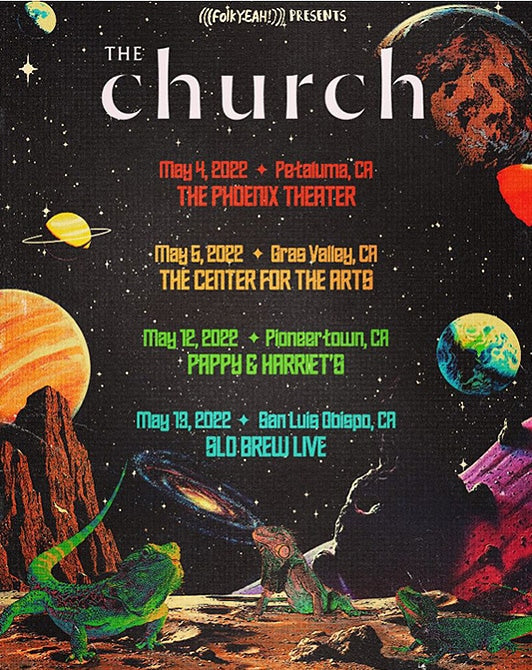
The Church, concert poster.


I have long questioned the hearing acuity of many, if not most, rock concert sound engineers. In fact, I fantasize about being at a show with lousy sound, going up behind the mixer, yanking the sound guy out of his chair, and immediately lowering the master volume fader before tackling the mix and equalization settings. I have only done live sound mixing once, but I do believe I could improve things. Whenever I’ve been at a show where the sound was done well, I make it a point to compliment the engineer. They always appreciate the positive feedback (you should pardon the pun).

I understand that, unlike classical concerts, most rock shows are usually performed in venues where little or no attention has been paid to optimizing the acoustics for music. The cavernous structure in which this concert took place proved to be a rather extreme example of that lack of forethought. Virtually all seating had been removed, and the walls were reflective (another pun) of the idea that acoustic treatment had been given short shrift.


One notable thing about the show was that apparently there had been a problem with their regular drummer. A friend of the band’s from New Zealand stepped in at the last minute. Lead vocalist/bassist (and the only remaining original member) Steve Kilbey told us that this friend (I couldn’t catch his name because of the sound) had “put his life on hold to help out,” and that this was their first gig together. I think he was preparing us for the possibility of a few screw-ups (which didn’t happen). As a former drummer myself, I would never have guessed they hadn’t performed together previously, so smooth was his fit with the band. They couldn’t have had much time to rehearse, but it sounded like they had played together for years. The band was fleshed out with two guitarists and another who alternately played guitar, bass, or keyboards. Those three also contributed backing vocals.

After a few songs, Kilbey seemed pleased with the reception, going so far as to quote the line from Sgt. Pepper, “you’re such a lovely audience, we’d like to take you home with us.” He also begged our indulgence as the band introduced a number of new songs, which were well received. Once again, the sound quality (or lack thereof) prevented me from discerning titles.

I was hoping the band would play my other favorite of theirs, “Lost,” but, alas, they didn’t. The moody feel of that song fits right in with 1980s-era Pink Floyd.


Even if you think you don’t know the Church, you might be familiar with their best-known song, “Under the Milky Way,” which they saved for late in the show.


They were generous with their time, including an encore with three songs, and they seemed to have enjoyed themselves. Unfortunately, this concert experience has me wondering just how many more shows are in the cards for me. There just aren’t that many groups still performing live that will get me off the couch and into the hall.

Header image courtesy of Pexels.com/picjumbo.com.

More from Issue 163

View All Articles in Issue 163

Search Copper Magazine

#231 Piano Prodigy Jude Kofie Releases His Debut Album On Octave Records by Frank Doris Jun 01, 2026 #231 Underappreciated Artists, Part Two: City Boy by Rich Isaacs Jun 01, 2026 #231 Music and the Art of Creation: Talking With Saxophonist Rob Scheps by Joe Caplan Jun 01, 2026 #231 How to Play in a Rock Band, 24: Further Adventures at the 2026 Montauk Music Festival by Frank Doris Jun 01, 2026 #231 Courtney Barnett: Creature of Habit by Wayne Robins Jun 01, 2026 #231 Angine de Poitrine: Interstellar Guitar Rock Saviors Headed for Late-Night TV Pop Stardom? by Mark Lepage Jun 01, 2026 #231 My Impressions of AXPONA 2026, Part One by Frank Doris Jun 01, 2026 #231 2026 La Jolla Concours d'Elegance: Another Aesthetic Feast by B. Jan Montana Jun 01, 2026 #231 Country Music Icon Jo Dee Messina’s Bridges: A New Beginning by Ray Chelstowski Jun 01, 2026 #231 The Luxury Dispatch Hosts a Video Podcast With Ken Kessler by Ken Kessler Jun 01, 2026 #231 The Vinyl Beat: Tracking in the Motor City by Rudy Radelic Jun 01, 2026 #231 Lots of Fun With DSP: The Ferrum Audio WANDLA DAC and Its Tube Mode by Frank Doris Jun 01, 2026 #231 From The Audiophile's Guide: Digital Source Components and Streaming Audio by Paul McGowan Jun 01, 2026 #231 Onkyo’s Monster M-510 power amplifier by The Staff at Just Audio Jun 01, 2026 #231 PS Audio in the News by PS Audio Staff Jun 01, 2026 #231 Naming Convention by Peter Xeni Jun 01, 2026 #231 Les Invisibles by Frank Doris Jun 01, 2026 #231 Wildlife Scene by James Schrimpf Jun 01, 2026 #230 Camaraderie by B. Jan Montana May 04, 2026 #230 AXPONA 2026: A Family Gathering by Paul McGowan May 04, 2026 #230 Pianist Ryan Benthall Explores Jazz Realms and Far Beyond With Divine Sky by Frank Doris May 04, 2026 #230 The Vinyl Beat in AXPONA-Land by Rudy Radelic May 04, 2026 #230 Teddy Thompson’s Musical Growth Deepens With Never Be the Same by Ray Chelstowski May 04, 2026 #230 More Fun in the Sun: Florida Audio Expo, Part Two by Frank Doris May 04, 2026 #230 CanJam NYC 2026 Show Report: Heady Sound, Part Two by Frank Doris and Harris Fogel May 04, 2026 #230 Sonic Youth On Murray Street by Wayne Robins May 04, 2026 #230 Graffeo Coffee: A Symphony of Sensory Experience by Joe Caplan May 04, 2026 #230 The Saul Authority: The Story of Hi-Fi Pioneer Saul Marantz by Olivier Meunier-Plante May 04, 2026 #230 How to Play in a Rock Band, 23: Encounters With Famous Musicians, Part Two by Frank Doris May 04, 2026 #230 An Outlier in the Rack: A Vintage BIC Beam Box by The Staff at Just Audio May 04, 2026 #230 PS Audio in the News by PS Audio Staff May 04, 2026 #230 A Cautionary Tale by Rich Isaacs May 04, 2026 #230 Reel-to-Reel Roots, Part 33 (Revised): Ken Kessler Reports On the 2026 (British) AudioJumble by Ken Kessler May 04, 2026 #230 Text Messaging by Frank Doris May 04, 2026 #230 The Audiophile Rat Race by Peter Xeni May 04, 2026 #230 On the Rocks by Rich Isaacs May 04, 2026 #229 The Earliest Stars of Country Music, Part Three by Jeff Weiner Apr 06, 2026 #229 The Healing Power of Music and Sound at the Omega Institute by Joe Caplan Apr 06, 2026 #229 CanJam NYC 2026 Show Report: Heady Sound, Part One by Frank Doris Apr 06, 2026 #229 Florida Audio Expo 2026: Warming Up to High-End Audio, Part One by Frank Doris Apr 06, 2026 #229 Quick Takes: Anne Bisson, Sam Morrison, The Velvet Underground, and the Stooges by Frank Doris Apr 06, 2026 #229 The Vinyl Beat: New Arrivals, and Old Audio Show Demo Scores to Settle by Rudy Radelic Apr 06, 2026 #229 Harvard Gets a High-End Audio Education by Frank Doris Apr 06, 2026 #229 No Country for Old Knees by B. Jan Montana Apr 06, 2026 #229 How To Play in A Rock Band, 22: Encounters With Famous Musicians, Part 1 by Frank Doris Apr 06, 2026 #229 The Soulful Grooves of Guinea-Bissau by Steve Kindig Apr 06, 2026 #229 Four-Hand Piano Performance at Its Finest by Stephan Haberthür Apr 06, 2026

Live Versus Recorded Music

Live Versus Recorded Music

I went to a rock concert a couple of weeks ago. This was only my second such show since the pandemic began (not counting a few bar gigs involving local bands), in stark contrast to the over 50 shows I wrote about attending in 1977 (see my article in Issue 161). I was instantly reminded of the problems one can encounter in the “concert hall” environment.

Stereophile editor Jim Austin, having recently been to a classical piano performance at Carnegie Hall, wrote about some of those problems in his editorial “On Live Music” in the May 2022 issue. He tackled the accepted notion that audiophiles should attend live, preferably acoustic, music events in order to have a point of reference for how “accurate” or “realistic” one’s system sounds at home. His conclusion was that there were distinct advantages to experiencing well-recorded music in a domestic setting, most notably fewer aural distractions emanating from other concertgoers. Austin mentioned cell phones going off, items being dropped and clattering on the floor, and the crinkling of paper programs, along with people who wear excessive amounts of scented products. To that list I would add other peoples’ conversations and – my all-time pet peeve – the person behind me who can’t manage to keep their foot or knee from bumping the back of my chair over and over. Have these folks never experienced any of this, or are they alone on the planet?

The show I saw was a performance by an Australian band, the Church, whose heyday was decades ago. I will admit to being a casual fan – I only own two of their albums – but the chance to see them locally in a relatively small setting was the draw. The concert took place in an old, run-down converted movie theatre, a venue that normally features punk and metal bands where volume trumps sound quality. In the hope of getting what should have been the best possible sound, I was able to put a folding chair ten feet behind the mixing board. My first thought as the performance began (with one of my favorite tracks of theirs, “Destination,” from their best-selling album, Starfish) was, “they sound so much better at home!” Vocals were almost unintelligible, and a general boominess muddied the other instruments. It was loud enough that earplugs were necessary, which added to the dulling effect.

The Church, concert poster.


I have long questioned the hearing acuity of many, if not most, rock concert sound engineers. In fact, I fantasize about being at a show with lousy sound, going up behind the mixer, yanking the sound guy out of his chair, and immediately lowering the master volume fader before tackling the mix and equalization settings. I have only done live sound mixing once, but I do believe I could improve things. Whenever I’ve been at a show where the sound was done well, I make it a point to compliment the engineer. They always appreciate the positive feedback (you should pardon the pun).

I understand that, unlike classical concerts, most rock shows are usually performed in venues where little or no attention has been paid to optimizing the acoustics for music. The cavernous structure in which this concert took place proved to be a rather extreme example of that lack of forethought. Virtually all seating had been removed, and the walls were reflective (another pun) of the idea that acoustic treatment had been given short shrift.


One notable thing about the show was that apparently there had been a problem with their regular drummer. A friend of the band’s from New Zealand stepped in at the last minute. Lead vocalist/bassist (and the only remaining original member) Steve Kilbey told us that this friend (I couldn’t catch his name because of the sound) had “put his life on hold to help out,” and that this was their first gig together. I think he was preparing us for the possibility of a few screw-ups (which didn’t happen). As a former drummer myself, I would never have guessed they hadn’t performed together previously, so smooth was his fit with the band. They couldn’t have had much time to rehearse, but it sounded like they had played together for years. The band was fleshed out with two guitarists and another who alternately played guitar, bass, or keyboards. Those three also contributed backing vocals.

After a few songs, Kilbey seemed pleased with the reception, going so far as to quote the line from Sgt. Pepper, “you’re such a lovely audience, we’d like to take you home with us.” He also begged our indulgence as the band introduced a number of new songs, which were well received. Once again, the sound quality (or lack thereof) prevented me from discerning titles.

I was hoping the band would play my other favorite of theirs, “Lost,” but, alas, they didn’t. The moody feel of that song fits right in with 1980s-era Pink Floyd.


Even if you think you don’t know the Church, you might be familiar with their best-known song, “Under the Milky Way,” which they saved for late in the show.


They were generous with their time, including an encore with three songs, and they seemed to have enjoyed themselves. Unfortunately, this concert experience has me wondering just how many more shows are in the cards for me. There just aren’t that many groups still performing live that will get me off the couch and into the hall.

Header image courtesy of Pexels.com/picjumbo.com.

0 comments

Leave a comment

0 Comments

Your avatar

Loading comments...

🗑️ Delete Comment

Enter moderator password to delete this comment:

✏️ Edit Comment

Enter your email to verify ownership: