COPPER

A PS Audio Publication

Issue 164 • Free Online Magazine

Issue 164 The Copper Interview

How Does a Vinyl Record Even Sound Good at All? Talking With Lewis Hopkin, Vinyl Mastering Engineer, Part One

How Does a Vinyl Record Even Sound Good at All? Talking With Lewis Hopkin, Vinyl Mastering Engineer, Part One

Have you ever wondered, just how does a vinyl record even sound good at all? Well, how does it in reality? The PVC vinyl that records are made from, and the record-manufacturing process, aren’t exactly free from factors that can ruin the chances of cutting a good record. In fact, the odds are heavily stacked against it.

In this series we will examine and demystify the many contributing factors which each have a critically essential part to play in making an outstanding-sounding record, as compared to the average offerings that are out there en masse.

Back to the question. How does a record even sound good at all? I asked Lewis Hopkin, vinyl mastering engineer and owner of Stardelta Audio Mastering, located in Dartmoor National Park in Devon, England. Stardelta offers a wide range of services including vinyl mastering and cutting, digital mastering, and mastering from stems or analog tape sources. He has formed a career spanning everything from GRAMMY award-winning records and worldwide number one hits to underground albums from independent artists in pretty much every genre of music. He has some strong opinions of which we include his thoughts here and in an upcoming Part Two, to appear in Issue 165.

Lewis Hopkin: Initially, I think the thing to say about a record is that I have always viewed [creating one] as a very honest and reasonably direct energy transfer, or at least [during] the cutting stage. After the cut, things get…interesting. What type of energy transfer are we referring to? Vibrations. Vibrations which are etched physically into the carrier [the vinyl record]. These grooves are then played back by a stylus that retraces the grooves. So, in essence, vibrations go in and those vibrations [ultimately] go [back] out to the speaker.

Although this is a gross oversimplification of the process, I have always felt that at least some of the lifelike qualities of a record, are just this. I feel that the emotional connection and realism we hear from records has a lot to do with the natural process of the reproduction of the vibrations. However, it would be hard to claim that making a high-quality record is a simple process, or indeed one that hasn’t undergone an enormous amount of processing.

I want to address the differences between a proper vinyl mastering engineer and a machine operator cutting at a pressing plant.

On the one hand you have an engineer who is dedicated to the technical pursuit and the audio pursuit of producing a profoundly impressive result. On the other hand, you have a machine operator who will do [simply] that, and will take the easiest and most efficient route to [producing a] product. And, of course, the [less-skilled or less-involved] machine operator will ruin the end result. Without fail, pressing plant cuts are compromised by being obligated to fit a directive: [be] quick and safe. The two approaches are at loggerheads with each other – day and night, chalk and cheese; yes, worlds apart.

You could produce a technically-perfect vinyl cut that ticks all the boxes of every desired technical mandate, but quite likely will sound terrible, because nearly all of the stereo [width], bass and top end has been removed from it to make it easy and safe to cut! This is habitual and indeed normal behavior at the cutting stage at [all too many] pressing plants. There are significant and insightful choices the professional vinyl mastering engineer has to make to preserve and optimize the great qualities which can result in an audio listening experience that sounds like no other. This is what we do here at Stardelta. It is an extremely involved and highly evolved skill set, which is required to produce such results, and takes years of experience to perfect. That is why when you have a record cut at a pressing plant [that might not be a specialist facility], it’s not the same as what we produce here at Stardelta, or with another vinyl mastering engineer who is a craftsman, not a machine operator. It has to be said though that some [more]-evolved pressing plants do use us to cut records for their direct clients. It goes without saying these are done with care like any other job we undertake and sound significantly better than the “operator” cuts.

Another important distinction, and something I come across in my work, is [that] some mastering engineers will sometimes offer masters to make vinyl records from, yet these engineers have never even been in the same room as a cutting lathe, let alone have any experience of actually cutting records or mastering for vinyl. They simply guess at what might work for vinyl. These best-guess masters are then given to operators at pressing plants to cut. The engineers remove anything that they think might cause problems. Often this is based on misunderstandings of what the vinyl may or may not do.
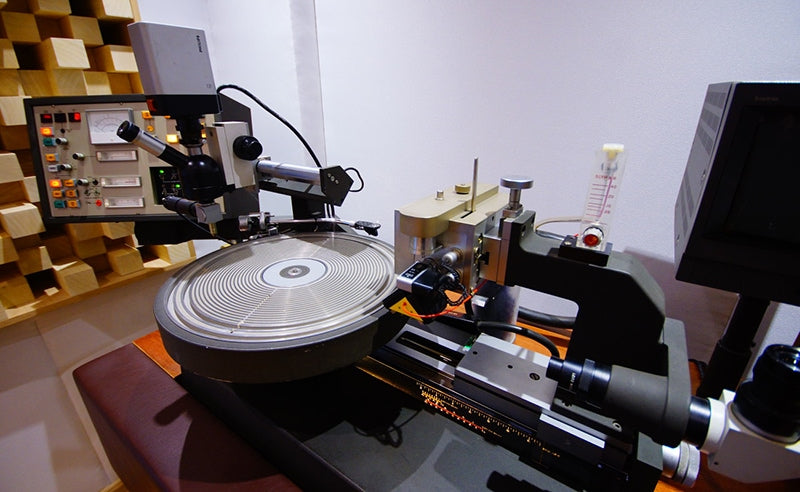
 

Record-cutting lathe at Stardelta Audio Mastering. From the Hutchinson Homes & Gardens website.

Record-cutting lathe at Stardelta Audio Mastering. From the Hutchinson Homes & Gardens website.

I take [a] big issue with this approach, as these engineers offer a digital file of a wild stab at what may work for a cut, which is truly at best a guess at what might work on the cut. In all [of these] cases they have compromised the original master by manipulating the parameters of what originally existed.

I want to say categorically that unless you are the vinyl mastering engineer who actually masters the record, including cutting the record, you are taking people’s money dishonestly. Vinyl mastering can only be carried out by the engineer who cuts the record.

Test cutting and listening and microscope inspection are intrinsically part of vinyl mastering. It’s not possible to do that without a cutting lathe, [or with] any claim you somehow can do this digitally and predict the future of how something will sound without [really] knowing.

The prominence or recent re-emergence and popularity of the vinyl medium has meant a proliferation of bad-sounding records, often cut from 16-bit CD or even just MP3 masters. The common denominator of most reissues is that they are made to very poor standards of quality and this is sadly true of most major label’s reissues. Lots of these are cut with no respect for the music. The [corporate] mandate is an easy-to-cut record with all the difficult-to-deal-with areas of the original mixes simply removed. A narrative I hear a lot is, “vinyl can’t do that,” or “vinyl can’t do this.” It’s rubbish.

The new listening audience is missing out on the potential of what can be heard, so we are continually seeking to address this. It is true that vinyl is not automatically better than digital, but it must be acknowledged that there is categorically no problem in reproducing a completely perfect rendition on vinyl of anything than can be done digitally. When done right, vinyl provides a high-end listening experience that is every bit that is good [as] high-resolution digital.

There is a qualifying caveat to that statement: Making a record the way it should be done may affect the playing time of a record side. But it is perfectly possible to do it with no reduction of stereo, and no reduction in bass, or high frequencies. It’s also entirely untrue that heavily-compressed music doesn’t work on vinyl. It works fine and sounds just as bad or good as it did before. It’s a creative choice. A good vinyl mastering engineer will work with compressed music with high average levels and still get a great-sounding result.

You can cut brick-wall, limited masters if that is what is required; however, [cutting music with] high average levels will use much more disc space, so in the end the record ends up quieter, with a lower dynamic range.

******

We’ll continue Lewis’s discussion in Part Two. For now, we’ll leave with this thought: sound reproduction on vinyl can also be like a distortion amplifier. Something distorted on the way in could sound more distorted on the way out. So, how do we address the problems faced by this quest to get the perfect sound, as well as the perfect technical rendition?

We will break this down in Part Two, which will cover mastering and cutting, achieving proper cutting levels, and avoiding sibilance. Lewis and Russ will collaborate to also discuss the question of cutting with stereo versus mono bass, dealing with out-of-phase content, the problem of hysteresis in metering, decisions made regarding the use of the record’s inner diameter, and much more.

More from Issue 164

View All Articles in Issue 164

Search Copper Magazine

#231 Piano Prodigy Jude Kofie Releases His Debut Album On Octave Records by Frank Doris Jun 01, 2026 #231 Underappreciated Artists, Part Two: City Boy by Rich Isaacs Jun 01, 2026 #231 Music and the Art of Creation: Talking With Saxophonist Rob Scheps by Joe Caplan Jun 01, 2026 #231 How to Play in a Rock Band, 24: Further Adventures at the 2026 Montauk Music Festival by Frank Doris Jun 01, 2026 #231 Courtney Barnett: Creature of Habit by Wayne Robins Jun 01, 2026 #231 Angine de Poitrine: Interstellar Guitar Rock Saviors Headed for Late-Night TV Pop Stardom? by Mark Lepage Jun 01, 2026 #231 My Impressions of AXPONA 2026, Part One by Frank Doris Jun 01, 2026 #231 2026 La Jolla Concours d'Elegance: Another Aesthetic Feast by B. Jan Montana Jun 01, 2026 #231 Country Music Icon Jo Dee Messina’s Bridges: A New Beginning by Ray Chelstowski Jun 01, 2026 #231 The Luxury Dispatch Hosts a Video Podcast With Ken Kessler by Ken Kessler Jun 01, 2026 #231 The Vinyl Beat: Tracking in the Motor City by Rudy Radelic Jun 01, 2026 #231 Lots of Fun With DSP: The Ferrum Audio WANDLA DAC and Its Tube Mode by Frank Doris Jun 01, 2026 #231 From The Audiophile's Guide: Digital Source Components and Streaming Audio by Paul McGowan Jun 01, 2026 #231 Onkyo’s Monster M-510 power amplifier by The Staff at Just Audio Jun 01, 2026 #231 PS Audio in the News by PS Audio Staff Jun 01, 2026 #231 Naming Convention by Peter Xeni Jun 01, 2026 #231 Les Invisibles by Frank Doris Jun 01, 2026 #231 Wildlife Scene by James Schrimpf Jun 01, 2026 #230 Camaraderie by B. Jan Montana May 04, 2026 #230 AXPONA 2026: A Family Gathering by Paul McGowan May 04, 2026 #230 Pianist Ryan Benthall Explores Jazz Realms and Far Beyond With Divine Sky by Frank Doris May 04, 2026 #230 The Vinyl Beat in AXPONA-Land by Rudy Radelic May 04, 2026 #230 Teddy Thompson’s Musical Growth Deepens With Never Be the Same by Ray Chelstowski May 04, 2026 #230 More Fun in the Sun: Florida Audio Expo, Part Two by Frank Doris May 04, 2026 #230 CanJam NYC 2026 Show Report: Heady Sound, Part Two by Frank Doris and Harris Fogel May 04, 2026 #230 Sonic Youth On Murray Street by Wayne Robins May 04, 2026 #230 Graffeo Coffee: A Symphony of Sensory Experience by Joe Caplan May 04, 2026 #230 The Saul Authority: The Story of Hi-Fi Pioneer Saul Marantz by Olivier Meunier-Plante May 04, 2026 #230 How to Play in a Rock Band, 23: Encounters With Famous Musicians, Part Two by Frank Doris May 04, 2026 #230 An Outlier in the Rack: A Vintage BIC Beam Box by The Staff at Just Audio May 04, 2026 #230 PS Audio in the News by PS Audio Staff May 04, 2026 #230 A Cautionary Tale by Rich Isaacs May 04, 2026 #230 Reel-to-Reel Roots, Part 33 (Revised): Ken Kessler Reports On the 2026 (British) AudioJumble by Ken Kessler May 04, 2026 #230 Text Messaging by Frank Doris May 04, 2026 #230 The Audiophile Rat Race by Peter Xeni May 04, 2026 #230 On the Rocks by Rich Isaacs May 04, 2026 #229 The Earliest Stars of Country Music, Part Three by Jeff Weiner Apr 06, 2026 #229 The Healing Power of Music and Sound at the Omega Institute by Joe Caplan Apr 06, 2026 #229 CanJam NYC 2026 Show Report: Heady Sound, Part One by Frank Doris Apr 06, 2026 #229 Florida Audio Expo 2026: Warming Up to High-End Audio, Part One by Frank Doris Apr 06, 2026 #229 Quick Takes: Anne Bisson, Sam Morrison, The Velvet Underground, and the Stooges by Frank Doris Apr 06, 2026 #229 The Vinyl Beat: New Arrivals, and Old Audio Show Demo Scores to Settle by Rudy Radelic Apr 06, 2026 #229 Harvard Gets a High-End Audio Education by Frank Doris Apr 06, 2026 #229 No Country for Old Knees by B. Jan Montana Apr 06, 2026 #229 How To Play in A Rock Band, 22: Encounters With Famous Musicians, Part 1 by Frank Doris Apr 06, 2026 #229 The Soulful Grooves of Guinea-Bissau by Steve Kindig Apr 06, 2026 #229 Four-Hand Piano Performance at Its Finest by Stephan Haberthür Apr 06, 2026

How Does a Vinyl Record Even Sound Good at All? Talking With Lewis Hopkin, Vinyl Mastering Engineer, Part One

How Does a Vinyl Record Even Sound Good at All? Talking With Lewis Hopkin, Vinyl Mastering Engineer, Part One

Have you ever wondered, just how does a vinyl record even sound good at all? Well, how does it in reality? The PVC vinyl that records are made from, and the record-manufacturing process, aren’t exactly free from factors that can ruin the chances of cutting a good record. In fact, the odds are heavily stacked against it.

In this series we will examine and demystify the many contributing factors which each have a critically essential part to play in making an outstanding-sounding record, as compared to the average offerings that are out there en masse.

Back to the question. How does a record even sound good at all? I asked Lewis Hopkin, vinyl mastering engineer and owner of Stardelta Audio Mastering, located in Dartmoor National Park in Devon, England. Stardelta offers a wide range of services including vinyl mastering and cutting, digital mastering, and mastering from stems or analog tape sources. He has formed a career spanning everything from GRAMMY award-winning records and worldwide number one hits to underground albums from independent artists in pretty much every genre of music. He has some strong opinions of which we include his thoughts here and in an upcoming Part Two, to appear in Issue 165.

Lewis Hopkin: Initially, I think the thing to say about a record is that I have always viewed [creating one] as a very honest and reasonably direct energy transfer, or at least [during] the cutting stage. After the cut, things get…interesting. What type of energy transfer are we referring to? Vibrations. Vibrations which are etched physically into the carrier [the vinyl record]. These grooves are then played back by a stylus that retraces the grooves. So, in essence, vibrations go in and those vibrations [ultimately] go [back] out to the speaker.

Although this is a gross oversimplification of the process, I have always felt that at least some of the lifelike qualities of a record, are just this. I feel that the emotional connection and realism we hear from records has a lot to do with the natural process of the reproduction of the vibrations. However, it would be hard to claim that making a high-quality record is a simple process, or indeed one that hasn’t undergone an enormous amount of processing.

I want to address the differences between a proper vinyl mastering engineer and a machine operator cutting at a pressing plant.

On the one hand you have an engineer who is dedicated to the technical pursuit and the audio pursuit of producing a profoundly impressive result. On the other hand, you have a machine operator who will do [simply] that, and will take the easiest and most efficient route to [producing a] product. And, of course, the [less-skilled or less-involved] machine operator will ruin the end result. Without fail, pressing plant cuts are compromised by being obligated to fit a directive: [be] quick and safe. The two approaches are at loggerheads with each other – day and night, chalk and cheese; yes, worlds apart.

You could produce a technically-perfect vinyl cut that ticks all the boxes of every desired technical mandate, but quite likely will sound terrible, because nearly all of the stereo [width], bass and top end has been removed from it to make it easy and safe to cut! This is habitual and indeed normal behavior at the cutting stage at [all too many] pressing plants. There are significant and insightful choices the professional vinyl mastering engineer has to make to preserve and optimize the great qualities which can result in an audio listening experience that sounds like no other. This is what we do here at Stardelta. It is an extremely involved and highly evolved skill set, which is required to produce such results, and takes years of experience to perfect. That is why when you have a record cut at a pressing plant [that might not be a specialist facility], it’s not the same as what we produce here at Stardelta, or with another vinyl mastering engineer who is a craftsman, not a machine operator. It has to be said though that some [more]-evolved pressing plants do use us to cut records for their direct clients. It goes without saying these are done with care like any other job we undertake and sound significantly better than the “operator” cuts.

Another important distinction, and something I come across in my work, is [that] some mastering engineers will sometimes offer masters to make vinyl records from, yet these engineers have never even been in the same room as a cutting lathe, let alone have any experience of actually cutting records or mastering for vinyl. They simply guess at what might work for vinyl. These best-guess masters are then given to operators at pressing plants to cut. The engineers remove anything that they think might cause problems. Often this is based on misunderstandings of what the vinyl may or may not do.


Record-cutting lathe at Stardelta Audio Mastering. From the Hutchinson Homes & Gardens website.

Record-cutting lathe at Stardelta Audio Mastering. From the Hutchinson Homes & Gardens website.

I take [a] big issue with this approach, as these engineers offer a digital file of a wild stab at what may work for a cut, which is truly at best a guess at what might work on the cut. In all [of these] cases they have compromised the original master by manipulating the parameters of what originally existed.

I want to say categorically that unless you are the vinyl mastering engineer who actually masters the record, including cutting the record, you are taking people’s money dishonestly. Vinyl mastering can only be carried out by the engineer who cuts the record.

Test cutting and listening and microscope inspection are intrinsically part of vinyl mastering. It’s not possible to do that without a cutting lathe, [or with] any claim you somehow can do this digitally and predict the future of how something will sound without [really] knowing.

The prominence or recent re-emergence and popularity of the vinyl medium has meant a proliferation of bad-sounding records, often cut from 16-bit CD or even just MP3 masters. The common denominator of most reissues is that they are made to very poor standards of quality and this is sadly true of most major label’s reissues. Lots of these are cut with no respect for the music. The [corporate] mandate is an easy-to-cut record with all the difficult-to-deal-with areas of the original mixes simply removed. A narrative I hear a lot is, “vinyl can’t do that,” or “vinyl can’t do this.” It’s rubbish.

The new listening audience is missing out on the potential of what can be heard, so we are continually seeking to address this. It is true that vinyl is not automatically better than digital, but it must be acknowledged that there is categorically no problem in reproducing a completely perfect rendition on vinyl of anything than can be done digitally. When done right, vinyl provides a high-end listening experience that is every bit that is good [as] high-resolution digital.

There is a qualifying caveat to that statement: Making a record the way it should be done may affect the playing time of a record side. But it is perfectly possible to do it with no reduction of stereo, and no reduction in bass, or high frequencies. It’s also entirely untrue that heavily-compressed music doesn’t work on vinyl. It works fine and sounds just as bad or good as it did before. It’s a creative choice. A good vinyl mastering engineer will work with compressed music with high average levels and still get a great-sounding result.

You can cut brick-wall, limited masters if that is what is required; however, [cutting music with] high average levels will use much more disc space, so in the end the record ends up quieter, with a lower dynamic range.

******

We’ll continue Lewis’s discussion in Part Two. For now, we’ll leave with this thought: sound reproduction on vinyl can also be like a distortion amplifier. Something distorted on the way in could sound more distorted on the way out. So, how do we address the problems faced by this quest to get the perfect sound, as well as the perfect technical rendition?

We will break this down in Part Two, which will cover mastering and cutting, achieving proper cutting levels, and avoiding sibilance. Lewis and Russ will collaborate to also discuss the question of cutting with stereo versus mono bass, dealing with out-of-phase content, the problem of hysteresis in metering, decisions made regarding the use of the record’s inner diameter, and much more.

0 comments

Leave a comment

0 Comments

Your avatar

Loading comments...

🗑️ Delete Comment

Enter moderator password to delete this comment:

✏️ Edit Comment

Enter your email to verify ownership: