COPPER

A PS Audio Publication

Issue 146 • Free Online Magazine

Issue 146 FROM THE SWEET SPOT

Global Groovin’ with Analog Africa

Global Groovin’ with Analog Africa

“Greetings, funky friends.”

So began a recent email announcing the latest release from one of my favorite music labels, Analog Africa. Launched in 2007, AA has so far produced 44 ear-opening reissues and compilations of rare and little-known music from the 1960s, 1970s, and 1980s. As the name suggests, the label’s catalog is mostly focused on Africa, but there are also several titles from South America.

Analog Africa is based in Frankfurt, Germany, home of the label’s founder and owner, Samy Ben Redjeb (SBR). Originally from Tunisia, SBR developed his ear for funky dance music while DJing in Dakar, Senegal. As his collection of African music grew, he found that the rawer styles he preferred weren’t always so popular with the disco crowd. Later, during a stint as a flight attendant for Lufthansa, he made about a thousand trips to various African cities, using his free time during layovers to hunt for records.

Some Western listeners have been introduced to African music from countries like Mali and Nigeria through international superstars like Salif Keita and Fela Kuti. But many other nations have deep music scenes that are still relatively unknown. AA has focused on the music of those countries, including Benin, Togo, Ghana, Cameroon, and Burkina Faso, among others.

SBR personally chooses every cut on every Analog Africa compilation. When assembling a compilation he may listen to 1,000 tracks or more in order to end up with 14 or so keepers. He gradually whittles down the number of tracks to a few dozen candidates, then listens to them again and again over the course of months, gradually discarding the ones he tires of. Once he decides on the final track selection, sequencing them for optimal flow can take several more months.
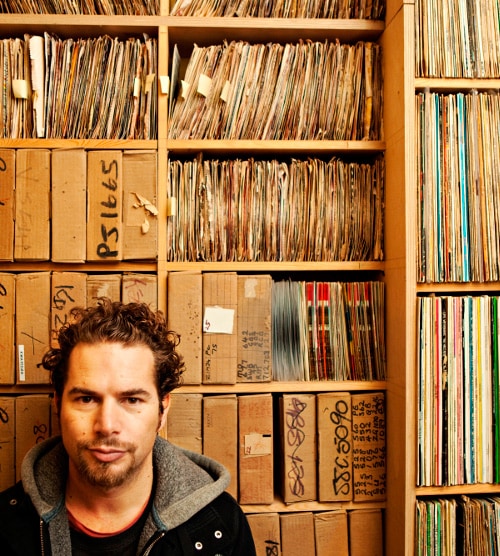
Samy Ben Redjeb.


Besides going to great lengths to gather the choicest cuts, and ensuring that these less-than-pristine sources sound their best, AA consistently provides deluxe packaging, including liner notes that may run to 40 pages or more. These booklets don’t include song lyrics, which nearly always aren’t in English. Nor will you find technical specs on the recording process or equipment used. What you will find are Samy Ben Redjeb’s personal stories of how each recording came to be, fleshed out with interviews with musicians and producers, plus loads of great photos.

With a name like Analog Africa, you’d expect the label to be vinyl-focused, but that’s not necessarily the case. The recordings are virtually all-analog, but the music is digitized prior to re-mastering. Each release is initially available as an LP, CD, or digital download (check out AA’s Bandcamp page). Some LP titles are pressed on audiophile-approved 180-gram vinyl, while others get more typical 140-gram vinyl.

Samy Ben Redjeb himself has said that the CD and vinyl versions usually sound very close, and that he sometimes prefers the CDs for their more detailed sound. I’ve only purchased CD versions so far, and played through my current DAC – the Benchmark DAC3 HGC – they sound clean, clear, and dynamic. If you’re on the fence, one reason to consider vinyl is that the format provides a bigger canvas for Analog Africa’s cool, colorful artwork.

I’d been hosting a world music radio show for a few years before I discovered Analog Africa, and when I did, it was a real revelation. I’d simply had no idea that this type of music was being made during this time period, in these places. I return to AA’s compilations often, both for radio play and for listening at home. Although it’s been decades since these tracks were originally laid down, they always sound fresh, funky, and fun!

Every Analog Africa compilation is packed with groovy tunes, but if you’re wondering where to start, I’d suggest Afro-Beat Airways. You might associate Afrobeat with the pioneer of the genre, the late Fela Kuti, but much of Afro-Beat Airways doesn’t feature his slow-burn style. The selection here, by the Togolese band Orchestre Abass, sounds like it owes as much to Bo Diddley as to Fela. What stands out to me is the raw energy that infuses this and every other cut on this compilation.

Awula Bo Fee Ene (Orchestre Abass):


AA is mainly known for its collections that feature several bands representing certain musical styles. But their catalog also includes titles showcasing a single artist or band. For Orchestre Poly-Rythmo de Cotonou, a band hailing from Cotonou, Benin, Analog Africa actually released three CDs culled from dusty cartons of vinyl and master tapes that SBR found in a warehouse. Echos Hypnotiques is volume two of the three, and probably my favorite for its consistency. This is one of the greatest African bands ever!

Mi Ve Wa Se:


Burkina Faso is a landlocked country in West Africa with a diverse music scene that draws influences from neighboring countries like Mali, Ivory Coast, and Ghana. The jangly guitar and upbeat pop energy of “Rog Mik Africa” make it a bit of an outlier in AA’s Bambara Mystic Soul compilation.

Rog Mik Africa (Orchestre CVD):


Amara Toure first made his name as the lead singer and percussionist for Le Star Band de Dakar, who helped popularize Afro-Cuban music in Senegal in the late 1950s and early 1960s. After 10 years with the Star Band, he cut records with two other Afro-Cuban groups: L’Ensemble Black & White in Cameroon, and L’Orchestre Massako in Gabon. The AA release Amara Toure collects music from his Cameroon and Gabon periods.  These atmospheric songs make for great late night listening.

Lamento Cubano (with L’Ensemble Black & White):

Here’s a link to a Spotify playlist featuring music from Analog Africa:


Header image of Samy Ben Redjeb from the Analog Africa website.

More from Issue 146

View All Articles in Issue 146

Search Copper Magazine

#231 Piano Prodigy Jude Kofie Releases His Debut Album On Octave Records by Frank Doris Jun 01, 2026 #231 Underappreciated Artists, Part Two: City Boy by Rich Isaacs Jun 01, 2026 #231 Music and the Art of Creation: Talking With Saxophonist Rob Scheps by Joe Caplan Jun 01, 2026 #231 How to Play in a Rock Band, 24: Further Adventures at the 2026 Montauk Music Festival by Frank Doris Jun 01, 2026 #231 Courtney Barnett: Creature of Habit by Wayne Robins Jun 01, 2026 #231 Angine de Poitrine: Interstellar Guitar Rock Saviors Headed for Late-Night TV Pop Stardom? by Mark Lepage Jun 01, 2026 #231 My Impressions of AXPONA 2026, Part One by Frank Doris Jun 01, 2026 #231 2026 La Jolla Concours d'Elegance: Another Aesthetic Feast by B. Jan Montana Jun 01, 2026 #231 Country Music Icon Jo Dee Messina’s Bridges: A New Beginning by Ray Chelstowski Jun 01, 2026 #231 The Luxury Dispatch Hosts a Video Podcast With Ken Kessler by Ken Kessler Jun 01, 2026 #231 The Vinyl Beat: Tracking in the Motor City by Rudy Radelic Jun 01, 2026 #231 Lots of Fun With DSP: The Ferrum Audio WANDLA DAC and Its Tube Mode by Frank Doris Jun 01, 2026 #231 From The Audiophile's Guide: Digital Source Components and Streaming Audio by Paul McGowan Jun 01, 2026 #231 Onkyo’s Monster M-510 power amplifier by The Staff at Just Audio Jun 01, 2026 #231 PS Audio in the News by PS Audio Staff Jun 01, 2026 #231 Naming Convention by Peter Xeni Jun 01, 2026 #231 Les Invisibles by Frank Doris Jun 01, 2026 #231 Wildlife Scene by James Schrimpf Jun 01, 2026 #230 Camaraderie by B. Jan Montana May 04, 2026 #230 AXPONA 2026: A Family Gathering by Paul McGowan May 04, 2026 #230 Pianist Ryan Benthall Explores Jazz Realms and Far Beyond With Divine Sky by Frank Doris May 04, 2026 #230 The Vinyl Beat in AXPONA-Land by Rudy Radelic May 04, 2026 #230 Teddy Thompson’s Musical Growth Deepens With Never Be the Same by Ray Chelstowski May 04, 2026 #230 More Fun in the Sun: Florida Audio Expo, Part Two by Frank Doris May 04, 2026 #230 CanJam NYC 2026 Show Report: Heady Sound, Part Two by Frank Doris and Harris Fogel May 04, 2026 #230 Sonic Youth On Murray Street by Wayne Robins May 04, 2026 #230 Graffeo Coffee: A Symphony of Sensory Experience by Joe Caplan May 04, 2026 #230 The Saul Authority: The Story of Hi-Fi Pioneer Saul Marantz by Olivier Meunier-Plante May 04, 2026 #230 How to Play in a Rock Band, 23: Encounters With Famous Musicians, Part Two by Frank Doris May 04, 2026 #230 An Outlier in the Rack: A Vintage BIC Beam Box by The Staff at Just Audio May 04, 2026 #230 PS Audio in the News by PS Audio Staff May 04, 2026 #230 A Cautionary Tale by Rich Isaacs May 04, 2026 #230 Reel-to-Reel Roots, Part 33 (Revised): Ken Kessler Reports On the 2026 (British) AudioJumble by Ken Kessler May 04, 2026 #230 Text Messaging by Frank Doris May 04, 2026 #230 The Audiophile Rat Race by Peter Xeni May 04, 2026 #230 On the Rocks by Rich Isaacs May 04, 2026 #229 The Earliest Stars of Country Music, Part Three by Jeff Weiner Apr 06, 2026 #229 The Healing Power of Music and Sound at the Omega Institute by Joe Caplan Apr 06, 2026 #229 CanJam NYC 2026 Show Report: Heady Sound, Part One by Frank Doris Apr 06, 2026 #229 Florida Audio Expo 2026: Warming Up to High-End Audio, Part One by Frank Doris Apr 06, 2026 #229 Quick Takes: Anne Bisson, Sam Morrison, The Velvet Underground, and the Stooges by Frank Doris Apr 06, 2026 #229 The Vinyl Beat: New Arrivals, and Old Audio Show Demo Scores to Settle by Rudy Radelic Apr 06, 2026 #229 Harvard Gets a High-End Audio Education by Frank Doris Apr 06, 2026 #229 No Country for Old Knees by B. Jan Montana Apr 06, 2026 #229 How To Play in A Rock Band, 22: Encounters With Famous Musicians, Part 1 by Frank Doris Apr 06, 2026 #229 The Soulful Grooves of Guinea-Bissau by Steve Kindig Apr 06, 2026 #229 Four-Hand Piano Performance at Its Finest by Stephan Haberthür Apr 06, 2026

Global Groovin’ with Analog Africa

Global Groovin’ with Analog Africa

“Greetings, funky friends.”

So began a recent email announcing the latest release from one of my favorite music labels, Analog Africa. Launched in 2007, AA has so far produced 44 ear-opening reissues and compilations of rare and little-known music from the 1960s, 1970s, and 1980s. As the name suggests, the label’s catalog is mostly focused on Africa, but there are also several titles from South America.

Analog Africa is based in Frankfurt, Germany, home of the label’s founder and owner, Samy Ben Redjeb (SBR). Originally from Tunisia, SBR developed his ear for funky dance music while DJing in Dakar, Senegal. As his collection of African music grew, he found that the rawer styles he preferred weren’t always so popular with the disco crowd. Later, during a stint as a flight attendant for Lufthansa, he made about a thousand trips to various African cities, using his free time during layovers to hunt for records.

Some Western listeners have been introduced to African music from countries like Mali and Nigeria through international superstars like Salif Keita and Fela Kuti. But many other nations have deep music scenes that are still relatively unknown. AA has focused on the music of those countries, including Benin, Togo, Ghana, Cameroon, and Burkina Faso, among others.

SBR personally chooses every cut on every Analog Africa compilation. When assembling a compilation he may listen to 1,000 tracks or more in order to end up with 14 or so keepers. He gradually whittles down the number of tracks to a few dozen candidates, then listens to them again and again over the course of months, gradually discarding the ones he tires of. Once he decides on the final track selection, sequencing them for optimal flow can take several more months.

Samy Ben Redjeb.


Besides going to great lengths to gather the choicest cuts, and ensuring that these less-than-pristine sources sound their best, AA consistently provides deluxe packaging, including liner notes that may run to 40 pages or more. These booklets don’t include song lyrics, which nearly always aren’t in English. Nor will you find technical specs on the recording process or equipment used. What you will find are Samy Ben Redjeb’s personal stories of how each recording came to be, fleshed out with interviews with musicians and producers, plus loads of great photos.

With a name like Analog Africa, you’d expect the label to be vinyl-focused, but that’s not necessarily the case. The recordings are virtually all-analog, but the music is digitized prior to re-mastering. Each release is initially available as an LP, CD, or digital download (check out AA’s Bandcamp page). Some LP titles are pressed on audiophile-approved 180-gram vinyl, while others get more typical 140-gram vinyl.

Samy Ben Redjeb himself has said that the CD and vinyl versions usually sound very close, and that he sometimes prefers the CDs for their more detailed sound. I’ve only purchased CD versions so far, and played through my current DAC – the Benchmark DAC3 HGC – they sound clean, clear, and dynamic. If you’re on the fence, one reason to consider vinyl is that the format provides a bigger canvas for Analog Africa’s cool, colorful artwork.

I’d been hosting a world music radio show for a few years before I discovered Analog Africa, and when I did, it was a real revelation. I’d simply had no idea that this type of music was being made during this time period, in these places. I return to AA’s compilations often, both for radio play and for listening at home. Although it’s been decades since these tracks were originally laid down, they always sound fresh, funky, and fun!

Every Analog Africa compilation is packed with groovy tunes, but if you’re wondering where to start, I’d suggest Afro-Beat Airways. You might associate Afrobeat with the pioneer of the genre, the late Fela Kuti, but much of Afro-Beat Airways doesn’t feature his slow-burn style. The selection here, by the Togolese band Orchestre Abass, sounds like it owes as much to Bo Diddley as to Fela. What stands out to me is the raw energy that infuses this and every other cut on this compilation.

Awula Bo Fee Ene (Orchestre Abass):


AA is mainly known for its collections that feature several bands representing certain musical styles. But their catalog also includes titles showcasing a single artist or band. For Orchestre Poly-Rythmo de Cotonou, a band hailing from Cotonou, Benin, Analog Africa actually released three CDs culled from dusty cartons of vinyl and master tapes that SBR found in a warehouse. Echos Hypnotiques is volume two of the three, and probably my favorite for its consistency. This is one of the greatest African bands ever!

Mi Ve Wa Se:


Burkina Faso is a landlocked country in West Africa with a diverse music scene that draws influences from neighboring countries like Mali, Ivory Coast, and Ghana. The jangly guitar and upbeat pop energy of “Rog Mik Africa” make it a bit of an outlier in AA’s Bambara Mystic Soul compilation.

Rog Mik Africa (Orchestre CVD):


Amara Toure first made his name as the lead singer and percussionist for Le Star Band de Dakar, who helped popularize Afro-Cuban music in Senegal in the late 1950s and early 1960s. After 10 years with the Star Band, he cut records with two other Afro-Cuban groups: L’Ensemble Black & White in Cameroon, and L’Orchestre Massako in Gabon. The AA release Amara Toure collects music from his Cameroon and Gabon periods.  These atmospheric songs make for great late night listening.

Lamento Cubano (with L’Ensemble Black & White):

Here’s a link to a Spotify playlist featuring music from Analog Africa:


Header image of Samy Ben Redjeb from the Analog Africa website.

0 comments

Leave a comment

0 Comments

Your avatar

Loading comments...

🗑️ Delete Comment

Enter moderator password to delete this comment:

✏️ Edit Comment

Enter your email to verify ownership: