Copper Magazine · Issue 19 · A free PS Audio publication
Issue 19 MY TURN

DeVore Fidelity

Like many other audio companies, DeVore Fidelity began as a hobby. Designer/owner John DeVore graduated from RISD (the Rhode Island School of Design, in Providence—alumni include Seth McFarlane, Marin Mull, Dale Chihuly, Nicole Miller and most of the Talking Heads), played drums in a number of bands, and worked as a salesman at both Sound By Singer and Stereo Exchange in Manhattan.DeVore “always built [speakers]”, as he puts it, beginning while at RISD in 1986. During his time in retail he was able to compare his creations with well-known audiophile favorites. In the late ‘90’s he built a design which worked particularly well, and he christened it “The Gibbon”. The name was partly a playful reaction to the hyper-serious product names often found in audio, and partly an  homage to his uncle  Irven  DeVore, a well-known primatologist and anthropologist. The practice still continues: DeVore’s three product lines are the Gibbons, Orangutans, and Silverbacks.


devore

The whimsical entry to DeVore Fidelity’s shop in the industrial-strength Brooklyn Navy Yard.

Beginning DeVore Fidelity in 2000, DeVore was able to leave retail in 2001, and devote all his time to designing and building speakers. In that year he moved his shop to the Brooklyn Navy Yard in order to be closer to cabinetmaker Anthony Abbate; a year later, the two moved to a larger shared space in the ‘Yard, where they still are.

Brooklyn Navy

Do I really need to label this? This place is huge, with dozens of giant buildings.

The company made a major splash around 2002 with the Gibbon Eight, a slender two-way that featured proprietary crossover topology, a side-firing port and a tweeter placed below the midrange, elements found in many DeVore designs. Much of the Eight’s notoriety came from the fact that several initial review samples went out, and never came back: all the reviewers bought them. Later updates included the Super Eight and 88; the Nines and (most recently) the 3- way Xs followed.
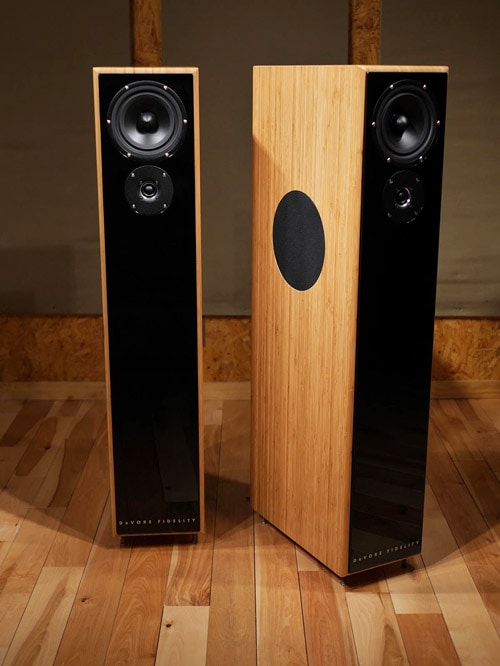
DeVore Gibbon X The

The Gibbon X (Photo from DeVore Fidelity).

DeVore’s designs have always been more efficient than your average monkey coffins (a term used by the late Harvey “Gizmo” Rosenberg which seems perversely apt in this case), with sensitivity around 90 or 91 dB and an uncommonly easy load.  Because of these characteristics, Gibbons were often found paired with tube or low-powered SET (single-ended triode)  amplifiers.

o96

The O/96 (Photo from DeVore Fidelity).

Maximizing designs to pair well with low-powered SETs, DeVore introduced the Orangutan series, broad-baffled two-way speakers with largish woofers that bring to mind a new-millenial take on classic designs like the Altec Valencias. The O-93 is a floorstander with a 10″ paper cone woofer and a silk-dome tweeter mounted in a slight horn; the O-96 is a standmounted floorstander (if you can follow that), with similar drivers to those in the 93, but with beefier motor structures on both. As you might expect, the models are 93 and 96 dB efficient.

So what does the future hold for DeVore Fidelity? Short term, perhaps an “Uber-Orangutan”, with hyper-tweaked drivers and even a little more sensitivity than the O-96. Beyond that, who knows? DeVore’s combination of musicality, flawless worksmanship and puckish originality is unlikely to go out of style.

And thank goodness for that.

More from Issue 19

View All Articles in Issue 19

Search Copper Magazine

#236 Magic Boy: The Jimi Hendrix Experience, Live and Rediscovered by Frank Doris Nov 02, 2026 #236 The Great Rhythmic Divide: Composer David Chesky Asks, Why Doesn't the Symphony Orchestra Groove? by David Chesky Nov 02, 2026 #236 More Record Reviews: Roni Eytan’s Microtonal Harmonica, Jane Ira Bloom, and a Frank Zappa Freak Out by Frank Doris Nov 02, 2026 #236 An Album of Inviting Beauty: Goodnight Moon from Acoustic Eidolon, And an Interview With the Artists Who Created it by Frank Doris Nov 02, 2026 #236 Never Ignore Your Inner Voice by B. Jan Montana Nov 02, 2026 #236 Composer Joseph Bertolozzi Uses Bridges, Structures and the World as Musical Instruments, Part One by Joe Caplan Nov 02, 2026 #236 Transmission: A Powerful Horn-Loaded Album from the Huntertones by Ray Chelstowski Nov 02, 2026 #236 Les Quatre Saisons du Québec: a New “Four Seasons” on Tour and on ATMA Classique by Robert Schryer Nov 02, 2026 #236 From The Audiophile's Guide: A Glossary of Terms for Today's Audio Systems, A – M by Paul McGowan Nov 02, 2026 #236 From The Listening Chair: An Introduction to Audiophile Tweaks by Howard Kneller Nov 02, 2026 #236 The Vinyl Beat Grew Two Inches Since October! by Rudy Radelic Nov 02, 2026 #236 How to Play in a Rock Band, Part 29: Figuring Out How to Play the Songs by Frank Doris Nov 02, 2026 #236 The Return of the Residents: Eskimo is On the Road by Wayne Robins Nov 02, 2026 #236 PS Audio in the News by PS Audio Staff Nov 02, 2026 #236 The People Who Make Audio Happen – Fun In Las Vegas at…CES 2026? by Harris Fogel Nov 02, 2026 #236 The Forms of Things Unknown by Frank Doris Nov 02, 2026 #236 Prophetic by Peter Xeni Nov 02, 2026 #236 Here's Looking at You, Kid by Rich Isaacs Nov 02, 2026 Favorites From T.H.E. Show SoCal 2026 by Cam Martin Oct 05, 2026 #235 Singer/Songwriter John David Schrader: On the Need to Create, Part Two by Joe Caplan Oct 05, 2026 #235 A Life in High-End Audio: The Roy Hall Interview, Part Two by Frank Doris Oct 05, 2026 #235 Grammy-Winning Producer, Songwriter, and Guitarist John Leventhal Goes Instrumental With National Drift by Ray Chelstowski Oct 05, 2026 #235 From Swimming Pool to New Listening Room—to Founding an Accidental Audio Company by Gilles Laferrière Oct 05, 2026 #235 The Vinyl Beat’s Size Matters Edition by Rudy Radelic Oct 05, 2026 #235 The Sublime Complexities of Nature by B. Jan Montana Oct 05, 2026 #235 How to Play In a Rock Band, 28: Growing Older and Dealing With It by Frank Doris Oct 05, 2026 #235 Young Rascals: From Bar Band to Stardom by Wayne Robins Oct 05, 2026 #235 Duncan Sheik: In Memoriam by Ray Chelstowski Oct 05, 2026 #235 From The Listening Chair: The Meze Audio 105 Silva Headphones by Howard Kneller Oct 05, 2026 #235 Checking Out Some NOLA Loudspeakers – and Some Thoughts About Audio Writing by Frank Doris Oct 05, 2026 #235 The Kanazawa Phonograph Museum: Music from a Time Capsule by Sebastian Polcyn Oct 05, 2026 #235 PS Audio in the News by PS Audio Staff Oct 05, 2026 #235 From The Audiophile’s Guide: Making the Most Critical Choice by Paul McGowan Oct 05, 2026 #235 Evolutionary Growth by Frank Doris Oct 05, 2026 #235 Speed Racer by Peter Xeni Oct 05, 2026 #235 Happy Halloween! by James Schrimpf Oct 05, 2026 #234 A Life in High-End Audio: The Roy Hall Interview, Part One by Frank Doris Sep 07, 2026 #234 Jason Greenlaw Offers His Personal Perspective on Jazz Guitar in Vantage Point by Frank Doris Sep 07, 2026 #234 Transcendent Phoenix: Lucina Yue Brings the Ancient Konghou Into Modern Times by Frank Doris Sep 07, 2026 #234 We Must All Follow Our Bliss by B. Jan Montana Sep 07, 2026 #234 How to Play in a Rock Band, 27: Leveling Up by Frank Doris Sep 07, 2026 #234 Ross Valory: Traveling Into New Musical Territory With All of the Above by Ray Chelstowski Sep 07, 2026 #234 Singer/Songwriter John David Schrader: On the Need to Create by Joe Caplan Sep 07, 2026 #234 The People Who Make Audio Happen: More From T.H.E. Show SoCal 2026 by Harris Fogel Sep 07, 2026 #234 The Vinyl Beat Digs Into the Gadget Box by Rudy Radelic Sep 07, 2026 #234 The Rolling Stones: Foreign Tongues Spoken Loud by Wayne Robins Sep 07, 2026 #234 Musical Moments by Rich Isaacs Sep 07, 2026

DeVore Fidelity

Like many other audio companies, DeVore Fidelity began as a hobby. Designer/owner John DeVore graduated from RISD (the Rhode Island School of Design, in Providence—alumni include Seth McFarlane, Marin Mull, Dale Chihuly, Nicole Miller and most of the Talking Heads), played drums in a number of bands, and worked as a salesman at both Sound By Singer and Stereo Exchange in Manhattan.DeVore “always built [speakers]”, as he puts it, beginning while at RISD in 1986. During his time in retail he was able to compare his creations with well-known audiophile favorites. In the late ‘90’s he built a design which worked particularly well, and he christened it “The Gibbon”. The name was partly a playful reaction to the hyper-serious product names often found in audio, and partly an  homage to his uncle  Irven  DeVore, a well-known primatologist and anthropologist. The practice still continues: DeVore’s three product lines are the Gibbons, Orangutans, and Silverbacks.


devore

The whimsical entry to DeVore Fidelity’s shop in the industrial-strength Brooklyn Navy Yard.

Beginning DeVore Fidelity in 2000, DeVore was able to leave retail in 2001, and devote all his time to designing and building speakers. In that year he moved his shop to the Brooklyn Navy Yard in order to be closer to cabinetmaker Anthony Abbate; a year later, the two moved to a larger shared space in the ‘Yard, where they still are.

Brooklyn Navy

Do I really need to label this? This place is huge, with dozens of giant buildings.

The company made a major splash around 2002 with the Gibbon Eight, a slender two-way that featured proprietary crossover topology, a side-firing port and a tweeter placed below the midrange, elements found in many DeVore designs. Much of the Eight’s notoriety came from the fact that several initial review samples went out, and never came back: all the reviewers bought them. Later updates included the Super Eight and 88; the Nines and (most recently) the 3- way Xs followed.

DeVore Gibbon X The

The Gibbon X (Photo from DeVore Fidelity).

DeVore’s designs have always been more efficient than your average monkey coffins (a term used by the late Harvey “Gizmo” Rosenberg which seems perversely apt in this case), with sensitivity around 90 or 91 dB and an uncommonly easy load.  Because of these characteristics, Gibbons were often found paired with tube or low-powered SET (single-ended triode)  amplifiers.

o96

The O/96 (Photo from DeVore Fidelity).

Maximizing designs to pair well with low-powered SETs, DeVore introduced the Orangutan series, broad-baffled two-way speakers with largish woofers that bring to mind a new-millenial take on classic designs like the Altec Valencias. The O-93 is a floorstander with a 10″ paper cone woofer and a silk-dome tweeter mounted in a slight horn; the O-96 is a standmounted floorstander (if you can follow that), with similar drivers to those in the 93, but with beefier motor structures on both. As you might expect, the models are 93 and 96 dB efficient.

So what does the future hold for DeVore Fidelity? Short term, perhaps an “Uber-Orangutan”, with hyper-tweaked drivers and even a little more sensitivity than the O-96. Beyond that, who knows? DeVore’s combination of musicality, flawless worksmanship and puckish originality is unlikely to go out of style.

And thank goodness for that.

0 comments

Leave a comment

0 Comments

Your avatar

Loading comments...

🗑️ Delete Comment

Enter moderator password to delete this comment:

✏️ Edit Comment

Enter your email to verify ownership: