COPPER

A PS Audio Publication

Issue 109 • Free Online Magazine

Issue 109 TRUE-LIFE ROCK TALES

Ninety Minutes and Three Encores

Ninety Minutes and Three Encores

It’s New Year’s Eve in the mid-seventies. It’s after the gig, not yet midnight, and I’m driving the group back to the hotel in a Hertz rental car. The Dayton airport Hyatt isn’t the most upscale hotel, but it’s not a dive either. Besides, the band has a flight to Baltimore tomorrow, January 1, so it is convenient.

The band are the British rockers Wishbone Ash and so far the tour is going well. They are headliners playing coliseums and the band is tight, and they are really cooking. Their albums are big sellers: Wishbone Ash, released in 1970. Then came Pilgrimage (1971), followed by Argus (1972), Wishbone Four (1973), There’s the Rub (1974) and New England in 1976. They are noted for their use of twin lead guitars playing in harmony (like Dickey and Duane in the Allman Brothers) with a mixture of hard rock, blues and other influences to create a unique progressive rock sound. Iron Maiden, Lynyrd Skynyrd, Thin Lizzy and Metallica have cited Wishbone Ash as an influence.

Wishbone Ash in 1976. Photo courtesy of Wikimedia Commons.

The other band on the tour, Wishbone’s opening act, is Eric Burdon and War. War is a mostly black fusion funk group with a smooth rhythmic sound. The only other white guy in the group besides Burdon is harmonica player Lee Oskar, and he’s not American, he’s from Europe. Lee’s wailing harmonica playing and especially his soloing fits beautifully with War’s funk/rock/Latin sound. Another unusual addition to War is the conga/percussion player, an older guy, Thomas “Papa Dee” Allen. He had played and toured with Lenny Bruce. For Lenny, Papa Dee was punctuation, Bada Boom.

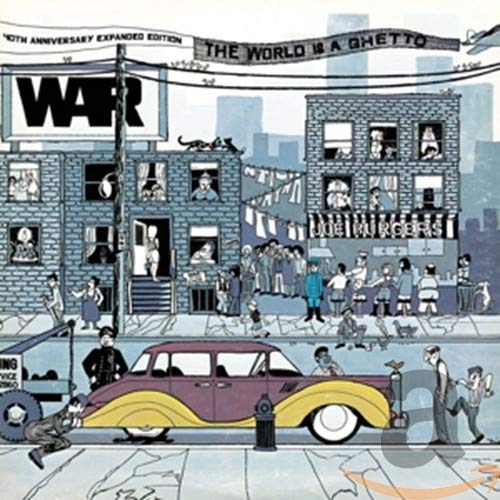
This is before War had their own breakout hit records and went out on their own without Burdon. When War did go on tour as headliners. They had a string of hit singles and successful albums, with hits like “Cisco Kid,” “Low Rider,” “Me and Baby Brother,” “Why Can’t We be Friends” and the smash, “The World Is a Ghetto.”

After dropping my coat on the bed and hiding nearly $8,000 in cash in my room, I hit the hotel’s hallway looking for the party. Everyone, including road crew from both bands, has rooms on the first floor. For this night I booked 17 rooms and because of that bulk booking, I was able to negotiate the free use of a meeting room for our New Year’s Eve party.

I walk into the meeting room. Eric is there and he kind of knows me from six years earlier when we were neighbors in Laurel Canyon. Back then Eric was always on tour with the Animals and I hardly ever saw him. The Animals (later, Eric Burdon and the Animals) were part of the 1960s British Invasion and they had hits, boy did they have hits. “The House of the Rising Sun,” “Help Me Girl,” “Mama Told Me Not to Come” (written by Randy Newman and much superior to Three Dog Night’s later version), San Franciscan Nights,” “Sky Pilot” “When I Was Young” and “Don’t Let Me Be Misunderstood,” and those are just some of them.

Eric Burdon in 1973.

As I enter the big meeting room Eric walks over to me and, while wishing me a Happy New Year, hands me a Quaalude. Eric Burdon and War had joined the tour as Wishbone’s opening act just after Christmas, and what a week it’s been. Just one example:

A few days previously we were playing Dothan, Alabama. The morning after the gig both groups are at the Dothan airport. All of us are walking across the tarmac to the Piedmont Airlines plane. As we’re walking to the boarding steps we pass two Alabama state troopers leaning against their patrol car. They’re both big men, six foot six and around 250 pounds, in their twenties and athletically built, probably former college ballplayers.

As we walk by them one of them says, “nice show last night, Eric!” Then he shouts out a slur against some of the band members. Eric gives them the finger and says “screw you.” Although both the troopers laughed, I won’t lie; considering the time and the place I was more than a little unnerved by this.

Everyone boards the plane and Eric is wired up from this exchange. It doesn’t help that he is so drunk and belligerent that he won’t take his seat. The pilot calls the tower, the tower calls the cops and don’t you know it, those same two state troopers board the plane. One cop grabs Eric by his armpits and the other grabs his legs behind his knees, and the two of them carry Eric cussing and fussing off the plane, which takes off without him.

Forward to 7:30 that night and I’m backstage at the Coliseum in Cincinnati, Ohio. Both bands have done their sound checks and Eric is still nowhere in sight. (Remember, this was in the days before cell phones.) This is a real problem.

Eric and the band are due on stage at 8:00 sharp to open the show. They get 50 minutes including encore. After that, there are 10 minutes to get the opener’s equipment off stage. Then Wishbone Ash hits the stage at 9:00 and plays for 90 minutes. Their set is followed by three encores, finishing up just before 11:00.

They have to be done before 11:00 because all arenas in America are union halls. If they play one second past 11:00 it’s overtime, and that becomes an unexpected cost to the promoter. In fact, it would cost the promoter a lot of money. If that happens, word gets around to other promoters, and it affects a band’s bookings. Bands are warned about that, so it rarely happens.

Where the f**k is Eric? I’m worried, and I’m not ready to even consider that War could play without Eric. Would that even work? (Within a year I got my answer, but at the time, Eric was the star of the show.) I do not have a good Plan B.

Not sure of my options, I open my briefcase and pull out my Rand McNally map. I see that Dothan, Alabama is 660 miles south of Cincinnati. I don’t know how Eric is getting to Cincinnati or if it’s even possible. For all, I know his butt could be sitting in jail.

At 7:55 a station wagon speeds down the Coliseum’s loading ramp and screeches to a stop just thirty feet from the stage. Behind the wheel is Eric’s road manager, Big Jim Grant.

Eric is inside lying flat on his back. He pushes himself up to a sitting position, and, holding on to the door, climbs out the back of the station wagon. He’s still drunk as a lord. Eric steadies himself against the side of the vehicle and then lurches over to the stage steps, holding onto the handrail. War comes filing out of their dressing room and joins him. Together they climb up the stairs onto the stage.

Eric says “Hello!” to the audience and vaguely mumbles that he had a big adventure getting to Cincinnati. They launch into “Spill the Wine.” They hit it full tilt. They’re kicking ass! This is the same guy who could barely get out of a car five minutes ago. They follow it by “We Gotta Get Out of This Place.” The place is going nuts. It’s one of those fantastic rock and roll moments.

Spying Big Jim Grant across the room, I walk over. Smiling, the big guy turns towards me and I ask, “how the hell did you make it to Cincinnati on time?”

He tells me that the troopers didn’t arrest Eric. In fact, once they got him back to the terminal, they laughed, helped him stand up and told him he was free to go. “They even gave me directions,” said Jim.

It seems they were at the concert the night before, moonlighting in uniform as concert security. They really liked Eric’s music and thought he was cool. So, they cut him some slack even though he was roaring drunk at 7:15 in the morning. But, hey he’s a legend and English and most important, he is a Rock Star.

Barreling out of the airport, Jim took local roads north to Birmingham, then got on the interstate I-65 north to Louisville ,switching to I-71 Northeast straight into Cincinnati. Hauling ass and stopping just once just south of the Tennessee state line to get gas, pee, grab a bite to go and oh yeah, buy a bottle of Southern Comfort. Eric, Jim says, is all stretched out laying there like he’s dead in a poor man’s hearse. Well, actually he’s drinking and falling asleep, then waking up and drinking again. Jim says this cycle happened at least three times.

Feeling the pressure of getting to the gig with the clock ticking it must have been some sight. Big Jim speeding through the Deep South with a drunk Englishman lying semi-conscious in the back of a rented Avis station wagon. Insanity. By the grace of the rock and roll gods, they somehow breezed through.

By today’s standards our behavior would not cut it, but back then it was sex, drugs and rock and roll. The causality rate was high, but that was the life we embraced. Like soldiers in combat, no matter what the obstacle, we get the job done.
Header image courtesy of Wikimedia Commons/CC-BY-SA.

More from Issue 109

View All Articles in Issue 109

Search Copper Magazine

#228 Serita’s Black Rose Duo Shakes Your Soul With a Blend of Funk, Rock, Blues and a Whole Lot More by Frank Doris Mar 02, 2026 #228 Vinyl, A Love Story by Wayne Robins Mar 02, 2026 #228 Thrill Seeker by B. Jan Montana Mar 02, 2026 #228 The Vinyl Beat: Donald Byrd, Bill Evans, Wes Montgomery, Eddie Palmieri and Frank Sinatra by Rudy Radelic Mar 02, 2026 #228 Listening to Prestige: The History of a Vitally Important Jazz Record Label by Frank Doris Mar 02, 2026 #228 How to Play in a Rock Band, 21: Touring With James Lee Stanley by Frank Doris Mar 02, 2026 #228 The NAMM 2026 Show: The Music Industry’s Premier Event by John Volanski Mar 02, 2026 #228 The Earliest Stars of Country Music, Part Two by Jeff Weiner Mar 02, 2026 #228 From The Audiophile's Guide: A Brief History of Stereophonic Sound by Paul McGowan Mar 02, 2026 #228 A Bone to Pick With Streaming Audio by Frank Doris Mar 02, 2026 #228 Blast Off With Bluesman Duke Robillard by Ray Chelstowski Mar 02, 2026 #228 A Visit to the Marten Loudspeaker Factory in Göteborg, Sweden by Ingo Schulz and Sebastian Polcyn Mar 02, 2026 #228 Pure Distortion by Peter Xeni Mar 02, 2026 #228 A Nagra Factory Tour by Markus "Marsu" Manthey Mar 02, 2026 #228 Back to My Reel-to-Reel Roots, Part 27: Noodge and Ye Shall Receive, Part Two by Ken Kessler Mar 02, 2026 #228 PS Audio in the News by PS Audio Staff Mar 02, 2026 #228 90-Degree Stereo by Frank Doris Mar 02, 2026 #228 The Keys to Art by Rich Isaacs Mar 02, 2026 #227 Seth Lewis Gets in the Groove With Take a Look Around: a Tribute to the Meters by Frank Doris Feb 02, 2026 #227 Passport to Sound: May Anwar’s Audio Learning Experience for Young People by Frank Doris Feb 02, 2026 #227 Conjectures on Cosmic Consciousness by B. Jan Montana Feb 02, 2026 #227 The Big Takeover Turns 45 by Wayne Robins Feb 02, 2026 #227 Music and Chocolate: On the Sensory Connection by Joe Caplan Feb 02, 2026 #227 Singer/Songwriter Chris Berardo: Getting Wilder All the Time by Ray Chelstowski Feb 02, 2026 #227 The Earliest Stars of Country Music, Part One by Jeff Weiner Feb 02, 2026 #227 The Vinyl Beat Goes Down to Tijuana (By Way of Los Angeles), Part Two by Rudy Radelic Feb 02, 2026 #227 How to Play in a Rock Band, 20: On the Road With Blood, Sweat & Tears’ Guitarist Gabe Cummins by Frank Doris Feb 02, 2026 #227 From The Audiophile’s Guide: Audio Specs and Measuring by Paul McGowan Feb 02, 2026 #227 Our Brain is Always Listening by Peter Trübner Feb 02, 2026 #227 PS Audio in the News by PS Audio Staff Feb 02, 2026 #227 The Listening Chair: Sleek Style and Sound From the Luxman L3 by Howard Kneller Feb 02, 2026 #227 The Los Angeles and Orange County Audio Society Celebrates Its 32nd Anniversary, Honoring David and Sheryl Lee Wilson and Bernie Grundman by Harris Fogel Feb 02, 2026 #227 Back to My Reel-to-Reel Roots, Part 26: Half Full – Not Half Empty, Redux by Ken Kessler Feb 02, 2026 #227 That's What Puzzles Us... by Frank Doris Feb 02, 2026 #227 Record-Breaking by Peter Xeni Feb 02, 2026 #227 The Long and Winding Road by B. Jan Montana Feb 02, 2026 #226 JJ Murphy’s Sleep Paralysis is a Genre-Bending Musical Journey Through Jazz, Fusion and More by Frank Doris Jan 05, 2026 #226 Stewardship by Consent by B. Jan Montana Jan 05, 2026 #226 Food, Music, and Sensory Experience: An Interview With Professor Jonathan Zearfoss of the Culinary Institute of America by Joe Caplan Jan 05, 2026 #226 Studio Confidential: A Who’s Who of Recording Engineers Tell Their Stories by Frank Doris Jan 05, 2026 #226 Pilot Radio is Reborn, 50 Years Later: Talking With CEO Barak Epstein by Frank Doris Jan 05, 2026 #226 The Vinyl Beat Goes Down to Tijuana (By Way of Los Angeles), Part One by Rudy Radelic Jan 05, 2026 #226 Capital Audiofest 2025: Must-See Stereo, Part Two by Frank Doris Jan 05, 2026 #226 My Morning Jacket’s Carl Broemel and Tyler Ramsey Collaborate on Their Acoustic Guitar Album, Celestun by Ray Chelstowski Jan 05, 2026 #226 The People Who Make Audio Happen: CanJam SoCal 2025, Part Two by Harris Fogel Jan 05, 2026 #226 How to Play in a Rock Band, 19: Touring Can Make You Crazy, Part One by Frank Doris Jan 05, 2026 #226 Linda Ronstadt Goes Bigger by Wayne Robins Jan 05, 2026

Ninety Minutes and Three Encores

Ninety Minutes and Three Encores

It’s New Year’s Eve in the mid-seventies. It’s after the gig, not yet midnight, and I’m driving the group back to the hotel in a Hertz rental car. The Dayton airport Hyatt isn’t the most upscale hotel, but it’s not a dive either. Besides, the band has a flight to Baltimore tomorrow, January 1, so it is convenient.

The band are the British rockers Wishbone Ash and so far the tour is going well. They are headliners playing coliseums and the band is tight, and they are really cooking. Their albums are big sellers: Wishbone Ash, released in 1970. Then came Pilgrimage (1971), followed by Argus (1972), Wishbone Four (1973), There’s the Rub (1974) and New England in 1976. They are noted for their use of twin lead guitars playing in harmony (like Dickey and Duane in the Allman Brothers) with a mixture of hard rock, blues and other influences to create a unique progressive rock sound. Iron Maiden, Lynyrd Skynyrd, Thin Lizzy and Metallica have cited Wishbone Ash as an influence.

Wishbone Ash in 1976. Photo courtesy of Wikimedia Commons.

The other band on the tour, Wishbone’s opening act, is Eric Burdon and War. War is a mostly black fusion funk group with a smooth rhythmic sound. The only other white guy in the group besides Burdon is harmonica player Lee Oskar, and he’s not American, he’s from Europe. Lee’s wailing harmonica playing and especially his soloing fits beautifully with War’s funk/rock/Latin sound. Another unusual addition to War is the conga/percussion player, an older guy, Thomas “Papa Dee” Allen. He had played and toured with Lenny Bruce. For Lenny, Papa Dee was punctuation, Bada Boom.

This is before War had their own breakout hit records and went out on their own without Burdon. When War did go on tour as headliners. They had a string of hit singles and successful albums, with hits like “Cisco Kid,” “Low Rider,” “Me and Baby Brother,” “Why Can’t We be Friends” and the smash, “The World Is a Ghetto.”

After dropping my coat on the bed and hiding nearly $8,000 in cash in my room, I hit the hotel’s hallway looking for the party. Everyone, including road crew from both bands, has rooms on the first floor. For this night I booked 17 rooms and because of that bulk booking, I was able to negotiate the free use of a meeting room for our New Year’s Eve party.

I walk into the meeting room. Eric is there and he kind of knows me from six years earlier when we were neighbors in Laurel Canyon. Back then Eric was always on tour with the Animals and I hardly ever saw him. The Animals (later, Eric Burdon and the Animals) were part of the 1960s British Invasion and they had hits, boy did they have hits. “The House of the Rising Sun,” “Help Me Girl,” “Mama Told Me Not to Come” (written by Randy Newman and much superior to Three Dog Night’s later version), San Franciscan Nights,” “Sky Pilot” “When I Was Young” and “Don’t Let Me Be Misunderstood,” and those are just some of them.

Eric Burdon in 1973.

As I enter the big meeting room Eric walks over to me and, while wishing me a Happy New Year, hands me a Quaalude. Eric Burdon and War had joined the tour as Wishbone’s opening act just after Christmas, and what a week it’s been. Just one example:

A few days previously we were playing Dothan, Alabama. The morning after the gig both groups are at the Dothan airport. All of us are walking across the tarmac to the Piedmont Airlines plane. As we’re walking to the boarding steps we pass two Alabama state troopers leaning against their patrol car. They’re both big men, six foot six and around 250 pounds, in their twenties and athletically built, probably former college ballplayers.

As we walk by them one of them says, “nice show last night, Eric!” Then he shouts out a slur against some of the band members. Eric gives them the finger and says “screw you.” Although both the troopers laughed, I won’t lie; considering the time and the place I was more than a little unnerved by this.

Everyone boards the plane and Eric is wired up from this exchange. It doesn’t help that he is so drunk and belligerent that he won’t take his seat. The pilot calls the tower, the tower calls the cops and don’t you know it, those same two state troopers board the plane. One cop grabs Eric by his armpits and the other grabs his legs behind his knees, and the two of them carry Eric cussing and fussing off the plane, which takes off without him.

Forward to 7:30 that night and I’m backstage at the Coliseum in Cincinnati, Ohio. Both bands have done their sound checks and Eric is still nowhere in sight. (Remember, this was in the days before cell phones.) This is a real problem.

Eric and the band are due on stage at 8:00 sharp to open the show. They get 50 minutes including encore. After that, there are 10 minutes to get the opener’s equipment off stage. Then Wishbone Ash hits the stage at 9:00 and plays for 90 minutes. Their set is followed by three encores, finishing up just before 11:00.

They have to be done before 11:00 because all arenas in America are union halls. If they play one second past 11:00 it’s overtime, and that becomes an unexpected cost to the promoter. In fact, it would cost the promoter a lot of money. If that happens, word gets around to other promoters, and it affects a band’s bookings. Bands are warned about that, so it rarely happens.

Where the f**k is Eric? I’m worried, and I’m not ready to even consider that War could play without Eric. Would that even work? (Within a year I got my answer, but at the time, Eric was the star of the show.) I do not have a good Plan B.

Not sure of my options, I open my briefcase and pull out my Rand McNally map. I see that Dothan, Alabama is 660 miles south of Cincinnati. I don’t know how Eric is getting to Cincinnati or if it’s even possible. For all, I know his butt could be sitting in jail.

At 7:55 a station wagon speeds down the Coliseum’s loading ramp and screeches to a stop just thirty feet from the stage. Behind the wheel is Eric’s road manager, Big Jim Grant.

Eric is inside lying flat on his back. He pushes himself up to a sitting position, and, holding on to the door, climbs out the back of the station wagon. He’s still drunk as a lord. Eric steadies himself against the side of the vehicle and then lurches over to the stage steps, holding onto the handrail. War comes filing out of their dressing room and joins him. Together they climb up the stairs onto the stage.

Eric says “Hello!” to the audience and vaguely mumbles that he had a big adventure getting to Cincinnati. They launch into “Spill the Wine.” They hit it full tilt. They’re kicking ass! This is the same guy who could barely get out of a car five minutes ago. They follow it by “We Gotta Get Out of This Place.” The place is going nuts. It’s one of those fantastic rock and roll moments.

Spying Big Jim Grant across the room, I walk over. Smiling, the big guy turns towards me and I ask, “how the hell did you make it to Cincinnati on time?”

He tells me that the troopers didn’t arrest Eric. In fact, once they got him back to the terminal, they laughed, helped him stand up and told him he was free to go. “They even gave me directions,” said Jim.

It seems they were at the concert the night before, moonlighting in uniform as concert security. They really liked Eric’s music and thought he was cool. So, they cut him some slack even though he was roaring drunk at 7:15 in the morning. But, hey he’s a legend and English and most important, he is a Rock Star.

Barreling out of the airport, Jim took local roads north to Birmingham, then got on the interstate I-65 north to Louisville ,switching to I-71 Northeast straight into Cincinnati. Hauling ass and stopping just once just south of the Tennessee state line to get gas, pee, grab a bite to go and oh yeah, buy a bottle of Southern Comfort. Eric, Jim says, is all stretched out laying there like he’s dead in a poor man’s hearse. Well, actually he’s drinking and falling asleep, then waking up and drinking again. Jim says this cycle happened at least three times.

Feeling the pressure of getting to the gig with the clock ticking it must have been some sight. Big Jim speeding through the Deep South with a drunk Englishman lying semi-conscious in the back of a rented Avis station wagon. Insanity. By the grace of the rock and roll gods, they somehow breezed through.

By today’s standards our behavior would not cut it, but back then it was sex, drugs and rock and roll. The causality rate was high, but that was the life we embraced. Like soldiers in combat, no matter what the obstacle, we get the job done.

Header image courtesy of Wikimedia Commons/CC-BY-SA.

0 comments

Leave a comment

0 Comments

Your avatar

Loading comments...

🗑️ Delete Comment

Enter moderator password to delete this comment:

✏️ Edit Comment

Enter your email to verify ownership: