Copper Magazine · Issue 111 · A free PS Audio publication
Issue 111 REVOLUTIONS PER MINUTE

For the Record: Restoring a Vintage Disc Cutting Lathe

For the Record: Restoring a Vintage Disc Cutting Lathe

A customer recently imported a vintage Presto 75A disk recording lathe from the US, with a view to cutting records in Europe. [J.I. is based in Europe – Ed.]

He quickly discovered, like many people before him, that it was spinning a bit slower than it should, when operated from European 50 Hz AC via a simple step-down transformer. As with most vintage record cutting machines, the platter is powered by a synchronous AC motor, which “locks” to the line frequency.

The Problem with Industrial Inverters

He then tried to run it from an industrial inverter, a device similar to a phase inverter and intended for controlling the speed of industrial motors. The first issue with this is that such industrial applications do not normally require highly accurate speed control. The second problem is that inverters and VFDs (variable-frequency drives) are usually paired with motors designed to be powered by such devices – which don’t include cutting lathes! Their output is quite far from a pure sine wave and contains a lot of harmonics, extending to high frequencies. This tends to produce an audible whine from older motors and causes them to overheat, greatly reducing their performance and reliability.

When we tried to run the Presto from the inverter, the high frequency whine was even finding its way to the cutter head as electro-magnetic interference (EMI).

The inverter was promptly discarded and a new capstan was machined, to allow the motor to run from 50 Hz and still transmit the correct speed to the platter.


This process was described in more detail in this link. It was tricky, but we successfully converted the machine to run at an accurate 33 1/3 and 45 (instead of 78) rpm, connected directly to our EU mains.

A step-down transformer, a special version of our Type 1760, was designed and installed inside the lathe, to deliver the appropriate voltage to the motor for quiet and reliable operation without overheating.

Renewing the Wiring
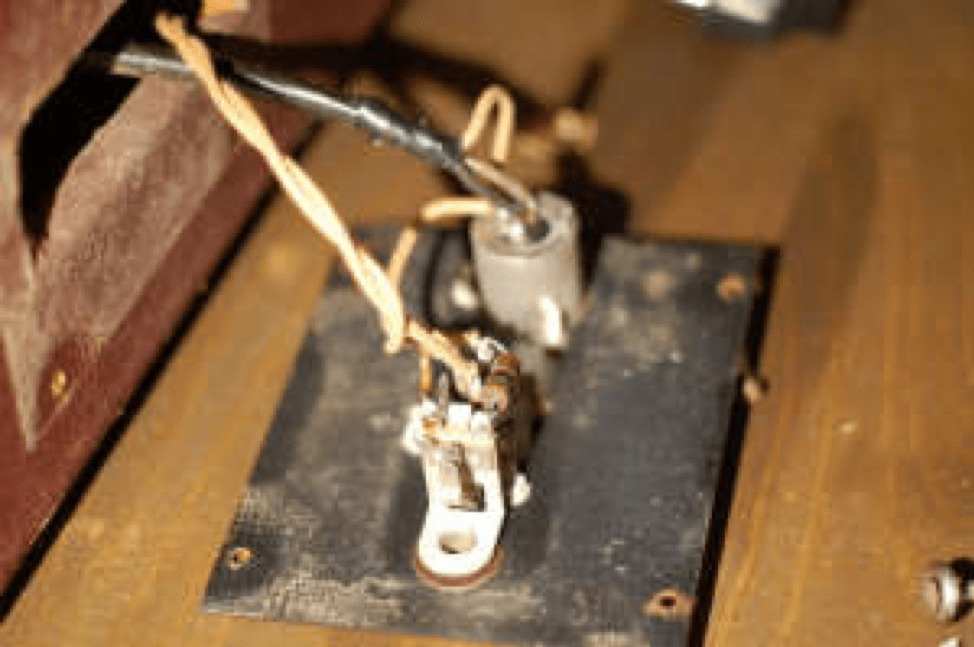
 

There was a plate on the side of the lathe, that housed audio connectors. These were wired to a different standard than what is presently used by the audio industry. Some wires were cut, others were missing the insulation, and the wiring inside the machine had been badly bodged. It was a mess, even posing a safety hazard to the operator and equipment. The power cord was loosely coming out from a hole in the chassis, with the ground connection loose. We decided to remove everything and start from scratch.

We made a new plate to replace the old one. The new plate would accept an IEC power connector and mains fuse. There was no fuse anywhere on that machine when we got it! Since the metallic plate is only attached to the wooden frame, it also had to be reliably grounded. Similarly, all metallic parts of the machine were grounded.

On the other side of the machine, there was an ugly, butchered plate with electrical tape over it. Upon removing it and turning it around, it was discovered that this was a knob dial, pressed into service, from a machine manufactured by Cinema Engineering Co., of Burbank, CA. They used to also make disk recording equipment, but they are very rarely seen nowadays.

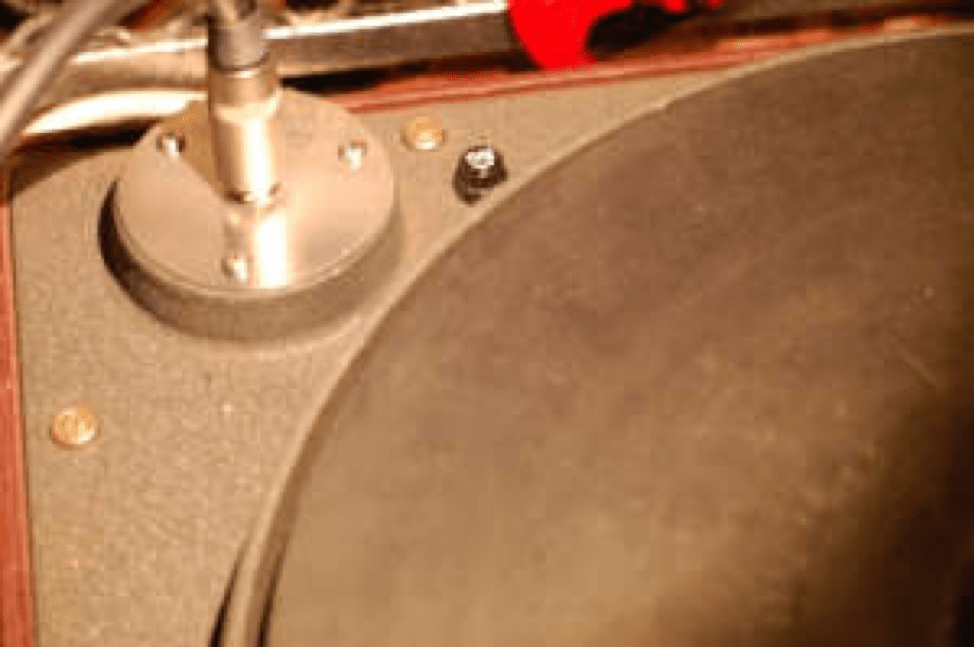
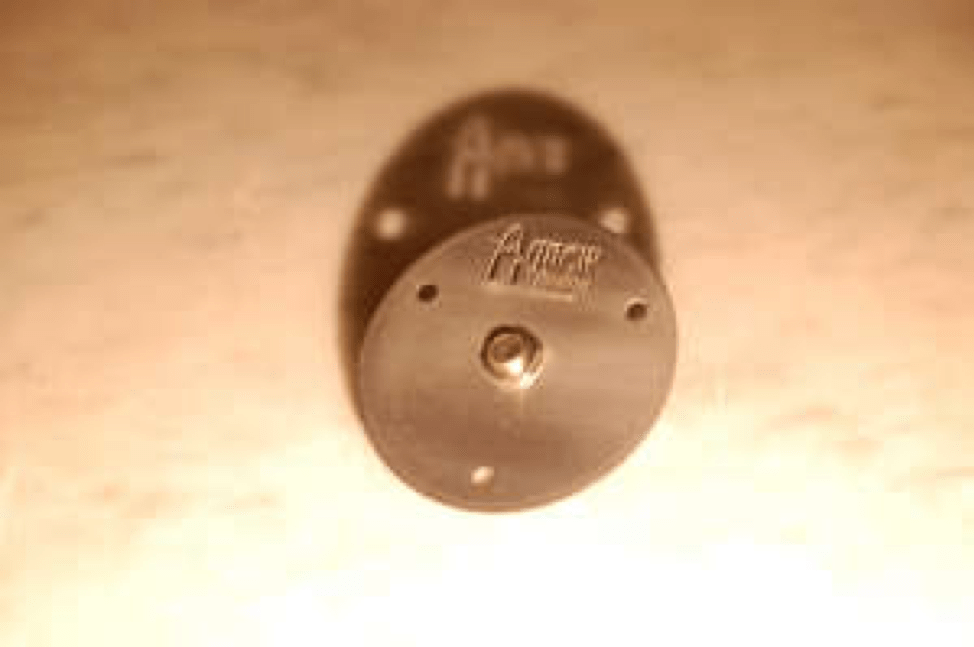
Next to it was a badly drilled hole with nothing in it. We enlarged the hole by civilized means, resulting in a properly round and smooth mounting hole for a fuse holder. A stainless steel round plate was made, with the Agnew Analog logo engraved in it, to hold a ¼-inch jack connector for hooking up the cutting amp.

The Mechanical Assembly: Inside-Out and Outside-In

With the wiring sorted, it was time to work on the mechanical assembly. This machine is very simple and elegant in this respect. A lever on the side allows the operator to shift between Inside-Out, Neutral and Outside-In cutting modes. This engages the cutting arm (or disengages it in Neutral) and defines the direction of the cut. Records can therefore just as easily be cut from the outer edge towards the center, or from the center towards the edge. Inside-out records were commonly used in the broadcasting sector. The practical significance was that if a recording was too long to fit on one disk, the sound would gradually change from the outer diameter to the inner diameter of the disk, and the sonic transition from the end of the first disk to the beginning of the next would be too abrupt. By recording the first disk outside-in and the second one inside-out, the abrupt sonic transition was eliminated.


The platter shaft has a worm gear at the top which engages the central geared portion of a horizontal shaft:

A bronze rack is attached to the cutting arm, while the horizontal shaft and its base are attached to the Direction-of-Cut lever. In Neutral, there is no contact between the horizontal shaft and the rack: When the lever is moved to the "Outside-In" position, one of the worm gears at one end of the horizontal shaft meshes with the rack teeth and advances the cutting arm inwards:

When the operator shifts the lever to the "Inside-Out" position the other worm gear meshes, advancing the cutting arm outwards:

The central portion of the horizontal shaft remains permanently meshed with the worm gear on the platter (vertical) shaft. The rack ends shortly before the inner and outer limits of the cutting arm travel, disengaging from the worm gear, to prevent "crashes." Two end-stops limit the travel of the cutting arm so it does not collide with something expensive, if manually pushed all the way to the end.

Fixed-Pitch and Double-Groove Records

With this design, the machine is limited to fixed-pitch operation, at 96 LPI (lines per inch) However, due to its intelligent design, the pitch is highly accurate. There are no grouping effects whatsoever. As it is also a rather coarse pitch, it leaves plenty of room to cut double-groove records, where a different song plays each time you put the needle down on the record depending on where it happens to land!

One would really have to try hard to break this machine. With proper maintenance it works like a horse!

As with all precision instruments, the 75A requires careful adjustment to run well. The horizontal shaft was sorely out of adjustment, causing noise. Someone had filled up the main bearing with grease…! Please, never use grease on precision mechanical instruments, unless the manufacturer explicitly calls for it. It may work fine for crude and primitive tools for the farm, but it has no place in precision lathe bearings, which are usually designed for a particular type of light machine oil.

The presence of the correct oil in the assembly is as important as any of the solid parts! Consider the oil as part of the assembly. The lathe won’t run as intended without it!

In the absence of the original specifications, the type of oil can be calculated by measuring and calculating the clearances, load, speed, temperature, friction, materials, accuracy required, and several more factors. This is best left to a qualified mechanical engineer with experience in machine tool design, but also well versed in the particular application of disk recording.

Fortunately, the manual for this lathe specifies the lubrication procedures, so we do not need to reinvent the wheel. We can supply all the lubricants specified, if required.

The Interesting Little Details

  The Presto badge is particularly noteworthy on this machine, resembling a record. Also noteworthy is the fact that this machine has matching serial numbers on all parts, proving all parts to be original, as fitted by the factory:  

Many disk recording lathes have an oil dashpot for damping the suspension. Others have an advance ball system, a mechanical means of controlling and regulating groove depth, while others have nothing at all.

The 75A, being marketed as a portable machine, came with a “dry” dashpot:

This is the Presto 171-A damper, especially suitable for portable systems, as there is no oil or other liquid to spill and make a mess!  

It is a very heavy brass casting, suspended on a reed spring, damped heavily, and tuned to counteract the vertical oscillation tendencies when cutting lacquer disks with a Presto cutter head.

Don’t laugh, it actually works!

This machine was in need of a cutter head, so we paired it up with an RCA MI-4889, a moving iron design, also dating from the 1930's.  

These heads are quite sturdy and can sound good if used with due care.

A friend of the owner got excited about all this and built a custom cutting amp with built-in RIAA pre-emphasis:

 As a final touch, we made a custom mount for a microscope stand to fit the chassis. A very basic groove and stylus inspection microscope is thus provided, which is essential for adjusting cutting parameters, troubleshooting and inspecting the final product.

The result is a fully restored, fully functional disk recording lathe that will take any blank size from CDs to 16-inch blanks and will cut or emboss. CDs are the cheapest, easiest and most widely available material that grooves can be cut/embossed onto with acceptable fidelity and have found widespread use among users of vintage disk recording lathes. In some cases, the same CD can then be played back both in a CD player and on a turntable!


The performance is very good for its age and it can even cut master lacquer disks, within its operational limitations. It is portable, reliable and easy to set up, making it the ideal system for mobile recording and events.

This machine was deemed to fulfill the notoriously high performance expectations of the British Broadcasting Corporation and was widely used in various BBC studios. It was commonly installed in sturdy, floor-standing cabinets. Two of these can be seen side by side in an installation in Aldenham, in a photograph dating from 1949, on Plate 6, between pages 106 and 107 of the BBC Recording Training Manual, published by the BBC in 1950. A close-up of the speed selection lever appears as Fig. 97 on page 108.

This article was originally published on the Agnew Analog Reference Instruments website, www.agnewanalog.com.

More from Issue 111

View All Articles in Issue 111

Search Copper Magazine

Favorites From T.H.E. Show SoCal 2026 by Cam Martin Oct 05, 2026 #235 Singer/Songwriter John David Schrader: On the Need to Create, Part Two by Joe Caplan Oct 05, 2026 #235 A Life in High-End Audio: The Roy Hall Interview, Part Two by Frank Doris Oct 05, 2026 #235 Grammy-Winning Producer, Songwriter, and Guitarist John Leventhal Goes Instrumental With National Drift by Ray Chelstowski Oct 05, 2026 #235 From Swimming Pool to New Listening Room—to Founding an Accidental Audio Company by Gilles Laferrière Oct 05, 2026 #235 The Vinyl Beat’s Size Matters Edition by Rudy Radelic Oct 05, 2026 #235 The Sublime Complexities of Nature by B. Jan Montana Oct 05, 2026 #235 How to Play In a Rock Band, 28: Growing Older and Dealing With It by Frank Doris Oct 05, 2026 #235 Young Rascals: From Bar Band to Stardom by Wayne Robins Oct 05, 2026 #235 Duncan Sheik: In Memoriam by Ray Chelstowski Oct 05, 2026 #235 From The Listening Chair: The Meze Audio 105 Silva Headphones by Howard Kneller Oct 05, 2026 #235 Checking Out Some NOLA Loudspeakers – and Some Thoughts About Audio Writing by Frank Doris Oct 05, 2026 #235 The Kanazawa Phonograph Museum: Music from a Time Capsule by Sebastian Polcyn Oct 05, 2026 #235 PS Audio in the News by PS Audio Staff Oct 05, 2026 #235 From The Audiophile’s Guide: Making the Most Critical Choice by Paul McGowan Oct 05, 2026 #235 Evolutionary Growth by Frank Doris Oct 05, 2026 #235 Speed Racer by Peter Xeni Oct 05, 2026 #235 Happy Halloween! by James Schrimpf Oct 05, 2026 #234 A Life in High-End Audio: The Roy Hall Interview, Part One by Frank Doris Sep 07, 2026 #234 Jason Greenlaw Offers His Personal Perspective on Jazz Guitar in Vantage Point by Frank Doris Sep 07, 2026 #234 Transcendent Phoenix: Lucina Yue Brings the Ancient Konghou Into Modern Times by Frank Doris Sep 07, 2026 #234 We Must All Follow Our Bliss by B. Jan Montana Sep 07, 2026 #234 How to Play in a Rock Band, 27: Leveling Up by Frank Doris Sep 07, 2026 #234 Ross Valory: Traveling Into New Musical Territory With All of the Above by Ray Chelstowski Sep 07, 2026 #234 Singer/Songwriter John David Schrader: On the Need to Create by Joe Caplan Sep 07, 2026 #234 The People Who Make Audio Happen: More From T.H.E. Show SoCal 2026 by Harris Fogel Sep 07, 2026 #234 The Vinyl Beat Digs Into the Gadget Box by Rudy Radelic Sep 07, 2026 #234 The Rolling Stones: Foreign Tongues Spoken Loud by Wayne Robins Sep 07, 2026 #234 Musical Moments by Rich Isaacs Sep 07, 2026 #234 Rags for Solo Piano and a Dog: David Chesky's Ragtime Music for the Modern Age by Frankly Speaking Sep 07, 2026 #234 HIGH END 2026, Vienna: Here to Stay by Carsten Barnbeck Sep 07, 2026 #234 From The Audiophile’s Guide: The Two Main Types of Loudpeakers – Box and Panel by Paul McGowan Sep 07, 2026 #234 Letting it Slide by Frank Doris Sep 07, 2026 #234 PS Audio in the News by PS Audio Staff Sep 07, 2026 #234 Long Playing by Peter Xeni Sep 07, 2026 #234 La Mer by B. Jan Montana Sep 07, 2026 #233 A Report From The Total Hi-Fi Experience Show SoCal 2026 by B. Jan Montana Aug 03, 2026 #233 Bluegrass Meets Country, Folk, Jazz and More in All That We Carried by The Squid City Slingers by Frank Doris Aug 03, 2026 #233 Corey Glover and One Tribe Nation: A Variegated Musical Collective by Ray Chelstowski Aug 03, 2026 #233 Excursions with Clive: The Late Clive Davis, A Personal History by Wayne Robins Aug 03, 2026 #233 AI, Art, and Music: A Conversation With Synthography Art by Joe Caplan Aug 03, 2026 #233 New American Symphonies: A Rediscovered Gem and a Vital Contemporary Work by Frank Doris Aug 03, 2026 #233 The Vinyl Beat: Genesis, the Dave Clark Five, Antonio Carlos Jobim and More by Rudy Radelic Aug 03, 2026 #233 How to Play in a Rock Band, 26: When It's Time to Record Your Music by Frank Doris Aug 03, 2026 #233 More From T.H.E. Show 2026, and the People Who Made it Happen by Harris Fogel Aug 03, 2026 #233 Underappreciated Artists, Part Three: Icehouse by Rich Isaacs Aug 03, 2026 #233 The Surprisingly Rich and Varied Music of Somalia by Steve Kindig Aug 03, 2026

For the Record: Restoring a Vintage Disc Cutting Lathe

For the Record: Restoring a Vintage Disc Cutting Lathe

A customer recently imported a vintage Presto 75A disk recording lathe from the US, with a view to cutting records in Europe. [J.I. is based in Europe – Ed.]

He quickly discovered, like many people before him, that it was spinning a bit slower than it should, when operated from European 50 Hz AC via a simple step-down transformer. As with most vintage record cutting machines, the platter is powered by a synchronous AC motor, which “locks” to the line frequency.

The Problem with Industrial Inverters

He then tried to run it from an industrial inverter, a device similar to a phase inverter and intended for controlling the speed of industrial motors. The first issue with this is that such industrial applications do not normally require highly accurate speed control. The second problem is that inverters and VFDs (variable-frequency drives) are usually paired with motors designed to be powered by such devices – which don’t include cutting lathes! Their output is quite far from a pure sine wave and contains a lot of harmonics, extending to high frequencies. This tends to produce an audible whine from older motors and causes them to overheat, greatly reducing their performance and reliability.

When we tried to run the Presto from the inverter, the high frequency whine was even finding its way to the cutter head as electro-magnetic interference (EMI).

The inverter was promptly discarded and a new capstan was machined, to allow the motor to run from 50 Hz and still transmit the correct speed to the platter.


This process was described in more detail in this link. It was tricky, but we successfully converted the machine to run at an accurate 33 1/3 and 45 (instead of 78) rpm, connected directly to our EU mains.

A step-down transformer, a special version of our Type 1760, was designed and installed inside the lathe, to deliver the appropriate voltage to the motor for quiet and reliable operation without overheating.

Renewing the Wiring
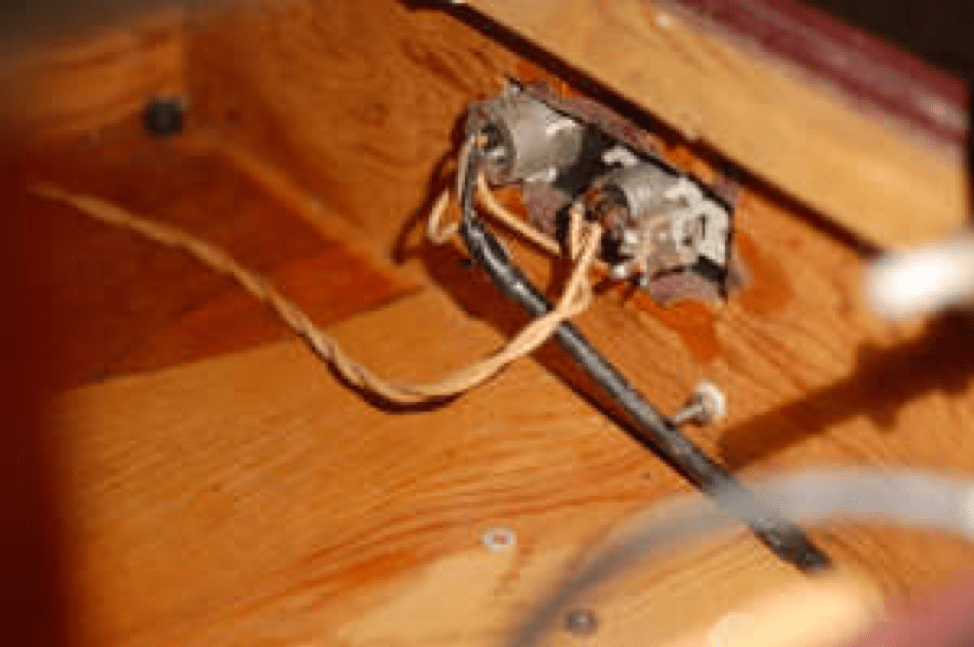
 

There was a plate on the side of the lathe, that housed audio connectors. These were wired to a different standard than what is presently used by the audio industry. Some wires were cut, others were missing the insulation, and the wiring inside the machine had been badly bodged. It was a mess, even posing a safety hazard to the operator and equipment. The power cord was loosely coming out from a hole in the chassis, with the ground connection loose. We decided to remove everything and start from scratch.

We made a new plate to replace the old one. The new plate would accept an IEC power connector and mains fuse. There was no fuse anywhere on that machine when we got it! Since the metallic plate is only attached to the wooden frame, it also had to be reliably grounded. Similarly, all metallic parts of the machine were grounded.

On the other side of the machine, there was an ugly, butchered plate with electrical tape over it. Upon removing it and turning it around, it was discovered that this was a knob dial, pressed into service, from a machine manufactured by Cinema Engineering Co., of Burbank, CA. They used to also make disk recording equipment, but they are very rarely seen nowadays.

Next to it was a badly drilled hole with nothing in it. We enlarged the hole by civilized means, resulting in a properly round and smooth mounting hole for a fuse holder. A stainless steel round plate was made, with the Agnew Analog logo engraved in it, to hold a ¼-inch jack connector for hooking up the cutting amp.
The Mechanical Assembly: Inside-Out and Outside-In

With the wiring sorted, it was time to work on the mechanical assembly. This machine is very simple and elegant in this respect. A lever on the side allows the operator to shift between Inside-Out, Neutral and Outside-In cutting modes. This engages the cutting arm (or disengages it in Neutral) and defines the direction of the cut. Records can therefore just as easily be cut from the outer edge towards the center, or from the center towards the edge. Inside-out records were commonly used in the broadcasting sector. The practical significance was that if a recording was too long to fit on one disk, the sound would gradually change from the outer diameter to the inner diameter of the disk, and the sonic transition from the end of the first disk to the beginning of the next would be too abrupt. By recording the first disk outside-in and the second one inside-out, the abrupt sonic transition was eliminated.


The platter shaft has a worm gear at the top which engages the central geared portion of a horizontal shaft:

A bronze rack is attached to the cutting arm, while the horizontal shaft and its base are attached to the Direction-of-Cut lever. In Neutral, there is no contact between the horizontal shaft and the rack: When the lever is moved to the "Outside-In" position, one of the worm gears at one end of the horizontal shaft meshes with the rack teeth and advances the cutting arm inwards:

When the operator shifts the lever to the "Inside-Out" position the other worm gear meshes, advancing the cutting arm outwards:

The central portion of the horizontal shaft remains permanently meshed with the worm gear on the platter (vertical) shaft. The rack ends shortly before the inner and outer limits of the cutting arm travel, disengaging from the worm gear, to prevent "crashes." Two end-stops limit the travel of the cutting arm so it does not collide with something expensive, if manually pushed all the way to the end.

Fixed-Pitch and Double-Groove Records

With this design, the machine is limited to fixed-pitch operation, at 96 LPI (lines per inch) However, due to its intelligent design, the pitch is highly accurate. There are no grouping effects whatsoever. As it is also a rather coarse pitch, it leaves plenty of room to cut double-groove records, where a different song plays each time you put the needle down on the record depending on where it happens to land!

One would really have to try hard to break this machine. With proper maintenance it works like a horse!

As with all precision instruments, the 75A requires careful adjustment to run well. The horizontal shaft was sorely out of adjustment, causing noise. Someone had filled up the main bearing with grease…! Please, never use grease on precision mechanical instruments, unless the manufacturer explicitly calls for it. It may work fine for crude and primitive tools for the farm, but it has no place in precision lathe bearings, which are usually designed for a particular type of light machine oil.

The presence of the correct oil in the assembly is as important as any of the solid parts! Consider the oil as part of the assembly. The lathe won’t run as intended without it!

In the absence of the original specifications, the type of oil can be calculated by measuring and calculating the clearances, load, speed, temperature, friction, materials, accuracy required, and several more factors. This is best left to a qualified mechanical engineer with experience in machine tool design, but also well versed in the particular application of disk recording.

Fortunately, the manual for this lathe specifies the lubrication procedures, so we do not need to reinvent the wheel. We can supply all the lubricants specified, if required.

The Interesting Little Details

  The Presto badge is particularly noteworthy on this machine, resembling a record. Also noteworthy is the fact that this machine has matching serial numbers on all parts, proving all parts to be original, as fitted by the factory:  

Many disk recording lathes have an oil dashpot for damping the suspension. Others have an advance ball system, a mechanical means of controlling and regulating groove depth, while others have nothing at all.

The 75A, being marketed as a portable machine, came with a “dry” dashpot:
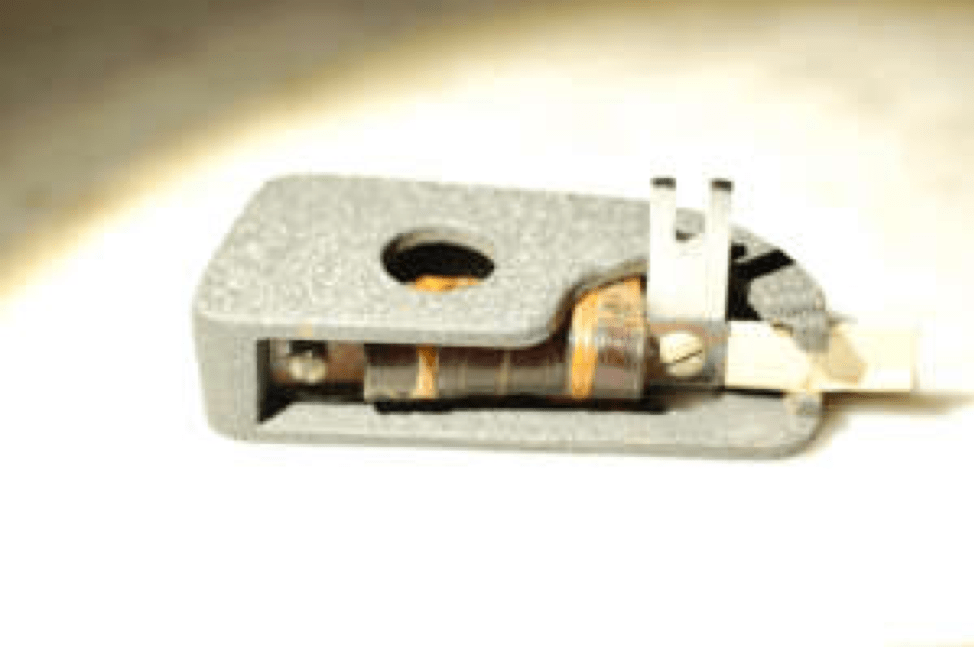
This is the Presto 171-A damper, especially suitable for portable systems, as there is no oil or other liquid to spill and make a mess!  

It is a very heavy brass casting, suspended on a reed spring, damped heavily, and tuned to counteract the vertical oscillation tendencies when cutting lacquer disks with a Presto cutter head.

Don’t laugh, it actually works!
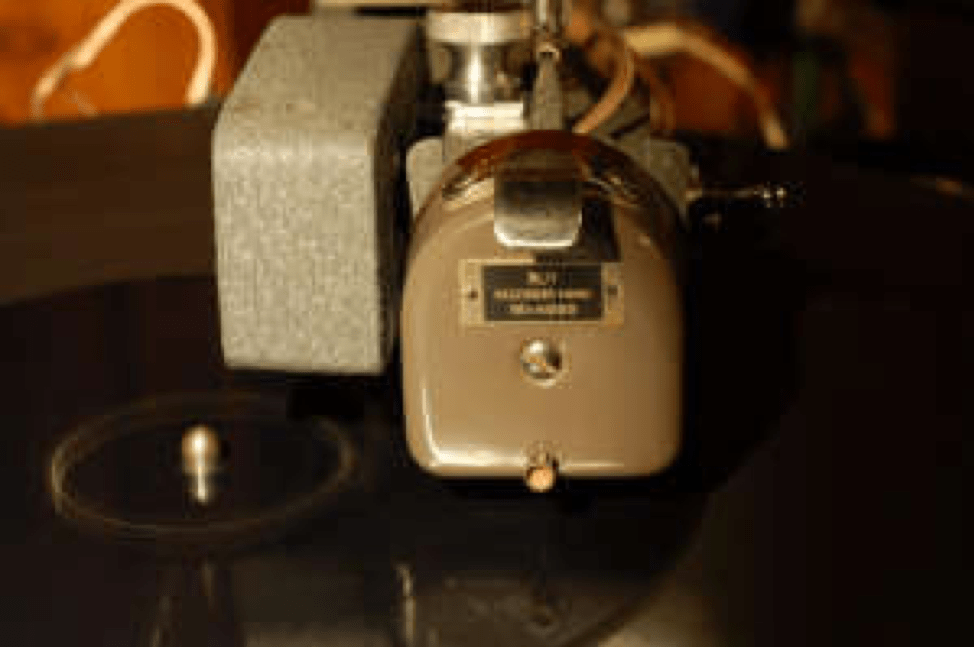
This machine was in need of a cutter head, so we paired it up with an RCA MI-4889, a moving iron design, also dating from the 1930's.  

These heads are quite sturdy and can sound good if used with due care.

A friend of the owner got excited about all this and built a custom cutting amp with built-in RIAA pre-emphasis:

 As a final touch, we made a custom mount for a microscope stand to fit the chassis. A very basic groove and stylus inspection microscope is thus provided, which is essential for adjusting cutting parameters, troubleshooting and inspecting the final product.

The result is a fully restored, fully functional disk recording lathe that will take any blank size from CDs to 16-inch blanks and will cut or emboss. CDs are the cheapest, easiest and most widely available material that grooves can be cut/embossed onto with acceptable fidelity and have found widespread use among users of vintage disk recording lathes. In some cases, the same CD can then be played back both in a CD player and on a turntable!


The performance is very good for its age and it can even cut master lacquer disks, within its operational limitations. It is portable, reliable and easy to set up, making it the ideal system for mobile recording and events.

This machine was deemed to fulfill the notoriously high performance expectations of the British Broadcasting Corporation and was widely used in various BBC studios. It was commonly installed in sturdy, floor-standing cabinets. Two of these can be seen side by side in an installation in Aldenham, in a photograph dating from 1949, on Plate 6, between pages 106 and 107 of the BBC Recording Training Manual, published by the BBC in 1950. A close-up of the speed selection lever appears as Fig. 97 on page 108.

This article was originally published on the Agnew Analog Reference Instruments website, www.agnewanalog.com.

0 comments

Leave a comment

0 Comments

Your avatar

Loading comments...

🗑️ Delete Comment

Enter moderator password to delete this comment:

✏️ Edit Comment

Enter your email to verify ownership: