COPPER

A PS Audio Publication

Issue 153 • Free Online Magazine

Issue 153 Octave Pitch

Octave Records Releases The Moon Leans In by Singer/Songwriter Thom LaFond

Octave Records Releases The Moon Leans In  by Singer/Songwriter Thom LaFond

Octave Records’ newest release is The Moon Leans In by singer/songwriter/guitarist Thom LaFond. The album offers a broad range of moods and styles, from stripped-down acoustic instrument-based songs to upbeat, up-tempo cuts, and even some early jazz and swing influences.

The Moon Leans In has Thom going for a vocal-centric and conversational style, and has him leading two different quartets during the recording. The majority of the tracks feature Thom and musicians playing mostly live with some overdubs, with Thom on electric guitar, vocals, synthesizer, piano and acoustic guitar, accompanied by Enion Pelta (6-string violin, backing vocals), Chris Duffy (5-string electric bass), Forrest Kelley (drums), Zea Stallings (backing vocals) and Katie Mintle (backing vocals). “To the Moon” and “So Busy in the Wild” showcase Thom and an acoustic swing quartet playing live in the studio, including Michelle Pietrafitta (drums), Jeremy Mohney (alto sax) and John Heiland (acoustic bass).
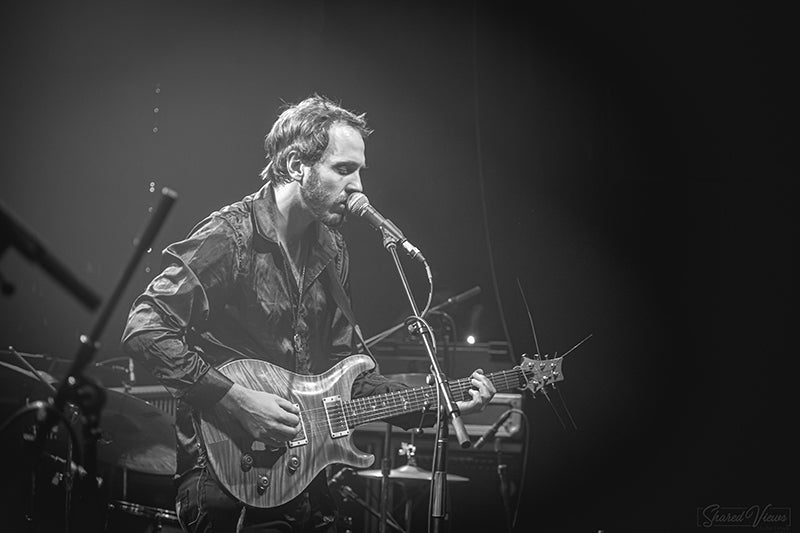
Thom LaFond. Thom LaFond.

The album was recorded at Animal Lane Studios in Lyons, Colorado using Octave Records’ Pure DSD process and the Sonoma multi-track DSD recording system, and mixed at PS Audio in Boulder, CO. The Moon Leans In is available as a limited-edition release of 1,000 hybrid SACD discs with the master DSD layer and a CD layer. In addition, the album can be purchased as a download bundle including DSD64, DSDDirect Mastered 192kHz/24-bit, 96kHz/24-bit and 44.1kHz/16-bit PCM.

“When I play acoustic guitar, I get more intricate with the arrangements, and when I’m on piano I tend to lean more towards a swing kind of improvised jamming feel,” said Thom. The Moon Leans In showcases this stylistic diversity, from the poetic title track with its loping 3/4-time bounce, to the swing quartet tracks, and the upbeat “Isolation Hymn,” an ironic look at the social distancing everyone’s had to go through.

The Moon Leans In was produced by Thom LaFond, recorded and mixed by Jay Elliott, and mastered by Gus Skinas. Jessica Carson was the executive producer. “I like to play music for people, but sometimes I just like being alone, and playing music for the moon is something that feels good to me.”

We asked Thom for some thoughts about the new album.

Frank Doris: What does the title The Moon Leans In mean?

Thom LaFond: I have a kind of fascination with the moon. On some nights when the moon is close, it seems like it’s coming to listen. I’m someone who likes to stay up all night playing songs. I like to play music for people, but sometimes I just like being alone, and playing music for the moon is something that feels good to me.

FD: I like the fact that you have different musical elements, and some of it almost sounds like swing or ragtime. How did you decide on getting the players for the album?

TL: I’ve known Chris Duffy since I was about 15. We had started a band when I was 16 and he comes to play on all my recordings. My current housemate, John Heiland, is the bass player on the swing tracks. I had different bands for the record, the acoustic band where I played piano, and the [swing quartet with] upright bass, saxophone and drums. And then, more of an electric band where I play electric guitar and there’s a louder drum kit, an electric bass and a violin. We recorded over the course of four days.
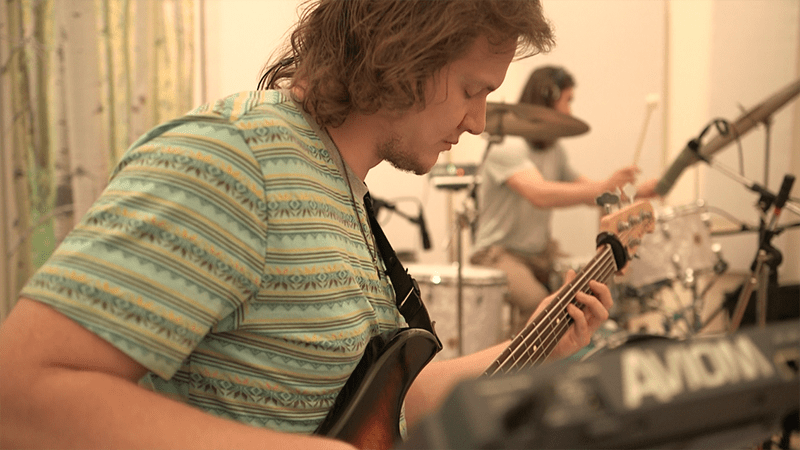


Chris Duffy. Chris Duffy.


FD: How do you write your songs? I ask everybody that. Do they just pop into your brain when you’re looking at a menu in a restaurant or something, or do you spend years writing them?

TL: I start with a kind of a rhythmic vocal melody. And then I just improvise words to that melody. Lately I’ve been doing improv takes where I make up words and then I listen back and edit the crap out of them. I’ll have a hundred Voice Memos [on my phone] that I’ll listen back to and I’ll take one line from each of them.

For the album, it was kind of a mixture of that and rewriting the verses to some of them in the studio to better fit the music. Once you start recording a song you think, oh man, I went right to that chorus without really saying anything in that verse. Or maybe I need two extra verses (laughs). I think I could push a little further.

FD: How did you get hooked up with Octave Records?

TL: (Producer) Jessica (Carson) called me to do a jazz session on guitar. A couple weeks later they called me back because they’d heard I do synthesizer composition and wanted a track for The Audiophile’s Guide: The Stereo album. Gus Skinas sat me down – he’d lined up a bunch of synthesizers – and said, “okay, now compose something!” [It’s the track “Slow Moving Ferns” – Ed.] After that, they asked me to do a complete album.


Forrest Kelley. Forrest Kelley.


TL: I really, really love acoustic music, the sound of hearing an acoustic band in a room. Jessica was also interested in having stylistic variation. Most record labels insist that you reign your music into one “brand.” That wasn’t something Octave was interested in.

FD: An obvious question: how did COVID affect your mood and songwriting?

TL: At the beginning of the pandemic, I spent all my savings on a video camera. I went out in my yard every day and recorded a song, and posted it on YouTube or [social media] the next day. And I was getting the largest audience I’d ever found. I eventually got comfortable just filming every day. I left the camera in the corner of the studio for every take that we recorded for The Moon Leans In.

FD: When you’re a musician, you don’t want to work in a vacuum, you know!

TL: It’s true. It’s true.

FD: What’s next?

TL: We did an entire album of swing music by saxophonist Jeremy Mohney, where I’m the producer. It features three decades of swing, from Dixieland into the late 1940s. It’s music I’m really passionate about.


Jeremy Mohney. Jeremy Mohney.

More from Issue 153

View All Articles in Issue 153

Search Copper Magazine

#226 JJ Murphy’s Sleep Paralysis is a Genre-Bending Musical Journey Through Jazz, Fusion and More by Frank Doris Jan 05, 2026 #226 Stewardship by Consent by B. Jan Montana Jan 05, 2026 #226 Food, Music, and Sensory Experience: An Interview With Professor Jonathan Zearfoss of the Culinary Institute of America by Joe Caplan Jan 05, 2026 #226 Studio Confidential: A Who’s Who of Recording Engineers Tell Their Stories by Frank Doris Jan 05, 2026 #226 Pilot Radio is Reborn, 50 Years Later: Talking With CEO Barak Epstein by Frank Doris Jan 05, 2026 #226 The Vinyl Beat Goes Down to Tijuana (By Way of Los Angeles), Part One by Rudy Radelic Jan 05, 2026 #226 Capital Audiofest 2025: Must-See Stereo, Part Two by Frank Doris Jan 05, 2026 #226 My Morning Jacket’s Carl Broemel and Tyler Ramsey Collaborate on Their Acoustic Guitar Album, Celestun by Ray Chelstowski Jan 05, 2026 #226 The People Who Make Audio Happen: CanJam SoCal 2025, Part Two by Harris Fogel Jan 05, 2026 #226 How to Play in a Rock Band, 19: Touring Can Make You Crazy, Part One by Frank Doris Jan 05, 2026 #226 Linda Ronstadt Goes Bigger by Wayne Robins Jan 05, 2026 #226 From The Audiophile’s Guide: Active Room Correction and Digital Signal Processing by Paul McGowan Jan 05, 2026 #226 PS Audio in the News by Frank Doris Jan 05, 2026 #226 Back to My Reel-to-Reel Roots, Part 25: Half-Full, Not Empty by Ken Kessler Jan 05, 2026 #226 Happy New Year! by Frank Doris Jan 05, 2026 #226 Turn It Down! by Peter Xeni Jan 05, 2026 #226 Ghost Riders by James Schrimpf Jan 05, 2026 #226 A Factory Tour of Audio Manufacturer German Physiks by Markus "Marsu" Manthey Jan 04, 2026 #225 Capital Audiofest 2025: Must-See Stereo, Part One by Frank Doris Dec 01, 2025 #225 Otis Taylor and the Electrics Delivers a Powerful Set of Hypnotic Modern Blues by Frank Doris Dec 01, 2025 #225 A Christmas Miracle by B. Jan Montana Dec 01, 2025 #225 T.H.E. Show New York 2025, Part Two: Plenty to See, Hear, and Enjoy by Frank Doris Dec 01, 2025 #225 Underappreciated Artists, Part One: Martin Briley by Rich Isaacs Dec 01, 2025 #225 Rock and Roll is Here to Stay by Wayne Robins Dec 01, 2025 #225 A Lifetime of Holiday Record (and CD) Listening by Rudy Radelic Dec 01, 2025 #225 Little Feat: Not Saying Goodbye, Not Yet by Ray Chelstowski Dec 01, 2025 #225 How to Play in a Rock Band, Part 18: Dealing With Burnout by Frank Doris Dec 01, 2025 #225 The People Who Make Audio Happen: CanJam SoCal 2025 by Harris Fogel Dec 01, 2025 #225 Chicago’s Sonic Sanctuaries: Four Hi‑Fi Listening Bars Channeling the Jazz‑Kissa Spirit by Olivier Meunier-Plante Dec 01, 2025 #225 From The Audiophile’s Guide: Controlling Bass Frequencies Through Membrane Absorbers (and How to Build Your Own) by Paul McGowan Dec 01, 2025 #225 Your Editor’s Tips for Attending Audio Shows by Frank Doris Dec 01, 2025 #225 PS Audio in the News by Frank Doris Dec 01, 2025 #225 Back to My Reel-to-Reel Roots, Part 24 by Ken Kessler Dec 01, 2025 #225 Holiday Music by Frank Doris Dec 01, 2025 #225 Puppy Prognostication by Peter Xeni Dec 01, 2025 #225 How to Post Comments on Copper by Frank Doris Dec 01, 2025 #225 Living Color by Rudy Radelic Dec 01, 2025 #224 T.H.E. Show New York 2025, Part One: A New Beginning by Frank Doris Nov 03, 2025 #224 Fool’s Leap of Faith is the Extraordinary Octave Records Debut from Singer/Songwriter Tyler Burba and Visit by Frank Doris Nov 03, 2025 #224 The Beatles’ “Aeolian Cadences.” What? by Wayne Robins Nov 03, 2025 #224 Persona Non Grata by B. Jan Montana Nov 03, 2025 #224 Talking With Recording Engineer Barry Diament of Soundkeeper Recordings, Part Two by Frank Doris Nov 03, 2025 #224 B Sides, B Movies, and Beware of Zombies by Rudy Radelic Nov 03, 2025 #224 The Burn-In Chronicles: 1,000 Hours to Sonic Salvation by Olivier Meunier-Plante Nov 03, 2025 #224 A Conversation With Mat Weisfeld of VPI Industries by Joe Caplan Nov 03, 2025 #224 Blues-Rocker Kenny Wayne Shepherd Celebrates 30 Years of Ledbetter Heights by Ray Chelstowski Nov 03, 2025 #224 Playing in a Rock Band, 17: When Good Gigs Go Bad, Part Two by Frank Doris Nov 03, 2025

Octave Records Releases The Moon Leans In by Singer/Songwriter Thom LaFond

Octave Records Releases The Moon Leans In  by Singer/Songwriter Thom LaFond

Octave Records’ newest release is The Moon Leans In by singer/songwriter/guitarist Thom LaFond. The album offers a broad range of moods and styles, from stripped-down acoustic instrument-based songs to upbeat, up-tempo cuts, and even some early jazz and swing influences.

The Moon Leans In has Thom going for a vocal-centric and conversational style, and has him leading two different quartets during the recording. The majority of the tracks feature Thom and musicians playing mostly live with some overdubs, with Thom on electric guitar, vocals, synthesizer, piano and acoustic guitar, accompanied by Enion Pelta (6-string violin, backing vocals), Chris Duffy (5-string electric bass), Forrest Kelley (drums), Zea Stallings (backing vocals) and Katie Mintle (backing vocals). “To the Moon” and “So Busy in the Wild” showcase Thom and an acoustic swing quartet playing live in the studio, including Michelle Pietrafitta (drums), Jeremy Mohney (alto sax) and John Heiland (acoustic bass).

Thom LaFond. Thom LaFond.

The album was recorded at Animal Lane Studios in Lyons, Colorado using Octave Records’ Pure DSD process and the Sonoma multi-track DSD recording system, and mixed at PS Audio in Boulder, CO. The Moon Leans In is available as a limited-edition release of 1,000 hybrid SACD discs with the master DSD layer and a CD layer. In addition, the album can be purchased as a download bundle including DSD64, DSDDirect Mastered 192kHz/24-bit, 96kHz/24-bit and 44.1kHz/16-bit PCM.

“When I play acoustic guitar, I get more intricate with the arrangements, and when I’m on piano I tend to lean more towards a swing kind of improvised jamming feel,” said Thom. The Moon Leans In showcases this stylistic diversity, from the poetic title track with its loping 3/4-time bounce, to the swing quartet tracks, and the upbeat “Isolation Hymn,” an ironic look at the social distancing everyone’s had to go through.

The Moon Leans In was produced by Thom LaFond, recorded and mixed by Jay Elliott, and mastered by Gus Skinas. Jessica Carson was the executive producer. “I like to play music for people, but sometimes I just like being alone, and playing music for the moon is something that feels good to me.”

We asked Thom for some thoughts about the new album.

Frank Doris: What does the title The Moon Leans In mean?

Thom LaFond: I have a kind of fascination with the moon. On some nights when the moon is close, it seems like it’s coming to listen. I’m someone who likes to stay up all night playing songs. I like to play music for people, but sometimes I just like being alone, and playing music for the moon is something that feels good to me.

FD: I like the fact that you have different musical elements, and some of it almost sounds like swing or ragtime. How did you decide on getting the players for the album?

TL: I’ve known Chris Duffy since I was about 15. We had started a band when I was 16 and he comes to play on all my recordings. My current housemate, John Heiland, is the bass player on the swing tracks. I had different bands for the record, the acoustic band where I played piano, and the [swing quartet with] upright bass, saxophone and drums. And then, more of an electric band where I play electric guitar and there’s a louder drum kit, an electric bass and a violin. We recorded over the course of four days.


Chris Duffy. Chris Duffy.


FD: How do you write your songs? I ask everybody that. Do they just pop into your brain when you’re looking at a menu in a restaurant or something, or do you spend years writing them?

TL: I start with a kind of a rhythmic vocal melody. And then I just improvise words to that melody. Lately I’ve been doing improv takes where I make up words and then I listen back and edit the crap out of them. I’ll have a hundred Voice Memos [on my phone] that I’ll listen back to and I’ll take one line from each of them.

For the album, it was kind of a mixture of that and rewriting the verses to some of them in the studio to better fit the music. Once you start recording a song you think, oh man, I went right to that chorus without really saying anything in that verse. Or maybe I need two extra verses (laughs). I think I could push a little further.

FD: How did you get hooked up with Octave Records?

TL: (Producer) Jessica (Carson) called me to do a jazz session on guitar. A couple weeks later they called me back because they’d heard I do synthesizer composition and wanted a track for The Audiophile’s Guide: The Stereo album. Gus Skinas sat me down – he’d lined up a bunch of synthesizers – and said, “okay, now compose something!” [It’s the track “Slow Moving Ferns” – Ed.] After that, they asked me to do a complete album.


Forrest Kelley. Forrest Kelley.


TL: I really, really love acoustic music, the sound of hearing an acoustic band in a room. Jessica was also interested in having stylistic variation. Most record labels insist that you reign your music into one “brand.” That wasn’t something Octave was interested in.

FD: An obvious question: how did COVID affect your mood and songwriting?

TL: At the beginning of the pandemic, I spent all my savings on a video camera. I went out in my yard every day and recorded a song, and posted it on YouTube or [social media] the next day. And I was getting the largest audience I’d ever found. I eventually got comfortable just filming every day. I left the camera in the corner of the studio for every take that we recorded for The Moon Leans In.

FD: When you’re a musician, you don’t want to work in a vacuum, you know!

TL: It’s true. It’s true.

FD: What’s next?

TL: We did an entire album of swing music by saxophonist Jeremy Mohney, where I’m the producer. It features three decades of swing, from Dixieland into the late 1940s. It’s music I’m really passionate about.


Jeremy Mohney. Jeremy Mohney.

0 comments

Leave a comment

0 Comments

Your avatar

Loading comments...

🗑️ Delete Comment

Enter moderator password to delete this comment: