COPPER

A PS Audio Publication

Issue 157 • Free Online Magazine

Issue 157 Revolutions Per Minute

Around the World in 80 Lathes, Part Seven

Around the World in 80 Lathes, Part Seven

The last episode in this series (in Issue 156) discussed the technological and aesthetic shifts in the record cutting lathe manufacturing industry that began in the late 1970s and concluded in the 1980s, with the ultimate demise of the industry. (Believe it or not, it has not been possible to purchase a new professional disk mastering lathe, manufactured in large numbers by a company of more than two employees, since the 1980s!) Up until that point, things had been somewhat conservative. In this episode, we will examine what was perhaps the single most well-known, well-remembered, well-documented, widely-used and ridiculously overhyped disk recording lathe of all time! While it was a very capable performer, it was also cleverly marketed. It filled a market gap that had existed for some time, clearly demonstrating the differences in mentality that existed in this industry between the US and Europe. In fact, this market gap had begun to be filled in Europe much earlier, but by the early 1970s, the West was won, and it wasn't by Led Zeppelin this time!


Mike Papas of XL Productions, Ashbury, Australia with a Neumann VMS lathe, cutter head, transfer console, and tape machine console (containing a Telefunken M15A preview head tape machine). Photo courtesy of Mike Papas. Mike Papas of XL Productions, Ashbury, Australia
(http://www.vinylrecordproduction.com) with a Neumann VMS-70 lathe, cutter head, transfer console, and tape machine console (containing a Telefunken M15A preview head tape machine). Photo courtesy of Mike Papas.

The machine in question was the Neumann VMS-70, a complete, turnkey and highly automated system that conveniently eliminated a lot of the guesswork that had traditionally gone into purchasing, setting up, and using a disk mastering system. The VMS-70 set a new standard in the industry, and became the world's most popular lathe. Not the most popular by numbers sold; this would have been one of the primitive monophonic record-cutting machines once found in every radio broadcasting facility. The Neumann VMS-70 did not actually sell anywhere near that many numbers. But it did become the most commonly encountered lathe in commercial disk mastering facilities during the entire stereophonic era. It is probably safe to say that during the stereophonic era and up to the present day, more master lacquer disks have been cut on a VMS-70 than on any other lathe ever made. Still, only about 500 of these were ever produced, with much fewer surviving today. But, this is a lot, considering that the world has never had 500 professional disk mastering facilities operating at any one time! This has made the VMS-70 highly sought after to this day, and perhaps the most widely discussed lathe in the media and on the internet. In fact, its dominance in all mastering-related articles and discussions has led some people to believe that this is the only lathe that can cut "modern" masters, even though the Neumann VMS-80 (see Issue 153 and Issue 154) that superseded it, as well as the competing L.J. Scully LS-76 (covered in Issue 155 and Issue 156) were way more modern in every sense, right down to their aesthetics. As a result, the price for a Neumann VMS-70 in the used market nowadays can easily be mistaken for the telephone number of the person selling it!


The Neumann AM 31, the first lathe developed by Georg Neumann in 1931.
The origins of the VMS-70 can be traced back to the 1930s, when Georg Neumann developed his first disk recording lathe. The lathe bed was a large aluminum casting, a design that was carried over with very few changes all the way to 1980, when it was finally dropped in favor of the redesigned flat-slab approach of the VMS-80 lathe. That first lathe, introduced in 1931 and named the AM 31, already had many of the key features that established the Neumann lathe in the industry. None of it was that unique, but it was offered as a complete package, and that was the true innovation.
The Neumann AM 31 specifications, from a Neumann brochure of the time. The Neumann AM 31 specifications, from a Neumann brochure of the time.

The general approach was very similar to the early Western Electric lathes. The early Neumann lathes had a sturdy machine tool-type bed, a substantial vacuum platter, a horizontal slideway (for the carriage that transported the head across the blank disk surface) that ran under the platter, a carriage arm that held the cutter head and its suspension unit above the platter, and an accurate leadscrew mechanism. The lathe had enough space to allow the mounting of any cutter head of the past, present and future, and a high-performance floor-standing motor (supplied by Lyrec in Denmark), that directly drove the platter via an oil-coupler, to reduce rumble and noise. The latter was inspired by the much more advanced, but also much more expensive to manufacture than the Kingsbury bearing fluid coupler used in the early Western Electric lathes.

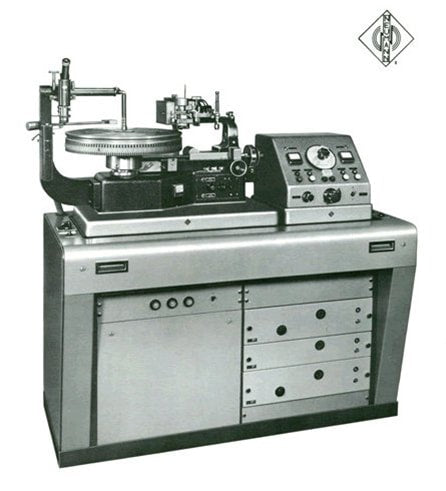
 

The Neumann AM 31.
The Neumann AM 31.
Neumann, however, did a lot more than just design a lathe. They also developed cutter heads, cutting amplifiers, lathe automation systems, transfer consoles, and even microphones! In doing so, they introduced the concept of the turnkey disk mastering system, which could be ordered from a single one-stop shop and would be guaranteed to work right out of the bag. This would prove to be a major difference between the US and European markets throughout the monophonic era and up until the early stereophonic days.
Further development: The Neumann AM 32b system.

The US market consisted of various individuals and small companies, who were very much used to making stuff on their own, modifying equipment, mixing and matching and generally using whatever means were at their disposal to set up a sound recording studio that they could work in. It was therefore common for someone interested in building up a disk recording setup to purchase a lathe from Scully, and a cutter head from Presto, Olson, RCA, Western Electric, or Haeco, and drive it with a McIntosh amplifier, while making their own equalizers from scratch. They often had to make custom parts, and they needed to be able to figure out what would work and what wouldn't. There were no guarantees of compatibility or good results with such an approach, and it took considerable skill and knowledge to put together a system that would be capable of competitive sound quality. But, for those who were able to do that, the sky was the limit as to how their system could be set up. This was not limited to disk recording and mastering systems, but was the general approach in sound recording technology, and continued in a very similar manner well into the era of magnetic tape recording. In Europe, this approach was not very popular and in fact was often frowned upon. It was felt that only a well-known manufacturer should have the authority to decide how a disk recording system should be set up, so the manufacturers would either develop all parts of the system in-house, or they would partner with other established manufacturers to supply a complete turnkey system that was guaranteed to deliver a certain performance.

Modifications or any form of tampering by the user were very much discouraged.

The Neumann VMS Special, based on the AM3 2b mechanical assembly, with fancier electronic bells and whistles. The Neumann VMS Special, based on the AM3 2b mechanical assembly, with fancier electronic bells and whistles.

To get a better feeling for this, imagine you are looking to purchase a car, but nobody sells complete cars! You need to purchase the frame from one company, the engine from another, the transmission from a third company, the differential from a fourth, suspension from a fifth, steering from a sixth, and the body from elsewhere. However, maybe the body would not necessarily fit the frame, so you might have to do some cutting and welding to get it to bolt up. You would probably have to make your own engine mounts, figure out what torque converter would be a good match for the drivetrain, decide on the appropriate axle ratio, and so on. This is what the disk recording industry looked like in the US up until the 1960s. Europeans tended to prefer an approach similar to how the automotive industry works nowadays: just sell me a car that works. I'll take the red one, thank you. This is exactly what Neumann made possible. Not only did this prove very successful in Europe, but it also won over the US market and gradually shifted it away from the DIY mentality towards the "complete system" philosophy.
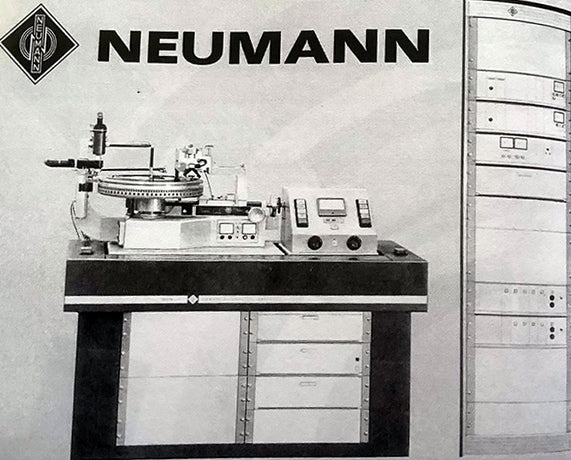
 

The Neumann VMS-70 system, the final version of this lathe bed design. The VMS-80 which came after that introduced an entirely new lathe bed, new platter, new motor, new electronics and even new standards of delay time needed for the preview system. The Neumann VMS-70 system, the final version of this lathe bed design.
The VMS-80 which came after that introduced an entirely new lathe bed, new platter, new motor, new electronics and even new standards of delay time needed for the preview system.

There are parallels here with consumer audio equipment. In the early days of gramophones, it was common to purchase a complete self-contained unit, with a platter, hand-cranked drive, sound-box, horn and cabinet. When the electrical era arrived, it brought "consoles," which consisted of a radio receiver or record player, with a built-in amplifier and loudspeaker built into the same cabinet. But then the specialist high fidelity market evolved, where "separates" were offered, and the enthusiast could freely mix and match any record player with any preamplifier, power amplifier and loudspeakers they thought would offer better performance. Naturally, not everyone was qualified to put together a good system, and many bad choices have been made through the years, along with many outstanding ones. Besides, even in the realm of automotive technology, imagine wanting to enter competition motorsports, but only being limited to turnkey vehicles as offered by the established manufacturers. It would probably make for a rather boring race...!

Header image: The "pitch box of a Neumann VMS-70 lathe, from where the recording pitch could be monitored and adjusted. A couple of motors and a differential lived under this box, driving the leadscrew of the lathe, which would advance the carriage, suspension box and cutter head across the lacquer disk.

Photo courtesy of Greg Reierson of Rare Form Mastering, Minneapolis, Minnesota.

More from Issue 157

View All Articles in Issue 157

Search Copper Magazine

#226 JJ Murphy’s Sleep Paralysis is a Genre-Bending Musical Journey Through Jazz, Fusion and More by Frank Doris Jan 05, 2026 #226 Stewardship by Consent by B. Jan Montana Jan 05, 2026 #226 Food, Music, and Sensory Experience: An Interview With Professor Jonathan Zearfoss of the Culinary Institute of America by Joe Caplan Jan 05, 2026 #226 Studio Confidential: A Who’s Who of Recording Engineers Tell Their Stories by Frank Doris Jan 05, 2026 #226 Pilot Radio is Reborn, 50 Years Later: Talking With CEO Barak Epstein by Frank Doris Jan 05, 2026 #226 The Vinyl Beat Goes Down to Tijuana (By Way of Los Angeles), Part One by Rudy Radelic Jan 05, 2026 #226 Capital Audiofest 2025: Must-See Stereo, Part Two by Frank Doris Jan 05, 2026 #226 My Morning Jacket’s Carl Broemel and Tyler Ramsey Collaborate on Their Acoustic Guitar Album, Celestun by Ray Chelstowski Jan 05, 2026 #226 The People Who Make Audio Happen: CanJam SoCal 2025, Part Two by Harris Fogel Jan 05, 2026 #226 How to Play in a Rock Band, 19: Touring Can Make You Crazy, Part One by Frank Doris Jan 05, 2026 #226 Linda Ronstadt Goes Bigger by Wayne Robins Jan 05, 2026 #226 From The Audiophile’s Guide: Active Room Correction and Digital Signal Processing by Paul McGowan Jan 05, 2026 #226 PS Audio in the News by Frank Doris Jan 05, 2026 #226 Back to My Reel-to-Reel Roots, Part 25: Half-Full, Not Empty by Ken Kessler Jan 05, 2026 #226 Happy New Year! by Frank Doris Jan 05, 2026 #226 Turn It Down! by Peter Xeni Jan 05, 2026 #226 Ghost Riders by James Schrimpf Jan 05, 2026 #226 A Factory Tour of Audio Manufacturer German Physiks by Markus "Marsu" Manthey Jan 04, 2026 #225 Capital Audiofest 2025: Must-See Stereo, Part One by Frank Doris Dec 01, 2025 #225 Otis Taylor and the Electrics Delivers a Powerful Set of Hypnotic Modern Blues by Frank Doris Dec 01, 2025 #225 A Christmas Miracle by B. Jan Montana Dec 01, 2025 #225 T.H.E. Show New York 2025, Part Two: Plenty to See, Hear, and Enjoy by Frank Doris Dec 01, 2025 #225 Underappreciated Artists, Part One: Martin Briley by Rich Isaacs Dec 01, 2025 #225 Rock and Roll is Here to Stay by Wayne Robins Dec 01, 2025 #225 A Lifetime of Holiday Record (and CD) Listening by Rudy Radelic Dec 01, 2025 #225 Little Feat: Not Saying Goodbye, Not Yet by Ray Chelstowski Dec 01, 2025 #225 How to Play in a Rock Band, Part 18: Dealing With Burnout by Frank Doris Dec 01, 2025 #225 The People Who Make Audio Happen: CanJam SoCal 2025 by Harris Fogel Dec 01, 2025 #225 Chicago’s Sonic Sanctuaries: Four Hi‑Fi Listening Bars Channeling the Jazz‑Kissa Spirit by Olivier Meunier-Plante Dec 01, 2025 #225 From The Audiophile’s Guide: Controlling Bass Frequencies Through Membrane Absorbers (and How to Build Your Own) by Paul McGowan Dec 01, 2025 #225 Your Editor’s Tips for Attending Audio Shows by Frank Doris Dec 01, 2025 #225 PS Audio in the News by Frank Doris Dec 01, 2025 #225 Back to My Reel-to-Reel Roots, Part 24 by Ken Kessler Dec 01, 2025 #225 Holiday Music by Frank Doris Dec 01, 2025 #225 Puppy Prognostication by Peter Xeni Dec 01, 2025 #225 How to Post Comments on Copper by Frank Doris Dec 01, 2025 #225 Living Color by Rudy Radelic Dec 01, 2025 #224 T.H.E. Show New York 2025, Part One: A New Beginning by Frank Doris Nov 03, 2025 #224 Fool’s Leap of Faith is the Extraordinary Octave Records Debut from Singer/Songwriter Tyler Burba and Visit by Frank Doris Nov 03, 2025 #224 The Beatles’ “Aeolian Cadences.” What? by Wayne Robins Nov 03, 2025 #224 Persona Non Grata by B. Jan Montana Nov 03, 2025 #224 Talking With Recording Engineer Barry Diament of Soundkeeper Recordings, Part Two by Frank Doris Nov 03, 2025 #224 B Sides, B Movies, and Beware of Zombies by Rudy Radelic Nov 03, 2025 #224 The Burn-In Chronicles: 1,000 Hours to Sonic Salvation by Olivier Meunier-Plante Nov 03, 2025 #224 A Conversation With Mat Weisfeld of VPI Industries by Joe Caplan Nov 03, 2025 #224 Blues-Rocker Kenny Wayne Shepherd Celebrates 30 Years of Ledbetter Heights by Ray Chelstowski Nov 03, 2025 #224 Playing in a Rock Band, 17: When Good Gigs Go Bad, Part Two by Frank Doris Nov 03, 2025

Around the World in 80 Lathes, Part Seven

Around the World in 80 Lathes, Part Seven

The last episode in this series (in Issue 156) discussed the technological and aesthetic shifts in the record cutting lathe manufacturing industry that began in the late 1970s and concluded in the 1980s, with the ultimate demise of the industry. (Believe it or not, it has not been possible to purchase a new professional disk mastering lathe, manufactured in large numbers by a company of more than two employees, since the 1980s!) Up until that point, things had been somewhat conservative. In this episode, we will examine what was perhaps the single most well-known, well-remembered, well-documented, widely-used and ridiculously overhyped disk recording lathe of all time! While it was a very capable performer, it was also cleverly marketed. It filled a market gap that had existed for some time, clearly demonstrating the differences in mentality that existed in this industry between the US and Europe. In fact, this market gap had begun to be filled in Europe much earlier, but by the early 1970s, the West was won, and it wasn't by Led Zeppelin this time!


Mike Papas of XL Productions, Ashbury, Australia with a Neumann VMS lathe, cutter head, transfer console, and tape machine console (containing a Telefunken M15A preview head tape machine). Photo courtesy of Mike Papas. Mike Papas of XL Productions, Ashbury, Australia
(http://www.vinylrecordproduction.com) with a Neumann VMS-70 lathe, cutter head, transfer console, and tape machine console (containing a Telefunken M15A preview head tape machine). Photo courtesy of Mike Papas.

The machine in question was the Neumann VMS-70, a complete, turnkey and highly automated system that conveniently eliminated a lot of the guesswork that had traditionally gone into purchasing, setting up, and using a disk mastering system. The VMS-70 set a new standard in the industry, and became the world's most popular lathe. Not the most popular by numbers sold; this would have been one of the primitive monophonic record-cutting machines once found in every radio broadcasting facility. The Neumann VMS-70 did not actually sell anywhere near that many numbers. But it did become the most commonly encountered lathe in commercial disk mastering facilities during the entire stereophonic era. It is probably safe to say that during the stereophonic era and up to the present day, more master lacquer disks have been cut on a VMS-70 than on any other lathe ever made. Still, only about 500 of these were ever produced, with much fewer surviving today. But, this is a lot, considering that the world has never had 500 professional disk mastering facilities operating at any one time! This has made the VMS-70 highly sought after to this day, and perhaps the most widely discussed lathe in the media and on the internet. In fact, its dominance in all mastering-related articles and discussions has led some people to believe that this is the only lathe that can cut "modern" masters, even though the Neumann VMS-80 (see Issue 153 and Issue 154) that superseded it, as well as the competing L.J. Scully LS-76 (covered in Issue 155 and Issue 156) were way more modern in every sense, right down to their aesthetics. As a result, the price for a Neumann VMS-70 in the used market nowadays can easily be mistaken for the telephone number of the person selling it!


The Neumann AM 31, the first lathe developed by Georg Neumann in 1931.
The origins of the VMS-70 can be traced back to the 1930s, when Georg Neumann developed his first disk recording lathe. The lathe bed was a large aluminum casting, a design that was carried over with very few changes all the way to 1980, when it was finally dropped in favor of the redesigned flat-slab approach of the VMS-80 lathe. That first lathe, introduced in 1931 and named the AM 31, already had many of the key features that established the Neumann lathe in the industry. None of it was that unique, but it was offered as a complete package, and that was the true innovation.
The Neumann AM 31 specifications, from a Neumann brochure of the time. The Neumann AM 31 specifications, from a Neumann brochure of the time.

The general approach was very similar to the early Western Electric lathes. The early Neumann lathes had a sturdy machine tool-type bed, a substantial vacuum platter, a horizontal slideway (for the carriage that transported the head across the blank disk surface) that ran under the platter, a carriage arm that held the cutter head and its suspension unit above the platter, and an accurate leadscrew mechanism. The lathe had enough space to allow the mounting of any cutter head of the past, present and future, and a high-performance floor-standing motor (supplied by Lyrec in Denmark), that directly drove the platter via an oil-coupler, to reduce rumble and noise. The latter was inspired by the much more advanced, but also much more expensive to manufacture than the Kingsbury bearing fluid coupler used in the early Western Electric lathes.


The Neumann AM 31.
The Neumann AM 31.
Neumann, however, did a lot more than just design a lathe. They also developed cutter heads, cutting amplifiers, lathe automation systems, transfer consoles, and even microphones! In doing so, they introduced the concept of the turnkey disk mastering system, which could be ordered from a single one-stop shop and would be guaranteed to work right out of the bag. This would prove to be a major difference between the US and European markets throughout the monophonic era and up until the early stereophonic days.
Further development: The Neumann AM 32b system.

The US market consisted of various individuals and small companies, who were very much used to making stuff on their own, modifying equipment, mixing and matching and generally using whatever means were at their disposal to set up a sound recording studio that they could work in. It was therefore common for someone interested in building up a disk recording setup to purchase a lathe from Scully, and a cutter head from Presto, Olson, RCA, Western Electric, or Haeco, and drive it with a McIntosh amplifier, while making their own equalizers from scratch. They often had to make custom parts, and they needed to be able to figure out what would work and what wouldn't. There were no guarantees of compatibility or good results with such an approach, and it took considerable skill and knowledge to put together a system that would be capable of competitive sound quality. But, for those who were able to do that, the sky was the limit as to how their system could be set up. This was not limited to disk recording and mastering systems, but was the general approach in sound recording technology, and continued in a very similar manner well into the era of magnetic tape recording. In Europe, this approach was not very popular and in fact was often frowned upon. It was felt that only a well-known manufacturer should have the authority to decide how a disk recording system should be set up, so the manufacturers would either develop all parts of the system in-house, or they would partner with other established manufacturers to supply a complete turnkey system that was guaranteed to deliver a certain performance.

Modifications or any form of tampering by the user were very much discouraged.

The Neumann VMS Special, based on the AM3 2b mechanical assembly, with fancier electronic bells and whistles. The Neumann VMS Special, based on the AM3 2b mechanical assembly, with fancier electronic bells and whistles.

To get a better feeling for this, imagine you are looking to purchase a car, but nobody sells complete cars! You need to purchase the frame from one company, the engine from another, the transmission from a third company, the differential from a fourth, suspension from a fifth, steering from a sixth, and the body from elsewhere. However, maybe the body would not necessarily fit the frame, so you might have to do some cutting and welding to get it to bolt up. You would probably have to make your own engine mounts, figure out what torque converter would be a good match for the drivetrain, decide on the appropriate axle ratio, and so on. This is what the disk recording industry looked like in the US up until the 1960s. Europeans tended to prefer an approach similar to how the automotive industry works nowadays: just sell me a car that works. I'll take the red one, thank you. This is exactly what Neumann made possible. Not only did this prove very successful in Europe, but it also won over the US market and gradually shifted it away from the DIY mentality towards the "complete system" philosophy.


The Neumann VMS-70 system, the final version of this lathe bed design. The VMS-80 which came after that introduced an entirely new lathe bed, new platter, new motor, new electronics and even new standards of delay time needed for the preview system. The Neumann VMS-70 system, the final version of this lathe bed design.
The VMS-80 which came after that introduced an entirely new lathe bed, new platter, new motor, new electronics and even new standards of delay time needed for the preview system.

There are parallels here with consumer audio equipment. In the early days of gramophones, it was common to purchase a complete self-contained unit, with a platter, hand-cranked drive, sound-box, horn and cabinet. When the electrical era arrived, it brought "consoles," which consisted of a radio receiver or record player, with a built-in amplifier and loudspeaker built into the same cabinet. But then the specialist high fidelity market evolved, where "separates" were offered, and the enthusiast could freely mix and match any record player with any preamplifier, power amplifier and loudspeakers they thought would offer better performance. Naturally, not everyone was qualified to put together a good system, and many bad choices have been made through the years, along with many outstanding ones. Besides, even in the realm of automotive technology, imagine wanting to enter competition motorsports, but only being limited to turnkey vehicles as offered by the established manufacturers. It would probably make for a rather boring race...!

Header image: The "pitch box of a Neumann VMS-70 lathe, from where the recording pitch could be monitored and adjusted. A couple of motors and a differential lived under this box, driving the leadscrew of the lathe, which would advance the carriage, suspension box and cutter head across the lacquer disk.

Photo courtesy of Greg Reierson of Rare Form Mastering, Minneapolis, Minnesota.

0 comments

Leave a comment

0 Comments

Your avatar

Loading comments...

🗑️ Delete Comment

Enter moderator password to delete this comment: