COPPER

A PS Audio Publication

Issue 134 • Free Online Magazine

Issue 134 THE COPPER INTERVIEW

Sylvia Massy: Pushing Sonic Boundaries With a Rock and Roll Attitude

Sylvia Massy: Pushing Sonic Boundaries With a Rock and Roll Attitude

From her punk and hard rock roots as a musician, Sylvia Massy has risen to dizzily lofty heights and accolades as an innovative and highly-sought producer and engineer. Her work with Rick Rubin, Tool, Red Hot Chili Peppers, Johnny Cash, Lenny Kravitz, Aerosmith, Queens of the Stone Age, Tom Petty, Prince, Seal, and many other artists could fill an entire music library. She has also conducted workshops and taught both in the US and abroad, and her 2016 book, Recording Unhinged, led to her subsequent acquisition of the largest microphone museum in the world (an article about the collection is in Copper Issue 128).

Sylvia Massy graciously took the time from her busy schedule for an interview with Copper.

John Seetoo: You have stated in your workshops and lectures that you have used old crystal, dynamic, and condenser mics or even carbon mics from your museum collection on sessions (see article in Copper Issue 128). Do you prefer to record a unique sound from the get-go as opposed to manipulating it afterwards? And this is completely opposite the “conventional wisdom” of using the best mics possible. Why do you sometimes like to do this?

Sylvia Massy: I like to record with the end result in mind. As close to the final sound I can get is where I want to start. That means committing the EQ, compression, levels and amplification at the time the parts are being recorded. I do this for several reasons. First, it is easier to envision the final production if all the parts are in a finished form as you build them. Next, as the players are performing, the closer to a finished sound they have in their headphones [the more it] will inspire a better performance from them. Next, if tracks are committed with all EQ and compression, I am ensuring that any future mixer can’t f*ck it up too badly.

JS: Your roots as a musician are in punk and metal. As a producer and engineer, you’ve recorded the sound of a piano being pummeled with sledgehammers and blown to bits with a shotgun on Tool’s Undertow, and you’ve also recorded a guitar being tossed off a cliff. Did the final results match the sound you had in your head when you originally envisioned them, and did bands like Wendy O. Williams and the Plasmatics influence that element of aural destruction being incorporated into your music production?

SM: I like to approach music production with a punk attitude, and I’ll try to find the most extreme sounds to add into recordings. Sometimes these punk ideas work and are fantastic. Sometimes they don’t work or are not appropriate. Smashing pianos was out-of-control and the sounds became the final song “Disgustipated” on [Tool’s] Undertow. On another project, tossing a screaming guitar off a cliff was wild…crashing, sproinging. That was on Machines Of Loving Grace’s Gilt. But alas, the cliff guitar did not fit anywhere on their album and we did not use it. No regrets.

If you want to do this kind of crazy stuff, you need to carefully budget the time so you are not stealing a day or two away from recording your main, foundational tracks. I usually wait until the end of a project for the punk reward. And when the actual “punk” recording doesn’t fit on the record it’s still okay because it is incredibly fun and sometimes a bit daredevil. One time we snuck into an art museum in Dresden with a hidden load of recording equipment and recorded creepy vocals in front of Raphael’s giant “Two Angels” painting. That was Lucy Luvs Fur and it worked. Another time we recorded in an Etruscan tomb with bats outside of Rome. That was [for] Spiritual Front and that one worked too.

JS: You have stated in the past that you often like to change the environment for an artist in order to get a different kind of performance. This type of “performance shaping” is reminiscent of techniques used by film directors like Alfred Hitchcock or Roman Polanski. Was this something you learned from someone else or something you developed on your own?

SM: Most singers respond to the environment you put them in. Think of this. Record a singer in a vocal booth, then record the same singer, same part in a cathedral. You will get a vastly different performance. Some singers will be inspired, others may be very shy. Either emotion could be useful in the delivery of the song’s message.

JS: You have mentioned in your book, Recording Unhinged: Creative and Unconventional Recording Techniques, of experimenting with processing sound through light bulbs, household appliances, and even food. Can you elaborate a bit more about that and what the results were like?

SM: Cheese sounds best. Especially if you are going for a bluesy tone. But not necessarily bleu Cheese, ha ha. Actually I think Gouda has a killer tone. For realz.

JS: I understand that one of your teaching tests is to challenge a student to match a mix done on an SSL (Solid State Logic) console with an analog Trident console. Having an engineer do it all in analog is a great way to make someone mix with their ears, as opposed to staring at a screen display. Can you comment on this? (note: Sylvia Massy’s SSL console is a vintage J series wraparound 96 channel model.)

SM: This is a very surprising exercise. I ask a new engineer to listen to one of my finished mixes, then I give them the files and ask them to duplicate my mix using an entirely different studio. Hehe. We learn who is actually listening. The song I give them was mixed on an SSL, and they would do the test on a Trident 80 Series. Some contenders were very, very close. Others made a good mix, but ignored matching my mix. Those contenders showed me they don’t listen to instructions or take direction. I would never be able to give them a critical job.

 The Trident console.

JS: You have stated that you and Rick Rubin share an affinity for left-center-right (L-C-R 3-channel) mixing. How did this develop, and what are the advantages and drawbacks for you in using that approach? And how would you mix this to stereo?

SM: I learned to love the L-C-R approach while engineering Johnny Cash’s Unchained for Rick Rubin. Rick wanted to give the album a roots feel. Organic and real. Because older analog consoles had no panning, [and] only had a left and right and center selection [for placing sounds in the mix], we used that technique to keep it vintage-sounding. Johnny’s backup band was Tom Petty and the Heartbreakers. Some songs were dense with two electric guitars, Hammond B3 [organ] or piano, acoustic guitars and John’s vocals, yet the hard-left, hard-right or in the middle panning approach never felt compromising.

JS: Some producers, such as Tony Visconti (see the interview in Copper Issue 96 and Issue 97) have been known to overdub instruments themselves surreptitiously or to fix a track that drifted in tempo too widely after the band was finished cutting tracks, in order to finish the record to the label’s satisfaction. Have you ever felt the need or been tempted to do that as well, and if so, on which instruments?

SM: Sometimes I will surprise a mix client with string arrangements, harmonies, choirs, piano, synth, acoustic. Whatever the song needs and is appropriate. But the best results come from [a] collaboration of ideas. I have corrected drums, flown bass and guitar parts, comped and copied parts by editing tape, using ancient samplers and slicing and dicing in Pro Tools.

JS: How has the pandemic affected the way you, the artists and the studios in the way you have been working over the past year?

SM: 2020 was a big mix year for me. COVID kept me grounded in my home studio, giving me a great excuse to build a new Dolby Atmos mix rig for immersive mixing. Hehehe!
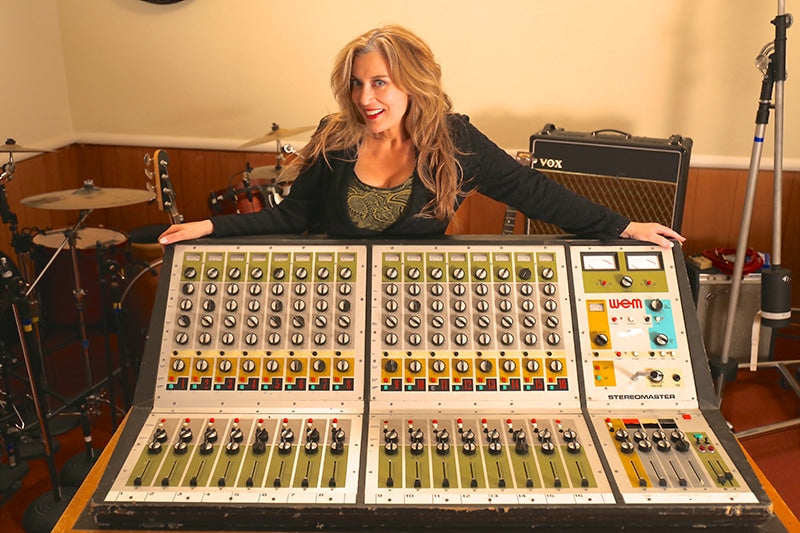


Massy with a vintage WEM Stereomaster console. Massy with a vintage WEM Stereomaster console.
All images courtesy of Sylvia Massy.

More from Issue 134

View All Articles in Issue 134

Search Copper Magazine

#230 Camaraderie by B. Jan Montana May 04, 2026 #230 AXPONA 2026: A Family Gathering by Paul McGowan May 04, 2026 #230 Pianist Ryan Benthall Explores Jazz Realms and Far Beyond With Divine Sky by Frank Doris May 04, 2026 #230 The Vinyl Beat in AXPONA-Land by Rudy Radelic May 04, 2026 #230 Teddy Thompson’s Musical Growth Deepens With Never Be the Same by Ray Chelstowski May 04, 2026 #230 More Fun in the Sun: Florida Audio Expo, Part Two by Frank Doris May 04, 2026 #230 CanJam NYC 2026 Show Report: Heady Sound, Part Two by Frank Doris and Harris Fogel May 04, 2026 #230 Sonic Youth On Murray Street by Wayne Robins May 04, 2026 #230 Graffeo Coffee: A Symphony of Sensory Experience by Joe Caplan May 04, 2026 #230 The Saul Authority: The Story of Hi-Fi Pioneer Saul Marantz by Olivier Meunier-Plante May 04, 2026 #230 How to Play in a Rock Band, 23: Encounters With Famous Musicians, Part Two by Frank Doris May 04, 2026 #230 An Outlier in the Rack: A Vintage BIC Beam Box by The Staff at Just Audio May 04, 2026 #230 PS Audio in the News by PS Audio Staff May 04, 2026 #230 A Cautionary Tale by Rich Isaacs May 04, 2026 #230 Reel-to-Reel Roots, Part 33 (Revised): Ken Kessler Reports On the 2026 (British) AudioJumble by Ken Kessler May 04, 2026 #230 Text Messaging by Frank Doris May 04, 2026 #230 The Audiophile Rat Race by Peter Xeni May 04, 2026 #230 On the Rocks by Rich Isaacs May 04, 2026 #229 The Earliest Stars of Country Music, Part Three by Jeff Weiner Apr 06, 2026 #229 The Healing Power of Music and Sound at the Omega Institute by Joe Caplan Apr 06, 2026 #229 CanJam NYC 2026 Show Report: Heady Sound, Part One by Frank Doris Apr 06, 2026 #229 Florida Audio Expo 2026: Warming Up to High-End Audio, Part One by Frank Doris Apr 06, 2026 #229 Quick Takes: Anne Bisson, Sam Morrison, The Velvet Underground, and the Stooges by Frank Doris Apr 06, 2026 #229 The Vinyl Beat: New Arrivals, and Old Audio Show Demo Scores to Settle by Rudy Radelic Apr 06, 2026 #229 Harvard Gets a High-End Audio Education by Frank Doris Apr 06, 2026 #229 No Country for Old Knees by B. Jan Montana Apr 06, 2026 #229 How To Play in A Rock Band, 22: Encounters With Famous Musicians, Part 1 by Frank Doris Apr 06, 2026 #229 The Soulful Grooves of Guinea-Bissau by Steve Kindig Apr 06, 2026 #229 Four-Hand Piano Performance at Its Finest by Stephan Haberthür Apr 06, 2026 #229 The People Who Make Audio Happen: Supreme Acoustics Systems’ Las Vegas Grand Opening by Harris Fogel Apr 06, 2026 #229 Blue Öyster Cult: Tyranny and Expectations by Wayne Robins Apr 06, 2026 #229 Guitarist Rick Vito’s Cinematic New Album, Slidemaster by Ray Chelstowski Apr 06, 2026 #229 Measurements and Observational Listening by Paul McGowan Apr 06, 2026 #229 PS Audio in the News by PS Audio Staff Apr 06, 2026 #229 Back to My Reel-to-Reel Roots, Part 28: The Cassette Strikes Back by Ken Kessler Apr 06, 2026 #229 Are You Receiving Me? by Frank Doris Apr 06, 2026 #229 Hospitality by Peter Xeni Apr 06, 2026 #229 Cantina Gateway by James Schrimpf Apr 06, 2026 #228 Serita’s Black Rose Duo Shakes Your Soul With a Blend of Funk, Rock, Blues and a Whole Lot More by Frank Doris Mar 02, 2026 #228 Vinyl, A Love Story by Wayne Robins Mar 02, 2026 #228 Thrill Seeker by B. Jan Montana Mar 02, 2026 #228 The Vinyl Beat: Donald Byrd, Bill Evans, Wes Montgomery, Eddie Palmieri and Frank Sinatra by Rudy Radelic Mar 02, 2026 #228 Listening to Prestige: The History of a Vitally Important Jazz Record Label by Frank Doris Mar 02, 2026 #228 How to Play in a Rock Band, 21: Touring With James Lee Stanley by Frank Doris Mar 02, 2026 #228 The NAMM 2026 Show: The Music Industry’s Premier Event by John Volanski Mar 02, 2026 #228 The Earliest Stars of Country Music, Part Two by Jeff Weiner Mar 02, 2026 #228 From The Audiophile's Guide: A Brief History of Stereophonic Sound by Paul McGowan Mar 02, 2026

Sylvia Massy: Pushing Sonic Boundaries With a Rock and Roll Attitude

Sylvia Massy: Pushing Sonic Boundaries With a Rock and Roll Attitude

From her punk and hard rock roots as a musician, Sylvia Massy has risen to dizzily lofty heights and accolades as an innovative and highly-sought producer and engineer. Her work with Rick Rubin, Tool, Red Hot Chili Peppers, Johnny Cash, Lenny Kravitz, Aerosmith, Queens of the Stone Age, Tom Petty, Prince, Seal, and many other artists could fill an entire music library. She has also conducted workshops and taught both in the US and abroad, and her 2016 book, Recording Unhinged, led to her subsequent acquisition of the largest microphone museum in the world (an article about the collection is in Copper Issue 128).

Sylvia Massy graciously took the time from her busy schedule for an interview with Copper.

John Seetoo: You have stated in your workshops and lectures that you have used old crystal, dynamic, and condenser mics or even carbon mics from your museum collection on sessions (see article in Copper Issue 128). Do you prefer to record a unique sound from the get-go as opposed to manipulating it afterwards? And this is completely opposite the “conventional wisdom” of using the best mics possible. Why do you sometimes like to do this?

Sylvia Massy: I like to record with the end result in mind. As close to the final sound I can get is where I want to start. That means committing the EQ, compression, levels and amplification at the time the parts are being recorded. I do this for several reasons. First, it is easier to envision the final production if all the parts are in a finished form as you build them. Next, as the players are performing, the closer to a finished sound they have in their headphones [the more it] will inspire a better performance from them. Next, if tracks are committed with all EQ and compression, I am ensuring that any future mixer can’t f*ck it up too badly.

JS: Your roots as a musician are in punk and metal. As a producer and engineer, you’ve recorded the sound of a piano being pummeled with sledgehammers and blown to bits with a shotgun on Tool’s Undertow, and you’ve also recorded a guitar being tossed off a cliff. Did the final results match the sound you had in your head when you originally envisioned them, and did bands like Wendy O. Williams and the Plasmatics influence that element of aural destruction being incorporated into your music production?

SM: I like to approach music production with a punk attitude, and I’ll try to find the most extreme sounds to add into recordings. Sometimes these punk ideas work and are fantastic. Sometimes they don’t work or are not appropriate. Smashing pianos was out-of-control and the sounds became the final song “Disgustipated” on [Tool’s] Undertow. On another project, tossing a screaming guitar off a cliff was wild…crashing, sproinging. That was on Machines Of Loving Grace’s Gilt. But alas, the cliff guitar did not fit anywhere on their album and we did not use it. No regrets.

If you want to do this kind of crazy stuff, you need to carefully budget the time so you are not stealing a day or two away from recording your main, foundational tracks. I usually wait until the end of a project for the punk reward. And when the actual “punk” recording doesn’t fit on the record it’s still okay because it is incredibly fun and sometimes a bit daredevil. One time we snuck into an art museum in Dresden with a hidden load of recording equipment and recorded creepy vocals in front of Raphael’s giant “Two Angels” painting. That was Lucy Luvs Fur and it worked. Another time we recorded in an Etruscan tomb with bats outside of Rome. That was [for] Spiritual Front and that one worked too.

JS: You have stated in the past that you often like to change the environment for an artist in order to get a different kind of performance. This type of “performance shaping” is reminiscent of techniques used by film directors like Alfred Hitchcock or Roman Polanski. Was this something you learned from someone else or something you developed on your own?

SM: Most singers respond to the environment you put them in. Think of this. Record a singer in a vocal booth, then record the same singer, same part in a cathedral. You will get a vastly different performance. Some singers will be inspired, others may be very shy. Either emotion could be useful in the delivery of the song’s message.

JS: You have mentioned in your book, Recording Unhinged: Creative and Unconventional Recording Techniques, of experimenting with processing sound through light bulbs, household appliances, and even food. Can you elaborate a bit more about that and what the results were like?

SM: Cheese sounds best. Especially if you are going for a bluesy tone. But not necessarily bleu Cheese, ha ha. Actually I think Gouda has a killer tone. For realz.

JS: I understand that one of your teaching tests is to challenge a student to match a mix done on an SSL (Solid State Logic) console with an analog Trident console. Having an engineer do it all in analog is a great way to make someone mix with their ears, as opposed to staring at a screen display. Can you comment on this? (note: Sylvia Massy’s SSL console is a vintage J series wraparound 96 channel model.)

SM: This is a very surprising exercise. I ask a new engineer to listen to one of my finished mixes, then I give them the files and ask them to duplicate my mix using an entirely different studio. Hehe. We learn who is actually listening. The song I give them was mixed on an SSL, and they would do the test on a Trident 80 Series. Some contenders were very, very close. Others made a good mix, but ignored matching my mix. Those contenders showed me they don’t listen to instructions or take direction. I would never be able to give them a critical job.

 The Trident console.

JS: You have stated that you and Rick Rubin share an affinity for left-center-right (L-C-R 3-channel) mixing. How did this develop, and what are the advantages and drawbacks for you in using that approach? And how would you mix this to stereo?

SM: I learned to love the L-C-R approach while engineering Johnny Cash’s Unchained for Rick Rubin. Rick wanted to give the album a roots feel. Organic and real. Because older analog consoles had no panning, [and] only had a left and right and center selection [for placing sounds in the mix], we used that technique to keep it vintage-sounding. Johnny’s backup band was Tom Petty and the Heartbreakers. Some songs were dense with two electric guitars, Hammond B3 [organ] or piano, acoustic guitars and John’s vocals, yet the hard-left, hard-right or in the middle panning approach never felt compromising.

JS: Some producers, such as Tony Visconti (see the interview in Copper Issue 96 and Issue 97) have been known to overdub instruments themselves surreptitiously or to fix a track that drifted in tempo too widely after the band was finished cutting tracks, in order to finish the record to the label’s satisfaction. Have you ever felt the need or been tempted to do that as well, and if so, on which instruments?

SM: Sometimes I will surprise a mix client with string arrangements, harmonies, choirs, piano, synth, acoustic. Whatever the song needs and is appropriate. But the best results come from [a] collaboration of ideas. I have corrected drums, flown bass and guitar parts, comped and copied parts by editing tape, using ancient samplers and slicing and dicing in Pro Tools.

JS: How has the pandemic affected the way you, the artists and the studios in the way you have been working over the past year?

SM: 2020 was a big mix year for me. COVID kept me grounded in my home studio, giving me a great excuse to build a new Dolby Atmos mix rig for immersive mixing. Hehehe!


Massy with a vintage WEM Stereomaster console. Massy with a vintage WEM Stereomaster console.
All images courtesy of Sylvia Massy.

0 comments

Leave a comment

0 Comments

Your avatar

Loading comments...

🗑️ Delete Comment

Enter moderator password to delete this comment:

✏️ Edit Comment

Enter your email to verify ownership: