COPPER

A PS Audio Publication

Issue 149 • Free Online Magazine

Issue 149 Featured

Choosing New Speakers: Sensitivity and Room Size

Choosing New Speakers: Sensitivity and Room Size

In a previous article (Issue 147) we considered the reality that, although there is an abundance of information describing the technical specifications of loudspeakers, not all of it is particularly helpful in assisting us in making informed purchasing decisions. The specs don’t give a complete idea of how a speaker will be suited to our listening rooms, or provide an optimal listening distance.

We also briefly looked at the fact that power handling ratings and frequency response are only part of the picture in telling us about a speaker’s “personality” and potential to deliver volume at our preferred listening levels, because we don’t typically listen to our speakers at their peak output rating, nor can we tell how much power our speaker is delivering at different bandwidths and frequencies across the audio spectrum. It’s worth remembering that often times, nominal test data may be obtained from measurements conducted in an anechoic chamber, and do not directly represent how a loudspeaker may perform in an actual listening environment, or account for different room dimensions, reflections, absorption and even listener preferences for a more bright, forward and lively sound or perhaps a darker or more laid-back tonality.

We know that if we sit farther away from the speakers, we will lose some of the volume compared to if we sat nearer. If your speakers have been engineered to produce, say, an average of 85 dB output at a given listening position, the location you end up selecting for your seating position may not correspond to this average distance for average volume output. Again, the spec doesn’t provide a useful “real world” measurement. You may think the simple answer is to just turn the volume up or down according to what you are listening to!

However, any given recording has been made with either incidental, or more commonly, very intentional dynamic ranges from within its quietest and to its loudest parts. It’s safe to say that all of us want to listen to an album’s mix as intended by the engineer, without having to change the volume radically throughout our listening to the piece! Many of us may not enjoy constantly adjusting the volume control (and/or applying some kind of compression like the night mode of an A/V receiver or soundbar) unless perhaps we are listening late at night and being considerate of our neighbors.

Our listening position can have more of an impact on this than we might at first think. The album Talk by Yes is a great example of a recording with vast dynamic range. A big reason is that it was recorded by producer Trevor Rabin with his pioneering use of Mark of the Unicorn Digital Performer software (now up to Version 11). As Rabin put it in 1994: “…this Talk album, we really went into doing seriously, to do something that hopefully we could say, [in] twenty years’ time, that’s one of the things we did that we’re really proud of.”

If you love to listen to orchestral music, then you know I am preaching to the converted when it comes to appreciating a recording’s dynamics, from subtle passages to monstrous power that could dust off any Marshall stack!

So, are there any standards we can adhere to when assessing equipment? A traditional and tested requirement for many mixing rooms is that the front speakers in a multichannel setup should be able to handle peaks of 105 dB across a bandwidth from 80 Hz to 20 kHz (20 dB above the rated average listening volume of 85dB), with the surround speakers at 102 dB covering the same bandwidth range, and subwoofers the capable of producing 115 dB. This starts to provide some context for how we may set our volume levels on our home stereo or surround systems so that they are balanced in the same proportions. If you calibrate your listening volume to something closer to 75 dB, then you afford yourself 10 dB headroom. Also, knowing how loud you like to listen to your music for most of the time gives a great starting point in comparing different speakers at the same volume.

What if you run a 5.1-channel or bigger system for music and movies? Many films have a mix that is biased in favor of in producing a center channel volume that is 3 dB louder than the front main speakers, and with front main speakers mixed at 3 dB louder than the surrounds. If you are watching a live music Blu-ray (or other format), you may likely notice that the center channel is very prominent, and it requires a lot more power than the other speakers. This can be especially noticeable in dialogue and for vocal performances. For this reason, many tout the center speaker as the most important in a surround sound system, along with the fact that it has an important role in dispersing its sound over an off-axis angle of about 60 degrees to provide adequate room coverage and blend with the main left and right speakers. The takeaway is to keep in mind that, when determining your preferred listening levels and listening position with a surround sound system, you need to consider that the center channel will require more power.

Of course, your room has a major impact on the volume and the sound your speakers will produce. Examples may include furniture, mirrors, windows, soft furnishings, blankets, bookcases, and of course any dedicated room absorption and dispersion treatments. This is nothing new, but have you considered the following?
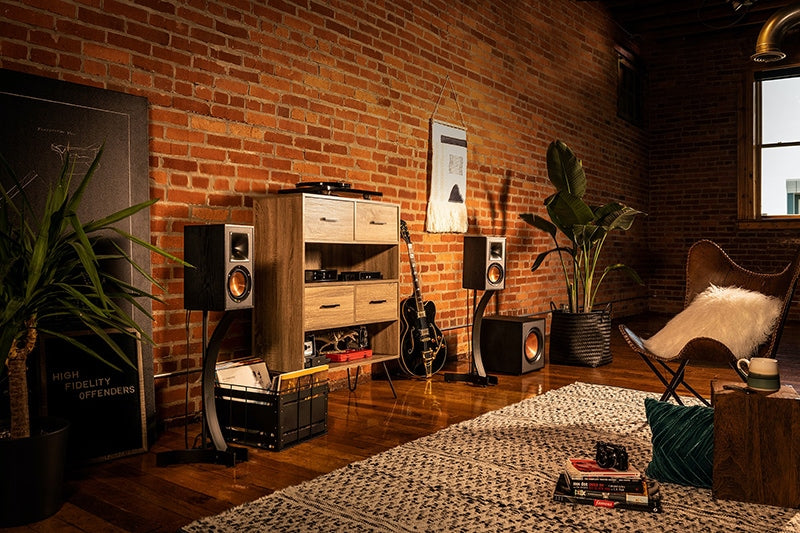

The distance from the loudspeakers to the listening position, and the size and furnishings of the room are important factors to consider. From the Klipsch website. Klipsch loudspeakers and subwoofer in a surround sound system. From the Klipsch website.

It’s a well-known fact to us audiophiles, that to double the acoustic energy output, we need an increase of +3 dB. So, how does this factor into our thinking about room sizes and the sensitivity ratings of our speakers?

For a room size of approximately 80 cubic meters (3,000 cubic feet), based on average room reflections and decay times, the measured sensitivity of speakers at the standard one-meter measurement point, translates to -7 dB by the time you get to the average listening position for that room size. This is based on a typical triangular placement of a listening chair between speakers in a room following the IEC dimensions of a 21-foot/6.4m x 16-foot/4.8m x 9-foot/2.7m room. Because of the inverse square law – volume drops off as the square of the distance, not in a linear fashion. Think of it as the sound power being spread out in all directions from the source, a bit like the surface of an inflating balloon skin.

As you double the distance from the speaker to 2 meters (about 6-1/2 feet), the volume will have dropped by more than 6 dB by the time you hear it at that distance compared to the sound source measured at one meter. If you double the distance again to 4 meters (a little over 13 feet away in a bigger room as illustrated below you will be more than 12 dB down (actually closer to 13 dB) at the listening position.

In other words, if you are considering buying a speaker with a sensitivity rating of 87 dB, it will translate to a sensitivity of 80 dB at a seating position of a distance a little more than 2 meters (about 6-1/2 feet) away from the speakers. Speakers rated at a sensitivity of 92 dB will be performing at the listening position at a sensitivity of 85 dB. If your speakers have a sensitivity rating of 82 dB then you will have an effective sensitivity at such a seating position of 75 dB – a typical suggested minimum reference volume for a home hi-fi set up. Factor this into your decision-making process when choosing the right speakers for your room size, preferred listening volumes and distance from your speakers.


Sound pressure level vs. distance. From the PUIaudio website. Sound pressure level vs. distance. From the PUIaudio website.

So, if you have ever bemoaned the fact that your room isn’t quite as big as you would like it to be, say less than 80 cubic meters (about 2,825 cubic feet), you now have more reason to be happy about the fact that your speakers play louder because you’ll be sitting closer to them and need less amplifier power.

What about those of us who do have a larger room? If your room is double the previous example’s cubic volume at 160 cubic meters (about 5,650 cubic feet), and assuming the same ceiling height, you’ll need double the amplifier power (for example, from 100 to 200 watts) to hear the same volume as the room which has half of that cubic volume. Why? Because the room volume requires 3 dB more power each time you increase the volume of the room by 80 cubic meters and so you are now down -10dB at the listening position. And, for a room three times the volume at 240 cubic meters (approx. 8.9 x 10 x 2.7 meters or about 8,476 cubic feet), the you must double the power again from 200 to 400 watts, as you lose a further 3 dB and are now -13 dB down from your (anechoic) speaker sensitivity rating at 1 meter. In a room this size, speakers rated at 87 dB will have an effective sensitivity of 74 dB at the listening position.

Again, although these are only statistical average examples, and your personal mileage may vary a little, they may prove very helpful in making a more informed decision when analyzing speaker specifications, your room size, and amplifier power and headroom requirements to adequately support typical seating position listening volumes. (Note that differences in spectral balance and decay time will alter the perceived volume to some extent).

You may of course enjoy listening to your speakers more in the near field than at an average listening distance for any given room size. You may also prefer listening to them at below reference levels.

What other factors can we consider that will help choose a good-sounding speaker? We will consider this in a future article.

Header image courtesy of Pixabay.com/Tomislav Jakupec.


More from Issue 149

View All Articles in Issue 149

Search Copper Magazine

#230 Camaraderie by B. Jan Montana May 04, 2026 #230 AXPONA 2026: A Family Gathering by Paul McGowan May 04, 2026 #230 Pianist Ryan Benthall Explores Jazz Realms and Far Beyond With Divine Sky by Frank Doris May 04, 2026 #230 The Vinyl Beat in AXPONA-Land by Rudy Radelic May 04, 2026 #230 Teddy Thompson’s Musical Growth Deepens With Never Be the Same by Ray Chelstowski May 04, 2026 #230 More Fun in the Sun: Florida Audio Expo, Part Two by Frank Doris May 04, 2026 #230 CanJam NYC 2026 Show Report: Heady Sound, Part Two by Frank Doris and Harris Fogel May 04, 2026 #230 Sonic Youth On Murray Street by Wayne Robins May 04, 2026 #230 Graffeo Coffee: A Symphony of Sensory Experience by Joe Caplan May 04, 2026 #230 The Saul Authority: The Story of Hi-Fi Pioneer Saul Marantz by Olivier Meunier-Plante May 04, 2026 #230 How to Play in a Rock Band, 23: Encounters With Famous Musicians, Part Two by Frank Doris May 04, 2026 #230 An Outlier in the Rack: A Vintage BIC Beam Box by The Staff at Just Audio May 04, 2026 #230 PS Audio in the News by PS Audio Staff May 04, 2026 #230 A Cautionary Tale by Rich Isaacs May 04, 2026 #230 Reel-to-Reel Roots, Part 33 (Revised): Ken Kessler Reports On the 2026 (British) AudioJumble by Ken Kessler May 04, 2026 #230 Text Messaging by Frank Doris May 04, 2026 #230 The Audiophile Rat Race by Peter Xeni May 04, 2026 #230 On the Rocks by Rich Isaacs May 04, 2026 #229 The Earliest Stars of Country Music, Part Three by Jeff Weiner Apr 06, 2026 #229 The Healing Power of Music and Sound at the Omega Institute by Joe Caplan Apr 06, 2026 #229 CanJam NYC 2026 Show Report: Heady Sound, Part One by Frank Doris Apr 06, 2026 #229 Florida Audio Expo 2026: Warming Up to High-End Audio, Part One by Frank Doris Apr 06, 2026 #229 Quick Takes: Anne Bisson, Sam Morrison, The Velvet Underground, and the Stooges by Frank Doris Apr 06, 2026 #229 The Vinyl Beat: New Arrivals, and Old Audio Show Demo Scores to Settle by Rudy Radelic Apr 06, 2026 #229 Harvard Gets a High-End Audio Education by Frank Doris Apr 06, 2026 #229 No Country for Old Knees by B. Jan Montana Apr 06, 2026 #229 How To Play in A Rock Band, 22: Encounters With Famous Musicians, Part 1 by Frank Doris Apr 06, 2026 #229 The Soulful Grooves of Guinea-Bissau by Steve Kindig Apr 06, 2026 #229 Four-Hand Piano Performance at Its Finest by Stephan Haberthür Apr 06, 2026 #229 The People Who Make Audio Happen: Supreme Acoustics Systems’ Las Vegas Grand Opening by Harris Fogel Apr 06, 2026 #229 Blue Öyster Cult: Tyranny and Expectations by Wayne Robins Apr 06, 2026 #229 Guitarist Rick Vito’s Cinematic New Album, Slidemaster by Ray Chelstowski Apr 06, 2026 #229 Measurements and Observational Listening by Paul McGowan Apr 06, 2026 #229 PS Audio in the News by PS Audio Staff Apr 06, 2026 #229 Back to My Reel-to-Reel Roots, Part 28: The Cassette Strikes Back by Ken Kessler Apr 06, 2026 #229 Are You Receiving Me? by Frank Doris Apr 06, 2026 #229 Hospitality by Peter Xeni Apr 06, 2026 #229 Cantina Gateway by James Schrimpf Apr 06, 2026 #228 Serita’s Black Rose Duo Shakes Your Soul With a Blend of Funk, Rock, Blues and a Whole Lot More by Frank Doris Mar 02, 2026 #228 Vinyl, A Love Story by Wayne Robins Mar 02, 2026 #228 Thrill Seeker by B. Jan Montana Mar 02, 2026 #228 The Vinyl Beat: Donald Byrd, Bill Evans, Wes Montgomery, Eddie Palmieri and Frank Sinatra by Rudy Radelic Mar 02, 2026 #228 Listening to Prestige: The History of a Vitally Important Jazz Record Label by Frank Doris Mar 02, 2026 #228 How to Play in a Rock Band, 21: Touring With James Lee Stanley by Frank Doris Mar 02, 2026 #228 The NAMM 2026 Show: The Music Industry’s Premier Event by John Volanski Mar 02, 2026 #228 The Earliest Stars of Country Music, Part Two by Jeff Weiner Mar 02, 2026 #228 From The Audiophile's Guide: A Brief History of Stereophonic Sound by Paul McGowan Mar 02, 2026

Choosing New Speakers: Sensitivity and Room Size

Choosing New Speakers: Sensitivity and Room Size

In a previous article (Issue 147) we considered the reality that, although there is an abundance of information describing the technical specifications of loudspeakers, not all of it is particularly helpful in assisting us in making informed purchasing decisions. The specs don’t give a complete idea of how a speaker will be suited to our listening rooms, or provide an optimal listening distance.

We also briefly looked at the fact that power handling ratings and frequency response are only part of the picture in telling us about a speaker’s “personality” and potential to deliver volume at our preferred listening levels, because we don’t typically listen to our speakers at their peak output rating, nor can we tell how much power our speaker is delivering at different bandwidths and frequencies across the audio spectrum. It’s worth remembering that often times, nominal test data may be obtained from measurements conducted in an anechoic chamber, and do not directly represent how a loudspeaker may perform in an actual listening environment, or account for different room dimensions, reflections, absorption and even listener preferences for a more bright, forward and lively sound or perhaps a darker or more laid-back tonality.

We know that if we sit farther away from the speakers, we will lose some of the volume compared to if we sat nearer. If your speakers have been engineered to produce, say, an average of 85 dB output at a given listening position, the location you end up selecting for your seating position may not correspond to this average distance for average volume output. Again, the spec doesn’t provide a useful “real world” measurement. You may think the simple answer is to just turn the volume up or down according to what you are listening to!

However, any given recording has been made with either incidental, or more commonly, very intentional dynamic ranges from within its quietest and to its loudest parts. It’s safe to say that all of us want to listen to an album’s mix as intended by the engineer, without having to change the volume radically throughout our listening to the piece! Many of us may not enjoy constantly adjusting the volume control (and/or applying some kind of compression like the night mode of an A/V receiver or soundbar) unless perhaps we are listening late at night and being considerate of our neighbors.

Our listening position can have more of an impact on this than we might at first think. The album Talk by Yes is a great example of a recording with vast dynamic range. A big reason is that it was recorded by producer Trevor Rabin with his pioneering use of Mark of the Unicorn Digital Performer software (now up to Version 11). As Rabin put it in 1994: “…this Talk album, we really went into doing seriously, to do something that hopefully we could say, [in] twenty years’ time, that’s one of the things we did that we’re really proud of.”

If you love to listen to orchestral music, then you know I am preaching to the converted when it comes to appreciating a recording’s dynamics, from subtle passages to monstrous power that could dust off any Marshall stack!

So, are there any standards we can adhere to when assessing equipment? A traditional and tested requirement for many mixing rooms is that the front speakers in a multichannel setup should be able to handle peaks of 105 dB across a bandwidth from 80 Hz to 20 kHz (20 dB above the rated average listening volume of 85dB), with the surround speakers at 102 dB covering the same bandwidth range, and subwoofers the capable of producing 115 dB. This starts to provide some context for how we may set our volume levels on our home stereo or surround systems so that they are balanced in the same proportions. If you calibrate your listening volume to something closer to 75 dB, then you afford yourself 10 dB headroom. Also, knowing how loud you like to listen to your music for most of the time gives a great starting point in comparing different speakers at the same volume.

What if you run a 5.1-channel or bigger system for music and movies? Many films have a mix that is biased in favor of in producing a center channel volume that is 3 dB louder than the front main speakers, and with front main speakers mixed at 3 dB louder than the surrounds. If you are watching a live music Blu-ray (or other format), you may likely notice that the center channel is very prominent, and it requires a lot more power than the other speakers. This can be especially noticeable in dialogue and for vocal performances. For this reason, many tout the center speaker as the most important in a surround sound system, along with the fact that it has an important role in dispersing its sound over an off-axis angle of about 60 degrees to provide adequate room coverage and blend with the main left and right speakers. The takeaway is to keep in mind that, when determining your preferred listening levels and listening position with a surround sound system, you need to consider that the center channel will require more power.

Of course, your room has a major impact on the volume and the sound your speakers will produce. Examples may include furniture, mirrors, windows, soft furnishings, blankets, bookcases, and of course any dedicated room absorption and dispersion treatments. This is nothing new, but have you considered the following?


The distance from the loudspeakers to the listening position, and the size and furnishings of the room are important factors to consider. From the Klipsch website. Klipsch loudspeakers and subwoofer in a surround sound system. From the Klipsch website.

It’s a well-known fact to us audiophiles, that to double the acoustic energy output, we need an increase of +3 dB. So, how does this factor into our thinking about room sizes and the sensitivity ratings of our speakers?

For a room size of approximately 80 cubic meters (3,000 cubic feet), based on average room reflections and decay times, the measured sensitivity of speakers at the standard one-meter measurement point, translates to -7 dB by the time you get to the average listening position for that room size. This is based on a typical triangular placement of a listening chair between speakers in a room following the IEC dimensions of a 21-foot/6.4m x 16-foot/4.8m x 9-foot/2.7m room. Because of the inverse square law – volume drops off as the square of the distance, not in a linear fashion. Think of it as the sound power being spread out in all directions from the source, a bit like the surface of an inflating balloon skin.

As you double the distance from the speaker to 2 meters (about 6-1/2 feet), the volume will have dropped by more than 6 dB by the time you hear it at that distance compared to the sound source measured at one meter. If you double the distance again to 4 meters (a little over 13 feet away in a bigger room as illustrated below you will be more than 12 dB down (actually closer to 13 dB) at the listening position.

In other words, if you are considering buying a speaker with a sensitivity rating of 87 dB, it will translate to a sensitivity of 80 dB at a seating position of a distance a little more than 2 meters (about 6-1/2 feet) away from the speakers. Speakers rated at a sensitivity of 92 dB will be performing at the listening position at a sensitivity of 85 dB. If your speakers have a sensitivity rating of 82 dB then you will have an effective sensitivity at such a seating position of 75 dB – a typical suggested minimum reference volume for a home hi-fi set up. Factor this into your decision-making process when choosing the right speakers for your room size, preferred listening volumes and distance from your speakers.


Sound pressure level vs. distance. From the PUIaudio website. Sound pressure level vs. distance. From the PUIaudio website.

So, if you have ever bemoaned the fact that your room isn’t quite as big as you would like it to be, say less than 80 cubic meters (about 2,825 cubic feet), you now have more reason to be happy about the fact that your speakers play louder because you’ll be sitting closer to them and need less amplifier power.

What about those of us who do have a larger room? If your room is double the previous example’s cubic volume at 160 cubic meters (about 5,650 cubic feet), and assuming the same ceiling height, you’ll need double the amplifier power (for example, from 100 to 200 watts) to hear the same volume as the room which has half of that cubic volume. Why? Because the room volume requires 3 dB more power each time you increase the volume of the room by 80 cubic meters and so you are now down -10dB at the listening position. And, for a room three times the volume at 240 cubic meters (approx. 8.9 x 10 x 2.7 meters or about 8,476 cubic feet), the you must double the power again from 200 to 400 watts, as you lose a further 3 dB and are now -13 dB down from your (anechoic) speaker sensitivity rating at 1 meter. In a room this size, speakers rated at 87 dB will have an effective sensitivity of 74 dB at the listening position.

Again, although these are only statistical average examples, and your personal mileage may vary a little, they may prove very helpful in making a more informed decision when analyzing speaker specifications, your room size, and amplifier power and headroom requirements to adequately support typical seating position listening volumes. (Note that differences in spectral balance and decay time will alter the perceived volume to some extent).

You may of course enjoy listening to your speakers more in the near field than at an average listening distance for any given room size. You may also prefer listening to them at below reference levels.

What other factors can we consider that will help choose a good-sounding speaker? We will consider this in a future article.

Header image courtesy of Pixabay.com/Tomislav Jakupec.


0 comments

Leave a comment

0 Comments

Your avatar

Loading comments...

🗑️ Delete Comment

Enter moderator password to delete this comment:

✏️ Edit Comment

Enter your email to verify ownership: