COPPER

A PS Audio Publication

Issue 218 • Free Online Magazine

Issue 218 Featured

A Visit to Turntable and Cartridge Maker Clearaudio: Feel, Then Measure

A Visit to Turntable and Cartridge Maker Clearaudio: Feel, Then Measure

Copper has an exchange program with selected magazines, where we share articles, including this one, between publications. This one's from Germany's FIDELITY magazine.


Did you know that Clearaudio initially manufactured loudspeakers when it was founded in 1978? However, soon afterwards (from 1980) company founder Peter Suchy realized that his analog talents were much more profitable. And so my visit was dedicated to the Erlangen-based company’s now well-established cartridge production facility. And my first impressions in the production room very nearly matched my expectations.


This photo shows a Clearaudio boron needle carrier with one of the two coils and the bearing (white).


At several workstations, the pickup task force is working on a batch of higher-end MC cartridges. Ranging from the Talisman to models like the MC Jubilee and Da Vinci, and all the way to the Goldfinger, they are the pinnacle of the in-house portfolio. It’s a point of pride that these are made in-house by hand. Yet I would soon discover that the more affordable models are also made here at the very same stations. And many more, in fact, since, as is commonly known, Clearaudio doesn’t just produce its own 20-model lineup. The manufactory supplies OEM products to brands like McIntosh, Linn and other manufacturers. And then there are the various adaptations of existing designs for special lines, currently including the gold-gleaming MC pickups for an Al Di Meola Signature turntable.


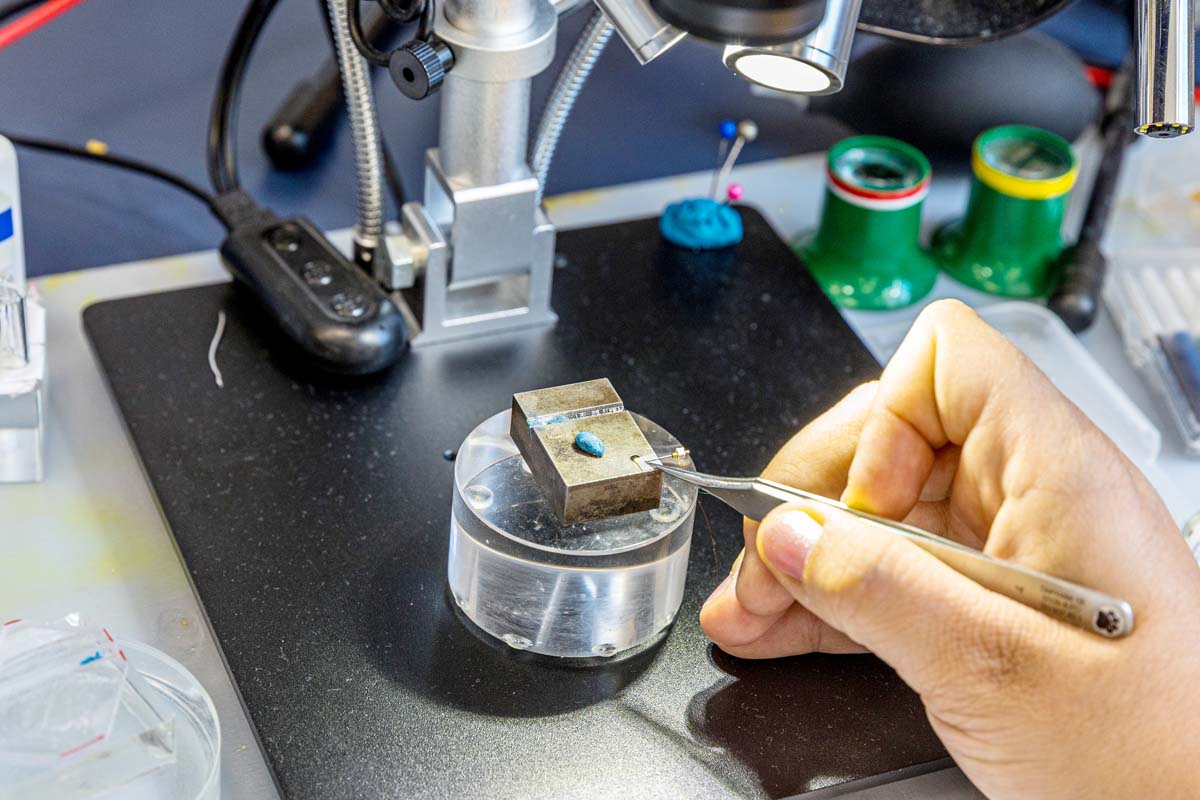
To give you an idea how delicate and tiny the part is, you can see various stages of its manufacture here.


The coils are attached by hand before everything is fixed in a sleeve.


Lorena Machado explains why the production of smaller and larger models is strictly separated: the coils of the more affordable cartridges are made from copper, while those of premium pickups are wound with 24-karat gold. Dozens of OEM cartridges are being prepared for shipping in one part of the room, and she is sitting at a work table, looking at the monitor of a macro camera. Like most of her colleagues, she is a trained watchmaker. Working with these tiny components requires advanced sensitivity and experience, a keen eye, “and steady hands,” she adds, proceeding to outline the manufacturing process that is fundamentally the same for all MC cartridges:

All MC systems are based on boron cantilevers, into which a microscopically fine groove is milled before diamonds of different shapes are glued in, depending on the cartridge class. This is one of the few pre-manufactured components: these tiny needles could never be affixed by hand, so Clearaudio relies on a long-term supplier instead. Next, for further processing, the cantilever is glued into a jig. Lorena Machado threads a coil, then a tiny rubber damper, and finally another coil onto the cantilever. The protruding wires are barely a tenth of a millimeter thick, but still visible to the eye in the bright light of the workbench. Before assembly, the loose ends have been marked with Edding pens in the familiar red/white/blue/green scheme. These will later also be found on the cartridge’s terminals.


The magnets are cut to size by the supplier, and the poles are color-coded. Eight of these minuscule power cubes are encapsulated in a small plastic housing at Clearaudio.


Here you can see Markus Hampel (sitting), who is busy grinding several magnet mounts into shape. Behind him (standing), are Lorena Machado and Stefan Kmuch.


Stefan Kmuch, the company’s technical trainer, explains that the two coils represent the left and right audio channels. The damper in between serves both as both an insulator and a foundation for securing the cantilever in its housing. The number of windings is strictly defined, as it determines the cartridge’s impedance: exactly 50 ohms for the in-house MC models, which is approximately 140 turns for gold wire. Lorena Machado first inserts the finished cantilever into a small metal sleeve, and then into the tiny inner housing of the cartridge. Simultaneously, her colleague Markus Hempel is at another bench filing a dozen of the housings into shape. Hours earlier, he had cast them in another part of the building. This meant arranging eight minuscule magnets on either side of a comparably small copper ring before casting everything in a plastic compound.

As Lorena Machado explains, the cartridge’s quality level is determined at precisely the point when the cantilever is aligned in its magnetic housing. Even the slightest of deviations will lead to channel imbalances. And with a process this delicate, there’s no jig for assembly. Instead, it’s a matter of experience and a gentle touch. Naturally, the Clearaudio team doesn’t depend solely on that. Immediately after assembly, the watchmaker secures the raw pickup in a holder, connects the four wires to contacts, and moments later the needle is picking up its first signals at a measurement bench. Then, Machado adjusts the needle’s position with tweezers and measures again. At this point, they determine in which model the cantilever will ultimately end up. The selection process becomes increasingly stringent. In this case, we’re likely looking at a rather elevated Da Vinci.


Finally, a macro shot of an (almost) finished pickup. You can see a drop of glue fixing the stylus to the carrier. The carrier itself protrudes at an angle from the housing and is essentially “clamped” in place between two of the front magnets. The tracking force will center it during operation.


At this juncture, Stefan Kmuch interjects, noting that the measurement tolerances [determine] the pickup’s precision, but for the system’s sound, they are just one of many factors. This is why Clearaudio manufactures so many different cartridges: the individual material mix plays a significant role. The outer housings made from plastic, wood, silver, or gold are supplied by different specialists. For the premium Goldfinger model, for example, Clearaudio commissions a goldsmith who casts, grinds and polishes each piece individually.

Before the handcrafted cartridge with its distinctive red housing is glued together, further corrections, fine-tuning and the final cleaning of adhesive residues are required. At this point I asked, how many cartridges could be made in this time-consuming process in one shift? And I received an answer that I could have guessed: on good days, it’s five to six MC models, and on bad days, it might be none at all. The entrance area has already filled up with boxes ready for shipping, and the three production employees reveal they have been at it for over a week.


During our conversation, I noticed countless printouts with photos hanging on the walls, showing cartridges, needles or other specifics. Stefan Kmuch explained that these are defective samples. Clearaudio is deeply committed to error analysis, and the images illustrate typical manufacturing problems, which make it easier for colleagues to recognize these issues. Further ahead in the room, there’s a whole catalog showing how a coil deforms when the cantilever directly above it has broken.

To conclude my visit, we briefly detour into the tonearm production area. Sales representative Niels Hoelscher leads me into a small room where three employees are busy with different production steps.

He indicates a detail that also applies to the cartridge production: Every model manufactured in-house has fixed workflows and a checklist that must be completed before packaging. However, the employees are free to sequence these workflows in any way that works best for them. Then, he shows me a prototype of the brand-new premium Unity tonearm, which already has “FIDELITY review sample” written all over it, so to speak. We’re scheduled to receive the sample in the coming weeks, along with a matching cartridge. We can’t wait.


Clearaudio Electronic
Spardorfer Straße 150
91054 Erlangen
Phone +49 9131 40300100
info@clearaudio.de
www.clearaudio.de

More from Issue 218

View All Articles in Issue 218

Search Copper Magazine

#228 Serita’s Black Rose Duo Shakes Your Soul With a Blend of Funk, Rock, Blues and a Whole Lot More by Frank Doris Mar 02, 2026 #228 Vinyl, A Love Story by Wayne Robins Mar 02, 2026 #228 Thrill Seeker by B. Jan Montana Mar 02, 2026 #228 The Vinyl Beat: Donald Byrd, Bill Evans, Wes Montgomery, Eddie Palmieri and Frank Sinatra by Rudy Radelic Mar 02, 2026 #228 Listening to Prestige: The History of a Vitally Important Jazz Record Label by Frank Doris Mar 02, 2026 #228 How to Play in a Rock Band, 21: Touring With James Lee Stanley by Frank Doris Mar 02, 2026 #228 The NAMM 2026 Show: The Music Industry’s Premier Event by John Volanski Mar 02, 2026 #228 The Earliest Stars of Country Music, Part Two by Jeff Weiner Mar 02, 2026 #228 From The Audiophile's Guide: A Brief History of Stereophonic Sound by Paul McGowan Mar 02, 2026 #228 A Bone to Pick With Streaming Audio by Frank Doris Mar 02, 2026 #228 Blast Off With Bluesman Duke Robillard by Ray Chelstowski Mar 02, 2026 #228 A Visit to the Marten Loudspeaker Factory in Göteborg, Sweden by Ingo Schulz and Sebastian Polcyn Mar 02, 2026 #228 Pure Distortion by Peter Xeni Mar 02, 2026 #228 A Nagra Factory Tour by Markus "Marsu" Manthey Mar 02, 2026 #228 Back to My Reel-to-Reel Roots, Part 27: Noodge and Ye Shall Receive, Part Two by Ken Kessler Mar 02, 2026 #228 PS Audio in the News by PS Audio Staff Mar 02, 2026 #228 90-Degree Stereo by Frank Doris Mar 02, 2026 #228 The Keys to Art by Rich Isaacs Mar 02, 2026 #227 Seth Lewis Gets in the Groove With Take a Look Around: a Tribute to the Meters by Frank Doris Feb 02, 2026 #227 Passport to Sound: May Anwar’s Audio Learning Experience for Young People by Frank Doris Feb 02, 2026 #227 Conjectures on Cosmic Consciousness by B. Jan Montana Feb 02, 2026 #227 The Big Takeover Turns 45 by Wayne Robins Feb 02, 2026 #227 Music and Chocolate: On the Sensory Connection by Joe Caplan Feb 02, 2026 #227 Singer/Songwriter Chris Berardo: Getting Wilder All the Time by Ray Chelstowski Feb 02, 2026 #227 The Earliest Stars of Country Music, Part One by Jeff Weiner Feb 02, 2026 #227 The Vinyl Beat Goes Down to Tijuana (By Way of Los Angeles), Part Two by Rudy Radelic Feb 02, 2026 #227 How to Play in a Rock Band, 20: On the Road With Blood, Sweat & Tears’ Guitarist Gabe Cummins by Frank Doris Feb 02, 2026 #227 From The Audiophile’s Guide: Audio Specs and Measuring by Paul McGowan Feb 02, 2026 #227 Our Brain is Always Listening by Peter Trübner Feb 02, 2026 #227 PS Audio in the News by PS Audio Staff Feb 02, 2026 #227 The Listening Chair: Sleek Style and Sound From the Luxman L3 by Howard Kneller Feb 02, 2026 #227 The Los Angeles and Orange County Audio Society Celebrates Its 32nd Anniversary, Honoring David and Sheryl Lee Wilson and Bernie Grundman by Harris Fogel Feb 02, 2026 #227 Back to My Reel-to-Reel Roots, Part 26: Half Full – Not Half Empty, Redux by Ken Kessler Feb 02, 2026 #227 That's What Puzzles Us... by Frank Doris Feb 02, 2026 #227 Record-Breaking by Peter Xeni Feb 02, 2026 #227 The Long and Winding Road by B. Jan Montana Feb 02, 2026 #226 JJ Murphy’s Sleep Paralysis is a Genre-Bending Musical Journey Through Jazz, Fusion and More by Frank Doris Jan 05, 2026 #226 Stewardship by Consent by B. Jan Montana Jan 05, 2026 #226 Food, Music, and Sensory Experience: An Interview With Professor Jonathan Zearfoss of the Culinary Institute of America by Joe Caplan Jan 05, 2026 #226 Studio Confidential: A Who’s Who of Recording Engineers Tell Their Stories by Frank Doris Jan 05, 2026 #226 Pilot Radio is Reborn, 50 Years Later: Talking With CEO Barak Epstein by Frank Doris Jan 05, 2026 #226 The Vinyl Beat Goes Down to Tijuana (By Way of Los Angeles), Part One by Rudy Radelic Jan 05, 2026 #226 Capital Audiofest 2025: Must-See Stereo, Part Two by Frank Doris Jan 05, 2026 #226 My Morning Jacket’s Carl Broemel and Tyler Ramsey Collaborate on Their Acoustic Guitar Album, Celestun by Ray Chelstowski Jan 05, 2026 #226 The People Who Make Audio Happen: CanJam SoCal 2025, Part Two by Harris Fogel Jan 05, 2026 #226 How to Play in a Rock Band, 19: Touring Can Make You Crazy, Part One by Frank Doris Jan 05, 2026 #226 Linda Ronstadt Goes Bigger by Wayne Robins Jan 05, 2026

A Visit to Turntable and Cartridge Maker Clearaudio: Feel, Then Measure

A Visit to Turntable and Cartridge Maker Clearaudio: Feel, Then Measure

Copper has an exchange program with selected magazines, where we share articles, including this one, between publications. This one's from Germany's FIDELITY magazine.


Did you know that Clearaudio initially manufactured loudspeakers when it was founded in 1978? However, soon afterwards (from 1980) company founder Peter Suchy realized that his analog talents were much more profitable. And so my visit was dedicated to the Erlangen-based company’s now well-established cartridge production facility. And my first impressions in the production room very nearly matched my expectations.


This photo shows a Clearaudio boron needle carrier with one of the two coils and the bearing (white).


At several workstations, the pickup task force is working on a batch of higher-end MC cartridges. Ranging from the Talisman to models like the MC Jubilee and Da Vinci, and all the way to the Goldfinger, they are the pinnacle of the in-house portfolio. It’s a point of pride that these are made in-house by hand. Yet I would soon discover that the more affordable models are also made here at the very same stations. And many more, in fact, since, as is commonly known, Clearaudio doesn’t just produce its own 20-model lineup. The manufactory supplies OEM products to brands like McIntosh, Linn and other manufacturers. And then there are the various adaptations of existing designs for special lines, currently including the gold-gleaming MC pickups for an Al Di Meola Signature turntable.


To give you an idea how delicate and tiny the part is, you can see various stages of its manufacture here.


The coils are attached by hand before everything is fixed in a sleeve.


Lorena Machado explains why the production of smaller and larger models is strictly separated: the coils of the more affordable cartridges are made from copper, while those of premium pickups are wound with 24-karat gold. Dozens of OEM cartridges are being prepared for shipping in one part of the room, and she is sitting at a work table, looking at the monitor of a macro camera. Like most of her colleagues, she is a trained watchmaker. Working with these tiny components requires advanced sensitivity and experience, a keen eye, “and steady hands,” she adds, proceeding to outline the manufacturing process that is fundamentally the same for all MC cartridges:

All MC systems are based on boron cantilevers, into which a microscopically fine groove is milled before diamonds of different shapes are glued in, depending on the cartridge class. This is one of the few pre-manufactured components: these tiny needles could never be affixed by hand, so Clearaudio relies on a long-term supplier instead. Next, for further processing, the cantilever is glued into a jig. Lorena Machado threads a coil, then a tiny rubber damper, and finally another coil onto the cantilever. The protruding wires are barely a tenth of a millimeter thick, but still visible to the eye in the bright light of the workbench. Before assembly, the loose ends have been marked with Edding pens in the familiar red/white/blue/green scheme. These will later also be found on the cartridge’s terminals.


The magnets are cut to size by the supplier, and the poles are color-coded. Eight of these minuscule power cubes are encapsulated in a small plastic housing at Clearaudio.


Here you can see Markus Hampel (sitting), who is busy grinding several magnet mounts into shape. Behind him (standing), are Lorena Machado and Stefan Kmuch.


Stefan Kmuch, the company’s technical trainer, explains that the two coils represent the left and right audio channels. The damper in between serves both as both an insulator and a foundation for securing the cantilever in its housing. The number of windings is strictly defined, as it determines the cartridge’s impedance: exactly 50 ohms for the in-house MC models, which is approximately 140 turns for gold wire. Lorena Machado first inserts the finished cantilever into a small metal sleeve, and then into the tiny inner housing of the cartridge. Simultaneously, her colleague Markus Hempel is at another bench filing a dozen of the housings into shape. Hours earlier, he had cast them in another part of the building. This meant arranging eight minuscule magnets on either side of a comparably small copper ring before casting everything in a plastic compound.

As Lorena Machado explains, the cartridge’s quality level is determined at precisely the point when the cantilever is aligned in its magnetic housing. Even the slightest of deviations will lead to channel imbalances. And with a process this delicate, there’s no jig for assembly. Instead, it’s a matter of experience and a gentle touch. Naturally, the Clearaudio team doesn’t depend solely on that. Immediately after assembly, the watchmaker secures the raw pickup in a holder, connects the four wires to contacts, and moments later the needle is picking up its first signals at a measurement bench. Then, Machado adjusts the needle’s position with tweezers and measures again. At this point, they determine in which model the cantilever will ultimately end up. The selection process becomes increasingly stringent. In this case, we’re likely looking at a rather elevated Da Vinci.


Finally, a macro shot of an (almost) finished pickup. You can see a drop of glue fixing the stylus to the carrier. The carrier itself protrudes at an angle from the housing and is essentially “clamped” in place between two of the front magnets. The tracking force will center it during operation.


At this juncture, Stefan Kmuch interjects, noting that the measurement tolerances [determine] the pickup’s precision, but for the system’s sound, they are just one of many factors. This is why Clearaudio manufactures so many different cartridges: the individual material mix plays a significant role. The outer housings made from plastic, wood, silver, or gold are supplied by different specialists. For the premium Goldfinger model, for example, Clearaudio commissions a goldsmith who casts, grinds and polishes each piece individually.

Before the handcrafted cartridge with its distinctive red housing is glued together, further corrections, fine-tuning and the final cleaning of adhesive residues are required. At this point I asked, how many cartridges could be made in this time-consuming process in one shift? And I received an answer that I could have guessed: on good days, it’s five to six MC models, and on bad days, it might be none at all. The entrance area has already filled up with boxes ready for shipping, and the three production employees reveal they have been at it for over a week.


During our conversation, I noticed countless printouts with photos hanging on the walls, showing cartridges, needles or other specifics. Stefan Kmuch explained that these are defective samples. Clearaudio is deeply committed to error analysis, and the images illustrate typical manufacturing problems, which make it easier for colleagues to recognize these issues. Further ahead in the room, there’s a whole catalog showing how a coil deforms when the cantilever directly above it has broken.

To conclude my visit, we briefly detour into the tonearm production area. Sales representative Niels Hoelscher leads me into a small room where three employees are busy with different production steps.

He indicates a detail that also applies to the cartridge production: Every model manufactured in-house has fixed workflows and a checklist that must be completed before packaging. However, the employees are free to sequence these workflows in any way that works best for them. Then, he shows me a prototype of the brand-new premium Unity tonearm, which already has “FIDELITY review sample” written all over it, so to speak. We’re scheduled to receive the sample in the coming weeks, along with a matching cartridge. We can’t wait.


Clearaudio Electronic
Spardorfer Straße 150
91054 Erlangen
Phone +49 9131 40300100
info@clearaudio.de
www.clearaudio.de

0 comments

Leave a comment

0 Comments

Your avatar

Loading comments...

🗑️ Delete Comment

Enter moderator password to delete this comment:

✏️ Edit Comment

Enter your email to verify ownership: